
Main Features Of Theatre Of Realism Their settings







- Slides: 39
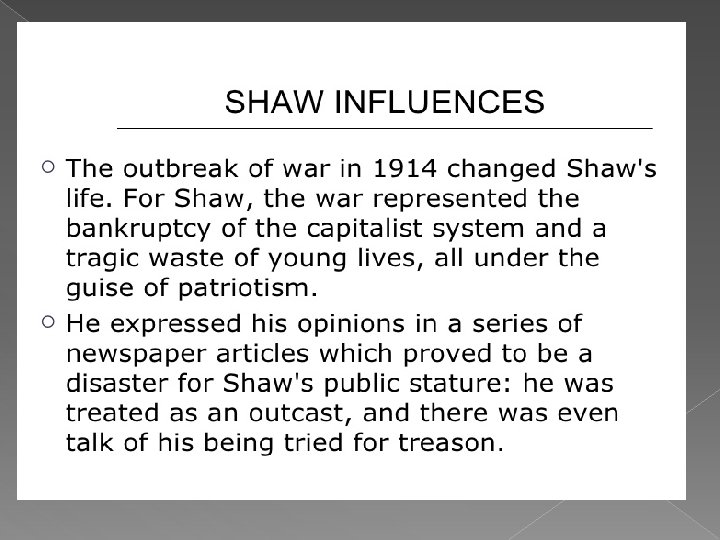
Main Features Of Theatre Of Realism Their settings were realistic in nature (not imagined) their characters could be imagined as those who could really exist. � Therefore playwrigths who wrote from a realist perspective were those who created true to life characters, settings, conflicts, and stagings. For example playwrights such as G. Bernard Shaw shows life as it really was for the period. Their characters were real and their actions were seen as things which actually happen in the real world. �
A focus on real life 2) An emphasis on behavior and tough decisions 3) Believable dialogue 4) Common everyday settings 1)
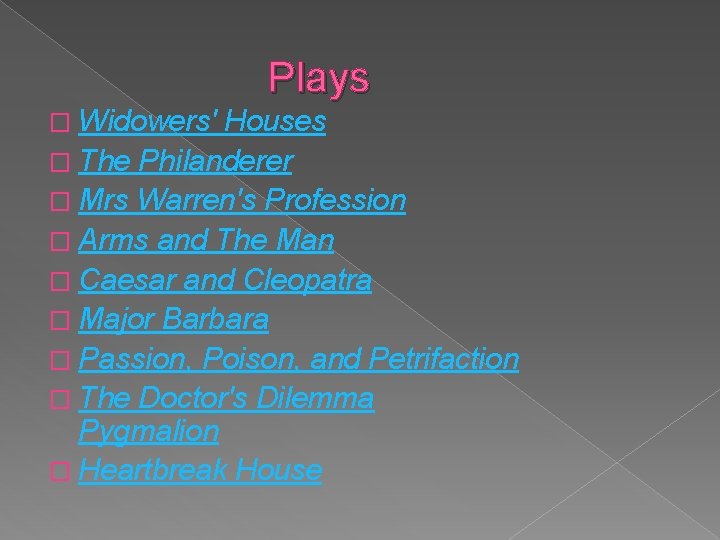
Plays � Widowers' Houses � The Philanderer � Mrs Warren's Profession � Arms and The Man � Caesar and Cleopatra � Major Barbara � Passion, Poison, and Petrifaction � The Doctor's Dilemma Pygmalion � Heartbreak House
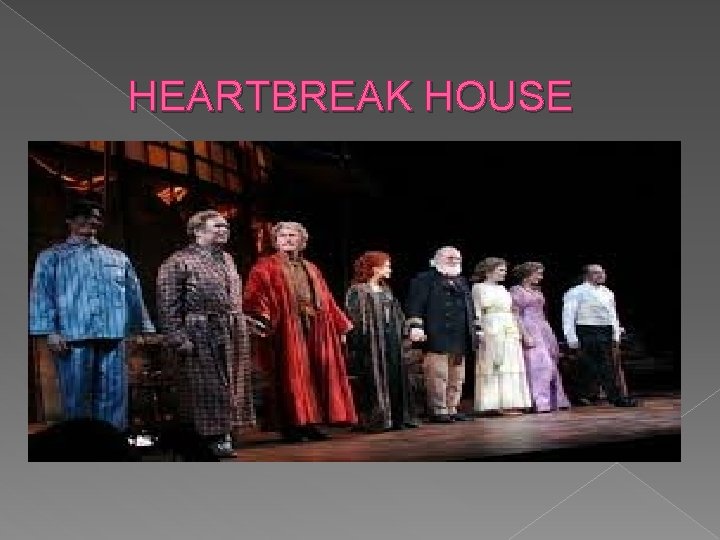
HEARTBREAK HOUSE
Characters � � Captain Shotover, the master of Heartbreak House. This eighty-eight-year-old eccentric retired sea captain is constantly cranky, impressively wise (a visionary), and generally drunk (three bottles of rum a day). Although a realist, Shotover has built his Sussex home in the form of a ship, strives to attain the seventh degree of concentration (perfect tranquillity), and spends much of his time experimenting with death-dealing inventions, especially dynamite. Shotover is a remnant of the culture and leisure that flourished in Europe, particularly England, before World War I.
Lady Ariadne (Addy) Utterword � Lady Ariadne (Addy) Utterword, Captain Shotover’s younger daughter, age forty-two. The wife of Sir Hastings Utterword, she is a handsome blonde who, although seemingly scatterbrained, is quite competent. � Mrs. Hesione (Hessy) Hushabye, the captain’s elder daughter, perhaps forty-four years old, the wife of Hector Hushabye. �
� Ellie Dunn � Guinness � Mazzini Dunn � Hector Hushabye � Alfred Mangan � Billy Dunn
Bernard Shaw defines his play: ‘Heartbreak House is not merely the name of the play which follows this preface. It is cultered, leisured Europe before the war. ’ � Heartbreak House”, perhaps Shaw’s richest and saddest play about the follies of humanity, as rehearsed by the British upper classes in the shivery days before World Ward I. The main challenge of the play is that heartbreak has become a focuse for analysis of the causes of the first world war and the condition of England. �
� The play is about war, even though the war is never mentioned and never makes its presence felt. He sets the play not in the world of government ministers, but among the educated, cultered, leisure classes, what one idealistic character admiringly identifies as “very charmingly people, most advanced, unprejudiced, frank, humane, unconven tion al, democratic, free-thinking and everything that is delightful to thoughtful people. ”
� The characters in “Heartbreak House” flirt and pose, but they are hunted, furtive figures too, uneasily aware of the world’s ugliness and their own idle complicity in the pervasive moral darkness. Hesione confesses to Ellie, ”I am just wondering how much longer I can stand living in this cruel, damnable world. ”
� The direct focus of the play on the war and culture includes the important initial emphasis that the people of “Heartbreak House” ‘wished to realize their favourite fictions and poems in their lives’. The corresponding passage in the play is Mrs. Hushabye’s reaction to Ellie Dunn’s romance with Marcus Darnley: “How much better than the happiest dream!. . . No more wishing one had an interesting book to read, because life is so much happier than any book!” The development of the argument conflates the idea of a catastrophic failure of European culture with the war in the condition of England. This means that the ‘talkers’ of the play are active propagandists of the war.
The war is seen as an occasion of social and cultural change which will lead to the rise of socialist civilization. ”Heartbreak House is an expression of well established and continued commitment to a socialist understanding of history and civilization, including even the horror of the first world war. � Bernard Shaw employed a lot of social problems of that period and capitalism is one of them. He does not mention it directly, but implies with the character of Boss Mangan. Alfred (Boss) Mangan, fifty-five, businessman, engaged to be married to Ellie Dunn, he confesses to her that he is not in fact a rich man. He is killed during the air raid when he hides in the captain’s cave. �
The other social problem mentioned by Shaw is liberalism. He uses the character, Mazzini Dunn, while criticizing liberalism. Mazzini Dunn, Ellie’s father, a little, earnest man no business sense at all. He has spent his life in poverty and fought all those years for liberty. Now he has resigned to his fate and has become the typical nineteenth century Liberal, the ineffectual good man. � To sum up “Heartbreak House” is not only a comic play. Bernard Shaw reflects the shivery days in the eve of World War I. He criticizes the unawareness of the society. So, we see a lot of themes related with society such as capitalism, liberalism, money, and war. He tries to give messages to readers, not directly but with images, symbols, metaphors and irony. �
� LANGUAGE The play has the characteristics of modern drama. As a characteristic of modernism, the language of the play is simple, not ornamental. The readers does not have any difficulty to understand the play although the play was written in 1917. For example; Ellie says to Mrs. Hushabye “There is something odd about this house, Hesione, and even about you. I do not know why I am talking to you so calmly. I have a horrible fear that my heart is broken, but heartbreak is not like what I thought it must be. ”
� � � � Major themes Society The house could arguably be a metaphorical reference to a ship which must be guided capably, not only by its crew, but also its passengers. Each character in the house represents some facet of British society, Mangan being the nouveau riche capitalist, Hesione the flighty Bohemian, Ellie a struggling member of the lower class and so on. Character traits One of Shaw's most important and evident themes is reality versus appearances. By the end of the play, each character is revealed to be nothing like who they appeared to be in the beginning. Mangan, who was reported to be "a Napoleon of industry" is revealed in the third act to be virtually penniless and incapable of running his own businesses. It is in fact Mazzini who runs Mangan's businesses although he at first appears mild and incompetent. Fate Mazzini's belief in fate ruling his life reinforces his feeble ability to control his situation and according to the captain dooms the ship to destruction unless competent navigation can be learned: Captain Shotover: "Navigation. Learn it and live; or leave it and be damned. "
Relation to Chekhov In the preface to the play Shaw acknowledges his debt to Chekhov, in particular to The Cherry Orchard. He writes that in comparison to himself, Chekhov was "more of a fatalist, had no faith in these charming people extricating themselves. They would, he thought, be sold up and sent adrift by the bailiffs; therefore he had no scruple in exploiting and even flattering their charm. “ � Heartbreak House there is more than the merest hint or tiny reflection of Chekhov's true method. � � � Heartbreak House is thus a redistillation of Chekhov and at the same time a passing beyond him, for Chekhov's world is static and directionless.
BETÜL ÖZDEMİR 2012172052 İNGİLİZ DİLİ VE EDEBİYATI 3