
Main Classification 08 Applications of Accelerators Technology Transfer
- Slides: 11
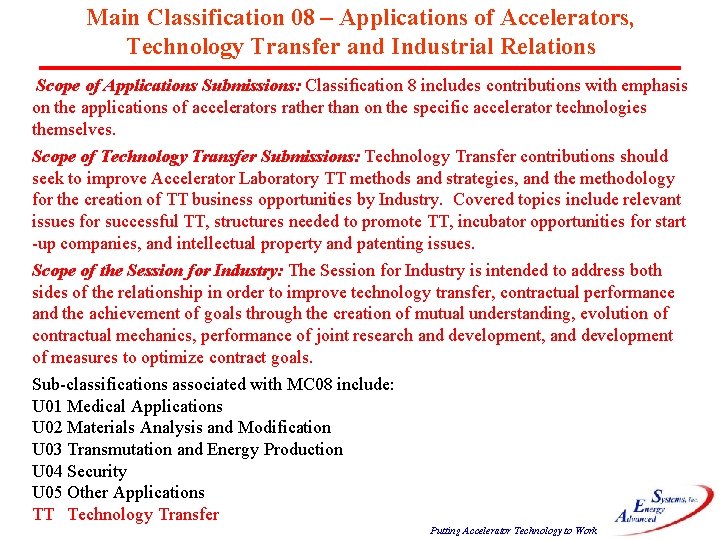
Main Classification 08 – Applications of Accelerators, Technology Transfer and Industrial Relations Scope of Applications Submissions: Classification 8 includes contributions with emphasis on the applications of accelerators rather than on the specific accelerator technologies themselves. Scope of Technology Transfer Submissions: Technology Transfer contributions should seek to improve Accelerator Laboratory TT methods and strategies, and the methodology for the creation of TT business opportunities by Industry. Covered topics include relevant issues for successful TT, structures needed to promote TT, incubator opportunities for start -up companies, and intellectual property and patenting issues. Scope of the Session for Industry: The Session for Industry is intended to address both sides of the relationship in order to improve technology transfer, contractual performance and the achievement of goals through the creation of mutual understanding, evolution of contractual mechanics, performance of joint research and development, and development of measures to optimize contract goals. Sub-classifications associated with MC 08 include: U 01 Medical Applications U 02 Materials Analysis and Modification U 03 Transmutation and Energy Production U 04 Security U 05 Other Applications TT Technology Transfer Putting Accelerator Technology to Work
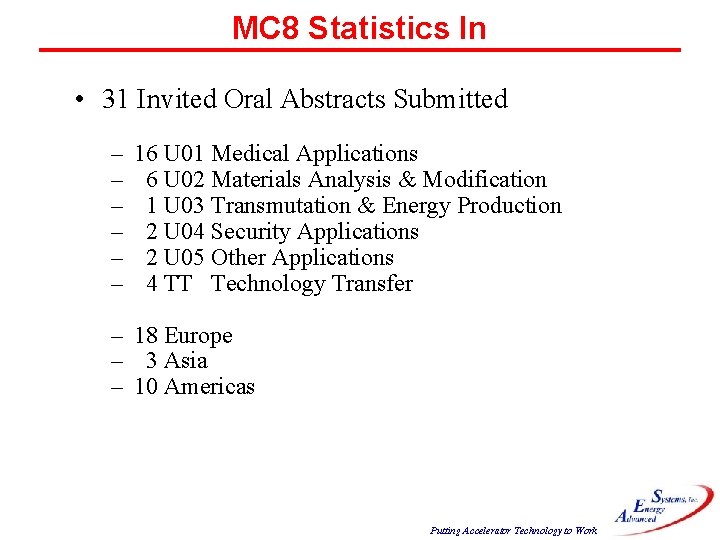
MC 8 Statistics In • 31 Invited Oral Abstracts Submitted – – – 16 U 01 Medical Applications 6 U 02 Materials Analysis & Modification 1 U 03 Transmutation & Energy Production 2 U 04 Security Applications 2 U 05 Other Applications 4 TT Technology Transfer – 18 Europe – 3 Asia – 10 Americas Putting Accelerator Technology to Work
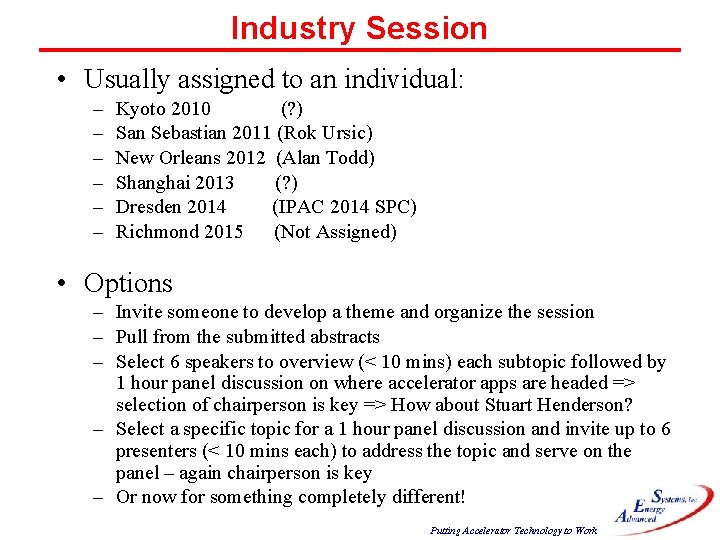
Industry Session • Usually assigned to an individual: – – – Kyoto 2010 (? ) San Sebastian 2011 (Rok Ursic) New Orleans 2012 (Alan Todd) Shanghai 2013 (? ) Dresden 2014 (IPAC 2014 SPC) Richmond 2015 (Not Assigned) • Options – Invite someone to develop a theme and organize the session – Pull from the submitted abstracts – Select 6 speakers to overview (< 10 mins) each subtopic followed by 1 hour panel discussion on where accelerator apps are headed => selection of chairperson is key => How about Stuart Henderson? – Select a specific topic for a 1 hour panel discussion and invite up to 6 presenters (< 10 mins each) to address the topic and serve on the panel – again chairperson is key – Or now for something completely different! Putting Accelerator Technology to Work
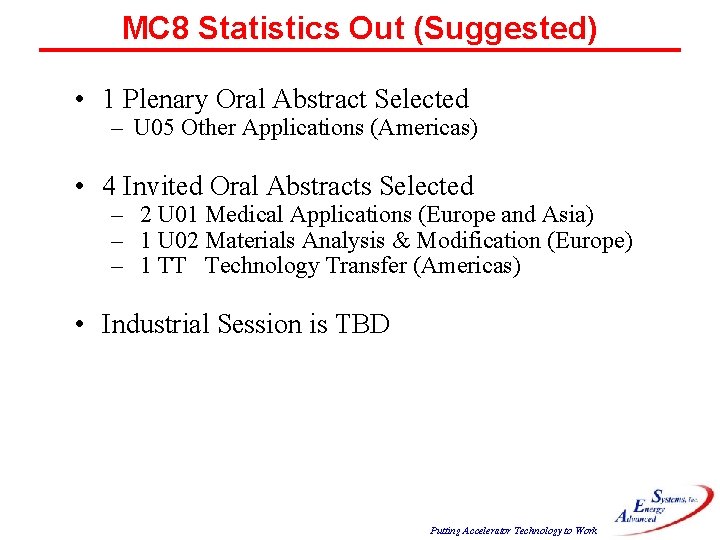
MC 8 Statistics Out (Suggested) • 1 Plenary Oral Abstract Selected – U 05 Other Applications (Americas) • 4 Invited Oral Abstracts Selected – 2 U 01 Medical Applications (Europe and Asia) – 1 U 02 Materials Analysis & Modification (Europe) – 1 TT Technology Transfer (Americas) • Industrial Session is TBD Putting Accelerator Technology to Work
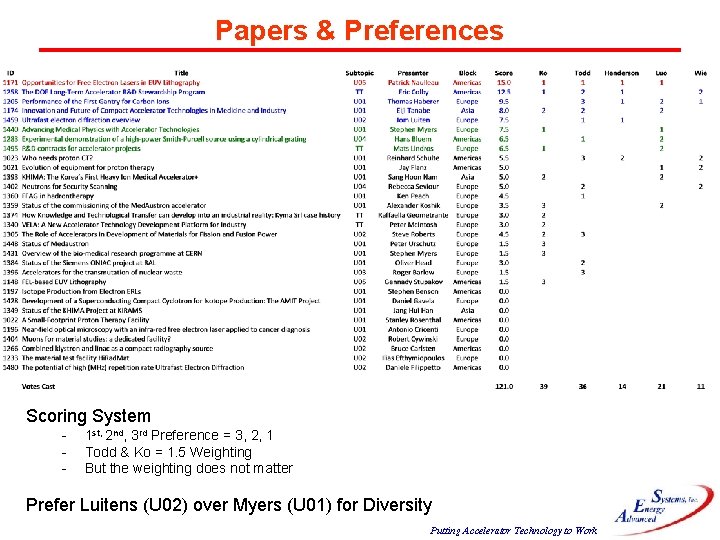
Papers & Preferences Scoring System - 1 st, 2 nd, 3 rd Preference = 3, 2, 1 Todd & Ko = 1. 5 Weighting But the weighting does not matter Prefer Luitens (U 02) over Myers (U 01) for Diversity Putting Accelerator Technology to Work
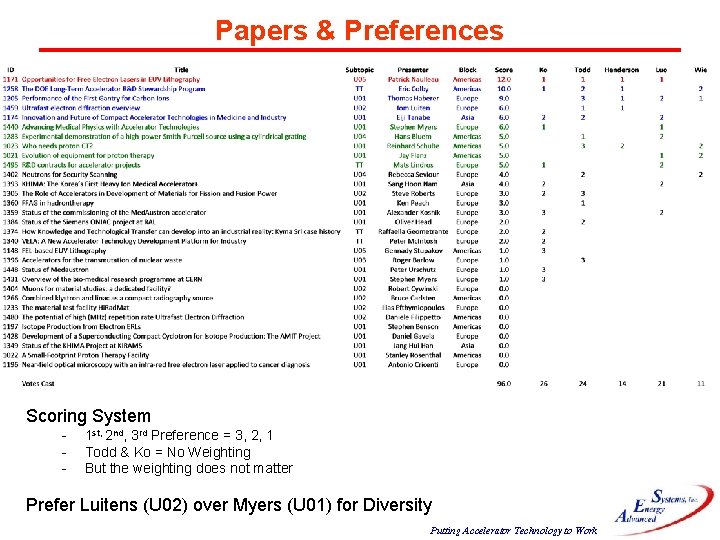
Papers & Preferences Scoring System - 1 st, 2 nd, 3 rd Preference = 3, 2, 1 Todd & Ko = No Weighting But the weighting does not matter Prefer Luitens (U 02) over Myers (U 01) for Diversity Putting Accelerator Technology to Work
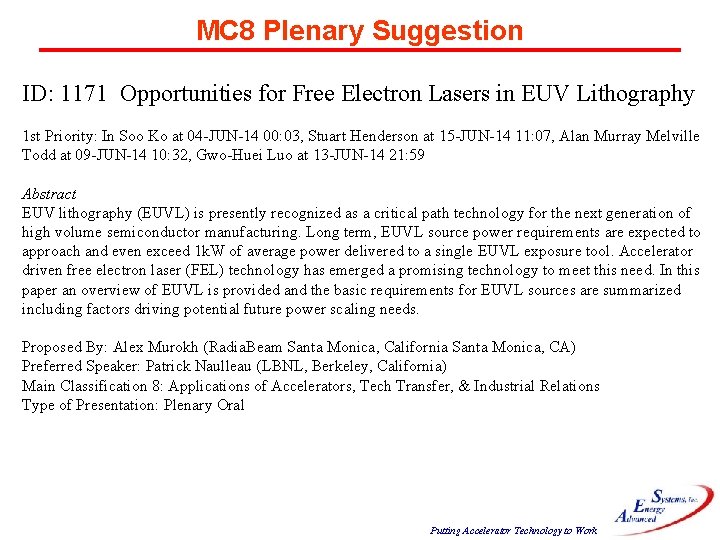
MC 8 Plenary Suggestion ID: 1171 Opportunities for Free Electron Lasers in EUV Lithography 1 st Priority: In Soo Ko at 04 -JUN-14 00: 03, Stuart Henderson at 15 -JUN-14 11: 07, Alan Murray Melville Todd at 09 -JUN-14 10: 32, Gwo-Huei Luo at 13 -JUN-14 21: 59 Abstract EUV lithography (EUVL) is presently recognized as a critical path technology for the next generation of high volume semiconductor manufacturing. Long term, EUVL source power requirements are expected to approach and even exceed 1 k. W of average power delivered to a single EUVL exposure tool. Accelerator driven free electron laser (FEL) technology has emerged a promising technology to meet this need. In this paper an overview of EUVL is provided and the basic requirements for EUVL sources are summarized including factors driving potential future power scaling needs. Proposed By: Alex Murokh (Radia. Beam Santa Monica, California Santa Monica, CA) Preferred Speaker: Patrick Naulleau (LBNL, Berkeley, California) Main Classification 8: Applications of Accelerators, Tech Transfer, & Industrial Relations Type of Presentation: Plenary Oral Putting Accelerator Technology to Work
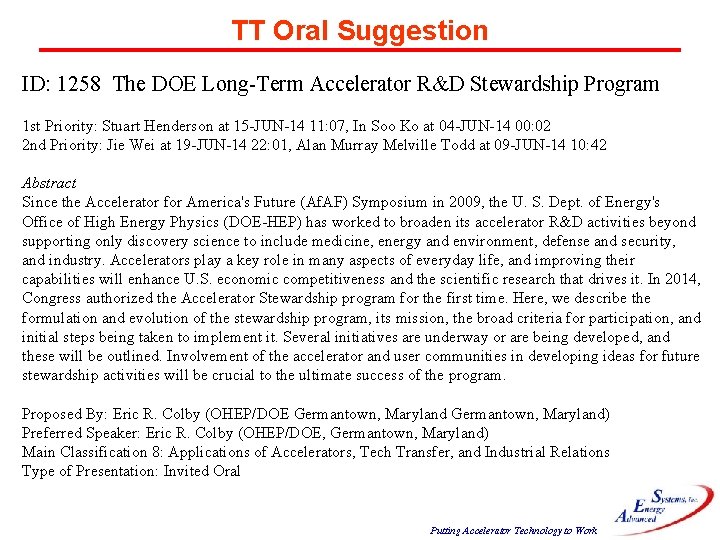
TT Oral Suggestion ID: 1258 The DOE Long-Term Accelerator R&D Stewardship Program 1 st Priority: Stuart Henderson at 15 -JUN-14 11: 07, In Soo Ko at 04 -JUN-14 00: 02 2 nd Priority: Jie Wei at 19 -JUN-14 22: 01, Alan Murray Melville Todd at 09 -JUN-14 10: 42 Abstract Since the Accelerator for America's Future (Af. AF) Symposium in 2009, the U. S. Dept. of Energy's Office of High Energy Physics (DOE-HEP) has worked to broaden its accelerator R&D activities beyond supporting only discovery science to include medicine, energy and environment, defense and security, and industry. Accelerators play a key role in many aspects of everyday life, and improving their capabilities will enhance U. S. economic competitiveness and the scientific research that drives it. In 2014, Congress authorized the Accelerator Stewardship program for the first time. Here, we describe the formulation and evolution of the stewardship program, its mission, the broad criteria for participation, and initial steps being taken to implement it. Several initiatives are underway or are being developed, and these will be outlined. Involvement of the accelerator and user communities in developing ideas for future stewardship activities will be crucial to the ultimate success of the program. Proposed By: Eric R. Colby (OHEP/DOE Germantown, Maryland) Preferred Speaker: Eric R. Colby (OHEP/DOE, Germantown, Maryland) Main Classification 8: Applications of Accelerators, Tech Transfer, and Industrial Relations Type of Presentation: Invited Oral Putting Accelerator Technology to Work
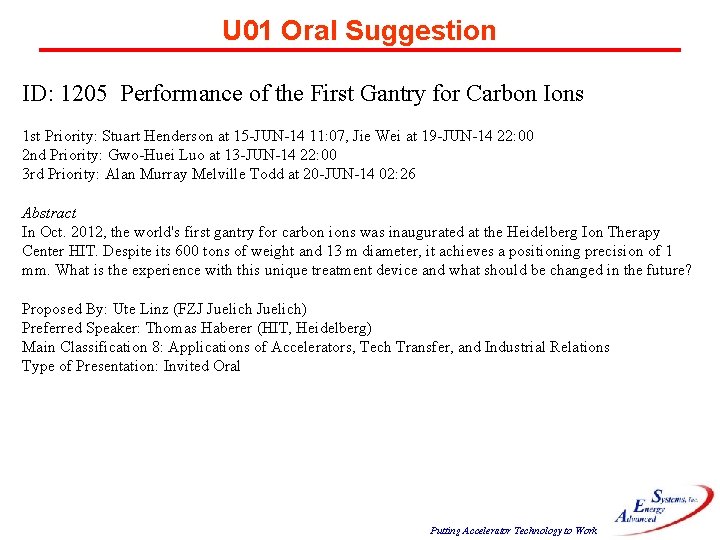
U 01 Oral Suggestion ID: 1205 Performance of the First Gantry for Carbon Ions 1 st Priority: Stuart Henderson at 15 -JUN-14 11: 07, Jie Wei at 19 -JUN-14 22: 00 2 nd Priority: Gwo-Huei Luo at 13 -JUN-14 22: 00 3 rd Priority: Alan Murray Melville Todd at 20 -JUN-14 02: 26 Abstract In Oct. 2012, the world's first gantry for carbon ions was inaugurated at the Heidelberg Ion Therapy Center HIT. Despite its 600 tons of weight and 13 m diameter, it achieves a positioning precision of 1 mm. What is the experience with this unique treatment device and what should be changed in the future? Proposed By: Ute Linz (FZJ Juelich) Preferred Speaker: Thomas Haberer (HIT, Heidelberg) Main Classification 8: Applications of Accelerators, Tech Transfer, and Industrial Relations Type of Presentation: Invited Oral Putting Accelerator Technology to Work
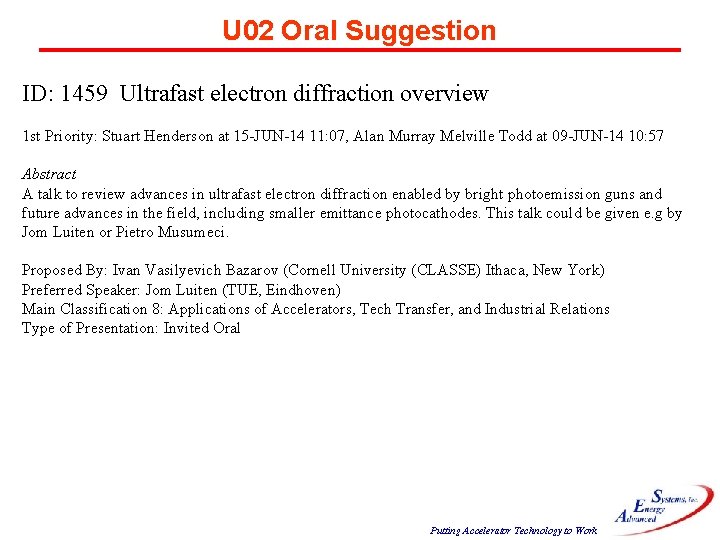
U 02 Oral Suggestion ID: 1459 Ultrafast electron diffraction overview 1 st Priority: Stuart Henderson at 15 -JUN-14 11: 07, Alan Murray Melville Todd at 09 -JUN-14 10: 57 Abstract A talk to review advances in ultrafast electron diffraction enabled by bright photoemission guns and future advances in the field, including smaller emittance photocathodes. This talk could be given e. g by Jom Luiten or Pietro Musumeci. Proposed By: Ivan Vasilyevich Bazarov (Cornell University (CLASSE) Ithaca, New York) Preferred Speaker: Jom Luiten (TUE, Eindhoven) Main Classification 8: Applications of Accelerators, Tech Transfer, and Industrial Relations Type of Presentation: Invited Oral Putting Accelerator Technology to Work
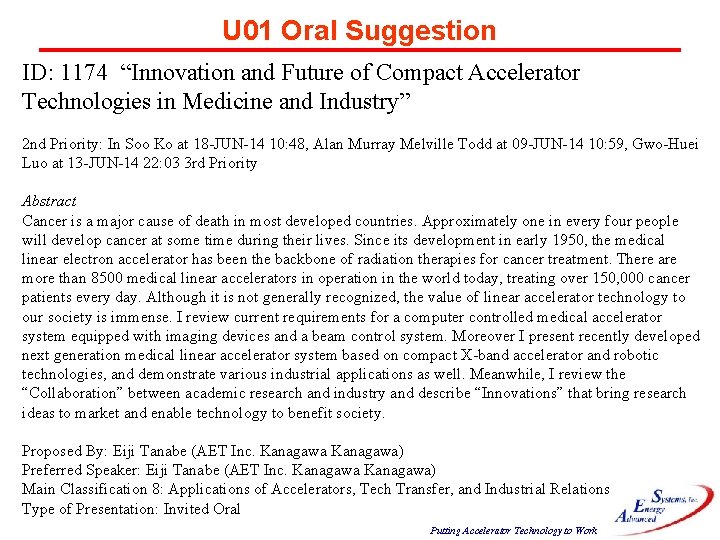
U 01 Oral Suggestion ID: 1174 “Innovation and Future of Compact Accelerator Technologies in Medicine and Industry” 2 nd Priority: In Soo Ko at 18 -JUN-14 10: 48, Alan Murray Melville Todd at 09 -JUN-14 10: 59, Gwo-Huei Luo at 13 -JUN-14 22: 03 3 rd Priority Abstract Cancer is a major cause of death in most developed countries. Approximately one in every four people will develop cancer at some time during their lives. Since its development in early 1950, the medical linear electron accelerator has been the backbone of radiation therapies for cancer treatment. There are more than 8500 medical linear accelerators in operation in the world today, treating over 150, 000 cancer patients every day. Although it is not generally recognized, the value of linear accelerator technology to our society is immense. I review current requirements for a computer controlled medical accelerator system equipped with imaging devices and a beam control system. Moreover I present recently developed next generation medical linear accelerator system based on compact X-band accelerator and robotic technologies, and demonstrate various industrial applications as well. Meanwhile, I review the “Collaboration” between academic research and industry and describe “Innovations” that bring research ideas to market and enable technology to benefit society. Proposed By: Eiji Tanabe (AET Inc. Kanagawa) Preferred Speaker: Eiji Tanabe (AET Inc. Kanagawa) Main Classification 8: Applications of Accelerators, Tech Transfer, and Industrial Relations Type of Presentation: Invited Oral Putting Accelerator Technology to Work