
MAIN ASSUMPTIONS UNIT 1 THE POSITIVE APPROACH INTRODUCTION

- Slides: 12
MAIN ASSUMPTIONS UNIT 1: THE POSITIVE APPROACH
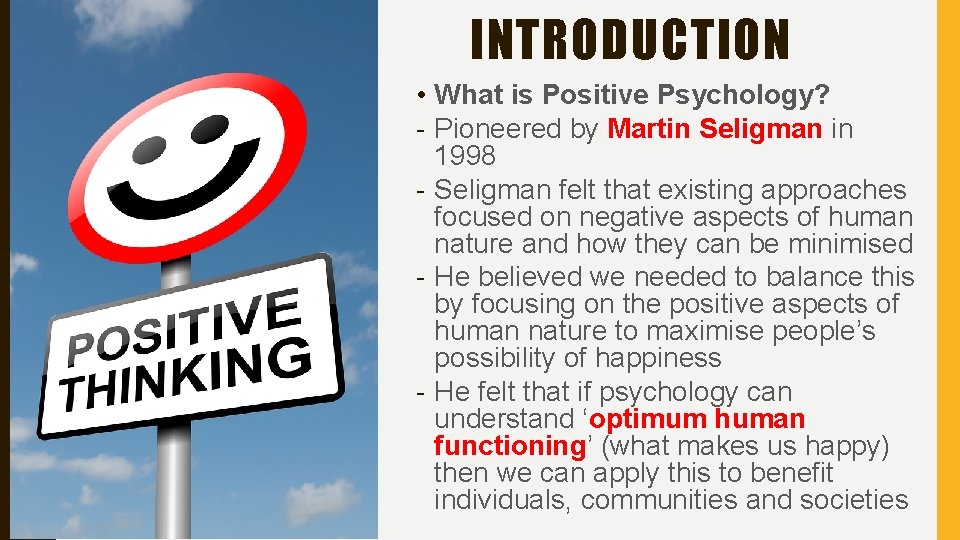
INTRODUCTION • What is Positive Psychology? - Pioneered by Martin Seligman in 1998 - Seligman felt that existing approaches focused on negative aspects of human nature and how they can be minimised - He believed we needed to balance this by focusing on the positive aspects of human nature to maximise people’s possibility of happiness - He felt that if psychology can understand ‘optimum human functioning’ (what makes us happy) then we can apply this to benefit individuals, communities and societies
STARTER ACTIVITY • What is happiness? - Write your own definition • What things make you happy? - Make a list • Compare your answers to those around you • Can we choose to be happy? How/Why?
LEARNING OBJECTIVES For each assumption you need to be able to. . - State the assumption - Explain the assumption in detail - Example: Use psychological examples to illustrate the assumption
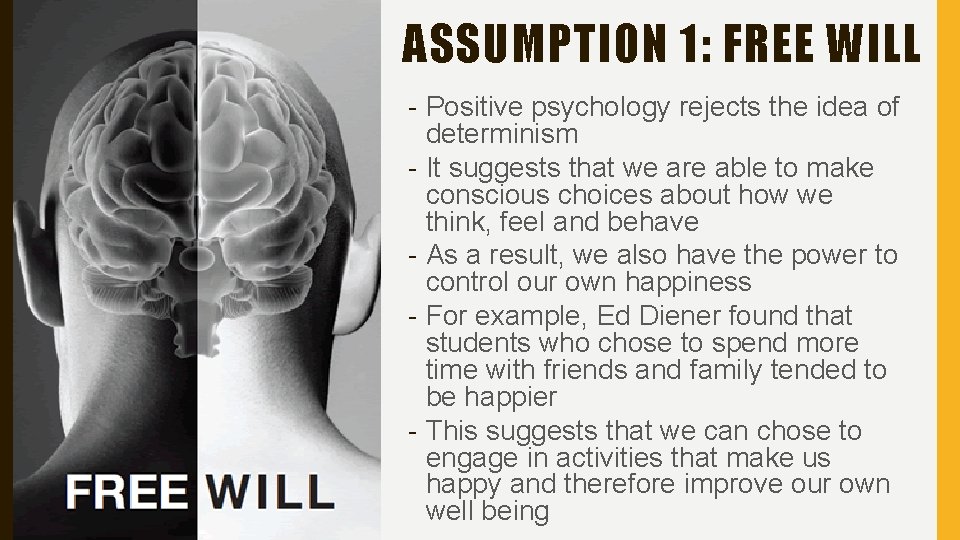
ASSUMPTION 1: FREE WILL - Positive psychology rejects the idea of determinism - It suggests that we are able to make conscious choices about how we think, feel and behave - As a result, we also have the power to control our own happiness - For example, Ed Diener found that students who chose to spend more time with friends and family tended to be happier - This suggests that we can chose to engage in activities that make us happy and therefore improve our own well being
TASK • Positive psychology differs from some of the other determinist approaches • Summarise the ways in which the following approaches may be considered determinist Biological - Psychodynamic - Behaviourist
ASSUMPTION 2: AUTHENTICITY OF GOODNESS AND EXCELLENCE - Positive psychology believes that positive states (e. g. happiness) are just as natural as negative ones (e. g. stress and anxiety) - Seligman (2002) suggests there are 6 core virtues which are underpinned by 24 strengths, - Each of us has a different combination of strengths and virtues, Seligman calls these our ‘signature strengths’ - He suggests that to change our lives for the better we need to nurture these strengths
WHAT ARE YOUR STRENGTHS? • Consider Seligman’s (2002) 24 strengths and select the 5 that you believe best describes you i. e. your signature strengths • How can you use these strengths to change your life for the better?
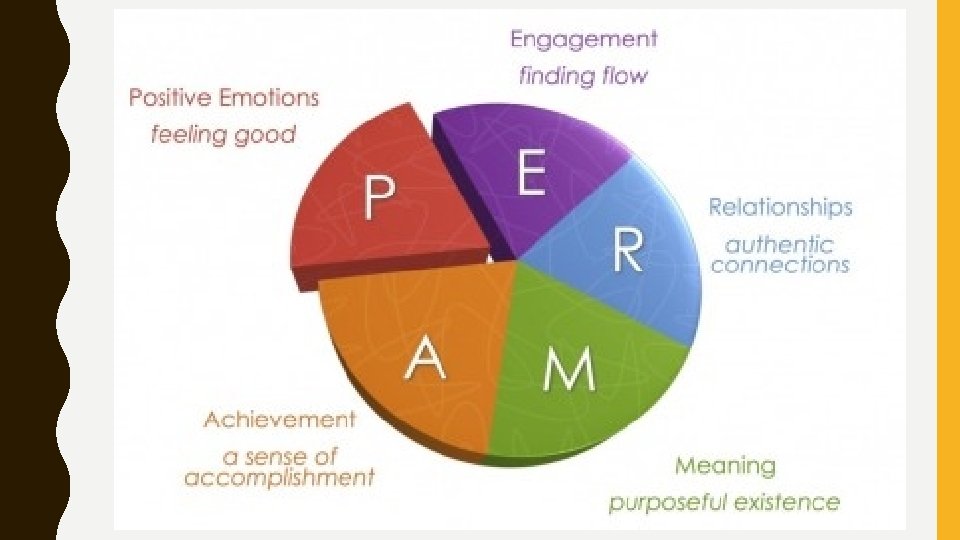
ASSUMPTION 3: FOCUS ON THE 'GOOD LIFE' - The positive approach believes that all humans are capable of having a sense of well-being and happiness i. e. living the 'good life' - Seligman (2011) suggested that there are 5 factors involved in well-being and as we move through these levels happiness and well-being gets deeper and more enduring P – Positive emotions E – Engagement R – Relationships M – Meaning
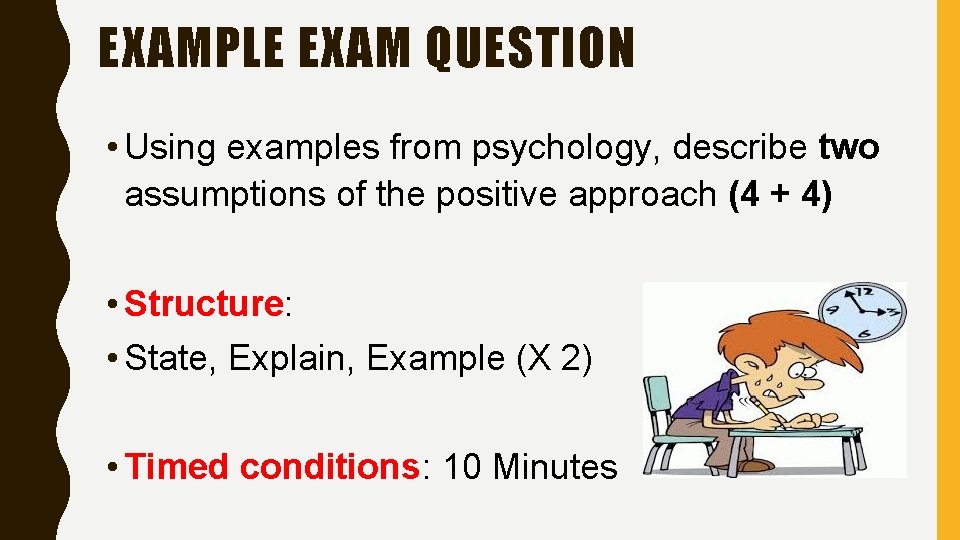
EXAMPLE EXAM QUESTION • Using examples from psychology, describe two assumptions of the positive approach (4 + 4) • Structure: • State, Explain, Example (X 2) • Timed conditions: 10 Minutes
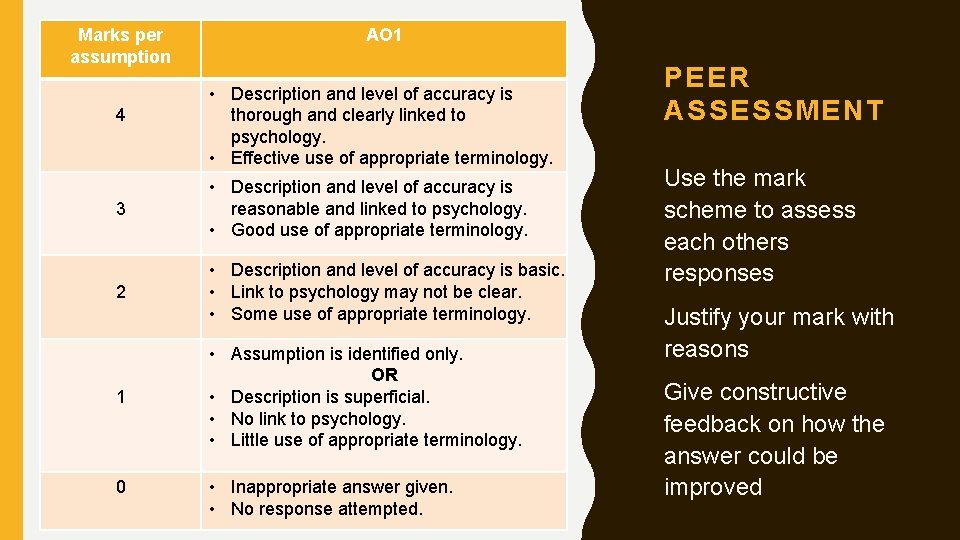
Marks per assumption 4 AO 1 • Description and level of accuracy is thorough and clearly linked to psychology. • Effective use of appropriate terminology. 3 • Description and level of accuracy is reasonable and linked to psychology. • Good use of appropriate terminology. 2 • Description and level of accuracy is basic. • Link to psychology may not be clear. • Some use of appropriate terminology. 1 0 • Assumption is identified only. OR • Description is superficial. • No link to psychology. • Little use of appropriate terminology. • Inappropriate answer given. • No response attempted. PEER ASSESSMENT Use the mark scheme to assess each others responses Justify your mark with reasons Give constructive feedback on how the answer could be improved