
Magnox the historical background Malcolm Grimston Imperial College
Magnox – the historical background Malcolm Grimston, Imperial College Farewell to Magnox, Wylfa Power Station, October 28 2015
Nuclear prehistory Democritus (c 430 – 360 BC) – ‘atomic’ theory Enlightenment – Boyle, Lavoisier, Proust, Dalton Becquerel (1896) – discovery of radiation Einstein (1905) – E=mc 2 Rutherford/Marsden (1909) – nucleus
Radiation in the early 20 th century Radium therapy 1901 (lupus then cancer). Came to be seen as the new miracle cure for almost everything. 1910, US Surgeon General George Torney: “Relief may be reasonably expected at the Hot Springs [Arkansas, high radon production] in various forms of gout and rheumatism, neuralgia, metallic or malarial poisoning, chronic Brights disease, gastric dyspepsia, chronic diarrhoea, chronic skin lesions, etc. ”
Radiation in the early 20 th century Dr C. G. Davis: “Radioactivity prevents insanity, rouses noble emotions, retards old age and creates a splendid youthful joyous life. ” Professor Bertram Boltwood: radioactivity “carries electrical energy into the depths of the body and there subjects the juices, protoplasm and nuclei of the cells to an immediate bombardment by explosions of electrical atoms, stimulating cell activity, arousing all secretory and excretory organs, causing the system to throw off waste products and acting as an agent for the destruction of bacteria. ”

Radium therapy
Cure-all Early 1920 s to 1930 s: radium-containing salves, beauty creams, toothpaste (radon was thought to fight dental decay and improve the digestion), ear plugs, chocolate bars, soap, suppositories, contraceptives, Radium Nose Cup, Radium Respirator (“Radium: scientists found it, governments approved it, physicians recommended it, users endorse it, we guarantee it, SURELY IT’S GOOD”).
Cure-all The Radiendocrinator was made of ‘refined radium’ encased in 14 -carat gold and shipped in an embossed velvet-lined leatherette case (at a price of $150, or $2, 000 in 2015 prices). Giving one example as to how their Radiendocrinator might be used, the manufacturers advised men to: “Wear the adaptor like any athletic strap. This puts the instrument under the scrotum as it should be. Wear at night. Radiate as directed. ”
Early regulation The American Medical Association (AMA) was deeply concerned that the public was being fleeced by charlatans. Fearing the some of the devices might not deliver the dose of radiation they promised, from 1916 to 1929 it established guidelines by which its approval would only be granted if the apparatus generated more than 75 k. Bq of radon per litre of water in a 24 -hour period, thereby striking an important blow for ensuring that people received the irradiation they were paying for.
The glow starts to dim 1915 – California Senator John Works questioned the efficacy of radium treatment for some cancers, which he said seemed to be made worse by the procedure; British Röntgen Society adopted a resolution to protect people from overexposure to Xrays. Mid-1920 s – lawsuit filed against the United States Radium Corporation by five dying ‘Radium Girl’ dial painters who had painted radium-based luminous paint on the dials of these watches and clocks. (During the litigation it was determined that the company’s scientists and management had taken considerable precautions to protect themselves from the effects of radiation. ) 1932 – Pittsburgh industrialist Eden Byers was so convinced of the benefits of ‘Radithor’ that he averaged three bottles a day until his death from radium poisoning.
A source of power? “On average we could not expect to obtain energy from these processes [Cockcroft and Geiger’s experiments bombarding lithium with protons to produce alpha particles and energy]. It was a very poor and inefficient way of producing energy … but the subject was scientifically interesting because it gave insight into the atoms. ” (Rutherford, 1932)
A source of power? 1933 -1938 – nuclear fission identified by Szilard, Fermi, Meitner, Frisch, Joliot, Hann, Strassmann … Importance of moderator recognised early – graphite a front runner. (In Germany graphite was manufactured using boron carbide rods. Boron is a powerful absorber of neutrons and the traces of boron in the graphite were sufficient to prevent a chain reaction developing by ‘mopping up’ too many neutrons. By 1942 the Germans had decided that fission could not work. Szilard had the US manufacturers create boron-free graphite which proved highly effective. )
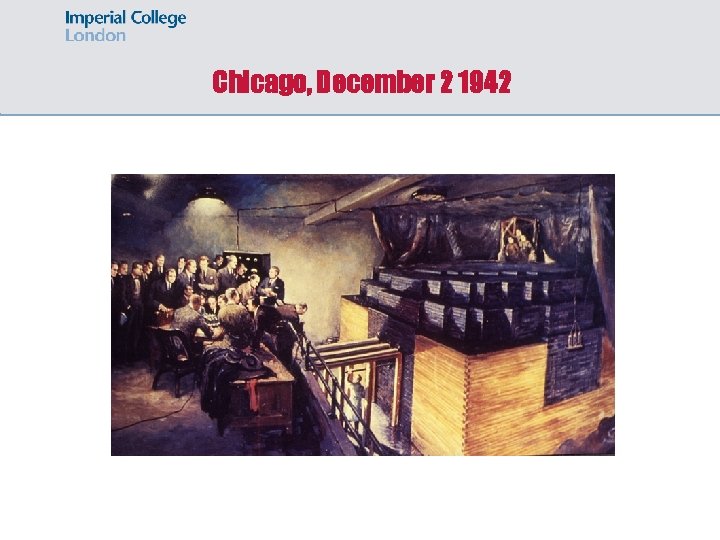
Chicago, December 2 1942
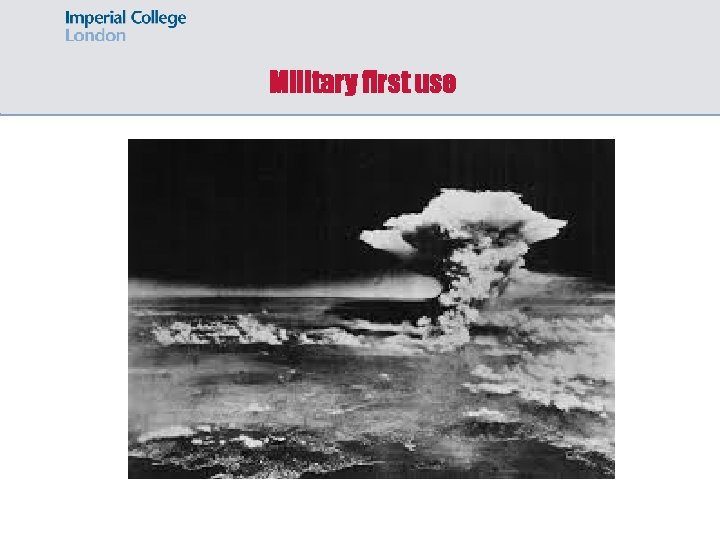
Military first use
The ‘nuclear boiler’ 1941 – the MAUD Committee (codename for the UK research programme into fission and its potential applications) produced two summary reports: Use of uranium for a bomb and Use of uranium as a source of power. Latter concluded that the controlled fission of uranium could be used to provide energy in the form of heat for use in machines. It referred to the use of heavy water and graphite as moderators, suggested light water could be used if the uranium was enriched in the U-235 isotope. Concluded that the ‘uranium boiler’ had considerable promise for future peaceful uses but that it was not worth considering during wartime conditions.
Post-War imperatives After dissolution of the Manhattan Project and the Mc. Mahon Act in the USA, the Attlee government decided the UK needed its own nuclear weapons capability. Plutonium initially to be manufactured in non-power reactors or ‘piles’ at Windscale, Cumberland. However, problems with strength of mining unions, urban air quality, growing power demand the severe winter of 1947 led to continued interest in the nuclear boiler concept.
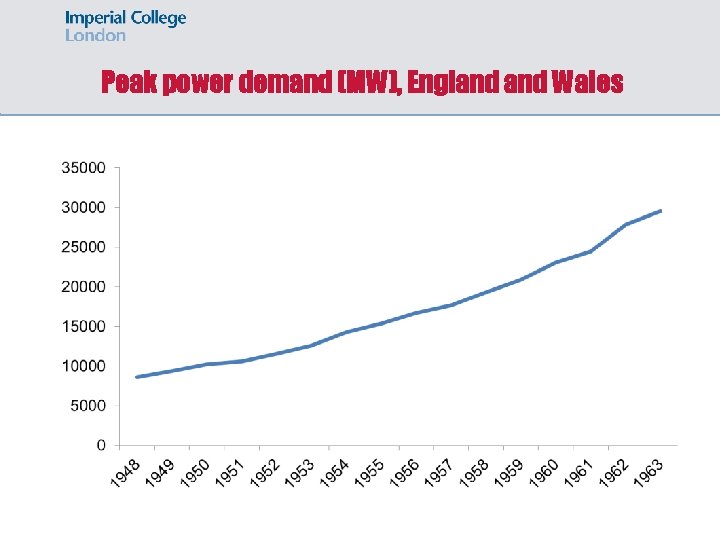
Peak power demand (MW), England Wales
What technology? US using water-cooled piles for plutonium production. 30 million gallons of very pure water a day required for cooling: any interruption of flow would result in rapid overheating and potential increased fission activity. Piles should be built five miles apart, 50 miles from any town of 50, 000 inhabitants, with 30 mile four-lane highway to evacuate the area rapidly in an emergency.
What technology? In effect no site in UK could meet these criteria (an area between Arisaig and Morar in northwest Scotland was considered but logistics made it impossible). Decision was taken to pursue gas-cooled technology instead (air for the Windscale Piles, carbon dioxide for power production) though research was also carried out into sodium-cooled fast reactors (at Dounreay).
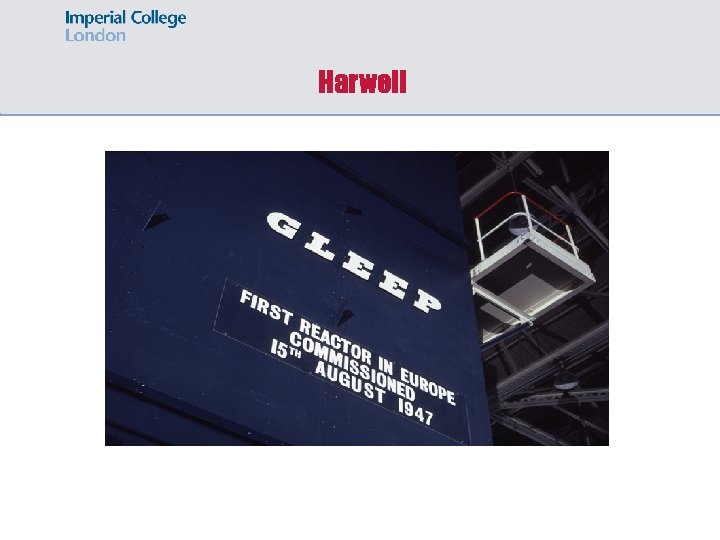
Harwell
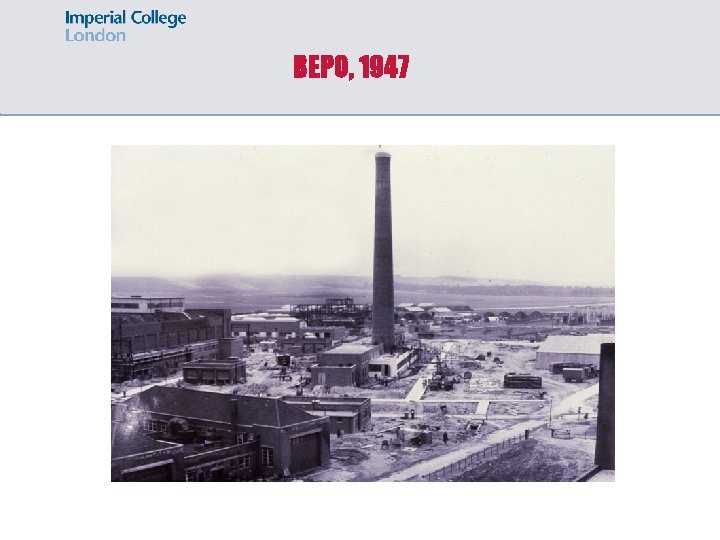
BEPO, 1947

A Windscale Pile
Post-War imperatives Recognised that the two Windcsale Piles could not produce sufficient plutonium for the weapons programme. Idea emerged of ‘dual-purpose’ reactors – PIPPA (Pressurised Pile Producing Power and Plutonium) – primary purpose to produce plutonium but also generating electricity as a ‘side-product’. Other options (heavy water reactors or enriched uranium reactors) rejected because of lack of heavy water and the slowness of enrichment techniques then available. Lead reactors, units of 60 MWe, to be built at Calder Hall on the Sellafield site next to Windscale.
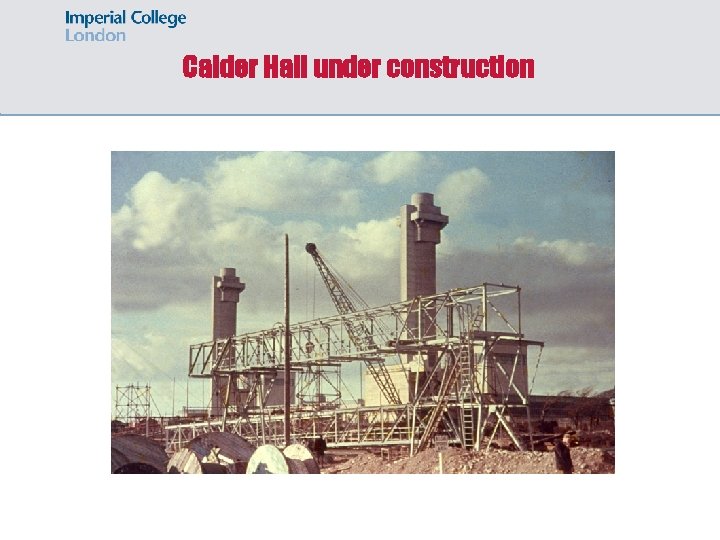
Calder Hall under construction
Global developments December 1951 – first nuclear reactor to produce electricity (Experimental Breeder Reactor, EBR-1, Idaho, USA) – 200 k. W which powered four light bulbs.
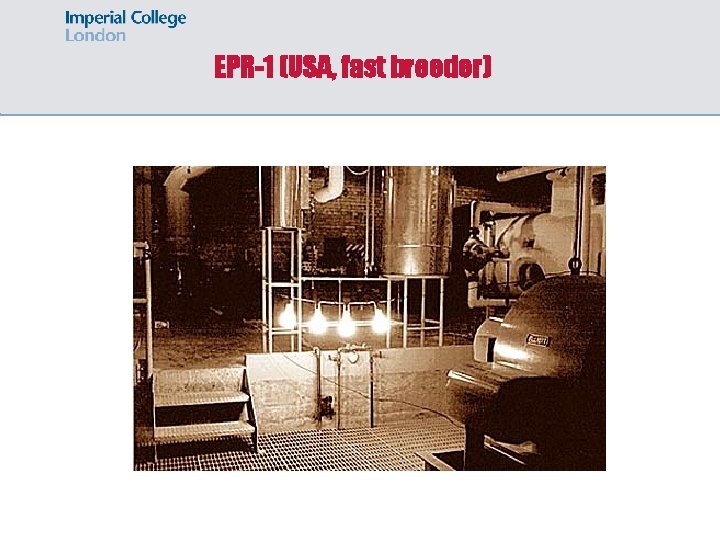
EPR-1 (USA, fast breeder)
Global developments 1953 – prototype naval PWR started up in March 1953 in Idaho (first nuclear-powered submarine, USS Nautilus, launched in 1954). June 1954 – first nuclear station to export electricity to a grid (Obninsk, USSR, in effect RBMK design, 5 MWe).
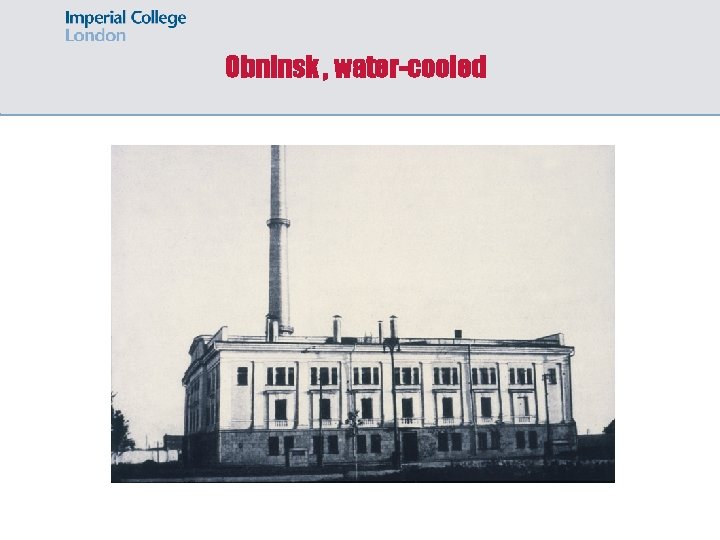
Obninsk , water-cooled
Global developments August 1956 – first nuclear power station to approach commercial scale at Calder Hall in the UK: ultimately four reactors with combined rated capacity of 240 MW.
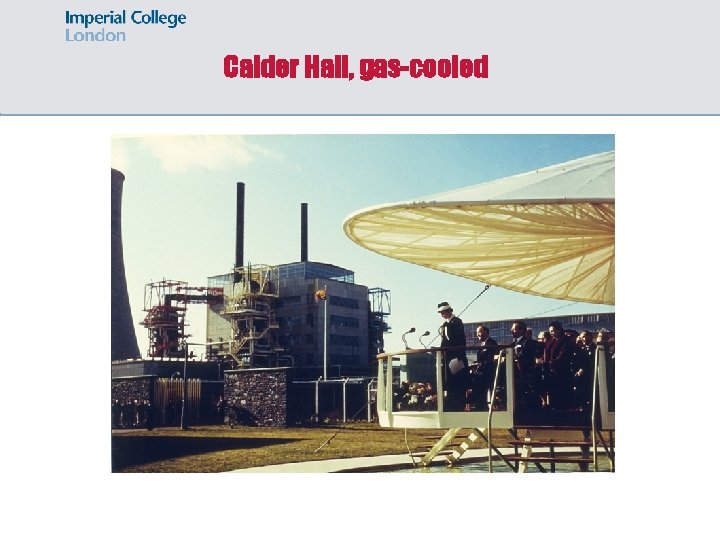
Calder Hall, gas-cooled
1955 White Paper 1955 – UK White Paper A Programme of Nuclear Power set out a 10 -year programme for construction of a fleet of Magnox civil nuclear power stations intended to supply between 1, 500 and 2, 000 MW of electricity to the national grid. The Magnox programme was intended to provide 25% of UK electricity needs at a total cost of £ 300 million (£ 6. 5 billion in 2015 prices). The first three orders were placed in 1956 for Berkeley, Bradwell and Hunterston, loosely based on the Calder Hall design. Post-Suez the plans were expanded to 6, 000 MW before being cut back.
1955 White Paper “The history of the development of nuclear energy has made everyone aware of its destructive possibilities and it would be natural to ask whethere were any special dangers associated with nuclear power installations. The first important thing to recognise is that it is impossible for an ‘atomic explosion’ to take place in a power reactor. If nuclear power facilities are properly designed any accidents that may occur will be no more dangerous than accidents in many other industries. ”
1955 White Paper “The main hazards in a nuclear power station are caused by the concentration of highly radioactive materials. But these are known dangers which can be guarded against, both by precautions in the design of the reactor itself and if necessary by enclosing some or all of it in a gas-tight container. The reactors that will be built for the commercial production of electricity will present no more danger to people living nearby than many existing industrial works that are sited within built-up areas. Nevertheless the first stations, even though they will be of inherently safe design, will not be built in heavily built-up areas. ”
1955 White Paper A month after the 1955 White Paper was published, Minister of Works Nigel Birch stated: “I am advised that there is no danger at all associated with radioactivity from the use of atomic power for civil purposes. Such radioactive materials as are emitted are very weak and their effect is not cumulative. Their radioactivity ceases almost at once. I want to dispose of any suggestion that the use of atomic energy for civil purposes raises any danger. ”
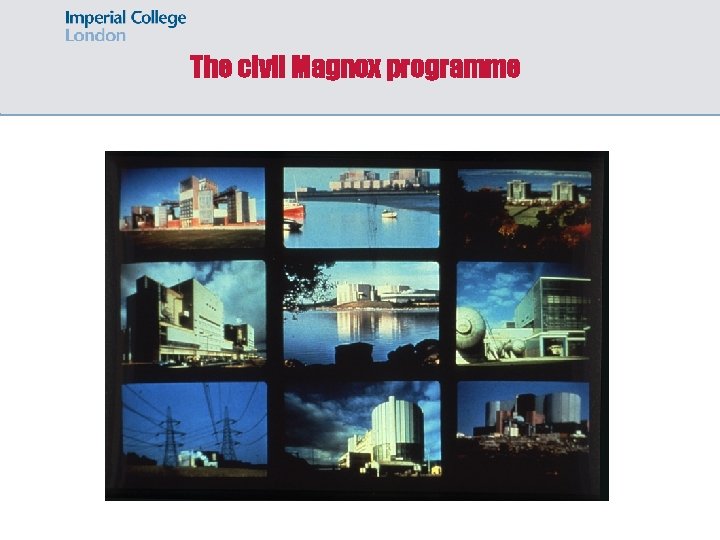
The civil Magnox programme
Final reflections The first UK nuclear programme was also the world’s. By the end of 1964 the UK had 1, 245 MW of nuclear capacity operating, followed by the USA with 599 MW, Italy with 413 MW and the USSR with 304 MW. Themes which are still relevant today: • dangers in making sweeping economic and technical claims about unproven technology; • problems of building a large number of what were effectively prototypes rather than identifying a single design and batch-producing them; • the importance of maintaining a strong link with international developments in the technological field.
‘Chain reaction’ or ‘I’m still waiting’? Decision-making and progress 1940/50 s style: • 1942 Fermi • 1951 EBR-1 • 1954 Obninsk • 1956 Calder Hall • 1962 Berkeley/Bradwell Decision-making and progress 2000/10 s style: • January 2008 – UK government says “more than ever before [nuclear power] has a key role to play”. • October 2015 – at last a possible funding mechanism is found.
- Slides: 36