
Magnoliidae Magnoliaceae the magnolia family 7 12 220
- Slides: 10
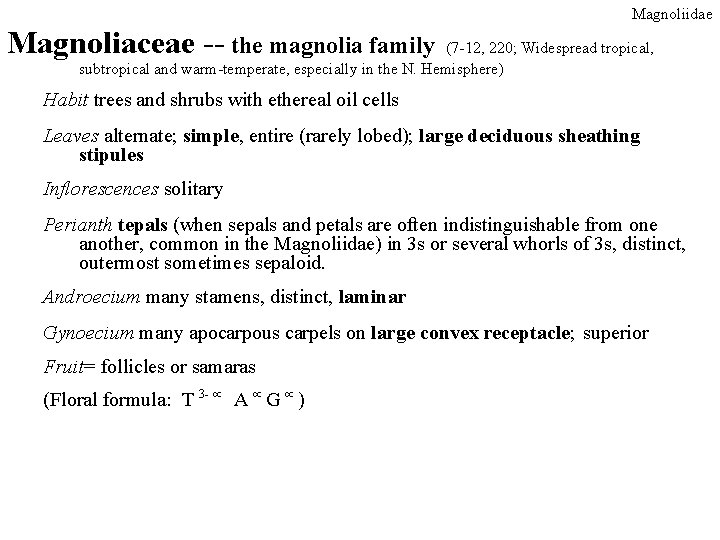
Magnoliidae Magnoliaceae -- the magnolia family (7 -12, 220; Widespread tropical, subtropical and warm-temperate, especially in the N. Hemisphere) Habit trees and shrubs with ethereal oil cells Leaves alternate; simple, entire (rarely lobed); large deciduous sheathing stipules Inflorescences solitary Perianth tepals (when sepals and petals are often indistinguishable from one another, common in the Magnoliidae) in 3 s or several whorls of 3 s, distinct, outermost sometimes sepaloid. Androecium many stamens, distinct, laminar Gynoecium many apocarpous carpels on large convex receptacle; superior Fruit= follicles or samaras (Floral formula: T 3 - A G )
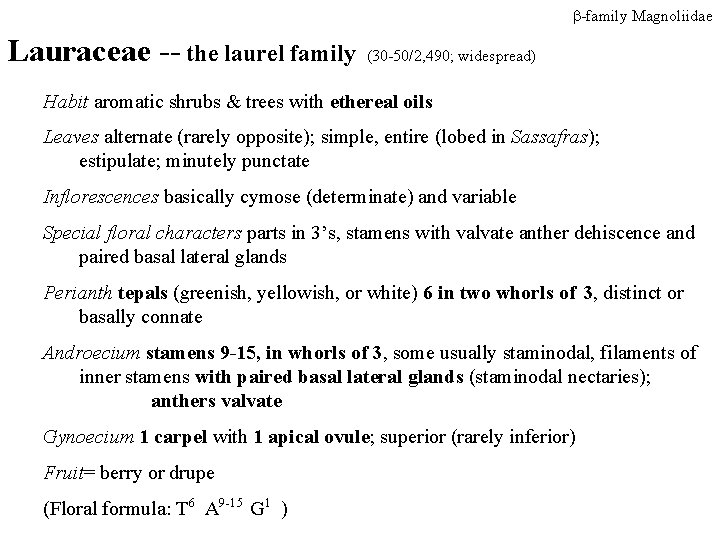
-family Magnoliidae Lauraceae -- the laurel family (30 -50/2, 490; widespread) Habit aromatic shrubs & trees with ethereal oils Leaves alternate (rarely opposite); simple, entire (lobed in Sassafras); estipulate; minutely punctate Inflorescences basically cymose (determinate) and variable Special floral characters parts in 3’s, stamens with valvate anther dehiscence and paired basal lateral glands Perianth tepals (greenish, yellowish, or white) 6 in two whorls of 3, distinct or basally connate Androecium stamens 9 -15, in whorls of 3, some usually staminodal, filaments of inner stamens with paired basal lateral glands (staminodal nectaries); anthers valvate Gynoecium 1 carpel with 1 apical ovule; superior (rarely inferior) Fruit= berry or drupe (Floral formula: T 6 A 9 -15 G 1 )
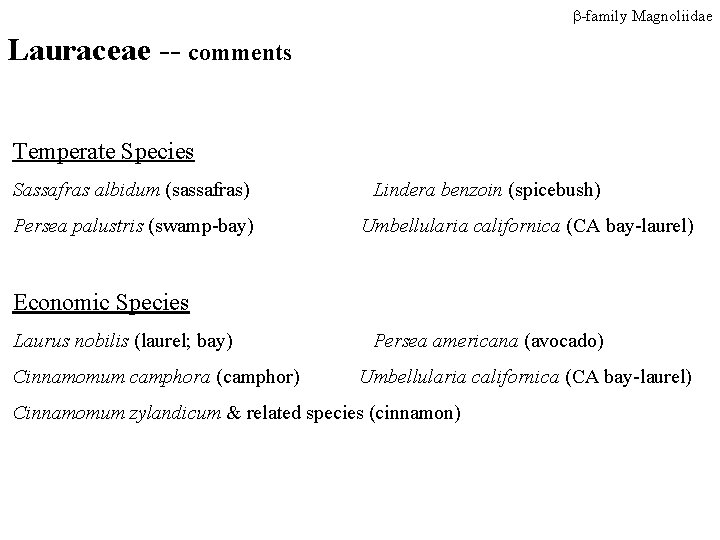
-family Magnoliidae Lauraceae -- comments Temperate Species Sassafras albidum (sassafras) Persea palustris (swamp-bay) Lindera benzoin (spicebush) Umbellularia californica (CA bay-laurel) Economic Species Laurus nobilis (laurel; bay) Cinnamomum camphora (camphor) Persea americana (avocado) Umbellularia californica (CA bay-laurel) Cinnamomum zylandicum & related species (cinnamon)
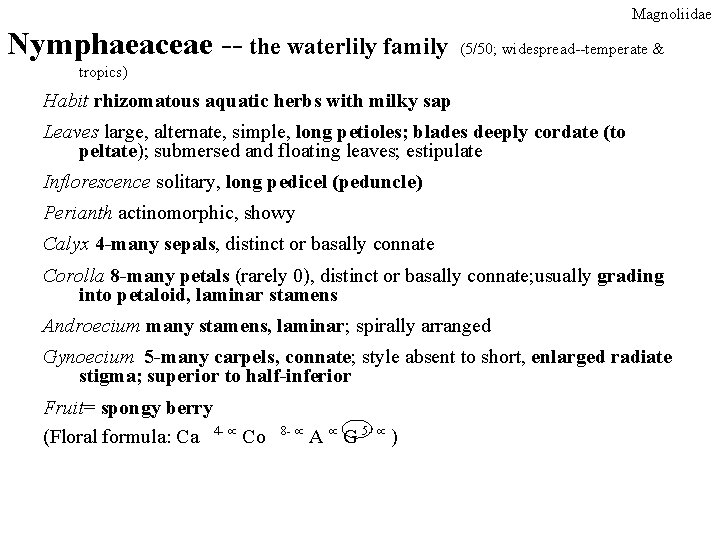
Magnoliidae Nymphaeaceae -- the waterlily family (5/50; widespread--temperate & tropics) Habit rhizomatous aquatic herbs with milky sap Leaves large, alternate, simple, long petioles; blades deeply cordate (to peltate); submersed and floating leaves; estipulate Inflorescence solitary, long pedicel (peduncle) Perianth actinomorphic, showy Calyx 4 -many sepals, distinct or basally connate Corolla 8 -many petals (rarely 0), distinct or basally connate; usually grading into petaloid, laminar stamens Androecium many stamens, laminar; spirally arranged Gynoecium 5 -many carpels, connate; style absent to short, enlarged radiate stigma; superior to half-inferior Fruit= spongy berry (Floral formula: Ca 4 - Co 8 - A G 5 - )
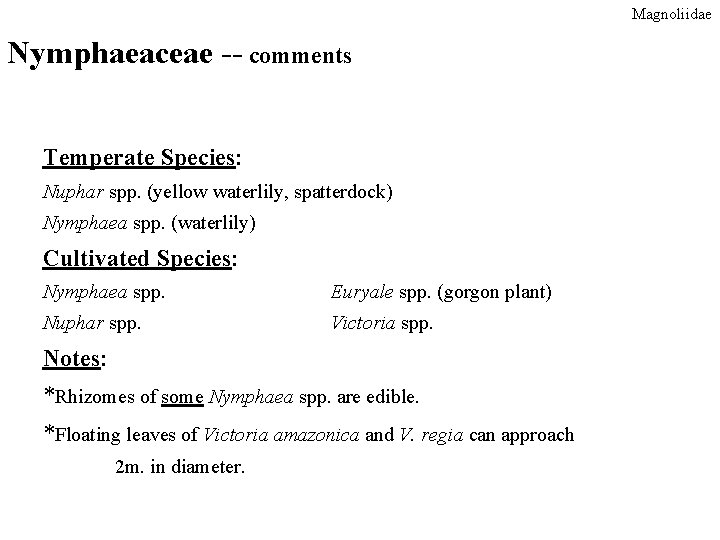
Magnoliidae Nymphaeaceae -- comments Temperate Species: Nuphar spp. (yellow waterlily, spatterdock) Nymphaea spp. (waterlily) Cultivated Species: Nymphaea spp. Euryale spp. (gorgon plant) Nuphar spp. Victoria spp. Notes: *Rhizomes of some Nymphaea spp. are edible. *Floating leaves of Victoria amazonica and V. regia can approach 2 m. in diameter.
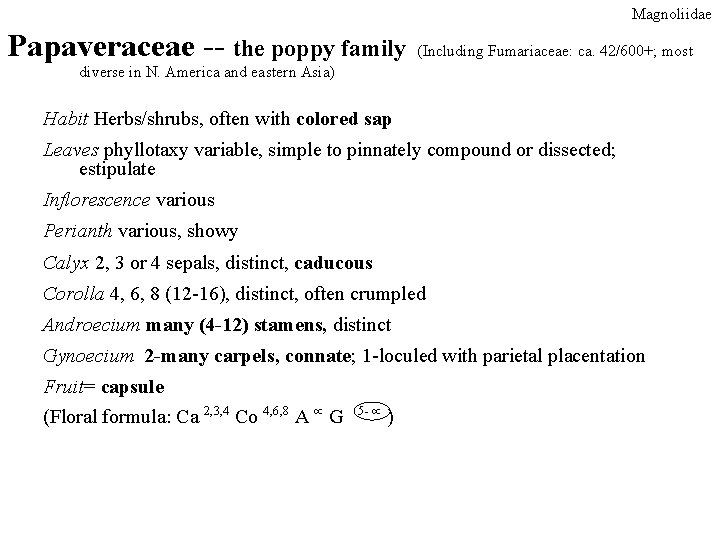
Magnoliidae Papaveraceae -- the poppy family (Including Fumariaceae: ca. 42/600+; most diverse in N. America and eastern Asia) Habit Herbs/shrubs, often with colored sap Leaves phyllotaxy variable, simple to pinnately compound or dissected; estipulate Inflorescence various Perianth various, showy Calyx 2, 3 or 4 sepals, distinct, caducous Corolla 4, 6, 8 (12 -16), distinct, often crumpled Androecium many (4 -12) stamens, distinct Gynoecium 2 -many carpels, connate; 1 -loculed with parietal placentation Fruit= capsule (Floral formula: Ca 2, 3, 4 Co 4, 6, 8 A G 5 - )
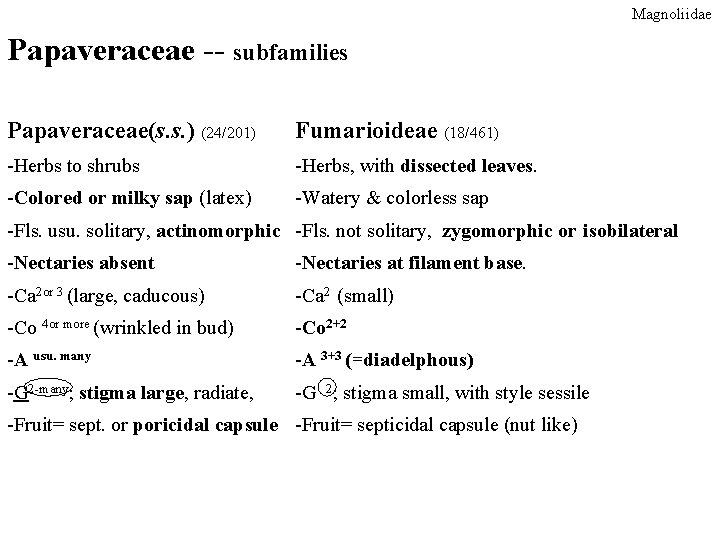
Magnoliidae Papaveraceae -- subfamilies Papaveraceae(s. s. ) (24/201) Fumarioideae (18/461) -Herbs to shrubs -Herbs, with dissected leaves. -Colored or milky sap (latex) -Watery & colorless sap -Fls. usu. solitary, actinomorphic -Fls. not solitary, zygomorphic or isobilateral -Nectaries absent -Nectaries at filament base. -Ca 2 or 3 (large, caducous) -Ca 2 (small) -Co 4 or more (wrinkled in bud) -Co 2+2 -A usu. many -A 3+3 (=diadelphous) -G 2 -many; stigma large, radiate, -G 2; stigma small, with style sessile -Fruit= sept. or poricidal capsule -Fruit= septicidal capsule (nut like)
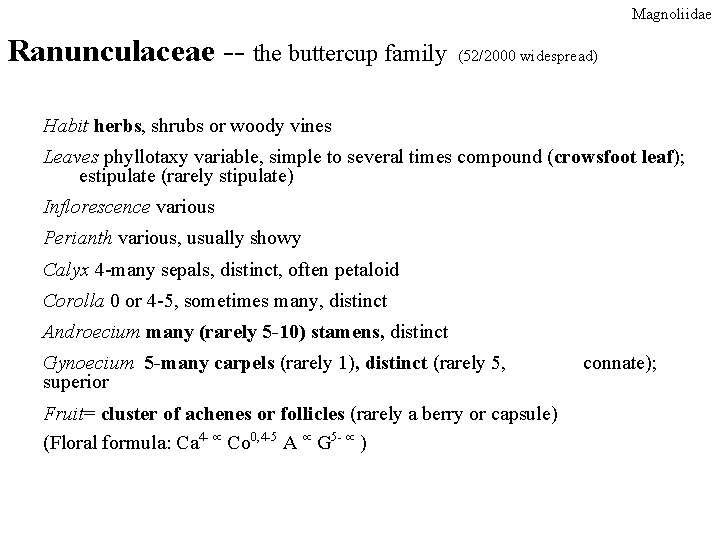
Magnoliidae Ranunculaceae -- the buttercup family (52/2000 widespread) Habit herbs, shrubs or woody vines Leaves phyllotaxy variable, simple to several times compound (crowsfoot leaf); estipulate (rarely stipulate) Inflorescence various Perianth various, usually showy Calyx 4 -many sepals, distinct, often petaloid Corolla 0 or 4 -5, sometimes many, distinct Androecium many (rarely 5 -10) stamens, distinct Gynoecium 5 -many carpels (rarely 1), distinct (rarely 5, superior Fruit= cluster of achenes or follicles (rarely a berry or capsule) (Floral formula: Ca 4 - Co 0, 4 -5 A G 5 - ) connate);
-family Magnoliidae Piperaceae -- the pepper family (10/2000 widespread tropically) Habit Herbs, shrubs and small trees, terrestrial and epiphytic, commonly succulent Leaves mostly alternate, some opposite, whorled; often punctately glandular (ethereal oils) attached to swollen nodes; simple, palmate or pinnately veined Inflorescence spike Special floral characters apetalous flowers on spikes Perianth highly reduced, flowers subtended by peltate (shield-shaped) bracts Androecium 1 -10 stamens, distinct Gynoecium 2 -5 carpels, connate; superior; 2 -5 stigmas Fruit= drupe or drupelet (Floral formula: A 1 -10 G 2 -5 )
-family Magnoliidae Piperaceae -- comments Some genera: Piper (often woody with distinctly swollen nodes), Peperomia, Pothomorphe, Macropiper, etc. Comments: Piper nigrum is common black pepper. Many Peperomia species display CAM metabolism. The stem has scattered vascular bundles like a monocot, for this reason some believe a Piperaceae-like member forms the link between the monocots and dicots. Piper and Peperomia are so different (in many aspects of their morphology) that they are sometimes divided into separate families.