
Magnitudes This is hard Lesson Objectives To relate
Magnitudes This is hard!!!
Lesson Objectives � To relate the apparent magnitude scale to the brightness of stars. � To perform simple calculations relating magnitude differences to brightness ratios. � To distinguish between apparent magnitude and absolute magnitude
What is Magnitude? � We measure the brightness of a star by its magnitude. There are two types of magnitude: � Apparent magnitude is how bright an object is to us on Earth. � Absolute magnitude is how bright a star would appear in space from a certain distance. http: //www. gcseastronomy. co. uk/space/ani mation/flash_magnitude. html
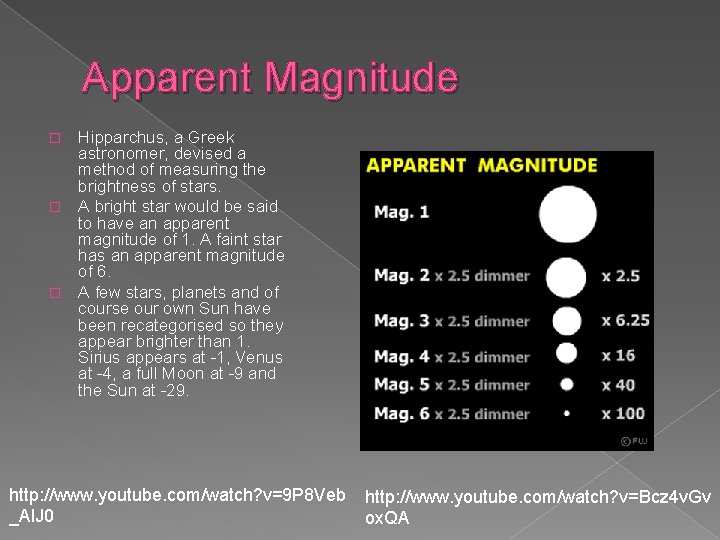
Apparent Magnitude Hipparchus, a Greek astronomer, devised a method of measuring the brightness of stars. � A bright star would be said to have an apparent magnitude of 1. A faint star has an apparent magnitude of 6. � A few stars, planets and of course our own Sun have been recategorised so they appear brighter than 1. Sirius appears at -1, Venus at -4, a full Moon at -9 and the Sun at -29. � http: //www. youtube. com/watch? v=9 P 8 Veb _Al. J 0 http: //www. youtube. com/watch? v=Bcz 4 v. Gv ox. QA

Absolute Magnitude Absolute magnitude is a useful way of finding out how bright a star would appear from a certain point in space. By doing this we understand each star's true magnitude. � The true absolute magnitude for the Sun is 4. 2 whereas to us on Earth it is -27. � It is the brightness of a star at a distance of 10 parsecs which is 32. 6 light years. � A log function is how many 0 s you have on a number. For example, the logarithm of 1000 to base 10 is 3, because 1000 is 10 to the power 3: 1000 = 10 × 10 = 10³

Calculations m = Apparent magniture M = Absolute magnitude There are different types of calculation you will be asked to make. Working out differences in apparent magnification, finding absolute and apparent magnification and also distance. � To work out Absolute Magnitude: � M = m + 5 - 5 log d � To work out Apparent Magnitude: � m = M-5+5 log d � To work out Distance using Magnitude: � D = 10(m-M+5)/5 �
Example 1 � Spica has an apparent magnitude of 0. 98 and an absolute magnitude of - 3. 55. Which is brighter when viewed from a distance of 10 parsecs?
Solution � 10 parsecs is the brightness measured at absolute magnitude. A smaller (or even negative) number is brighter. Spica's absolute magnitude is therefore brighter
Example 2 � Star A is apparent magnitude 2. 3. It is 2. 5 times brighter than B. What is B's apparent magnitude?
Answer � 2. 5 brighter = 1 magnitude � B = 3. 3
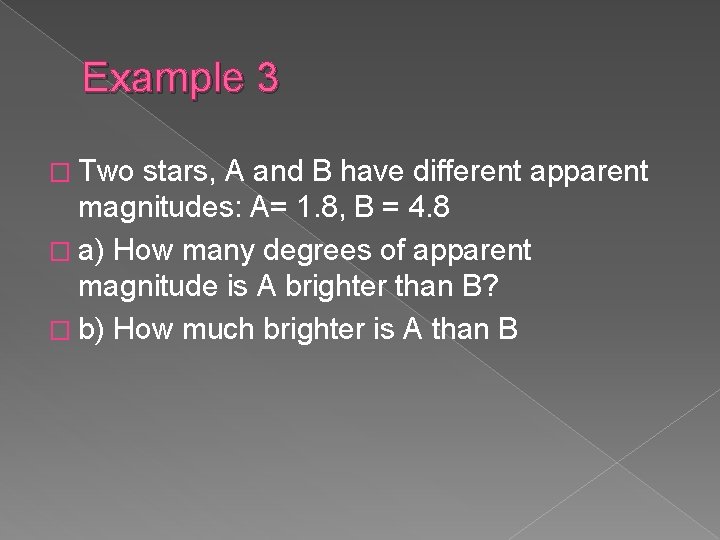
Example 3 � Two stars, A and B have different apparent magnitudes: A= 1. 8, B = 4. 8 � a) How many degrees of apparent magnitude is A brighter than B? � b) How much brighter is A than B
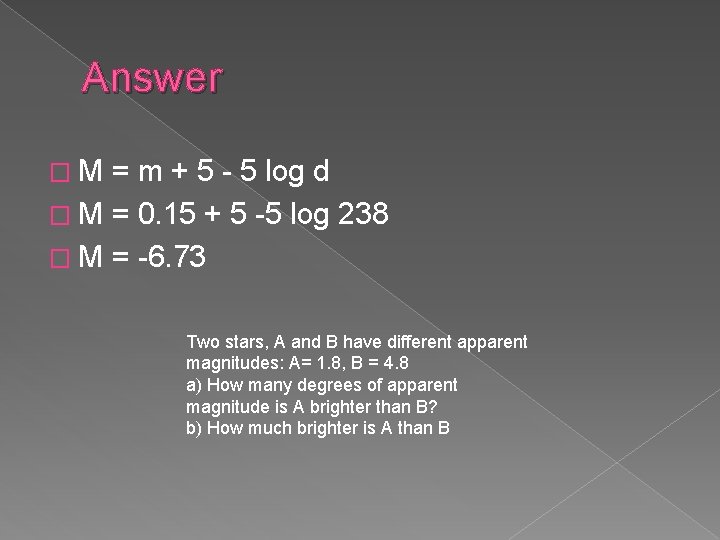
Answer �M = m + 5 - 5 log d � M = 0. 15 + 5 -5 log 238 � M = -6. 73 Two stars, A and B have different apparent magnitudes: A= 1. 8, B = 4. 8 a) How many degrees of apparent magnitude is A brighter than B? b) How much brighter is A than B
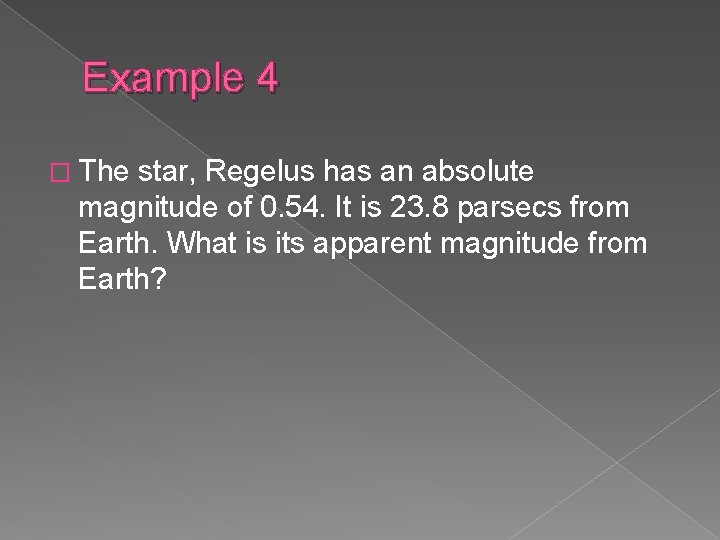
Example 4 � The star, Regelus has an absolute magnitude of 0. 54. It is 23. 8 parsecs from Earth. What is its apparent magnitude from Earth?
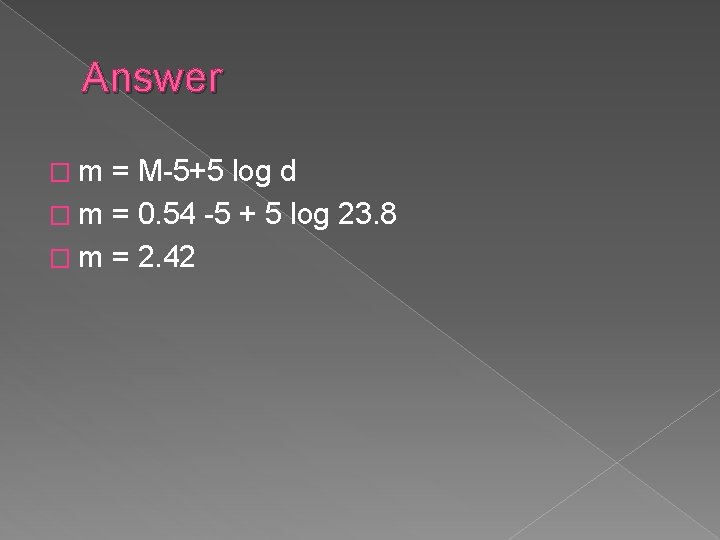
Answer �m = M-5+5 log d � m = 0. 54 -5 + 5 log 23. 8 � m = 2. 42

Apply your Knowledge � Try exam style questions on distance and magnitudes.
- Slides: 15