
Magnets And Magnetism The Discovery of Magnets The
- Slides: 26
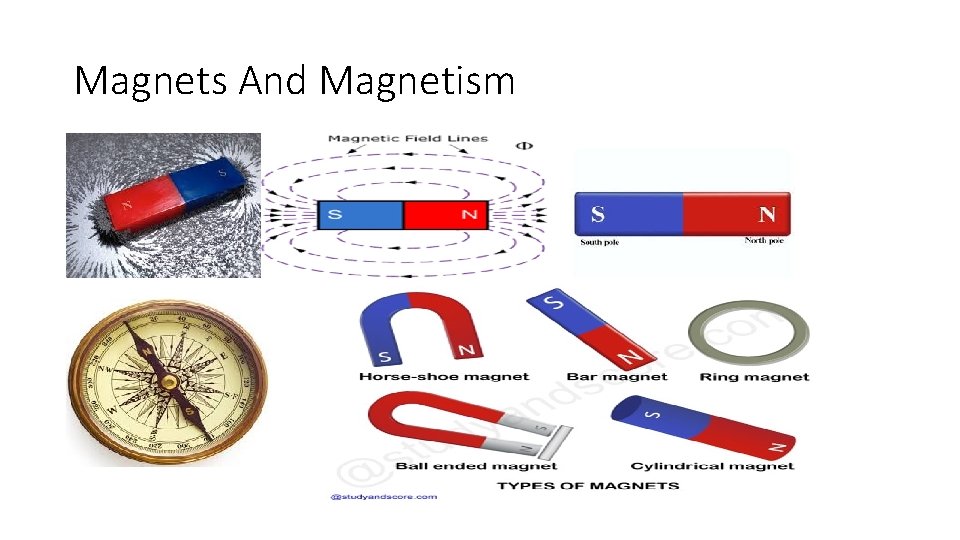
Magnets And Magnetism
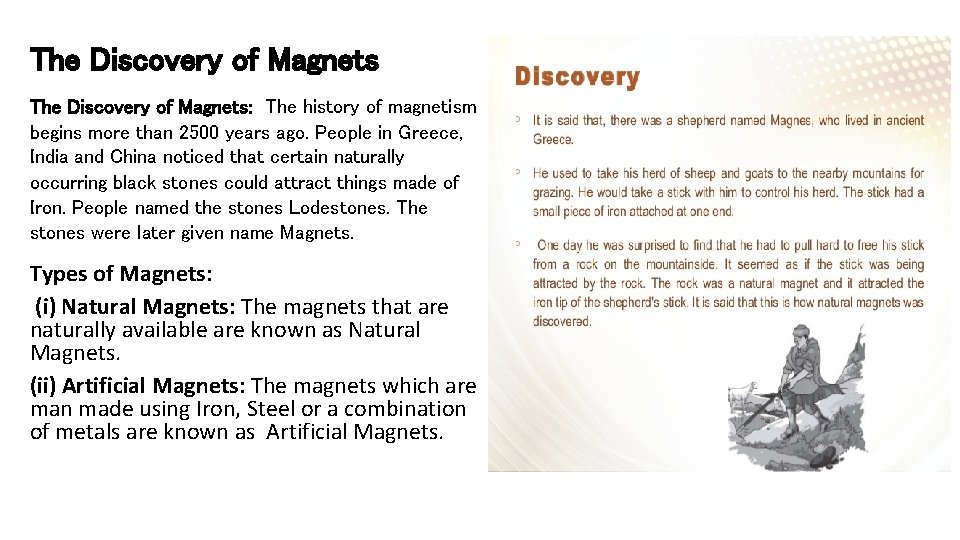
The Discovery of Magnets: The history of magnetism begins more than 2500 years ago. People in Greece, India and China noticed that certain naturally occurring black stones could attract things made of Iron. People named the stones Lodestones. The stones were later given name Magnets. Types of Magnets: (i) Natural Magnets: The magnets that are naturally available are known as Natural Magnets. (ii) Artificial Magnets: The magnets which are man made using Iron, Steel or a combination of metals are known as Artificial Magnets.
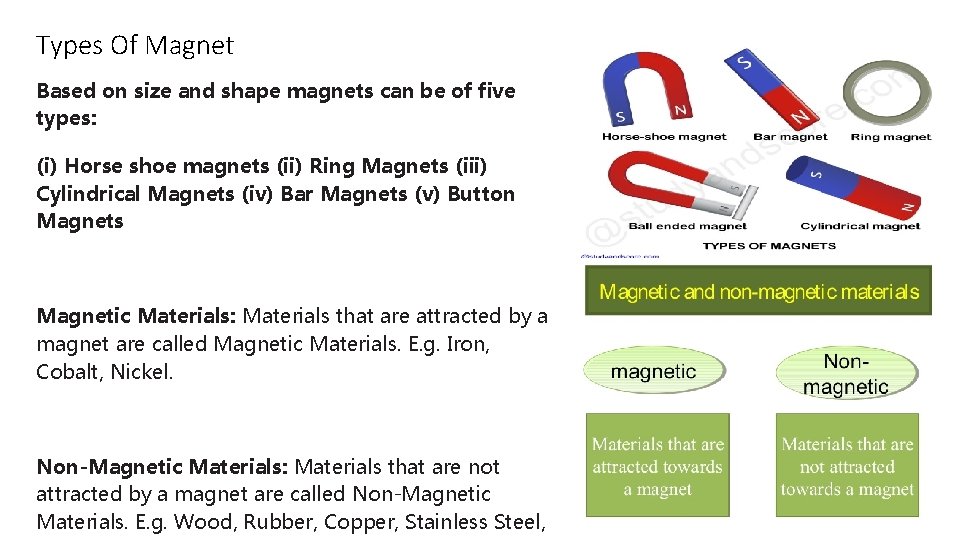
Types Of Magnet Based on size and shape magnets can be of five types: (i) Horse shoe magnets (ii) Ring Magnets (iii) Cylindrical Magnets (iv) Bar Magnets (v) Button Magnets Magnetic Materials: Materials that are attracted by a magnet are called Magnetic Materials. E. g. Iron, Cobalt, Nickel. Non-Magnetic Materials: Materials that are not attracted by a magnet are called Non-Magnetic Materials. E. g. Wood, Rubber, Copper, Stainless Steel,
Questions • Have you seen magnets? Have you played with them? • Do you know where was the first natural magnet discovered? • Do you know compass is also made of a magnet? • Differentiate between Natural Magnets and artificial Magnets. • Difference between Magnetic Materials and Non-Magnetic Materials.
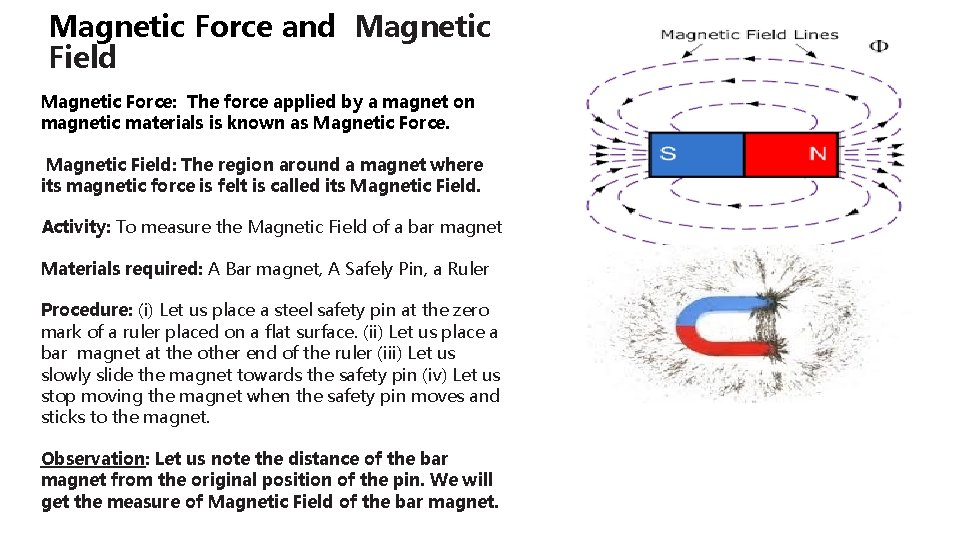
Magnetic Force and Magnetic Field Magnetic Force: The force applied by a magnet on magnetic materials is known as Magnetic Force. Magnetic Field: The region around a magnet where its magnetic force is felt is called its Magnetic Field. Activity: To measure the Magnetic Field of a bar magnet Materials required: A Bar magnet, A Safely Pin, a Ruler Procedure: (i) Let us place a steel safety pin at the zero mark of a ruler placed on a flat surface. (ii) Let us place a bar magnet at the other end of the ruler (iii) Let us slowly slide the magnet towards the safety pin (iv) Let us stop moving the magnet when the safety pin moves and sticks to the magnet. Observation: Let us note the distance of the bar magnet from the original position of the pin. We will get the measure of Magnetic Field of the bar magnet.
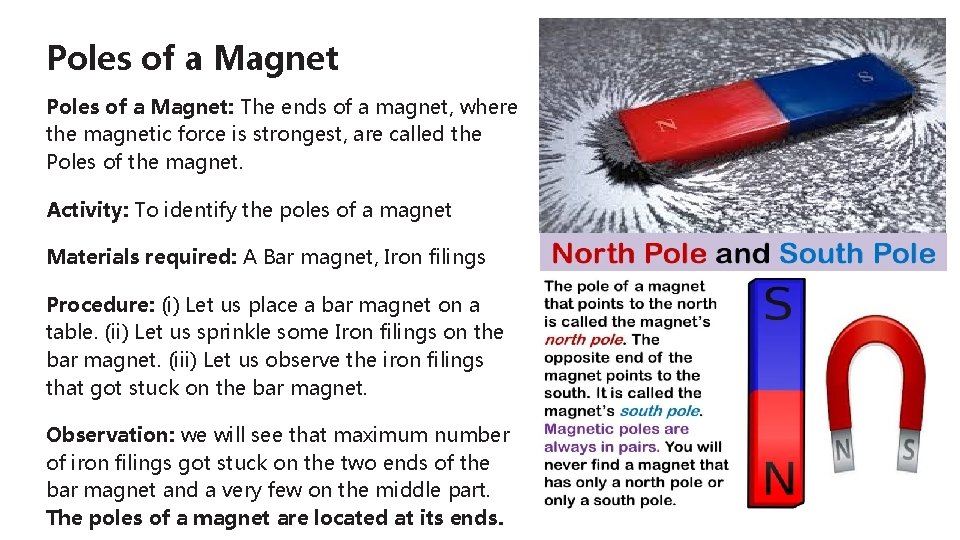
Poles of a Magnet: The ends of a magnet, where the magnetic force is strongest, are called the Poles of the magnet. Activity: To identify the poles of a magnet Materials required: A Bar magnet, Iron filings Procedure: (i) Let us place a bar magnet on a table. (ii) Let us sprinkle some Iron filings on the bar magnet. (iii) Let us observe the iron filings that got stuck on the bar magnet. Observation: we will see that maximum number of iron filings got stuck on the two ends of the bar magnet and a very few on the middle part. The poles of a magnet are located at its ends.
Questions • Define: (i) Magnetic Force (ii) Magnetic Field (iii) Poles of a Magnet • What will be the variation of the force applied by a magnet when a magnetic material is gradually brought closer? • Do all parts of a magnet apply equal amount of force on magnetic materials? • Define: (i) Magnetic Force (ii) Magnetic Field (iii) Poles of a Magnet • Write an activity to measure the Magnetic Field of a Bar Magnet. • Write an activity to identify the Poles of a Bar Magnet.
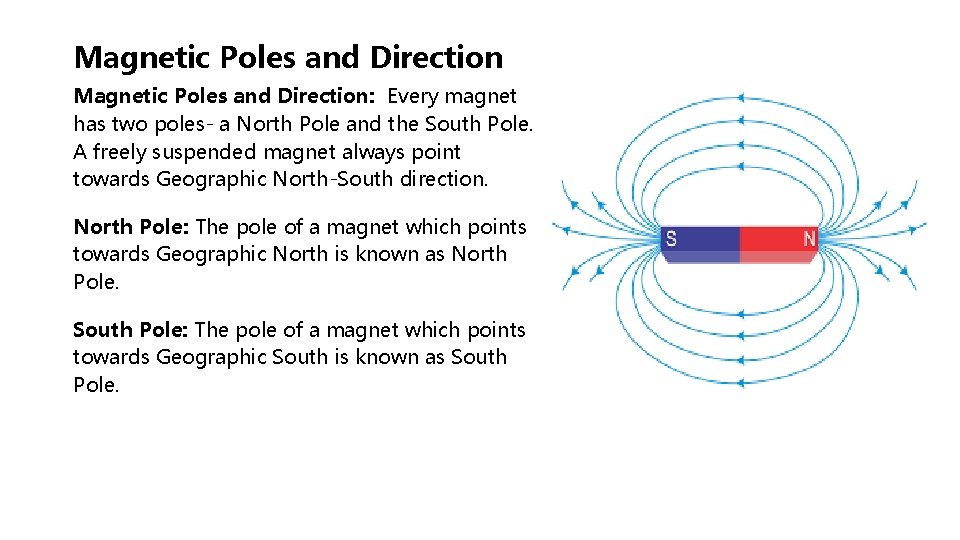
Magnetic Poles and Direction: Every magnet has two poles- a North Pole and the South Pole. A freely suspended magnet always point towards Geographic North-South direction. North Pole: The pole of a magnet which points towards Geographic North is known as North Pole. South Pole: The pole of a magnet which points towards Geographic South is known as South Pole.
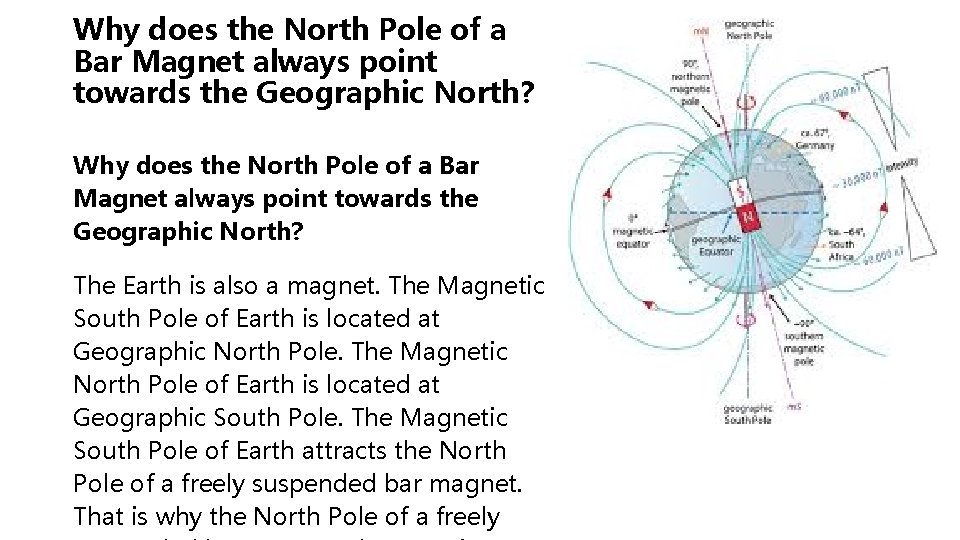
Why does the North Pole of a Bar Magnet always point towards the Geographic North? The Earth is also a magnet. The Magnetic South Pole of Earth is located at Geographic North Pole. The Magnetic North Pole of Earth is located at Geographic South Pole. The Magnetic South Pole of Earth attracts the North Pole of a freely suspended bar magnet. That is why the North Pole of a freely
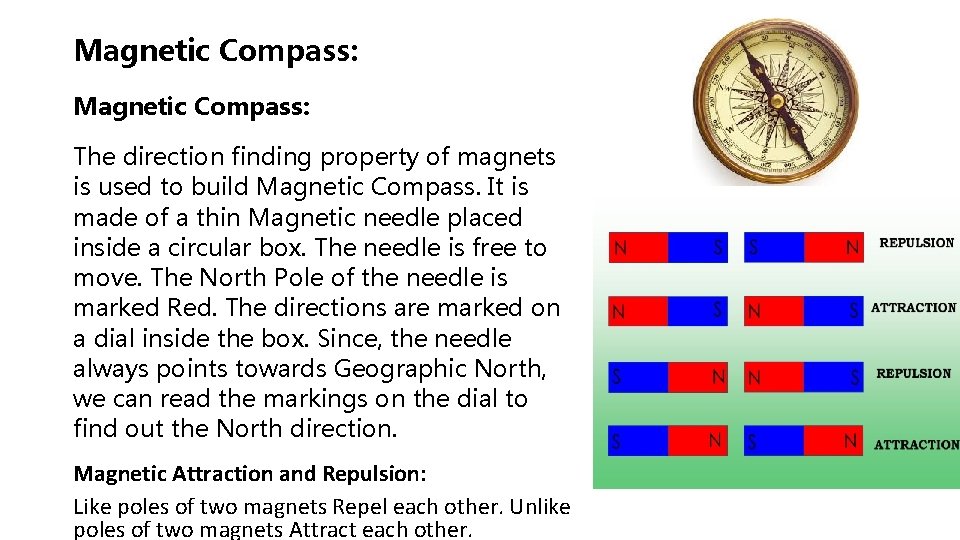
Magnetic Compass: The direction finding property of magnets is used to build Magnetic Compass. It is made of a thin Magnetic needle placed inside a circular box. The needle is free to move. The North Pole of the needle is marked Red. The directions are marked on a dial inside the box. Since, the needle always points towards Geographic North, we can read the markings on the dial to find out the North direction. Magnetic Attraction and Repulsion: Like poles of two magnets Repel each other. Unlike poles of two magnets Attract each other.
Questions • Define: Magnetic field. • Do all the parts of a magnet equally attract a magnetic material? • Why does the North pole of a bar magnet always point towards the Geographic North? • Why does the North Pole of a Bar Magnet always point towards the Geographic North? • What is Magnetic Compass? What is its use?
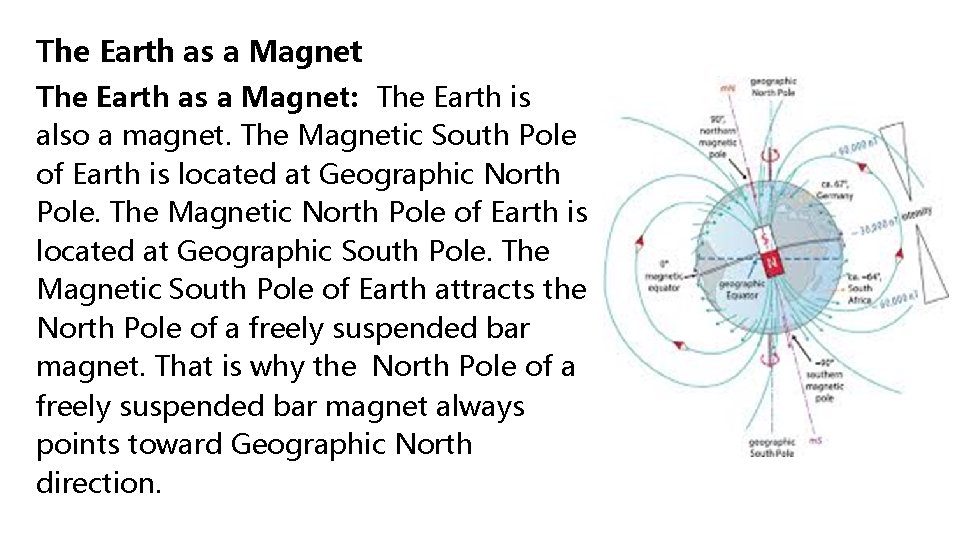
The Earth as a Magnet: The Earth is also a magnet. The Magnetic South Pole of Earth is located at Geographic North Pole. The Magnetic North Pole of Earth is located at Geographic South Pole. The Magnetic South Pole of Earth attracts the North Pole of a freely suspended bar magnet. That is why the North Pole of a freely suspended bar magnet always points toward Geographic North direction.
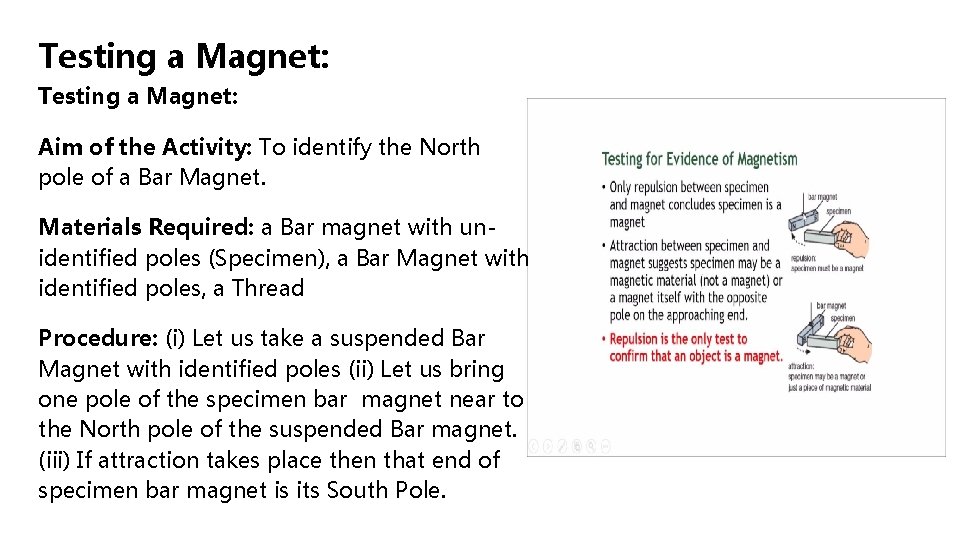
Testing a Magnet: Aim of the Activity: To identify the North pole of a Bar Magnet. Materials Required: a Bar magnet with unidentified poles (Specimen), a Bar Magnet with identified poles, a Thread Procedure: (i) Let us take a suspended Bar Magnet with identified poles (ii) Let us bring one pole of the specimen bar magnet near to the North pole of the suspended Bar magnet. (iii) If attraction takes place then that end of specimen bar magnet is its South Pole.
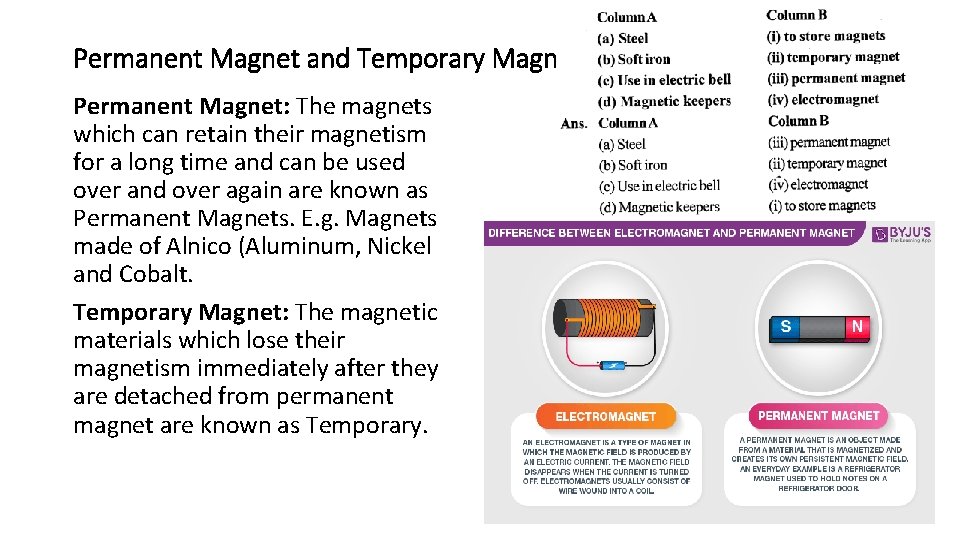
Permanent Magnet and Temporary Magnet Permanent Magnet: The magnets which can retain their magnetism for a long time and can be used over and over again are known as Permanent Magnets. E. g. Magnets made of Alnico (Aluminum, Nickel and Cobalt. Temporary Magnet: The magnetic materials which lose their magnetism immediately after they are detached from permanent magnet are known as Temporary.
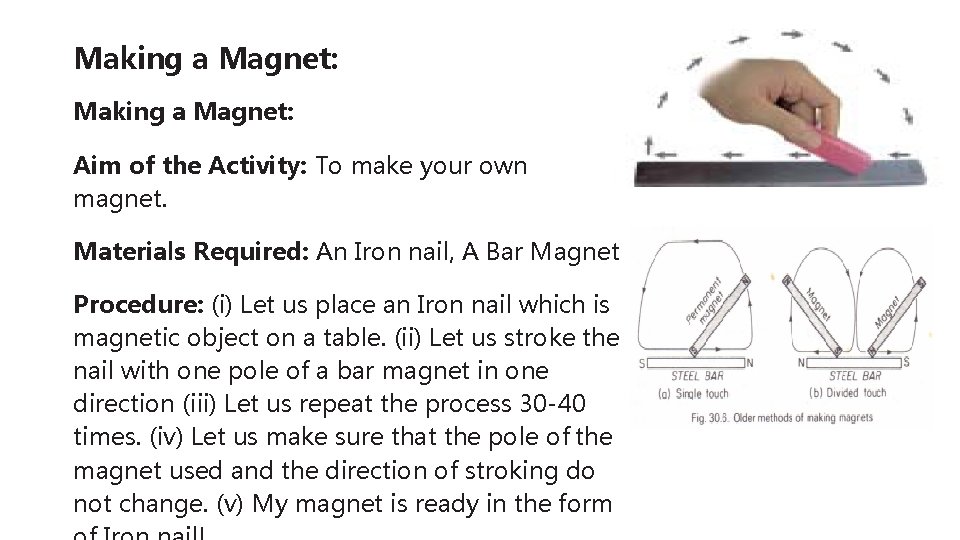
Making a Magnet: Aim of the Activity: To make your own magnet. Materials Required: An Iron nail, A Bar Magnet Procedure: (i) Let us place an Iron nail which is magnetic object on a table. (ii) Let us stroke the nail with one pole of a bar magnet in one direction (iii) Let us repeat the process 30 -40 times. (iv) Let us make sure that the pole of the magnet used and the direction of stroking do not change. (v) My magnet is ready in the form
Questions • Why does the North Pole of a Bar Magnet always point towards the Geographic North? • What is Magnetic Compass? What is its use? • Do you know Earth also has its own Magnet? • With the help of an activity explain the process of testing unidentified poles of a magnet. • With the help of an activity explain how can you make your own magnet?
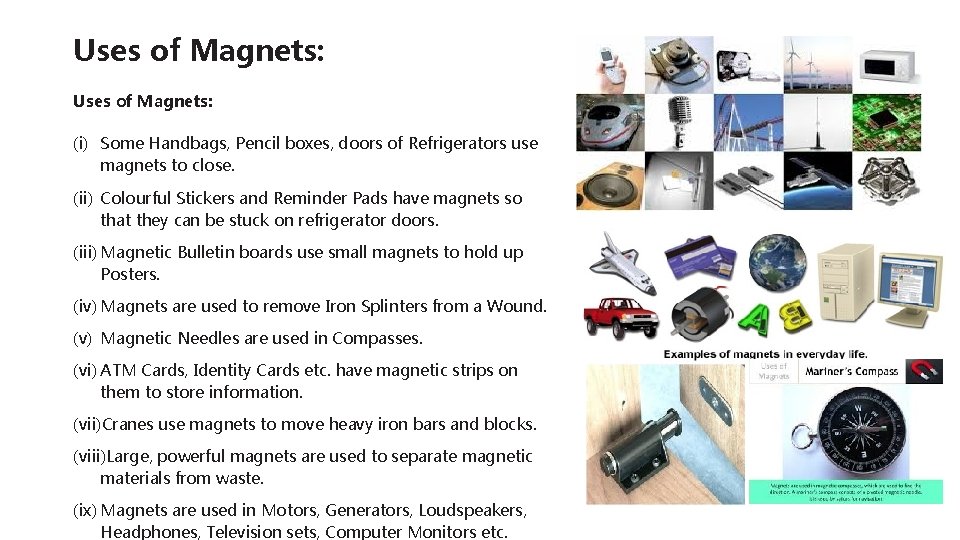
Uses of Magnets: (i) Some Handbags, Pencil boxes, doors of Refrigerators use magnets to close. (ii) Colourful Stickers and Reminder Pads have magnets so that they can be stuck on refrigerator doors. (iii) Magnetic Bulletin boards use small magnets to hold up Posters. (iv) Magnets are used to remove Iron Splinters from a Wound. (v) Magnetic Needles are used in Compasses. (vi) ATM Cards, Identity Cards etc. have magnetic strips on them to store information. (vii)Cranes use magnets to move heavy iron bars and blocks. (viii)Large, powerful magnets are used to separate magnetic materials from waste. (ix) Magnets are used in Motors, Generators, Loudspeakers, Headphones, Television sets, Computer Monitors etc.
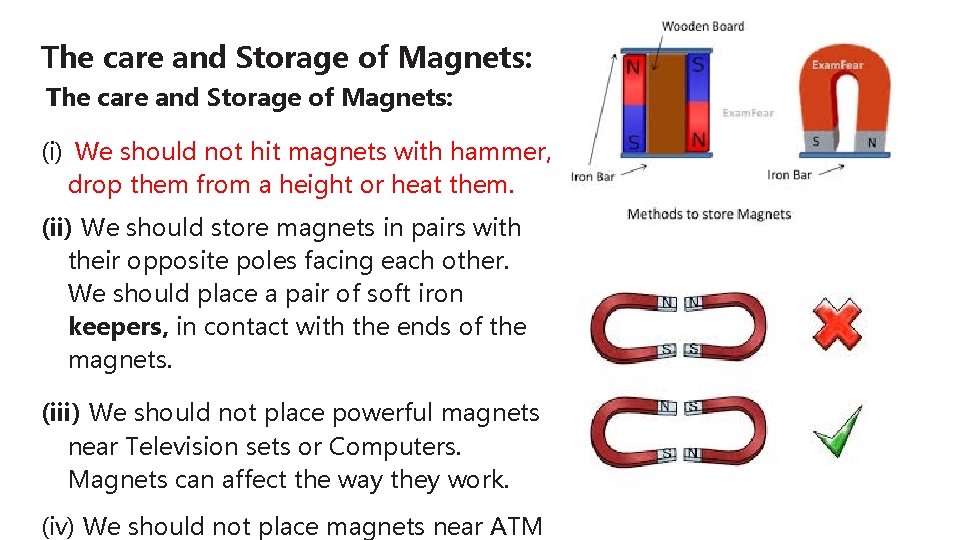
The care and Storage of Magnets: (i) We should not hit magnets with hammer, drop them from a height or heat them. (ii) We should store magnets in pairs with their opposite poles facing each other. We should place a pair of soft iron keepers, in contact with the ends of the magnets. (iii) We should not place powerful magnets near Television sets or Computers. Magnets can affect the way they work. (iv) We should not place magnets near ATM
Questions • What is Magnetic Compass? What is its use? • Can we store information in magnetic strips? • Do you if not properly stored magnet loses its magnetic property? • What is the function of a magnetic Keeper? • Point out two ways in which a magnet can be demagnetised? • List down three uses of magnets.
One mark questions A. Multiple Choice questions 1. Study the two groups. Which two materials have been placed in the wrong group? Magnetic materials: Nickel, Iron, Copper Non-Magnetic materials: Steel, Rubber, Gold (a) Steel and Gold (b) Nickel and Steel (c) Copper and Steel (d) Copper and Gold 2. Reena found that a magnet could attract plastic-coated paper clips. What does this show? (a) The plastic is magnetized (b) Plastic is magnetic (c) Plastic protects the clip from magnetic fields (d) Magnetic fields can pass through plastic 3. When the north poles of two magnets are brought near each other, --------. (a) They repel each other (b) They attract each other (c) The magnets become stronger (d) They lose their magnetism 4. The magnetism of a magnet can be lost if --------. (a) it is kept inside a plastic box (b) it is wrapped in paper (c) it is hit with a hammer (d) it is stuck to a metal door 5. Lodestones were later given the name (a) Magnetite (b) Magnets (c) Magnesium (d) Manganese 6. Which of the following is not a Magnetic Material? (a) Cobalt (b) Iron (c) Nickel (d) Copper 7. Each magnets has (a) Two North poles (b) Two South Poles (c) One North pole and one South Pole (d) One East pole and one West pole
B. Very Short answer Questions 1. Fill in the Blanks. (i) --------- is a naturally occurring magnet. (ii) Materials that are attracted by a magnet are called ---------- materials. (iii) A magnetic compass uses the property of magnets of pointing in the ____- ____ direction. (iv)--------- magnets lose their magnetism after Short time. (v)The soft iron pieces placed across the ends of magnets while storing them are called -----. 1. Pick the odd one out in each case. (i) Cobalt, Nickel, Copper, Iron (ii) Motor, Generator, Loudspeaker, Plastic straw (iii)Bar magnet, Horse shoe magnet, Ring magnet, Cuboids magnet
1. Say whether the following statements are true or false? (i) Electro magnets are Permanent magnets. (ii) A Bar magnet has its North pole and south pole located towards the ends. (iii) A magnet does not pull objects made of Magnetic materials. (iv) The region around a magnet where its magnetic force is felt is called its Electric field. (v) A magnetic compass is used to find North direction at any place.
Give the definitions of the following: (i) Magnetic materials (ii) Non-Magnetic materials (iii) Magnetic Force (iv) Magnetic Field (v) Magnetic Compass (vi) Permanent magnets (vii) Temporary magnets (viii) Electromagnet (ix) Demagnetization (x) Keepers (xi) Magnetic resonance imaging (MRI) (xii) Magnetic Poles
Two marks questions 1. What happens when a magnet is cut in two? 2. Why does the North Pole of a freely suspended magnet point to the Geographical north? 3. Point out two ways in which a magnet can be demagnetized. 4. What is Demagnetization? Mention the function of a magnetic keeper. 5. List two uses of Magnets. 6. Draw and describe a Magnetic Compass. 7. Define: (i) Magnetic force (ii) Magnetic field 8. Name the device used to find North direction. What property does it use? 9. What is a Temporary Magnet? What are Electromagnets? 10. Why should Magnets not be placed near TVs and Computers? 11. Are Electromagnets Permanent magnets? Give you view. 12. How do you use an Electromagnet to separate scrap iron pieces from a garbage heap?
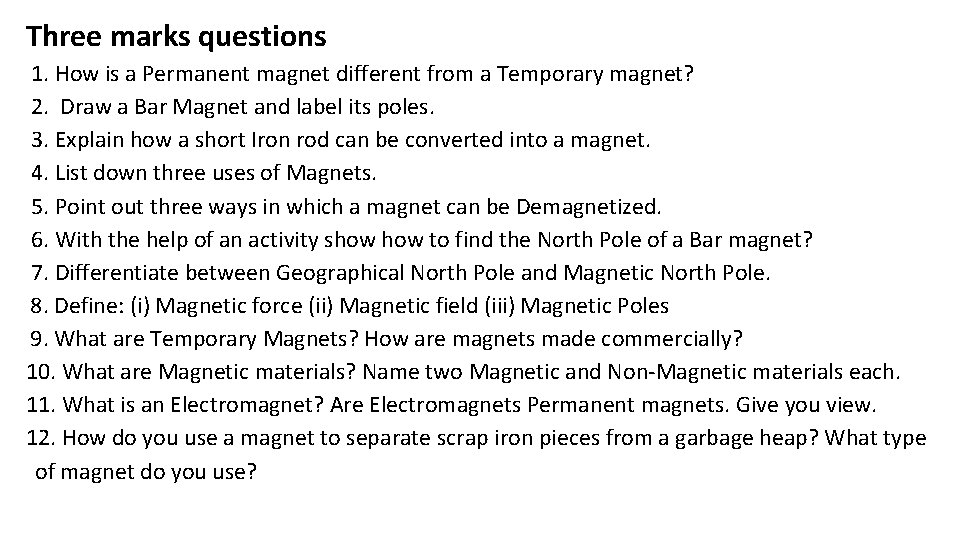
Three marks questions 1. How is a Permanent magnet different from a Temporary magnet? 2. Draw a Bar Magnet and label its poles. 3. Explain how a short Iron rod can be converted into a magnet. 4. List down three uses of Magnets. 5. Point out three ways in which a magnet can be Demagnetized. 6. With the help of an activity show to find the North Pole of a Bar magnet? 7. Differentiate between Geographical North Pole and Magnetic North Pole. 8. Define: (i) Magnetic force (ii) Magnetic field (iii) Magnetic Poles 9. What are Temporary Magnets? How are magnets made commercially? 10. What are Magnetic materials? Name two Magnetic and Non-Magnetic materials each. 11. What is an Electromagnet? Are Electromagnets Permanent magnets. Give you view. 12. How do you use a magnet to separate scrap iron pieces from a garbage heap? What type of magnet do you use?
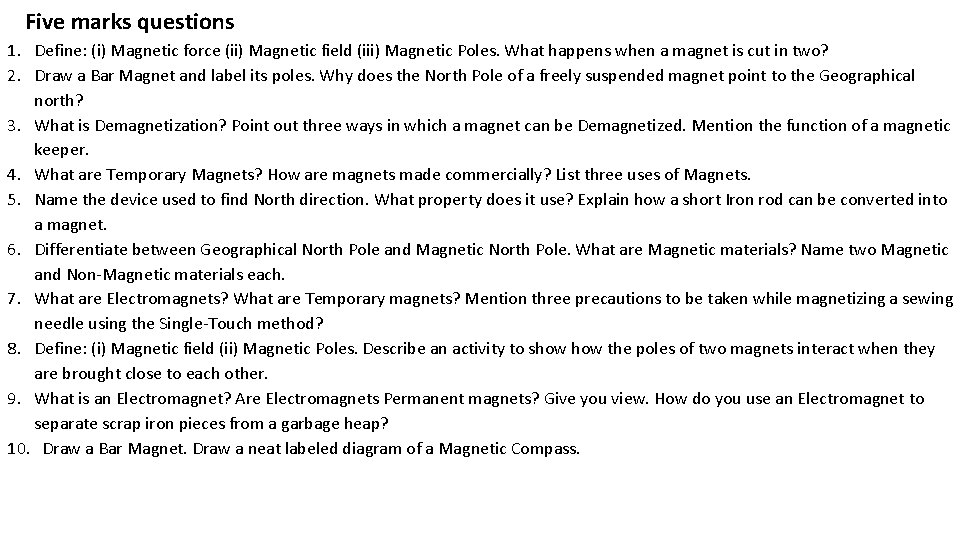
Five marks questions 1. Define: (i) Magnetic force (ii) Magnetic field (iii) Magnetic Poles. What happens when a magnet is cut in two? 2. Draw a Bar Magnet and label its poles. Why does the North Pole of a freely suspended magnet point to the Geographical north? 3. What is Demagnetization? Point out three ways in which a magnet can be Demagnetized. Mention the function of a magnetic keeper. 4. What are Temporary Magnets? How are magnets made commercially? List three uses of Magnets. 5. Name the device used to find North direction. What property does it use? Explain how a short Iron rod can be converted into a magnet. 6. Differentiate between Geographical North Pole and Magnetic North Pole. What are Magnetic materials? Name two Magnetic and Non-Magnetic materials each. 7. What are Electromagnets? What are Temporary magnets? Mention three precautions to be taken while magnetizing a sewing needle using the Single-Touch method? 8. Define: (i) Magnetic field (ii) Magnetic Poles. Describe an activity to show the poles of two magnets interact when they are brought close to each other. 9. What is an Electromagnet? Are Electromagnets Permanent magnets? Give you view. How do you use an Electromagnet to separate scrap iron pieces from a garbage heap? 10. Draw a Bar Magnet. Draw a neat labeled diagram of a Magnetic Compass.