
Magnetospheric Microinstabilities Andrew Gibby Physics 312 22007 Overview
Magnetospheric Microinstabilities Andrew Gibby Physics 312 2/20/07
Overview § § § Magnetospheric Plasma Macro vs. Microinstabilities Treatment of microinstabilities Whistler mode instability Experimental Evidence
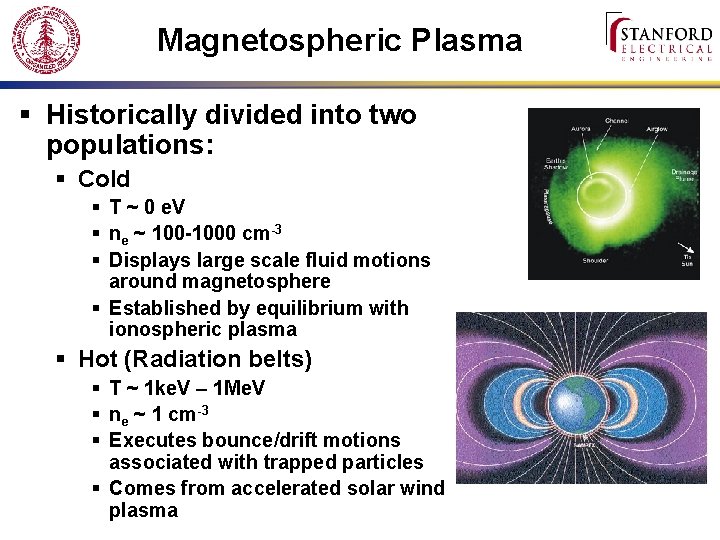
Magnetospheric Plasma § Historically divided into two populations: § Cold § T ~ 0 e. V § ne ~ 100 -1000 cm-3 § Displays large scale fluid motions around magnetosphere § Established by equilibrium with ionospheric plasma § Hot (Radiation belts) § T ~ 1 ke. V – 1 Me. V § ne ~ 1 cm-3 § Executes bounce/drift motions associated with trapped particles § Comes from accelerated solar wind plasma
Macro vs. Micro instabilities § Macro instabilities § Associated with fluid (MHD) instabilities in the cold plasma § E. g. Rayleigh-Taylor, Flute/Interchange, Sausage/Z-pinch instabilities § Driven by the configuration of the plasma
Macro vs. Micro § Micro instabilities § Associated with plasma waves § Driven by non-Maxwellian distributions (i. e. hot plasma) § Treatment proceeds from the dispersion relation
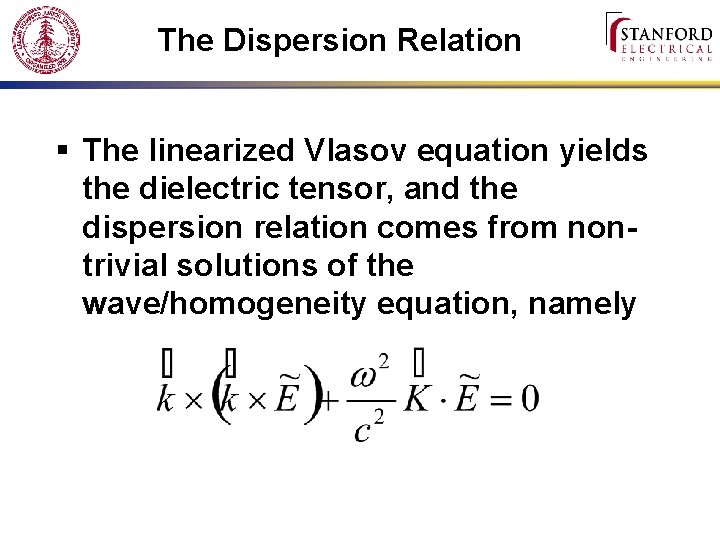
The Dispersion Relation § The linearized Vlasov equation yields the dielectric tensor, and the dispersion relation comes from nontrivial solutions of the wave/homogeneity equation, namely
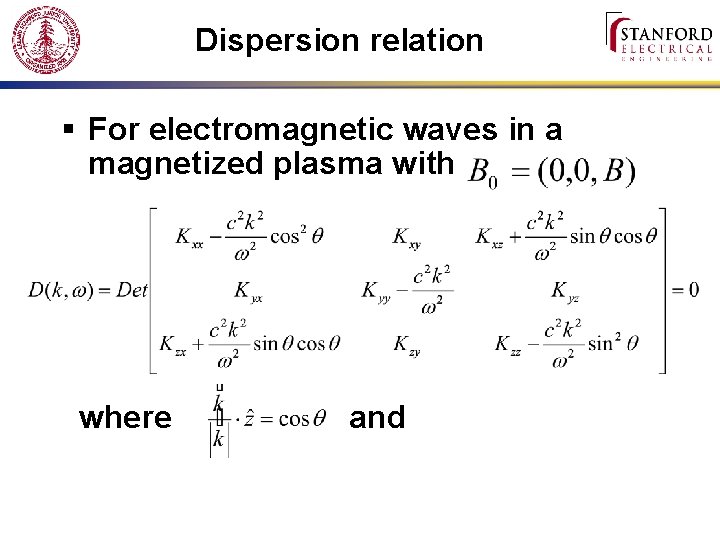
Dispersion relation § For electromagnetic waves in a magnetized plasma with where and

Dispersion relation
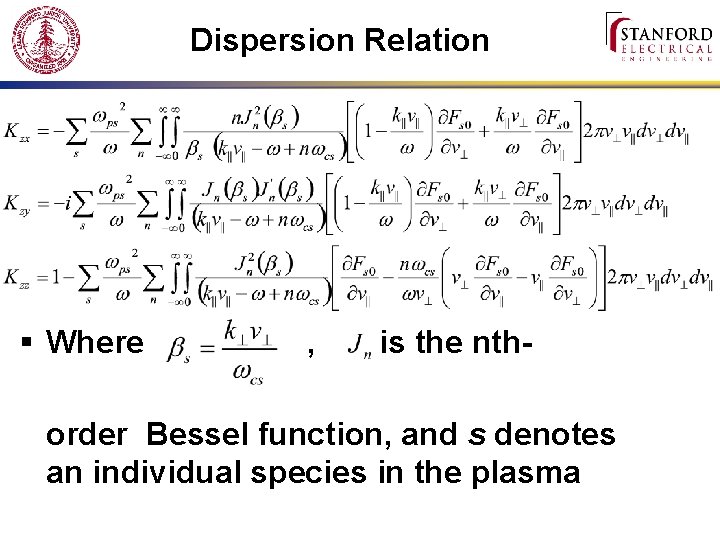
Dispersion Relation § Where , is the nth- order Bessel function, and s denotes an individual species in the plasma
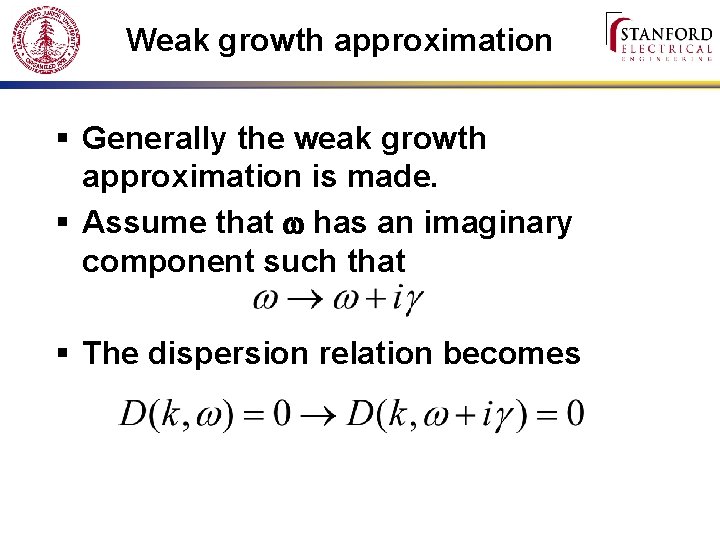
Weak growth approximation § Generally the weak growth approximation is made. § Assume that w has an imaginary component such that § The dispersion relation becomes
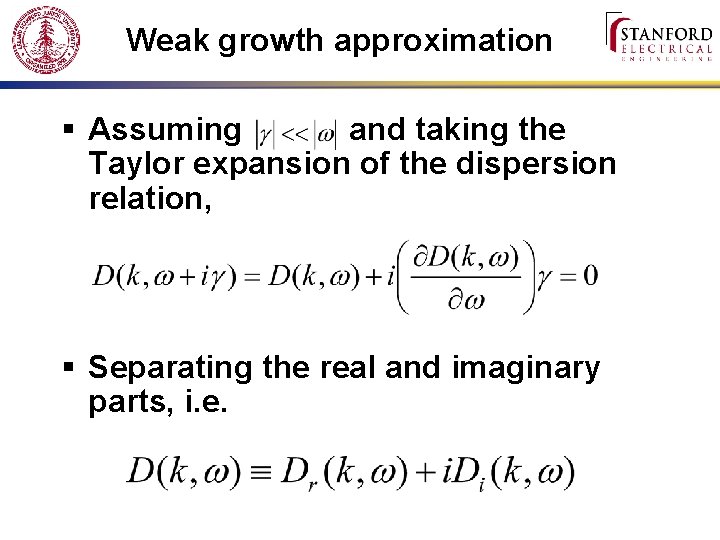
Weak growth approximation § Assuming and taking the Taylor expansion of the dispersion relation, § Separating the real and imaginary parts, i. e.
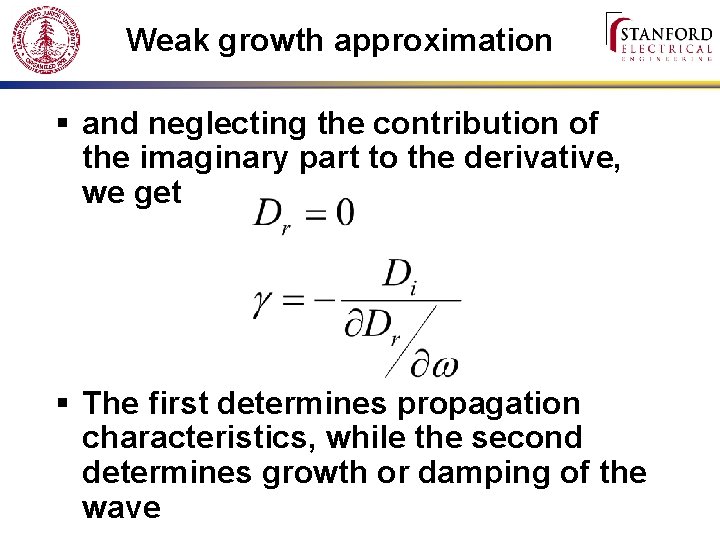
Weak growth approximation § and neglecting the contribution of the imaginary part to the derivative, we get § The first determines propagation characteristics, while the second determines growth or damping of the wave
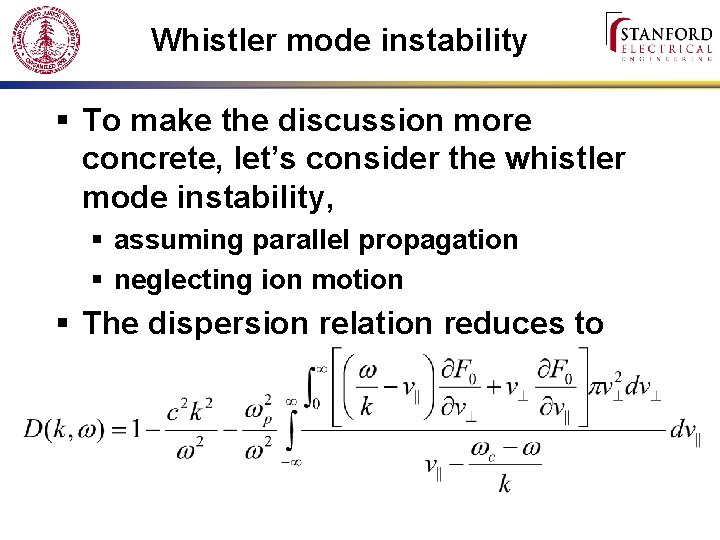
Whistler mode instability § To make the discussion more concrete, let’s consider the whistler mode instability, § assuming parallel propagation § neglecting ion motion § The dispersion relation reduces to
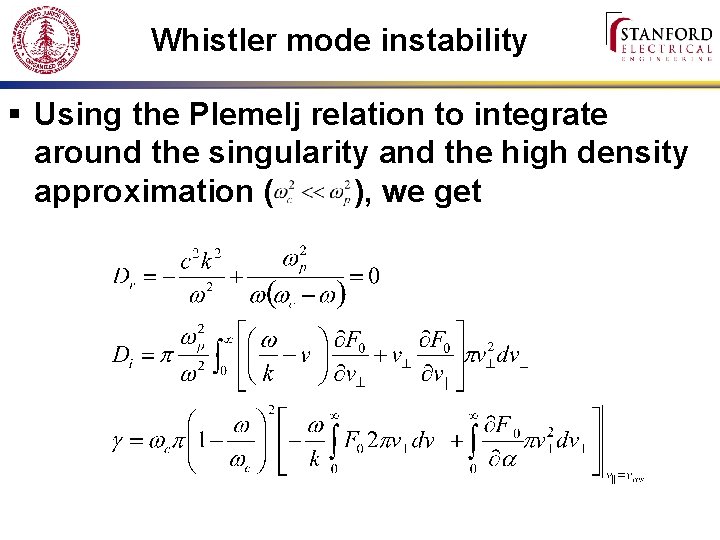
Whistler mode instability § Using the Plemelj relation to integrate around the singularity and the high density approximation ( ), we get
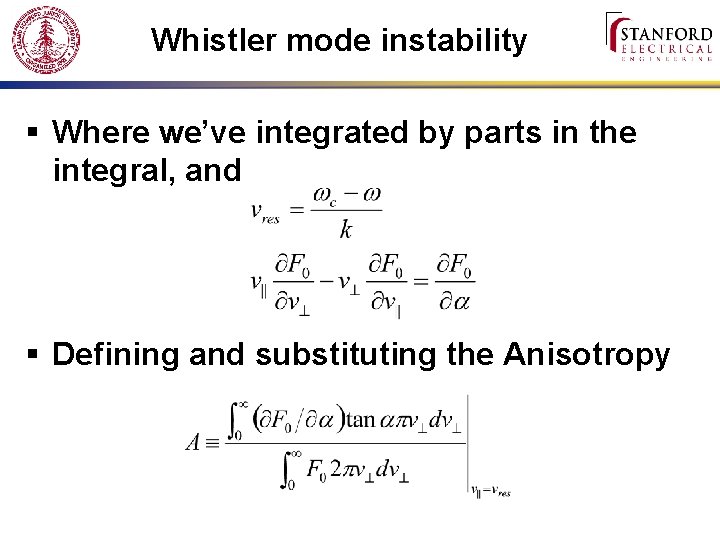
Whistler mode instability § Where we’ve integrated by parts in the integral, and § Defining and substituting the Anisotropy
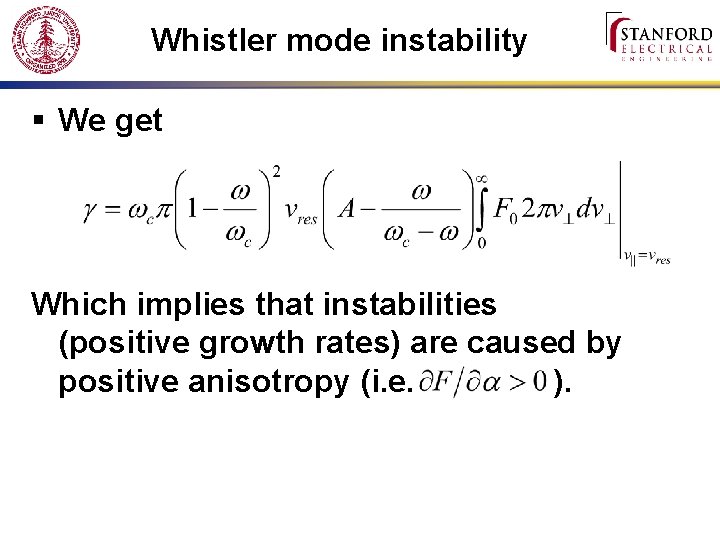
Whistler mode instability § We get Which implies that instabilities (positive growth rates) are caused by positive anisotropy (i. e. ).
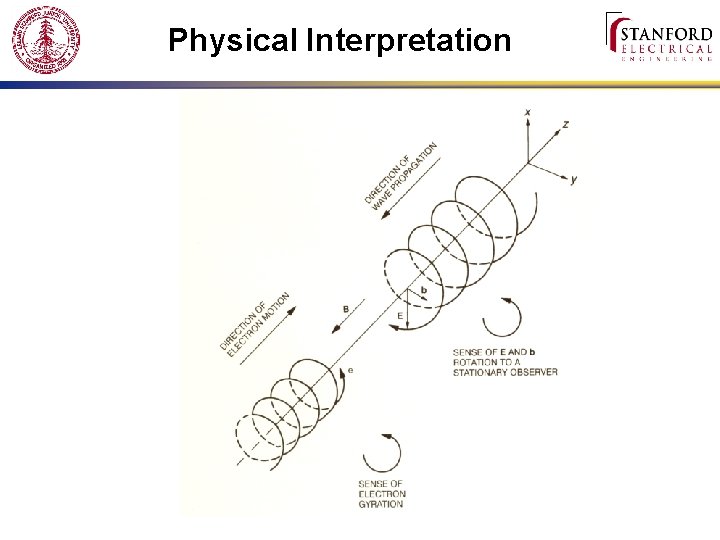
Physical Interpretation
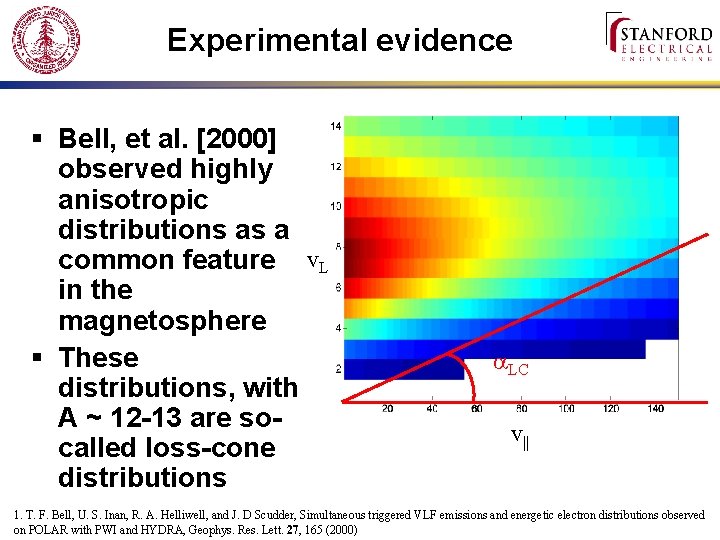
Experimental evidence § Bell, et al. [2000] observed highly anisotropic distributions as a common feature v. L in the magnetosphere § These distributions, with A ~ 12 -13 are socalled loss-cone distributions a. LC v|| 1. T. F. Bell, U. S. Inan, R. A. Helliwell, and J. D Scudder, Simultaneous triggered VLF emissions and energetic electron distributions observed on POLAR with PWI and HYDRA, Geophys. Res. Lett. 27, 165 (2000)
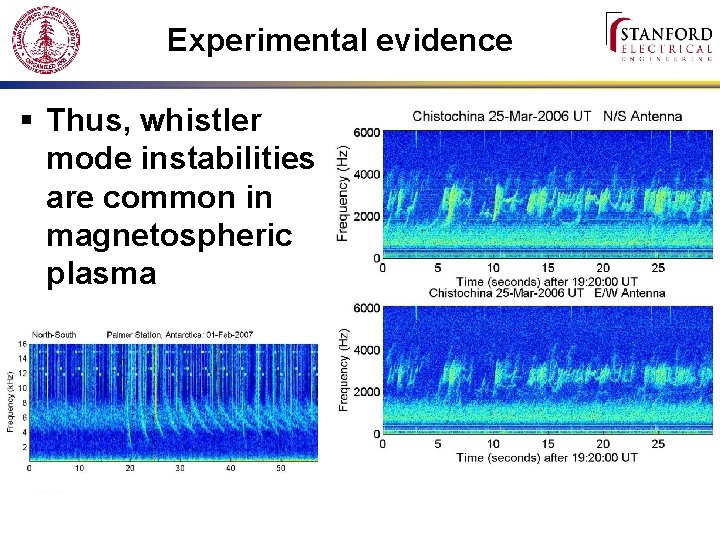
Experimental evidence § Thus, whistler mode instabilities are common in magnetospheric plasma
Experimental evidence
Experimental evidence
- Slides: 21