
Magnetometers by IRF observatory Kiruna KIR Lycksele SGU
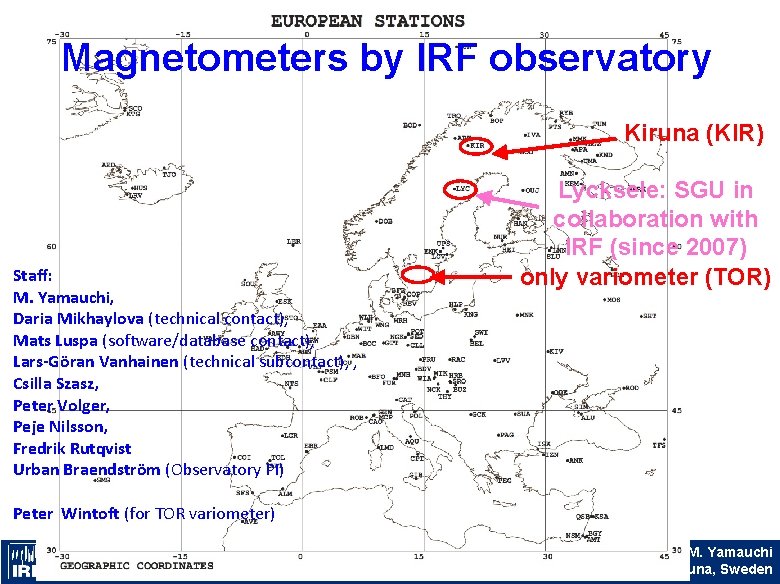
Magnetometers by IRF observatory Kiruna (KIR) Lycksele: SGU in collaboration with IRF (since 2007) only variometer (TOR) Staff: M. Yamauchi, Daria Mikhaylova (technical contact), Mats Luspa (software/database contact), Lars-Göran Vanhainen (technical subcontact), , Csilla Szasz, Peter Volger, Peje Nilsson, Fredrik Rutqvist Urban Braendström (Observatory PI) Peter Wintoft (for TOR variometer) 1 Kiruna M. Yamauchi Sweden Kiruna, Sweden
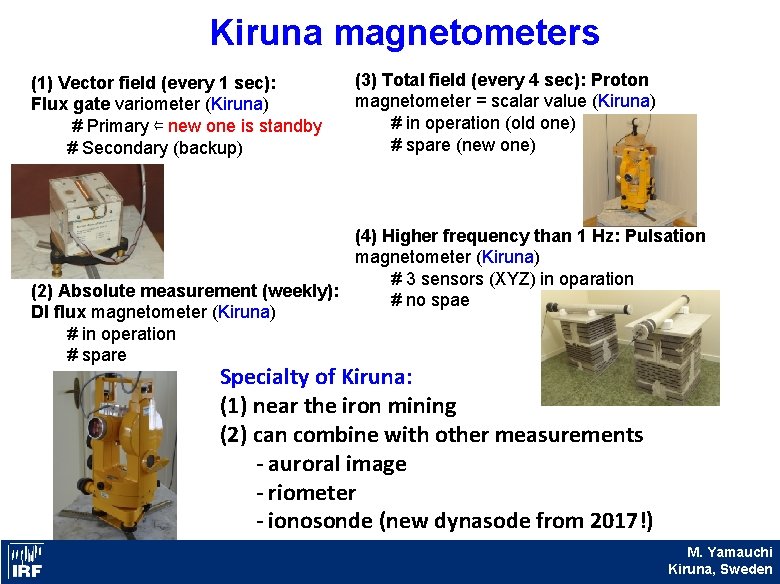
Kiruna magnetometers (1) Vector field (every 1 sec): Flux gate variometer (Kiruna) # Primary ⇐ new one is standby # Secondary (backup) (3) Total field (every 4 sec): Proton magnetometer = scalar value (Kiruna) # in operation (old one) # spare (new one) (4) Higher frequency than 1 Hz: Pulsation magnetometer (Kiruna) # 3 sensors (XYZ) in oparation (2) Absolute measurement (weekly): # no spae DI flux magnetometer (Kiruna) # in operation # spare Specialty of Kiruna: (1) near the iron mining (2) can combine with other measurements - auroral image - riometer - ionosonde (new dynasode from 2017!) Kiruna M. Yamauchi Sweden Kiruna, Sweden
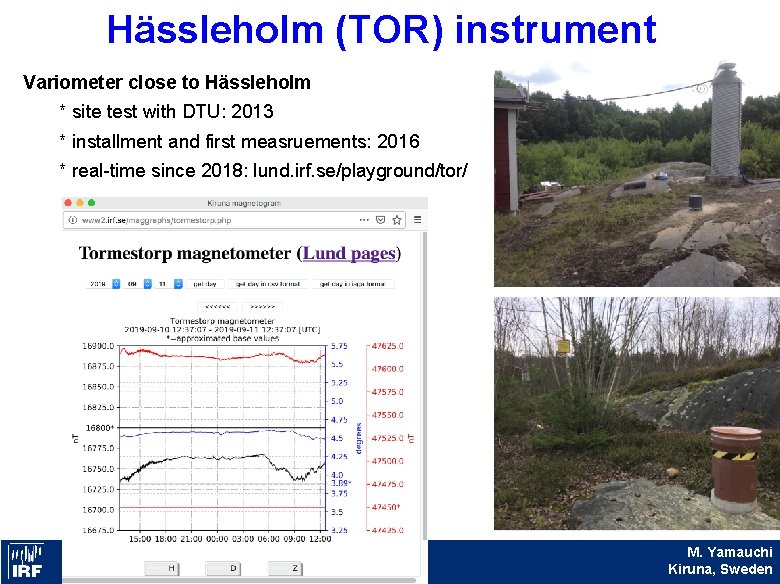
Hässleholm (TOR) instrument Variometer close to Hässleholm * site test with DTU: 2013 * installment and first measruements: 2016 * real-time since 2018: lund. irf. se/playground/tor/ 3 Kiruna M. Yamauchi Sweden Kiruna, Sweden
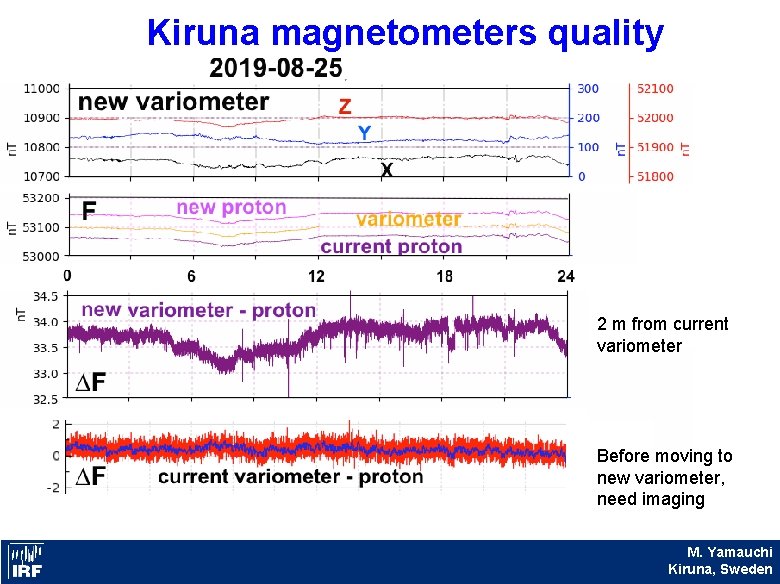
Kiruna magnetometers quality 2 m from current variometer Before moving to new variometer, need imaging Kiruna M. Yamauchi Sweden Kiruna, Sweden
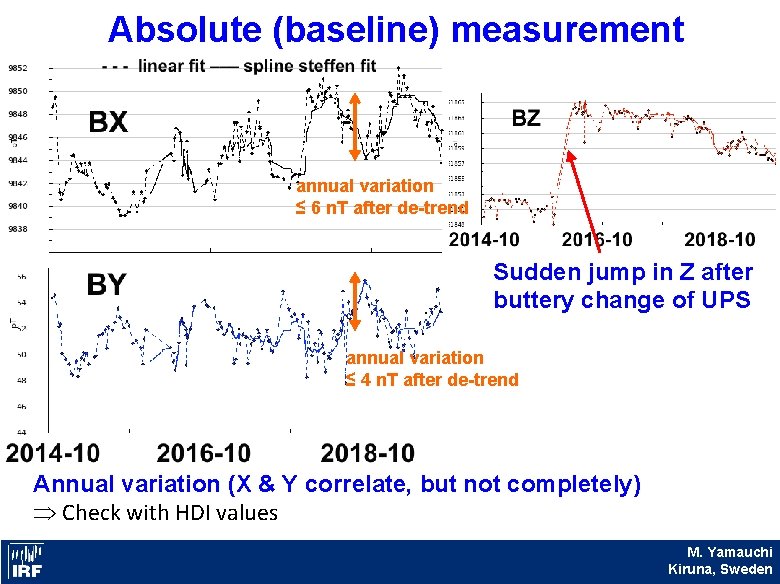
Absolute (baseline) measurement annual variation ≤ 6 n. T after de-trend Sudden jump in Z after buttery change of UPS annual variation ≤ 4 n. T after de-trend Annual variation (X & Y correlate, but not completely) Check with HDI values Kiruna M. Yamauchi Sweden Kiruna, Sweden
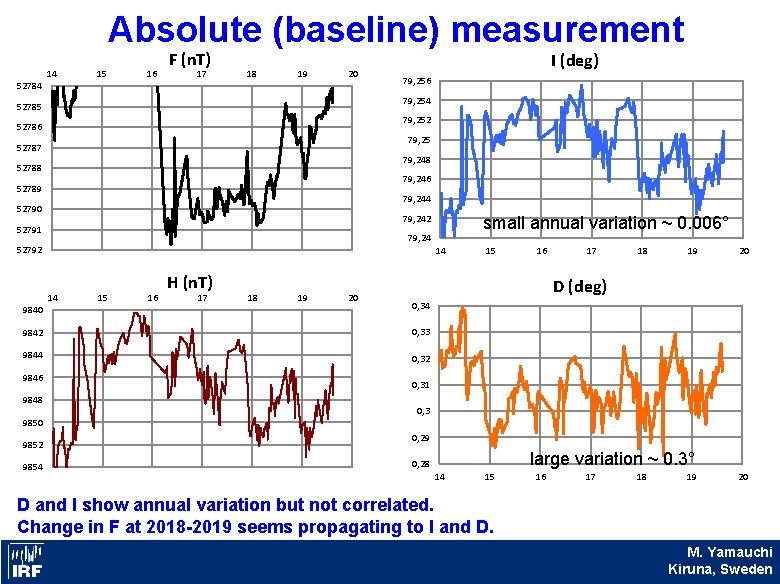
Absolute (baseline) measurement 14 15 16 F (n. T) 17 18 19 20 52784 I (deg) 79, 256 79, 254 52785 79, 252 52786 79, 25 52787 79, 248 52788 79, 246 52789 79, 244 52790 79, 242 52791 52792 14 14 15 16 H (n. T) 17 18 19 20 0, 34 9842 0, 33 9844 0, 32 9848 9850 9852 9854 15 16 17 18 19 20 D (deg) 9840 9846 small annual variation ~ 0. 006° 79, 24 0, 31 0, 3 0, 29 large variation ~ 0. 3° 0, 28 14 15 16 17 18 19 20 D and I show annual variation but not correlated. Change in F at 2018 -2019 seems propagating to I and D. Kiruna M. Yamauchi Sweden Kiruna, Sweden
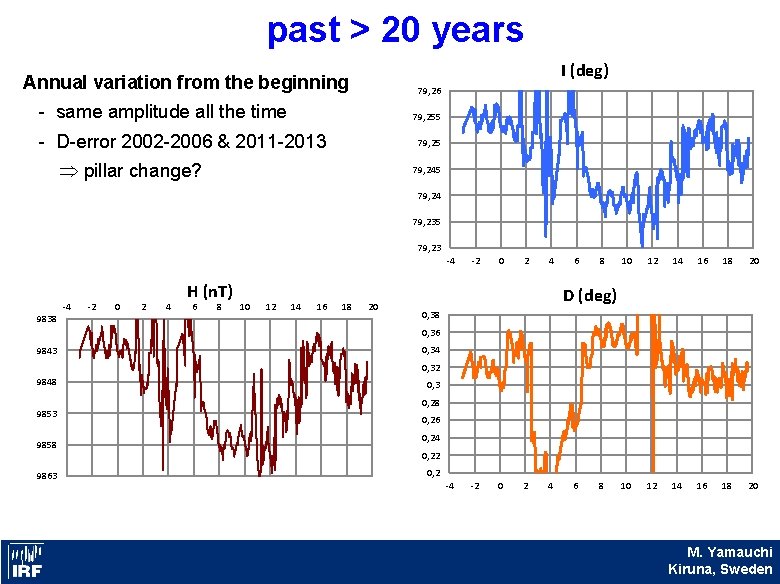
past > 20 years I (deg) Annual variation from the beginning 79, 26 - same amplitude all the time 79, 255 - D-error 2002 -2006 & 2011 -2013 79, 25 pillar change? 79, 245 79, 24 79, 235 79, 23 -4 -4 9838 -2 0 2 4 H (n. T) 6 8 10 12 14 16 18 20 -2 0 2 4 6 8 10 12 14 16 18 20 D (deg) 0, 38 0, 36 9843 0, 34 0, 32 9848 9853 9858 9863 0, 28 0, 26 0, 24 0, 22 0, 2 -4 -2 0 2 4 6 8 Kiruna M. Yamauchi Sweden Kiruna, Sweden
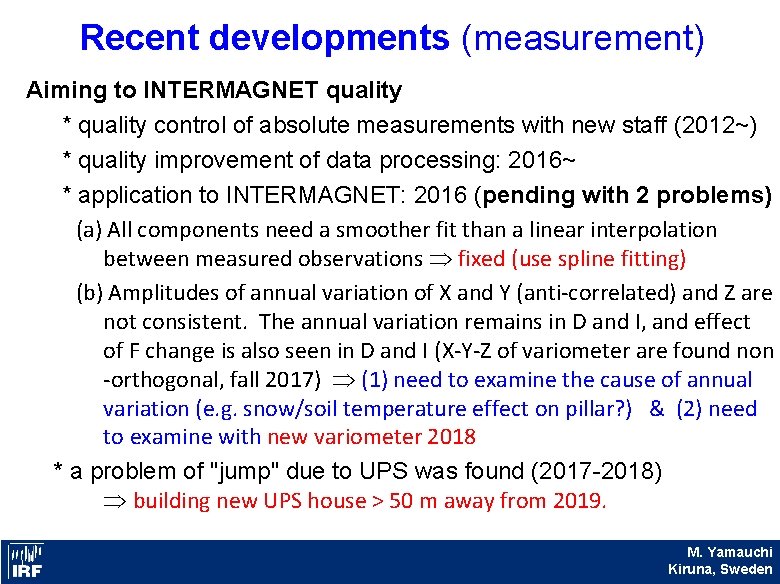
Recent developments (measurement) Aiming to INTERMAGNET quality * quality control of absolute measurements with new staff (2012~) * quality improvement of data processing: 2016~ * application to INTERMAGNET: 2016 (pending with 2 problems) (a) All components need a smoother fit than a linear interpolation between measured observations fixed (use spline fitting) (b) Amplitudes of annual variation of X and Y (anti-correlated) and Z are not consistent. The annual variation remains in D and I, and effect of F change is also seen in D and I (X-Y-Z of variometer are found non -orthogonal, fall 2017) (1) need to examine the cause of annual variation (e. g. snow/soil temperature effect on pillar? ) & (2) need to examine with new variometer 2018 * a problem of "jump" due to UPS was found (2017 -2018) building new UPS house > 50 m away from 2019. Kiruna M. Yamauchi Sweden Kiruna, Sweden
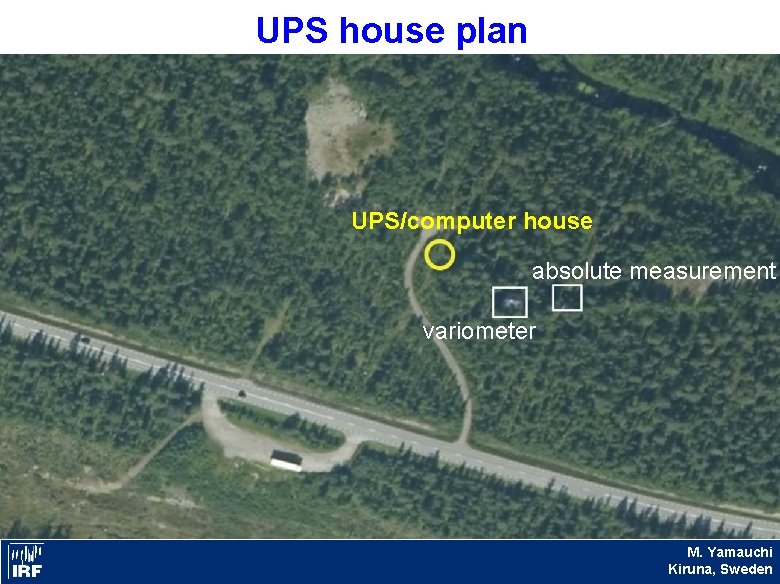
UPS house plan UPS/computer house absolute measurement variometer Kiruna M. Yamauchi Sweden Kiruna, Sweden
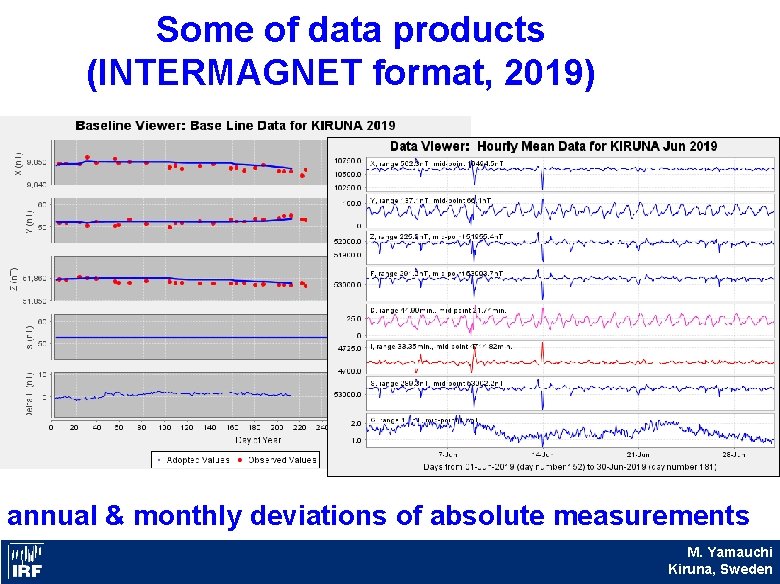
Some of data products (INTERMAGNET format, 2019) annual & monthly deviations of absolute measurements Kiruna M. Yamauchi Sweden Kiruna, Sweden
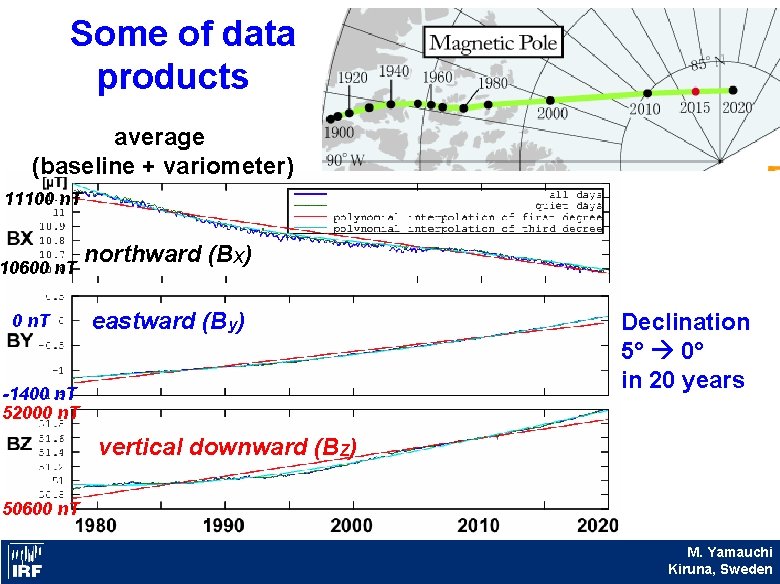
Some of data products average (baseline + variometer) 11100 n. T 10600 n. T northward (BX) eastward (By) -1400 n. T 52000 n. T Declination 5° 0° in 20 years vertical downward (BZ) 50600 n. T Kiruna M. Yamauchi Sweden Kiruna, Sweden
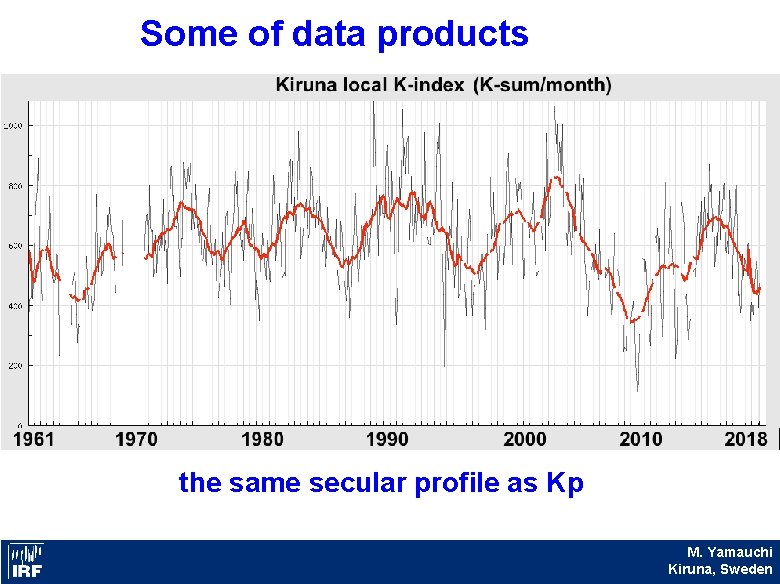
Some of data products the same secular profile as Kp Kiruna M. Yamauchi Sweden Kiruna, Sweden
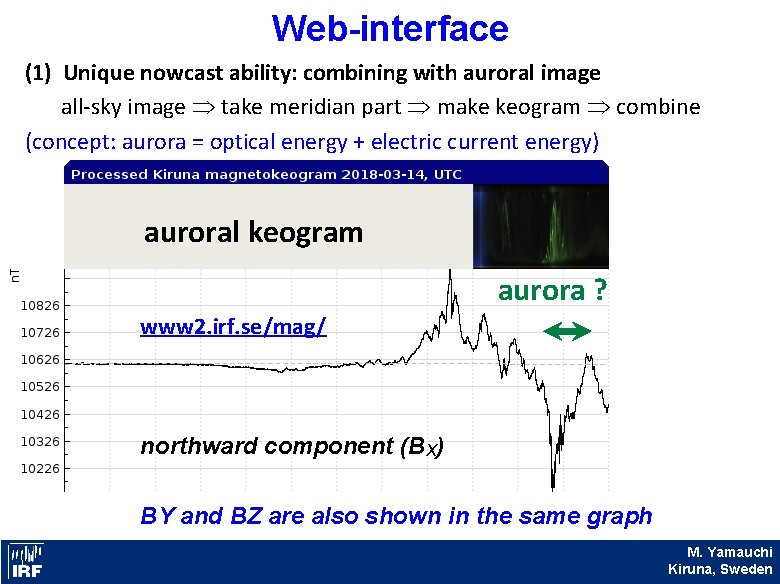
Web-interface (1) Unique nowcast ability: combining with auroral image all-sky image take meridian part make keogram combine (concept: aurora = optical energy + electric current energy) auroral keogram aurora ? www 2. irf. se/mag/ northward component (BX) BY and BZ are also shown in the same graph Kiruna M. Yamauchi Sweden Kiruna, Sweden
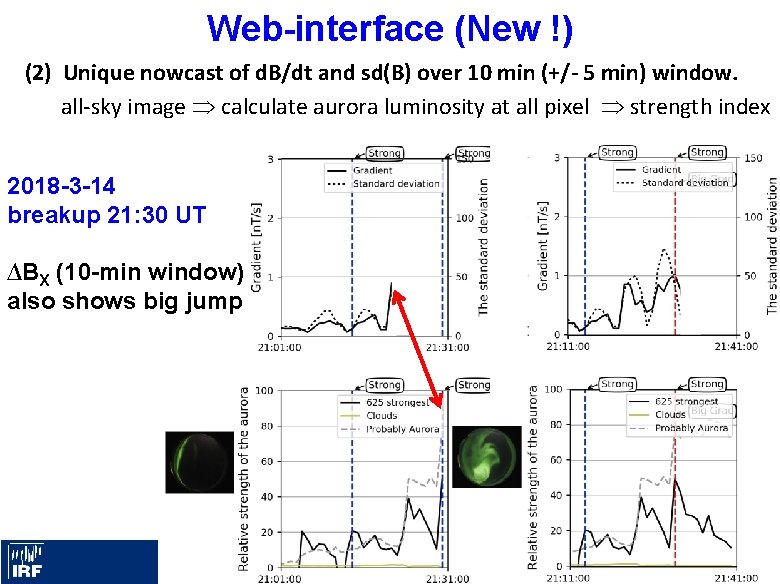
Web-interface (New !) (2) Unique nowcast of d. B/dt and sd(B) over 10 min (+/- 5 min) window. all-sky image calculate aurora luminosity at all pixel strength index 2018 -3 -14 breakup 21: 30 UT ∆BX (10 -min window) also shows big jump Kiruna M. Yamauchi Sweden Kiruna, Sweden
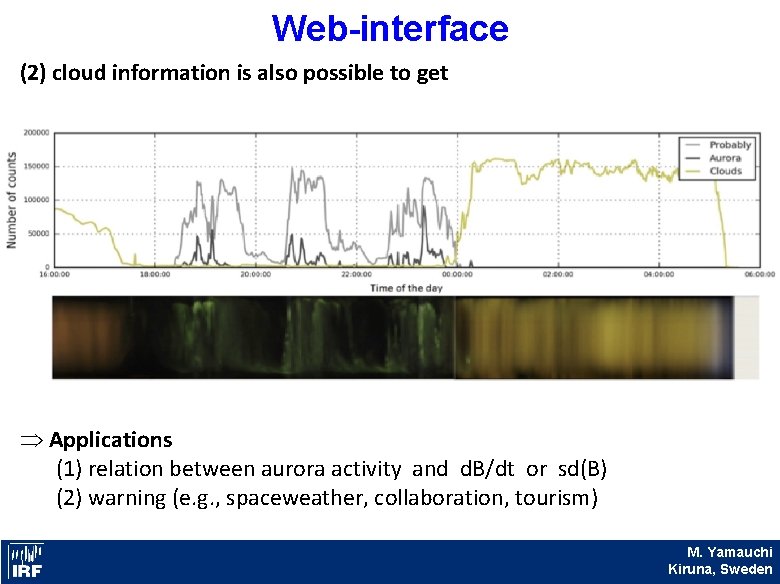
Web-interface (2) cloud information is also possible to get Applications (1) relation between aurora activity and d. B/dt or sd(B) (2) warning (e. g. , spaceweather, collaboration, tourism) Kiruna M. Yamauchi Sweden Kiruna, Sweden
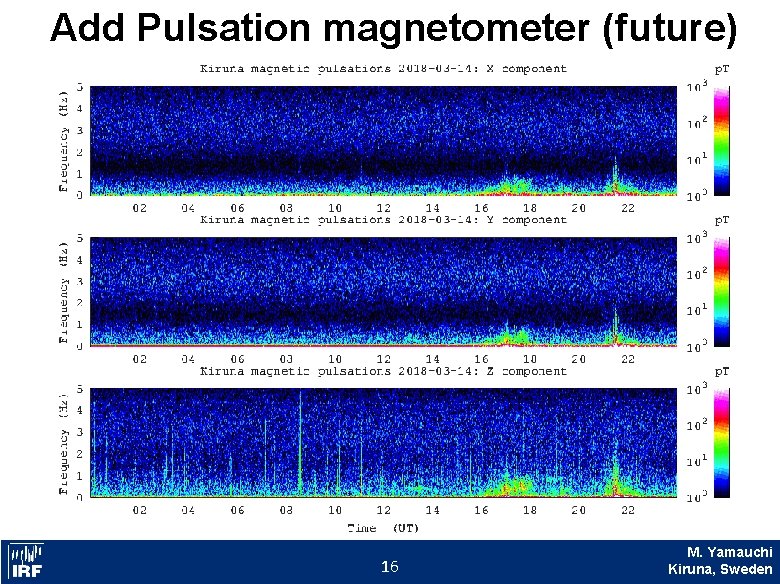
Add Pulsation magnetometer (future) 16 Kiruna M. Yamauchi Sweden Kiruna, Sweden
end 17 Kiruna M. Yamauchi 17 Sweden Kiruna, Sweden
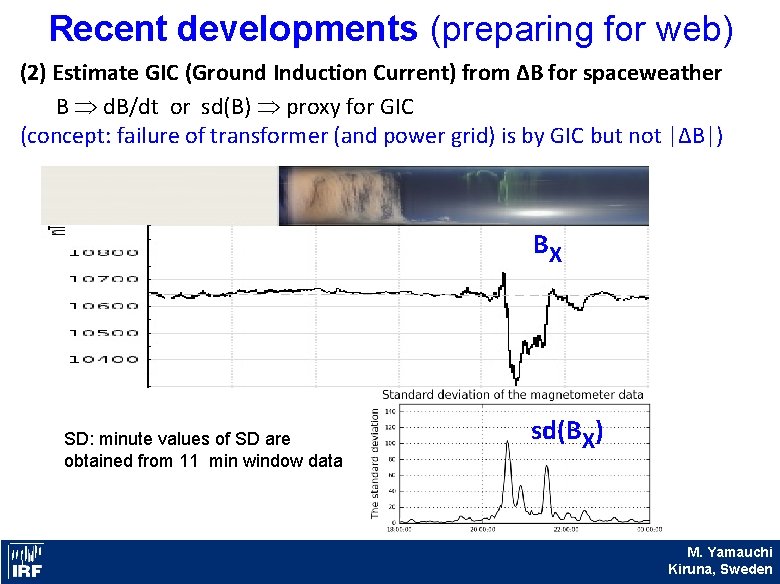
Recent developments (preparing for web) (2) Estimate GIC (Ground Induction Current) from ∆B for spaceweather B d. B/dt or sd(B) proxy for GIC (concept: failure of transformer (and power grid) is by GIC but not |∆B|) BX SD: minute values of SD are obtained from 11 min window data sd(BX) Kiruna M. Yamauchi Sweden Kiruna, Sweden
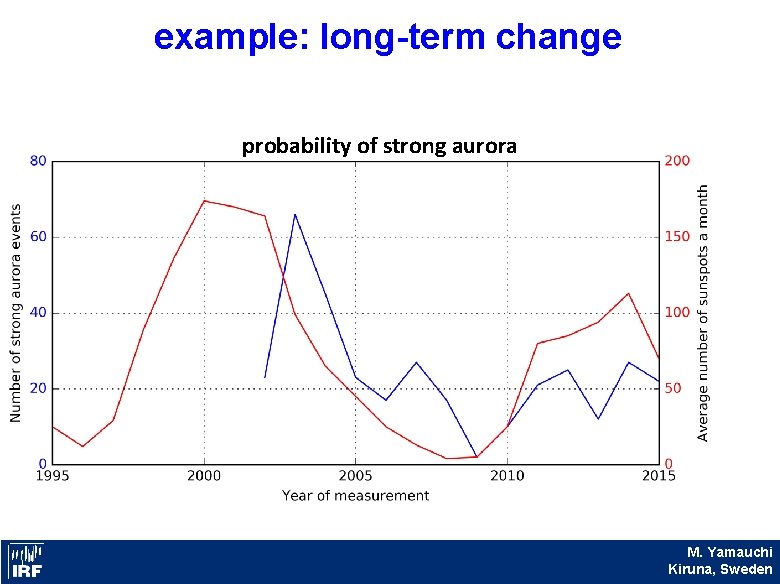
example: long-term change probability of strong aurora Kiruna M. Yamauchi Sweden Kiruna, Sweden
Future plan (for web-nowcast) (5) Combine pulsation data for calculation of GIC proxy pulsation data ? ? ? combine B-based proxy (concept: best use our unique capability) (6) dynamic link to all-sky data image of the timing of big activity clicking keogram all-sky image of that timing should pop-up (concept: non-specialist want to see image when prognosis is big aurora (7) Combine with Lund forecast page format TBD (concept: one can see the expected accuracy of "forecast") Kiruna M. Yamauchi Sweden Kiruna, Sweden
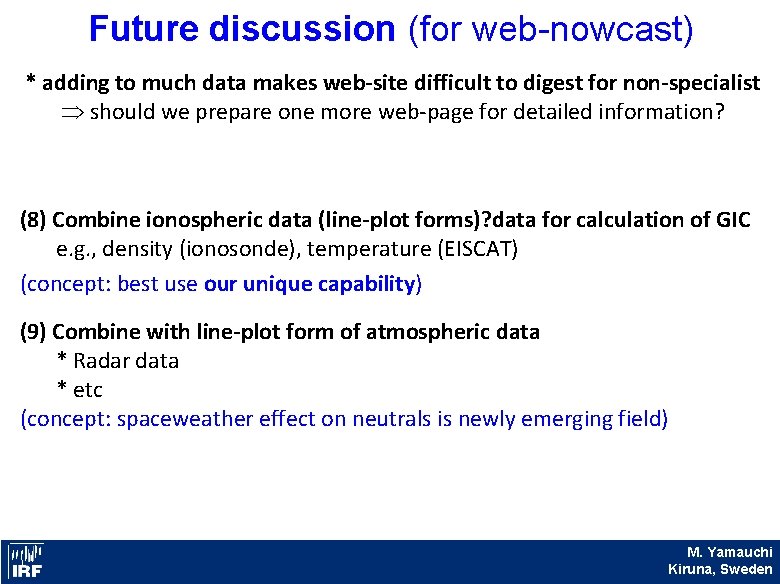
Future discussion (for web-nowcast) * adding to much data makes web-site difficult to digest for non-specialist should we prepare one more web-page for detailed information? (8) Combine ionospheric data (line-plot forms)? data for calculation of GIC e. g. , density (ionosonde), temperature (EISCAT) (concept: best use our unique capability) (9) Combine with line-plot form of atmospheric data * Radar data * etc (concept: spaceweather effect on neutrals is newly emerging field) Kiruna M. Yamauchi Sweden Kiruna, Sweden
- Slides: 21