
Magnetometer Booms Critical Design Review Dr Hari Dharan
Magnetometer Booms Critical Design Review Dr. Hari Dharan Berkeley Composites Laboratory Department of Mechanical Engineering University of California at Berkeley THEMIS Mission CDR 1 UCB, June 17, 2004
Overview Magnetometer Booms • • • • System Overview Technical Requirements System Mechanical Design Updates to Analyses Design Margins Mass and Power Test Plan Fabrication Plan Integration Plan Performance Assurance Schedule Parts and Materials Status Contamination Control Problem Areas THEMIS Mission CDR 2 UCB, June 17, 2004
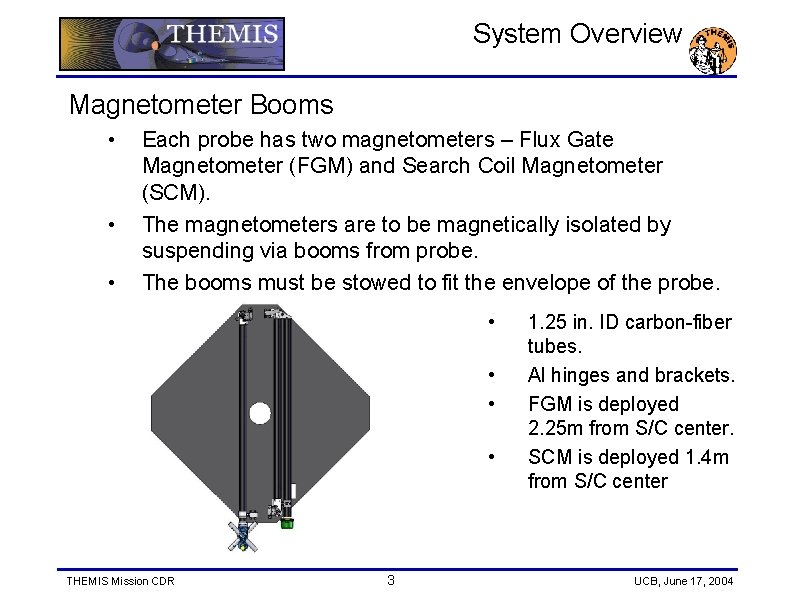
System Overview Magnetometer Booms • • • Each probe has two magnetometers – Flux Gate Magnetometer (FGM) and Search Coil Magnetometer (SCM). The magnetometers are to be magnetically isolated by suspending via booms from probe. The booms must be stowed to fit the envelope of the probe. • • THEMIS Mission CDR 3 1. 25 in. ID carbon-fiber tubes. Al hinges and brackets. FGM is deployed 2. 25 m from S/C center. SCM is deployed 1. 4 m from S/C center UCB, June 17, 2004
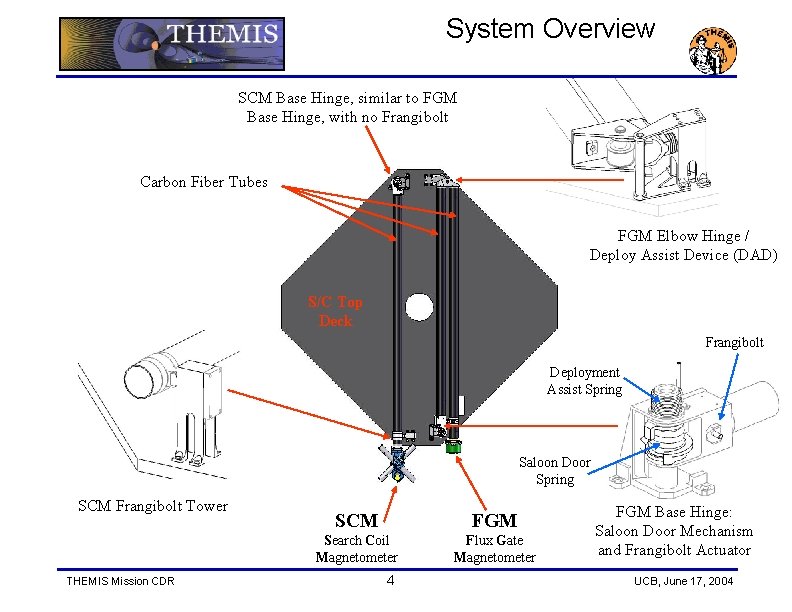
System Overview SCM Base Hinge, similar to FGM Base Hinge, with no Frangibolt Carbon Fiber Tubes FGM Elbow Hinge / Deploy Assist Device (DAD) S/C Top Deck Frangibolt Deployment Assist Spring Saloon Door Spring SCM Frangibolt Tower THEMIS Mission CDR SCM FGM Search Coil Magnetometer Flux Gate Magnetometer 4 FGM Base Hinge: Saloon Door Mechanism and Frangibolt Actuator UCB, June 17, 2004
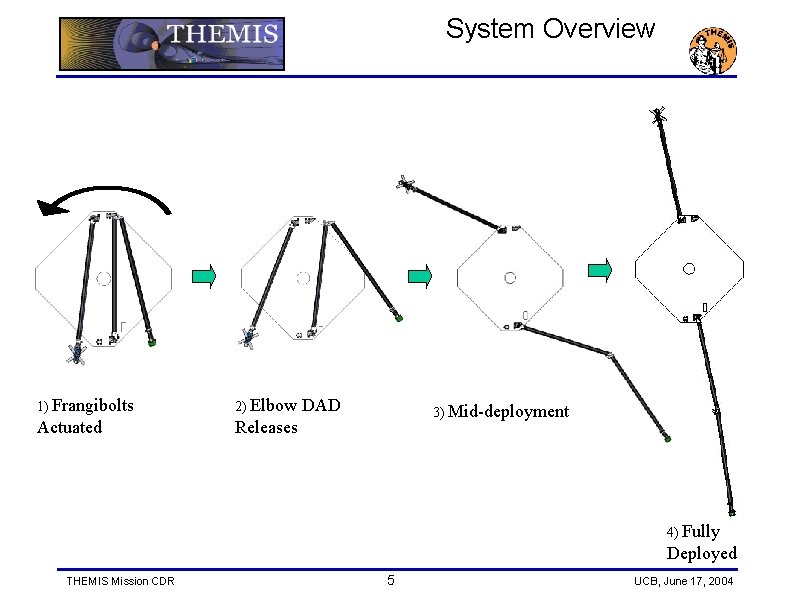
System Overview 1) Frangibolts 2) Elbow Actuated Releases DAD 3) Mid-deployment 4) Fully Deployed THEMIS Mission CDR 5 UCB, June 17, 2004
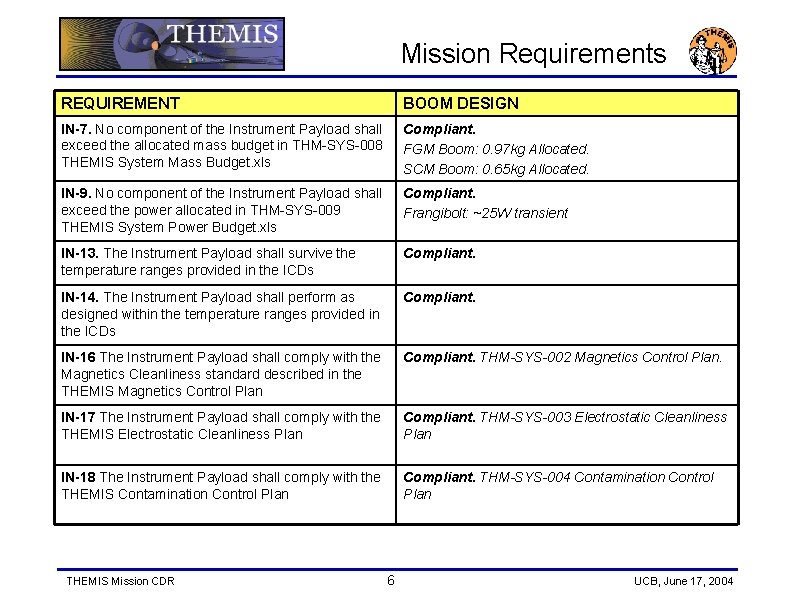
Mission Requirements REQUIREMENT BOOM DESIGN IN-7. No component of the Instrument Payload shall exceed the allocated mass budget in THM-SYS-008 THEMIS System Mass Budget. xls Compliant. FGM Boom: 0. 97 kg Allocated. SCM Boom: 0. 65 kg Allocated. IN-9. No component of the Instrument Payload shall exceed the power allocated in THM-SYS-009 THEMIS System Power Budget. xls Compliant. Frangibolt: ~25 W transient IN-13. The Instrument Payload shall survive the temperature ranges provided in the ICDs Compliant. IN-14. The Instrument Payload shall perform as designed within the temperature ranges provided in the ICDs Compliant. IN-16 The Instrument Payload shall comply with the Magnetics Cleanliness standard described in the THEMIS Magnetics Control Plan Compliant. THM-SYS-002 Magnetics Control Plan. IN-17 The Instrument Payload shall comply with the THEMIS Electrostatic Cleanliness Plan Compliant. THM-SYS-003 Electrostatic Cleanliness Plan IN-18 The Instrument Payload shall comply with the THEMIS Contamination Control Plan Compliant. THM-SYS-004 Contamination Control Plan THEMIS Mission CDR 6 UCB, June 17, 2004
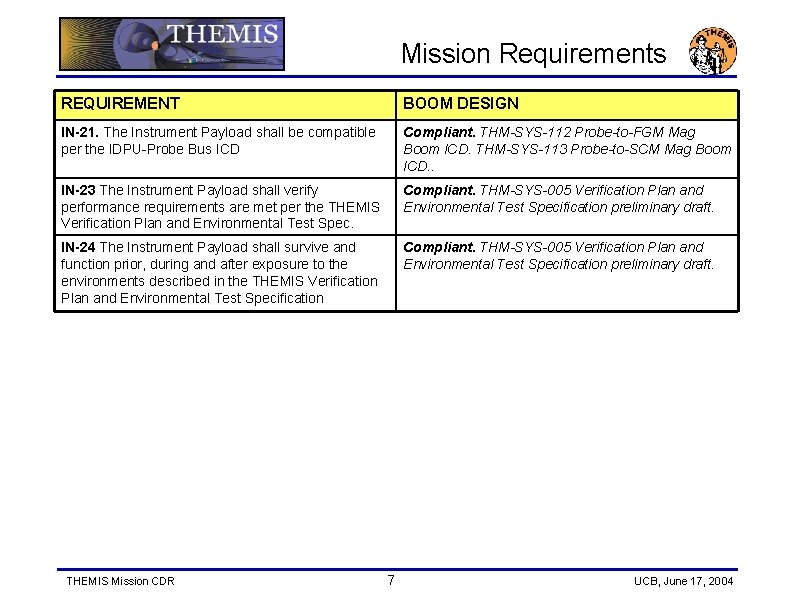
Mission Requirements REQUIREMENT BOOM DESIGN IN-21. The Instrument Payload shall be compatible per the IDPU-Probe Bus ICD Compliant. THM-SYS-112 Probe-to-FGM Mag Boom ICD. THM-SYS-113 Probe-to-SCM Mag Boom ICD. . IN-23 The Instrument Payload shall verify performance requirements are met per the THEMIS Verification Plan and Environmental Test Spec. Compliant. THM-SYS-005 Verification Plan and Environmental Test Specification preliminary draft. IN-24 The Instrument Payload shall survive and function prior, during and after exposure to the environments described in the THEMIS Verification Plan and Environmental Test Specification Compliant. THM-SYS-005 Verification Plan and Environmental Test Specification preliminary draft. THEMIS Mission CDR 7 UCB, June 17, 2004
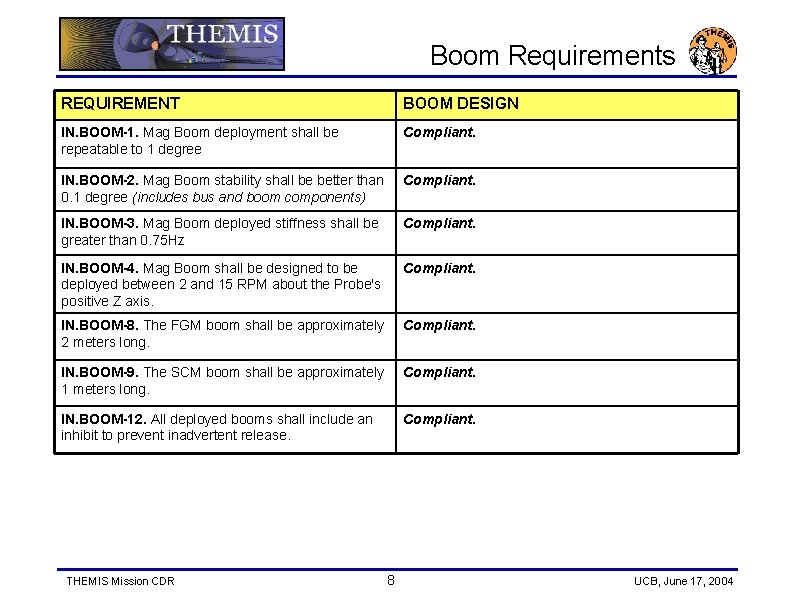
Boom Requirements REQUIREMENT BOOM DESIGN IN. BOOM-1. Mag Boom deployment shall be repeatable to 1 degree Compliant. IN. BOOM-2. Mag Boom stability shall be better than 0. 1 degree (includes bus and boom components) Compliant. IN. BOOM-3. Mag Boom deployed stiffness shall be greater than 0. 75 Hz Compliant. IN. BOOM-4. Mag Boom shall be designed to be deployed between 2 and 15 RPM about the Probe's positive Z axis. Compliant. IN. BOOM-8. The FGM boom shall be approximately 2 meters long. Compliant. IN. BOOM-9. The SCM boom shall be approximately 1 meters long. Compliant. IN. BOOM-12. All deployed booms shall include an inhibit to prevent inadvertent release. Compliant. THEMIS Mission CDR 8 UCB, June 17, 2004
Mechanical Design - Status Major design changes since PDR • • Harness routed within mag booms. (Nov 03) Addition of 2 degree cant angle to FGM and SCM booms. (Nov 03) Change of FGM boom cant angle to 5 degrees, and SCM boom cant angle to 10 degrees, while minimizing stowed profile. (Jan 04) Modification of base hinge with flexures to reduce thermal strains. (Feb 04) Status • Drawings completed and ETU sent out for bid for machining on 3/25/04. THEMIS Mission CDR 9 UCB, June 17, 2004
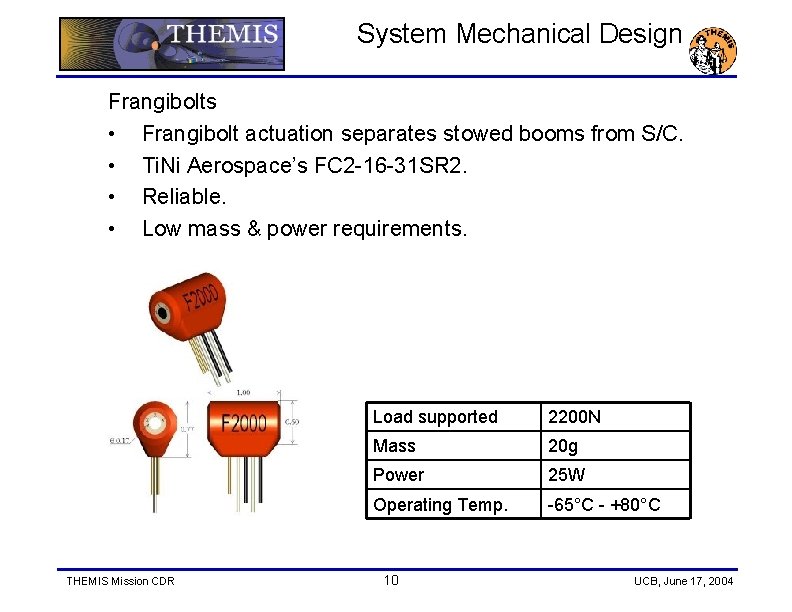
System Mechanical Design Frangibolts • Frangibolt actuation separates stowed booms from S/C. • Ti. Ni Aerospace’s FC 2 -16 -31 SR 2. • Reliable. • Low mass & power requirements. THEMIS Mission CDR Load supported 2200 N Mass 20 g Power 25 W Operating Temp. -65°C - +80°C 10 UCB, June 17, 2004
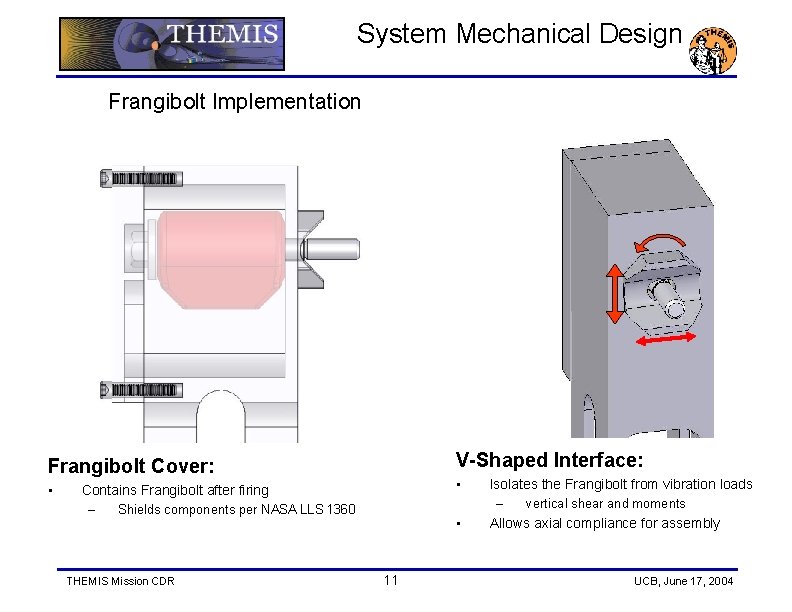
System Mechanical Design Frangibolt Implementation V-Shaped Interface: Frangibolt Cover: • • Contains Frangibolt after firing – Shields components per NASA LLS 1360 THEMIS Mission CDR • 11 Isolates the Frangibolt from vibration loads – vertical shear and moments Allows axial compliance for assembly UCB, June 17, 2004
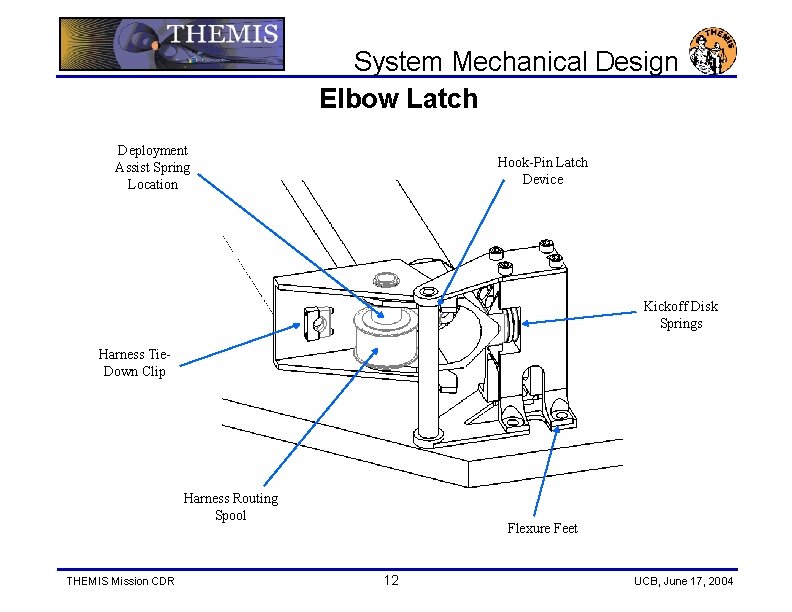
System Mechanical Design Elbow Latch Deployment Assist Spring Location Hook-Pin Latch Device Kickoff Disk Springs Harness Tie. Down Clip Harness Routing Spool THEMIS Mission CDR Flexure Feet 12 UCB, June 17, 2004
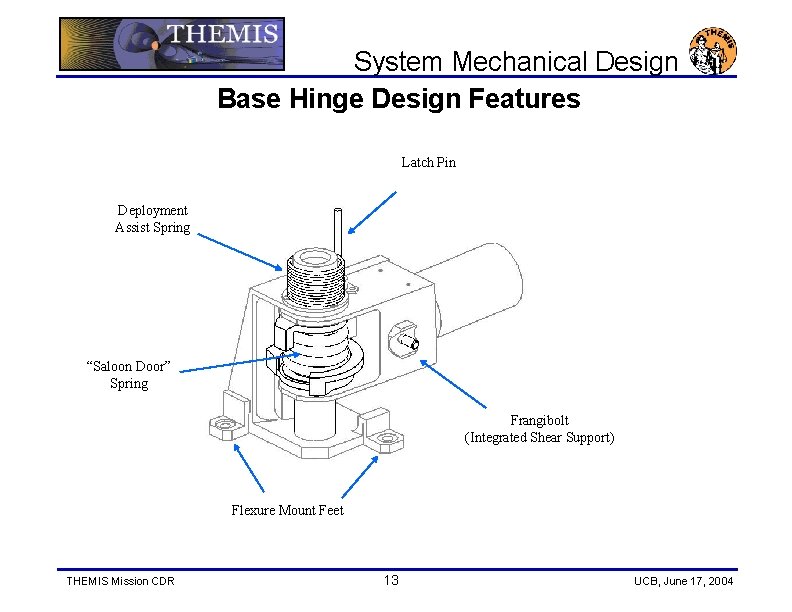
System Mechanical Design Base Hinge Design Features Latch Pin Deployment Assist Spring “Saloon Door” Spring Frangibolt (Integrated Shear Support) Flexure Mount Feet THEMIS Mission CDR 13 UCB, June 17, 2004
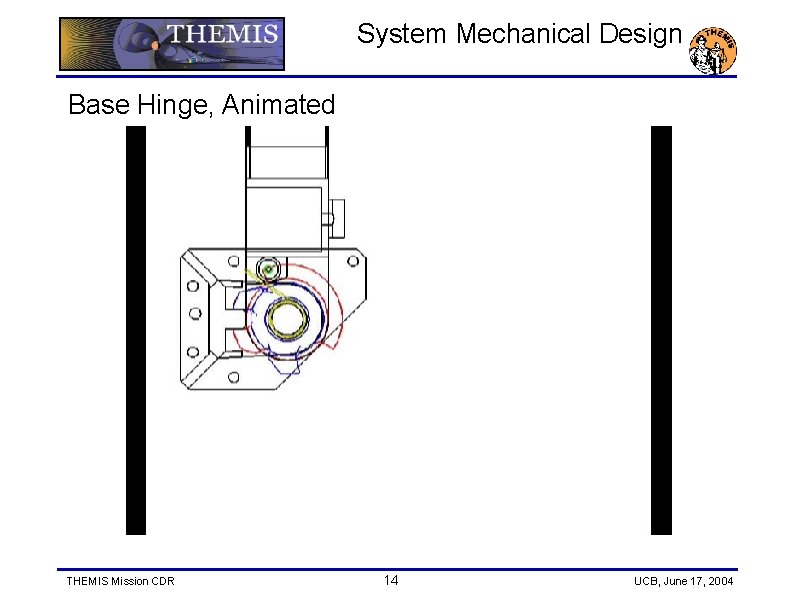
System Mechanical Design Base Hinge, Animated THEMIS Mission CDR 14 UCB, June 17, 2004
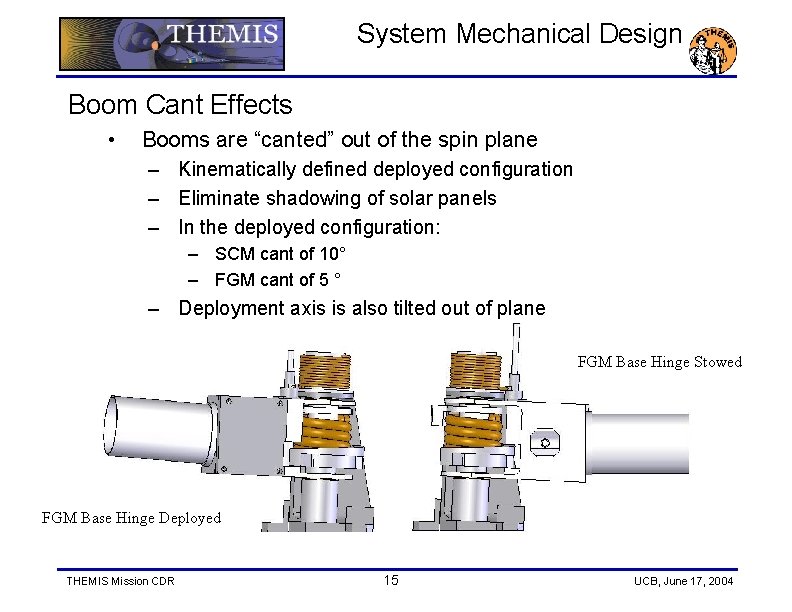
System Mechanical Design Boom Cant Effects • Booms are “canted” out of the spin plane – Kinematically defined deployed configuration – Eliminate shadowing of solar panels – In the deployed configuration: – SCM cant of 10° – FGM cant of 5 ° – Deployment axis is also tilted out of plane FGM Base Hinge Stowed FGM Base Hinge Deployed THEMIS Mission CDR 15 UCB, June 17, 2004
System Mechanical Design Tube Lay-up • [(± 45)T 300 / 0 M 55 J, 4 ]s – T 300 = high-strength carbon fiber woven composite (0. 005”/ply), M 55 J = high-modulus carbon fiber unidirectional composite tape (0. 0025”/ply) – Matrix = YLA RS 3 cyanate ester. • • Thickness = 0. 03 in. Inside diameter = 1. 25 in. Effective longitudinal modulus = 30. 9 x 10⁶ psi (213 GPa) Mass per unit length = 3. 2 g/in (1. 26 g/cm) THEMIS Mission CDR 16 UCB, June 17, 2004
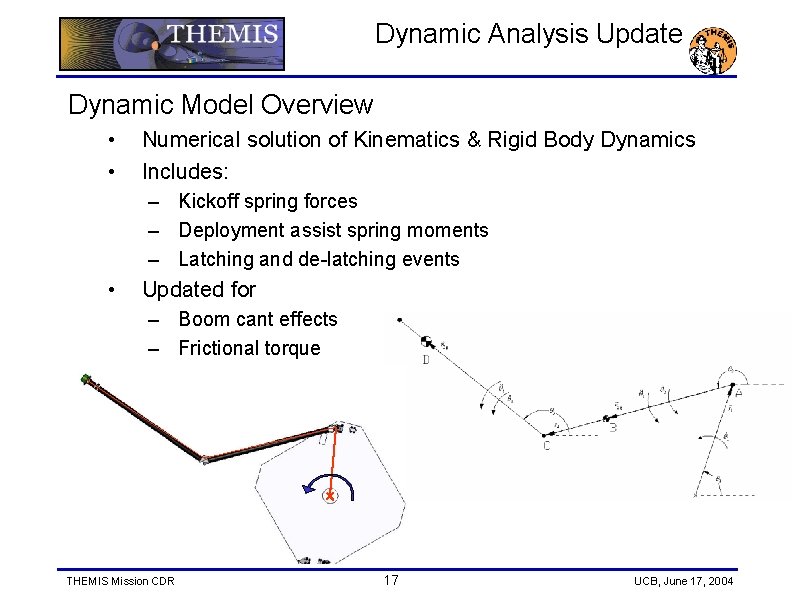
Dynamic Analysis Update Dynamic Model Overview • • Numerical solution of Kinematics & Rigid Body Dynamics Includes: – Kickoff spring forces – Deployment assist spring moments – Latching and de-latching events • Updated for – Boom cant effects – Frictional torque THEMIS Mission CDR 17 UCB, June 17, 2004
Dynamic Analysis Update Assumptions: • • • Increase in moment of inertia due to booms deploying will not slow the spacecraft enough to effect deployment use a constant spacecraft spin rate to simplify analysis Linear springs Elastic collisions (conservative assumption) Constant frictional torques Booms are rigid links Deployment is in-plane THEMIS Mission CDR 18 UCB, June 17, 2004
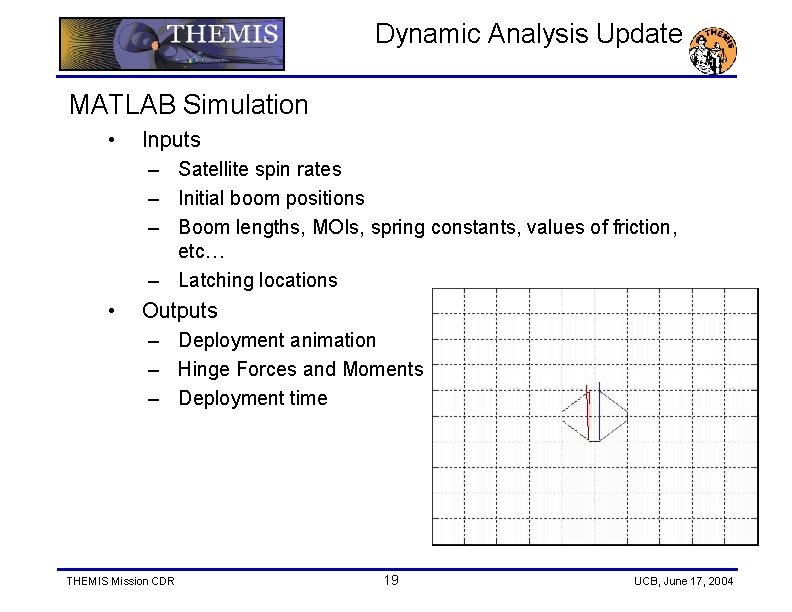
Dynamic Analysis Update MATLAB Simulation • Inputs – Satellite spin rates – Initial boom positions – Boom lengths, MOIs, spring constants, values of friction, etc… – Latching locations • Outputs – Deployment animation – Hinge Forces and Moments – Deployment time THEMIS Mission CDR 19 UCB, June 17, 2004
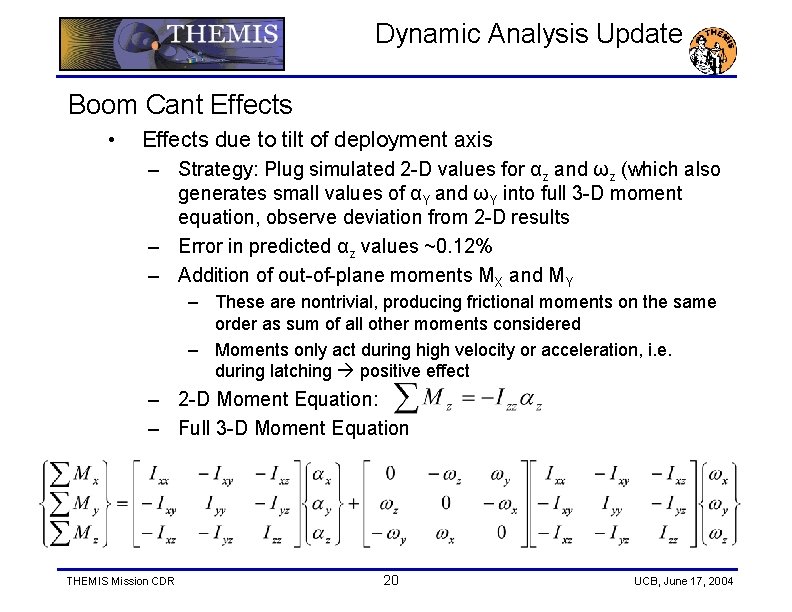
Dynamic Analysis Update Boom Cant Effects • Effects due to tilt of deployment axis – Strategy: Plug simulated 2 -D values for αz and ωz (which also generates small values of αY and ωY into full 3 -D moment equation, observe deviation from 2 -D results – Error in predicted αz values ~0. 12% – Addition of out-of-plane moments MX and MY – These are nontrivial, producing frictional moments on the same order as sum of all other moments considered – Moments only act during high velocity or acceleration, i. e. during latching positive effect – 2 -D Moment Equation: – Full 3 -D Moment Equation THEMIS Mission CDR 20 UCB, June 17, 2004
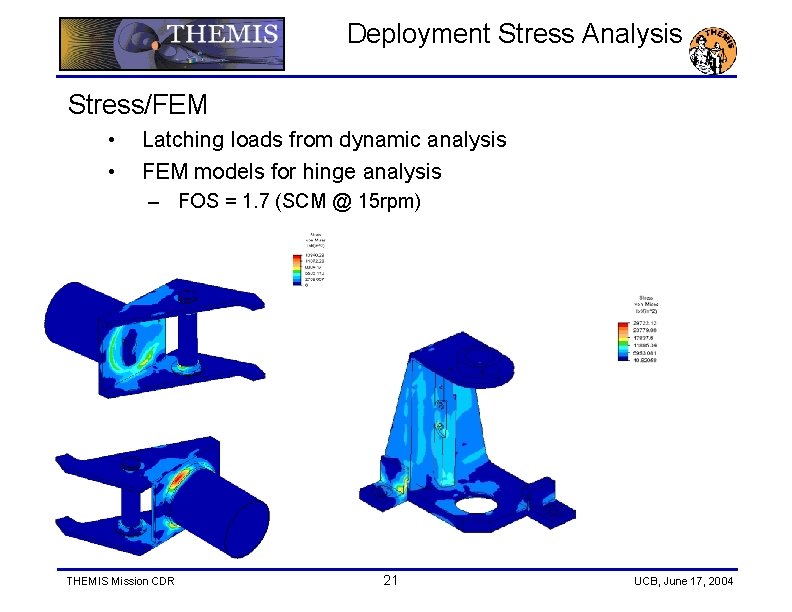
Deployment Stress Analysis Stress/FEM • • Latching loads from dynamic analysis FEM models for hinge analysis – FOS = 1. 7 (SCM @ 15 rpm) THEMIS Mission CDR 21 UCB, June 17, 2004
Torque Margin Analysis Sources of friction considered • • Latch pin sliding along ramp : Vespel-3 on aluminum Clevis on hinge pin: 544 bronze on 303 stainless – Applies for base hinge and elbow – Forces due to 1) deployment spring force reacting through hinge and 2) out-of-plane moment due to boom canting THEMIS Mission CDR 22 UCB, June 17, 2004
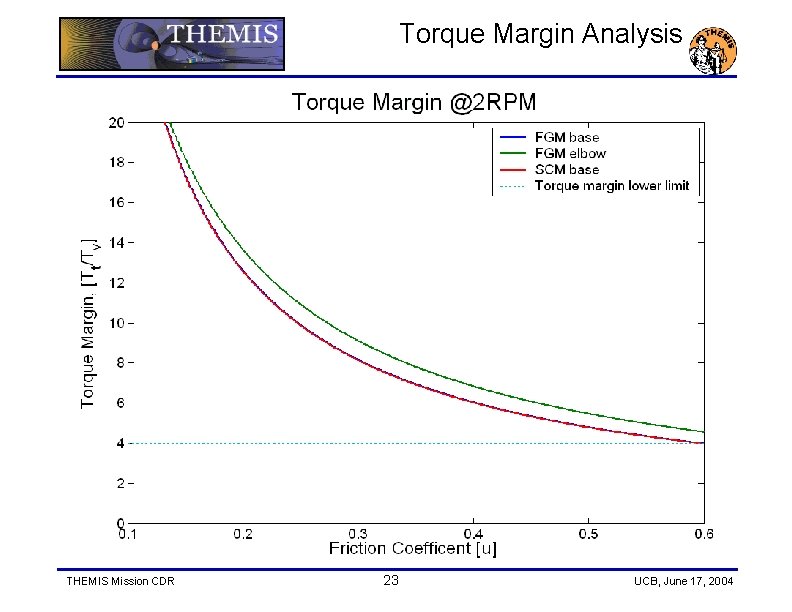
Torque Margin Analysis THEMIS Mission CDR 23 UCB, June 17, 2004
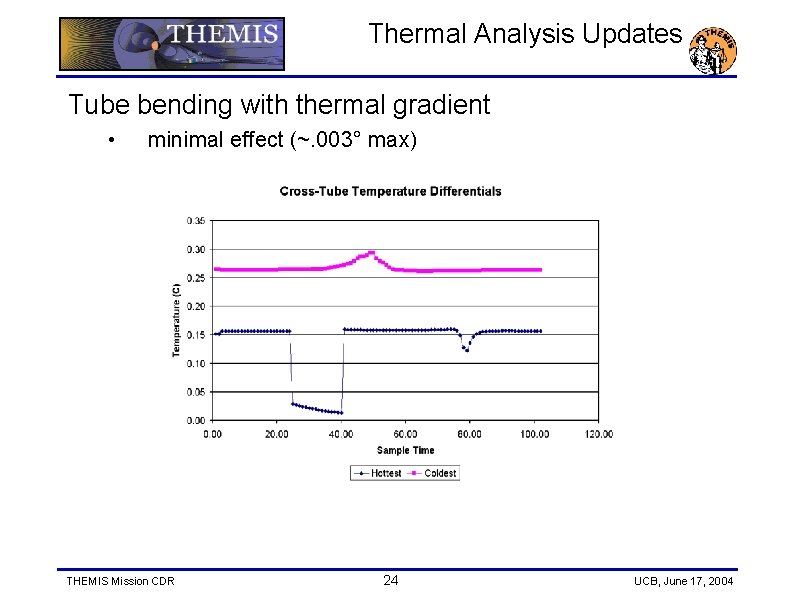
Thermal Analysis Updates Tube bending with thermal gradient • minimal effect (~. 003° max) THEMIS Mission CDR 24 UCB, June 17, 2004
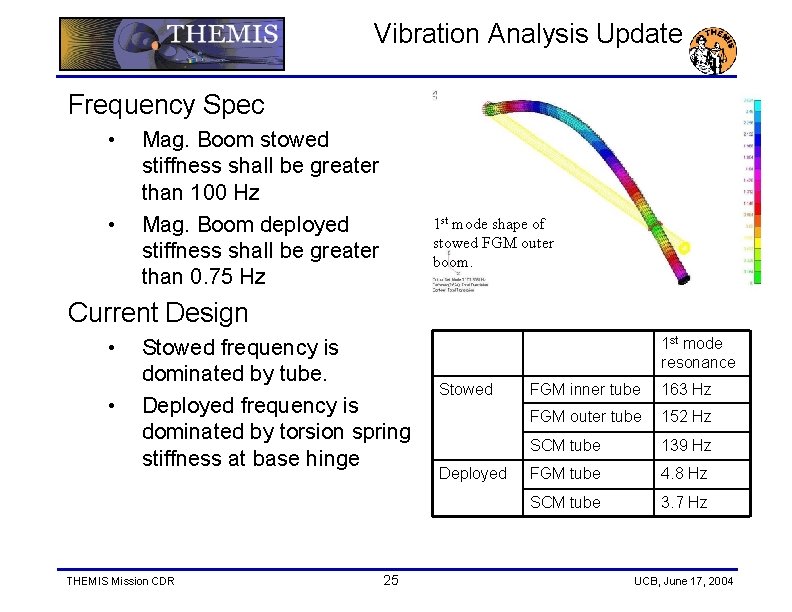
Vibration Analysis Update Frequency Spec • • Mag. Boom stowed stiffness shall be greater than 100 Hz Mag. Boom deployed stiffness shall be greater than 0. 75 Hz 1 st mode shape of stowed FGM outer boom. Current Design • • Stowed frequency is dominated by tube. Deployed frequency is dominated by torsion spring stiffness at base hinge THEMIS Mission CDR 25 1 st mode resonance Stowed Deployed FGM inner tube 163 Hz FGM outer tube 152 Hz SCM tube 139 Hz FGM tube 4. 8 Hz SCM tube 3. 7 Hz UCB, June 17, 2004
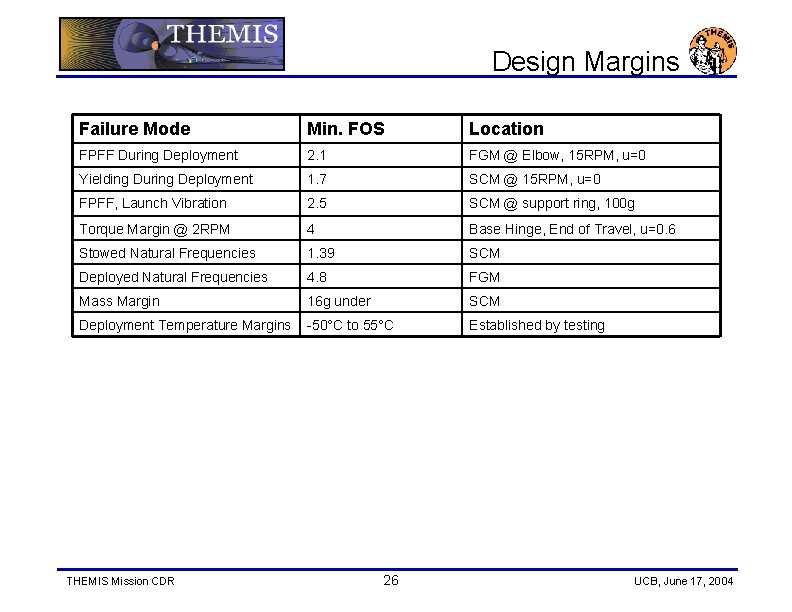
Design Margins Failure Mode Min. FOS Location FPFF During Deployment 2. 1 FGM @ Elbow, 15 RPM, u=0 Yielding During Deployment 1. 7 SCM @ 15 RPM, u=0 FPFF, Launch Vibration 2. 5 SCM @ support ring, 100 g Torque Margin @ 2 RPM 4 Base Hinge, End of Travel, u=0. 6 Stowed Natural Frequencies 1. 39 SCM Deployed Natural Frequencies 4. 8 FGM Mass Margin 16 g under SCM Deployment Temperature Margins -50°C to 55°C Established by testing THEMIS Mission CDR 26 UCB, June 17, 2004
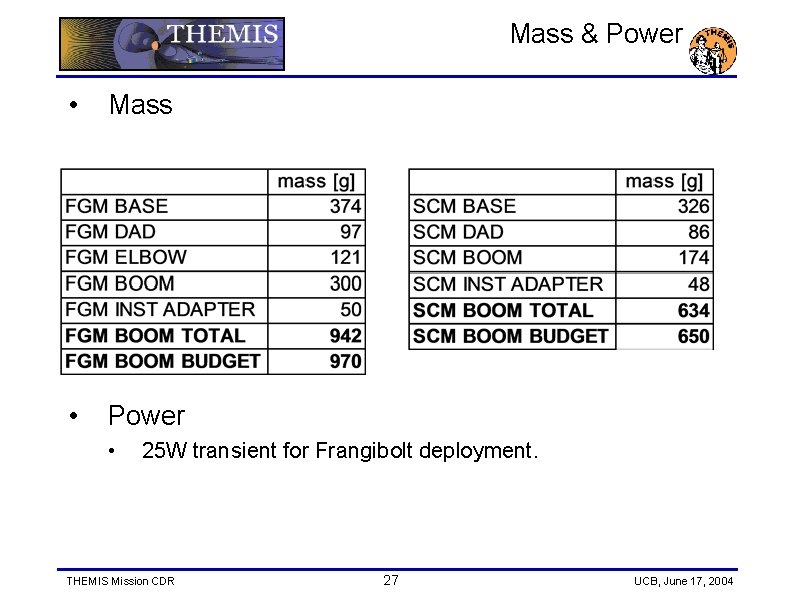
Mass & Power • Mass • Power • 25 W transient for Frangibolt deployment. THEMIS Mission CDR 27 UCB, June 17, 2004
Fabrication and Assembly Documentation • • All fabrication and assembly processes are developed and documented as Manufacturing Process Instructions. Any fabrication work and assembly will be logged. Fabrication • • Boom tubes – In-house Hinges – external machine shops. Assembly • • Bonding boom tubes and end fittings. Assembling hinges, harness and Frangibolt. THEMIS Mission CDR 28 UCB, June 17, 2004
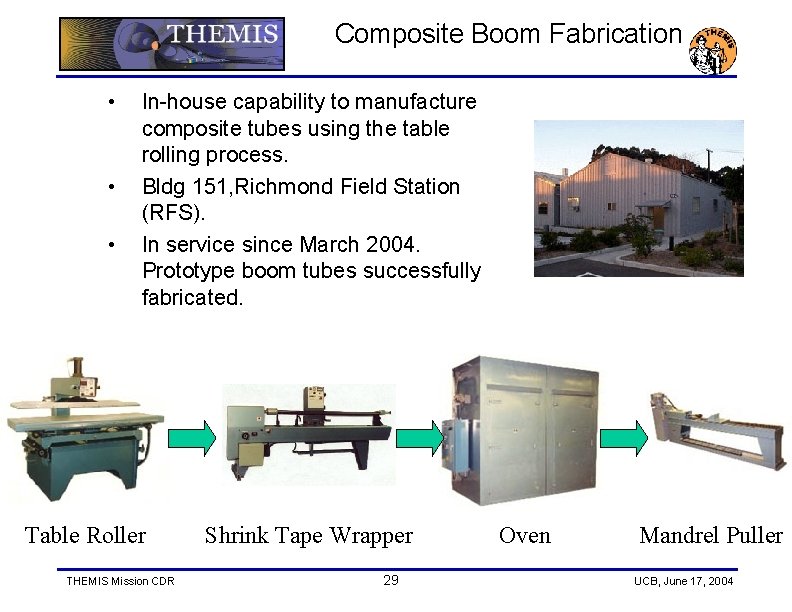
Composite Boom Fabrication • • • In-house capability to manufacture composite tubes using the table rolling process. Bldg 151, Richmond Field Station (RFS). In service since March 2004. Prototype boom tubes successfully fabricated. Table Roller THEMIS Mission CDR Shrink Tape Wrapper 29 Oven Mandrel Puller UCB, June 17, 2004
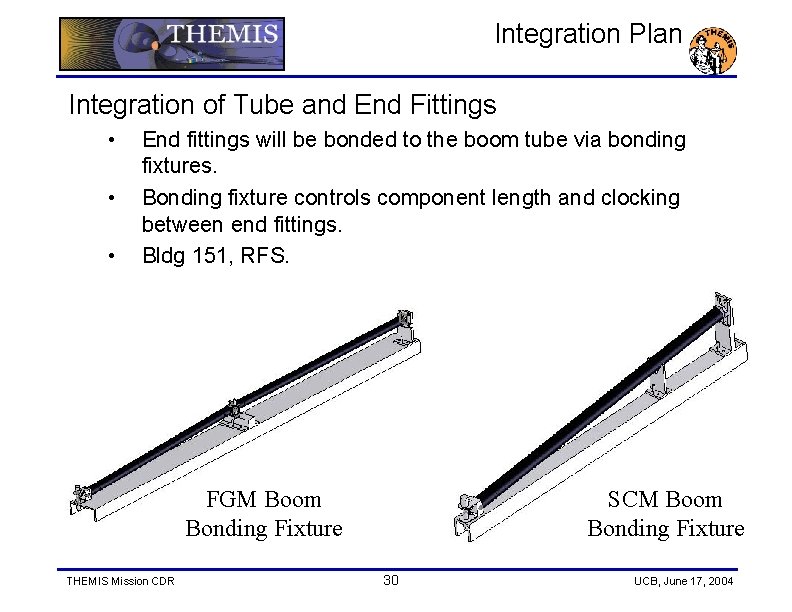
Integration Plan Integration of Tube and End Fittings • • • End fittings will be bonded to the boom tube via bonding fixtures. Bonding fixture controls component length and clocking between end fittings. Bldg 151, RFS. FGM Boom Bonding Fixture THEMIS Mission CDR SCM Boom Bonding Fixture 30 UCB, June 17, 2004
Assembly Plan Assembly of hinges • Assemble base hinge, and DAD boxes. Do not assemble elbow hinge can assembled. Integration of harness • Harness, without connectors, will be threaded through booms before assembling of boom. For the FGM, harness must also be threaded through the elbow before it is assembled. Assembly of mag boom • Assemble hinges and tubes with end fittings. Integration of Frangibolts • Frangibolts will be installed after boom is assembled. THEMIS Mission CDR 31 UCB, June 17, 2004
ETU Testing Plan • • • Vibration test for composite boom tubes. Mechanical characterization of composite materials. Proof testing of bonded joints subjected to survival temperature limits. Deployment testing at low and high deployment temperature extremes. Boom (tube and end-fittings) proof testing. Deployment testing at ambient conditions. THEMIS Mission CDR 32 UCB, June 17, 2004
Flight Unit Testing Plan • Flight Unit Testing Plan • • • Ambient deployment Vibration Ambient deployment Deployment test at deploy cold extreme minus 10 C Deployment test at deploy hot extreme plus 10 C THEMIS Mission CDR 33 UCB, June 17, 2004
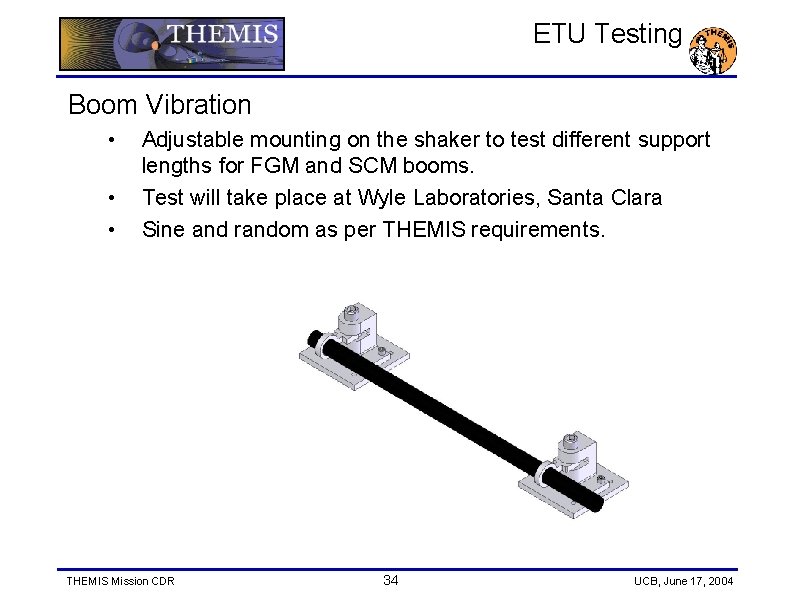
ETU Testing Boom Vibration • • • Adjustable mounting on the shaker to test different support lengths for FGM and SCM booms. Test will take place at Wyle Laboratories, Santa Clara Sine and random as per THEMIS requirements. THEMIS Mission CDR 34 UCB, June 17, 2004
ETU Testing Mechanical Characterization of laminate • • A laminate will be constructed and a coupon used for stiffness and strength. Four point bending test. Proof testing of bonded joints. • • An end fitting will be bonded to short lengths of the magboom and thermal cycled to THEMIS requirements. A tensile proof test of the bonded joint is carried out after thermal cycling. Composite boom with end fittings • Tensile proof test after thermal cycling. THEMIS Mission CDR 35 UCB, June 17, 2004
Deployment Test Plan Non-Ambient Testing • • Thermal vacuum test for hinge operation. Horizontal deployment at -50°C to 55°C. Ambient Testing • Spinless Horizontal Deployment – Gravity off-load fixture using air bearings. – Conservative test for torque margin due to lack of spin. • Vertical Gravity-Assisted Deployment – Gravity used to simulate centrifugal force at end of stroke. – Conservative test for latch up load due to large force at end of stroke. THEMIS Mission CDR 36 UCB, June 17, 2004
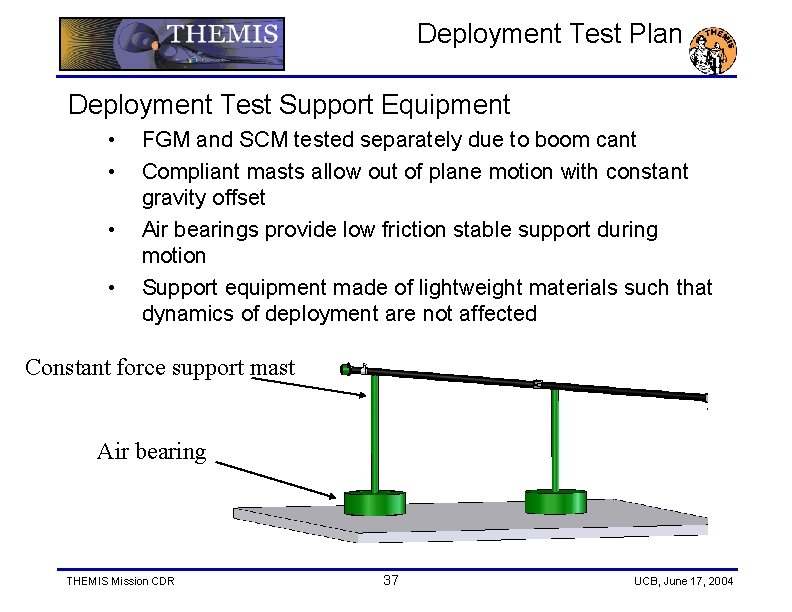
Deployment Test Plan Deployment Test Support Equipment • • FGM and SCM tested separately due to boom cant Compliant masts allow out of plane motion with constant gravity offset Air bearings provide low friction stable support during motion Support equipment made of lightweight materials such that dynamics of deployment are not affected Constant force support mast Air bearing THEMIS Mission CDR 37 UCB, June 17, 2004
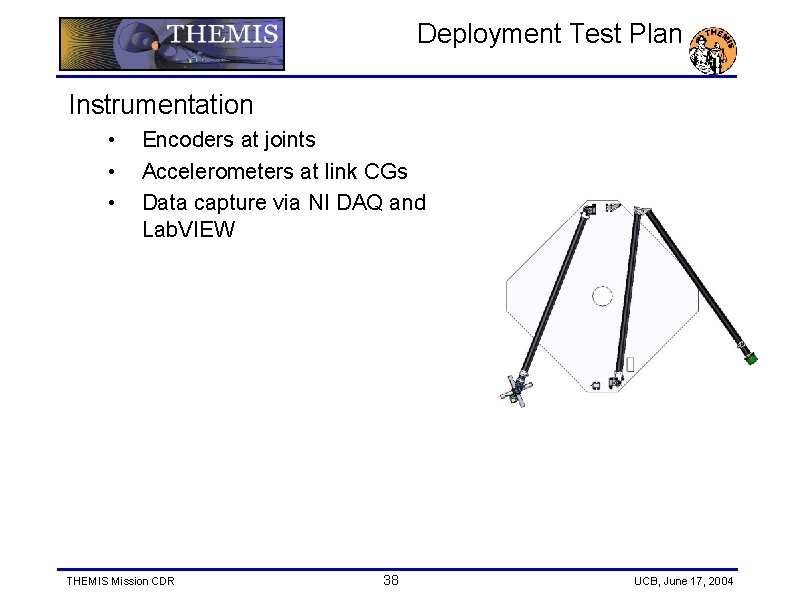
Deployment Test Plan Instrumentation • • • Encoders at joints Accelerometers at link CGs Data capture via NI DAQ and Lab. VIEW THEMIS Mission CDR 38 UCB, June 17, 2004
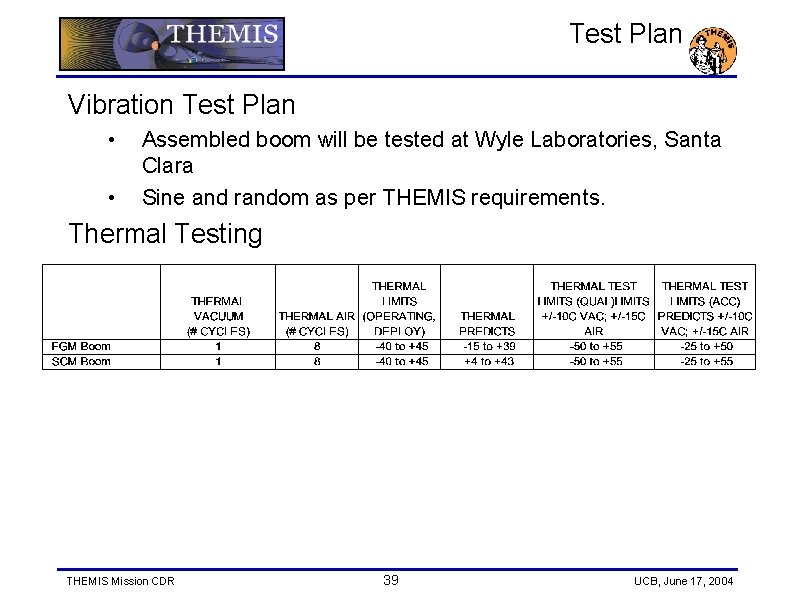
Test Plan Vibration Test Plan • • Assembled boom will be tested at Wyle Laboratories, Santa Clara Sine and random as per THEMIS requirements. Thermal Testing THEMIS Mission CDR 39 UCB, June 17, 2004
Performance Assurance Procedures • • During personnel, all assembly must follow established Manufacturing Process Instructions. Work performed on each assembly will be logged. Documentation • Manufacturing Process Instructions for – – THEMIS Mission CDR Tube fabrication Bonding of hinge and tubes Assembly of hinge, and harness Installation of frangibolts 40 UCB, June 17, 2004
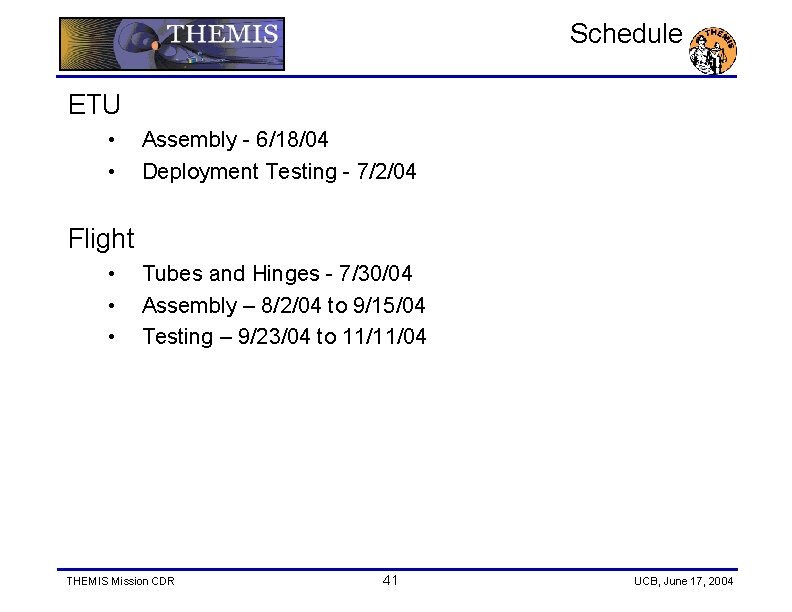
Schedule ETU • • Assembly - 6/18/04 Deployment Testing - 7/2/04 Flight • • • Tubes and Hinges - 7/30/04 Assembly – 8/2/04 to 9/15/04 Testing – 9/23/04 to 11/11/04 THEMIS Mission CDR 41 UCB, June 17, 2004
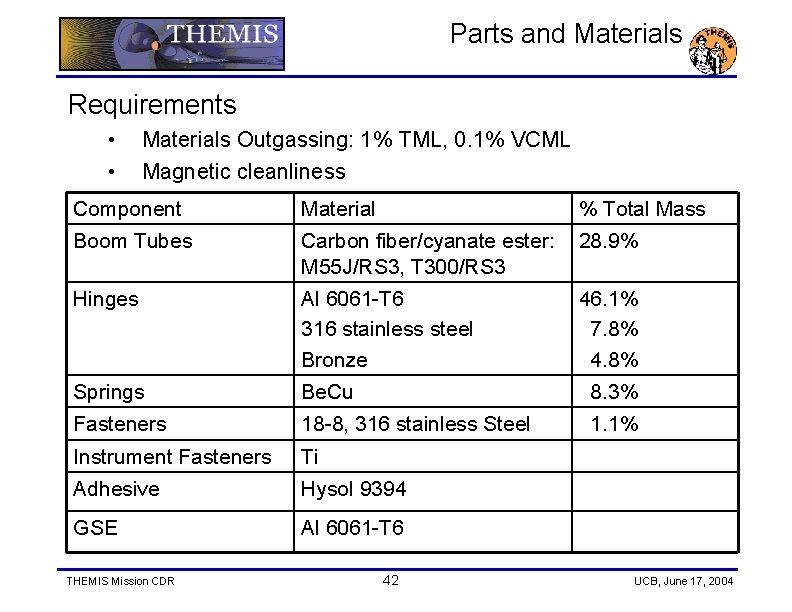
Parts and Materials Requirements • • Materials Outgassing: 1% TML, 0. 1% VCML Magnetic cleanliness Component Material % Total Mass Boom Tubes Carbon fiber/cyanate ester: M 55 J/RS 3, T 300/RS 3 28. 9% Hinges Al 6061 -T 6 316 stainless steel Bronze 46. 1% 7. 8% 4. 8% Springs Be. Cu 8. 3% Fasteners 18 -8, 316 stainless Steel 1. 1% Instrument Fasteners Ti Adhesive Hysol 9394 GSE Al 6061 -T 6 THEMIS Mission CDR 42 UCB, June 17, 2004
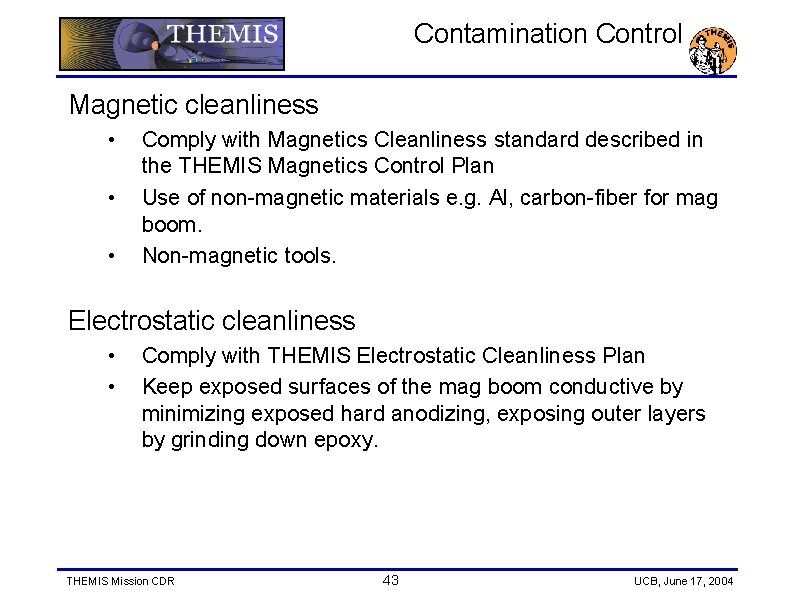
Contamination Control Magnetic cleanliness • • • Comply with Magnetics Cleanliness standard described in the THEMIS Magnetics Control Plan Use of non-magnetic materials e. g. Al, carbon-fiber for mag boom. Non-magnetic tools. Electrostatic cleanliness • • Comply with THEMIS Electrostatic Cleanliness Plan Keep exposed surfaces of the mag boom conductive by minimizing exposed hard anodizing, exposing outer layers by grinding down epoxy. THEMIS Mission CDR 43 UCB, June 17, 2004
- Slides: 43