
Magnetocentrifugal winds from accretion discs around black hole

Magneto-centrifugal winds from accretion discs around black hole binaries by Susmita Chakravorty from Indian Institute of Science with Pierre-Olivier Petrucci, Jonathan Ferreira, Gilles Henri as part of the ANR-CHAOS collaboration Institut de Planétologie et d'Astrophysique de Grenoble (IPAG) Wide Band Spectral and Timing Studies of Cosmic X-ray Sources 11 th January, 2017
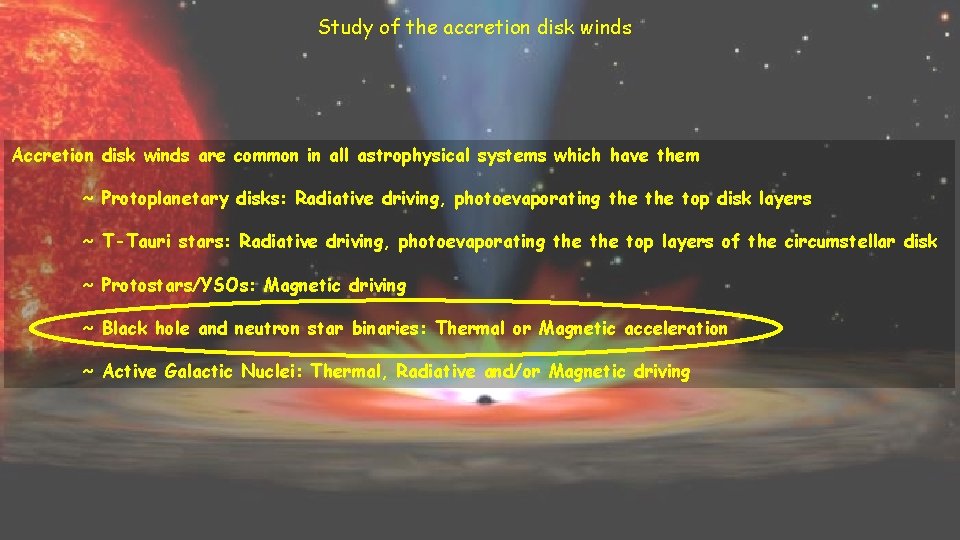
Study of the accretion disk winds Accretion disk winds are common in all astrophysical systems which have them ~ Protoplanetary disks: Radiative driving, photoevaporating the top disk layers ~ T-Tauri stars: Radiative driving, photoevaporating the top layers of the circumstellar disk ~ Protostars/YSOs: Magnetic driving ~ Black hole and neutron star binaries: Thermal or Magnetic acceleration ~ Active Galactic Nuclei: Thermal, Radiative and/or Magnetic driving
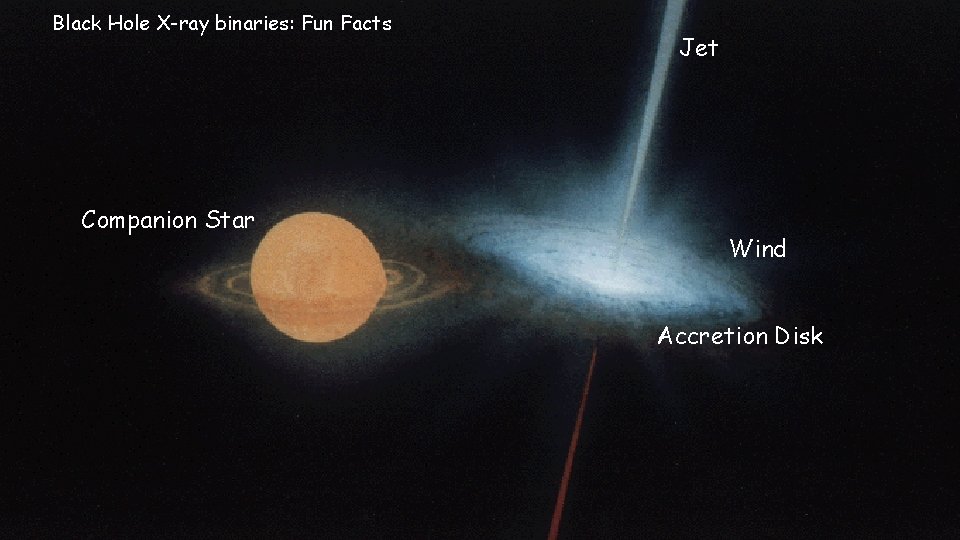
Black Hole X-ray binaries: Fun Facts Companion Star Jet Wind Accretion Disk
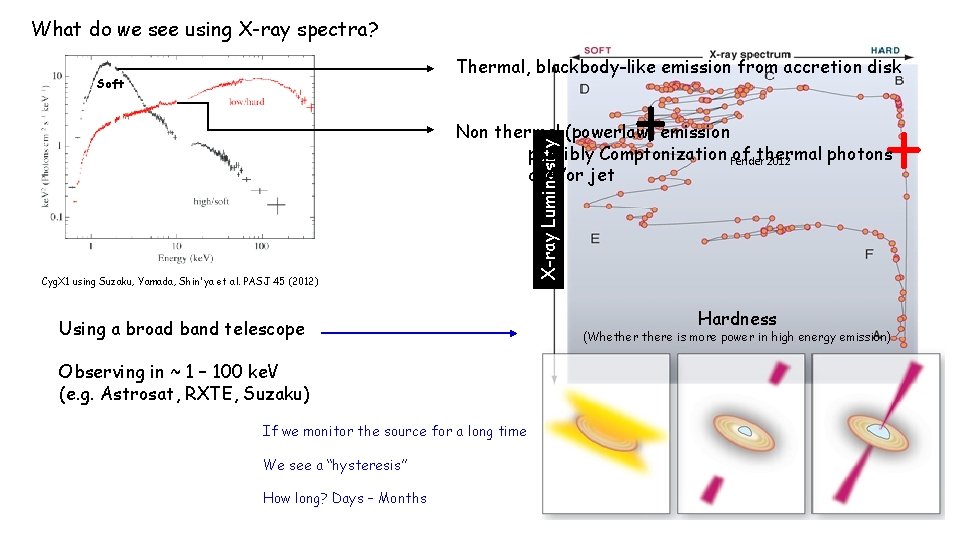
What do we see using X-ray spectra? Thermal, blackbody-like emission from accretion disk Soft Cyg. X 1 using Suzaku, Yamada, Shin'ya et al. PASJ 45 (2012) Using a broad band telescope Observing in ~ 1 – 100 ke. V (e. g. Astrosat, RXTE, Suzaku) If we monitor the source for a long time We see a “hysteresis” How long? Days – Months X-ray Luminosity Non thermal (powerlaw) emission possibly Comptonization Fender of thermal photons 2012 and/or jet Hardness (Whethere is more power in high energy emission)
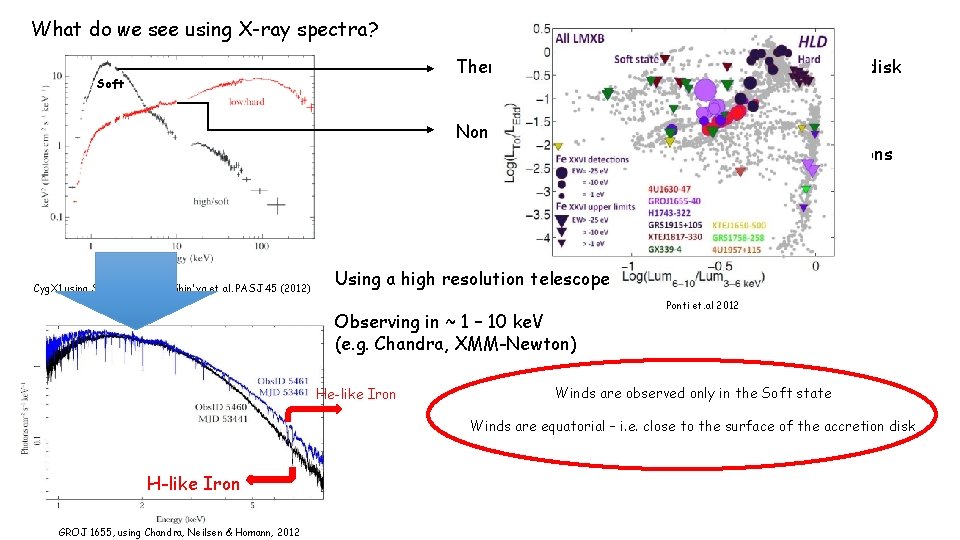
What do we see using X-ray spectra? Thermal, blackbody-like emission from accretion disk Soft Non thermal (powerlaw) emission possibly Comptonization of thermal photons and/or jet Cyg. X 1 using Suzaku, Yamada, Shin'ya et al. PASJ 45 (2012) Using a broad band telescope Observing in ~ 1 – 100 ke. V (e. g. Astrosat, RXTE, Suzaku) Using a high resolution telescope Observing in ~ 1 – 10 ke. V (e. g. Chandra, XMM-Newton) He-like Iron Ponti et. al 2012 Winds are observed only in the Soft state Winds are equatorial – i. e. close to the surface of the accretion disk H-like Iron GROJ 1655, using Chandra, Neilsen & Homann, 2012
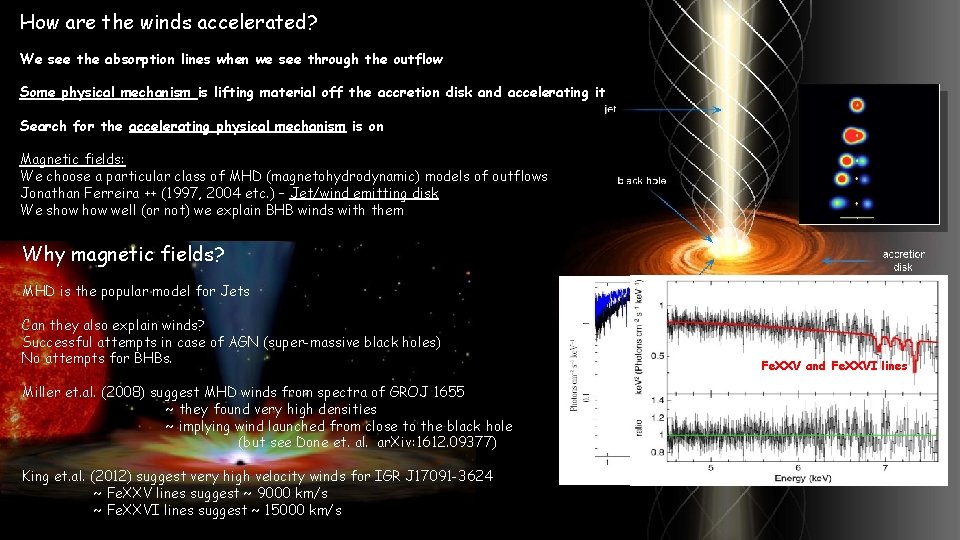
How are the winds accelerated? We see the absorption lines when we see through the outflow Some physical mechanism is lifting material off the accretion disk and accelerating it Search for the accelerating physical mechanism is on Magnetic fields: We choose a particular class of MHD (magnetohydrodynamic) models of outflows Jonathan Ferreira ++ (1997, 2004 etc. ) – Jet/wind emitting disk We show well (or not) we explain BHB winds with them Why magnetic fields? MHD is the popular model for Jets Can they also explain winds? Successful attempts in case of AGN (super-massive black holes) No attempts for BHBs. Miller et. al. (2008) suggest MHD winds from spectra of GROJ 1655 ~ they found very high densities ~ implying wind launched from close to the black hole (but see Done et. al. ar. Xiv: 1612. 09377) King et. al. (2012) suggest very high velocity winds for IGR J 17091 -3624 ~ Fe. XXV lines suggest ~ 9000 km/s ~ Fe. XXVI lines suggest ~ 15000 km/s He-like Iron Fe. XXV and Fe. XXVI lines H-like Iron
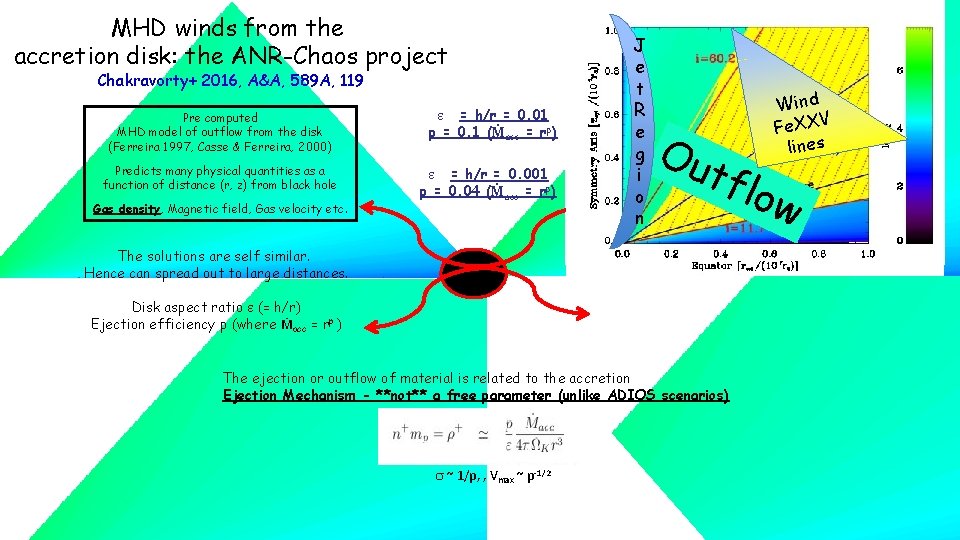
MHD winds from the accretion disk: the ANR-Chaos project Chakravorty+ 2016, A&A, 589 A, 119 Pre computed MHD model of outflow from the disk (Ferreira 1997, Casse & Ferreira, 2000) Predicts many physical quantities as a function of distance (r, z) from black hole Gas density, Magnetic field, Gas velocity etc. = h/r = 0. 01 p = 0. 1 (Ṁacc = rp) = h/r = 0. 001 p = 0. 04 (Ṁacc = rp) J e t R e g i o n Ou tfl The solutions are self similar. Hence can spread out to large distances. Disk aspect ratio (= h/r) Ejection efficiency p (where Ṁacc = rp ) The ejection or outflow of material is related to the accretion Ejection Mechanism - **not** a free parameter (unlike ADIOS scenarios) ~ 1/p, , Vmax ~ p-1/2 Wind Fe. XXV lines ow
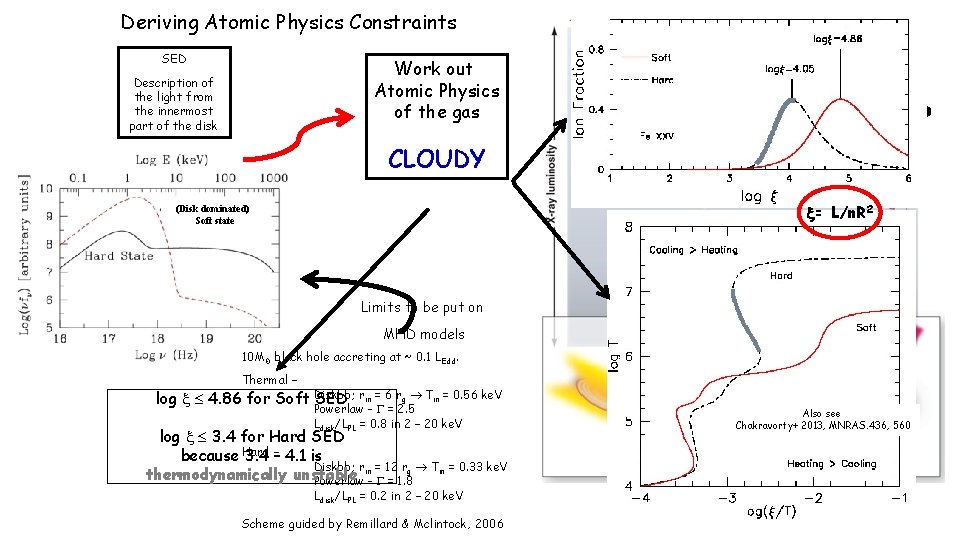
Deriving Atomic Physics Constraints SED Work out Atomic Physics of the gas Description of the light from the innermost part of the disk CLOUDY = L/n. R 2 (Disk dominated) Soft state Limits to be put on MHD models 10 Mʘ black hole accreting at ~ 0. 1 LEdd. Thermal – log 4. 86 for Soft Diskbb; SED rin = 6 rg Tin = 0. 56 ke. V Powerlaw - = 2. 5 Ldisk/LPL = 0. 8 in 2 – 20 ke. V log 3. 4 for Hard SED because Hard 3. 4 –– 4. 1 is Diskbb; rin = 12 rg Tin = 0. 33 ke. V thermodynamically unstable Powerlaw - = 1. 8 Ldisk/LPL = 0. 2 in 2 – 20 ke. V Scheme guided by Remillard & Mclintock, 2006 Also see Chakravorty+ 2013, MNRAS. 436, 560
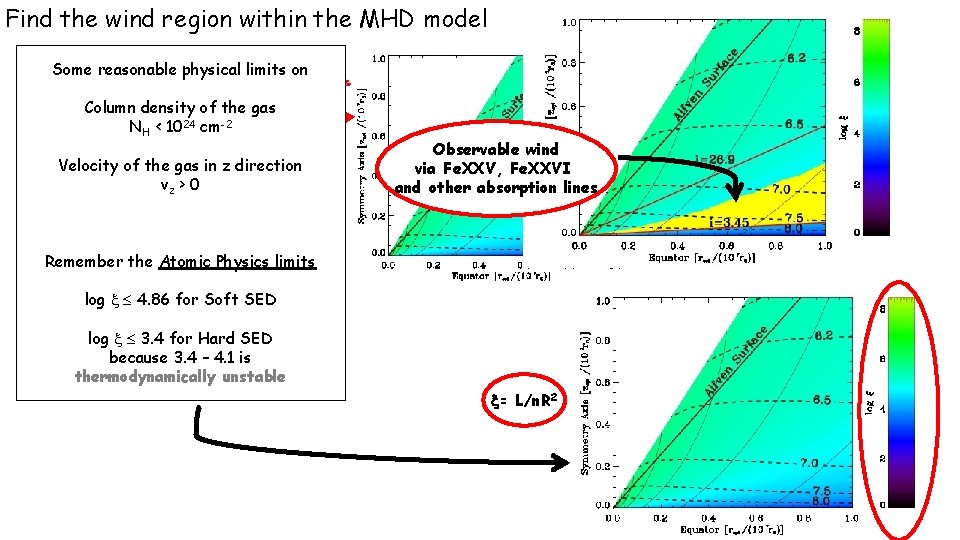
Find the wind region within the MHD model SED Some reasonable physical limits on Description of the light from Columnthe density of the innermost 24 part <of 10 the disk N cm-2 H gas Il s ga he st te na i lum Velocity of the gas in z direction vz > 0 Observable wind via Fe. XXV, Fe. XXVI and other absorption lines Soft state Remember the Atomic Physics limits log 4. 86 for Soft SED log 3. 4 for Hard SED because 3. 4 – 4. 1 is thermodynamically unstable = L/n. R 2
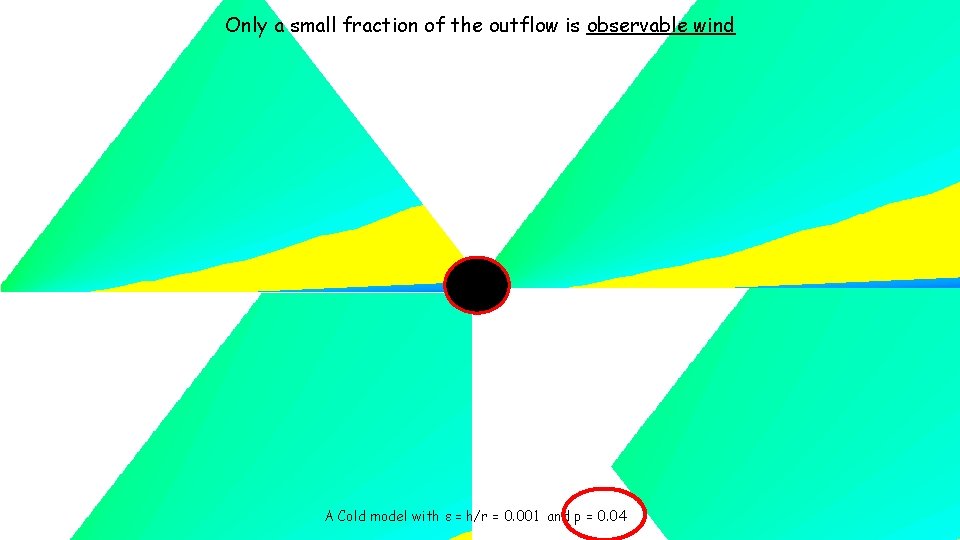
Only a small fraction of the outflow is observable wind A Cold model with = h/r = 0. 001 and p = 0. 04
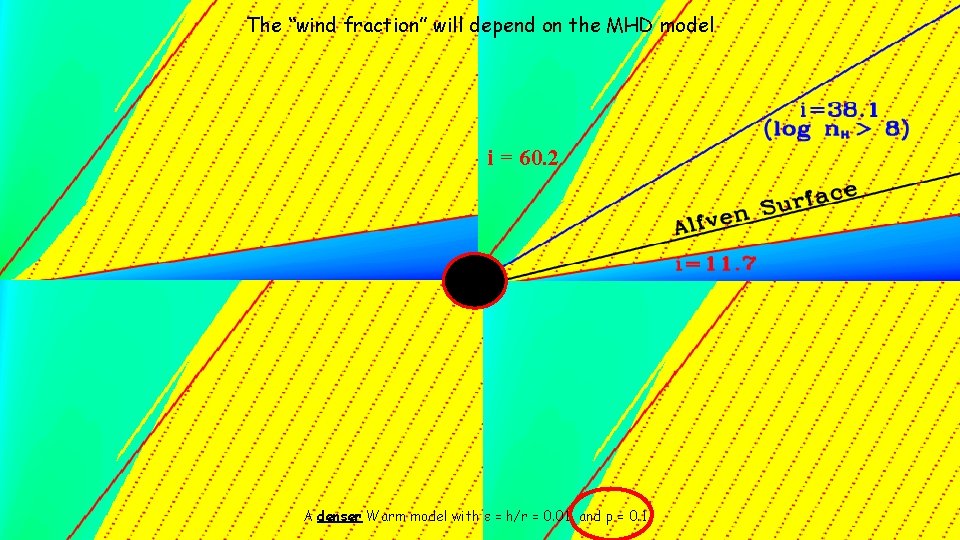
The “wind fraction” will depend on the MHD model i = 60. 2 A denser Warm model with = h/r = 0. 01 and p = 0. 1
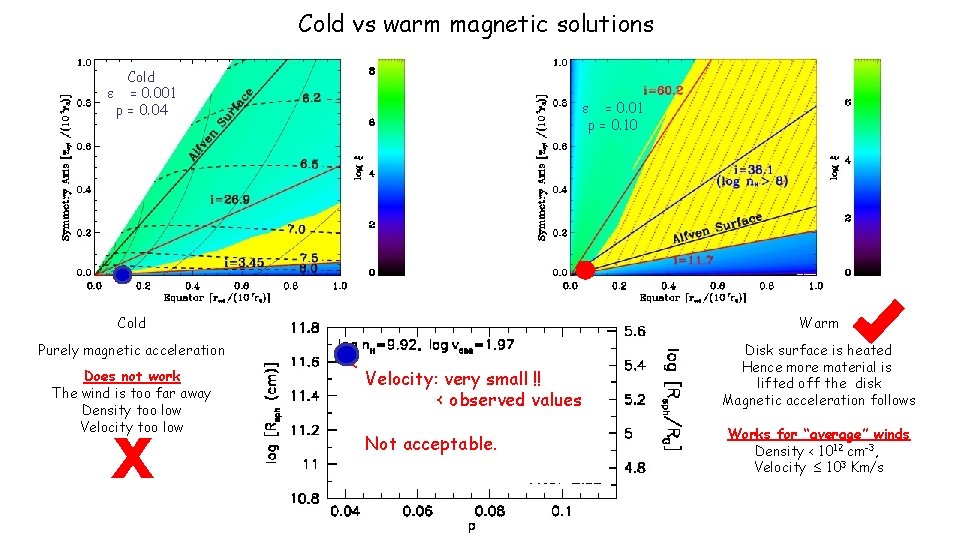
Cold vs warm magnetic solutions Cold = 0. 001 p = 0. 04 = 0. 01 p = 0. 10 Cold Warm Purely magnetic acceleration Disk surface is heated Hence more material is lifted off the disk Magnetic acceleration follows Does not work The wind is too far away Density too low Velocity too low X Velocity: very small !! < observed values Not acceptable. Works for “average” winds Density < 1012 cm-3, Velocity 103 Km/s
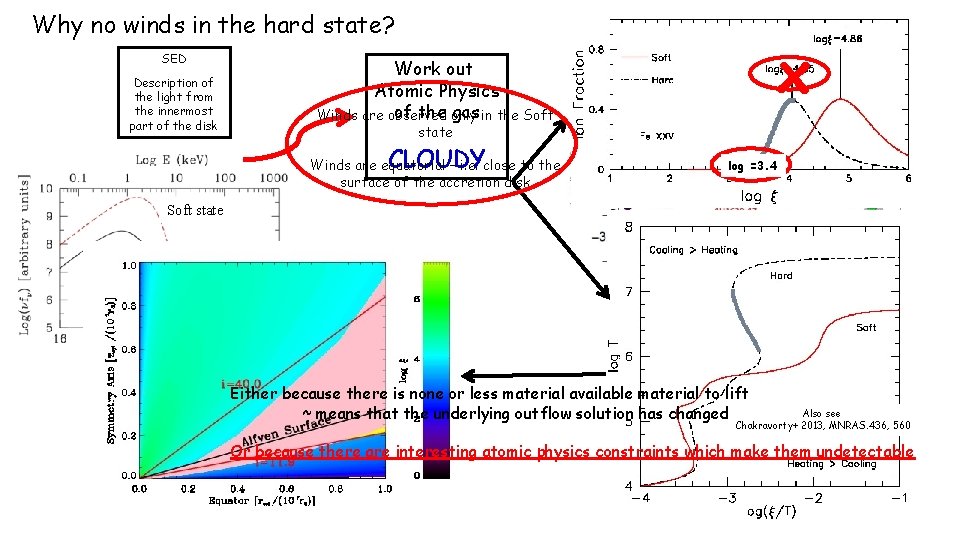
Why no winds in the hard state? SED Description of the light from the innermost part of the disk x Work out Atomic Physics of the only gas in the Soft Winds are observed state CLOUDY Winds are equatorial – i. e. close to the surface of the accretion disk log =3. 4 Soft state Ponti et. al 2012 Either because there is none or less material available material to lift ~ means that the underlying outflow solution has changed Also see Chakravorty+ 2013, MNRAS. 436, 560 Or because there are interesting atomic physics constraints which make them undetectable
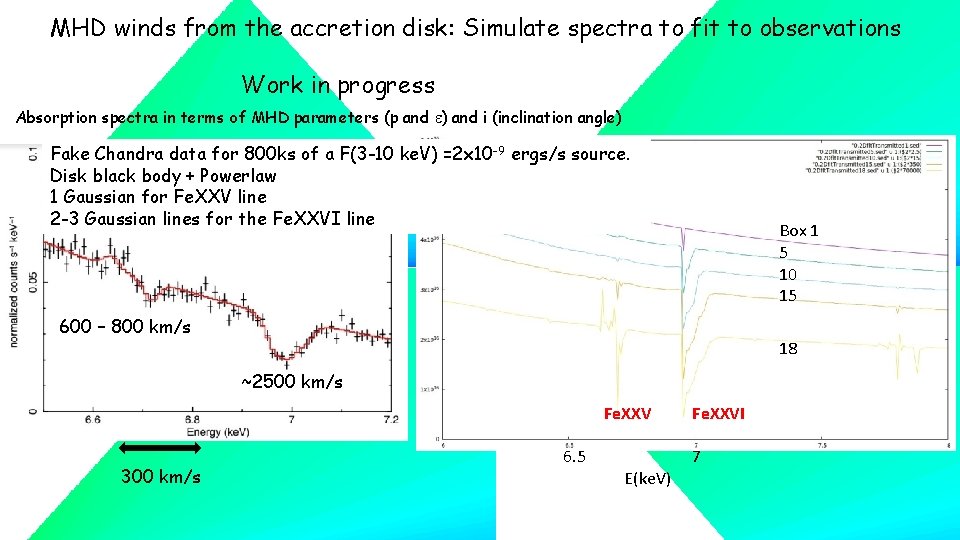
MHD winds from the accretion disk: Simulate spectra to fit to observations Work in progress Absorption spectra in terms of MHD parameters (p and ) and i (inclination angle) Fake Chandra data for 800 ks of a F(3 -10 ke. V) =2 x 10 -9 ergs/s source. Disk black body + Powerlaw 1 Gaussian for Fe. XXV line 2 -3 Gaussian lines for the Fe. XXVI line Box 1 5 10 15 600 – 800 km/s 18 ~2500 km/s Fe. XXV 300 km/s 6. 5 E(ke. V) Fe. XXVI 7
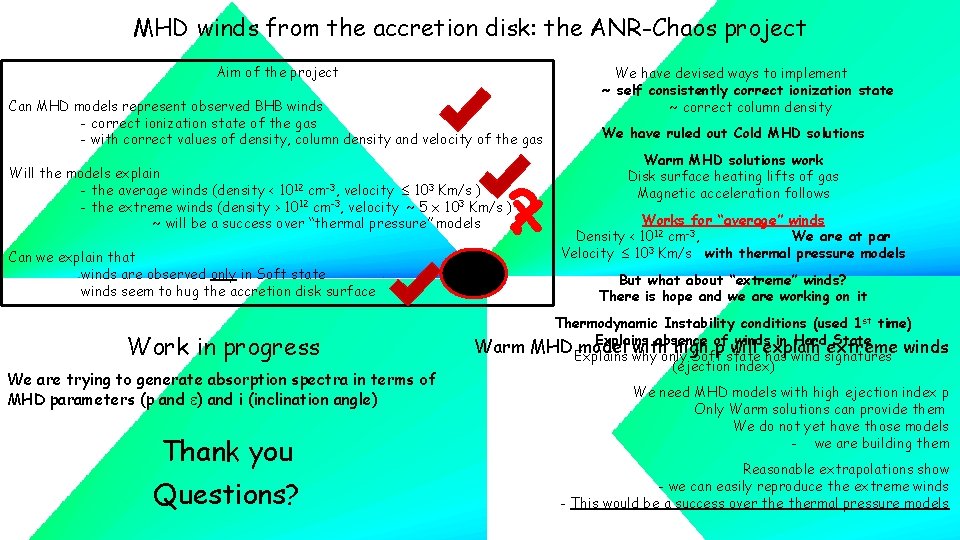
MHD winds from the accretion disk: the ANR-Chaos project Aim of the project Can MHD models represent observed BHB winds - correct ionization state of the gas - with correct values of density, column density and velocity of the gas Will the models explain - the average winds (density < 1012 cm-3, velocity 103 Km/s ) - the extreme winds (density > 1012 cm-3, velocity ~ 5 x 10³ Km/s ) ~ will be a success over “thermal pressure” models Can we explain that winds are observed only in Soft state winds seem to hug the accretion disk surface Work in progress We are trying to generate absorption spectra in terms of MHD parameters (p and ) and i (inclination angle) Thank you Questions? x ? We have devised ways to implement ~ self consistently correct ionization state ~ correct column density We have ruled out Cold MHD solutions Warm MHD solutions work Disk surface heating lifts of gas Magnetic acceleration follows Works for “average” winds Density < 1012 cm-3, We are at par 3 Velocity 10 Km/s with thermal pressure models But what about “extreme” winds? There is hope and we are working on it Warm Thermodynamic Instability conditions (used 1 st time) Explains absence of winds in Hard State MHD Explains model with high p will explain extreme winds why only Soft state has wind signatures (ejection index) We need MHD models with high ejection index p Only Warm solutions can provide them We do not yet have those models - we are building them Reasonable extrapolations show - we can easily reproduce the extreme winds - This would be a success over thermal pressure models
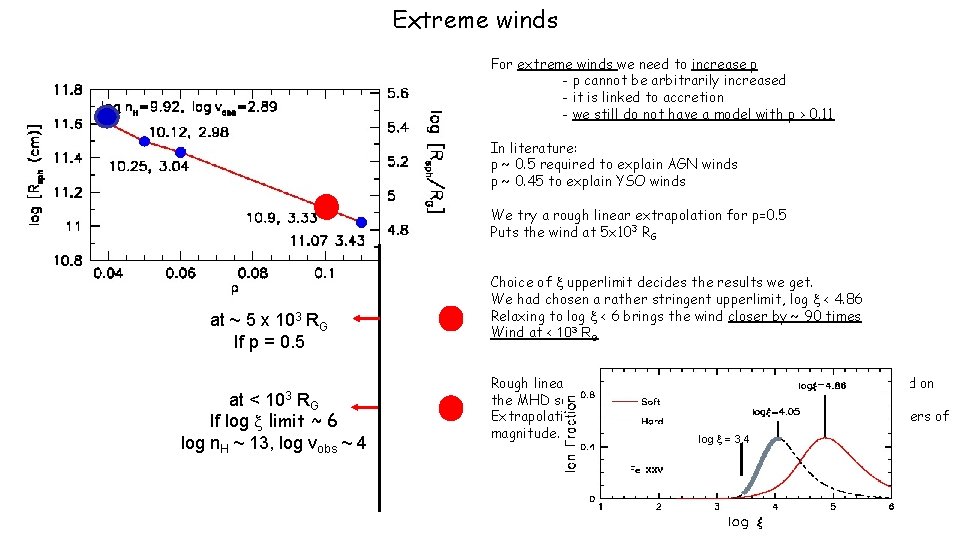
Extreme winds For extreme winds we need to increase p - p cannot be arbitrarily increased - it is linked to accretion - we still do not have a model with p > 0. 11 In literature: p ~ 0. 5 required to explain AGN winds p ~ 0. 45 to explain YSO winds We try a rough linear extrapolation for p=0. 5 Puts the wind at 5 x 10³ RG at ~ 5 x 10³ RG If p = 0. 5 at < 103 RG If log limit ~ 6 log n. H ~ 13, log vobs ~ 4 Choice of upperlimit decides the results we get. We had chosen a rather stringent upperlimit, log < 4. 86 Relaxing to log < 6 brings the wind closer by ~ 90 times Wind at < 103 RG Rough linear extrapolation on density and velocity - would depend on the MHD solution. Extrapolating linearly – they would increase through about 2 orders of magnitude. log = 3. 4
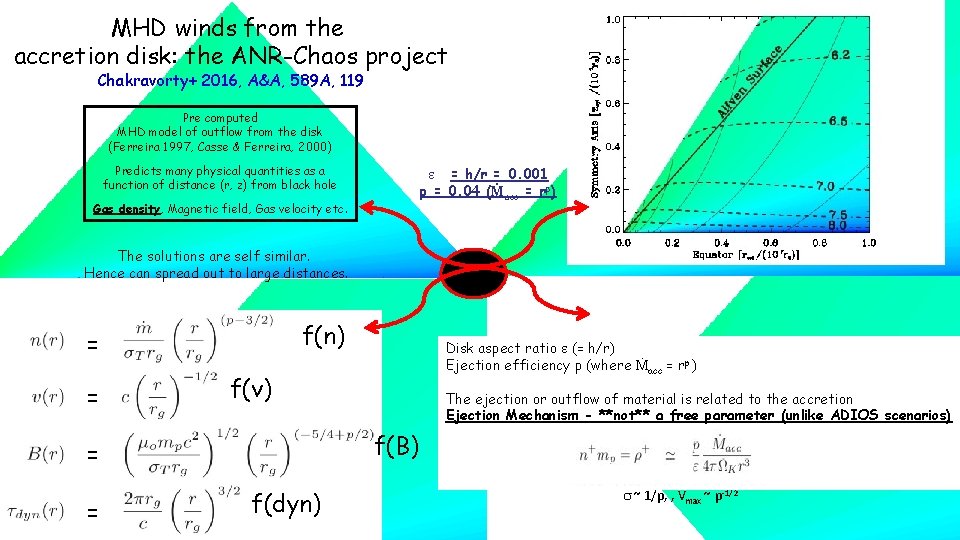
MHD winds from the accretion disk: the ANR-Chaos project Chakravorty+ 2016, A&A, 589 A, 119 Pre computed MHD model of outflow from the disk (Ferreira 1997, Casse & Ferreira, 2000) Predicts many physical quantities as a function of distance (r, z) from black hole = h/r = 0. 001 p = 0. 04 (Ṁacc = rp) Gas density, Magnetic field, Gas velocity etc. The solutions are self similar. Hence can spread out to large distances. f(n) = = f(v) The ejection or outflow of material is related to the accretion Ejection Mechanism - **not** a free parameter (unlike ADIOS scenarios) f(B) = = Disk aspect ratio (= h/r) Ejection efficiency p (where Ṁacc = rp ) f(dyn) ~ 1/p, , Vmax ~ p-1/2
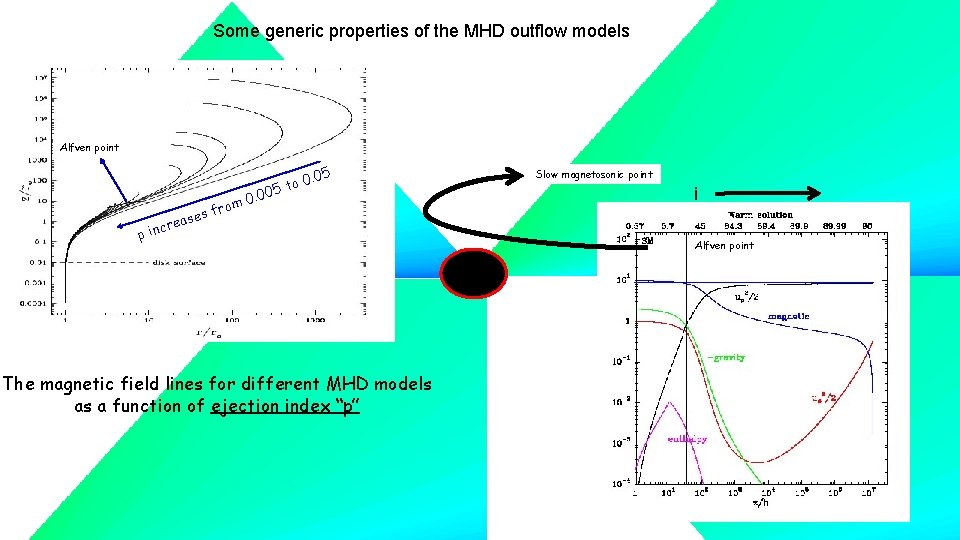
Some generic properties of the MHD outflow models Alfven point rom es f eas r c n pi 0. 0 o 0 05 t . 05 The magnetic field lines for different MHD models as a function of ejection index “p” Slow magnetosonic point i Alfven point
- Slides: 18