
Magnetism in Matter Electric polarisation P electric dipole




- Slides: 21
Magnetism in Matter Electric polarisation (P) - electric dipole moment per unit vol. Magnetic ‘polarisation’ (M) - magnetic dipole moment per unit vol. M magnetisation Am-1 c. f. P polarisation Cm-2 Element of magnetisation is magnetic dipole moment m When all moments have same magnitude & direction M=Nm N number density of magnetic moments Dielectric polarisation described in terms of surface (uniform) or bulk (non-uniform) bound charge densities Magnetisation described in terms of surface (uniform) or bulk (non-uniform) magnetisation current densities
Magnetism in Matter Paramagnetism Found in atoms, molecules with unpaired electron spins (magnetic moments) Examples O 2, haemoglobin (Fe ion) Paramagnetic substances become weakly magnetised in an applied field Magnetic moments align parallel to applied magnetic field to lower energy Paramagnetic susceptibility is therefore positive Moments fluctuate because system is at finite temperature Energy of magnetic moment in B field Um = -m. B Um = -9. 27. 10 -24 J for a moment of 1 m. B aligned in a field of 1 T Uthermal = k. T = 4. 10 -21 J at 300 K >> Um Um/k. T=2. 24. 10 -3 This implies little net magnetisation at room temperature
Magnetism in Matter Diamagnetism Found in atoms, molecules, solids with paired electron spins Examples H 2 O, N 2 Induced electric currents shield interior of a body from applied magnetic field Magnetic field of induced current opposes the applied field (Lenz’s Law) Diamagnetic susceptibilty is therefore negative Generally small except for type I superconductor where interior is completely shielded from magnetic fields by surface currents in superconducting state Strong, non-uniform magnetic fields can be used to levitate bodies via diamagnetism
Magnetism in Matter Ferromagnetism, Ferrimagnetism, Antiferromagnetism Found in solids with magnetic ions (with unpaired electron spins) Examples Fe, Fe 3 O 4 (magnetite), La 2 Cu. O 4 When interactions H = -J mi. mj between magnetic ions are (J) >= k. T Thermal energy required to flip moment is Nm. B >> m. B N is number of ions in a cluster to be flipped and Um/k. T > 1 Ferromagnet has J > 0 (moments align parallel) Anti-ferromagnet has J < 0 (moments align anti-parallel) Ferrimagnet has J < 0 but moments of different sizes giving net magnetisation Magnetic susceptibilities non-linear because of domain formation
Magnetism in Matter Electric polarisation P(r) p electric dipole moment of localised charge distribution Magnetisation M(r) m magnetic dipole moment of localised current distribution
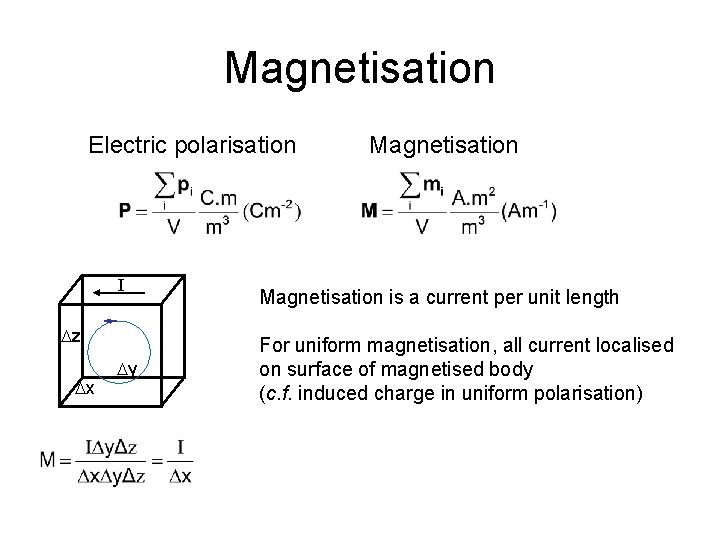
Magnetisation Electric polarisation I z x y Magnetisation is a current per unit length For uniform magnetisation, all current localised on surface of magnetised body (c. f. induced charge in uniform polarisation)
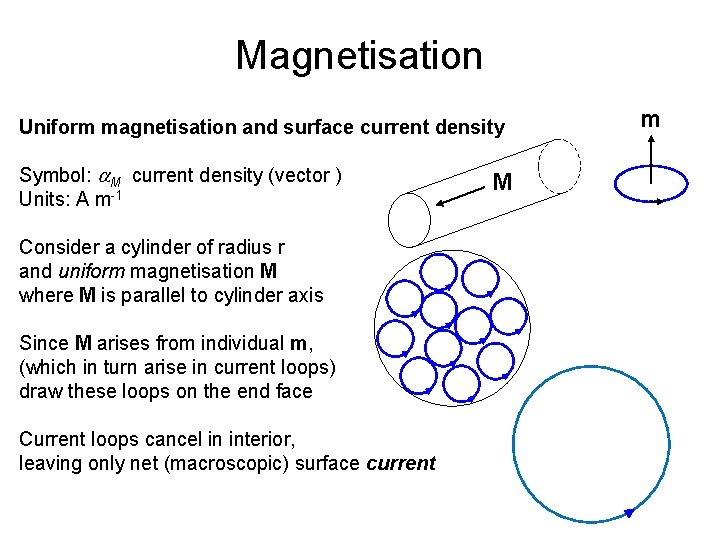
Magnetisation Uniform magnetisation and surface current density Symbol: a. M current density (vector ) Units: A m-1 Consider a cylinder of radius r and uniform magnetisation M where M is parallel to cylinder axis Since M arises from individual m, (which in turn arise in current loops) draw these loops on the end face Current loops cancel in interior, leaving only net (macroscopic) surface current M m
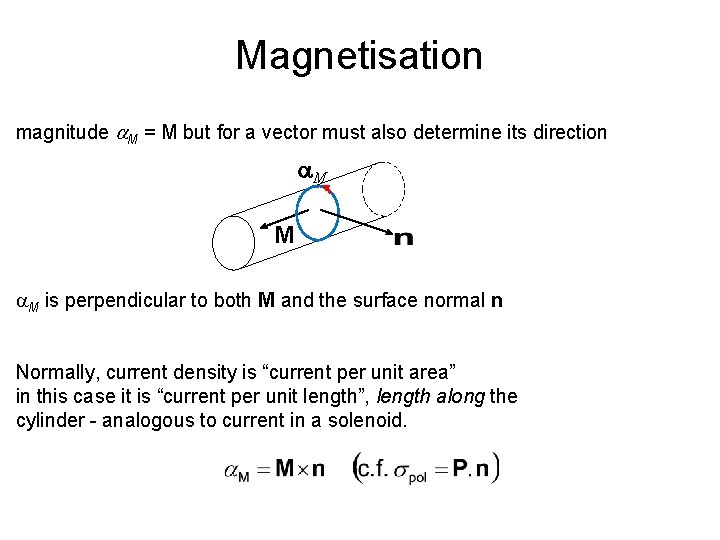
Magnetisation magnitude a. M = M but for a vector must also determine its direction a. M M a. M is perpendicular to both M and the surface normal n Normally, current density is “current per unit area” in this case it is “current per unit length”, length along the cylinder - analogous to current in a solenoid.
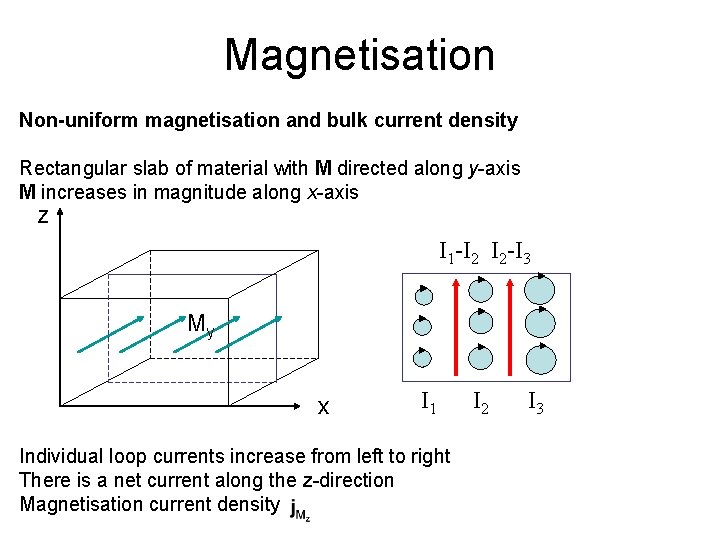
Magnetisation Non-uniform magnetisation and bulk current density Rectangular slab of material with M directed along y-axis M increases in magnitude along x-axis z I 1 -I 2 I 2 -I 3 My x I 1 Individual loop currents increase from left to right There is a net current along the z-direction Magnetisation current density I 2 I 3
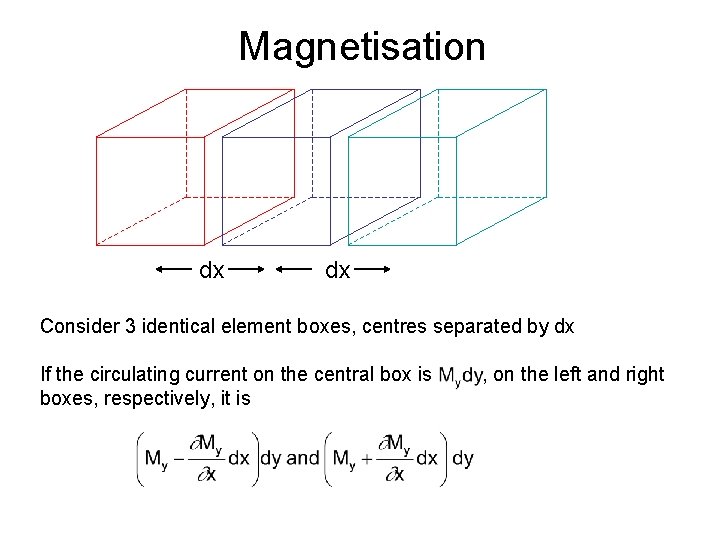
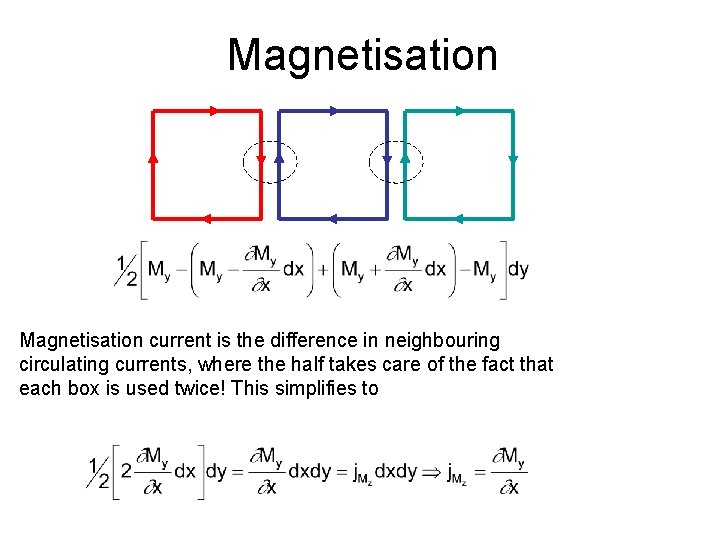
Magnetisation dx dx Consider 3 identical element boxes, centres separated by dx If the circulating current on the central box is boxes, respectively, it is , on the left and right
Magnetisation current is the difference in neighbouring circulating currents, where the half takes care of the fact that each box is used twice! This simplifies to
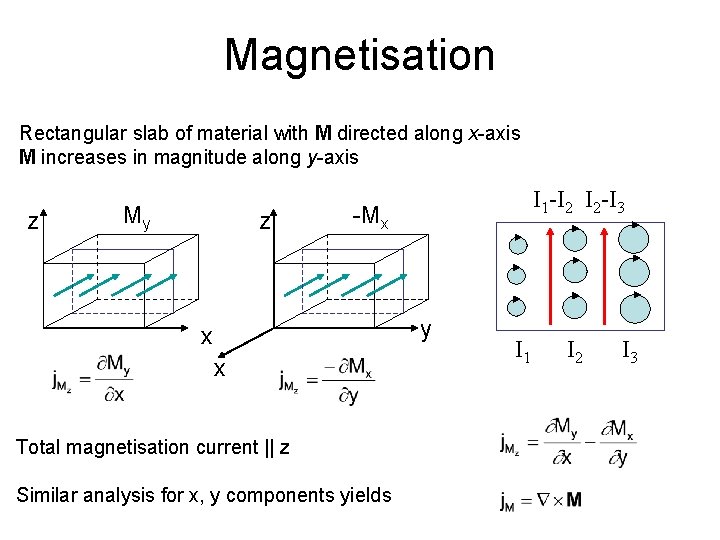
Magnetisation Rectangular slab of material with M directed along x-axis M increases in magnitude along y-axis z My z I 1 -I 2 I 2 -I 3 -Mx y x x Total magnetisation current || z Similar analysis for x, y components yields I 1 I 2 I 3
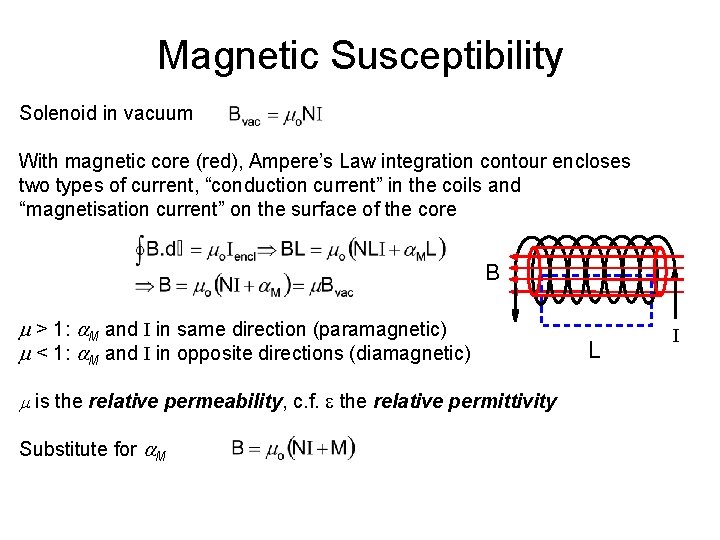
Magnetic Susceptibility Solenoid in vacuum With magnetic core (red), Ampere’s Law integration contour encloses two types of current, “conduction current” in the coils and “magnetisation current” on the surface of the core B > 1: a. M and I in same direction (paramagnetic) < 1: a. M and I in opposite directions (diamagnetic) is the relative permeability, c. f. e the relative permittivity Substitute for a. M L I
Magnetic Susceptibility Macroscopic electric field EMac= EApplied + EDep = E - P/ o Macroscopic magnetic field BMac= BApplied + BMagnetisation is the contribution to BMac from the magnetisation BMac= BApplied + BMagnetisation = B + mo. M Define magnetic susceptibility via M = c. BBMac/mo BMac= B + c. BBMac EMac= E - P/ o = E - EMac BMac(1 -c. B) = B EMac(1+c) = E Diamagnets Para, Ferromagnets Au Quartz O 2 STP BMagnetisation opposes BApplied BMagnetisation enhances BApplied B -3. 6. 10 -5 -6. 2. 10 -5 +1. 9. 10 -6 c. B < 0 c. B > 0 0. 99996 0. 99994 1. 000002
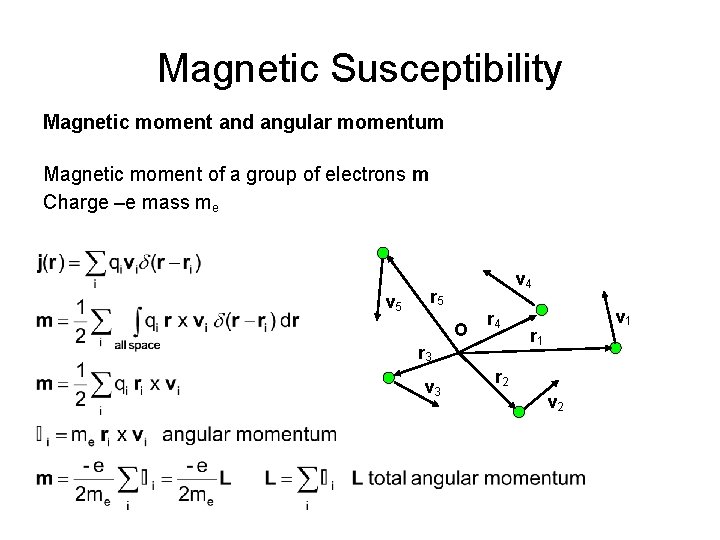
Magnetic Susceptibility Magnetic moment and angular momentum Magnetic moment of a group of electrons m Charge –e mass me v 5 v 4 r 5 O r 4 r 3 v 1 r 2 v 2
Magnetic Susceptibility Diamagnetic susceptibility Induced magnetic dipole moment when B field applied Applied field causes small change in electron orbit, inducing L, m Consider force balance equation when B = 0 (mass) x (accel) = (electric force) w. L is the Larmor frequency B -e
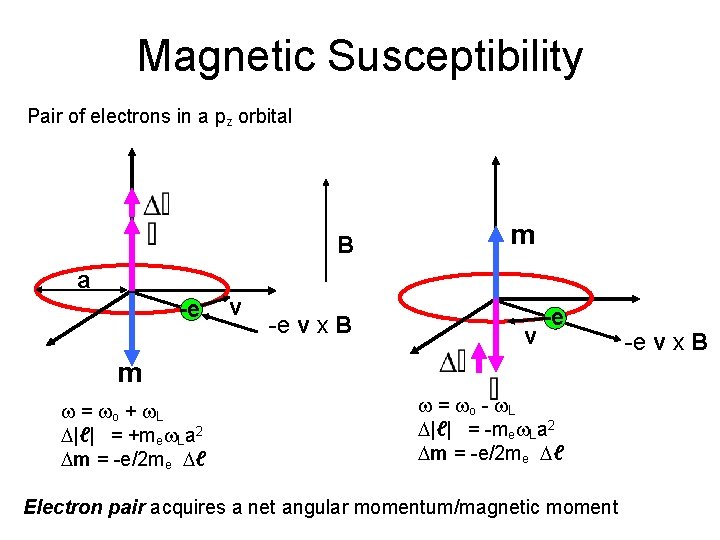
Magnetic Susceptibility Pair of electrons in a pz orbital B a -e v x B m v -e m w = wo + w. L |ℓ| = +mew. La 2 m = -e/2 me ℓ w = wo - w. L |ℓ| = -mew. La 2 m = -e/2 me ℓ Electron pair acquires a net angular momentum/magnetic moment -e v x B
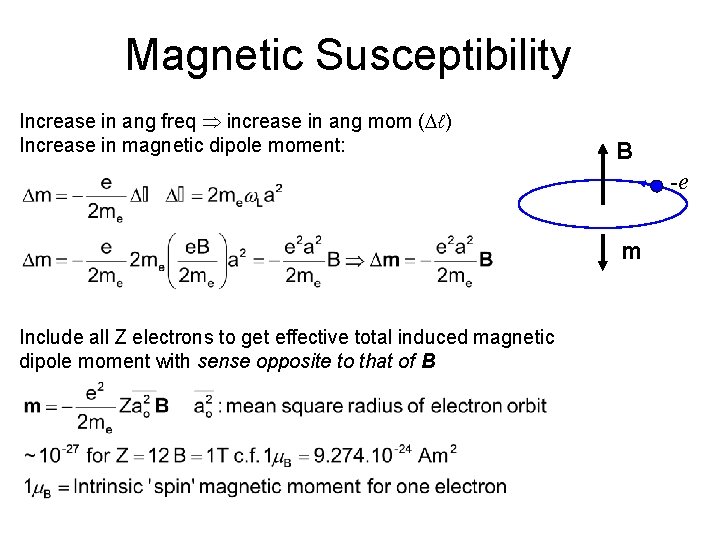
Magnetic Susceptibility Increase in ang freq increase in ang mom ( ℓ) Increase in magnetic dipole moment: B -e m Include all Z electrons to get effective total induced magnetic dipole moment with sense opposite to that of B
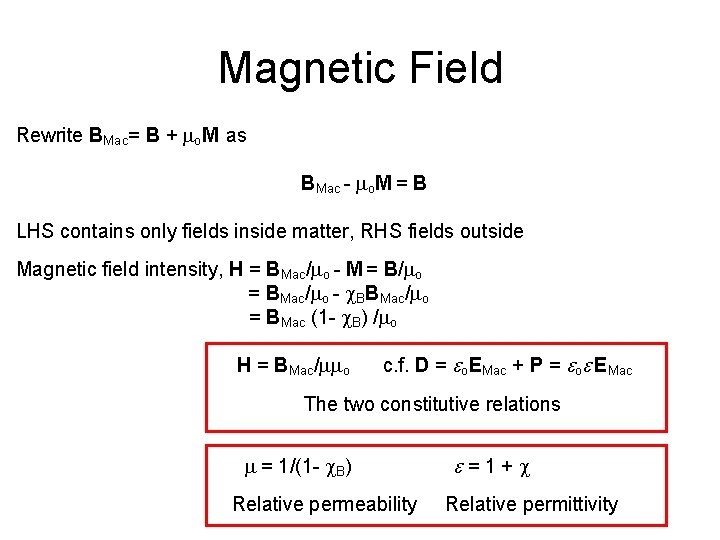
Magnetic Field Rewrite BMac= B + mo. M as BMac - mo. M = B LHS contains only fields inside matter, RHS fields outside Magnetic field intensity, H = BMac/mo - M = B/mo = BMac/mo - c. BBMac/mo = BMac (1 - c. B) /mo H = BMac/mmo c. f. D = o. EMac + P = o EMac The two constitutive relations m = 1/(1 - c. B) Relative permeability =1+c Relative permittivity
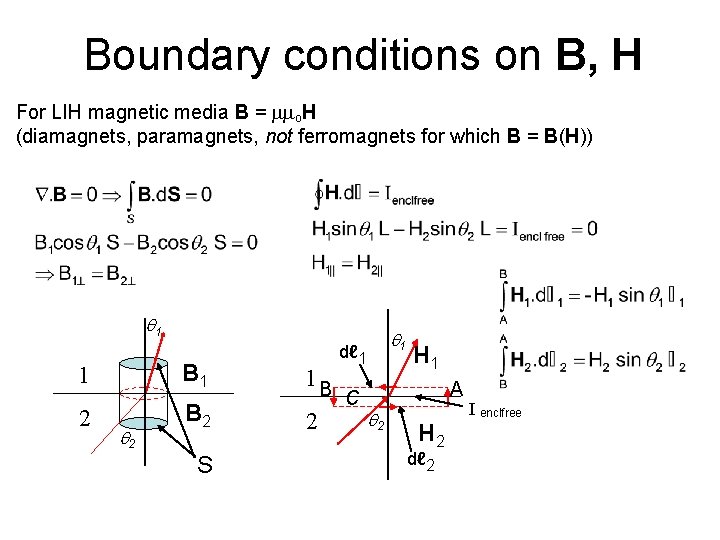
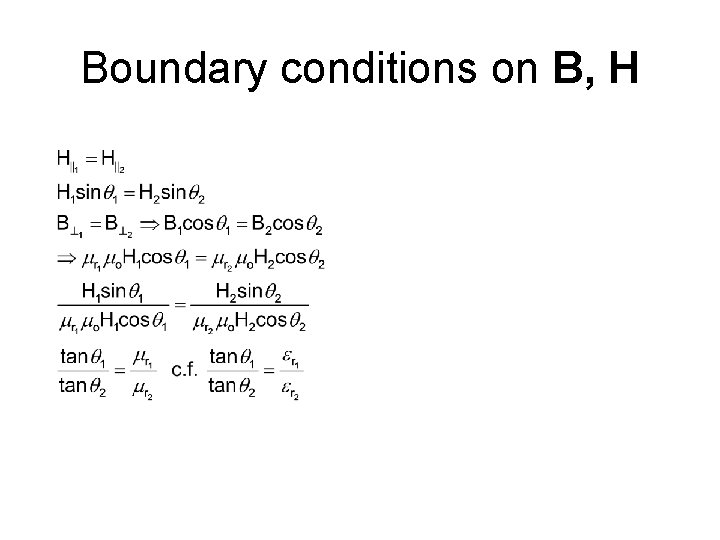
Boundary conditions on B, H For LIH magnetic media B = mmo. H (diamagnets, paramagnets, not ferromagnets for which B = B(H)) q 1 1 B 1 2 B 2 q 2 S 1 B 2 q 1 dℓ 1 C H 1 A q 2 H 2 dℓ 2 I enclfree
Boundary conditions on B, H