
Magnetism I Some of the basic concepts of
Magnetism I. Some of the basic concepts of magnetism…. • Magnets have poles - N poles and S poles • Poles always occur in pairs - there are no magnetic monopoles • The N pole of a magnet is the one that points north in the Earth’s magnetic field • Like poles repel, opposite poles attract • A compass is a magnet that is free to rotate, it will align itself with any magnetic field in which it is placed. • Materials such as iron, nickel, and cobalt show strong magnetic effects, they are said to be ferromagnetic.
Magnetism I. Some (more) of the basic concepts of magnetism…. • The direction of a magnetic field is defined as the direction of the force on small “N” pole (or the direction that the “N” pole of a compass needle would point). • Magnetic field strength is a vector quantity. It is represented by the symbol B. • Since the N pole of a compass points north in the earth’s magnetic field, the north pole of the earth acts like the “S” pole of a magnet.

Magnetism II. Electric currents produce magnetism Hans Christian Oersted, in 1820, accidentally discovered that a compass needle was affected by a nearby electric current. The electric current produced a magnetic field. Magnetic fields are caused by moving electric charges.
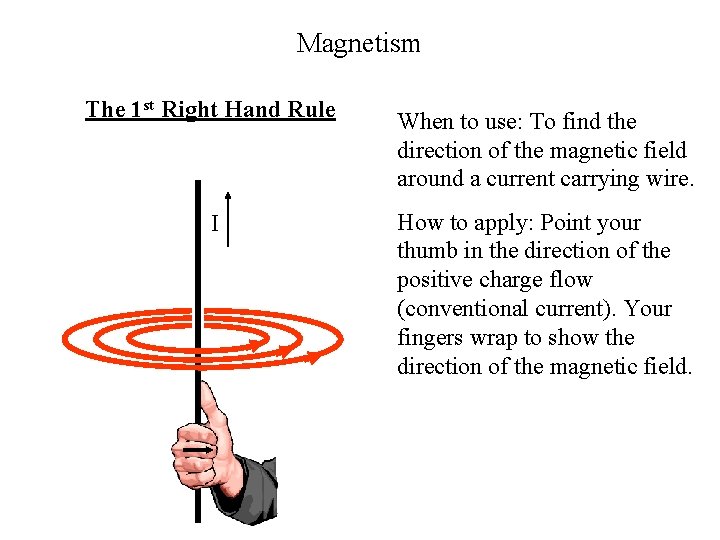
Magnetism The 1 st Right Hand Rule When to use: To find the direction of the magnetic field around a current carrying wire. I How to apply: Point your thumb in the direction of the positive charge flow (conventional current). Your fingers wrap to show the direction of the magnetic field.
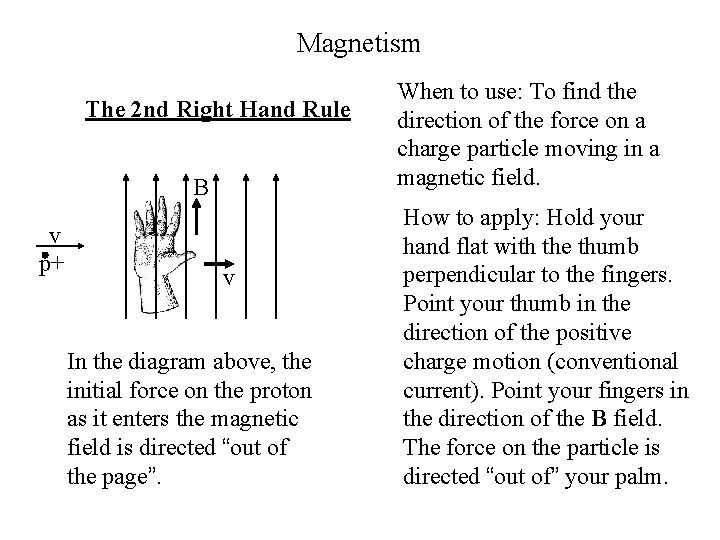
Magnetism The 2 nd Right Hand Rule B v p+ v In the diagram above, the initial force on the proton as it enters the magnetic field is directed “out of the page”. When to use: To find the direction of the force on a charge particle moving in a magnetic field. How to apply: Hold your hand flat with the thumb perpendicular to the fingers. Point your thumb in the direction of the positive charge motion (conventional current). Point your fingers in the direction of the B field. The force on the particle is directed “out of” your palm.
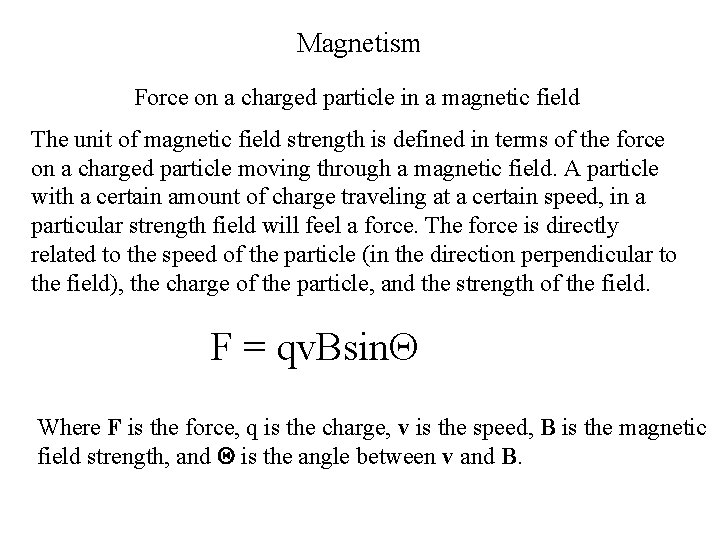
Magnetism Force on a charged particle in a magnetic field The unit of magnetic field strength is defined in terms of the force on a charged particle moving through a magnetic field. A particle with a certain amount of charge traveling at a certain speed, in a particular strength field will feel a force. The force is directly related to the speed of the particle (in the direction perpendicular to the field), the charge of the particle, and the strength of the field. F = qv. Bsin Where F is the force, q is the charge, v is the speed, B is the magnetic field strength, and is the angle between v and B.
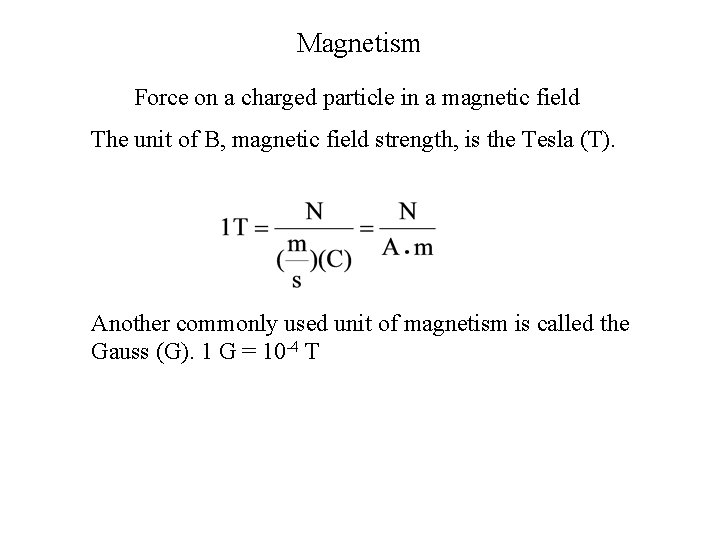
Magnetism Force on a charged particle in a magnetic field The unit of B, magnetic field strength, is the Tesla (T). Another commonly used unit of magnetism is called the Gauss (G). 1 G = 10 -4 T
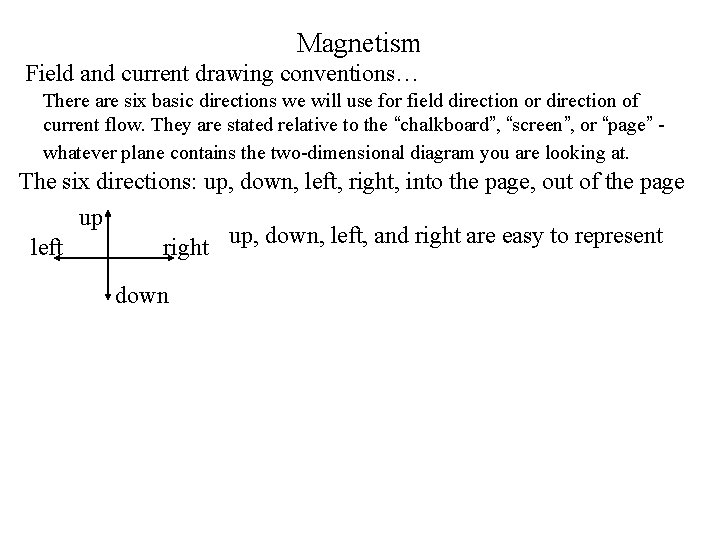
Magnetism Field and current drawing conventions… There are six basic directions we will use for field direction or direction of current flow. They are stated relative to the “chalkboard”, “screen”, or “page” whatever plane contains the two-dimensional diagram you are looking at. The six directions: up, down, left, right, into the page, out of the page up left right up, down, left, and right are easy to represent down
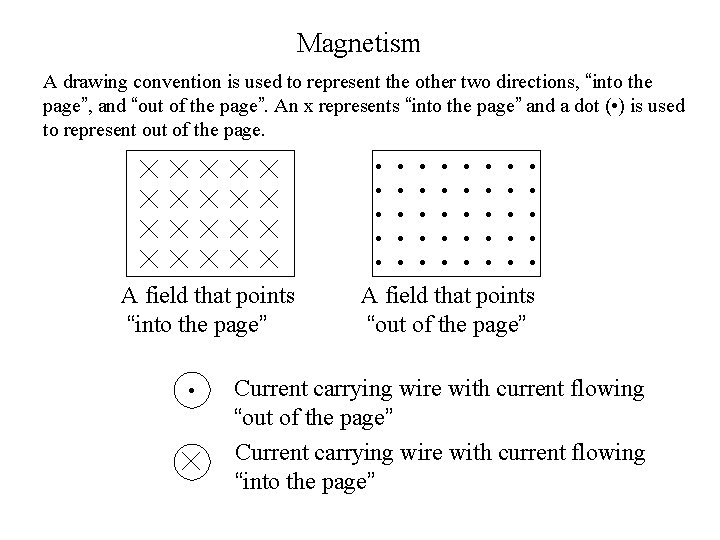
Magnetism A drawing convention is used to represent the other two directions, “into the page”, and “out of the page”. An x represents “into the page” and a dot ( • ) is used to represent out of the page. • • • A field that points “into the page” • • • • • • • • • A field that points “out of the page” Current carrying wire with current flowing “into the page”
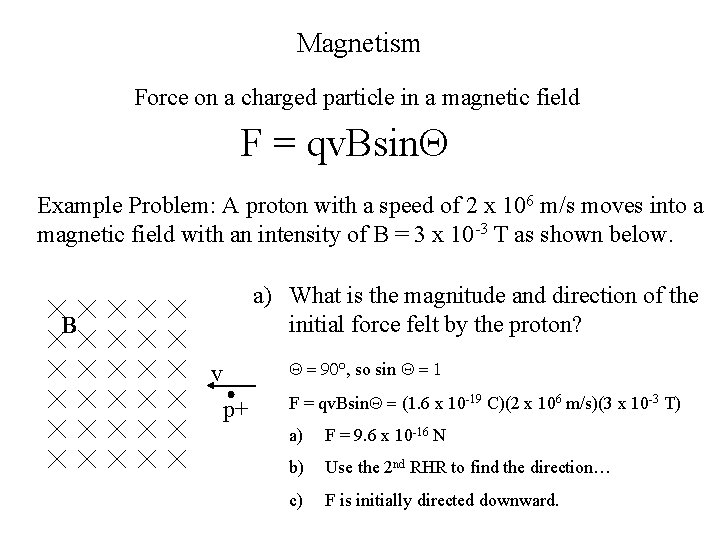
Magnetism Force on a charged particle in a magnetic field F = qv. Bsin Example Problem: A proton with a speed of 2 x 10⁶ m/s moves into a magnetic field with an intensity of B = 3 x 10 -3 T as shown below. a) What is the magnitude and direction of the initial force felt by the proton? B = 90 o, so sin = 1 v p+ F = qv. Bsin = (1. 6 x 10 -19 C)(2 x 10⁶ m/s)(3 x 10 -3 T) a) F = 9. 6 x 10 -16 N b) Use the 2 nd RHR to find the direction… c) F is initially directed downward.
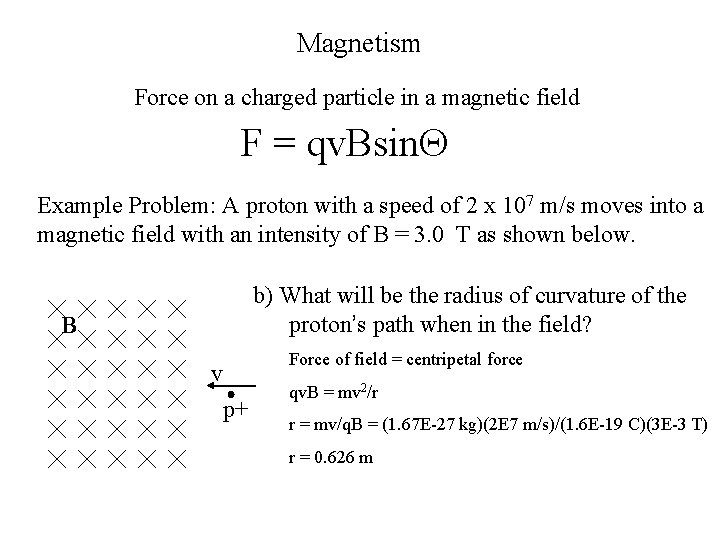
Magnetism Force on a charged particle in a magnetic field F = qv. Bsin Example Problem: A proton with a speed of 2 x 10⁷ m/s moves into a magnetic field with an intensity of B = 3. 0 T as shown below. b) What will be the radius of curvature of the proton’s path when in the field? B Force of field = centripetal force v p+ qv. B = mv 2/r r = mv/q. B = (1. 67 E-27 kg)(2 E 7 m/s)/(1. 6 E-19 C)(3 E-3 T) r = 0. 626 m
- Slides: 11