
Magnetism Chapter 19 Magnetism Section 3 Magnetic Force
- Slides: 13
Magnetism Chapter 19 Magnetism Section 3 Magnetic Force © Houghton Mifflin Harcourt Publishing Company Section 1
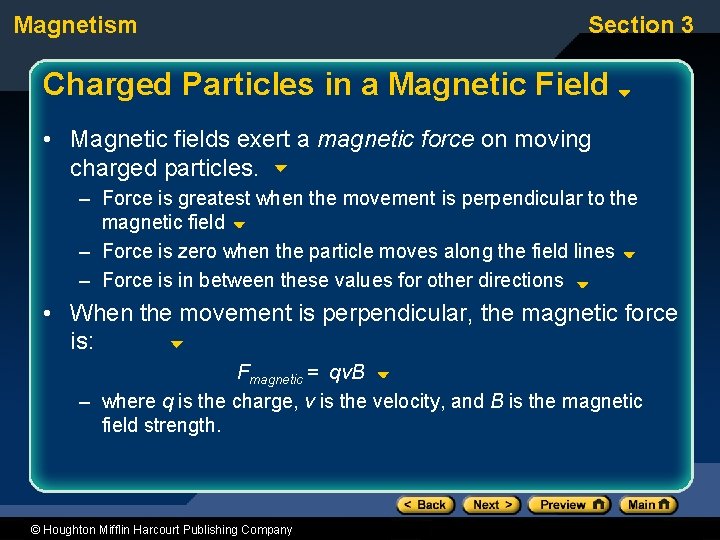
Magnetism Section 3 Charged Particles in a Magnetic Field • Magnetic fields exert a magnetic force on moving charged particles. – Force is greatest when the movement is perpendicular to the magnetic field – Force is zero when the particle moves along the field lines – Force is in between these values for other directions • When the movement is perpendicular, the magnetic force is: Fmagnetic = qv. B – where q is the charge, v is the velocity, and B is the magnetic field strength. © Houghton Mifflin Harcourt Publishing Company
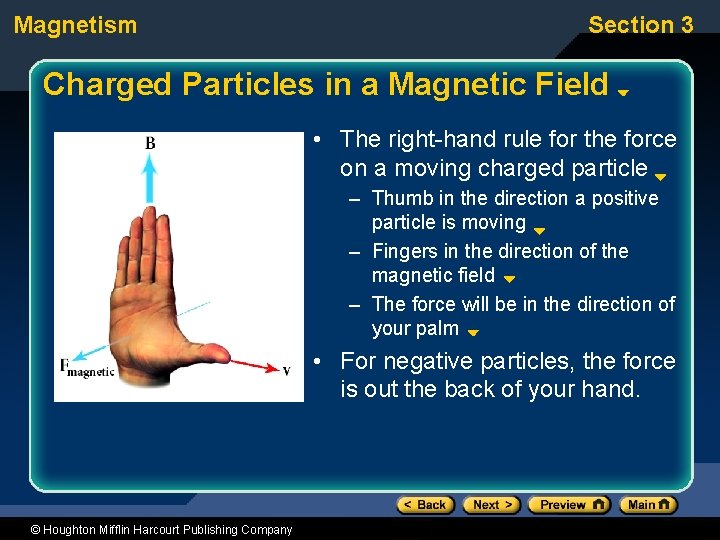
Magnetism Section 3 Charged Particles in a Magnetic Field • The right-hand rule for the force on a moving charged particle – Thumb in the direction a positive particle is moving – Fingers in the direction of the magnetic field – The force will be in the direction of your palm • For negative particles, the force is out the back of your hand. © Houghton Mifflin Harcourt Publishing Company
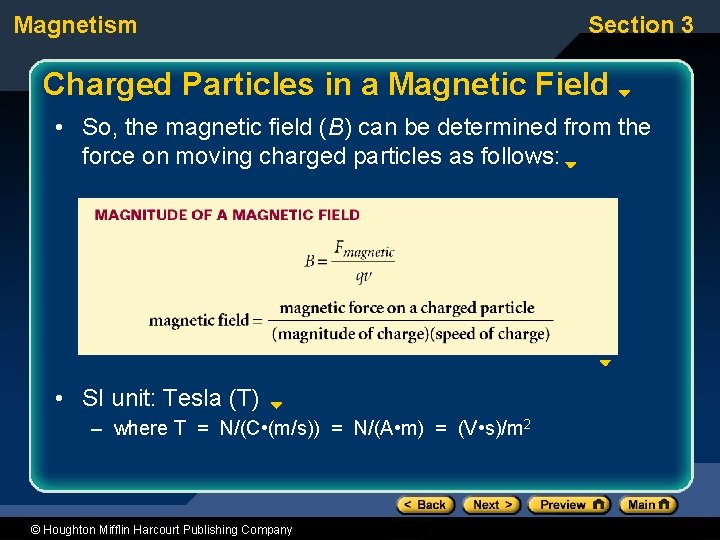
Magnetism Section 3 Charged Particles in a Magnetic Field • So, the magnetic field (B) can be determined from the force on moving charged particles as follows: • SI unit: Tesla (T) – where T = N/(C • (m/s)) = N/(A • m) = (V • s)/m 2 © Houghton Mifflin Harcourt Publishing Company
Magnetism Section 3 Force on a Charge Moving in a Magnetic Field Click below to watch the Visual Concept © Houghton Mifflin Harcourt Publishing Company
Magnetism Section 3 Classroom Practice Problems • An electron moving north at 4. 5 104 m/s enters a 1. 0 m. T magnetic field pointed upward. – What is the magnitude and direction of the force on the electron? – What would the force be if the particle was a proton? – What would the force be if the particle was a neutron? • Answers: – 7. 2 10 -18 N west – 7. 2 10 -18 N east – 0. 0 N © Houghton Mifflin Harcourt Publishing Company
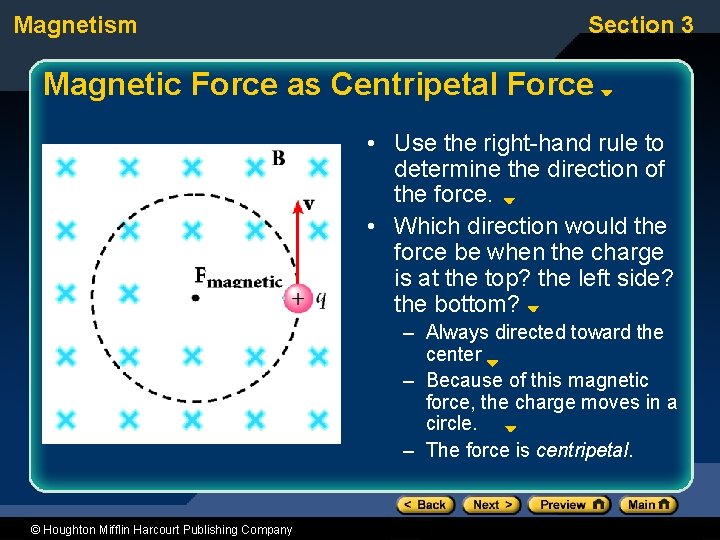
Magnetism Section 3 Magnetic Force as Centripetal Force • Use the right-hand rule to determine the direction of the force. • Which direction would the force be when the charge is at the top? the left side? the bottom? – Always directed toward the center – Because of this magnetic force, the charge moves in a circle. – The force is centripetal. © Houghton Mifflin Harcourt Publishing Company
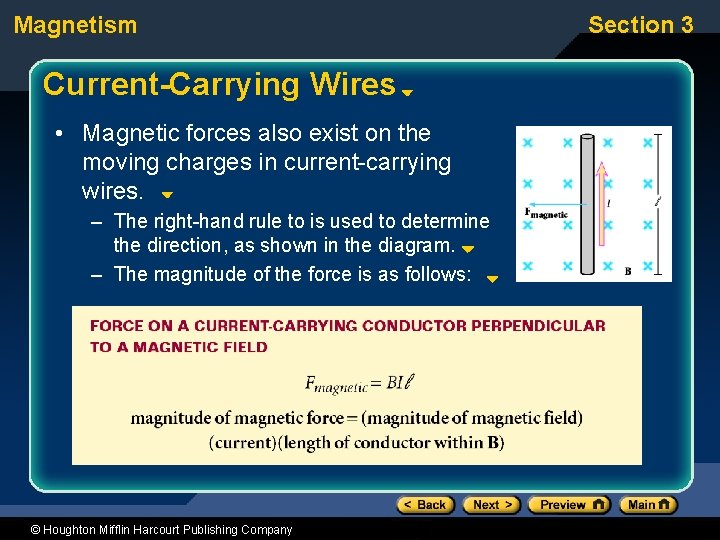
Magnetism Current-Carrying Wires • Magnetic forces also exist on the moving charges in current-carrying wires. – The right-hand rule to is used to determine the direction, as shown in the diagram. – The magnitude of the force is as follows: © Houghton Mifflin Harcourt Publishing Company Section 3
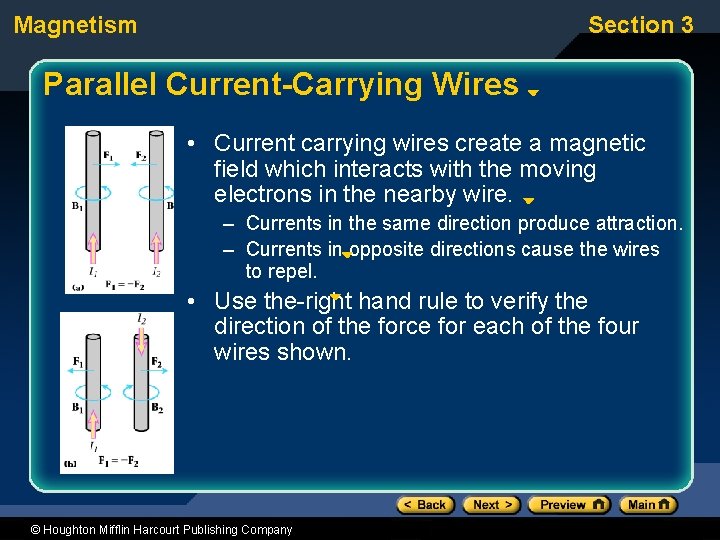
Magnetism Section 3 Parallel Current-Carrying Wires • Current carrying wires create a magnetic field which interacts with the moving electrons in the nearby wire. – Currents in the same direction produce attraction. – Currents in opposite directions cause the wires to repel. • Use the-right hand rule to verify the direction of the force for each of the four wires shown. © Houghton Mifflin Harcourt Publishing Company
Magnetism Section 3 Classroom Practice Problem • A 4. 5 m wire carries a current of 12. 5 A from north to south. If the magnetic force on the wire due to a uniform magnetic field is 1. 1 103 N downward, what is the magnitude and direction of the magnetic field? • Answer: 2. 0 101 T to the west © Houghton Mifflin Harcourt Publishing Company
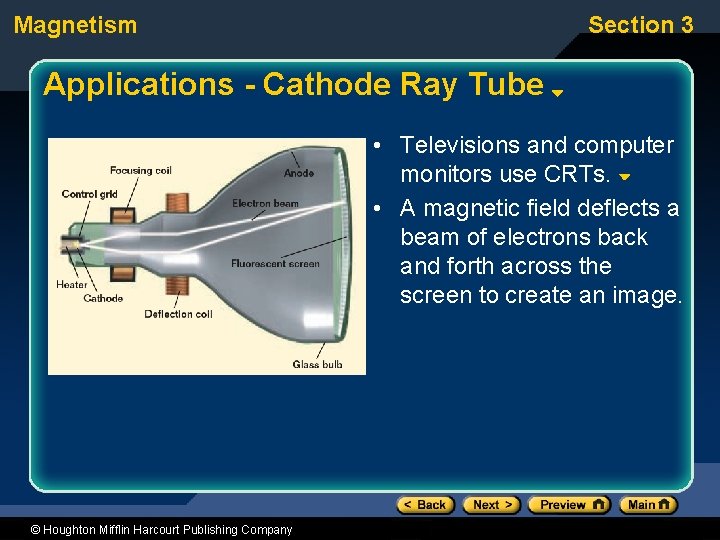
Magnetism Section 3 Applications - Cathode Ray Tube • Televisions and computer monitors use CRTs. • A magnetic field deflects a beam of electrons back and forth across the screen to create an image. © Houghton Mifflin Harcourt Publishing Company
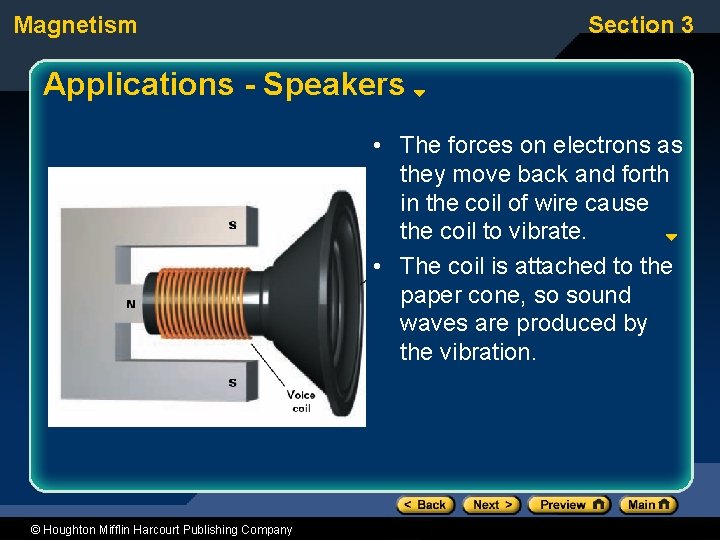
Magnetism Section 3 Applications - Speakers • The forces on electrons as they move back and forth in the coil of wire cause the coil to vibrate. • The coil is attached to the paper cone, so sound waves are produced by the vibration. © Houghton Mifflin Harcourt Publishing Company
Magnetism Section 3 Galvanometer Click below to watch the Visual Concept © Houghton Mifflin Harcourt Publishing Company