
Magnetism A magnet is any material that attracts
- Slides: 13
Magnetism • A magnet is any material that attracts iron or materials containing iron. • magnetism – force of attraction or repulsion
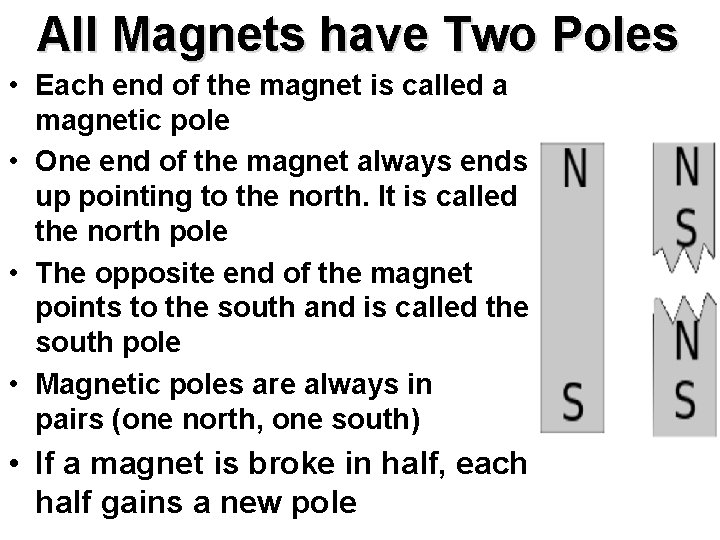
All Magnets have Two Poles • Each end of the magnet is called a magnetic pole • One end of the magnet always ends up pointing to the north. It is called the north pole • The opposite end of the magnet points to the south and is called the south pole • Magnetic poles are always in pairs (one north, one south) • If a magnet is broke in half, each half gains a new pole
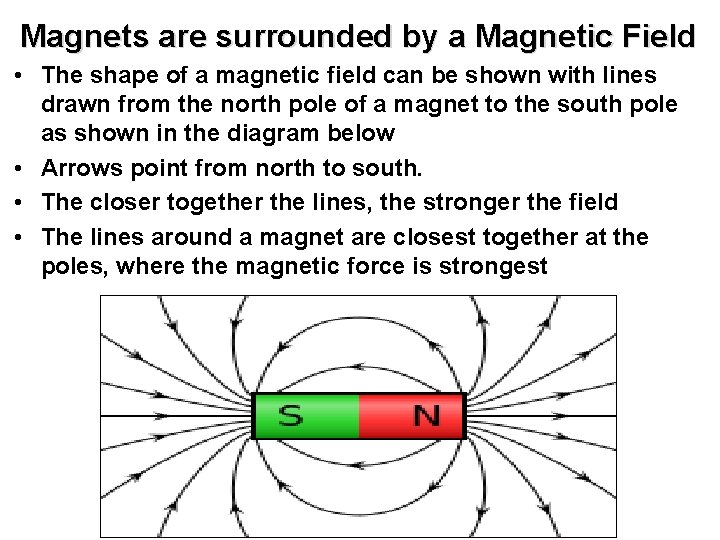
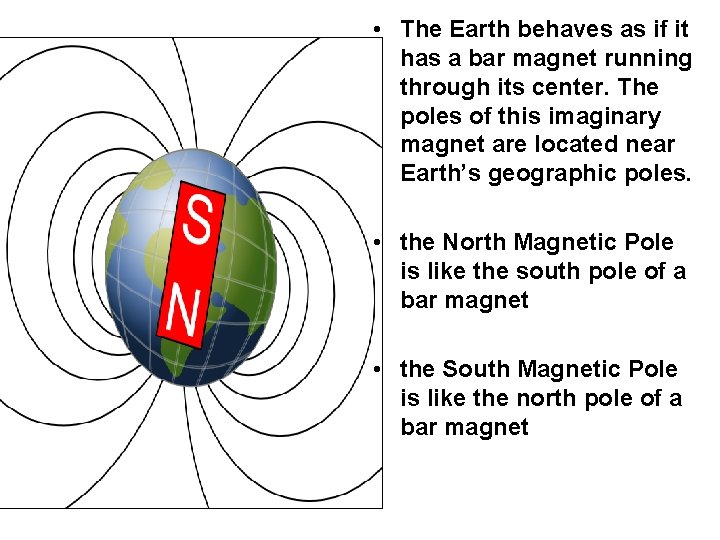
Magnets are surrounded by a Magnetic Field • The shape of a magnetic field can be shown with lines drawn from the north pole of a magnet to the south pole as shown in the diagram below • Arrows point from north to south. • The closer together the lines, the stronger the field • The lines around a magnet are closest together at the poles, where the magnetic force is strongest
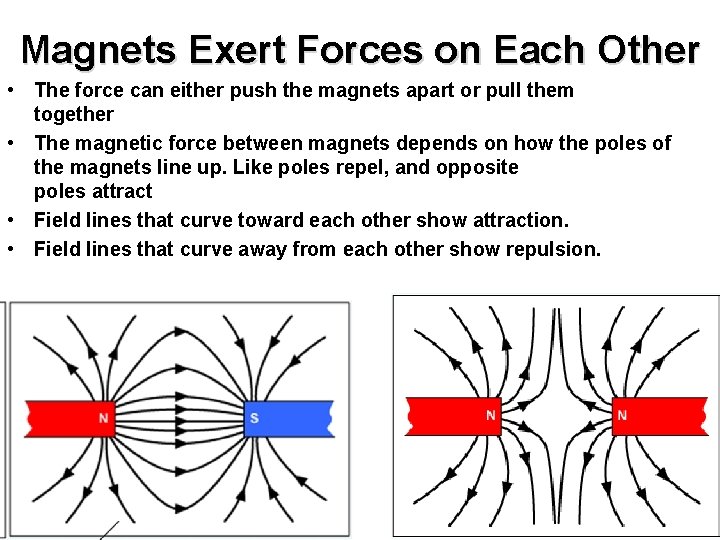
Magnets Exert Forces on Each Other • The force can either push the magnets apart or pull them together • The magnetic force between magnets depends on how the poles of the magnets line up. Like poles repel, and opposite poles attract • Field lines that curve toward each other show attraction. • Field lines that curve away from each other show repulsion.
• The Earth behaves as if it has a bar magnet running through its center. The poles of this imaginary magnet are located near Earth’s geographic poles. • the North Magnetic Pole is like the south pole of a bar magnet • the South Magnetic Pole is like the north pole of a bar magnet
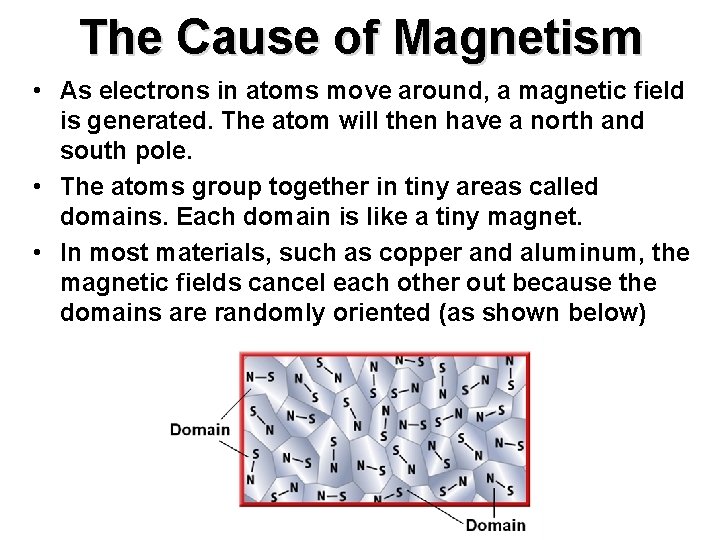
The Cause of Magnetism • As electrons in atoms move around, a magnetic field is generated. The atom will then have a north and south pole. • The atoms group together in tiny areas called domains. Each domain is like a tiny magnet. • In most materials, such as copper and aluminum, the magnetic fields cancel each other out because the domains are randomly oriented (as shown below)
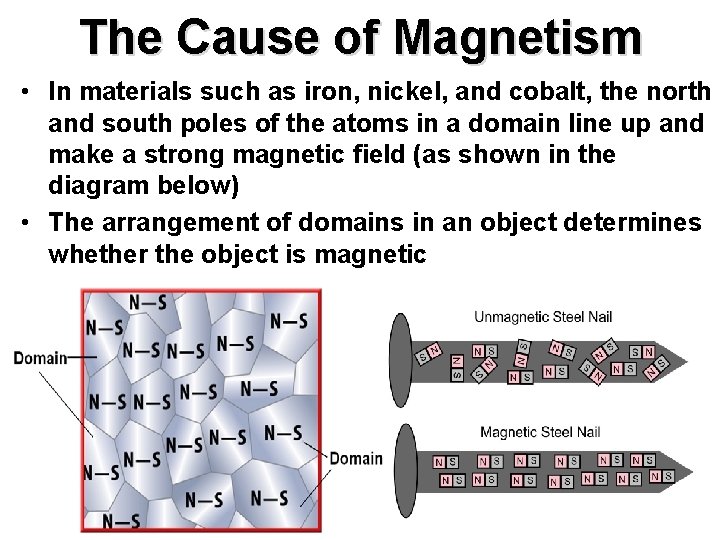
The Cause of Magnetism • In materials such as iron, nickel, and cobalt, the north and south poles of the atoms in a domain line up and make a strong magnetic field (as shown in the diagram below) • The arrangement of domains in an object determines whether the object is magnetic
Losing Alignment • The domains of a magnet may not always stay lined up • When domains move, the magnet is demagnetized, or loses it magnetic properties • Ways to demagnetize (move domains) • Dropping a magnet or hitting it too hard • Putting the magnet in a strong magnetic field that is opposite to its own • Increasing the temperature of a magnet (in higher temperatures, atoms vibrate faster so they may no longer line up)
Making Magnets • You can make a magnet from something made of iron, cobalt, or nickel. You just need to line up the domains. • You can magnetize an iron nail by dragging a magnet down it many times (in one direction) • The domains in the nail line up with the magnetic field of the magnet. So, the domains in the nail become aligned. • As more domains line up, the magnetic field grows stronger.
Electricity and Magnetism • an electric current passing through a wire causes a magnetic field • electromagnetism – relationship between electricity and magnetism • a wire carrying an electric current always has a magnetic field around it – the magnetic field in a straight wire is not very strong – if the wire is wound into a coil, the magnetic field becomes much stronger as the individual magnetic fields overlap – the greater the number of coils, the stronger the magnetic field
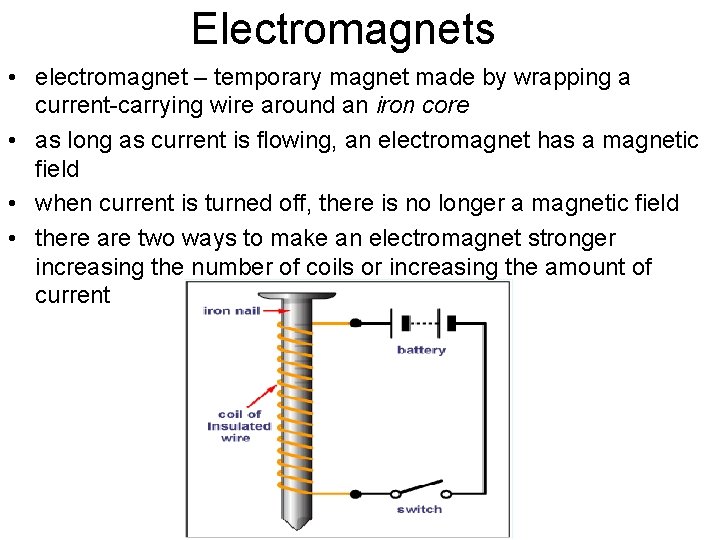
Electromagnets • electromagnet – temporary magnet made by wrapping a current-carrying wire around an iron core • as long as current is flowing, an electromagnet has a magnetic field • when current is turned off, there is no longer a magnetic field • there are two ways to make an electromagnet stronger increasing the number of coils or increasing the amount of current
• ELECTROMAGNETS • electromagnets are useful because they can be turned on and off electromagnets have many important uses ex. radios, telephones, computers • changing the direction of an electric current causes the poles of an electromagnet to reverse this feature is important in the production of electric motors • USES OF ELECTROMAGNETS • transformer – device in which alternating current in one coil of wire makes a current in a second coil • electric motor – device that changes electrical energy into mechanical energy • generator – device that changes mechanical energy into electrical energy a current can be induced in a loop of wire by spinning the loop inside a magnetic field due to the changing direction of the wire, an alternating current is produced • mechanical energy for many generators is supplied by turbines a turbine is a large wheel that is turned creating mechanical energy
Magnetic Fields https: //www. khanacademy. org/science/discoveries -projects/discoveries/magnetic-fields/p/magnetand-iron-filings