
Magnetic Variation CAT II and III Operations PANCPAFA

- Slides: 14
Magnetic Variation – CAT II and III Operations PANC/PAFA OSWG Presented by: John Swigart Date: March 18, 2015 Federal Aviation Administration
Overview • • Magnetic Variation 101 Airplane Systems, Airports, IAP Designs Mag. Var Tables Explained Course Steering Safety Effects if Airport & Airplane Mag. Var disagree Anchorage ILS Example Procedure Updates… Moving forward Federal Aviation Administration 2
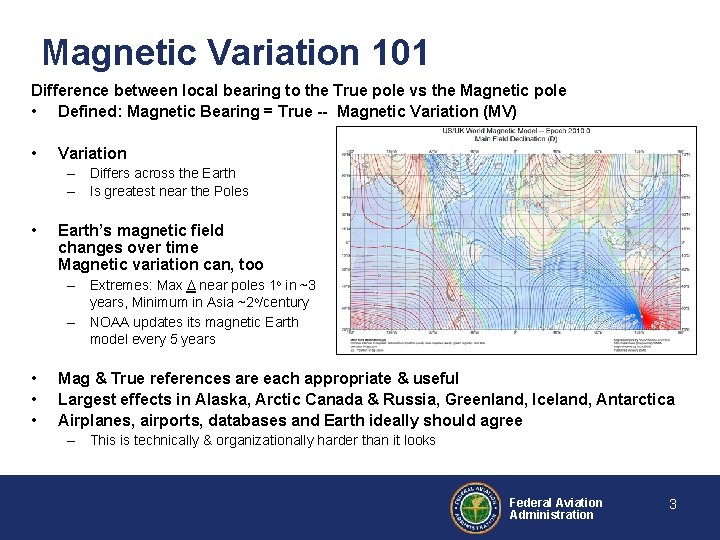
Magnetic Variation 101 Difference between local bearing to the True pole vs the Magnetic pole • Defined: Magnetic Bearing = True -- Magnetic Variation (MV) • Variation – Differs across the Earth – Is greatest near the Poles • Earth’s magnetic field changes over time Magnetic variation can, too – Extremes: Max D near poles 1 o in ~3 years, Minimum in Asia ~2 o/century – NOAA updates its magnetic Earth model every 5 years • • • Mag & True references are each appropriate & useful Largest effects in Alaska, Arctic Canada & Russia, Greenland, Iceland, Antarctica Airplanes, airports, databases and Earth ideally should agree – This is technically & organizationally harder than it looks Federal Aviation Administration 3
Airplane Systems, Airports, IAP Designs Air Navigation is a blend of True and Magnetic references • Most transport airplanes (with inertial) measure True and calculate Magnetic. Then they use both. • They do not include Magnetic sensors in nav solutions. – Don’t need to because they have inertials (IRS, IRU, ADIRU, etc) • They could, but would introduce other, even bigger errors – Global Nav, and most computers, work in True references – Magnetic values are converted from databases and for displays • Exceptions – Many RJs, turboprops & older jets rely on AHRS. They only measure magnetic. – Modern Standby systems measure magnetic. Those are independent, separate. • Most charts, runways, facility references & Navaids use Magnetic references • Instrument Approach Procedures, charts and airports use Magnetic references – Therefore they must all be updated as the Earth’s magnetic field moves – Always a challenge to reconcile the differences When it all works, it works very well, if all players understand limitations and obligations Federal Aviation Administration 4
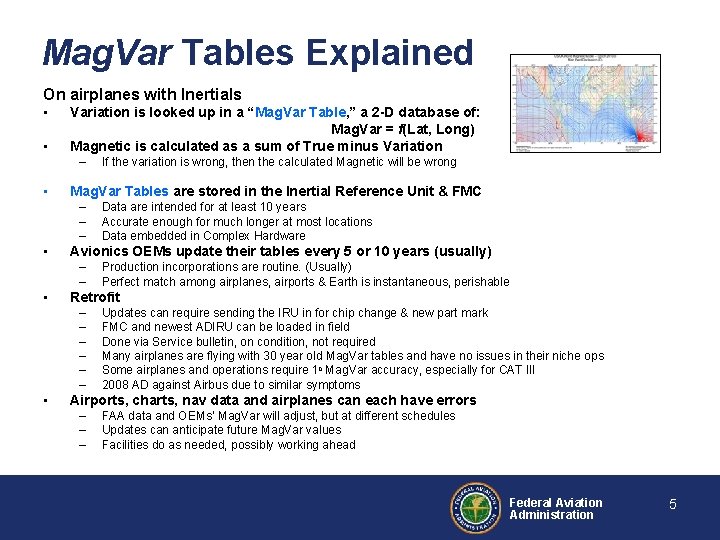
Mag. Var Tables Explained On airplanes with Inertials • • Variation is looked up in a “Mag. Var Table, ” a 2 -D database of: Mag. Var = f(Lat, Long) Magnetic is calculated as a sum of True minus Variation – • Mag. Var Tables are stored in the Inertial Reference Unit & FMC – – – • Production incorporations are routine. (Usually) Perfect match among airplanes, airports & Earth is instantaneous, perishable Retrofit – – – • Data are intended for at least 10 years Accurate enough for much longer at most locations Data embedded in Complex Hardware Avionics OEMs update their tables every 5 or 10 years (usually) – – • If the variation is wrong, then the calculated Magnetic will be wrong Updates can require sending the IRU in for chip change & new part mark FMC and newest ADIRU can be loaded in field Done via Service bulletin, on condition, not required Many airplanes are flying with 30 year old Mag. Var tables and have no issues in their niche ops Some airplanes and operations require 1 o Mag. Var accuracy, especially for CAT III 2008 AD against Airbus due to similar symptoms Airports, charts, nav data and airplanes can each have errors – – – FAA data and OEMs’ Mag. Var will adjust, but at different schedules Updates can anticipate future Mag. Var values Facilities do as needed, possibly working ahead Federal Aviation Administration 5
Course Steering • • Crew normally enters Magnetic course into the MCP, taken from the IAP chart Autopilot will construct a reference path in space – – – • On ILS, the autopilot computes steering commands using a blend of ILS and Inertial – – – • Tolerance varies by airplane type and by operation Differences between the LOC and the Inertial/Autopilot paths – • Biased to the ILS. A/P uses Inertial to stabilize, compensate for wind & turbulence, and to avoid chasing passing distortions in the LOC signal. VOR is similar. Important to the late stages of Autoland Specifics vary greatly by airplane type (blending schemes and error sensitivities) Systems can tolerate some nav source discrepancies – • Autopilot takes MCP Magnetic selection, adds Mag. Var from the inertial, builds a True course line, and commands that. If Mag. Var is wrong, then the commanded course diverges from local magnetic Navaids or visual references make large errors apparent. Small errors less so. Include Mag. Var errors, LOC distortion and errors, charting resolution, some FTE When Inertial Reference and the Localizer are in conflict – – – The autopilot tries to obey both. Trouble occurs when they disagree too much. Bulk of the issue appears during capture When any autopilot cannot reconcile its inputs, it gives the airplane back to the crew. This is good. Federal Aviation Administration 6
Safety Effects if Airport & Airplane Mag. Var disagree • • IRU will cause an error when flying a commanded course ILS, far away (usual symptom) – Missed capture – Try again, or try something else – Missed approach – Annoying, expensive, generally not dangerous ILS close in (less likely) – Poor or unstabilized approach dynamics – Misalignment with the physical runway when trying to capture. On an ADF procedure – Course misalignment. Misleading, especially while outbound. – HSI/RDMI are correct – Escape from TERPS area if unnoticed. – Potentially hazardous Federal Aviation Administration 7
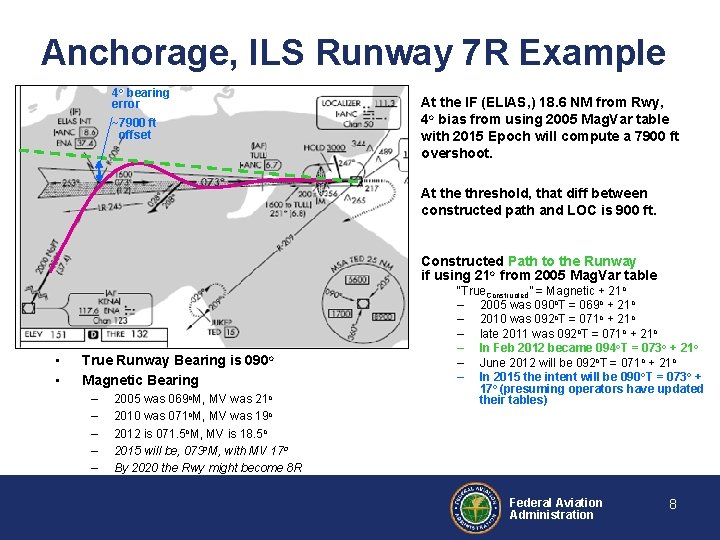
Anchorage, ILS Runway 7 R Example 4 o bearing error ~7900 ft offset At the IF (ELIAS, ) 18. 6 NM from Rwy, 4 o bias from using 2005 Mag. Var table with 2015 Epoch will compute a 7900 ft overshoot. At the threshold, that diff between constructed path and LOC is 900 ft. Constructed Path to the Runway if using 21 o from 2005 Mag. Var table • • True Runway Bearing is 090 o Magnetic Bearing – – – 2005 was 069 o. M, MV was 21 o 2010 was 071 o. M, MV was 19 o 2012 is 071. 5 o. M, MV is 18. 5 o 2015 will be, 073 o. M, with MV 17 o By 2020 the Rwy might become 8 R “True. Constructed” = Magnetic + 21 o – 2005 was 090 o. T = 069 o + 21 o – 2010 was 092 o. T = 071 o + 21 o – late 2011 was 092 o. T = 071 o + 21 o – In Feb 2012 became 094 o. T = 073 o + 21 o – June 2012 will be 092 o. T = 071 o + 21 o – In 2015 the intent will be 090 o. T = 073 o + 17 o (presuming operators have updated their tables) Federal Aviation Administration 8
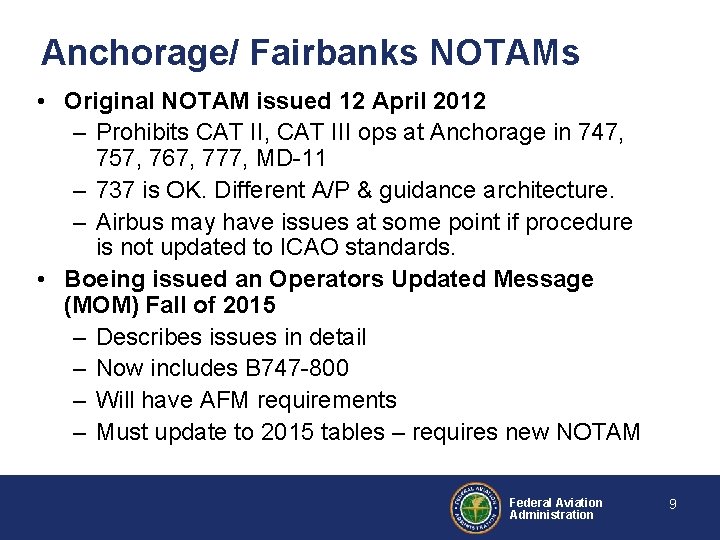
Anchorage/ Fairbanks NOTAMs • Original NOTAM issued 12 April 2012 – Prohibits CAT II, CAT III ops at Anchorage in 747, 757, 767, 777, MD-11 – 737 is OK. Different A/P & guidance architecture. – Airbus may have issues at some point if procedure is not updated to ICAO standards. • Boeing issued an Operators Updated Message (MOM) Fall of 2015 – Describes issues in detail – Now includes B 747 -800 – Will have AFM requirements – Must update to 2015 tables – requires new NOTAM Federal Aviation Administration 9
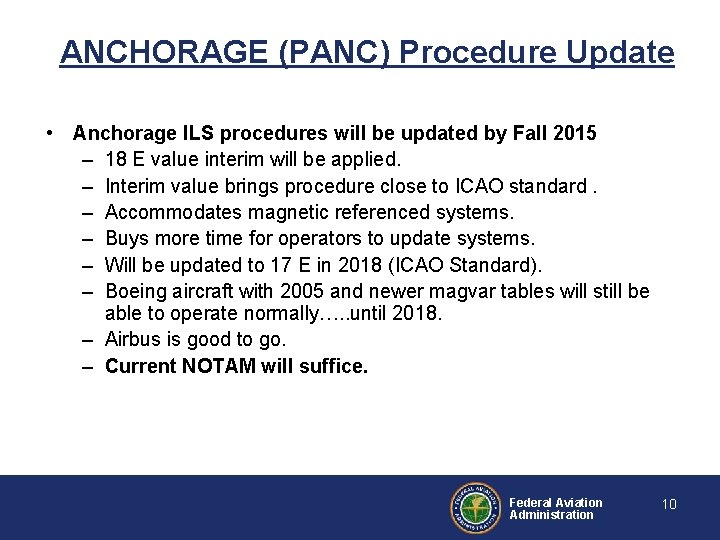
ANCHORAGE (PANC) Procedure Update • Anchorage ILS procedures will be updated by Fall 2015 – 18 E value interim will be applied. – Interim value brings procedure close to ICAO standard. – Accommodates magnetic referenced systems. – Buys more time for operators to update systems. – Will be updated to 17 E in 2018 (ICAO Standard). – Boeing aircraft with 2005 and newer magvar tables will still be able to operate normally…. . until 2018. – Airbus is good to go. – Current NOTAM will suffice. Federal Aviation Administration 10
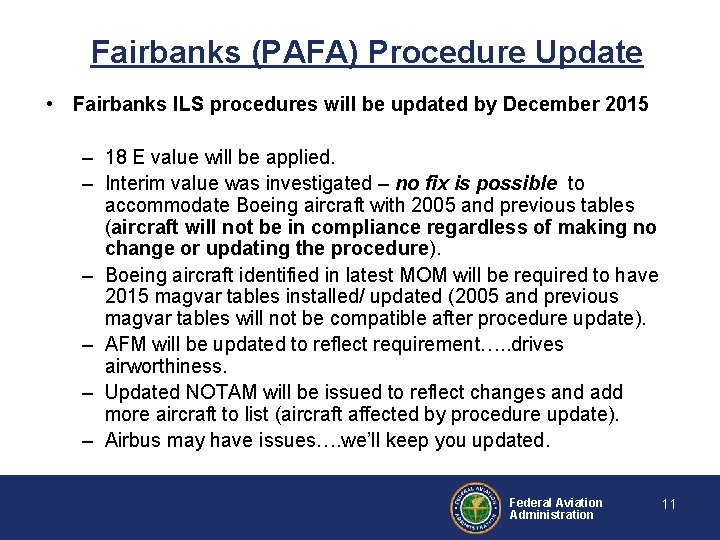
Fairbanks (PAFA) Procedure Update • Fairbanks ILS procedures will be updated by December 2015 – 18 E value will be applied. – Interim value was investigated – no fix is possible to accommodate Boeing aircraft with 2005 and previous tables (aircraft will not be in compliance regardless of making no change or updating the procedure). – Boeing aircraft identified in latest MOM will be required to have 2015 magvar tables installed/ updated (2005 and previous magvar tables will not be compatible after procedure update). – AFM will be updated to reflect requirement…. . drives airworthiness. – Updated NOTAM will be issued to reflect changes and add more aircraft to list (aircraft affected by procedure update). – Airbus may have issues…. we’ll keep you updated. Federal Aviation Administration 11
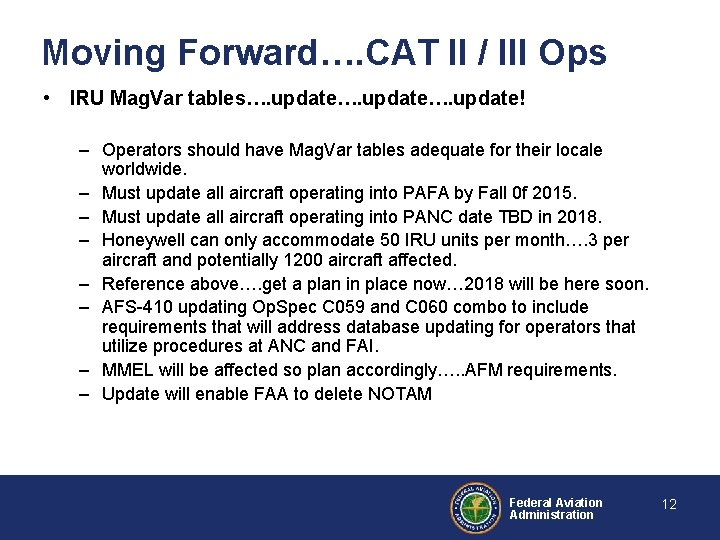
Moving Forward…. CAT II / III Ops • IRU Mag. Var tables…. update…. update! – Operators should have Mag. Var tables adequate for their locale worldwide. – Must update all aircraft operating into PAFA by Fall 0 f 2015. – Must update all aircraft operating into PANC date TBD in 2018. – Honeywell can only accommodate 50 IRU units per month…. 3 per aircraft and potentially 1200 aircraft affected. – Reference above…. get a plan in place now… 2018 will be here soon. – AFS-410 updating Op. Spec C 059 and C 060 combo to include requirements that will address database updating for operators that utilize procedures at ANC and FAI. – MMEL will be affected so plan accordingly…. . AFM requirements. – Update will enable FAA to delete NOTAM Federal Aviation Administration 12
Moving Forward…. • IRU Mag. Var tables…. update…. update! § Honeywell can only accommodate 50 IRU units per month…. 3 per aircraft and potentially 1200 aircraft affected. – Reference above…. get a plan in place now… 2018 will be here soon. – AFS-410 updating Op. Spec C 059 and C 060 combo to include requirements that will address database updating for operators that utilize procedures at ANC and FAI. – MMEL will be affected so plan accordingly…. . AFM requirements Federal Aviation Administration 13
Thank you Federal Aviation Administration 14