
MAGNETIC SPRING Reporter Reza M Namin 1 IYPT
- Slides: 22
MAGNETIC SPRING Reporter: Reza M. Namin 1 IYPT 2010 Austria, I. R. Iran
The Question • Two magnets are arranged on top of each other such that one is fixed and the other can move vertically, • Investigate the oscillations of the magnet. 2 IYPT 2010 Austria, I. R. Iran
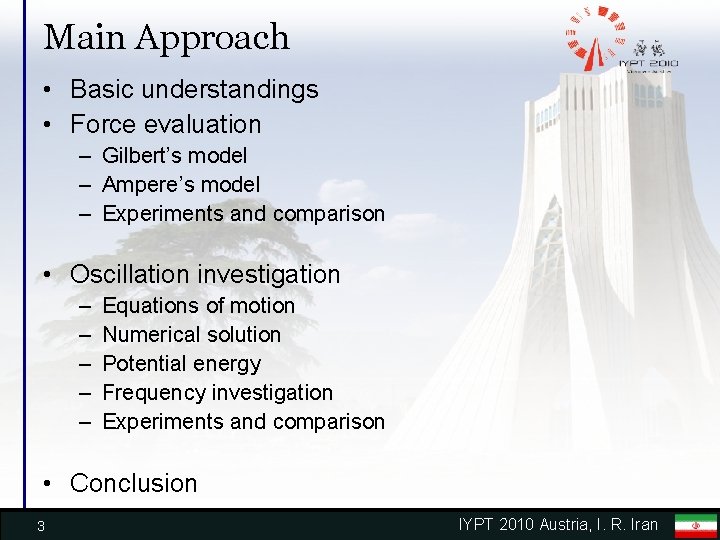
Main Approach • Basic understandings • Force evaluation – Gilbert’s model – Ampere’s model – Experiments and comparison • Oscillation investigation – – – Equations of motion Numerical solution Potential energy Frequency investigation Experiments and comparison • Conclusion 3 IYPT 2010 Austria, I. R. Iran
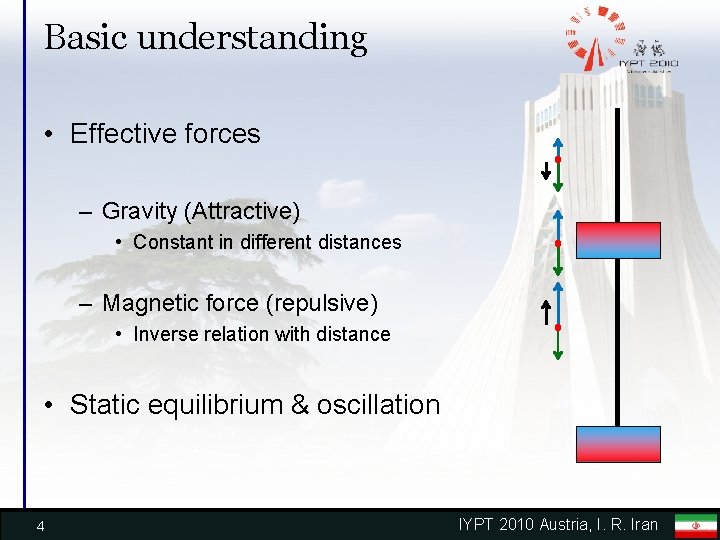
Basic understanding • Effective forces – Gravity (Attractive) • Constant in different distances – Magnetic force (repulsive) • Inverse relation with distance • Static equilibrium & oscillation 4 IYPT 2010 Austria, I. R. Iran
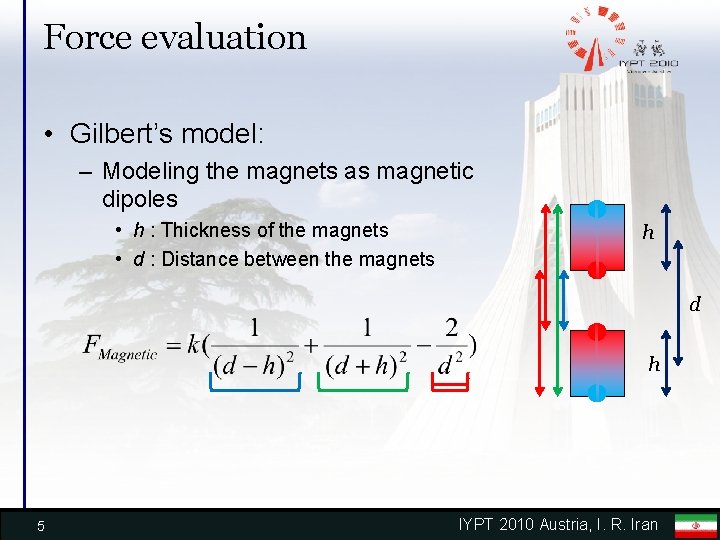
Force evaluation • Gilbert’s model: – Modeling the magnets as magnetic dipoles • h : Thickness of the magnets • d : Distance between the magnets h d h 5 IYPT 2010 Austria, I. R. Iran
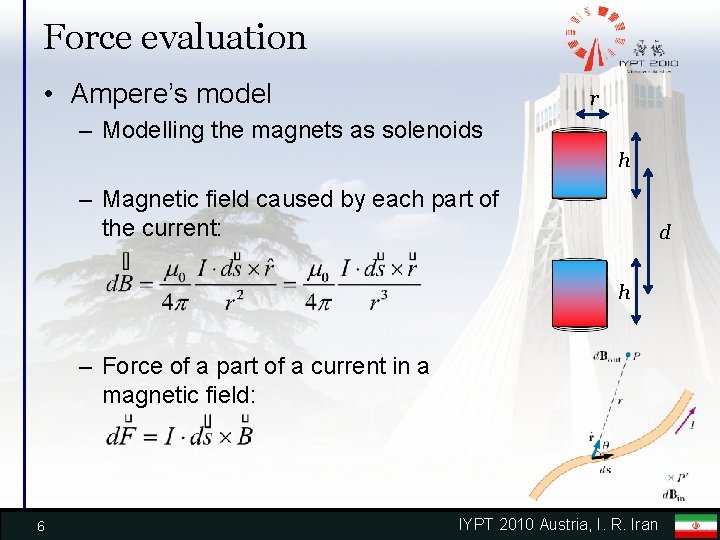
Force evaluation • Ampere’s model r – Modelling the magnets as solenoids h – Magnetic field caused by each part of the current: d h – Force of a part of a current in a magnetic field: 6 IYPT 2010 Austria, I. R. Iran
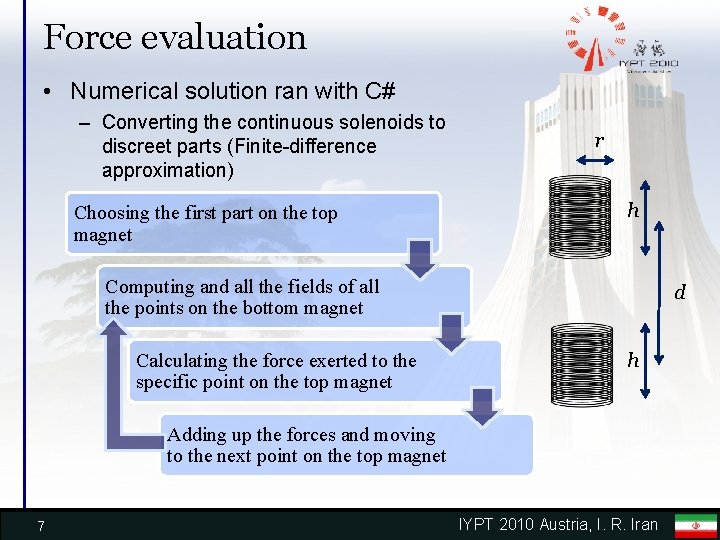
Force evaluation • Numerical solution ran with C# – Converting the continuous solenoids to discreet parts (Finite-difference approximation) Choosing the first part on the top magnet r h Computing and all the fields of all the points on the bottom magnet Calculating the force exerted to the specific point on the top magnet d h Adding up the forces and moving to the next point on the top magnet 7 IYPT 2010 Austria, I. R. Iran
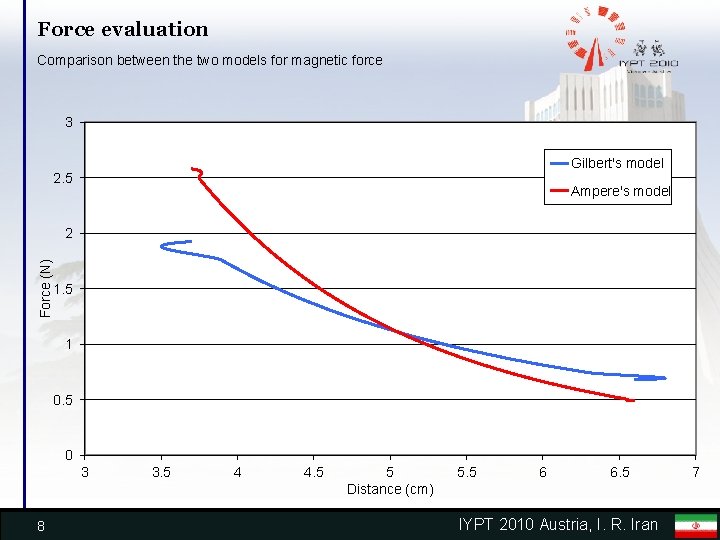
Force evaluation Comparison between the two models for magnetic force 3 Gilbert's model 2. 5 Ampere's model Force (N) 2 1. 5 1 0. 5 0 3 8 3. 5 4 4. 5 5 Distance (cm) 5. 5 6 6. 5 IYPT 2010 Austria, I. R. Iran 7
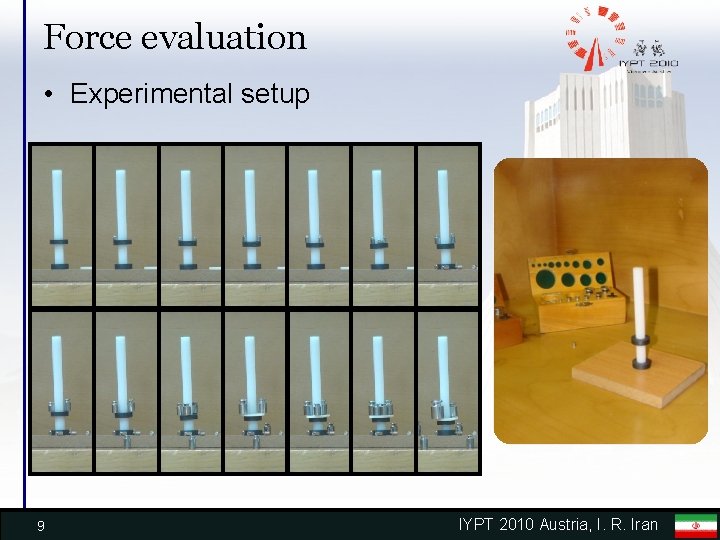
Force evaluation • Experimental setup 9 IYPT 2010 Austria, I. R. Iran
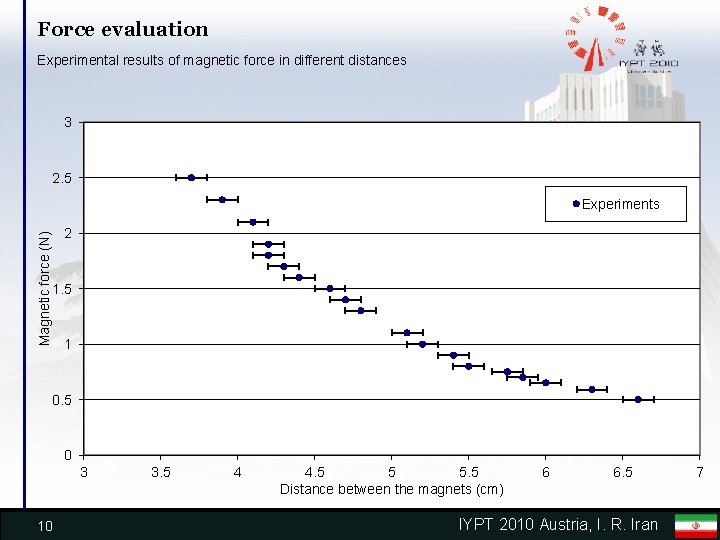
Force evaluation Experimental results of magnetic force in different distances 3 2. 5 Magnetic force (N) Experiments 2 1. 5 1 0. 5 0 3 10 3. 5 4 4. 5 5 5. 5 Distance between the magnets (cm) 6 6. 5 IYPT 2010 Austria, I. R. Iran 7
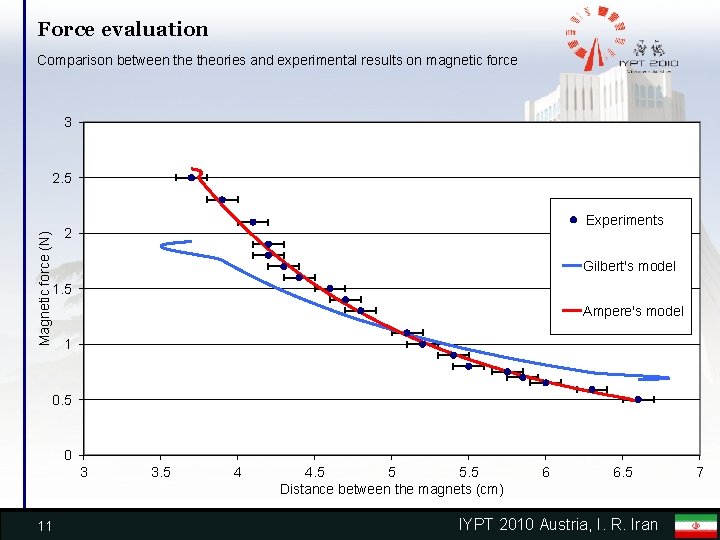
Force evaluation Comparison between theories and experimental results on magnetic force 3 Magnetic force (N) 2. 5 Experiments 2 Gilbert's model 1. 5 Ampere's model 1 0. 5 0 3 11 3. 5 4 4. 5 5 5. 5 Distance between the magnets (cm) 6 6. 5 IYPT 2010 Austria, I. R. Iran 7
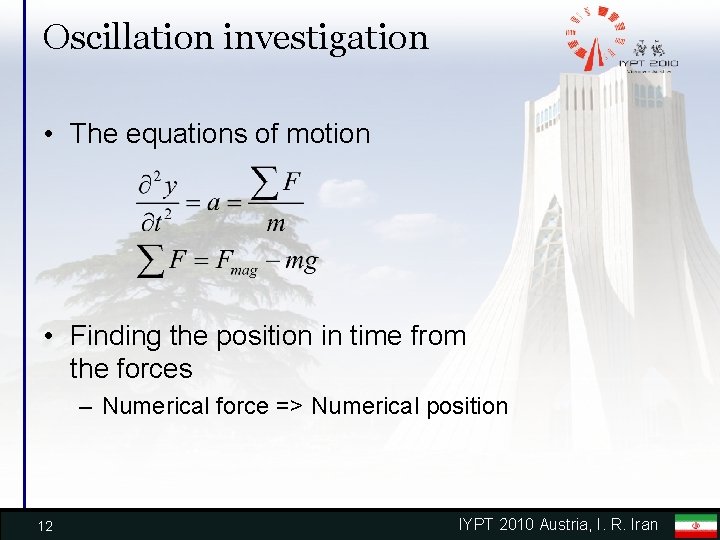
Oscillation investigation • The equations of motion • Finding the position in time from the forces – Numerical force => Numerical position 12 IYPT 2010 Austria, I. R. Iran
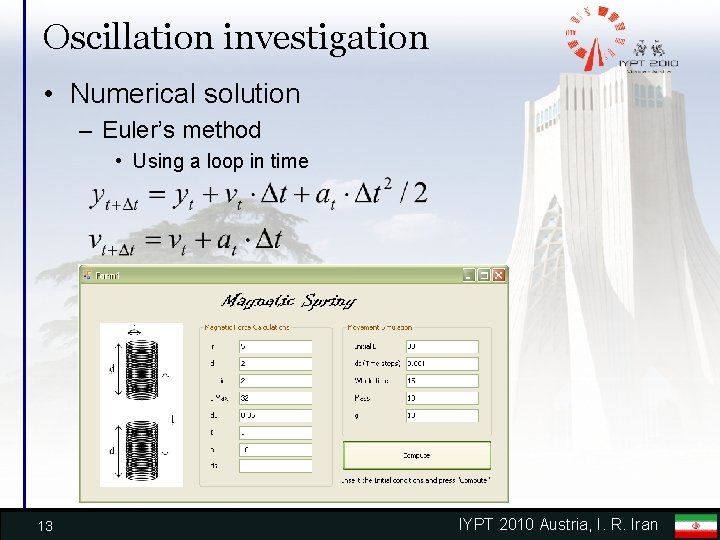
Oscillation investigation • Numerical solution – Euler’s method • Using a loop in time 13 IYPT 2010 Austria, I. R. Iran
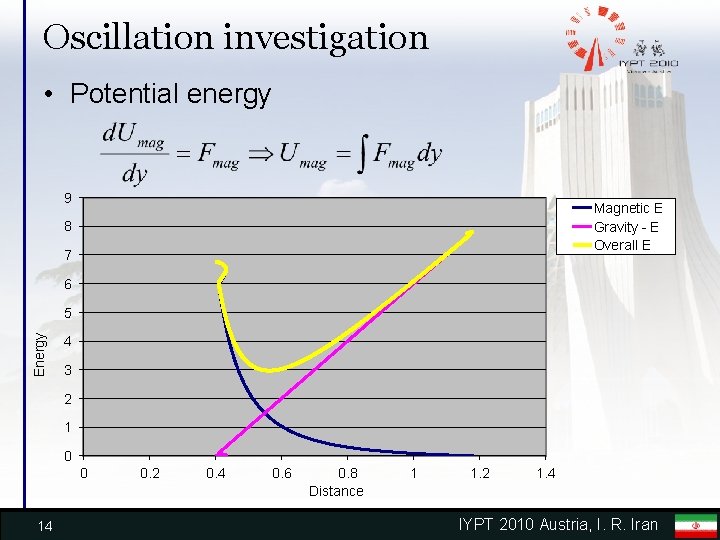
Oscillation investigation • Potential energy 9 Magnetic E Gravity - E Overall E 8 7 6 Energy 5 4 3 2 1 0 0 14 0. 2 0. 4 0. 6 0. 8 Distance 1 1. 2 1. 4 IYPT 2010 Austria, I. R. Iran
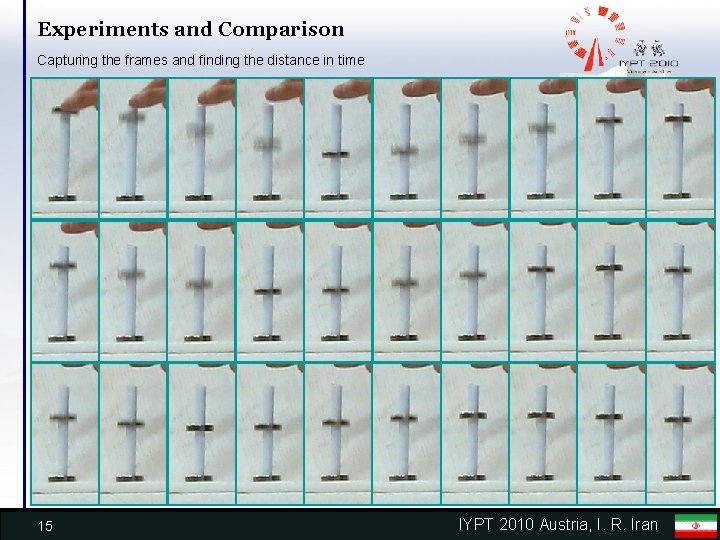
Experiments and Comparison Capturing the frames and finding the distance in time 15 IYPT 2010 Austria, I. R. Iran
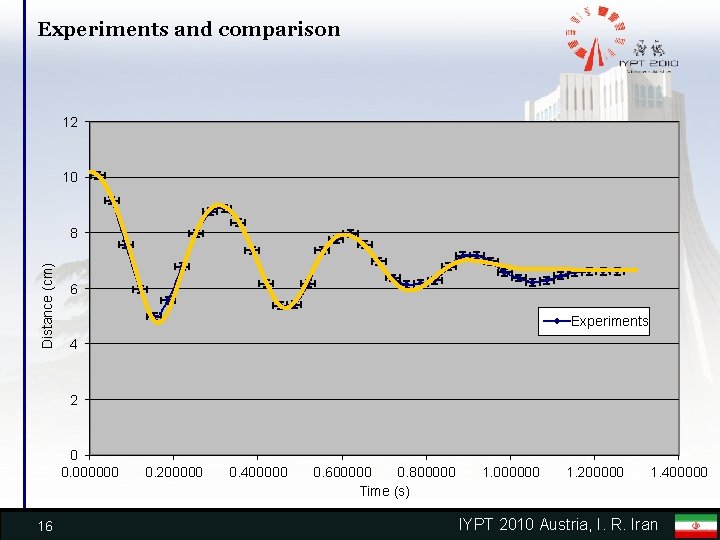
Experiments and comparison 12 10 Distance (cm) 8 6 Experiments 4 2 0 0. 000000 16 0. 200000 0. 400000 0. 600000 0. 800000 Time (s) 1. 000000 1. 200000 1. 400000 IYPT 2010 Austria, I. R. Iran
Conclusion • According to the force evaluation: – Considering the magnets to be solenoids (ampere’s model) will give accurate force relation. – Gilbert's model does not lead to precise results compared to the ampere’s model 17 IYPT 2010 Austria, I. R. Iran
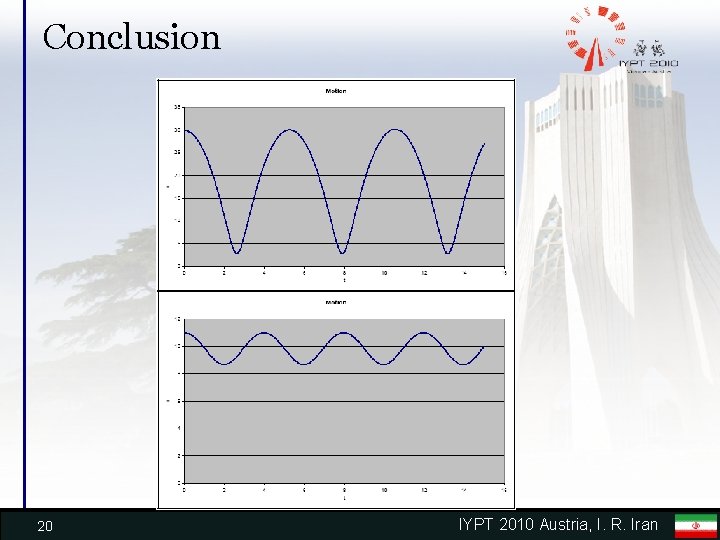
Conclusion • According to the oscillation investigations: – The motion of the magnet has been successfully solved numerically. – The motion has more acceleration in top and less in downside of the movement 18 IYPT 2010 Austria, I. R. Iran
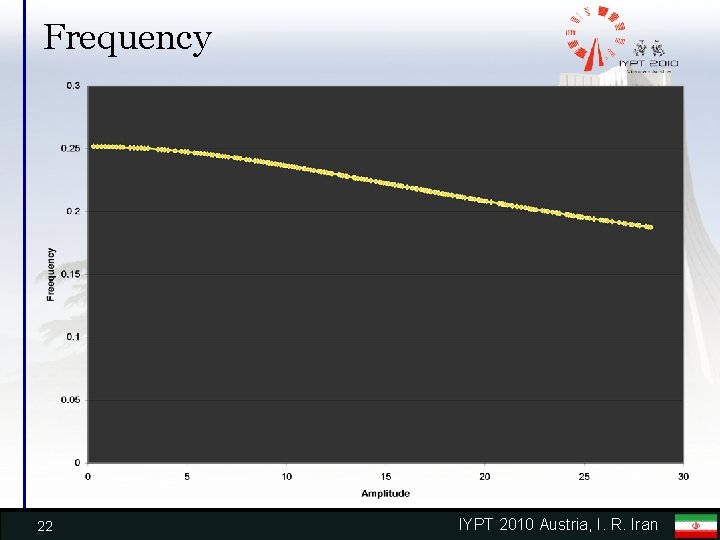
Conclusion – The motion approaches to simple harmonic motion when amplitude approaches to zero. – The motion approaches to free fall bouncing when amplitude approaches to infinity. 19 IYPT 2010 Austria, I. R. Iran
Conclusion 20 IYPT 2010 Austria, I. R. Iran
Thank you For your attention IYPT 2010 Austria, IYPT National 2010 Austria, team of I. R. Iran
Frequency 22 IYPT 2010 Austria, I. R. Iran