
Magnetic sensors and logic gates Ling Zhou EE
- Slides: 22
Magnetic sensors and logic gates Ling Zhou EE 698 A Advanced Electron Devices
Outline • • Anisotropic magnetoresistive sensors Giant magnetoresistive sensors Colossal magnetoresistive sensors Using magnetoresistive elements to build up logic gates • Hall sensors and devices EE 698 A Advanced Electron Devices
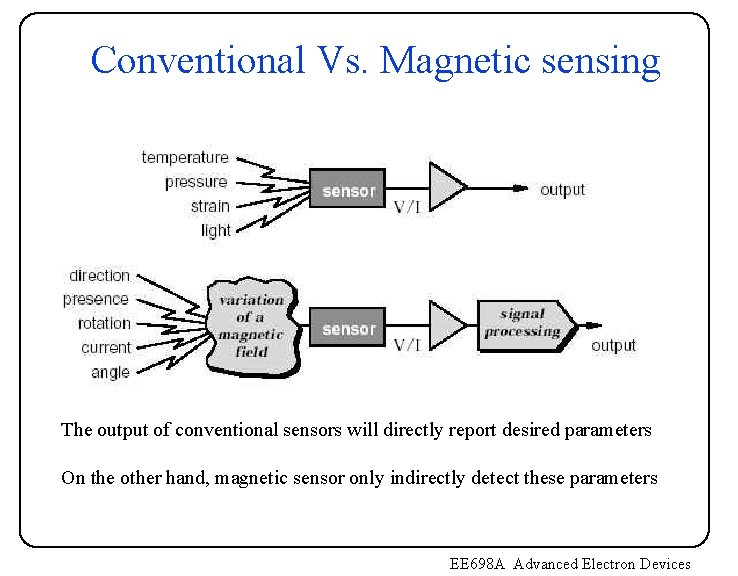
Conventional Vs. Magnetic sensing The output of conventional sensors will directly report desired parameters On the other hand, magnetic sensor only indirectly detect these parameters EE 698 A Advanced Electron Devices
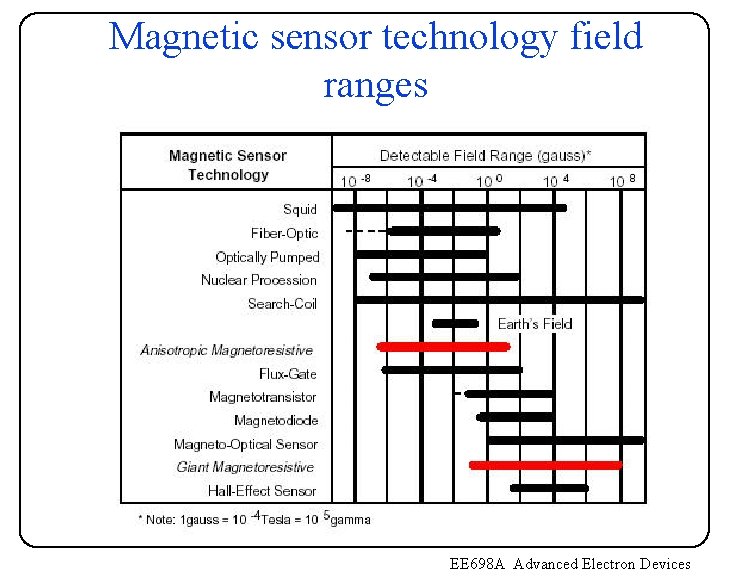
Magnetic sensor technology field ranges EE 698 A Advanced Electron Devices
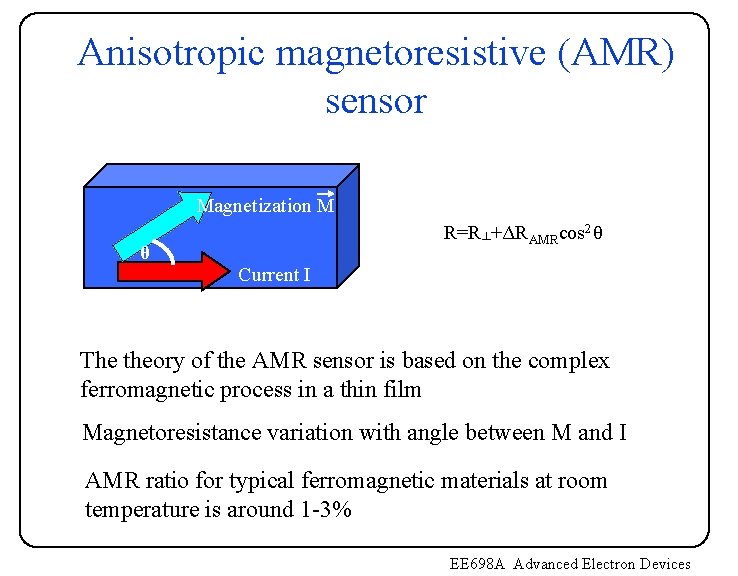
Anisotropic magnetoresistive (AMR) sensor Magnetization M θ R=R┴+ΔRAMRcos 2 θ Current I The theory of the AMR sensor is based on the complex ferromagnetic process in a thin film Magnetoresistance variation with angle between M and I AMR ratio for typical ferromagnetic materials at room temperature is around 1 -3% EE 698 A Advanced Electron Devices
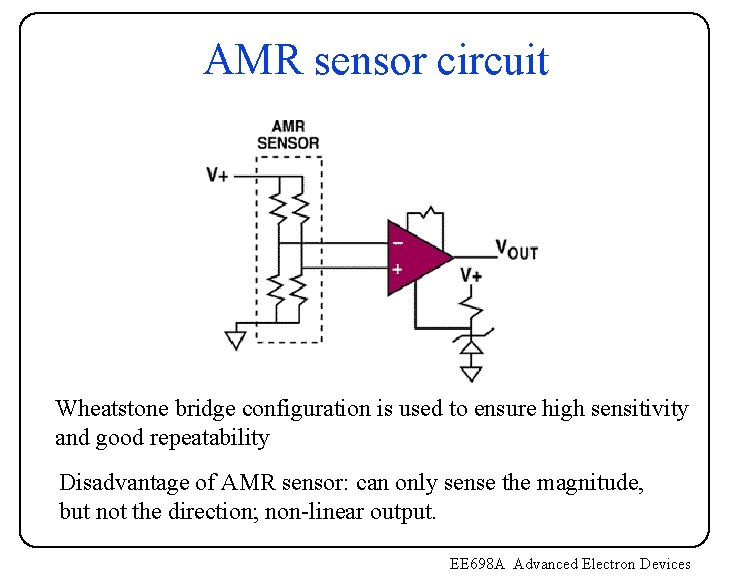
AMR sensor circuit Wheatstone bridge configuration is used to ensure high sensitivity and good repeatability Disadvantage of AMR sensor: can only sense the magnitude, but not the direction; non-linear output. EE 698 A Advanced Electron Devices
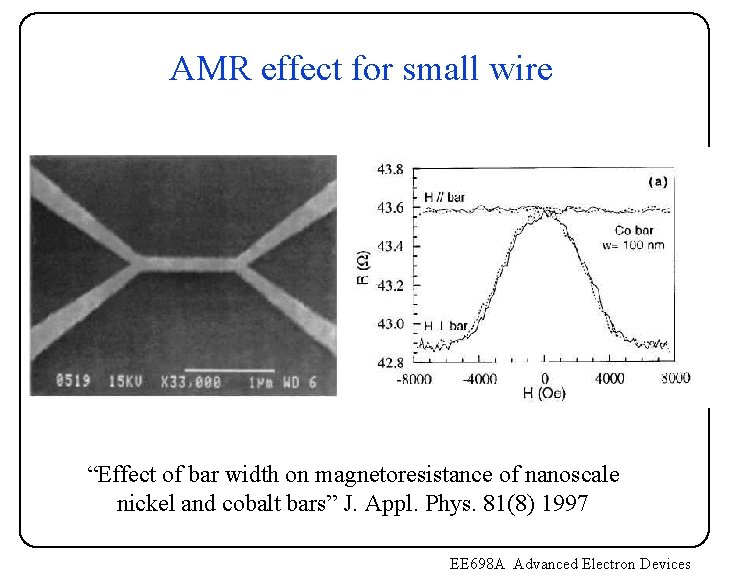
AMR effect for small wire “Effect of bar width on magnetoresistance of nanoscale nickel and cobalt bars” J. Appl. Phys. 81(8) 1997 EE 698 A Advanced Electron Devices
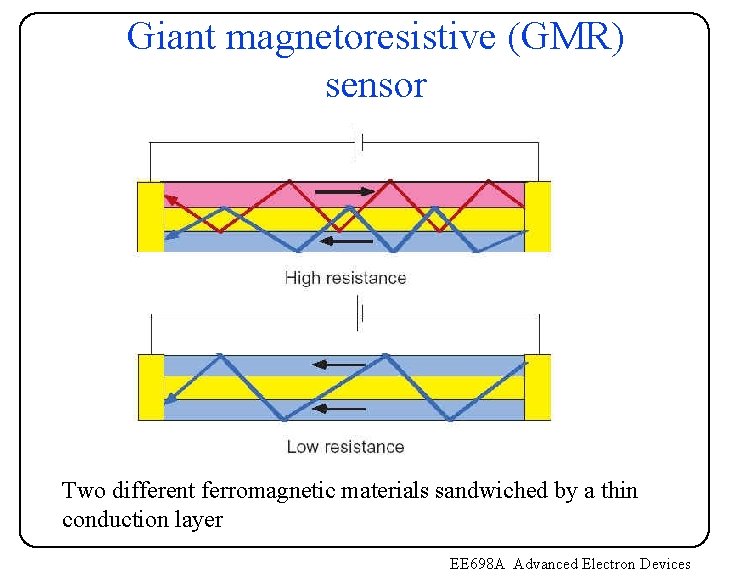
Giant magnetoresistive (GMR) sensor Two different ferromagnetic materials sandwiched by a thin conduction layer EE 698 A Advanced Electron Devices
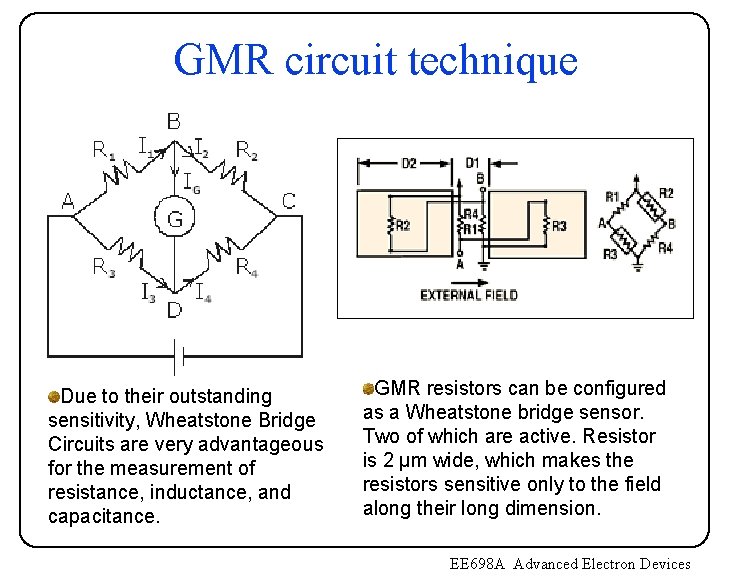
GMR circuit technique Due to their outstanding sensitivity, Wheatstone Bridge Circuits are very advantageous for the measurement of resistance, inductance, and capacitance. GMR resistors can be configured as a Wheatstone bridge sensor. Two of which are active. Resistor is 2 µm wide, which makes the resistors sensitive only to the field along their long dimension. EE 698 A Advanced Electron Devices
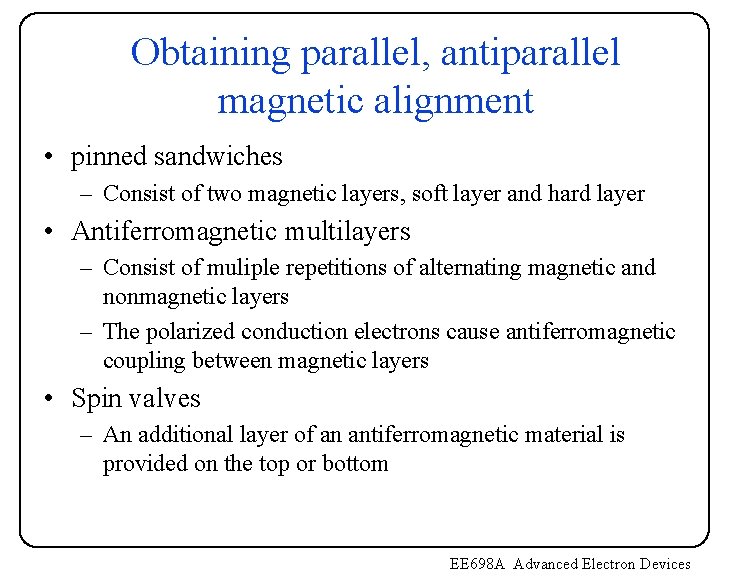
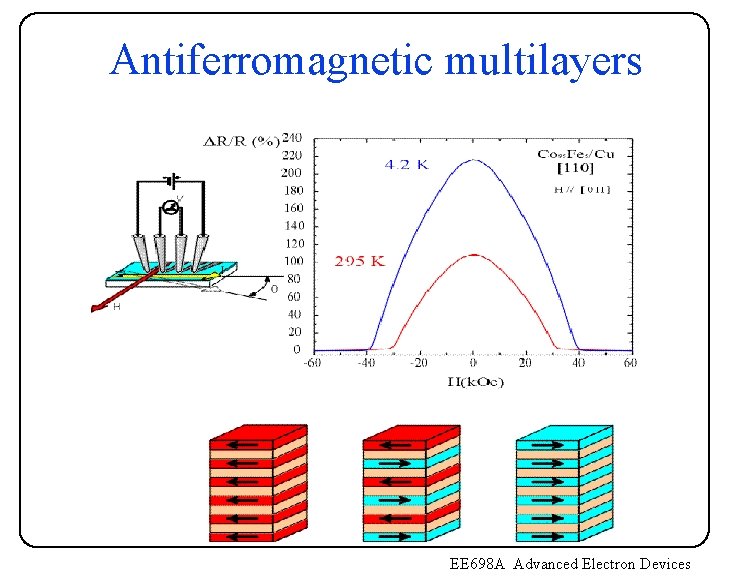
Obtaining parallel, antiparallel magnetic alignment • pinned sandwiches – Consist of two magnetic layers, soft layer and hard layer • Antiferromagnetic multilayers – Consist of muliple repetitions of alternating magnetic and nonmagnetic layers – The polarized conduction electrons cause antiferromagnetic coupling between magnetic layers • Spin valves – An additional layer of an antiferromagnetic material is provided on the top or bottom EE 698 A Advanced Electron Devices
Antiferromagnetic multilayers EE 698 A Advanced Electron Devices
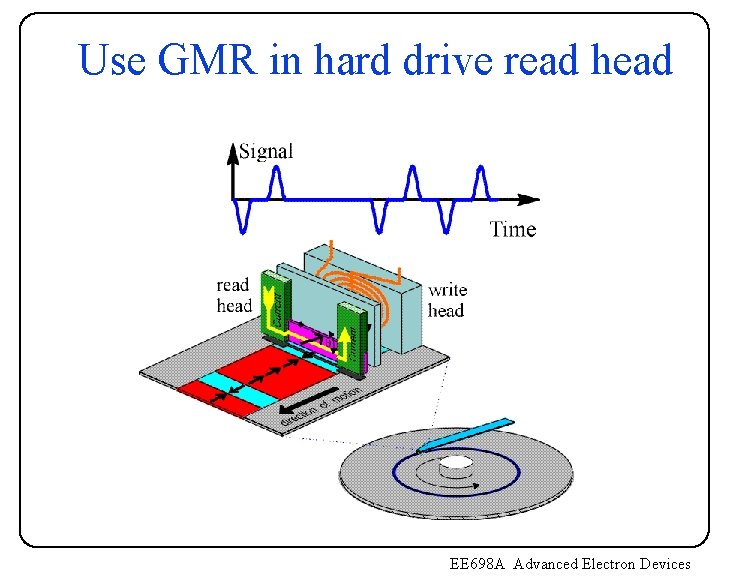
Use GMR in hard drive read head EE 698 A Advanced Electron Devices
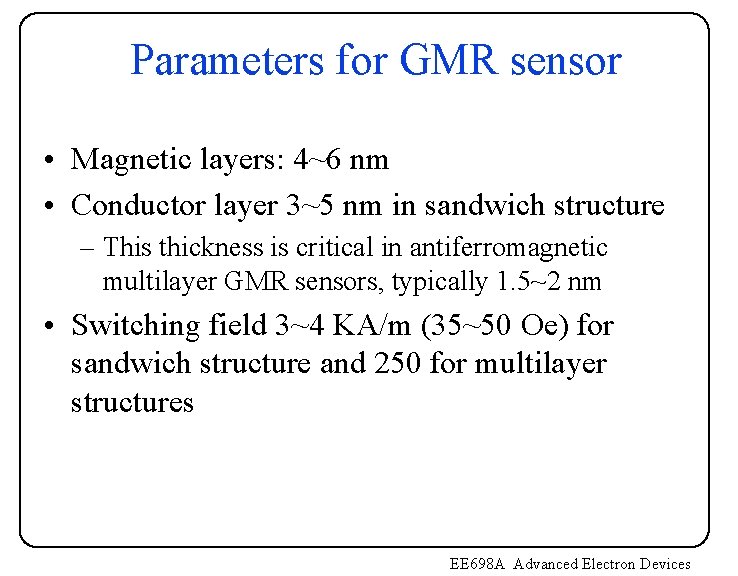
Parameters for GMR sensor • Magnetic layers: 4~6 nm • Conductor layer 3~5 nm in sandwich structure – This thickness is critical in antiferromagnetic multilayer GMR sensors, typically 1. 5~2 nm • Switching field 3~4 KA/m (35~50 Oe) for sandwich structure and 250 for multilayer structures EE 698 A Advanced Electron Devices
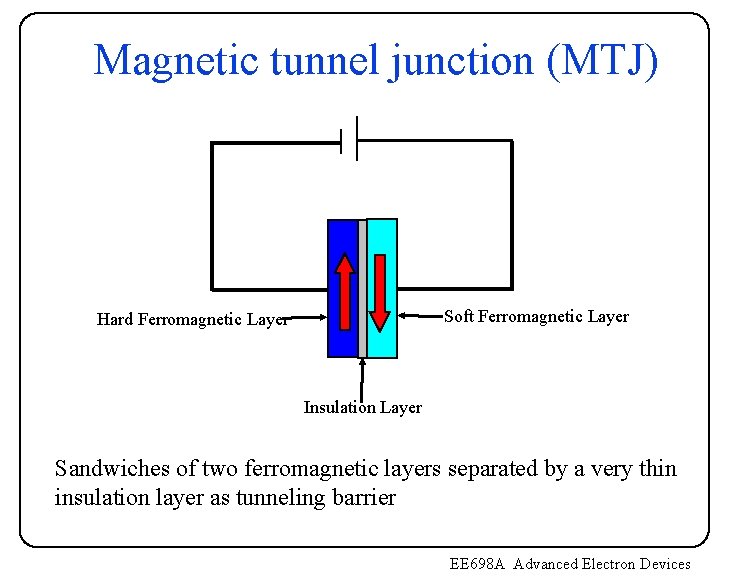
Magnetic tunnel junction (MTJ) Soft Ferromagnetic Layer Hard Ferromagnetic Layer Insulation Layer Sandwiches of two ferromagnetic layers separated by a very thin insulation layer as tunneling barrier EE 698 A Advanced Electron Devices
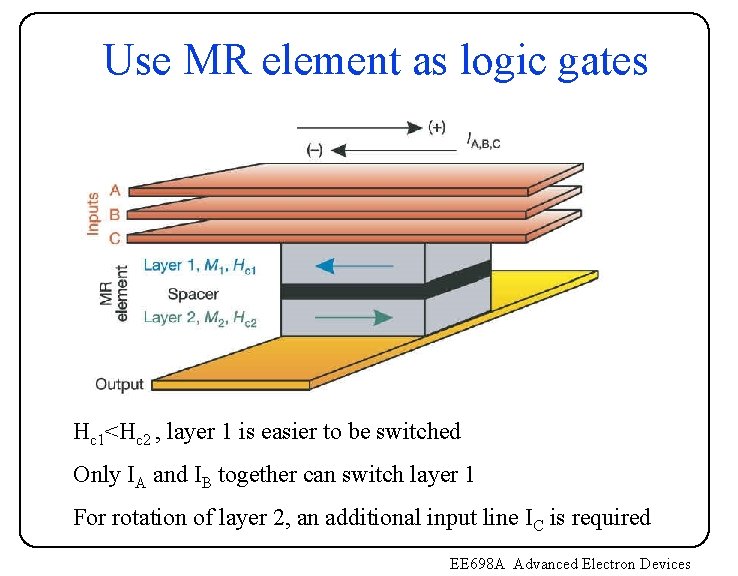
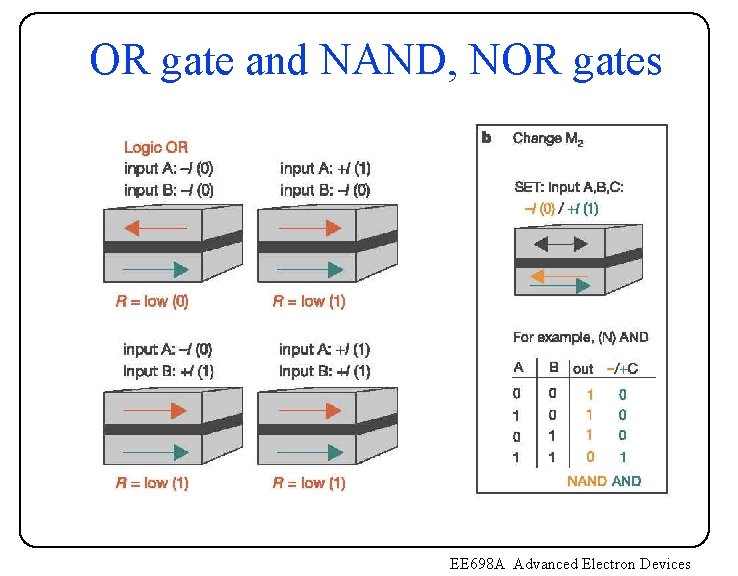
Use MR element as logic gates Hc 1<Hc 2 , layer 1 is easier to be switched Only IA and IB together can switch layer 1 For rotation of layer 2, an additional input line IC is required EE 698 A Advanced Electron Devices
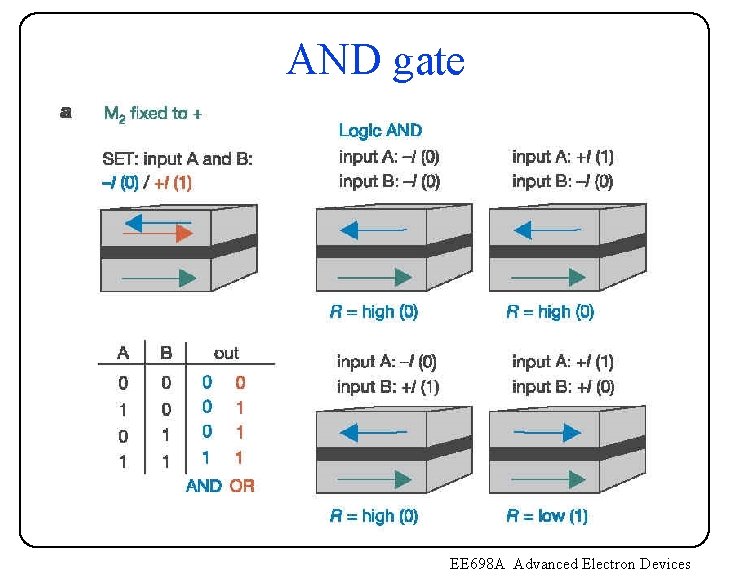
AND gate EE 698 A Advanced Electron Devices
OR gate and NAND, NOR gates EE 698 A Advanced Electron Devices
Advantages of MR element • A single MR element is sufficient to realize and store four basic logic functionalities. Integration density is increased. • The output is non-volatile and repeatedly readable without refreshing, which reduces the heat evolution. • Fast operation: the switching of frequency of magnetic films can be pushed to several GHZ. • Low power consumption. EE 698 A Advanced Electron Devices
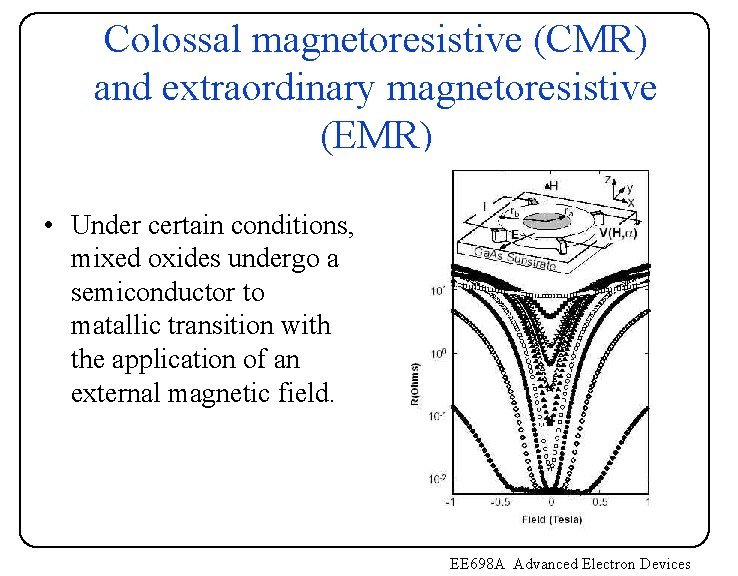
Colossal magnetoresistive (CMR) and extraordinary magnetoresistive (EMR) • Under certain conditions, mixed oxides undergo a semiconductor to matallic transition with the application of an external magnetic field. EE 698 A Advanced Electron Devices
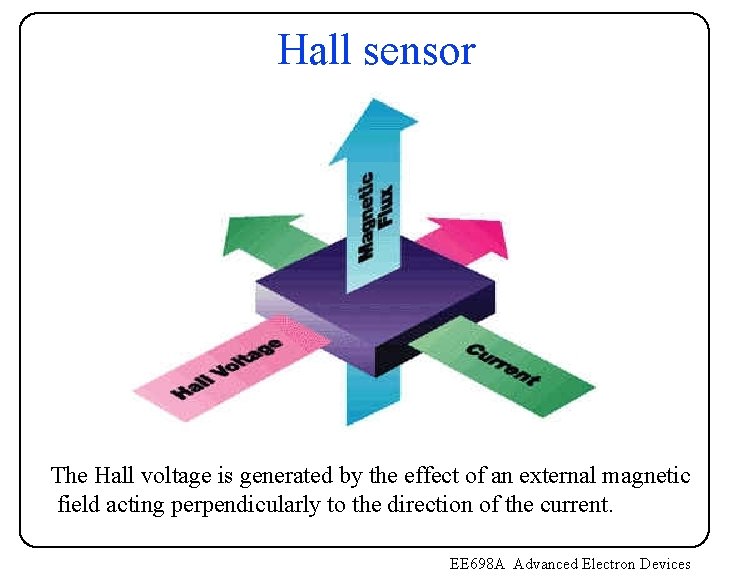
Hall sensor The Hall voltage is generated by the effect of an external magnetic field acting perpendicularly to the direction of the current. EE 698 A Advanced Electron Devices
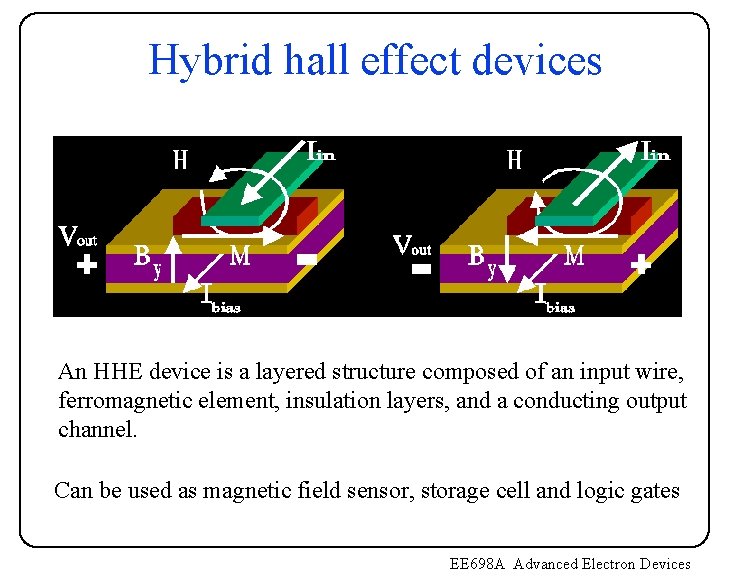
Hybrid hall effect devices An HHE device is a layered structure composed of an input wire, ferromagnetic element, insulation layers, and a conducting output channel. Can be used as magnetic field sensor, storage cell and logic gates EE 698 A Advanced Electron Devices
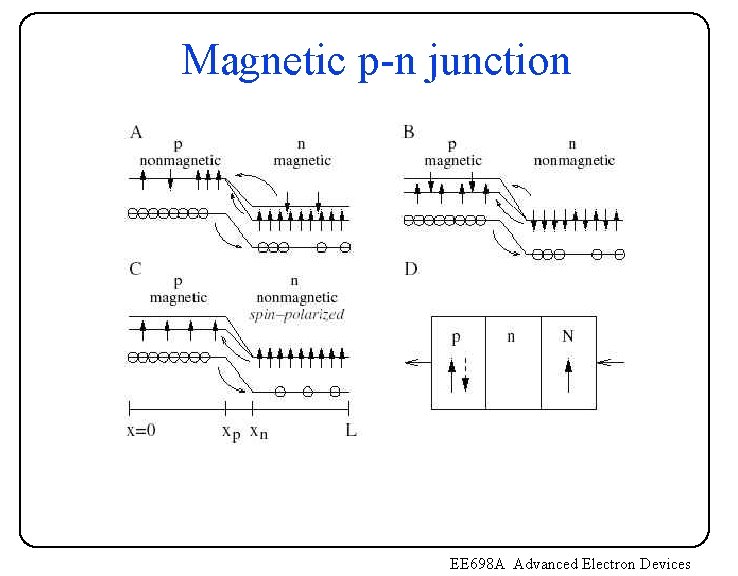
Magnetic p-n junction EE 698 A Advanced Electron Devices