
Magnetic Resonance Imaging MRI and Magnetic Resonance Spectroscopy
- Slides: 7
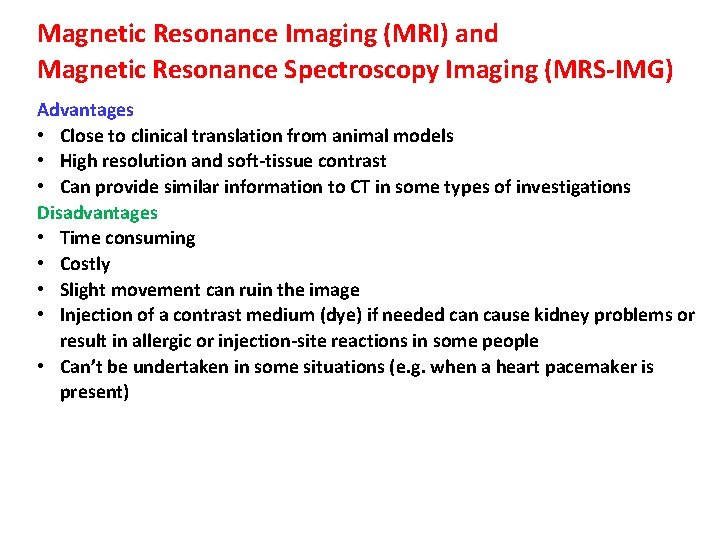
Magnetic Resonance Imaging (MRI) and Magnetic Resonance Spectroscopy Imaging (MRS-IMG) Advantages • Close to clinical translation from animal models • High resolution and soft-tissue contrast • Can provide similar information to CT in some types of investigations Disadvantages • Time consuming • Costly • Slight movement can ruin the image • Injection of a contrast medium (dye) if needed can cause kidney problems or result in allergic or injection-site reactions in some people • Can’t be undertaken in some situations (e. g. when a heart pacemaker is present)
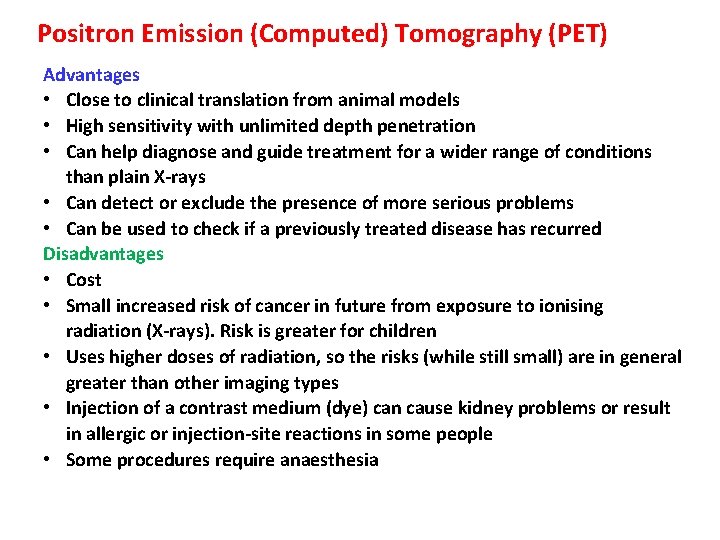
Positron Emission (Computed) Tomography (PET) Advantages • Close to clinical translation from animal models • High sensitivity with unlimited depth penetration • Can help diagnose and guide treatment for a wider range of conditions than plain X-rays • Can detect or exclude the presence of more serious problems • Can be used to check if a previously treated disease has recurred Disadvantages • Cost • Small increased risk of cancer in future from exposure to ionising radiation (X-rays). Risk is greater for children • Uses higher doses of radiation, so the risks (while still small) are in general greater than other imaging types • Injection of a contrast medium (dye) can cause kidney problems or result in allergic or injection-site reactions in some people • Some procedures require anaesthesia
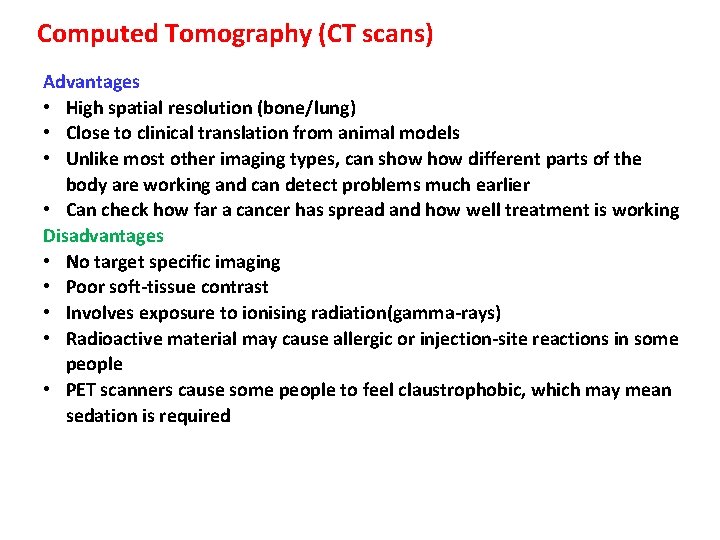
Computed Tomography (CT scans) Advantages • High spatial resolution (bone/lung) • Close to clinical translation from animal models • Unlike most other imaging types, can show different parts of the body are working and can detect problems much earlier • Can check how far a cancer has spread and how well treatment is working Disadvantages • No target specific imaging • Poor soft-tissue contrast • Involves exposure to ionising radiation(gamma-rays) • Radioactive material may cause allergic or injection-site reactions in some people • PET scanners cause some people to feel claustrophobic, which may mean sedation is required
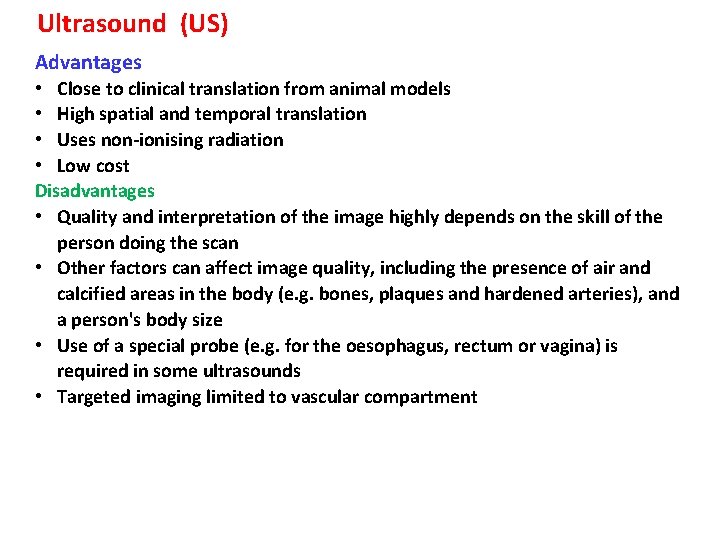
Ultrasound (US) Advantages • Close to clinical translation from animal models • High spatial and temporal translation • Uses non-ionising radiation • Low cost Disadvantages • Quality and interpretation of the image highly depends on the skill of the person doing the scan • Other factors can affect image quality, including the presence of air and calcified areas in the body (e. g. bones, plaques and hardened arteries), and a person's body size • Use of a special probe (e. g. for the oesophagus, rectum or vagina) is required in some ultrasounds • Targeted imaging limited to vascular compartment
Single Photon Emission Computed Tomography (SPECT) Advantages • Close to clinical translation from animal models • High sensitivity with unlimited depth penetration Disadvantages • Cost • Limited spatial resolution
X-Rays (Plain Radiography) Advantages • Quick • Can help diagnose various diseases and injuries, including broken bones, cancer and infections Disadvantages • Very small increased risk of cancer in future from exposure to ionising radiation(x-rays).
Optical Imaging – Fluorecence and Bioluminescence Advantages • Easily accessible • Highly sensitive (up to ~10– 15 moles/l) at limited depths of a few millimeters • quick and easy to perform Disadvantages • Limited by light penetration