
Magnetic model systems Goal Using magnetic model systems
- Slides: 10
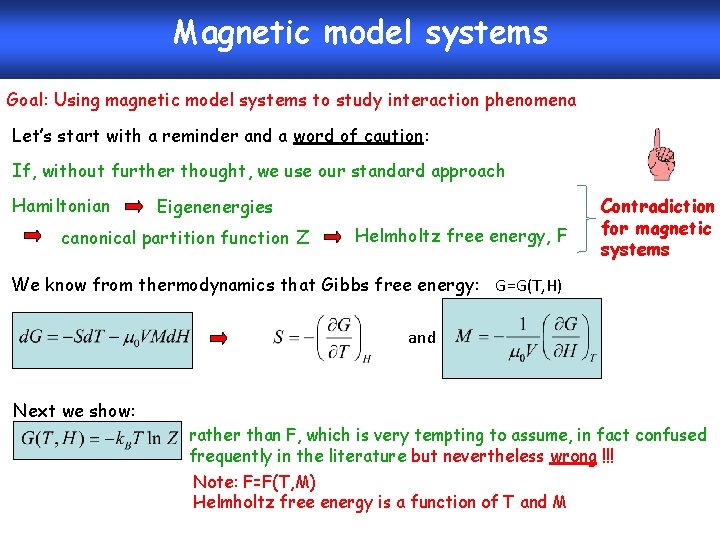
Magnetic model systems Goal: Using magnetic model systems to study interaction phenomena Let’s start with a reminder and a word of caution: If, without further thought, we use our standard approach Hamiltonian Eigenenergies canonical partition function Z Helmholtz free energy, F Contradiction for magnetic systems We know from thermodynamics that Gibbs free energy: G=G(T, H) and Next we show: rather than F, which is very tempting to assume, in fact confused frequently in the literature but nevertheless wrong !!! Note: F=F(T, M) Helmholtz free energy is a function of T and M
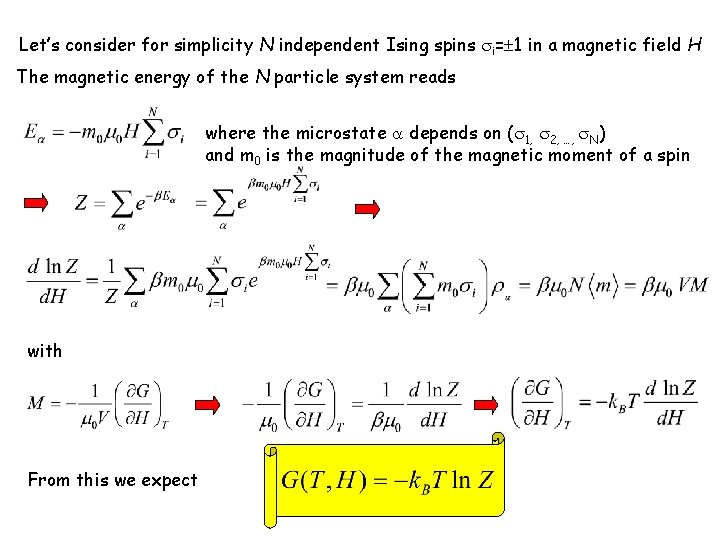
Let’s consider for simplicity N independent Ising spins i= 1 in a magnetic field H The magnetic energy of the N particle system reads where the microstate depends on ( 1, 2, …, N) and m 0 is the magnitude of the magnetic moment of a spin with From this we expect
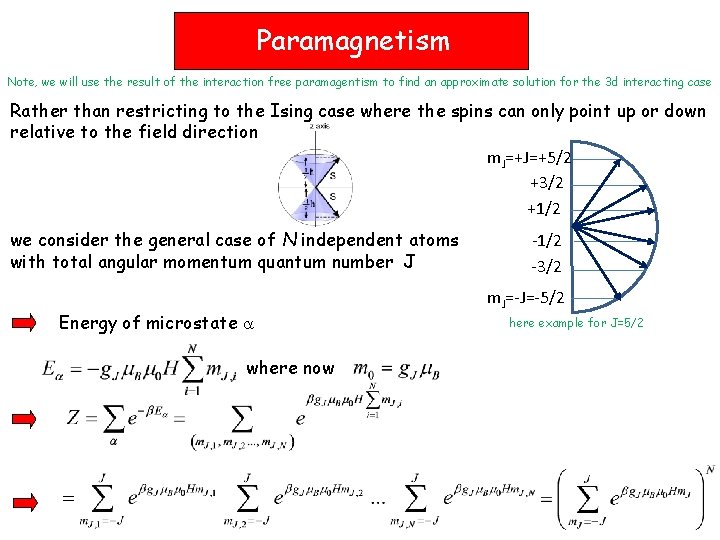
Paramagnetism Note, we will use the result of the interaction free paramagentism to find an approximate solution for the 3 d interacting case Rather than restricting to the Ising case where the spins can only point up or down relative to the field direction m. J=+J=+5/2 +3/2 +1/2 we consider the general case of N independent atoms with total angular momentum quantum number J Energy of microstate where now -1/2 -3/2 m. J=-J=-5/2 here example for J=5/2
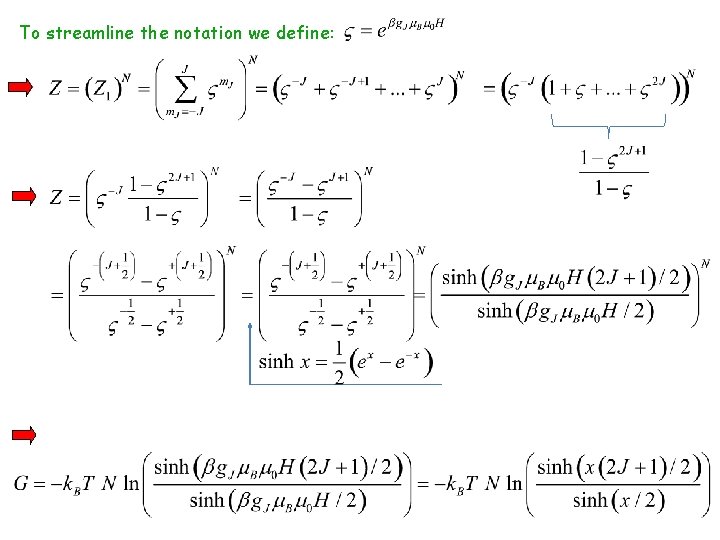
To streamline the notation we define:
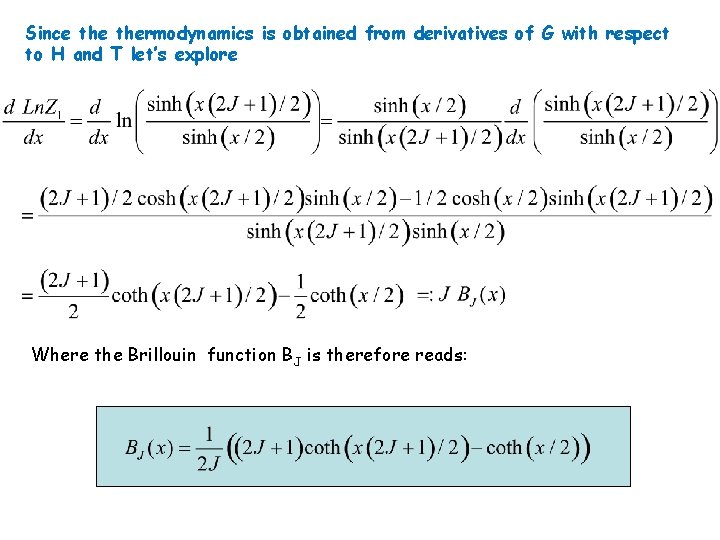
Since thermodynamics is obtained from derivatives of G with respect to H and T let’s explore Where the Brillouin function BJ is therefore reads:
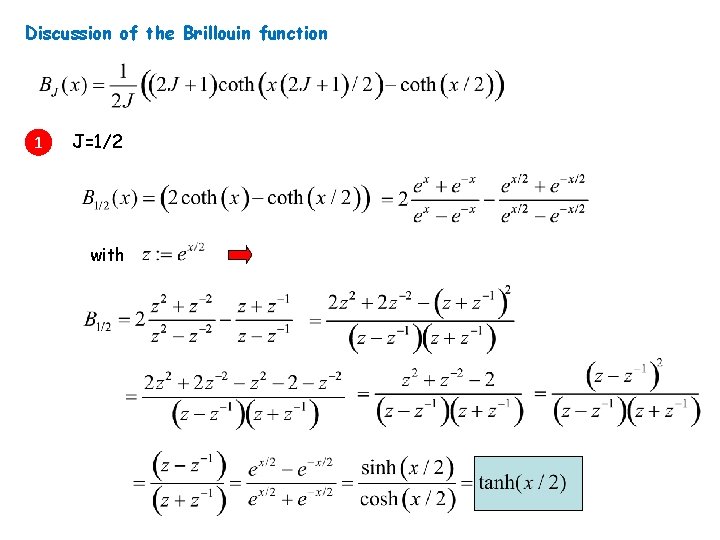
Discussion of the Brillouin function 1 J=1/2 with
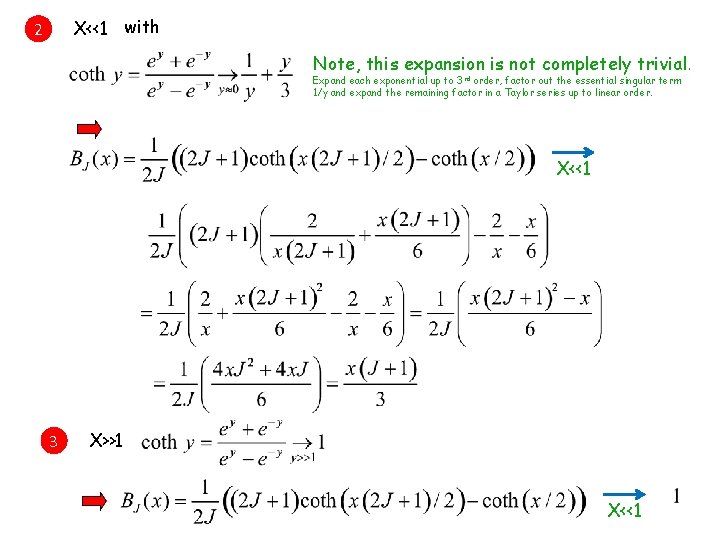
X<<1 with 2 Note, this expansion is not completely trivial. Expand each exponential up to 3 rd order, factor out the essential singular term 1/y and expand the remaining factor in a Taylor series up to linear order. X<<1 3 X>>1 X<<1
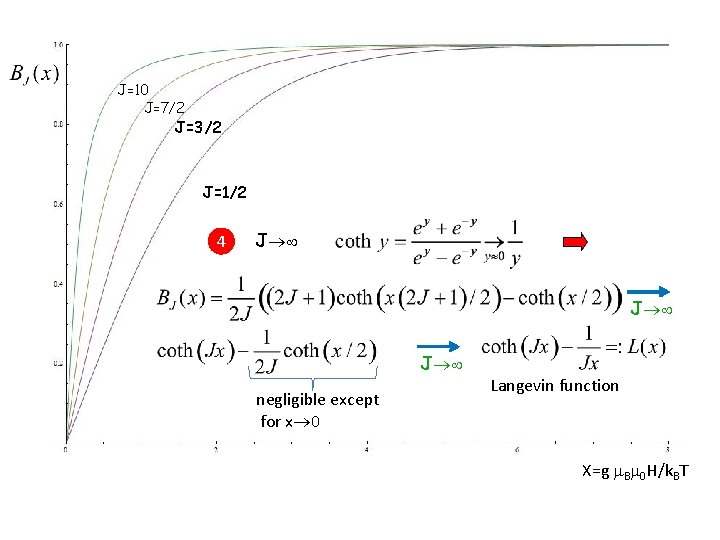
J=10 J=7/2 J=3/2 J=1/2 4 J J J negligible except for x 0 Langevin function X=g B 0 H/k. BT
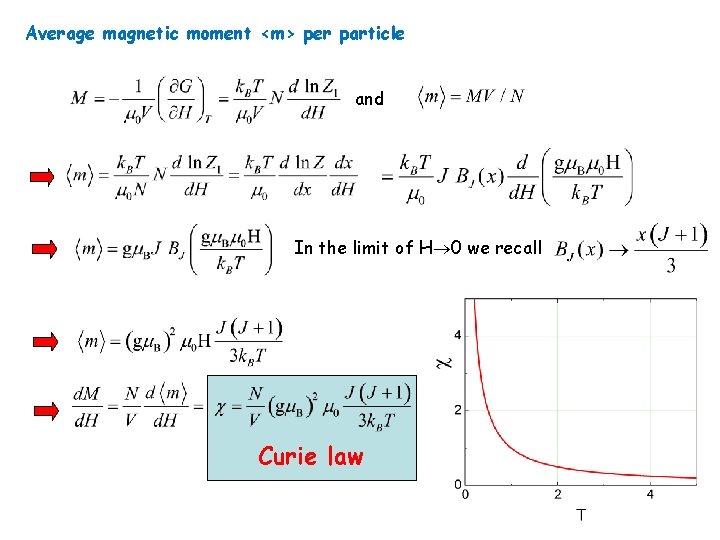
Average magnetic moment <m> per particle and In the limit of H 0 we recall Curie law
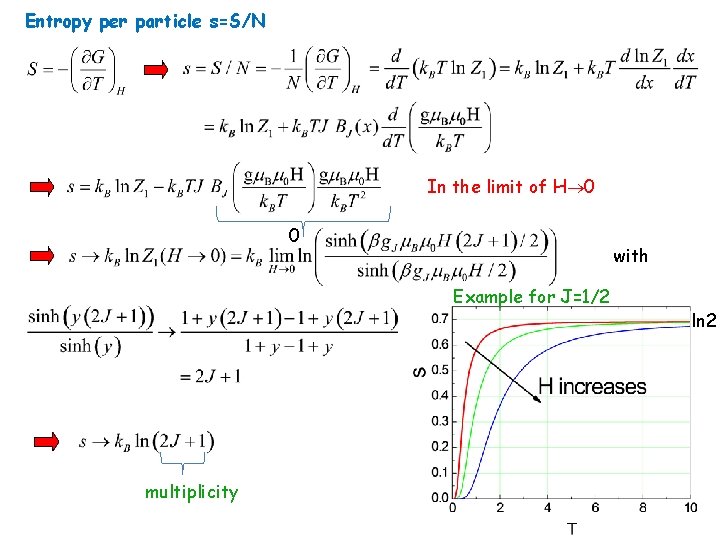
Entropy per particle s=S/N In the limit of H 0 0 with Example for J=1/2 multiplicity ln 2