
Magnetic Measurements of Storage Ring Bending Magnets at

Magnetic Measurements of Storage Ring Bending Magnets at ALBA-CELLS J. Campmany on behalf of ID, FE and magnetic measurements section 27 -28. 11. 2008 J. Campmany – ESLS 2008 – Cockcroft Institute
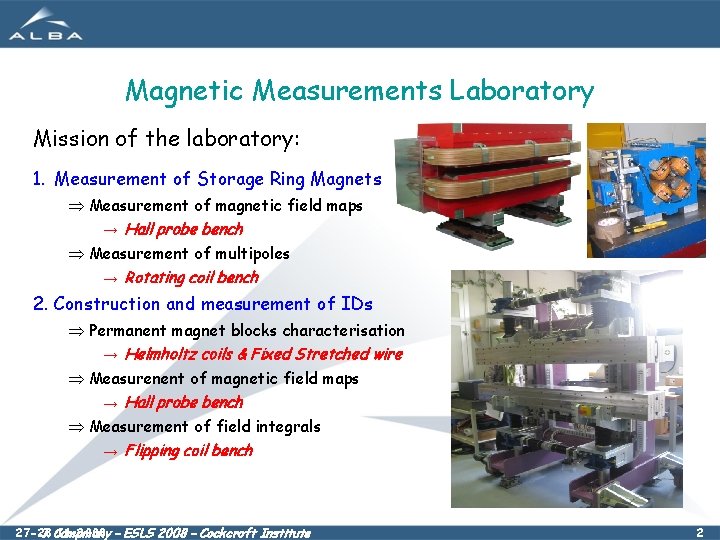
Magnetic Measurements Laboratory Mission of the laboratory: 1. Measurement of Storage Ring Magnets Þ Measurement of magnetic field maps → Hall probe bench Þ Measurement of multipoles → Rotating coil bench 2. Construction and measurement of IDs Þ Permanent magnet blocks characterisation → Helmholtz coils & Fixed Stretched wire Þ Measurenent of magnetic field maps → Hall probe bench Þ Measurement of field integrals → Flipping coil bench 27 -28. 11. 2008 J. Campmany – ESLS 2008 – Cockcroft Institute 2

Magnetic Measurements Laboratory Measurement benches 1. Hall probe bench – Partially build in-house 2. Rotating coil bench – Purchased from CERN 3. Flipping coil bench – Purchased from ESRF 4. Fixed stretched wire – Designed and built in-house 5. Helmholtz coils – Purchased from Elettra 27 -28. 11. 2008 J. Campmany – ESLS 2008 – Cockcroft Institute 3

Magnetic Measurements Laboratory General view of the laboratory: 27 -28. 11. 2008 J. Campmany – ESLS 2008 – Cockcroft Institute 4
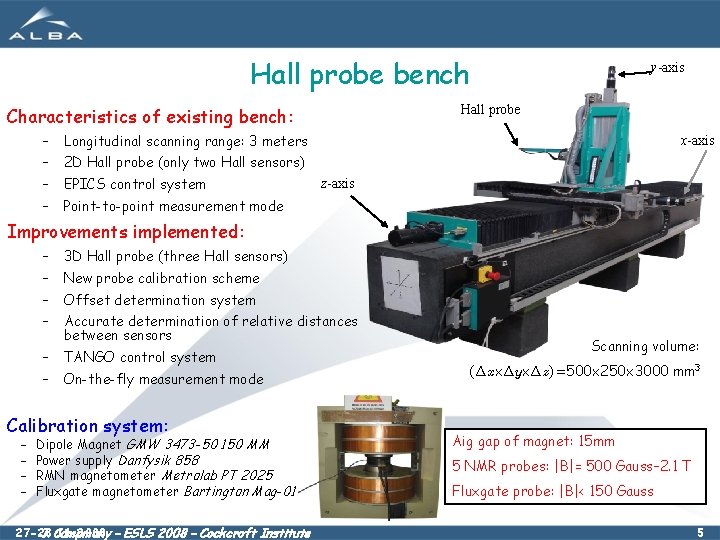
Hall probe bench Hall probe Characteristics of existing bench: – Longitudinal scanning range: 3 meters – 2 D Hall probe (only two Hall sensors) – EPICS control system – Point-to-point measurement mode y-axis x-axis z-axis Improvements implemented: – 3 D Hall probe (three Hall sensors) – New probe calibration scheme – Offset determination system – Accurate determination of relative distances between sensors – TANGO control system – On-the-fly measurement mode Calibration system: – – Dipole Magnet GMW 3473 -50 150 MM Power supply Danfysik 858 RMN magnetometer Metrolab PT 2025 Fluxgate magnetometer Bartington Mag-01 27 -28. 11. 2008 J. Campmany – ESLS 2008 – Cockcroft Institute Scanning volume: (¢x£¢y£¢z)=500£ 250£ 3000 mm 3 Aig gap of magnet: 15 mm 5 NMR probes: |B|= 500 Gauss– 2. 1 T Fluxgate probe: |B|< 150 Gauss 5

New TANGO control system • New devices have been included (additional voltmeter for 3 rd Hall sensor, fluxgate magnetometer…) • On-the-fly measurement mode has been implemented room temperature monitoring Hall probe T control Hall voltage reading • Control system has been migrated from EPICS to TANGO Calibration system Hall probe current source Motion controller Hardware architecture 27 -28. 11. 2008 J. Campmany – ESLS 2008 – Cockcroft Institute 6

New TANGO control system GUI screenshots on-the-fly application point-to-point application 27 -28. 11. 2008 J. Campmany – ESLS 2008 – Cockcroft Institute 7
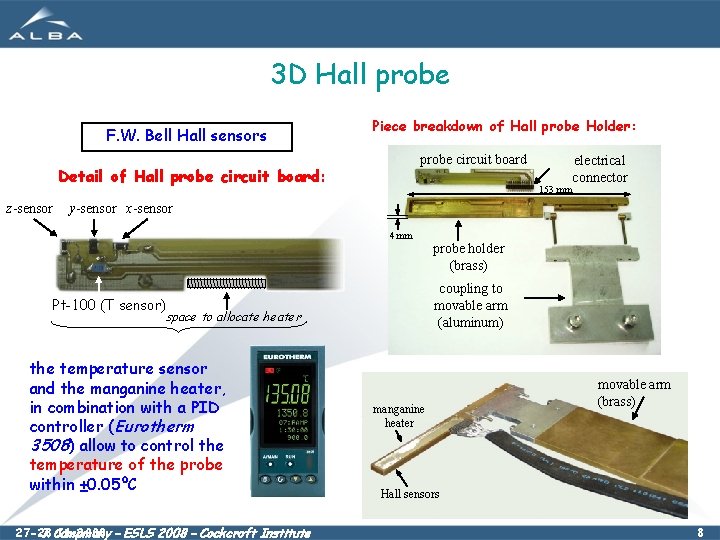
3 D Hall probe F. W. Bell Hall sensors Piece breakdown of Hall probe Holder: probe circuit board Detail of Hall probe circuit board: z-sensor electrical connector 153 mm y-sensor x-sensor 4 mm coupling to movable arm (aluminum) Pt-100 (T sensor) space to allocate heater the temperature sensor and the manganine heater, in combination with a PID controller (Eurotherm 3508) allow to control the temperature of the probe within ± 0. 05ºC 27 -28. 11. 2008 J. Campmany – ESLS 2008 – Cockcroft Institute probe holder (brass) manganine heater movable arm (brass) Hall sensors 8
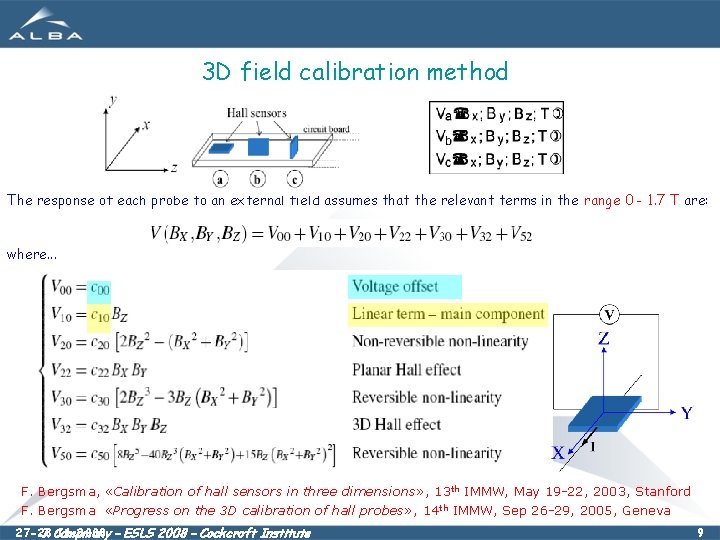
3 D field calibration method The response of each probe to an external field assumes that the relevant terms in the range 0 - 1. 7 T are: where. . . F. Bergsma, «Calibration of hall sensors in three dimensions» , 13 th IMMW, May 19 -22, 2003, Stanford F. Bergsma «Progress on the 3 D calibration of hall probes» , 14 th IMMW, Sep 26 -29, 2005, Geneva 27 -28. 11. 2008 J. Campmany – ESLS 2008 – Cockcroft Institute 9

3 D field calibration method All coefficients except the main (c 10) are assumed to be B independent, and all thermal dependence is assumed to be contained in the linear term c 10: a where T 0 is the calibration temperature. Hall sensors are not perfectly aligned with respect to the reference frame: (vertical) (horizontal) By Bx Bz (longitudinal) 27 -28. 11. 2008 J. Campmany – ESLS 2008 – Cockcroft Institute 10
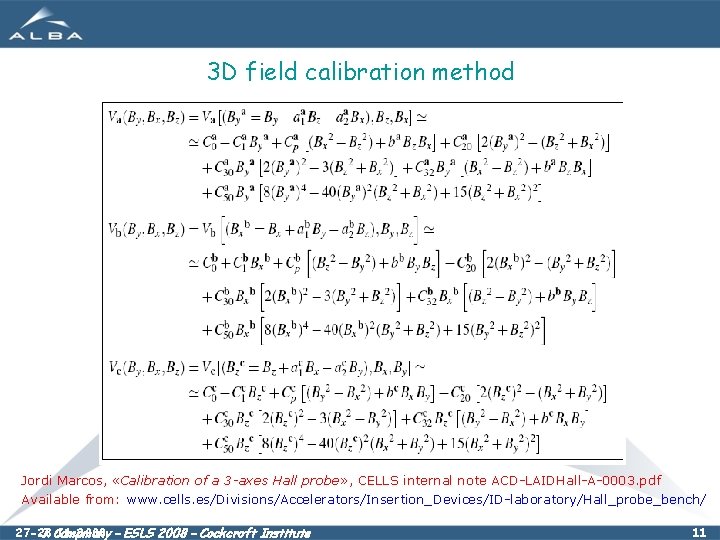
3 D field calibration method Jordi Marcos, «Calibration of a 3 -axes Hall probe» , CELLS internal note ACD-LAIDHall-A-0003. pdf Available from: www. cells. es/Divisions/Accelerators/Insertion_Devices/ID-laboratory/Hall_probe_bench/ 27 -28. 11. 2008 J. Campmany – ESLS 2008 – Cockcroft Institute 11
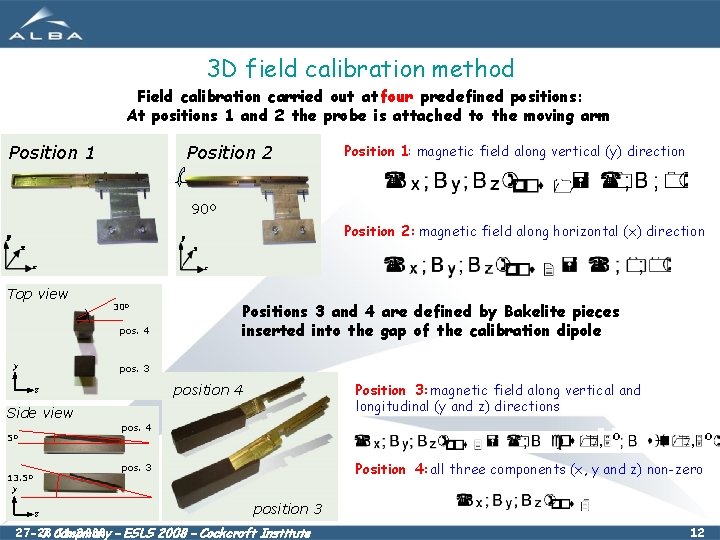
3 D field calibration method Field calibration carried out at four predefined positions: At positions 1 and 2 the probe is attached to the moving arm Position 2 Position 1: magnetic field along vertical (y) direction 90º Position 2: magnetic field along horizontal (x) direction Top view 30º pos. 4 y Positions 3 and 4 are defined by Bakelite pieces inserted into the gap of the calibration dipole pos. 3 Position 3: magnetic field along vertical and longitudinal (y and z) directions position 4 z Side view pos. 4 5º , º Position 4: all three components (x, y and z) non-zero pos. 3 13. 5º y z , º position 3 27 -28. 11. 2008 J. Campmany – ESLS 2008 – Cockcroft Institute 12

Reconstruction of the magnetic field Given the signals of the three sensors (Va, Vb and Vc) and the temperature of the probe (T), the three components of the magnetic field are determined by inverting the non-linear system (it is done by means of a C routine implementing Broydn method): Systematic measurement of Hall probes temperature (± 0. 01 ºC) 27 -28. 11. 2008 J. Campmany – ESLS 2008 – Cockcroft Institute Systematic measurement of offsets 13
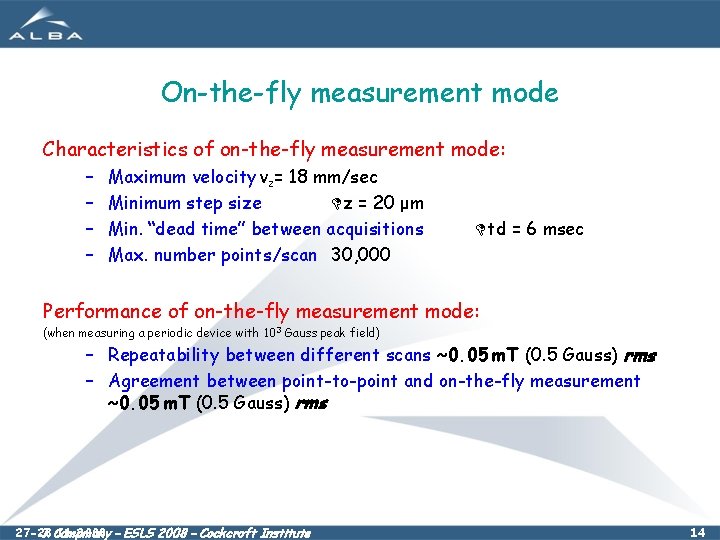
On-the-fly measurement mode Characteristics of on-the-fly measurement mode: – – Maximum velocity vz= 18 mm/sec Minimum step size Dz = 20 μm Min. “dead time” between acquisitions Max. number points/scan 30, 000 Dtd = 6 msec Performance of on-the-fly measurement mode: (when measuring a periodic device with 10 3 Gauss peak field) – Repeatability between different scans ~0. 05 m. T (0. 5 Gauss) rms – Agreement between point-to-point and on-the-fly measurement ~0. 05 m. T (0. 5 Gauss) rms 27 -28. 11. 2008 J. Campmany – ESLS 2008 – Cockcroft Institute 14

Performance of Hall probe bench Absolute accuracy of Hall probe bench in terms of field: ± 0. 05 m. T Comparison of field integral measured using flipping coil and determined using Hall probe for a straight magnetic array rms difference vertical Iy ~10 -5 T·m (10 G·cm) horizontal Ix 27 -28. 11. 2008 J. Campmany – ESLS 2008 – Cockcroft Institute 15
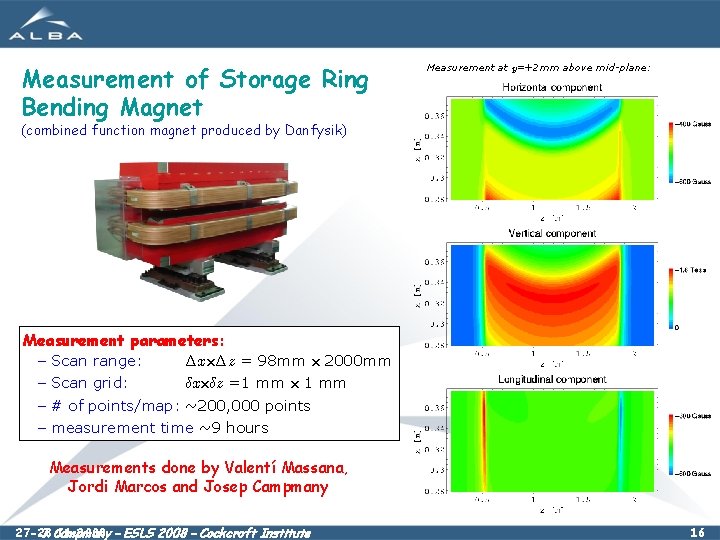
Measurement of Storage Ring Bending Magnet Measurement at y=+2 mm above mid-plane: (combined function magnet produced by Danfysik) Measurement parameters: – Scan range: ¢x£¢z = 98 mm £ 2000 mm – Scan grid: ±x£±z =1 mm £ 1 mm – # of points/map: ~200, 000 points – measurement time ~9 hours Measurements done by Valentí Massana, Jordi Marcos and Josep Campmany 27 -28. 11. 2008 J. Campmany – ESLS 2008 – Cockcroft Institute 16
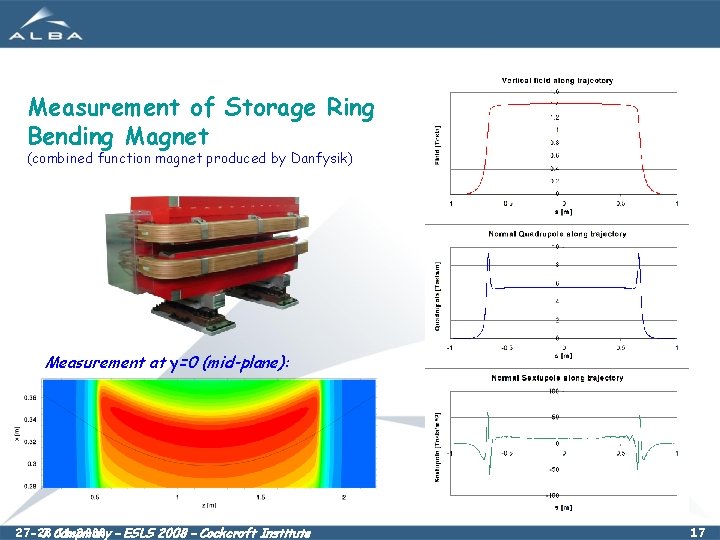
Measurement of Storage Ring Bending Magnet (combined function magnet produced by Danfysik) Measurement at y=0 (mid-plane): 27 -28. 11. 2008 J. Campmany – ESLS 2008 – Cockcroft Institute 17
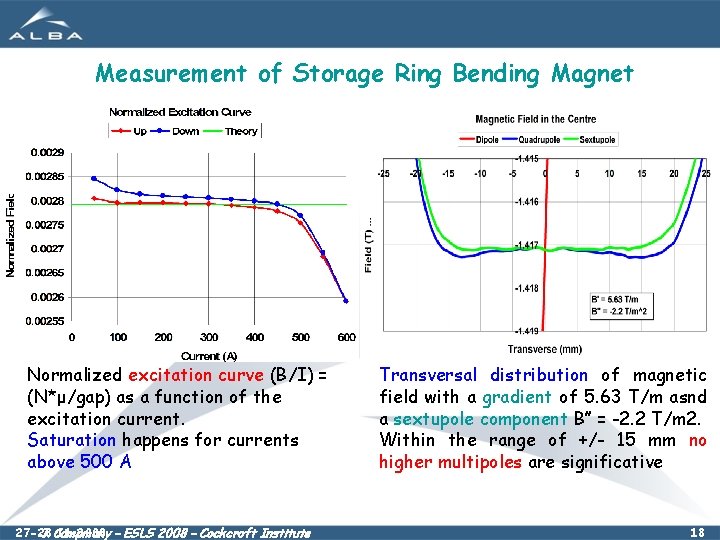
Measurement of Storage Ring Bending Magnet Normalized excitation curve (B/I) = (N*μ/gap) as a function of the excitation current. Saturation happens for currents above 500 A 27 -28. 11. 2008 J. Campmany – ESLS 2008 – Cockcroft Institute Transversal distribution of magnetic field with a gradient of 5. 63 T/m asnd a sextupole component B’’ = -2. 2 T/m 2. Within the range of +/- 15 mm no higher multipoles are significative 18
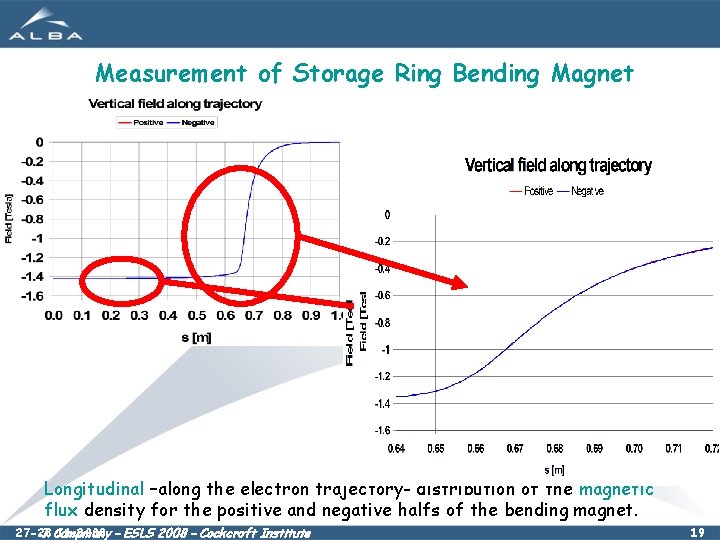
Measurement of Storage Ring Bending Magnet Longitudinal –along the electron trajectory- distribution of the magnetic flux density for the positive and negative halfs of the bending magnet. 27 -28. 11. 2008 J. Campmany – ESLS 2008 – Cockcroft Institute 19
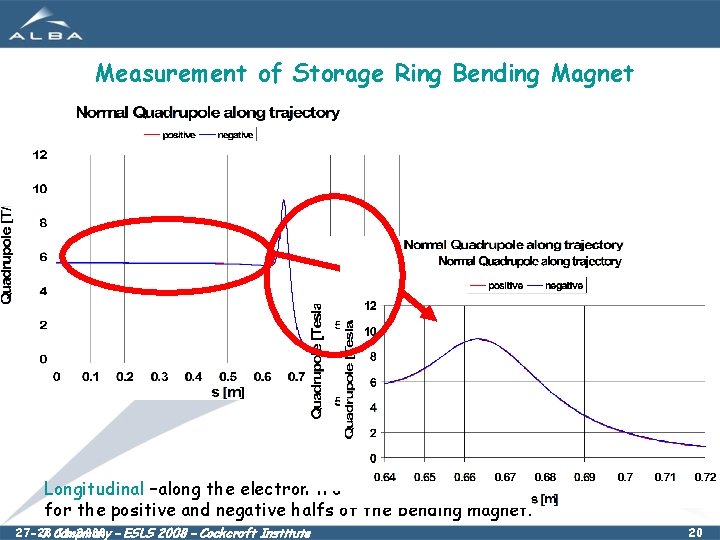
Measurement of Storage Ring Bending Magnet Longitudinal –along the electron trajectory- distribution of the gradient for the positive and negative halfs of the bending magnet. 27 -28. 11. 2008 J. Campmany – ESLS 2008 – Cockcroft Institute 20
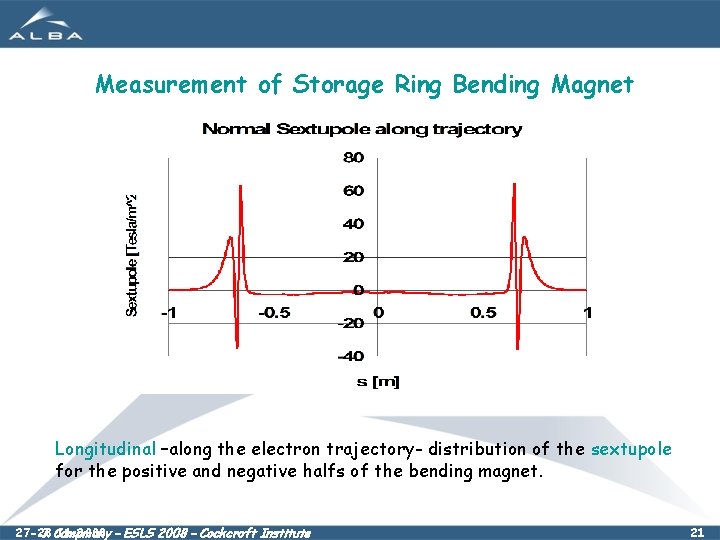
Measurement of Storage Ring Bending Magnet Longitudinal –along the electron trajectory- distribution of the sextupole for the positive and negative halfs of the bending magnet. 27 -28. 11. 2008 J. Campmany – ESLS 2008 – Cockcroft Institute 21
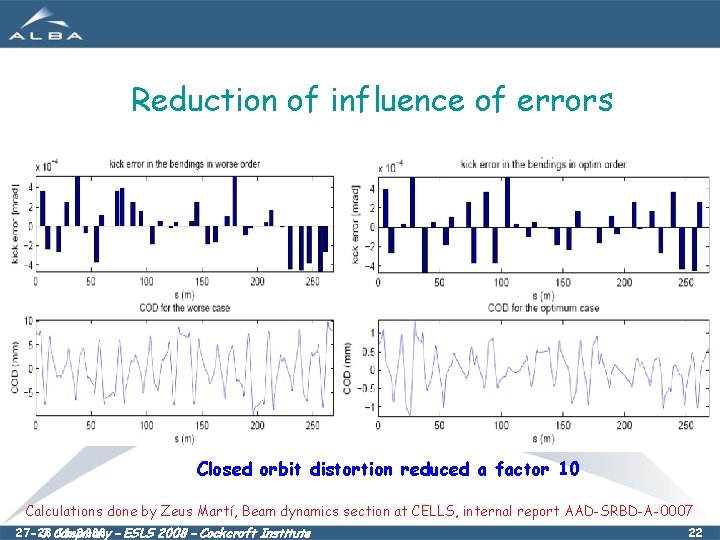
Reduction of influence of errors Closed orbit distortion reduced a factor 10 Calculations done by Zeus Martí, Beam dynamics section at CELLS, internal report AAD-SRBD-A-0007 27 -28. 11. 2008 J. Campmany – ESLS 2008 – Cockcroft Institute 22

Thank you for your attention 27 -28. 11. 2008 J. Campmany – ESLS 2008 – Cockcroft Institute 23
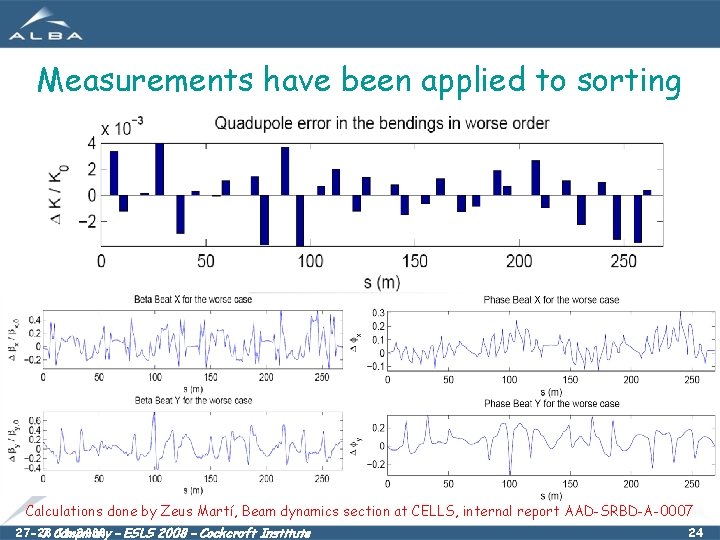
Measurements have been applied to sorting Calculations done by Zeus Martí, Beam dynamics section at CELLS, internal report AAD-SRBD-A-0007 27 -28. 11. 2008 J. Campmany – ESLS 2008 – Cockcroft Institute 24
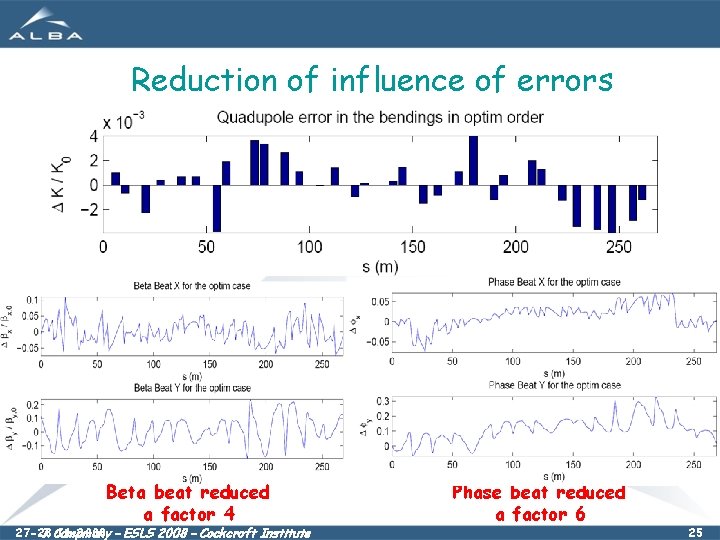
Reduction of influence of errors Beta beat reduced a factor 4 27 -28. 11. 2008 J. Campmany – ESLS 2008 – Cockcroft Institute Phase beat reduced a factor 6 25
- Slides: 25