
Magnetic helicity why is it so important and
- Slides: 20
Magnetic helicity: why is it so important and how to get rid of it Axel Brandenburg (Nordita, Copenhagen) Kandaswamy Subramanian (Pune) Brandenburg (2001, Ap. J 550, 824; 2005, Ap. J 625, 539) Brandenburg & Subramanian (2005, Phys. Rep. , astro-ph/0405052)
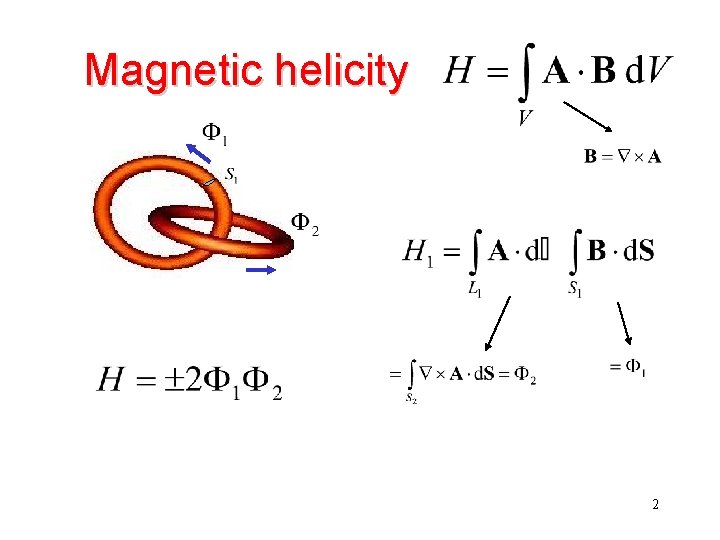
Magnetic helicity 2
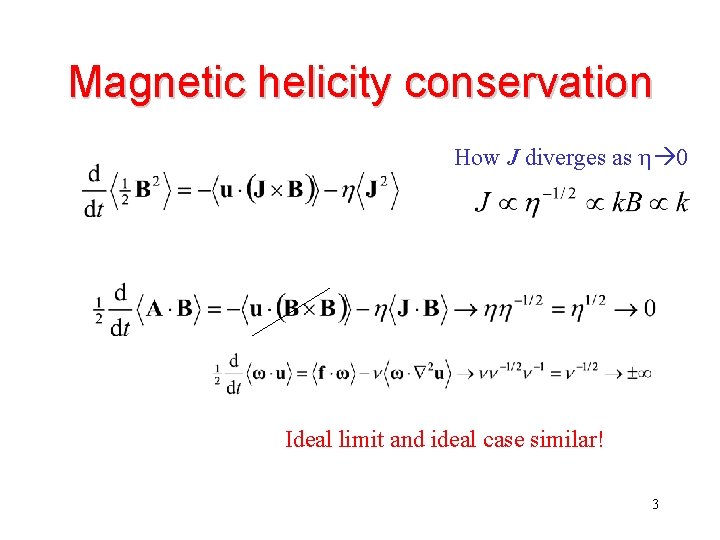
Magnetic helicity conservation How J diverges as h 0 Ideal limit and ideal case similar! 3
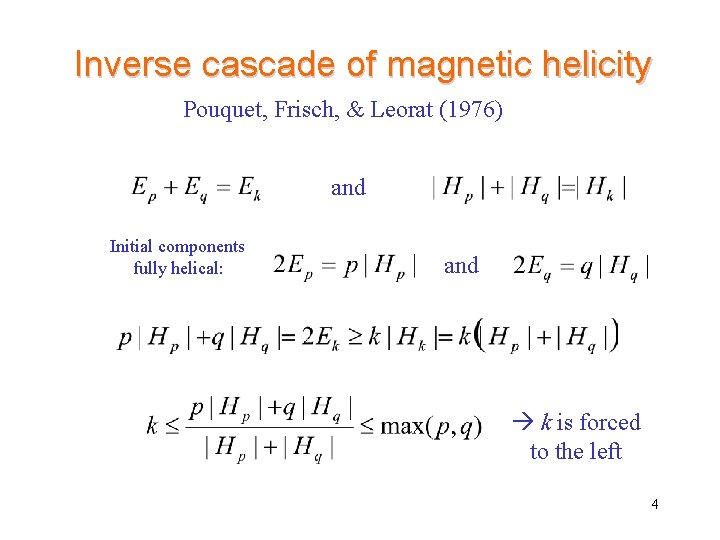
Inverse cascade of magnetic helicity Pouquet, Frisch, & Leorat (1976) and Initial components fully helical: and k is forced to the left 4
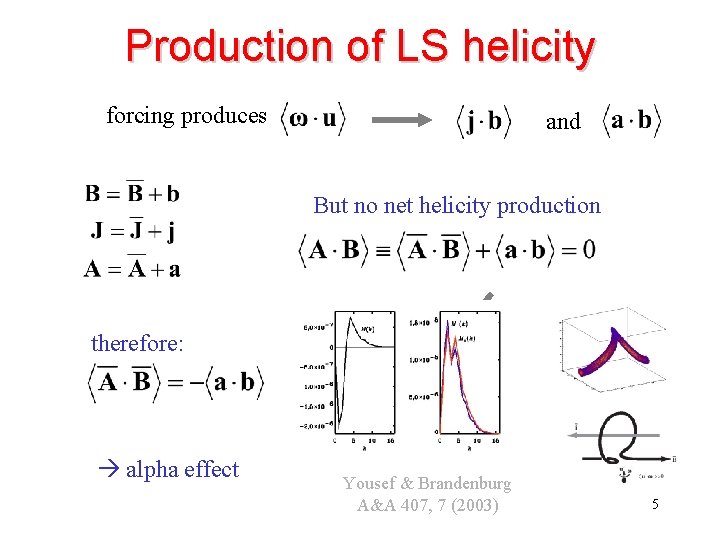
Production of LS helicity forcing produces and But no net helicity production therefore: alpha effect Yousef & Brandenburg A&A 407, 7 (2003) 5
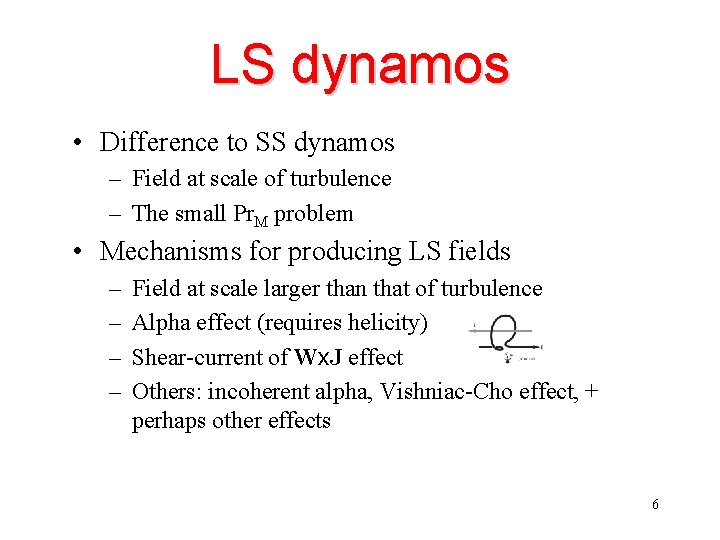
LS dynamos • Difference to SS dynamos – Field at scale of turbulence – The small Pr. M problem • Mechanisms for producing LS fields – – Field at scale larger than that of turbulence Alpha effect (requires helicity) Shear-current of Wx. J effect Others: incoherent alpha, Vishniac-Cho effect, + perhaps other effects 6
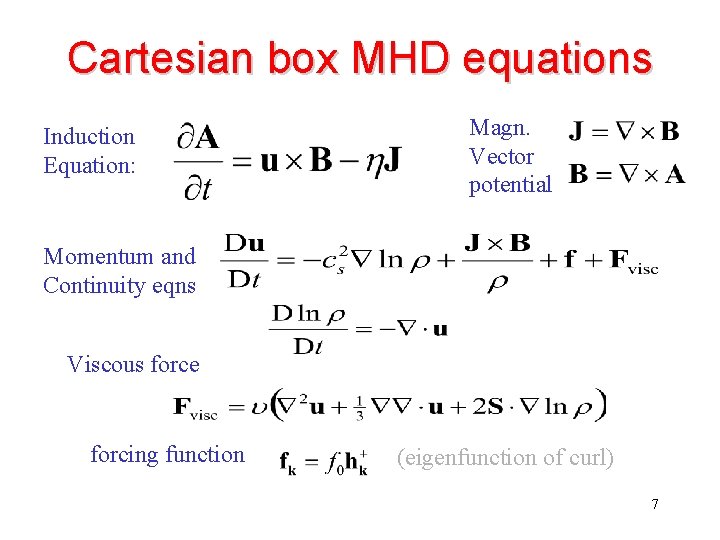
Cartesian box MHD equations Induction Equation: Magn. Vector potential Momentum and Continuity eqns Viscous force forcing function (eigenfunction of curl) 7
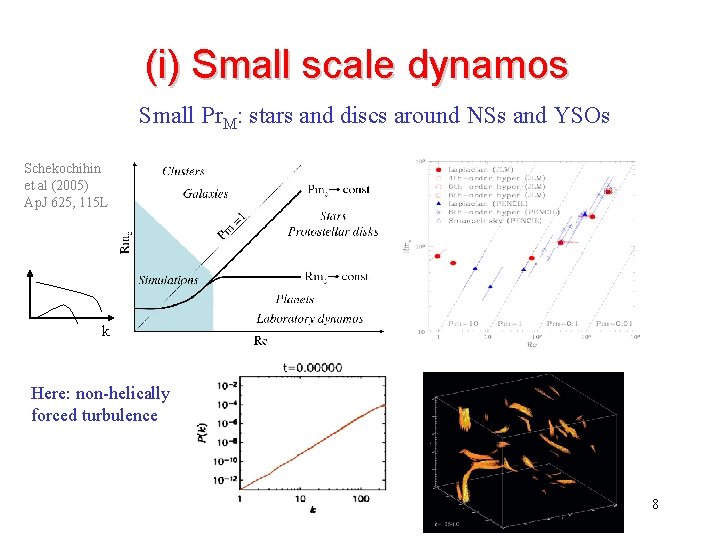
(i) Small scale dynamos Small Pr. M: stars and discs around NSs and YSOs Schekochihin et al (2005) Ap. J 625, 115 L k Here: non-helically forced turbulence 8
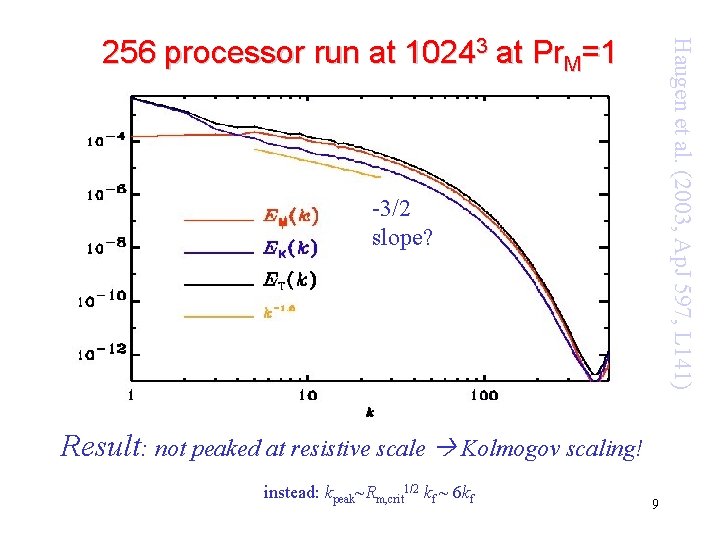
Haugen et al. (2003, Ap. J 597, L 141) 256 processor run at 10243 at Pr. M=1 -3/2 slope? Result: not peaked at resistive scale Kolmogov scaling! instead: kpeak~Rm, crit 1/2 kf ~ 6 kf 9
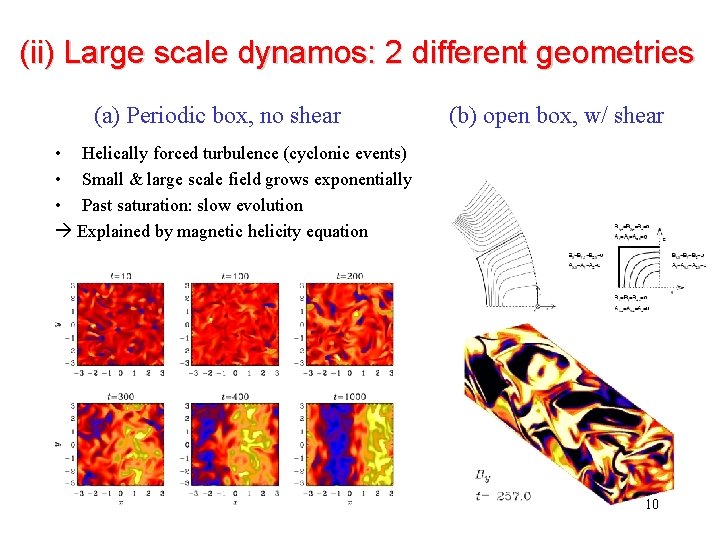
(ii) Large scale dynamos: 2 different geometries (a) Periodic box, no shear (b) open box, w/ shear • Helically forced turbulence (cyclonic events) • Small & large scale field grows exponentially • Past saturation: slow evolution Explained by magnetic helicity equation 10
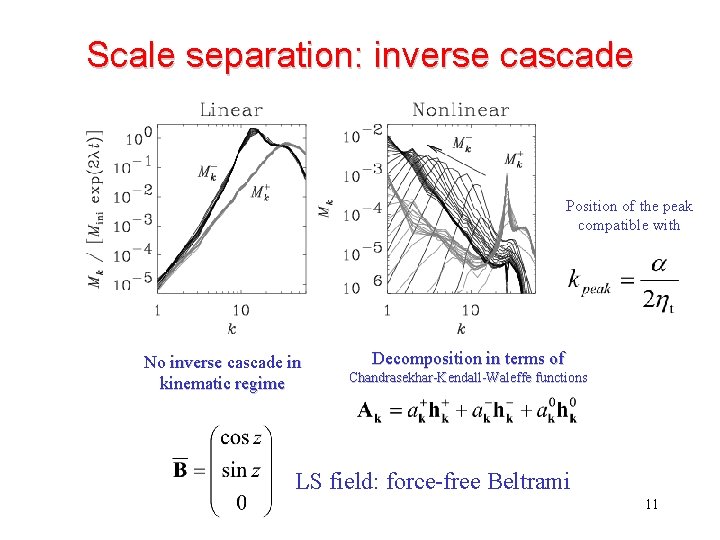
Scale separation: inverse cascade Position of the peak compatible with No inverse cascade in kinematic regime Decomposition in terms of Chandrasekhar-Kendall-Waleffe functions LS field: force-free Beltrami 11
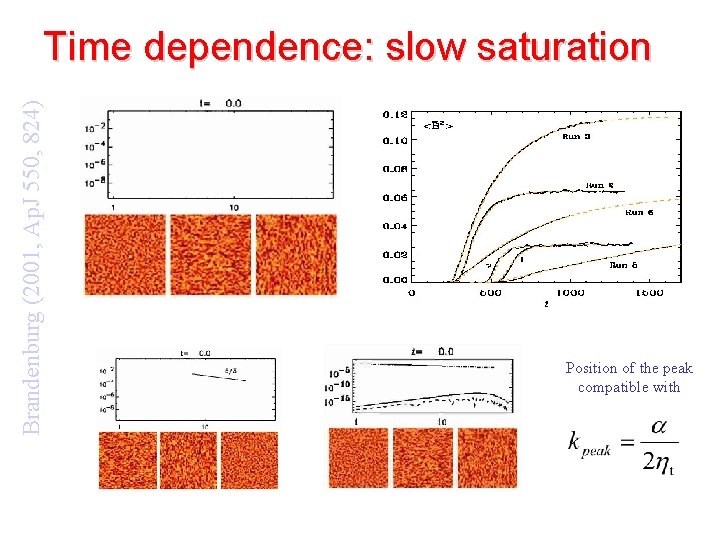
Brandenburg (2001, Ap. J 550, 824) Time dependence: slow saturation Position of the peak compatible with
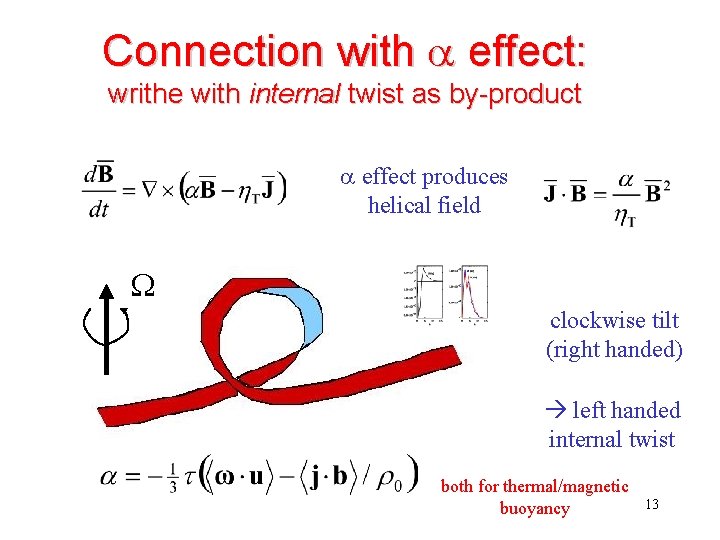
Connection with a effect: writhe with internal twist as by-product a effect produces helical field W clockwise tilt (right handed) left handed internal twist both for thermal/magnetic buoyancy 13
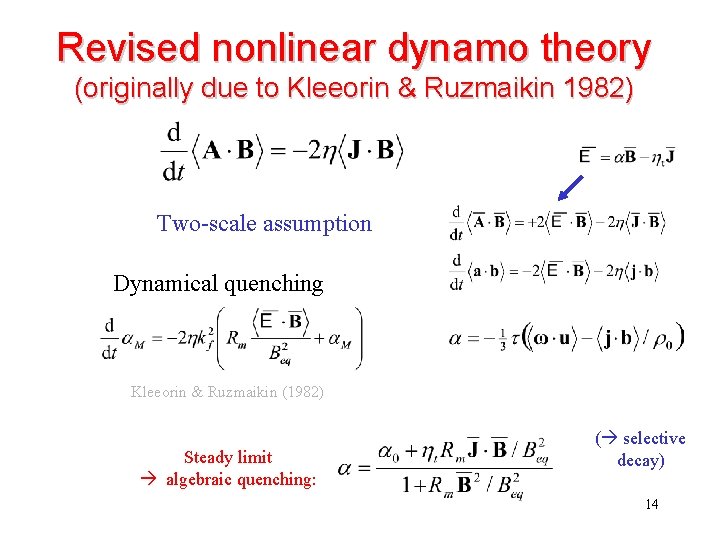
Revised nonlinear dynamo theory (originally due to Kleeorin & Ruzmaikin 1982) Two-scale assumption Dynamical quenching Kleeorin & Ruzmaikin (1982) Steady limit algebraic quenching: ( selective decay) 14
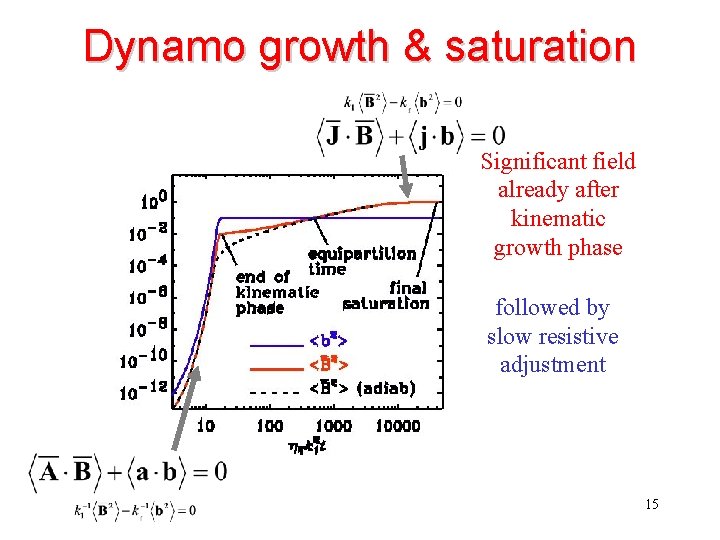
Dynamo growth & saturation Significant field already after kinematic growth phase followed by slow resistive adjustment 15
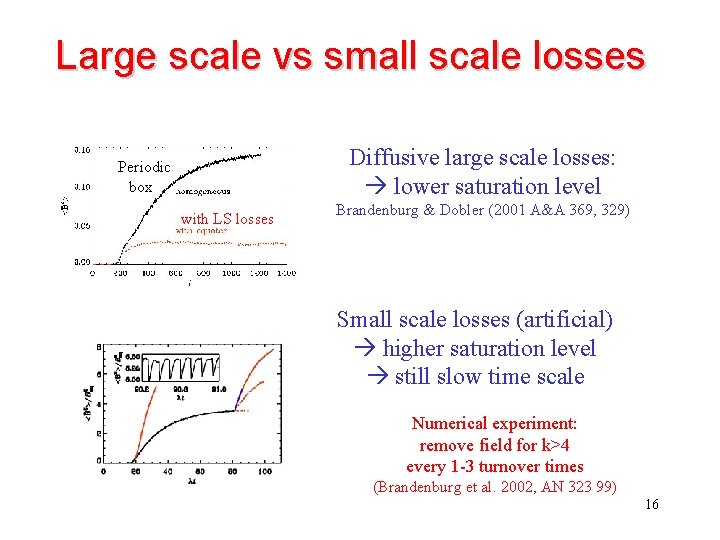
Large scale vs small scale losses Diffusive large scale losses: lower saturation level Periodic box with LS losses Brandenburg & Dobler (2001 A&A 369, 329) Small scale losses (artificial) higher saturation level still slow time scale Numerical experiment: remove field for k>4 every 1 -3 turnover times (Brandenburg et al. 2002, AN 323 99) 16
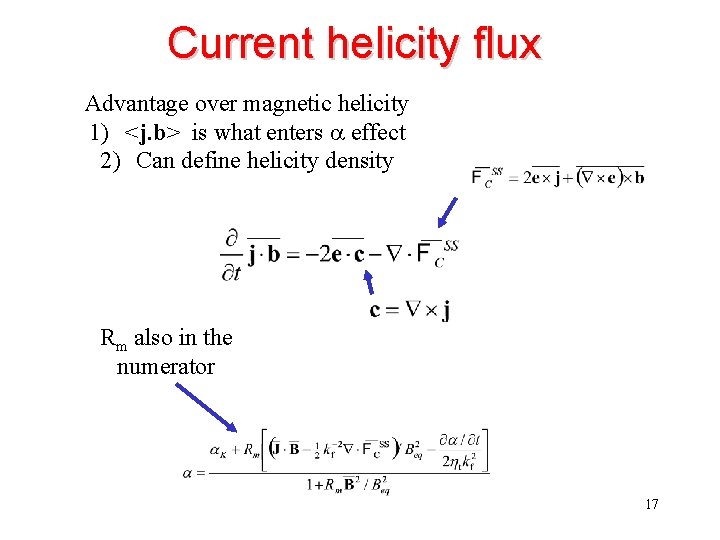
Current helicity flux Advantage over magnetic helicity 1) <j. b> is what enters a effect 2) Can define helicity density Rm also in the numerator 17
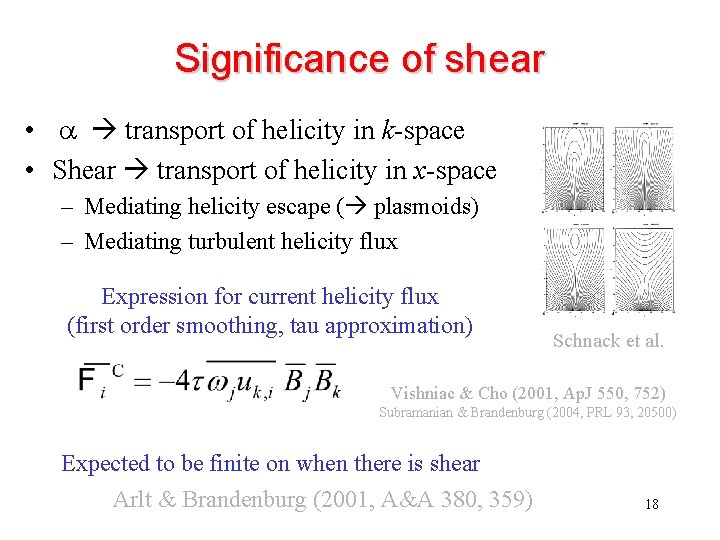
Significance of shear • a transport of helicity in k-space • Shear transport of helicity in x-space – Mediating helicity escape ( plasmoids) – Mediating turbulent helicity flux Expression for current helicity flux (first order smoothing, tau approximation) Schnack et al. Vishniac & Cho (2001, Ap. J 550, 752) Subramanian & Brandenburg (2004, PRL 93, 20500) Expected to be finite on when there is shear Arlt & Brandenburg (2001, A&A 380, 359) 18
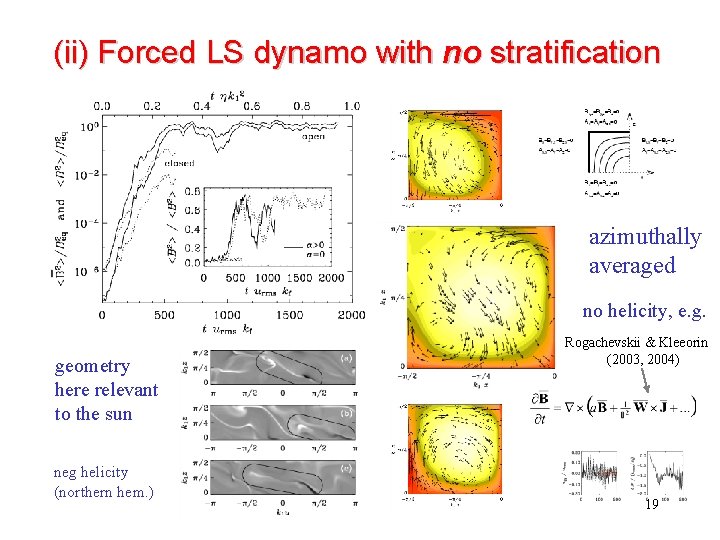
(ii) Forced LS dynamo with no stratification azimuthally averaged no helicity, e. g. geometry here relevant to the sun neg helicity (northern hem. ) Rogachevskii & Kleeorin (2003, 2004) 19
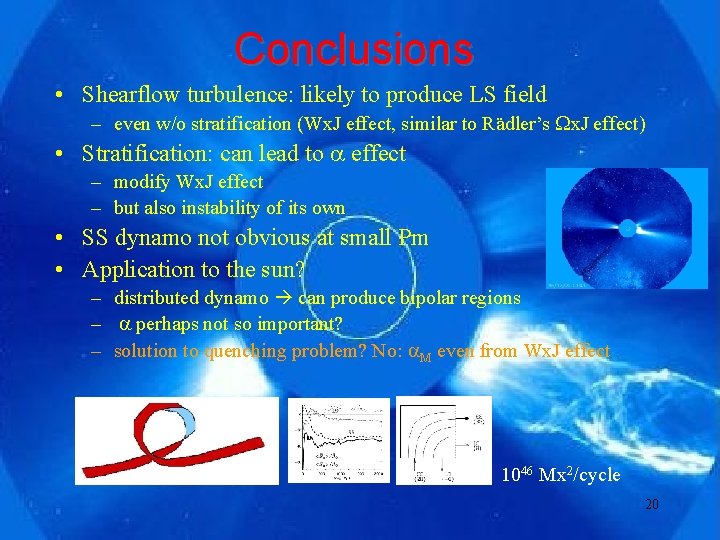
Conclusions • Shearflow turbulence: likely to produce LS field – even w/o stratification (Wx. J effect, similar to Rädler’s Wx. J effect) • Stratification: can lead to a effect – modify Wx. J effect – but also instability of its own • SS dynamo not obvious at small Pm • Application to the sun? – distributed dynamo can produce bipolar regions – a perhaps not so important? – solution to quenching problem? No: a. M even from Wx. J effect 1046 Mx 2/cycle 20