
Magnetic Fields in the Quark Gluon Plasma Alexander
- Slides: 8
Magnetic Fields in the Quark Gluon Plasma Alexander Baez Neglecting external fields, how do we quantify the magnetic fields in a static QGP? What about when we consider an expanding QGP? Are those effects significant? This material is based upon work supported by the U. S. Department of Energy Office of Science under Cooperative Agreement DE-SC 0000661, the State of Michigan and Michigan State University designs and establishes FRIB as a DOE Office of Science National User Facility in support of the mission of the Office of Nuclear Physics.
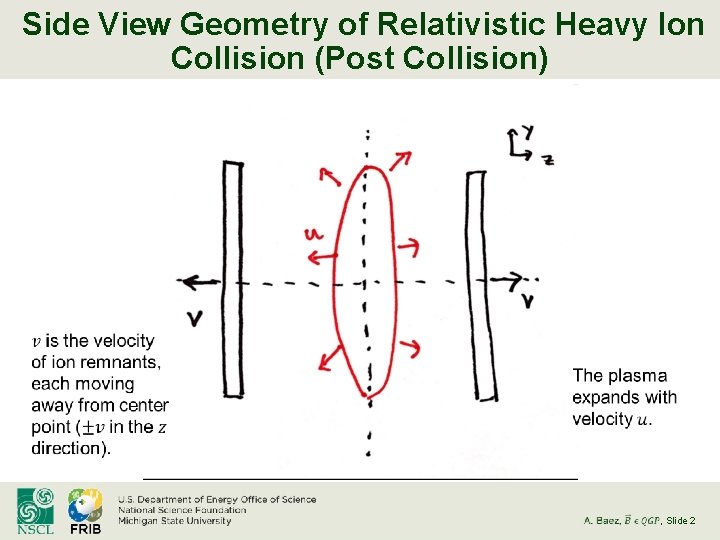
Side View Geometry of Relativistic Heavy Ion Collision (Post Collision) , Slide 2
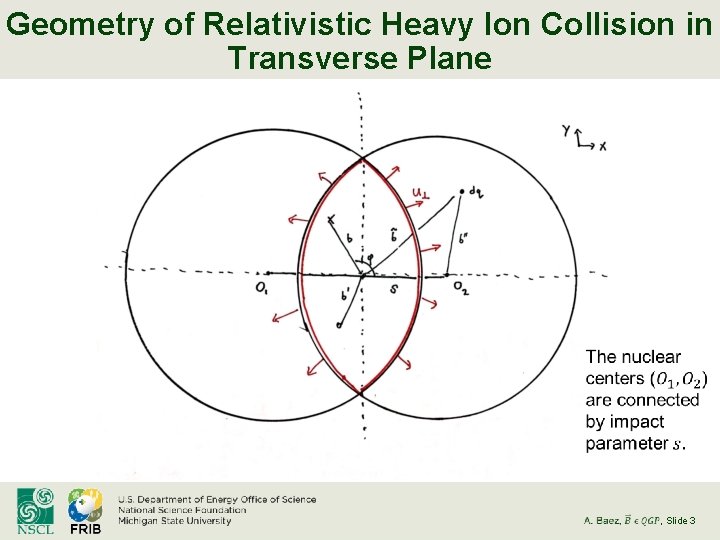
Geometry of Relativistic Heavy Ion Collision in Transverse Plane , Slide 3
Intense Fields are Created. What are the Effects on the QGP? § , Slide 4
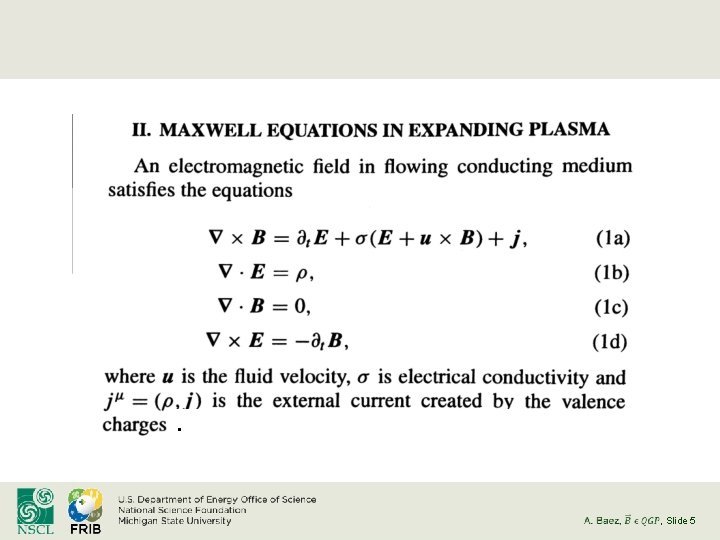
. , Slide 5
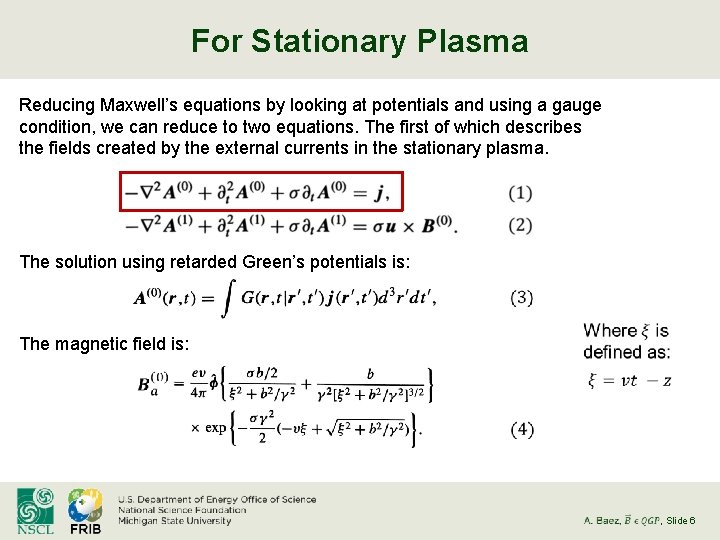
For Stationary Plasma Reducing Maxwell’s equations by looking at potentials and using a gauge condition, we can reduce to two equations. The first of which describes the fields created by the external currents in the stationary plasma. The solution using retarded Green’s potentials is: The magnetic field is: , Slide 6
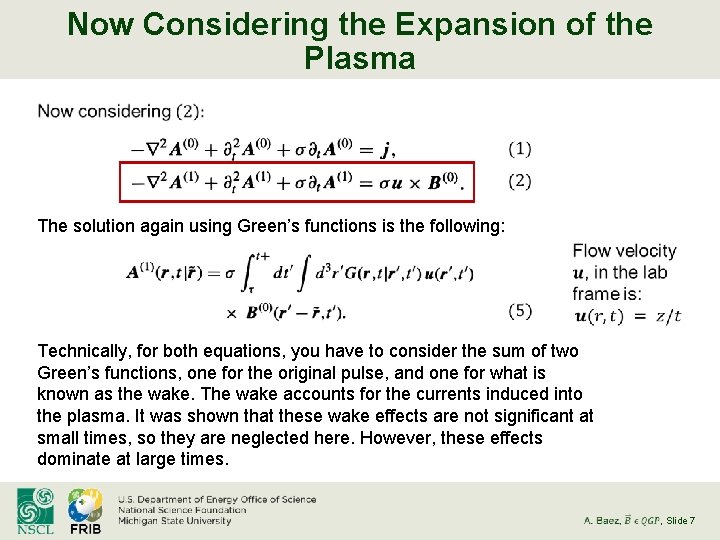
Now Considering the Expansion of the Plasma The solution again using Green’s functions is the following: Technically, for both equations, you have to consider the sum of two Green’s functions, one for the original pulse, and one for what is known as the wake. The wake accounts for the currents induced into the plasma. It was shown that these wake effects are not significant at small times, so they are neglected here. However, these effects dominate at large times. , Slide 7
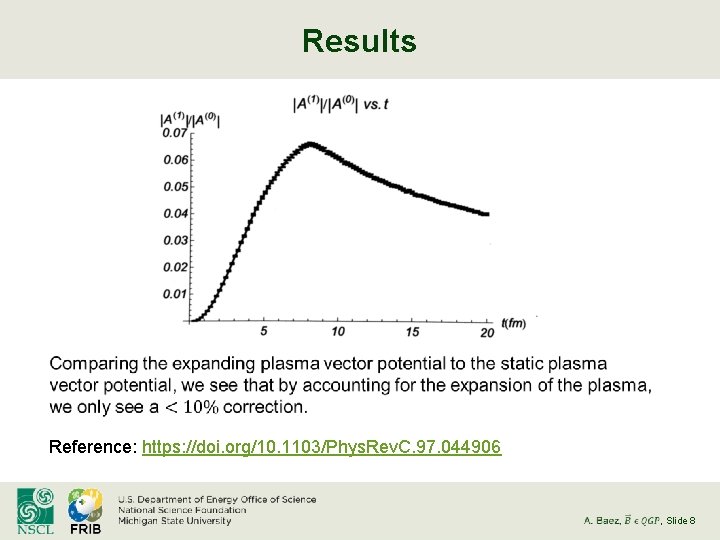
Results Reference: https: //doi. org/10. 1103/Phys. Rev. C. 97. 044906 , Slide 8