
Magnetic Fields in Supernova Remnants and PulsarWind Nebulae
Magnetic Fields in Supernova Remnants and Pulsar-Wind Nebulae 2013/12/18 Speaker : Yu-Hsun Cheng Professor: Yosuke Mizuno
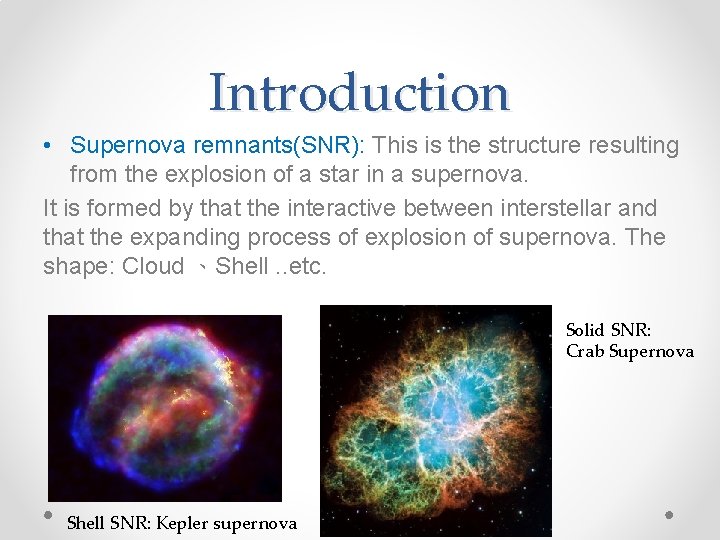
Introduction • Supernova remnants(SNR): This is the structure resulting from the explosion of a star in a supernova. It is formed by that the interactive between interstellar and that the expanding process of explosion of supernova. The shape: Cloud 、Shell. . etc. Solid SNR: Crab Supernova Shell SNR: Kepler supernova
Introduction •
Introdution Pulsar wind nebulae can be powerful probes of a pulsar's interaction with its surroundings — their properties can be used to infer the geometry, energetics, and composition of the pulsar wind, the space velocity of the pulsar itself, and the properties of the ambient medium • Supernova remnants and pulsar-wind nebulae are prominent Galactic synchrotron sources at radio and Xray wavelengths. The spectral analysis of the synchrotron emission can be used to deduce or constrain magnetic-field strengths and orientations.
Intrduction • Galactic synchrotron sources is the object in our galaxy which emit non-thermal synchrotron radiation at radio or x-ray. • If a SNR source is young and the emission is due to a pulsar. It is called pulsar-wind nebula(PWN). Thus a SNR may contain a PWN.
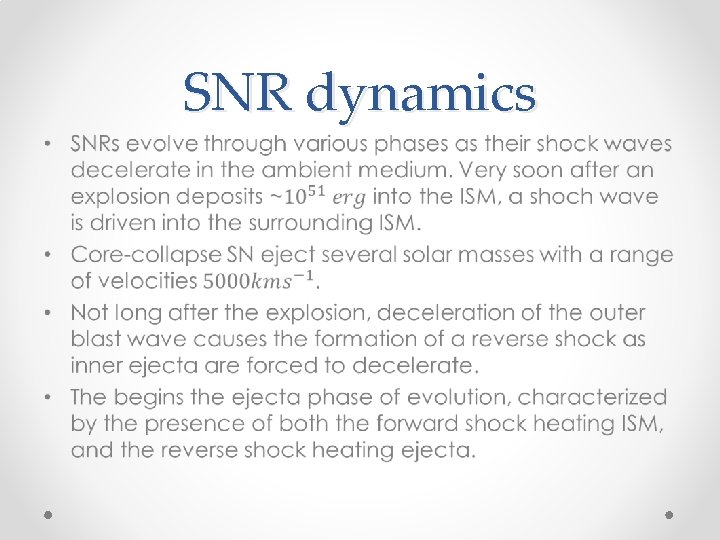
SNR dynamics •
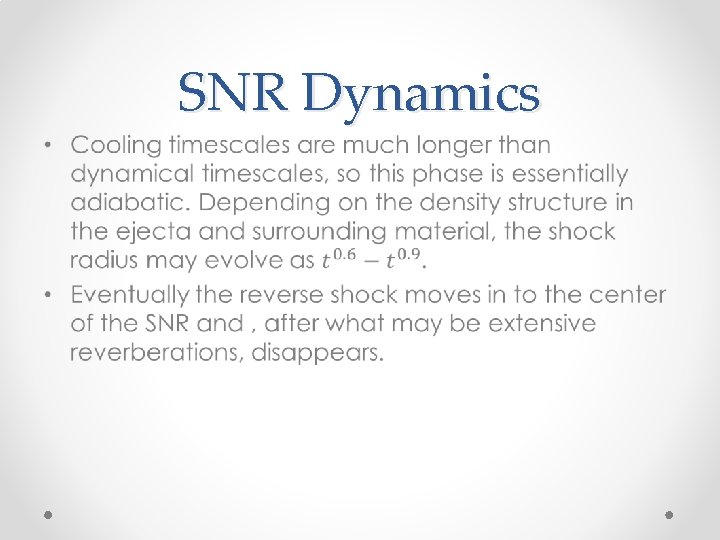
SNR Dynamics •
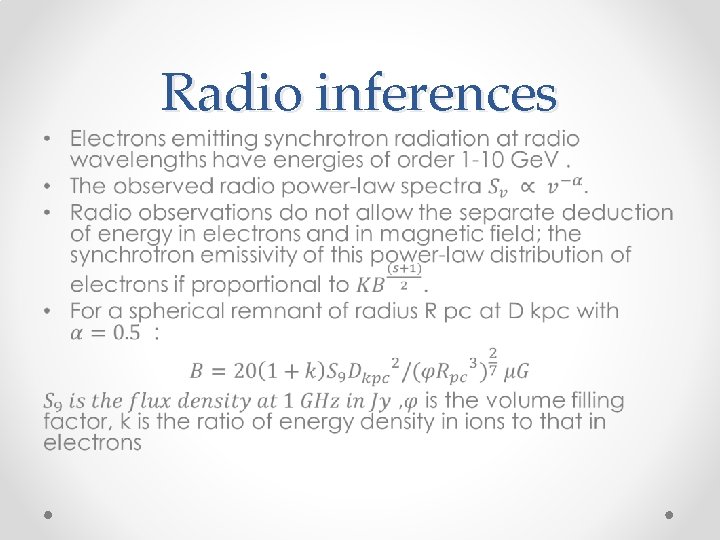
Radio inferences •
Radio inferences •
X-Ray and Gammer-Ray inferences • Four Galactic SNRs show X-ray spectra dominated by synchrotron emission : G 1. 9+0. 3, SN 1006, G 347. 30. 5, G 266. 2 -1. 2. • G 1. 9+0. 3 and SN 1006 are young. They are symmetric Xray morphologies. The two source show thermal X-ray emission from fainter regions. • SN 1006 is widely accepted to be the remnant of a Type Ia supernova. • G 347. 3 -0. 5 and G 266. 2 -1. 2 have much larger angular sizes and considerably more irregular morphologies.
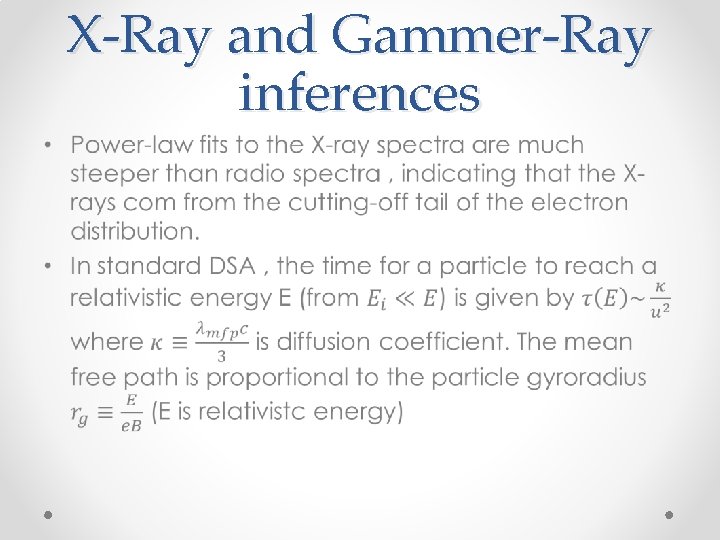
X-Ray and Gammer-Ray inferences •
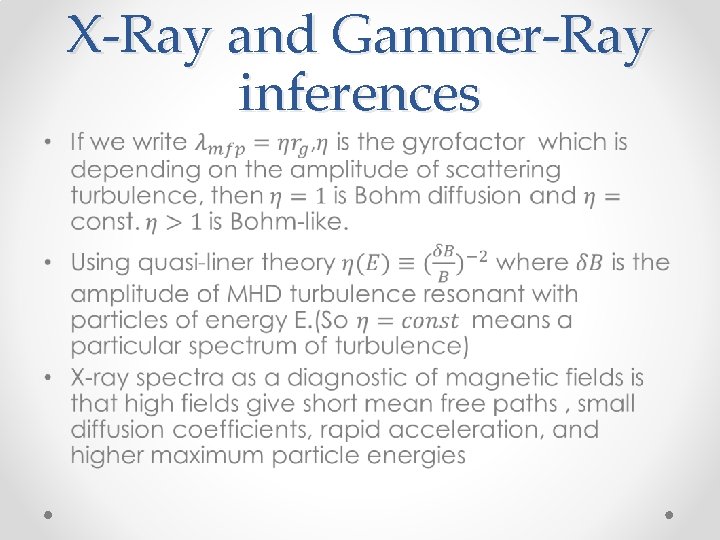
X-Ray and Gammer-Ray inferences •
X-Ray and Gammer-Ray inferences • A morphological argument is based on the commonly seen phenomenon of thin rims, in which synchrotron Xray emission occurs at remnant peripheries in very narrow tangential features coincident with the shock location as inferred. • Another argument for strong magnetic field is the discovery of variations in brightness on timescales of a few years of small features in X-ray synchrotron emission in Cas A and G 347. 3 -0. 5. • Brightness increases on similar timescale are also observed.
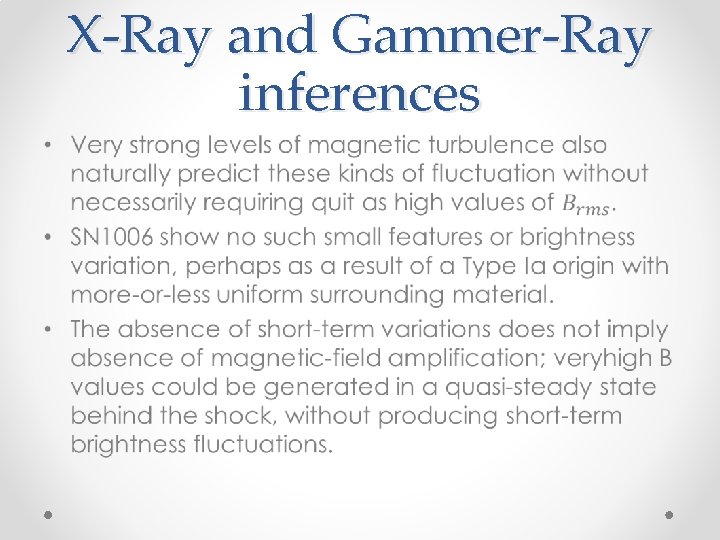
X-Ray and Gammer-Ray inferences •
X-Ray and Gammer-Ray inferences •
X-Ray and Gammer-Ray inferences • The leptonic model shown in Fig assumes a mean density of 26 cm− 1, which requires a mean magnetic field (averaged over the en- tire emitting region of Cas A) of about 0. 12 m. G. • If the actual emission is hadronic, the IC contribution must be lower (fewer relativistic electrons), demanding a larger magnetic field to produce the observed synchrotron fluxes at radio energies. • Similarly, any Te. V detection or upper limit places lower limits on the mean magnetic field in regions containing relativistic electrons. So far, four SNRs have been imaged with the HESS air-ˇCerenkov telescope array in Namibia.
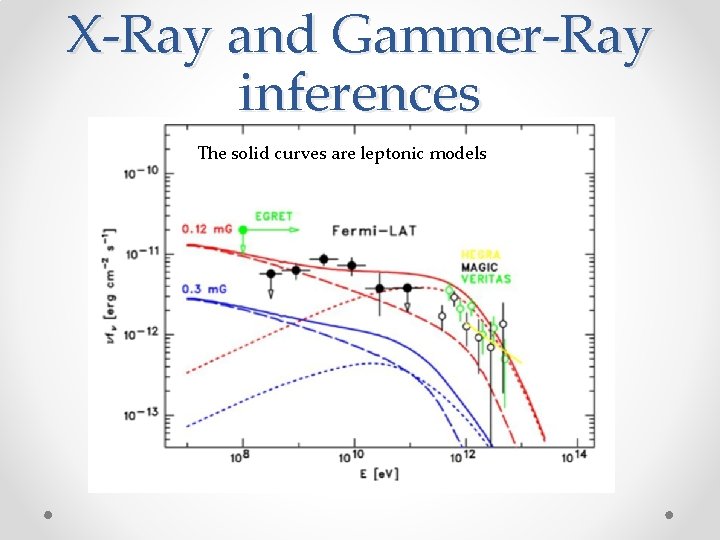
X-Ray and Gammer-Ray inferences The solid curves are leptonic models
X-Ray and Gammer-Ray inferences • The question of magnetic-field amplification is intimately connected with that of efficient particle acceleration through the proposals of Bell and Lucek (2001) and Bell (2004) that cosmic-ray driven instabilities can greatly increase the magnetic-field strength. Evidence for high magnetic fields is then taken as indirect evidence for an energetically significant component of cosmic rays (which must of necessity be ions) accelerated in the shock. This argument can be reversed: if evidence is found for efficient ion acceleration, then magnetic fields are likely to be amplified.
- Slides: 18