
Magnetic field sensors with qubits in diamond Paola
Magnetic field sensors with qubits in diamond Paola Cappellaro Massachusetts Institute of Technology Nuclear Science and Engineering Department
Promise of qt. metrology • Improved sensitivity – Entangled states – Feedback, adaptive methods • Nano-scale probes – Proximity to target, nano-materials or biology applications • Robust metrology – Clocks, based on fundamental physics laws P. Cappellaro —
Challenges in qt. metrology • Fragility of entangled states – Improved sensitivity implies higher sensitivity to external noise • Complexity of control for multi-qubit systems – Qubit addressability, control robustness and fidelity • Unavailable or inefficient quantum readout – Many-body observables, imperfect readouts P. Cappellaro —
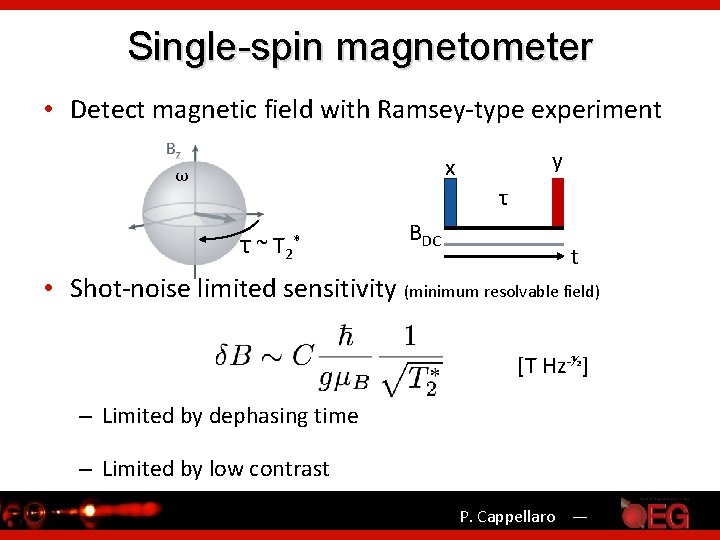
Single-spin magnetometer • Detect magnetic field with Ramsey-type experiment y x ω τ τ ~ T 2* BDC t • Shot-noise limited sensitivity (minimum resolvable field) [T Hz-½] – Limited by dephasing time – Limited by low contrast P. Cappellaro —
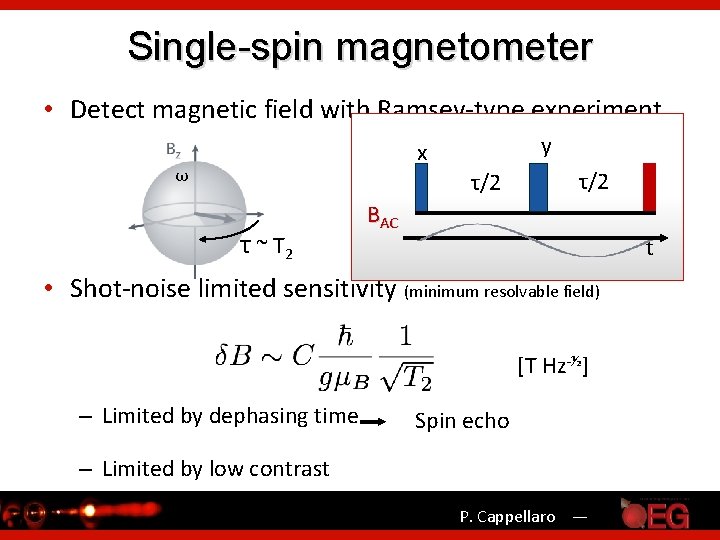
Single-spin magnetometer • Detect magnetic field with Ramsey-type experiment y x ω τ/2 τ ~ T 2 τ/2 BAC t • Shot-noise limited sensitivity (minimum resolvable field) [T Hz-½] – Limited by dephasing time Spin echo – Limited by low contrast P. Cappellaro —
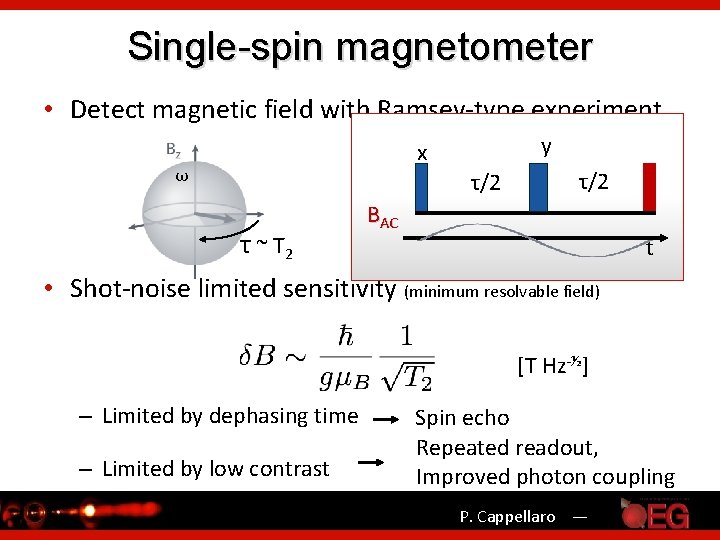
Single-spin magnetometer • Detect magnetic field with Ramsey-type experiment y x ω τ/2 τ ~ T 2 τ/2 BAC t • Shot-noise limited sensitivity (minimum resolvable field) [T Hz-½] – Limited by dephasing time – Limited by low contrast Spin echo Repeated readout, Improved photon coupling P. Cappellaro —
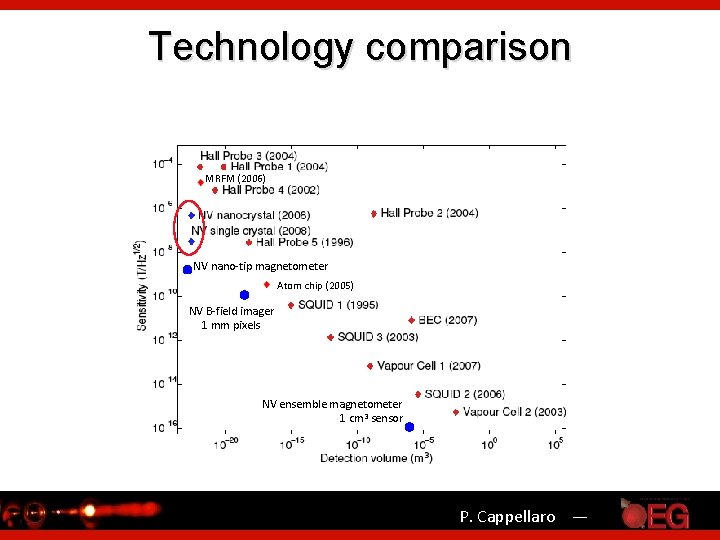
Technology comparison MRFM (2006) NV nano-tip magnetometer Atom chip (2005) NV B-field imager 1 mm pixels NV ensemble magnetometer 1 cm 3 sensor P. Cappellaro —
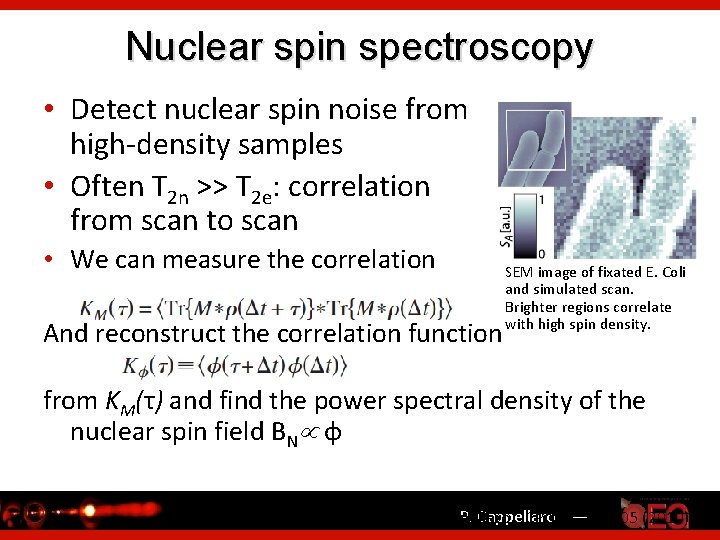
Nuclear spin spectroscopy • Detect nuclear spin noise from high-density samples • Often T 2 n >> T 2 e: correlation from scan to scan • We can measure the correlation And reconstruct the correlation function SEM image of fixated E. Coli and simulated scan. Brighter regions correlate with high spin density. from KM(τ) and find the power spectral density of the nuclear spin field BN φ P. Cappellaro Meriles, . . . Cappellaro, JCP 133, — 124105 (2010)
![Many-spins magnetometer • Improve the sensitivity by increasing the number of NV’s [T Hz-½]](http://slidetodoc.com/presentation_image_h2/c91c04f10cbb7142efaae88459aa4504/image-9.jpg "Many-spins magnetometer • Improve the sensitivity by increasing the number of NV’s [T Hz-½]")
Many-spins magnetometer • Improve the sensitivity by increasing the number of NV’s [T Hz-½] – δB per volume ~ 1/√n (n density) • Using quantum enhanced techniques, we could approach the Heisenberg limit [T Hz-½] P. Cappellaro —
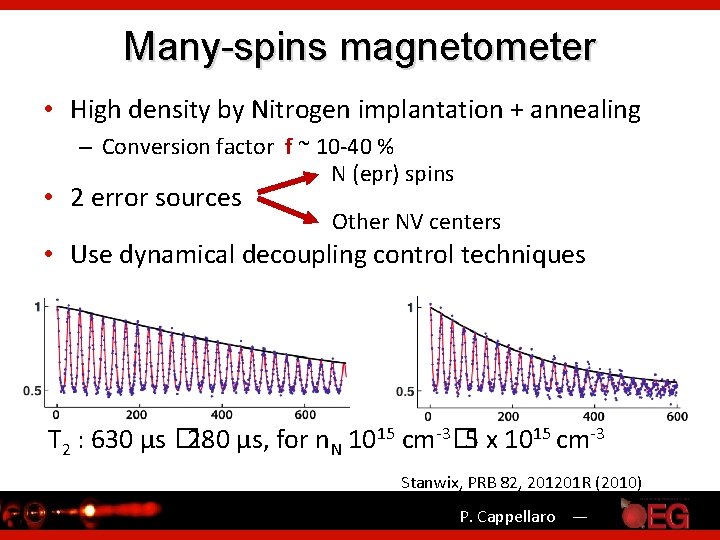
Many-spins magnetometer • High density by Nitrogen implantation + annealing – Conversion factor f ~ 10 -40 % N (epr) spins • 2 error sources Other NV centers • Use dynamical decoupling control techniques T 2 : 630 μs � 280 μs, for n. N 1015 cm-3� 5 x 1015 cm-3 Stanwix, PRB 82, 201201 R (2010) P. Cappellaro —

P. Cappellaro — APPLICATIONS

B-field imager – High density, macroscopic samples • Signal collected on CCD – Diamond divided into pixels • Imaging of magnetic surfaces – Hard disk drives, cell dynamics, brain function, … B t Action potential P. Cappellaro —
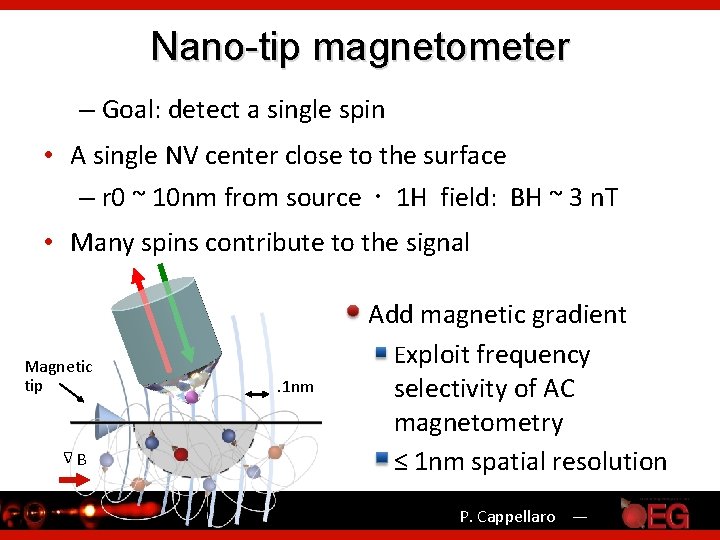
Nano-tip magnetometer – Goal: detect a single spin • A single NV center close to the surface – r 0 ~ 10 nm from source 1 H field: BH ~ 3 n. T • Many spins contribute to the signal Magnetic tip B . 1 nm Add magnetic gradient Exploit frequency selectivity of AC magnetometry ≤ 1 nm spatial resolution P. Cappellaro — Δ
P. Cappellaro — DARK SPIN MAGNETOMETRY
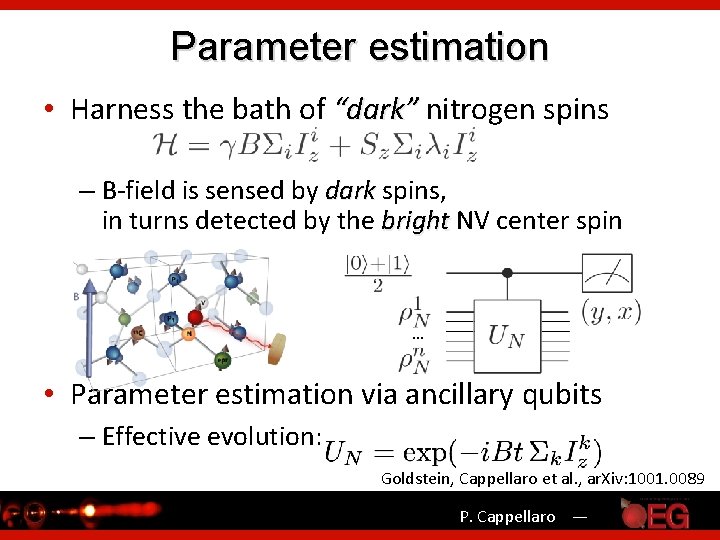
Parameter estimation • Harness the bath of “dark” nitrogen spins – B-field is sensed by dark spins, in turns detected by the bright NV center spin … • Parameter estimation via ancillary qubits – Effective evolution: Goldstein, Cappellaro et al. , ar. Xiv: 1001. 0089 P. Cappellaro —
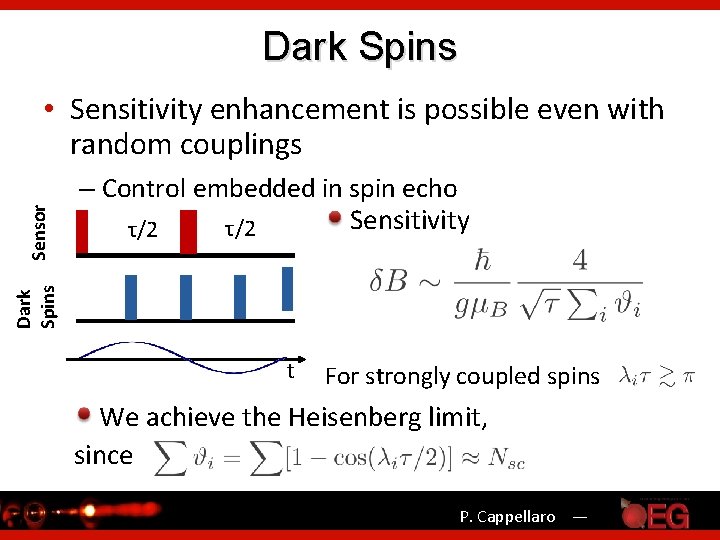
Dark Spins – Control embedded in spin echo Sensitivity τ/2 Dark Spins Sensor • Sensitivity enhancement is possible even with random couplings t For strongly coupled spins We achieve the Heisenberg limit, since P. Cappellaro —
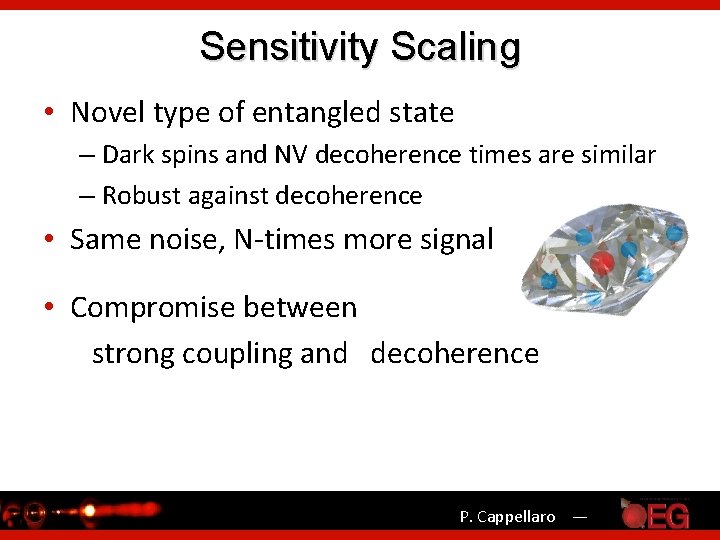
Sensitivity Scaling • Novel type of entangled state – Dark spins and NV decoherence times are similar – Robust against decoherence • Same noise, N-times more signal • Compromise between strong coupling and decoherence P. Cappellaro —
P. Cappellaro — ADAPTIVE METHODS
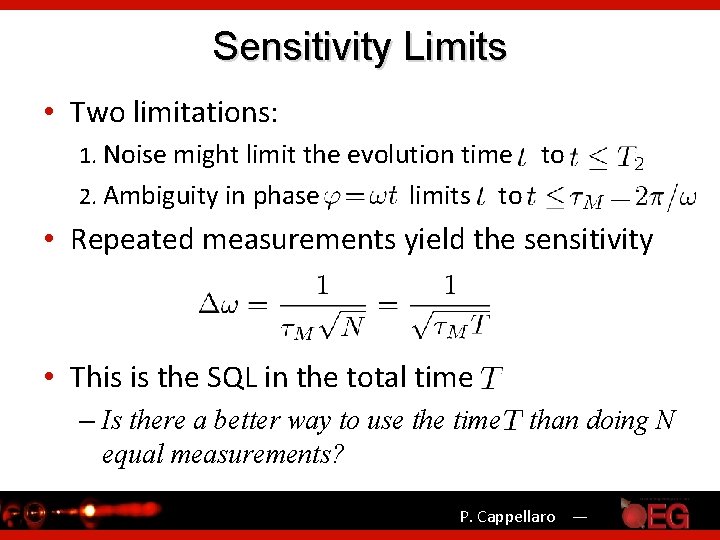
Sensitivity Limits • Two limitations: 1. Noise might limit the evolution time 2. Ambiguity in phase to limits to • Repeated measurements yield the sensitivity • This is the SQL in the total time – Is there a better way to use the time than doing N equal measurements? P. Cappellaro —
Quantum Metrology Limit • Goal: scaling with resources (QML) • Entangled states (squeezing) can achieve the QML with the number of probes*, – but they are usually fragile or difficult to prepare. • Adaptive readout schemes can achieve the QML in the total measurement time , – no entanglement is required *P. Cappellaro et al. , PRA 80, 032311 (2009); PRL 106, 140502 (2011); PRA (2012). P. Cappellaro —
Adaptive Methods • Update the interrogation scheme based on previous information (Bayesian method) • Adaptive rules desiderata: 1. Should converge to correct result 2. Can achieve a broader measurement bandwidth 3. Can converge faster than classical schemes P. Cappellaro —
Adaptive Methods • Update the interrogation scheme based on previous information (Bayesian method) • Adaptive rules desiderata: 1. 2. 3. 4. Should converge to correct result Can achieve a broader measurement bandwidth Can converge faster than classical schemes Should be robust against readout (and other) errors P. Cappellaro —
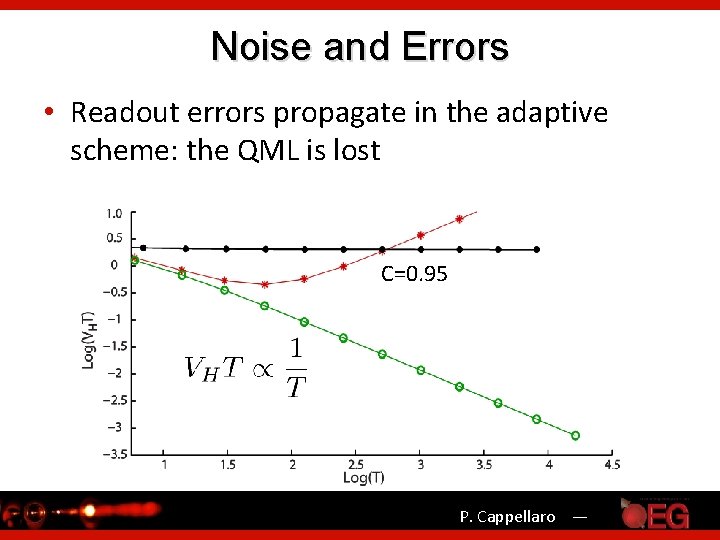
Noise and Errors • Readout errors propagate in the adaptive scheme: the QML is lost C=0. 95 P. Cappellaro —
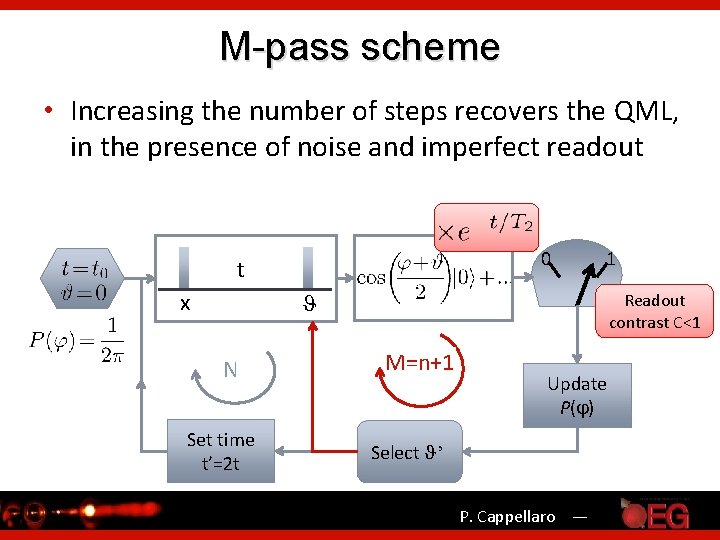
M-pass scheme • Increasing the number of steps recovers the QML, in the presence of noise and imperfect readout 0 t 1 J x N Set time t’=2 t Readout contrast C<1 M=n+1 M=2 Update P(j) Select J’ P. Cappellaro —
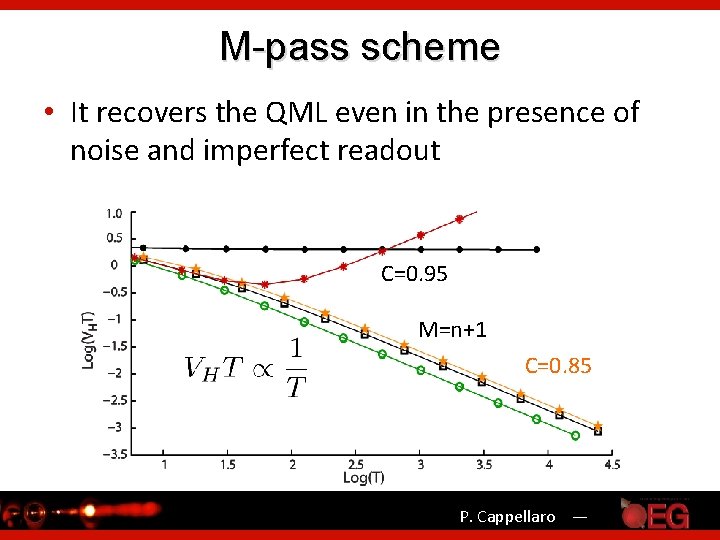
M-pass scheme • It recovers the QML even in the presence of noise and imperfect readout C=0. 95 M=n+1 C=0. 85 P. Cappellaro —
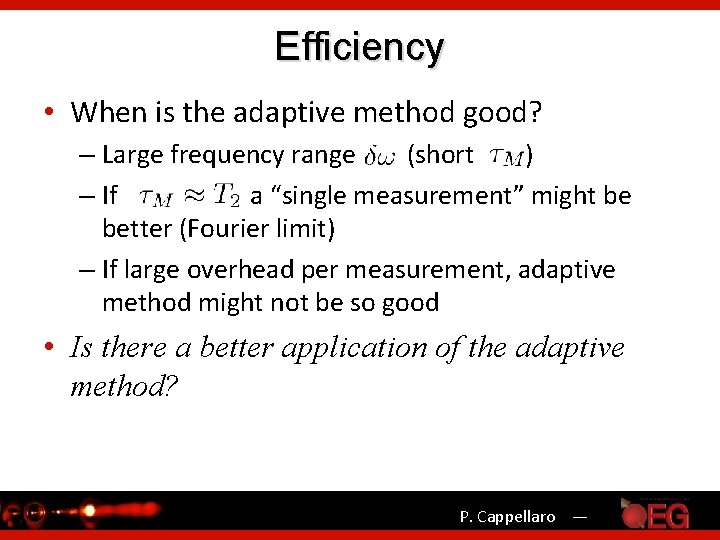
Efficiency • When is the adaptive method good? – Large frequency range (short ) – If a “single measurement” might be better (Fourier limit) – If large overhead per measurement, adaptive method might not be so good • Is there a better application of the adaptive method? P. Cappellaro —
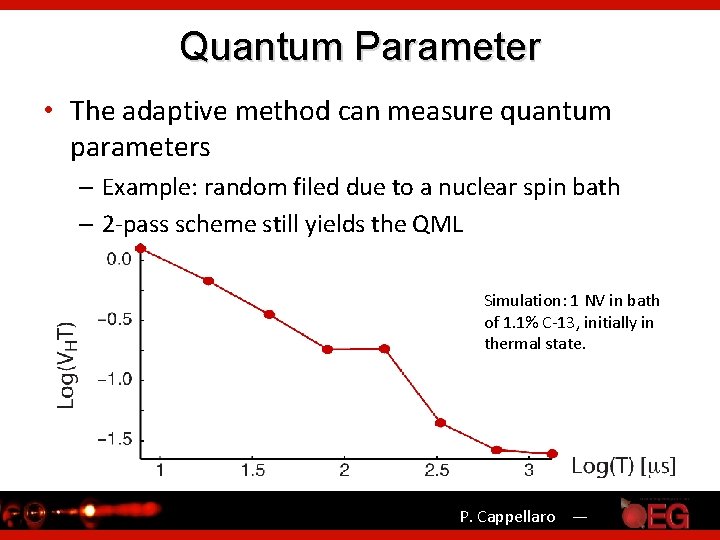
Quantum Parameter • The adaptive method can measure quantum parameters – Example: random filed due to a nuclear spin bath – 2 -pass scheme still yields the QML Simulation: 1 NV in bath of 1. 1% C-13, initially in thermal state. P. Cappellaro —
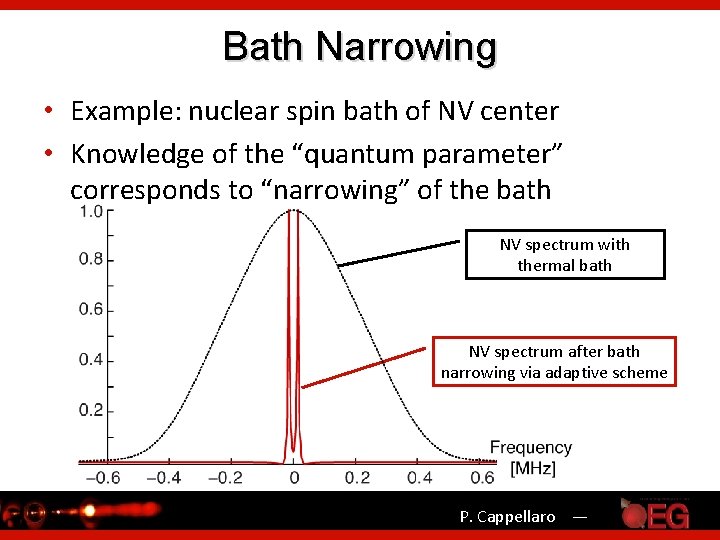
Bath Narrowing • Example: nuclear spin bath of NV center • Knowledge of the “quantum parameter” corresponds to “narrowing” of the bath NV spectrum with thermal bath NV spectrum after bath narrowing via adaptive scheme P. Cappellaro —
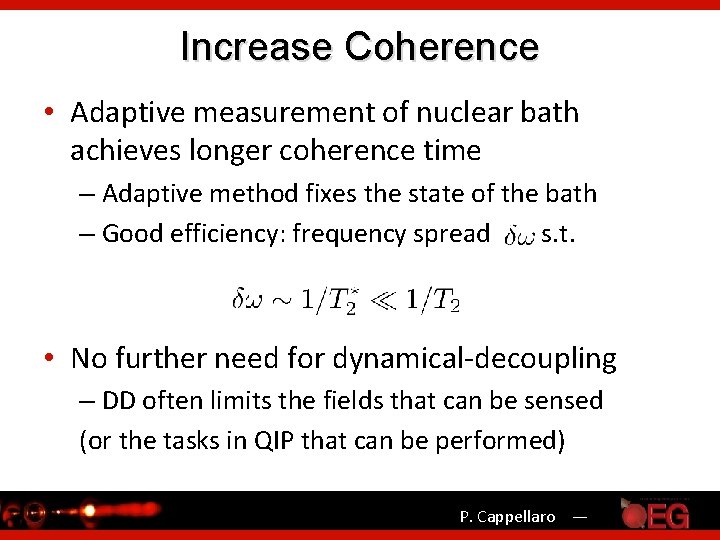
Increase Coherence • Adaptive measurement of nuclear bath achieves longer coherence time – Adaptive method fixes the state of the bath – Good efficiency: frequency spread s. t. • No further need for dynamical-decoupling – DD often limits the fields that can be sensed (or the tasks in QIP that can be performed) P. Cappellaro —
P. Cappellaro — COMPOSITE PULSE MAGNETOMETRY
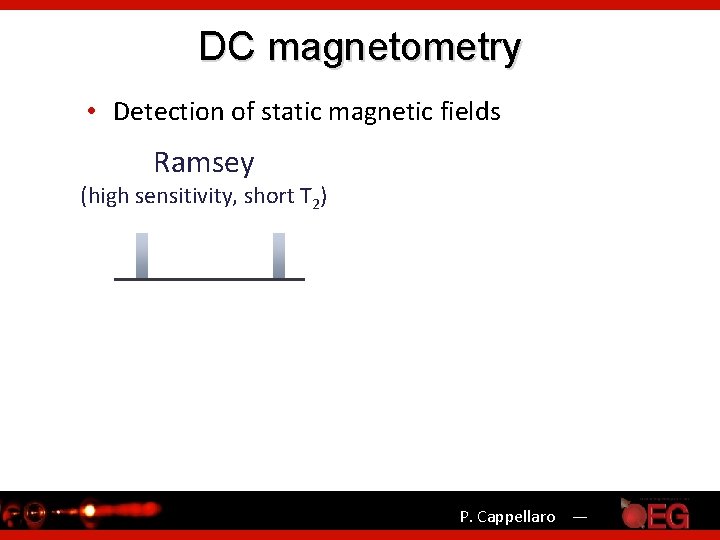
DC magnetometry • Detection of static magnetic fields Ramsey (high sensitivity, short T 2) P. Cappellaro —
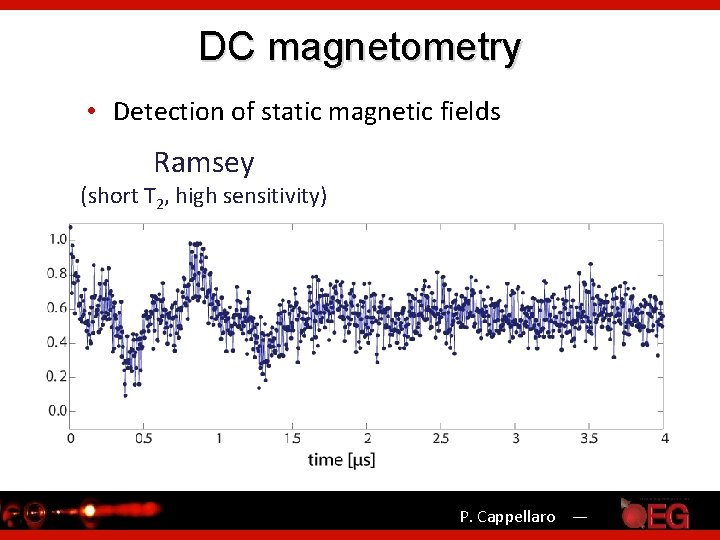
DC magnetometry • Detection of static magnetic fields Ramsey (short T 2, high sensitivity) P. Cappellaro —
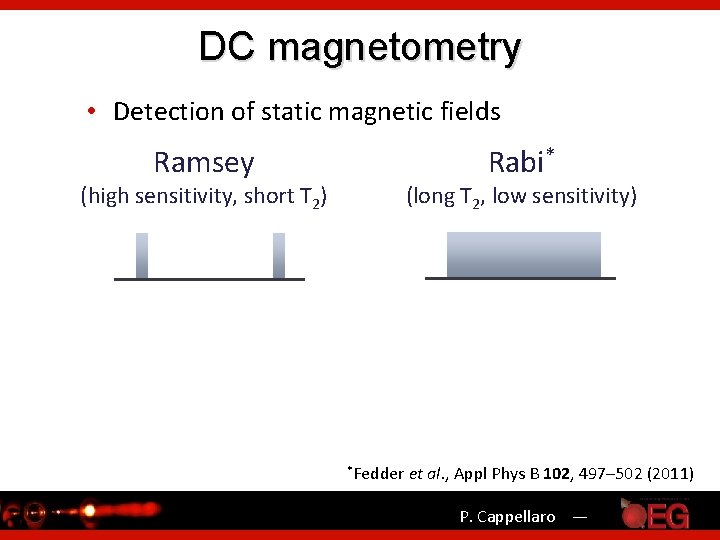
DC magnetometry • Detection of static magnetic fields Ramsey Rabi* (high sensitivity, short T 2) (long T 2, low sensitivity) *Fedder et al. , Appl Phys B 102, 497– 502 (2011) P. Cappellaro —
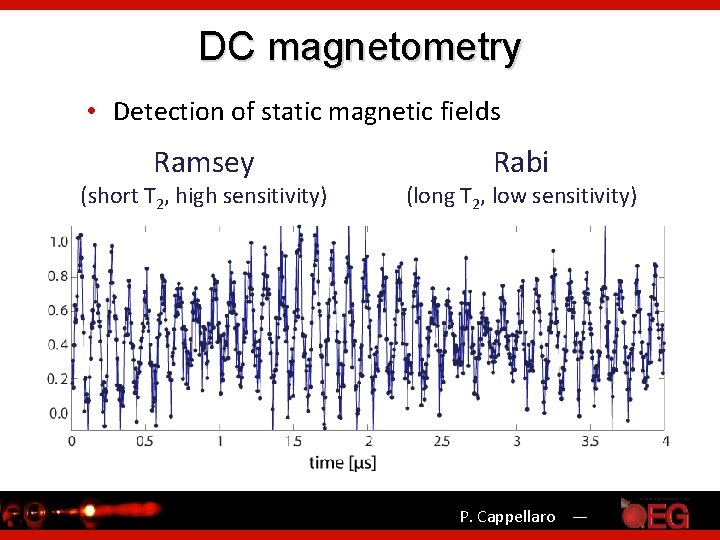
DC magnetometry • Detection of static magnetic fields Ramsey (short T 2, high sensitivity) Rabi (long T 2, low sensitivity) P. Cappellaro —
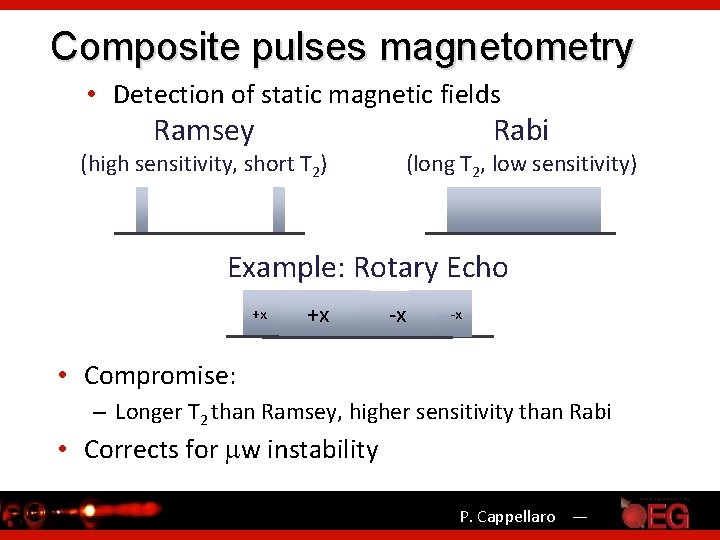
Composite pulses magnetometry • Detection of static magnetic fields Ramsey Rabi (high sensitivity, short T 2) (long T 2, low sensitivity) Example: Rotary Echo +x -x +x +x -x …-x +x -x • Compromise: – Longer T 2 than Ramsey, higher sensitivity than Rabi • Corrects for mw instability P. Cappellaro —
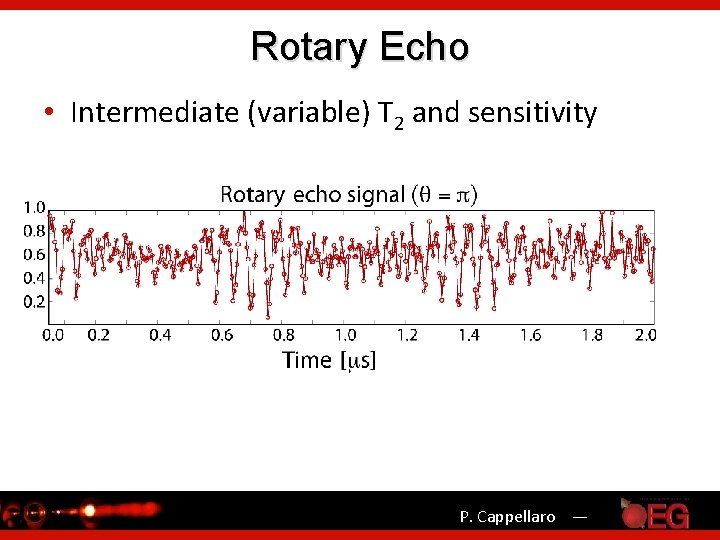
Rotary Echo • Intermediate (variable) T 2 and sensitivity P. Cappellaro —
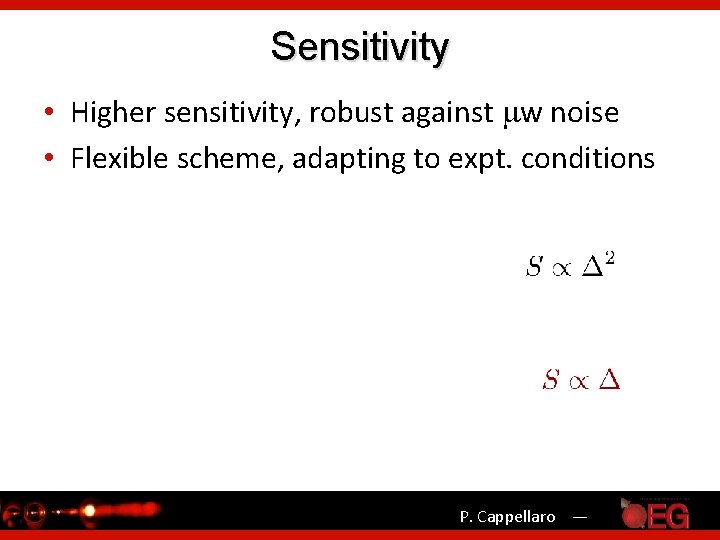
Sensitivity • Higher sensitivity, robust against mw noise • Flexible scheme, adapting to expt. conditions P. Cappellaro —
Conclusions • Quantum metrology offers many challenges but even more diverse opportunities for improvement – Control techniques – Adaptive methods – Harnessing the “environment” • Applications – Detection of static magnetic fields with NV centers – Nuclear spin bath narrowing P. Cappellaro —
P. Cappellaro — A stable, three axis gyroscope in diamond n. NV-GYRO
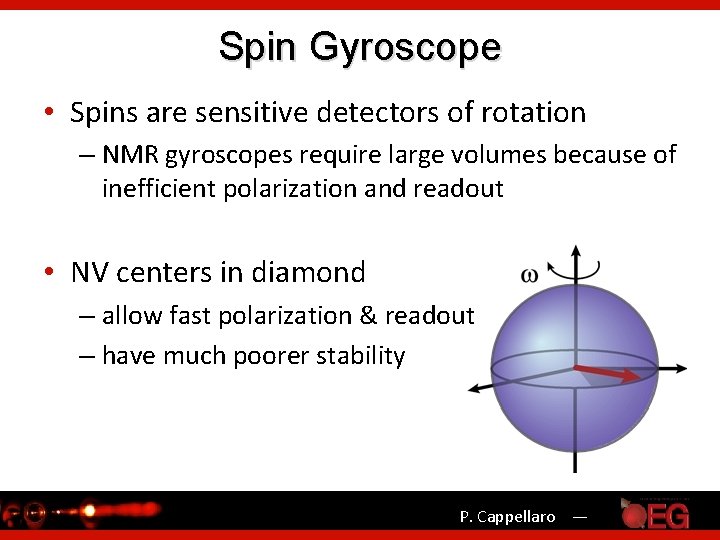
Spin Gyroscope • Spins are sensitive detectors of rotation – NMR gyroscopes require large volumes because of inefficient polarization and readout • NV centers in diamond – allow fast polarization & readout – have much poorer stability P. Cappellaro —
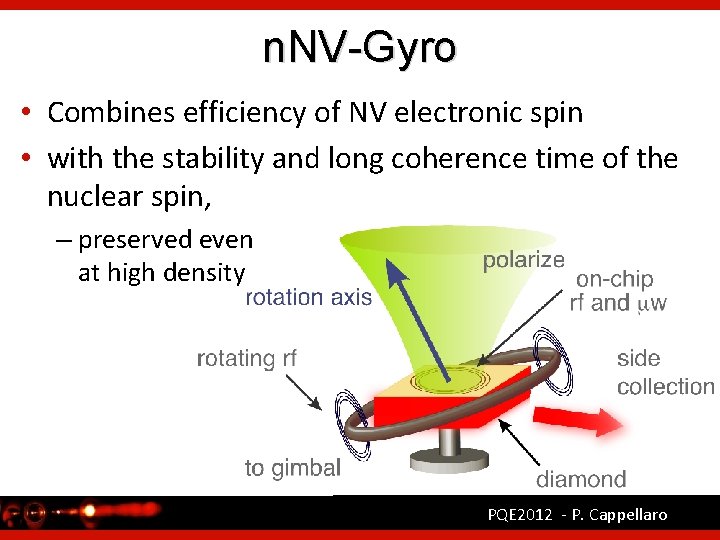
n. NV-Gyro • Combines efficiency of NV electronic spin • with the stability and long coherence time of the nuclear spin, – preserved even at high density PQE 2012 - P. Cappellaro
n. NV-gyro sensitivity • Using an echo scheme, the n. NV-gyro offers great stability • It could be combined with MEMS gyro, that are not stable PQE 2012 - P. Cappellaro
P. Cappellaro — Funding NIST DARPA (Qu. ASAR) AFOSR MURI (Qu. ISM) Publications N. Bar-Gill, L. M. Pham, C. Belthangady, D. Le Sage, P. Cappellaro, J. R. Maze, M. D. Lukin, A. Yacoby, R. Walsworth, Nature Comm. 3, 858 (2012) A. Ajoy and P. Cappellaro "Stable Three-Axis Nuclear Spin Gyroscope in Diamond" ar. Xiv: 1205. 1494 (2012) P. Cappellaro, Phys. Rev. A 85, 030301(R) (2012) P. Cappellaro, G. Goldstein, J. S. Hodges, L. Jiang, J. R. Maze, A. S. Sørensen, M. D. Lukin, Phys. Rev A 85, 032336 (2012) L. M. Pham, N. Bar-Gill, C. Belthangady, D. Le Sage, P. Cappellaro, M. D. Lukin, A. Yacoby, R. L. Walsworth, ar. Xiv: 1201. 5686 G. Goldstein, P. Cappellaro, J. R. Maze, J. S. Hodges, L. Jiang, A. S. Sørensen, M. D. Lukin, Phys. Rev. Lett. 106, 140502 (2011) L. M. Pham, D. Le Sage, P. L. Stanwix, T. K. Yeung, D. Glenn, A. Trifonov, P. Cappellaro, P. R. Hemmer, M. D. Lukin, H. Park, A. Yacoby and R. L. Walsworth, New J. Phys. 13 045021 (2011) C. A. Meriles, L. Jiang, G. Goldstein, J. S. Hodges, J. R. Maze, M. D. Lukin and P. Cappellaro J. Chem. Phys. 133, 124105 (2010) P. L. Stanwix, L. M. Pham, J. R. Maze, D. Le Sage, T. K. Yeung, P. Cappellaro, P. R. Hemmer, A. Yacoby, M. D. Lukin, R. L. Walsworth, Phys. Rev. B 82, 201201(R) (2010)
- Slides: 43