
Magnetic field and forces Early history of magnetism
- Slides: 24
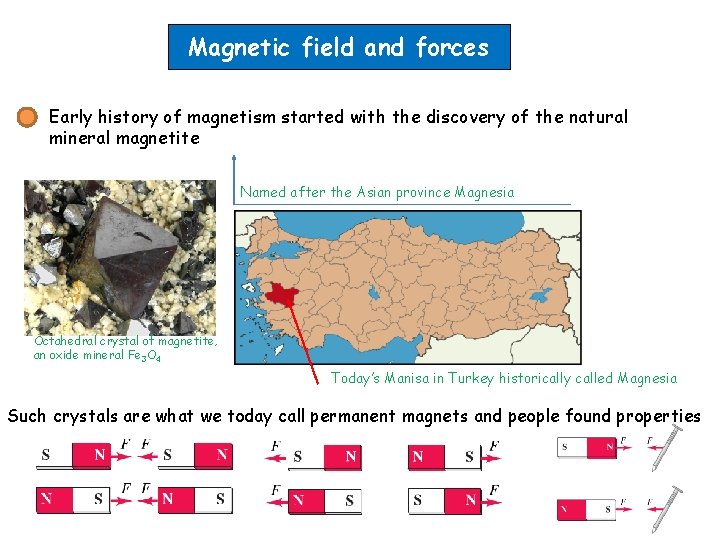
Magnetic field and forces Early history of magnetism started with the discovery of the natural mineral magnetite Named after the Asian province Magnesia Octahedral crystal of magnetite, an oxide mineral Fe 3 O 4 Today’s Manisa in Turkey historically called Magnesia Such crystals are what we today call permanent magnets and people found properties
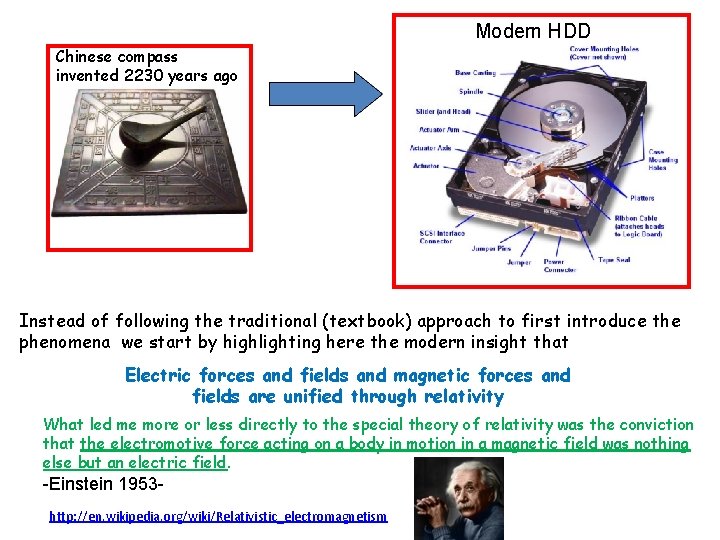
Modern HDD Chinese compass invented 2230 years ago Instead of following the traditional (textbook) approach to first introduce the phenomena we start by highlighting here the modern insight that Electric forces and fields and magnetic forces and fields are unified through relativity What led me more or less directly to the special theory of relativity was the conviction that the electromotive force acting on a body in motion in a magnetic field was nothing else but an electric field. -Einstein 1953 http: //en. wikipedia. org/wiki/Relativistic_electromagnetism
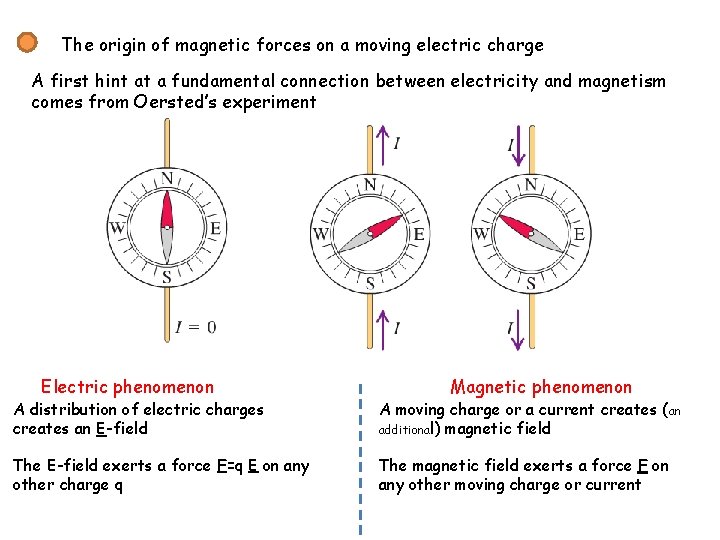
The origin of magnetic forces on a moving electric charge A first hint at a fundamental connection between electricity and magnetism comes from Oersted’s experiment Electric phenomenon Magnetic phenomenon A distribution of electric charges creates an E-field A moving charge or a current creates (an additional) magnetic field The E-field exerts a force F=q E on any other charge q The magnetic field exerts a force F on any other moving charge or current
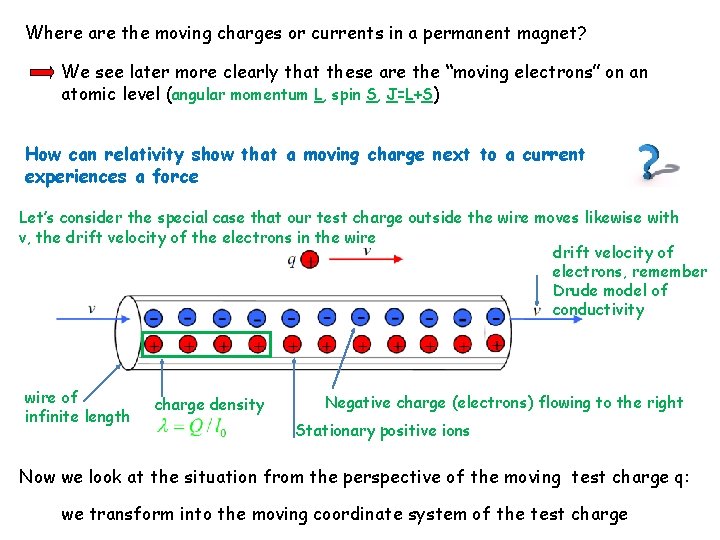
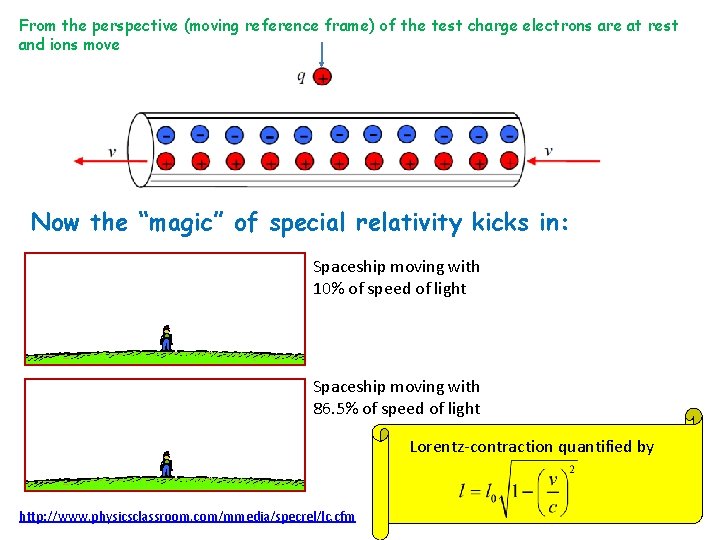
Where are the moving charges or currents in a permanent magnet? We see later more clearly that these are the “moving electrons” on an atomic level (angular momentum L, spin S, J=L+S) How can relativity show that a moving charge next to a current experiences a force Let’s consider the special case that our test charge outside the wire moves likewise with v, the drift velocity of the electrons in the wire drift velocity of electrons, remember Drude model of conductivity wire of infinite length charge density Negative charge (electrons) flowing to the right Stationary positive ions Now we look at the situation from the perspective of the moving test charge q: we transform into the moving coordinate system of the test charge
From the perspective (moving reference frame) of the test charge electrons are at rest and ions move Now the “magic” of special relativity kicks in: Spaceship moving with 10% of speed of light Spaceship moving with 86. 5% of speed of light Lorentz-contraction quantified by http: //www. physicsclassroom. com/mmedia/specrel/lc. cfm
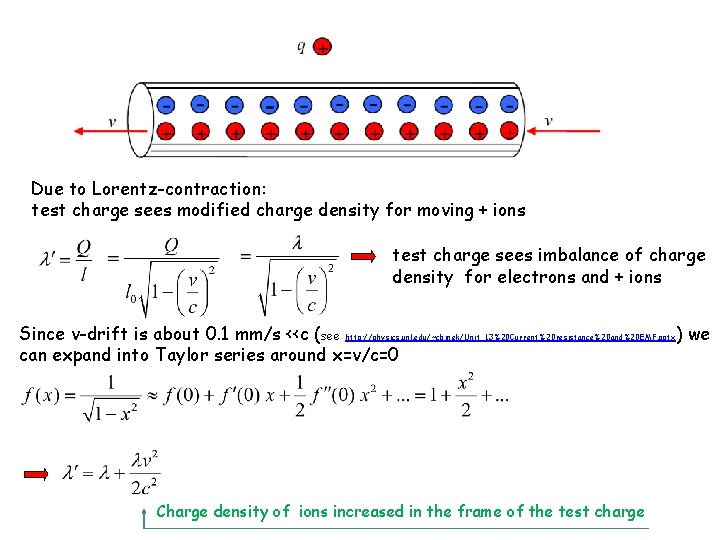
Due to Lorentz-contraction: test charge sees modified charge density for moving + ions test charge sees imbalance of charge density for electrons and + ions Since v-drift is about 0. 1 mm/s <<c (see http: //physics. unl. edu/~cbinek/Unit_13%20 Current%20 resistance%20 and%20 EMF. pptx) we can expand into Taylor series around x=v/c=0 Charge density of ions increased in the frame of the test charge
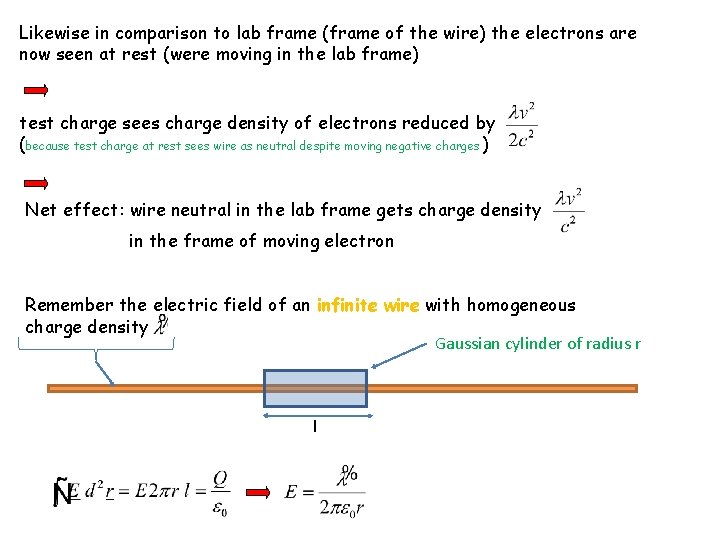
Likewise in comparison to lab frame (frame of the wire) the electrons are now seen at rest (were moving in the lab frame) test charge sees charge density of electrons reduced by (because test charge at rest sees wire as neutral despite moving negative charges ) Net effect: wire neutral in the lab frame gets charge density in the frame of moving electron Remember the electric field of an infinite wire with homogeneous charge density Gaussian cylinder of radius r l
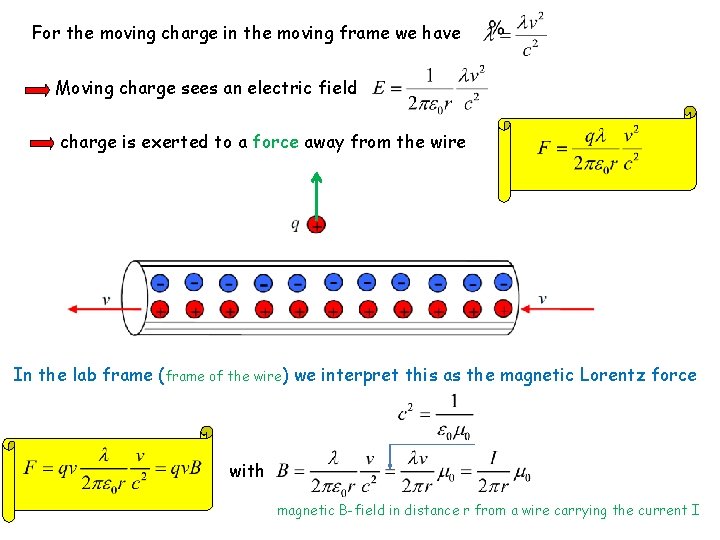
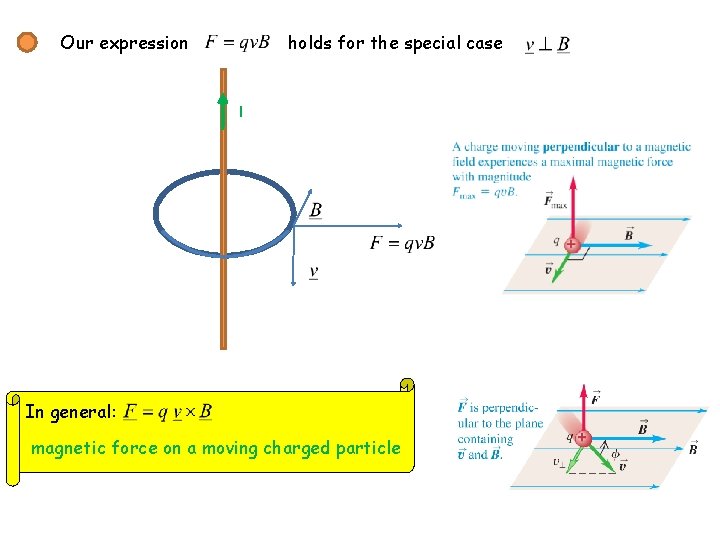
For the moving charge in the moving frame we have Moving charge sees an electric field charge is exerted to a force away from the wire In the lab frame (frame of the wire) we interpret this as the magnetic Lorentz force with magnetic B-field in distance r from a wire carrying the current I
Our expression holds for the special case I In general: magnetic force on a moving charged particle
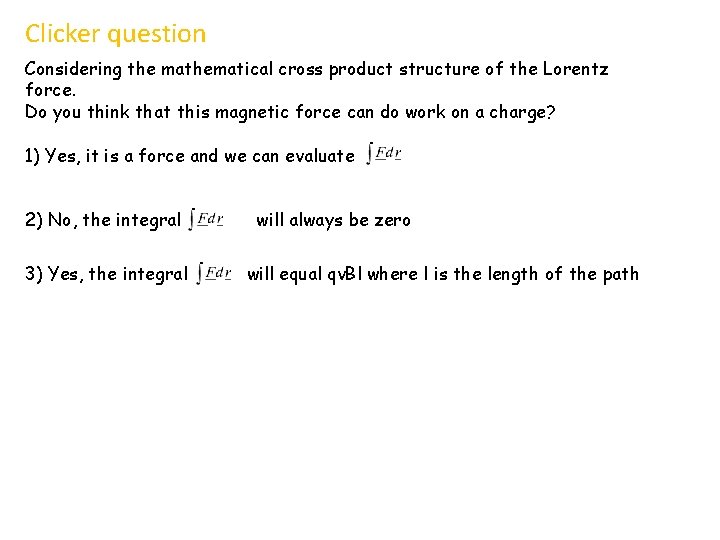
Clicker question Considering the mathematical cross product structure of the Lorentz force. Do you think that this magnetic force can do work on a charge? 1) Yes, it is a force and we can evaluate 2) No, the integral 3) Yes, the integral will always be zero will equal qv. Bl where l is the length of the path
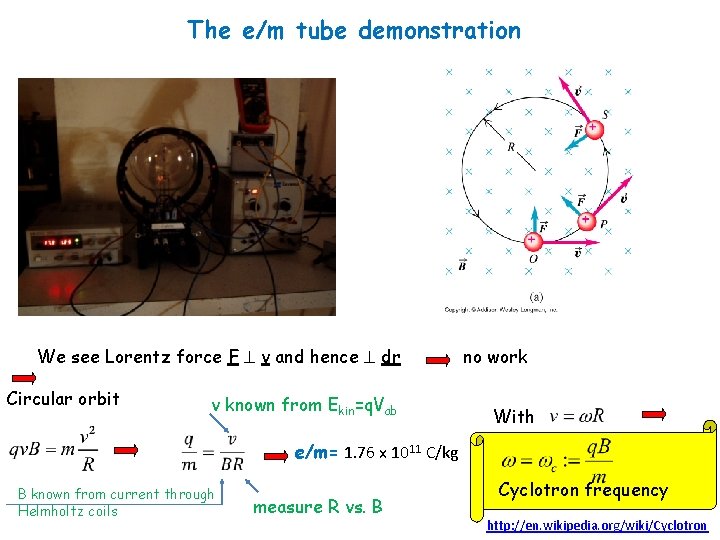
The e/m tube demonstration We see Lorentz force F v and hence dr Circular orbit v known from Ekin=q. Vab no work With e/m= 1. 76 x 1011 C/kg B known from current through Helmholtz coils measure R vs. B Cyclotron frequency http: //en. wikipedia. org/wiki/Cyclotron
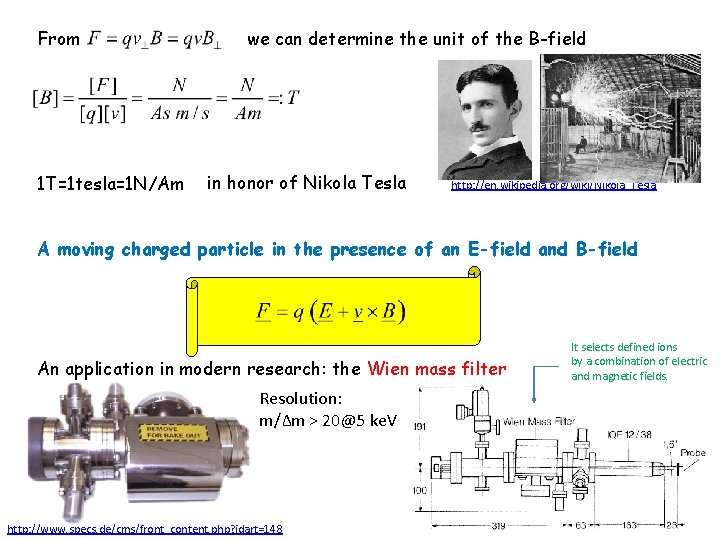
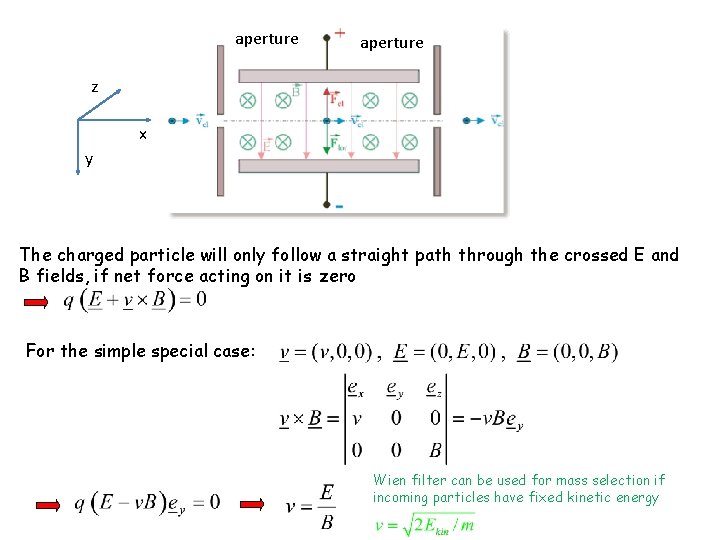
From 1 T=1 tesla=1 N/Am we can determine the unit of the B-field in honor of Nikola Tesla http: //en. wikipedia. org/wiki/Nikola_Tesla A moving charged particle in the presence of an E-field and B-field An application in modern research: the Wien mass filter Resolution: m/Δm > 20@5 ke. V http: //www. specs. de/cms/front_content. php? idart=148 It selects defined ions by a combination of electric and magnetic fields.
aperture z x y The charged particle will only follow a straight path through the crossed E and B fields, if net force acting on it is zero For the simple special case: Wien filter can be used for mass selection if incoming particles have fixed kinetic energy
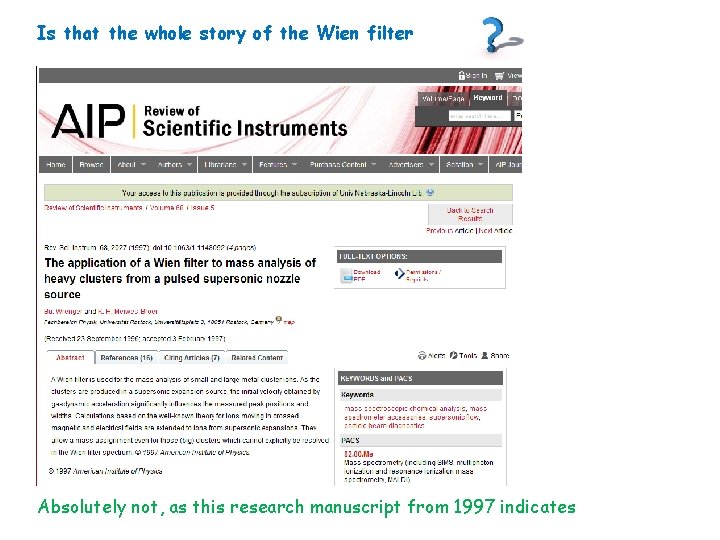
Is that the whole story of the Wien filter Absolutely not, as this research manuscript from 1997 indicates
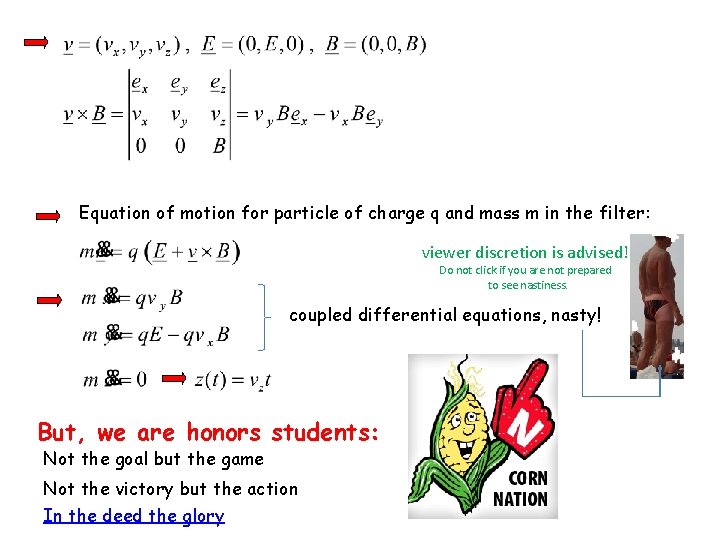
Equation of motion for particle of charge q and mass m in the filter: viewer discretion is advised! Do not click if you are not prepared to see nastiness. coupled differential equations, nasty! But, we are honors students: Not the goal but the game Not the victory but the action In the deed the glory
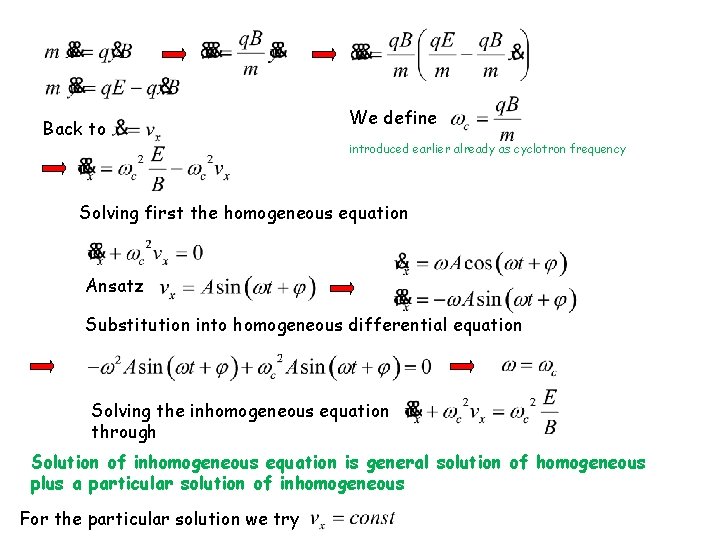
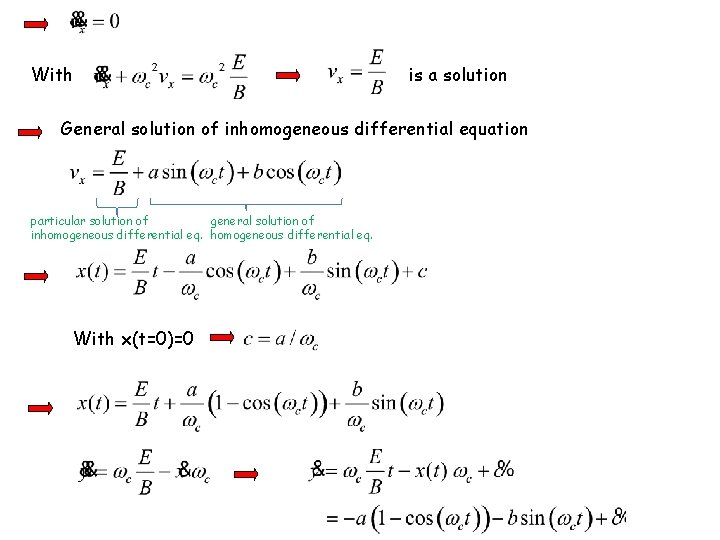
Back to We define introduced earlier already as cyclotron frequency Solving first the homogeneous equation Ansatz Substitution into homogeneous differential equation Solving the inhomogeneous equation through Solution of inhomogeneous equation is general solution of homogeneous plus a particular solution of inhomogeneous For the particular solution we try
With is a solution General solution of inhomogeneous differential equation particular solution of general solution of inhomogeneous differential eq. With x(t=0)=0
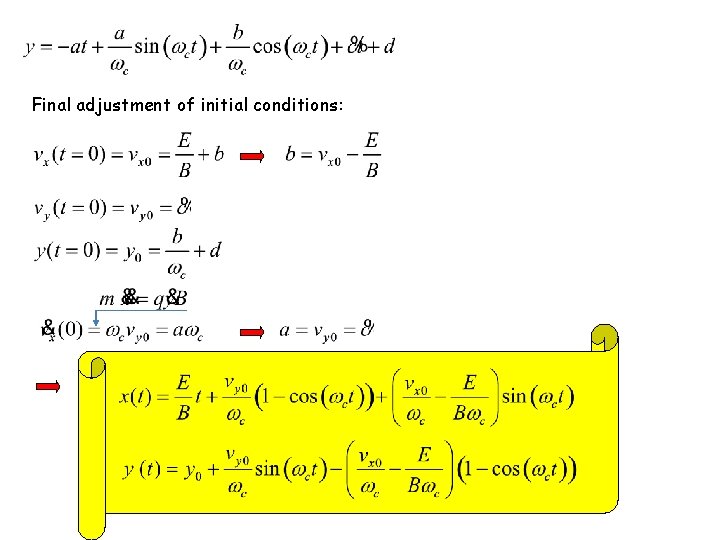
Final adjustment of initial conditions:
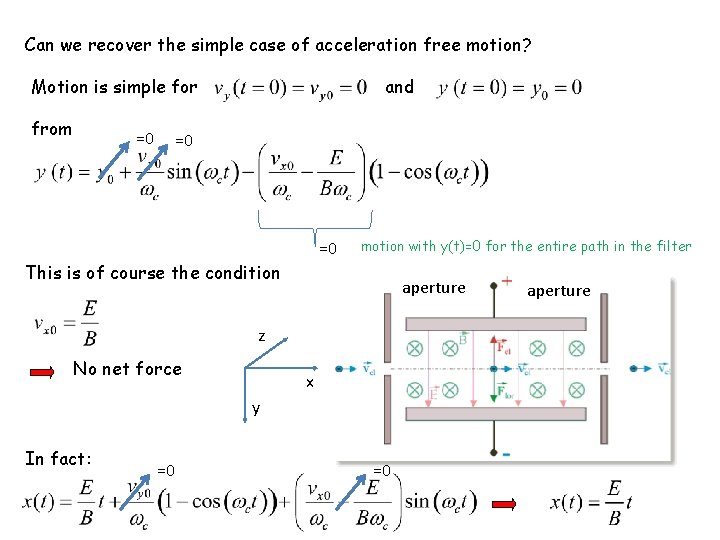
Can we recover the simple case of acceleration free motion? Motion is simple for from =0 and =0 =0 This is of course the condition motion with y(t)=0 for the entire path in the filter aperture z No net force x y In fact: =0 =0 aperture
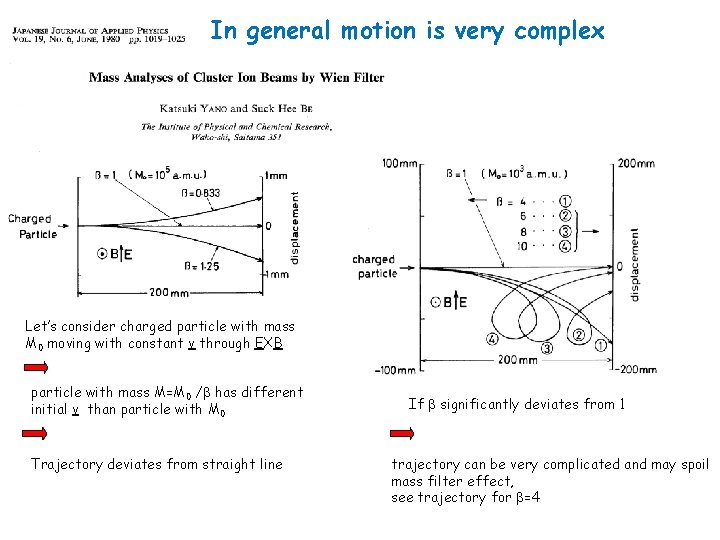
In general motion is very complex Let’s consider charged particle with mass M 0 moving with constant v through EXB particle with mass M=M 0 / has different initial v than particle with M 0 Trajectory deviates from straight line If significantly deviates from 1 trajectory can be very complicated and may spoil mass filter effect, see trajectory for =4
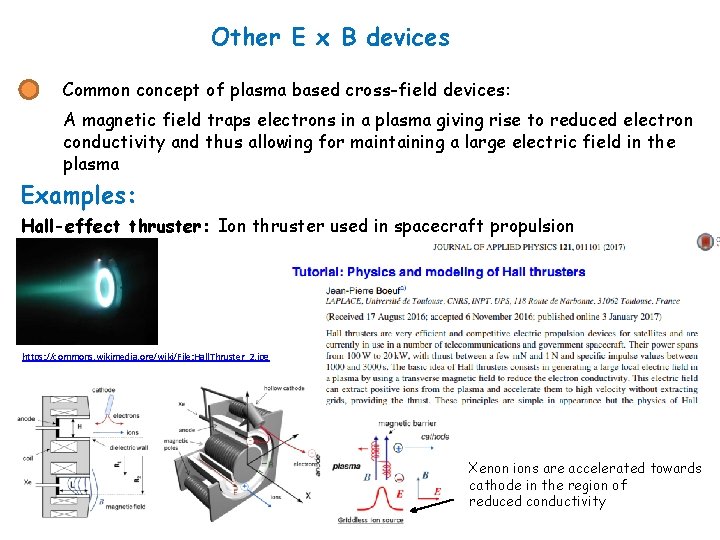
Other E x B devices Common concept of plasma based cross-field devices: A magnetic field traps electrons in a plasma giving rise to reduced electron conductivity and thus allowing for maintaining a large electric field in the plasma Examples: Hall-effect thruster: Ion thruster used in spacecraft propulsion https: //commons. wikimedia. org/wiki/File: Hall. Thruster_2. jpg Xenon ions are accelerated towards cathode in the region of reduced conductivity
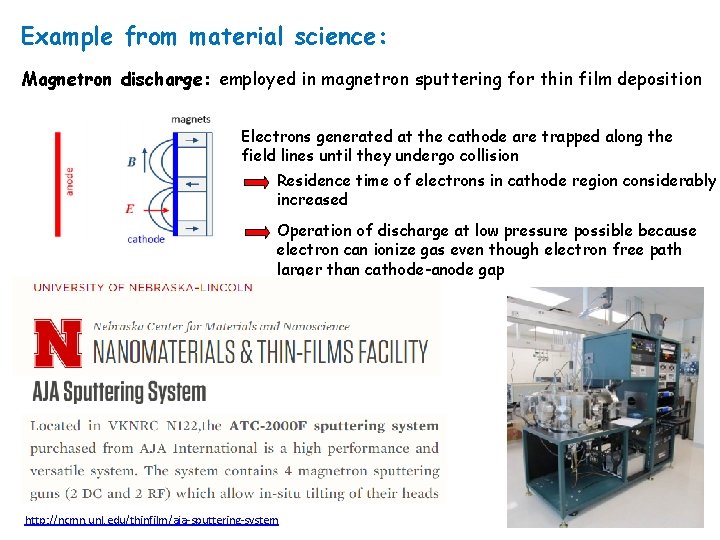
Example from material science: Magnetron discharge: employed in magnetron sputtering for thin film deposition Electrons generated at the cathode are trapped along the field lines until they undergo collision Residence time of electrons in cathode region considerably increased Operation of discharge at low pressure possible because electron can ionize gas even though electron free path larger than cathode-anode gap http: //ncmn. unl. edu/thinfilm/aja-sputtering-system
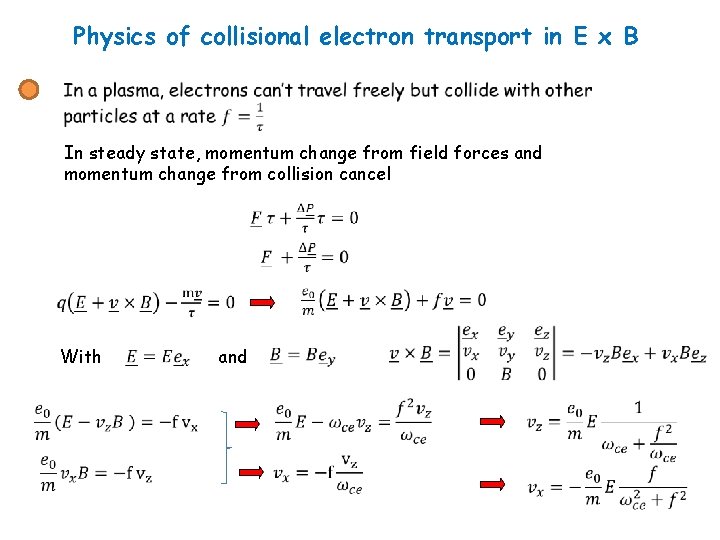
Physics of collisional electron transport in E x B In steady state, momentum change from field forces and momentum change from collision cancel With and
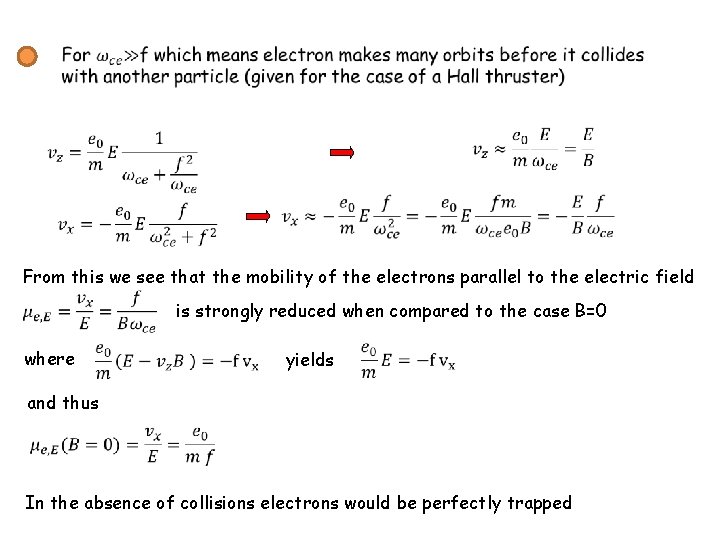
From this we see that the mobility of the electrons parallel to the electric field is strongly reduced when compared to the case B=0 where yields and thus In the absence of collisions electrons would be perfectly trapped