
Magnetars Jared Filseth What is a Magnetar Type

- Slides: 20
Magnetars Jared Filseth
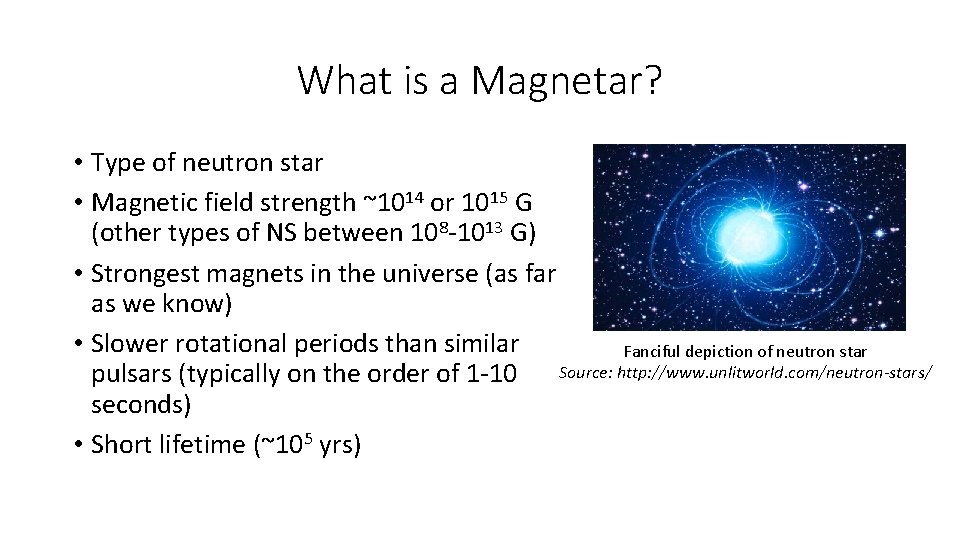
What is a Magnetar? • Type of neutron star • Magnetic field strength ~1014 or 1015 G (other types of NS between 108 -1013 G) • Strongest magnets in the universe (as far as we know) • Slower rotational periods than similar Fanciful depiction of neutron star Source: http: //www. unlitworld. com/neutron-stars/ pulsars (typically on the order of 1 -10 seconds) • Short lifetime (~105 yrs)
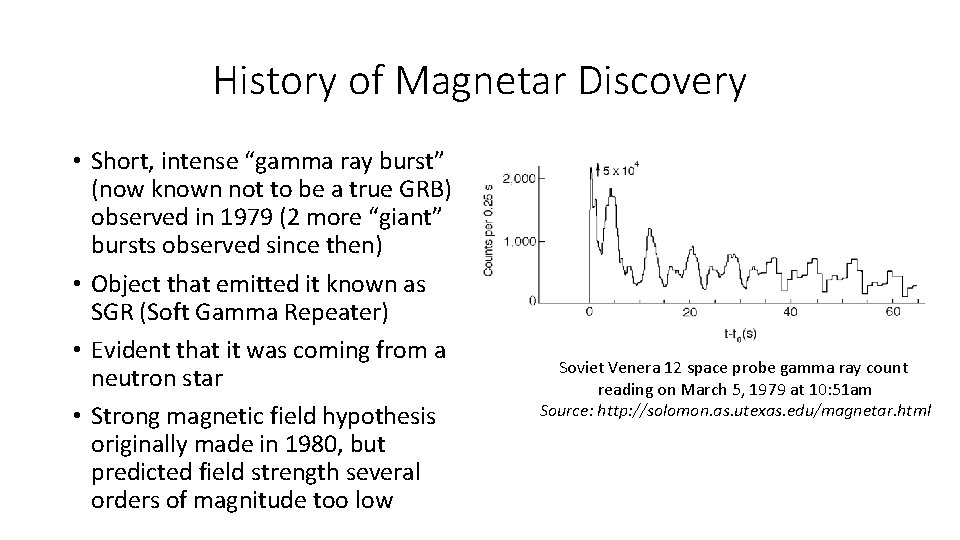
History of Magnetar Discovery • Short, intense “gamma ray burst” (now known not to be a true GRB) observed in 1979 (2 more “giant” bursts observed since then) • Object that emitted it known as SGR (Soft Gamma Repeater) • Evident that it was coming from a neutron star • Strong magnetic field hypothesis originally made in 1980, but predicted field strength several orders of magnitude too low Soviet Venera 12 space probe gamma ray count reading on March 5, 1979 at 10: 51 am Source: http: //solomon. as. utexas. edu/magnetar. html
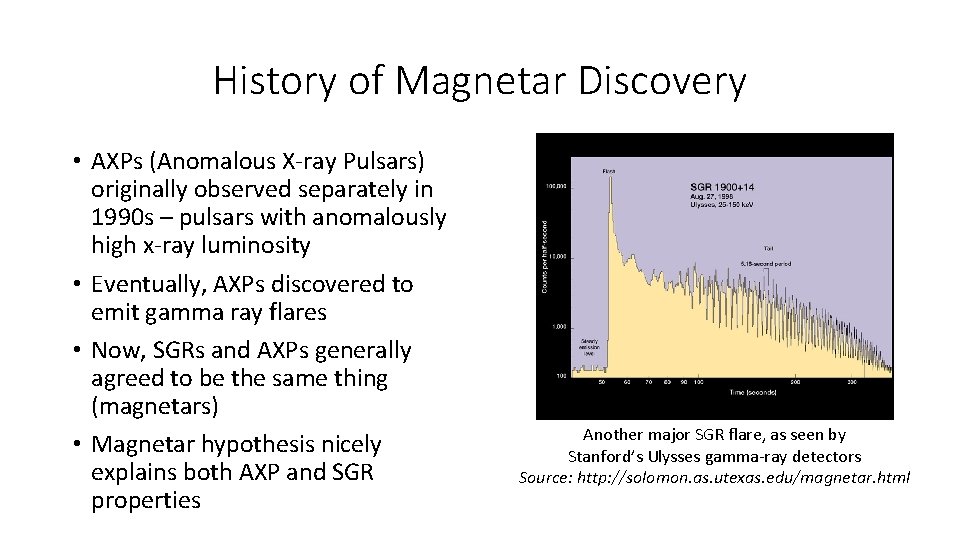
History of Magnetar Discovery • AXPs (Anomalous X-ray Pulsars) originally observed separately in 1990 s – pulsars with anomalously high x-ray luminosity • Eventually, AXPs discovered to emit gamma ray flares • Now, SGRs and AXPs generally agreed to be the same thing (magnetars) • Magnetar hypothesis nicely explains both AXP and SGR properties Another major SGR flare, as seen by Stanford’s Ulysses gamma-ray detectors Source: http: //solomon. as. utexas. edu/magnetar. html
Magnetar Properties • Magnetar hypothesis: energy for SGR bursts and high x-ray emissions comes from decay of extremely strong magnetic field • “Spin-down”: angular velocity of magnetar decreases over time • B-field decays over time • Energy from B-field decay powers SGR bursts and AXP emissions, and all other magnetar properties Magnetars are generally believed to originate in supernovae Source: http: //chandra. harvard. edu/formal/snr/bg 2. html
Evidence for Magnetars • Rotational energy loss alone (from spin-down) cannot explain AXP • SGR 1806 -20: based on time elapsed since supernova, SGR spin-down rate was calculated, which allowed for calculation of magnetic field strength: ~8*1014 G (Kouveliotou 1998) • High magnetic field (at least 1014 G) decreases scattering opacity, raising Eddington limit, which explains the super-Eddington luminosities of some bursts • Magnetic field changes provide energy needed to power sudden large SGR bursts, for magnetic fields of at least 1014 G • While accreting magnetars may exist, discovered SGRs have no stellar companions, meaning accretion cannot be an energy source
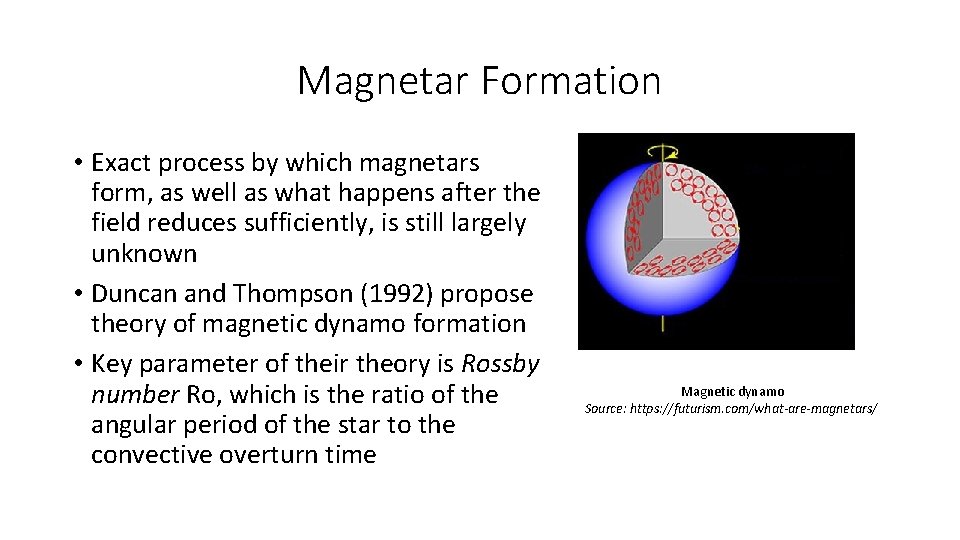
Magnetar Formation • Exact process by which magnetars form, as well as what happens after the field reduces sufficiently, is still largely unknown • Duncan and Thompson (1992) propose theory of magnetic dynamo formation • Key parameter of their theory is Rossby number Ro, which is the ratio of the angular period of the star to the convective overturn time Magnetic dynamo Source: https: //futurism. com/what-are-magnetars/
Duncan and Thompson Hypothesis (1992) • For Rossby number of order unity, initial orbital period must be ~1 ms – faster than the fastest observed NS pulsars • With Rossby number of order unity, efficient magnetic dynamos can theoretically form during neutron star birth, resulting in magnetic field up to 3*1017 G in ideal case; more than enough for magnetars • Magnetars are evolution of extremely rapidly rotating cores in massive stars • No evidence for highly energetic supernova ejects associated with extremely rapid star core rotation • Other hypotheses (e. g. fossil fields), but equally or more questionable
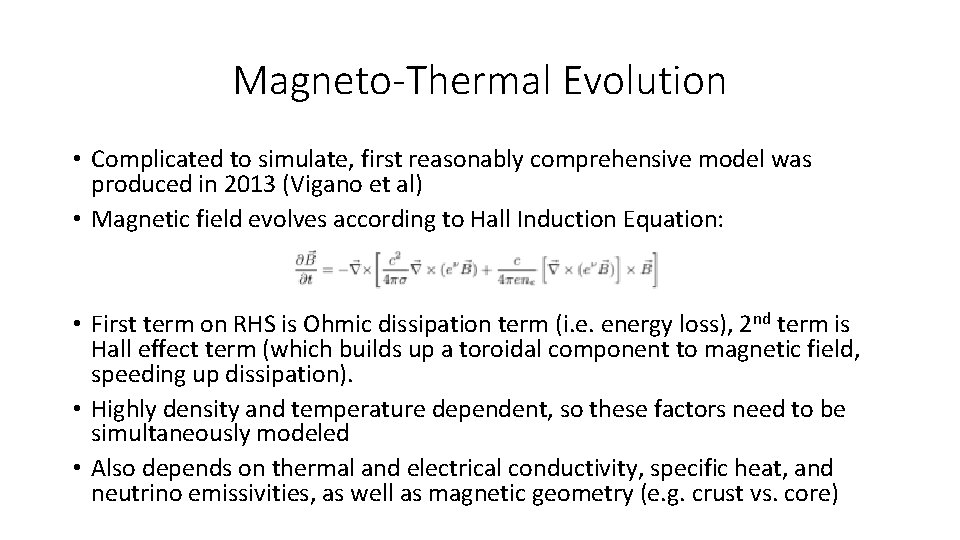
Magneto-Thermal Evolution • Complicated to simulate, first reasonably comprehensive model was produced in 2013 (Vigano et al) • Magnetic field evolves according to Hall Induction Equation: • First term on RHS is Ohmic dissipation term (i. e. energy loss), 2 nd term is Hall effect term (which builds up a toroidal component to magnetic field, speeding up dissipation). • Highly density and temperature dependent, so these factors need to be simultaneously modeled • Also depends on thermal and electrical conductivity, specific heat, and neutrino emissivities, as well as magnetic geometry (e. g. crust vs. core)
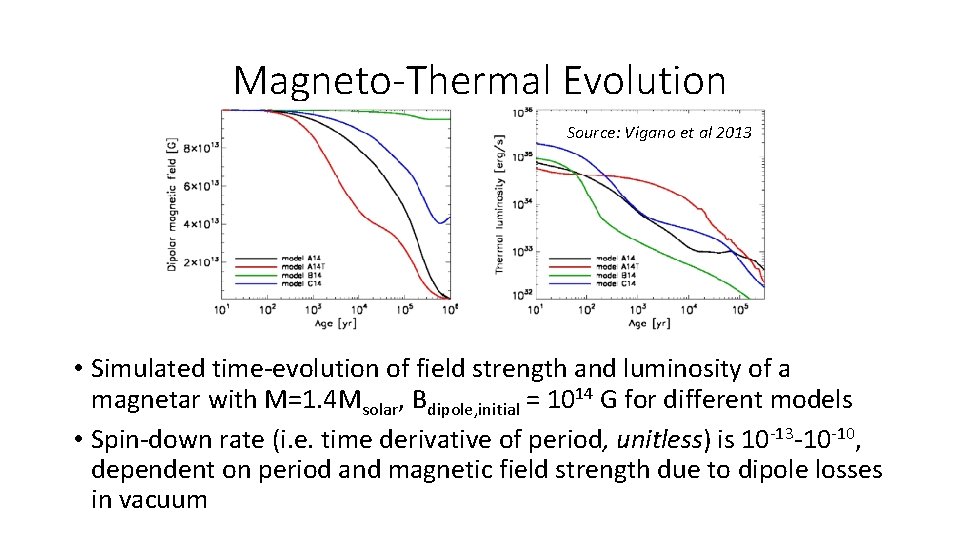
Magneto-Thermal Evolution Source: Vigano et al 2013 • Simulated time-evolution of field strength and luminosity of a magnetar with M=1. 4 Msolar, Bdipole, initial = 1014 G for different models • Spin-down rate (i. e. time derivative of period, unitless) is 10 -13 -10 -10, dependent on period and magnetic field strength due to dipole losses in vacuum
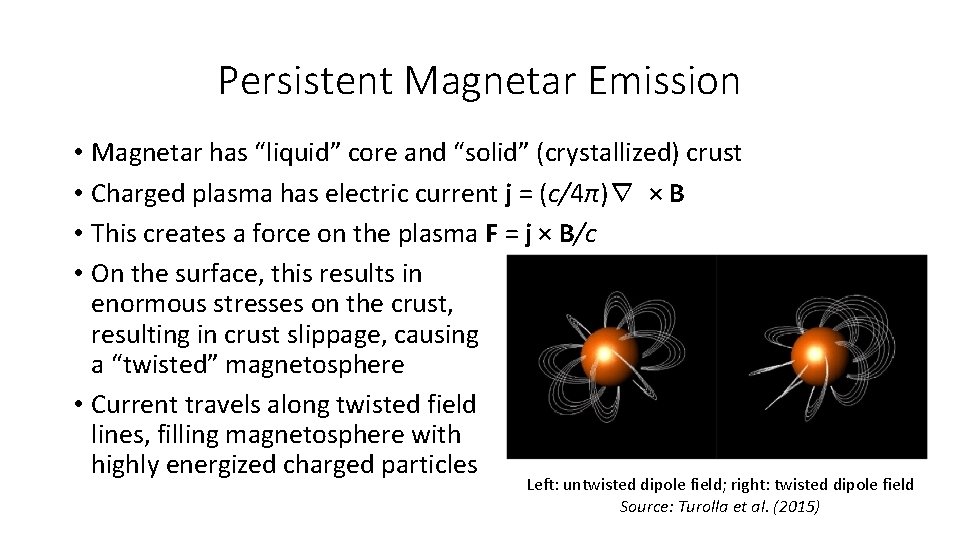
Persistent Magnetar Emission • Magnetar has “liquid” core and “solid” (crystallized) crust • Charged plasma has electric current j = (c/4π)∇ × B • This creates a force on the plasma F = j × B/c • On the surface, this results in enormous stresses on the crust, resulting in crust slippage, causing a “twisted” magnetosphere • Current travels along twisted field lines, filling magnetosphere with highly energized charged particles Left: untwisted dipole field; right: twisted dipole field Source: Turolla et al. (2015)
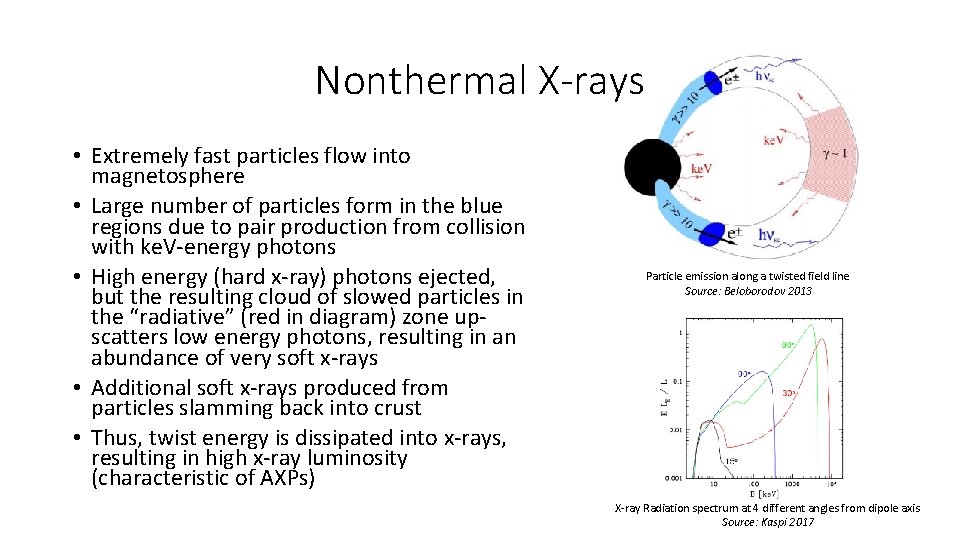
Nonthermal X-rays • Extremely fast particles flow into magnetosphere • Large number of particles form in the blue regions due to pair production from collision with ke. V-energy photons • High energy (hard x-ray) photons ejected, but the resulting cloud of slowed particles in the “radiative” (red in diagram) zone upscatters low energy photons, resulting in an abundance of very soft x-rays • Additional soft x-rays produced from particles slamming back into crust • Thus, twist energy is dissipated into x-rays, resulting in high x-ray luminosity (characteristic of AXPs) Particle emission along a twisted field line Source: Beloborodov 2013 X-ray Radiation spectrum at 4 different angles from dipole axis Source: Kaspi 2017
SGR Flares Overview • Categories of flare: short burst (E < 1041 erg), intermediate bursts (1041 erg < E < 1043 erg), and giant flares (1044 erg < E < 1046 erg) • Short bursts: last 0. 1 -1 s, seen in SGRs and AXPs • Intermediate bursts: last 1 -40 s, higher peak energy than short bursts (up to 1043 erg/s), seen in SGRs and AXPs • Giant flares: Initial spike of energy output up to 1047 erg/s lasting ~0. 1 s, followed by long pulsating tail lasting several hundred seconds, resonant with neutron star rotational frequency • Giant flares quite rare; only 3 have ever been observed (1979, 1998, 2004), and only in SGRs
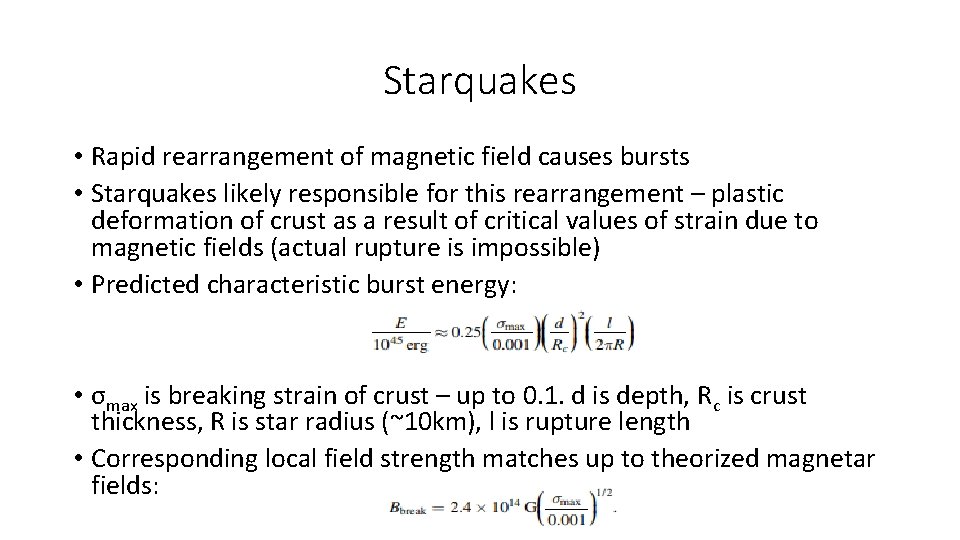
Starquakes • Rapid rearrangement of magnetic field causes bursts • Starquakes likely responsible for this rearrangement – plastic deformation of crust as a result of critical values of strain due to magnetic fields (actual rupture is impossible) • Predicted characteristic burst energy: • σmax is breaking strain of crust – up to 0. 1. d is depth, Rc is crust thickness, R is star radius (~10 km), l is rupture length • Corresponding local field strength matches up to theorized magnetar fields:
Alternatives to S tarquakes • Magnetic field evolves into unstable configuration within core • However, core is superconducting, meaning unstable core configurations may be difficult to achieve • Spontaneous plasma reconnection in magnetosphere as a stress relief mechanism • Could be a combination of all 3 of these mechanisms (which may help explain the high diversity of SGR flare properties) • All of these mechanisms fundamentally result in similar outcomes: producing rapid changes to magnetic field
Emission Processes • Rapid changes to magnetic field accelerate electrons, resulting in pair creation and gamma ray emission • Low proportion of baryonic material in magnetosphere (otherwise, scattering would occur, resulting in softening of gamma rays) • Radio afterglow: also seen in flares • Plasma cooling after running into existing material in outer magnetosphere (possibly trapped by magnetic field) may produce radio waves • How is gamma ray emission visible despite baryonic plasma? Various theories (“fireball model”)
Classification of Magnetars • Many classes of Isolated Neutron Star (INS), unclear how they all relate to magnetars • Magnetars tend to have longer and fasterincreasing periods as a result of magnetic fields • RRa. Ts rotationally powered • CCOs are low-magnetic-field supernova remnant neutron stars • XINS are neutron stars with dim x-ray emissions • All of these have properties different from standard RPPs (radio powered pulsars) Various INS’s categorized by period and period derivative Source: Turolla et al. (2015)
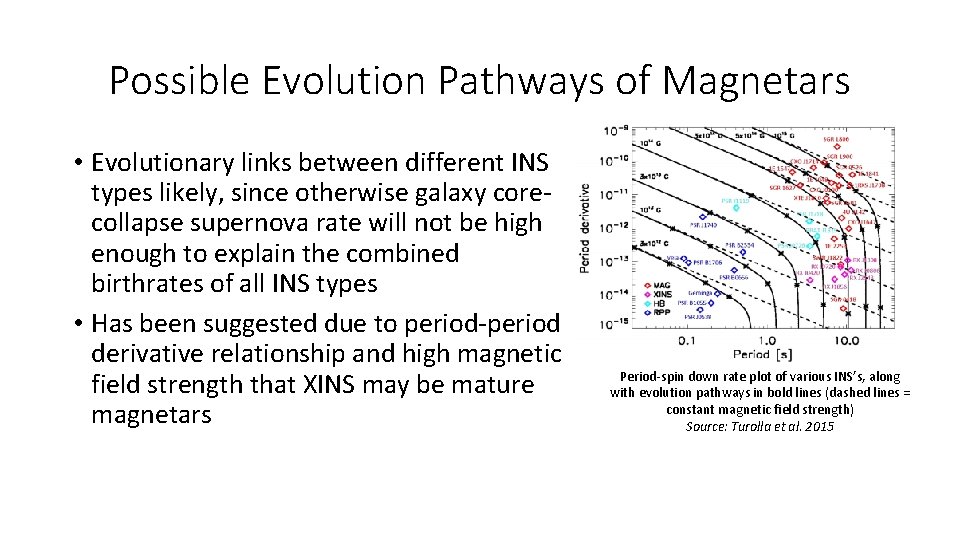
Possible Evolution Pathways of Magnetars • Evolutionary links between different INS types likely, since otherwise galaxy corecollapse supernova rate will not be high enough to explain the combined birthrates of all INS types • Has been suggested due to period-period derivative relationship and high magnetic field strength that XINS may be mature magnetars Period-spin down rate plot of various INS’s, along with evolution pathways in bold lines (dashed lines = constant magnetic field strength) Source: Turolla et al. 2015
Conclusions • Magnetars, while not having been directly observed, are extremely likely to exist, and explain a whole host of observed phenomena among SGRs and AXPs • Active, open area of research. Many unanswered questions, crude models needing improvement. • “Low-B” and “transient” magnetars also observed • Gravitational wave observations may provide useful insights into magnetar burst properties – candidate for LIGO?
Sources (not including image sources) • Kaspi and Beloborodov, Magnetars. 2017 • Turolla et al. Magnetars: the physics behind observations. A review. 2015 • Igoshev et al. How to make a mature accreting magnetar. 2017 • Duncan and Thompson, Formation of very strongly magnetized neutron stars: Implications for gamma-ray bursts. 1992 • Thomson and Duncan, Neutron star dynamos and the origins of pulsar magnetism. 1993 • Vigano et al. Unifying the observational diversity of isolated neutron stars via magneto-thermal evolution models. 2013