
Magnet Safety Training Center for In Vivo Microscopy

- Slides: 24
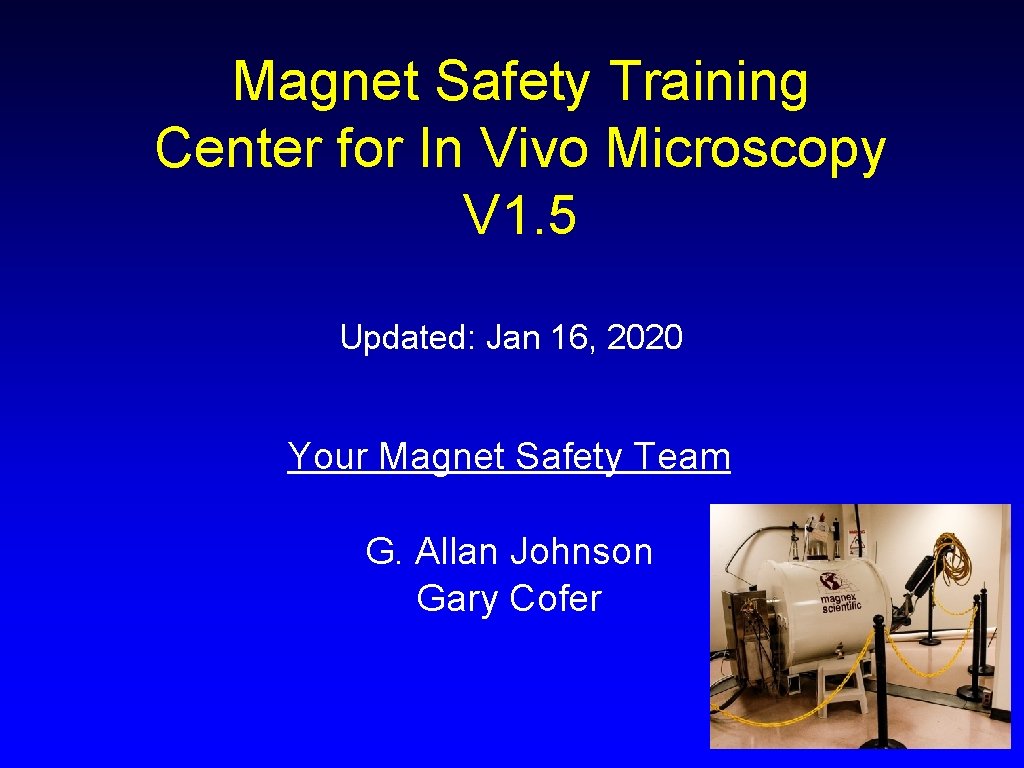
Magnet Safety Training Center for In Vivo Microscopy V 1. 5 Updated: Jan 16, 2020 Your Magnet Safety Team G. Allan Johnson Gary Cofer
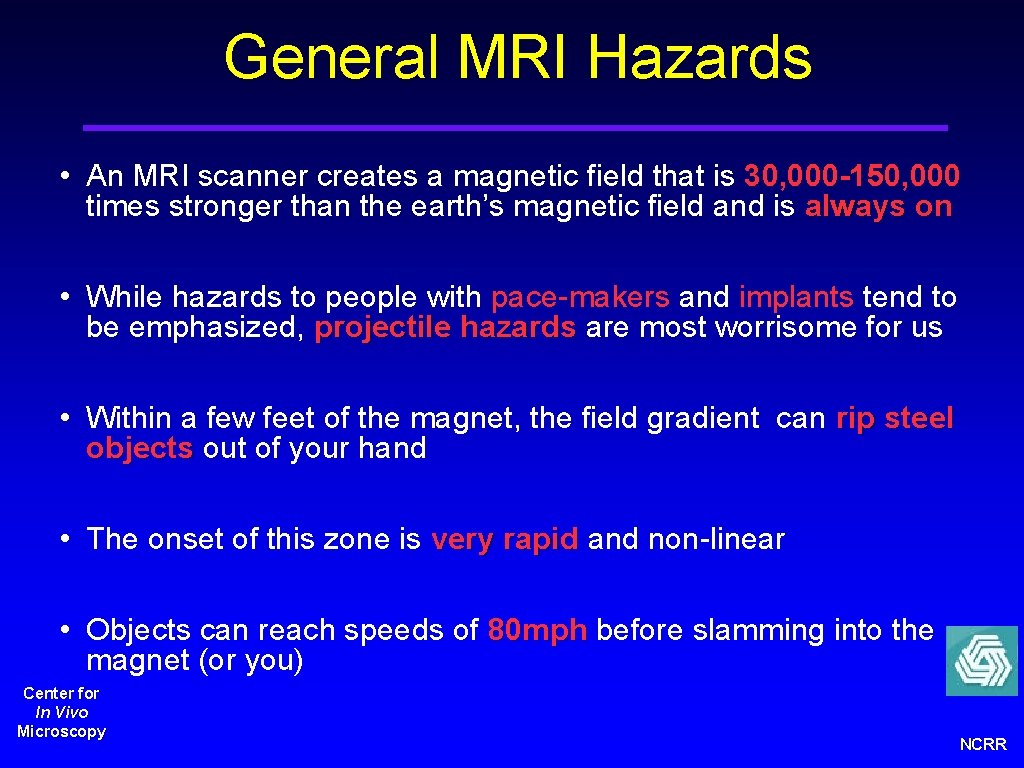
General MRI Hazards • An MRI scanner creates a magnetic field that is 30, 000 -150, 000 times stronger than the earth’s magnetic field and is always on • While hazards to people with pace-makers and implants tend to be emphasized, projectile hazards are most worrisome for us • Within a few feet of the magnet, the field gradient can rip steel objects out of your hand • The onset of this zone is very rapid and non-linear • Objects can reach speeds of 80 mph before slamming into the magnet (or you) Center for In Vivo Microscopy NCRR
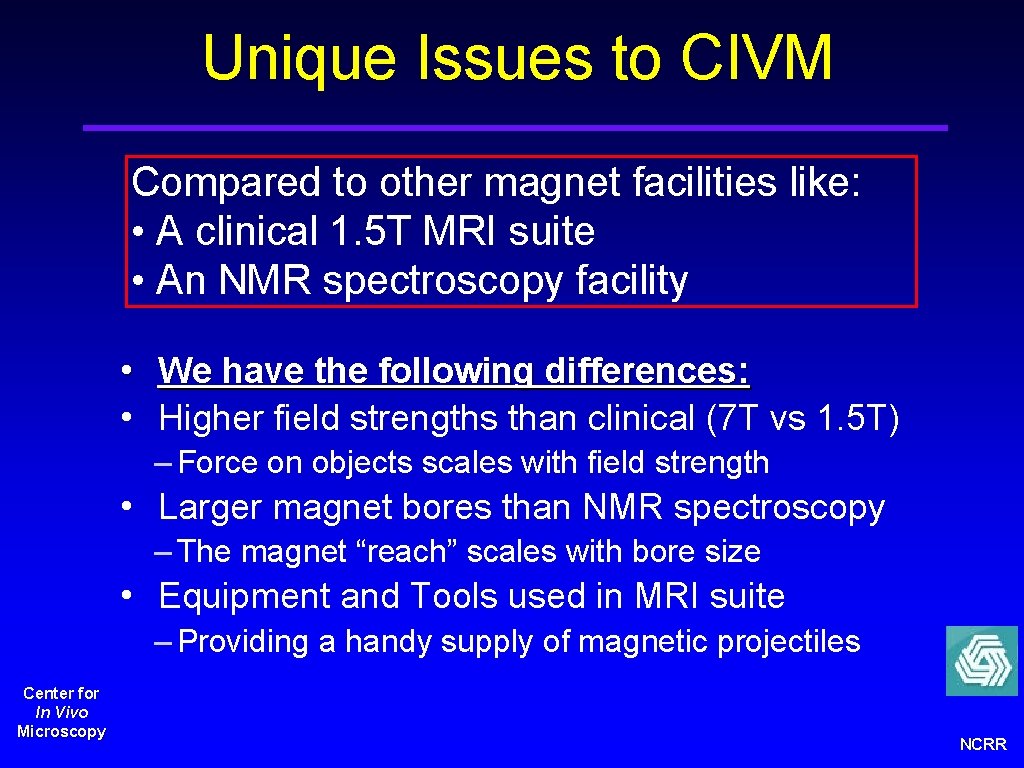
Unique Issues to CIVM Compared to other magnet facilities like: • A clinical 1. 5 T MRI suite • An NMR spectroscopy facility • We have the following differences: • Higher field strengths than clinical (7 T vs 1. 5 T) – Force on objects scales with field strength • Larger magnet bores than NMR spectroscopy – The magnet “reach” scales with bore size • Equipment and Tools used in MRI suite – Providing a handy supply of magnetic projectiles Center for In Vivo Microscopy NCRR
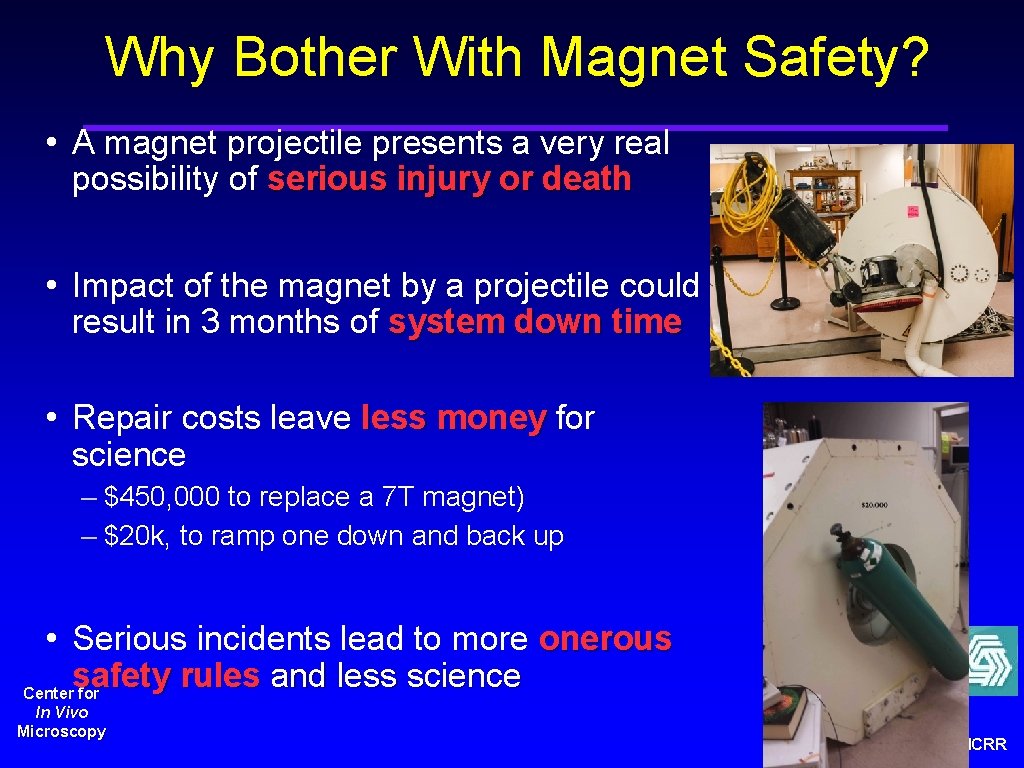
Why Bother With Magnet Safety? • A magnet projectile presents a very real possibility of serious injury or death • Impact of the magnet by a projectile could result in 3 months of system down time • Repair costs leave less money for science – $450, 000 to replace a 7 T magnet) – $20 k, to ramp one down and back up • Serious incidents lead to more onerous safety rules and less science Center for In Vivo Microscopy NCRR
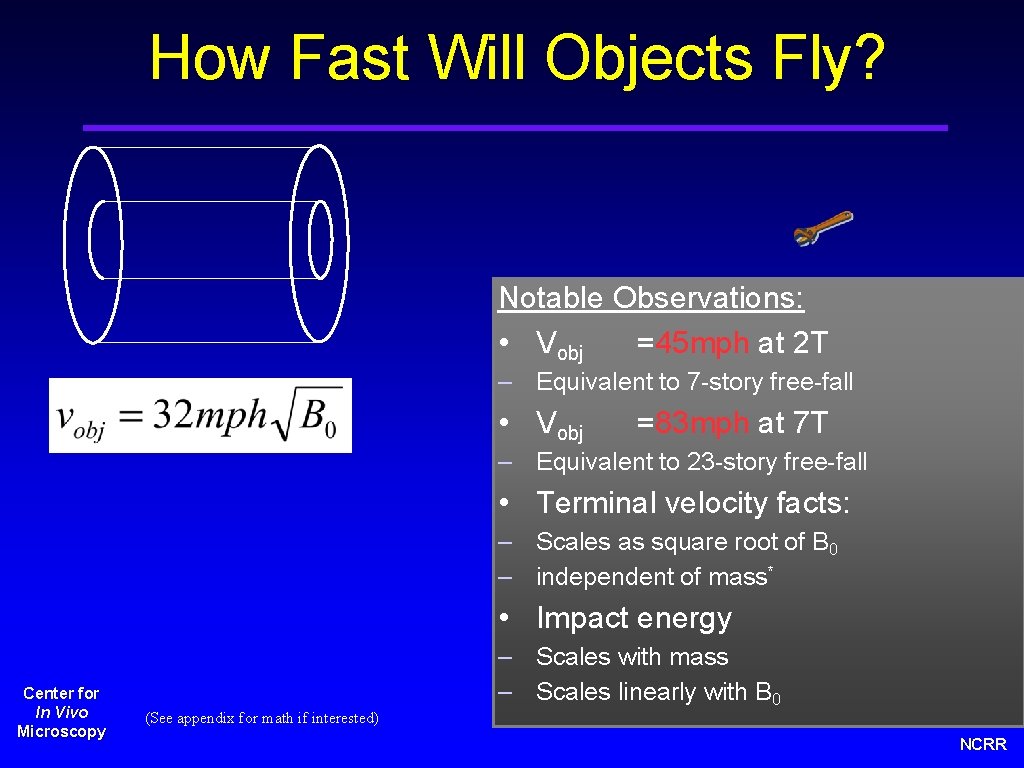
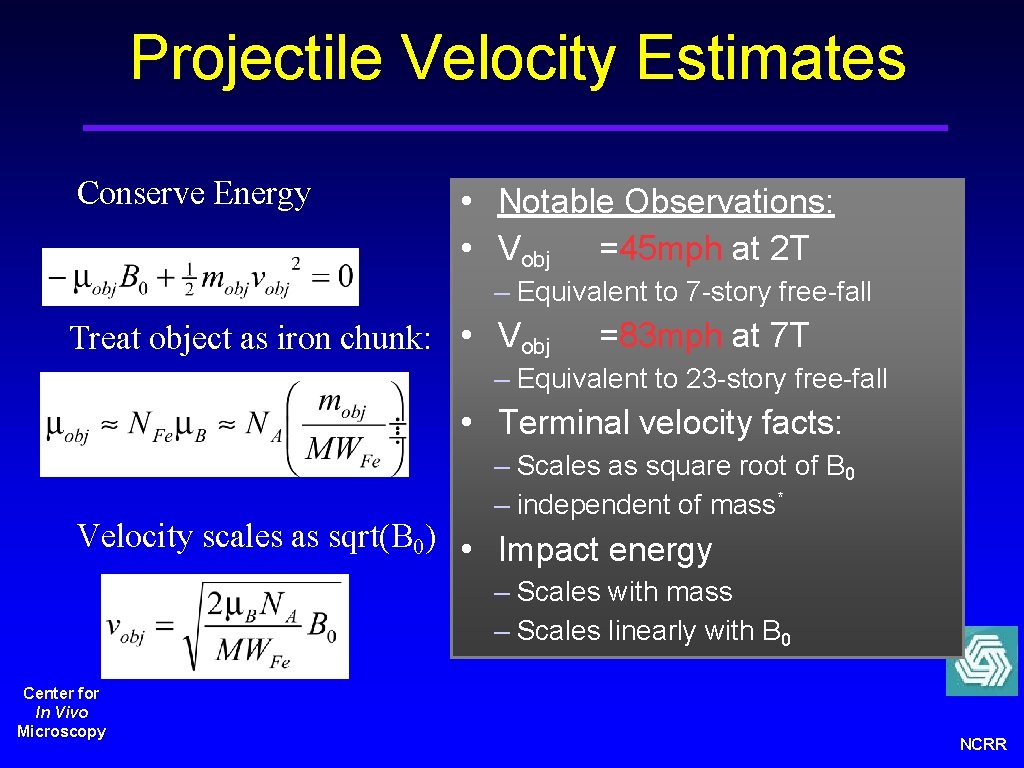
How Fast Will Objects Fly? Notable Observations: • Vobj =45 mph at 2 T – Equivalent to 7 -story free-fall • Vobj =83 mph at 7 T – Equivalent to 23 -story free-fall • Terminal velocity facts: – Scales as square root of B 0 – independent of mass* • Impact energy Center for In Vivo Microscopy – Scales with mass – Scales linearly with B 0 (See appendix for math if interested) NCRR
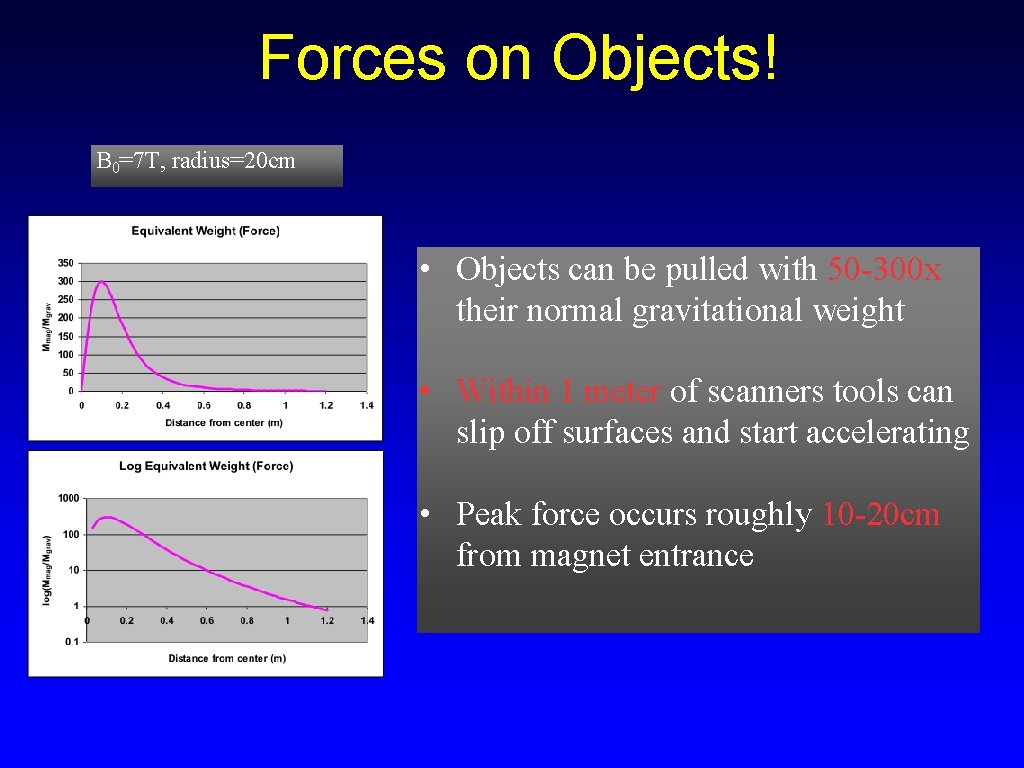
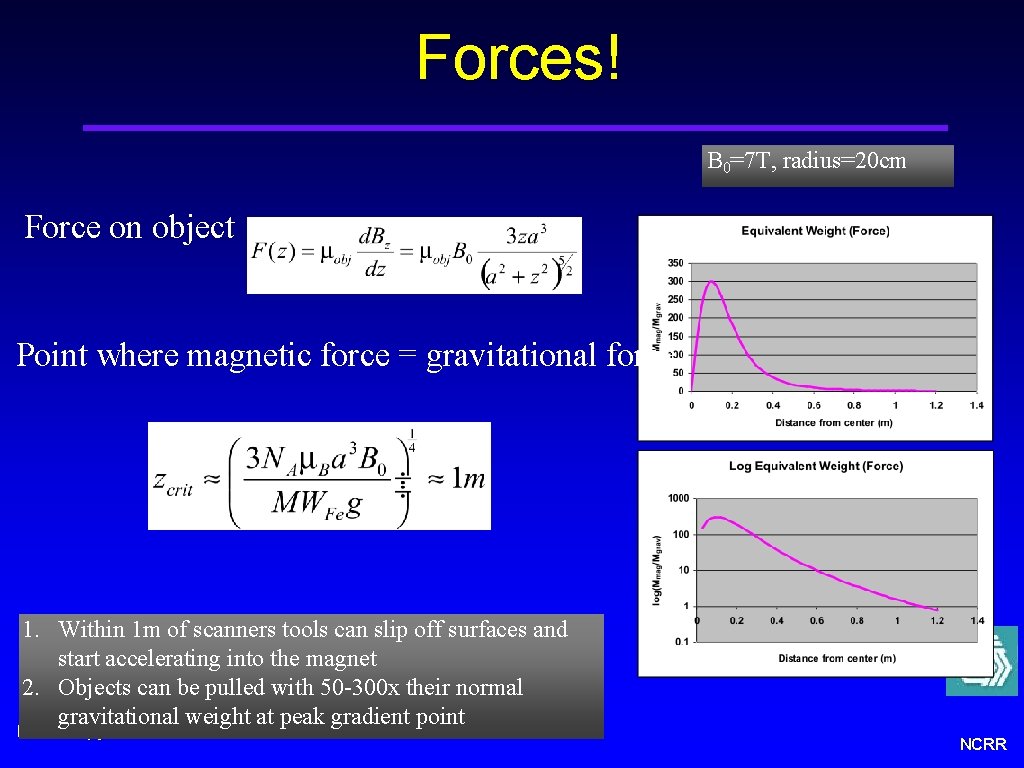
Forces on Objects! B 0=7 T, radius=20 cm • Objects can be pulled with 50 -300 x their normal gravitational weight • Within 1 meter of scanners tools can slip off surfaces and start accelerating • Peak force occurs roughly 10 -20 cm from magnet entrance
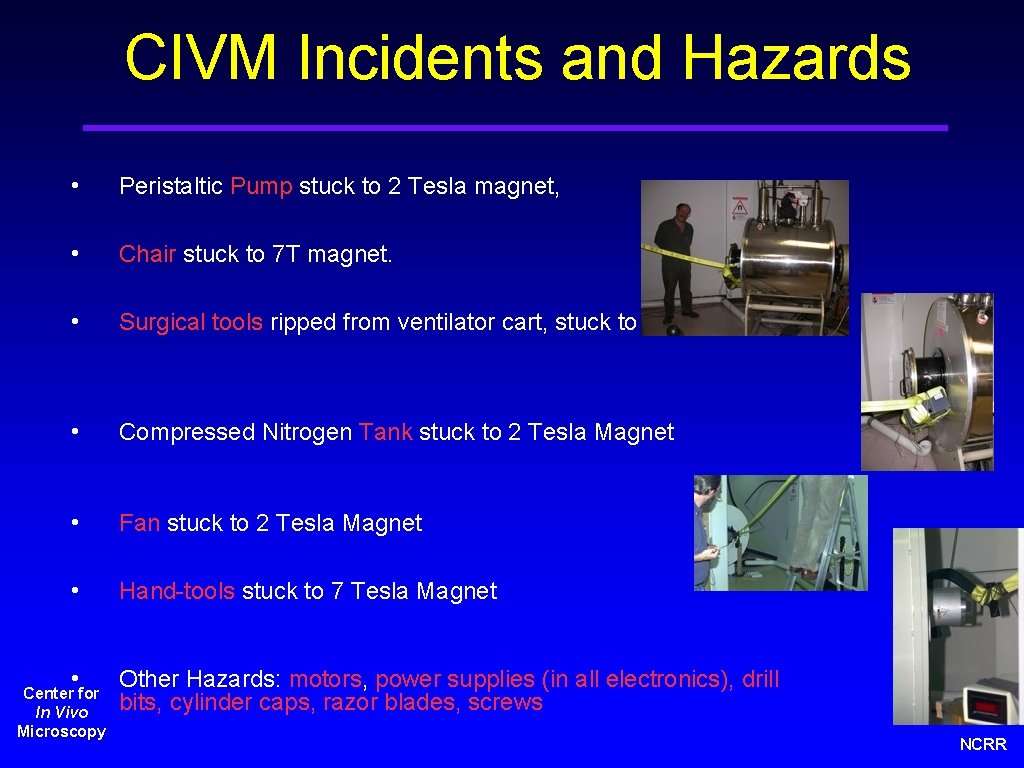
CIVM Incidents and Hazards • Peristaltic Pump stuck to 2 Tesla magnet, • Chair stuck to 7 T magnet. • Surgical tools ripped from ventilator cart, stuck to 7 T magnet • Compressed Nitrogen Tank stuck to 2 Tesla Magnet • Fan stuck to 2 Tesla Magnet • Hand-tools stuck to 7 Tesla Magnet • Other Hazards: motors, power supplies (in all electronics), drill bits, cylinder caps, razor blades, screws Center for In Vivo Microscopy NCRR
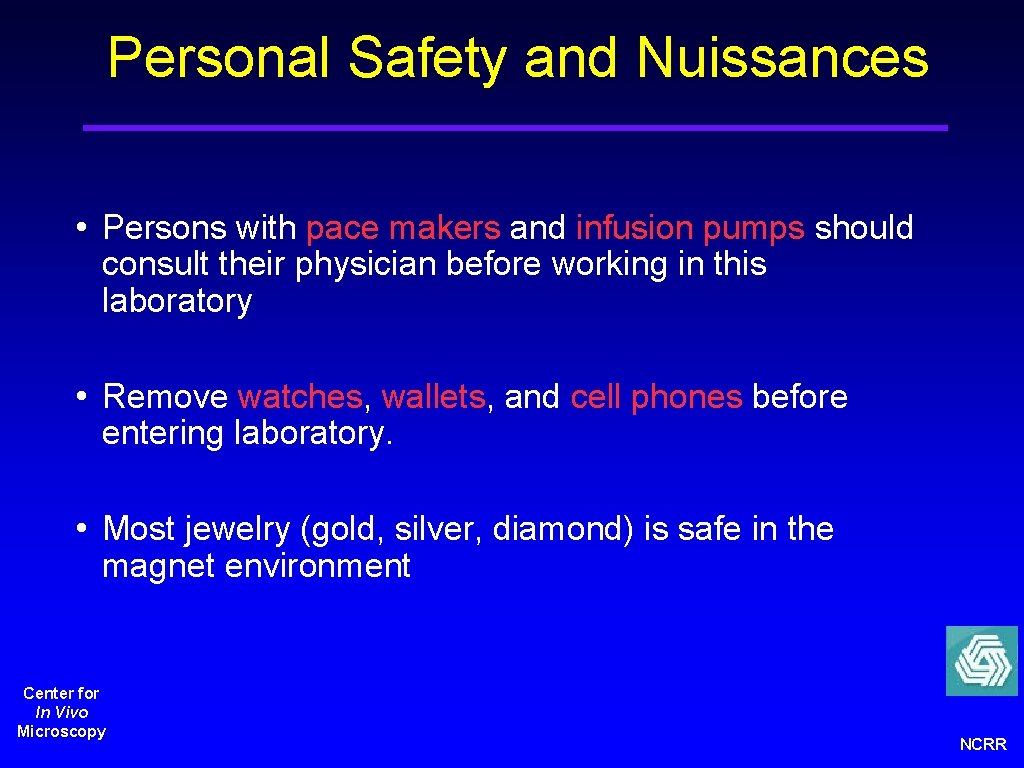
Personal Safety and Nuissances • Persons with pace makers and infusion pumps should consult their physician before working in this laboratory • Remove watches, wallets, and cell phones before entering laboratory. • Most jewelry (gold, silver, diamond) is safe in the magnet environment Center for In Vivo Microscopy NCRR
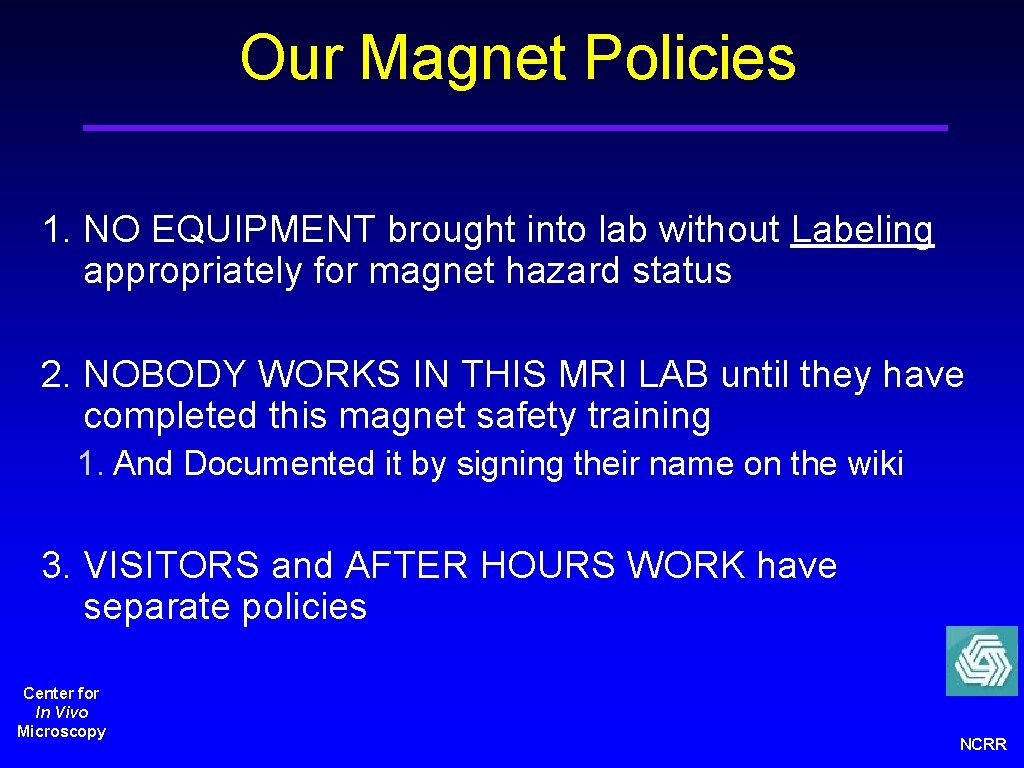
Our Magnet Policies 1. NO EQUIPMENT brought into lab without Labeling appropriately for magnet hazard status 2. NOBODY WORKS IN THIS MRI LAB until they have completed this magnet safety training 1. And Documented it by signing their name on the wiki 3. VISITORS and AFTER HOURS WORK have separate policies Center for In Vivo Microscopy NCRR
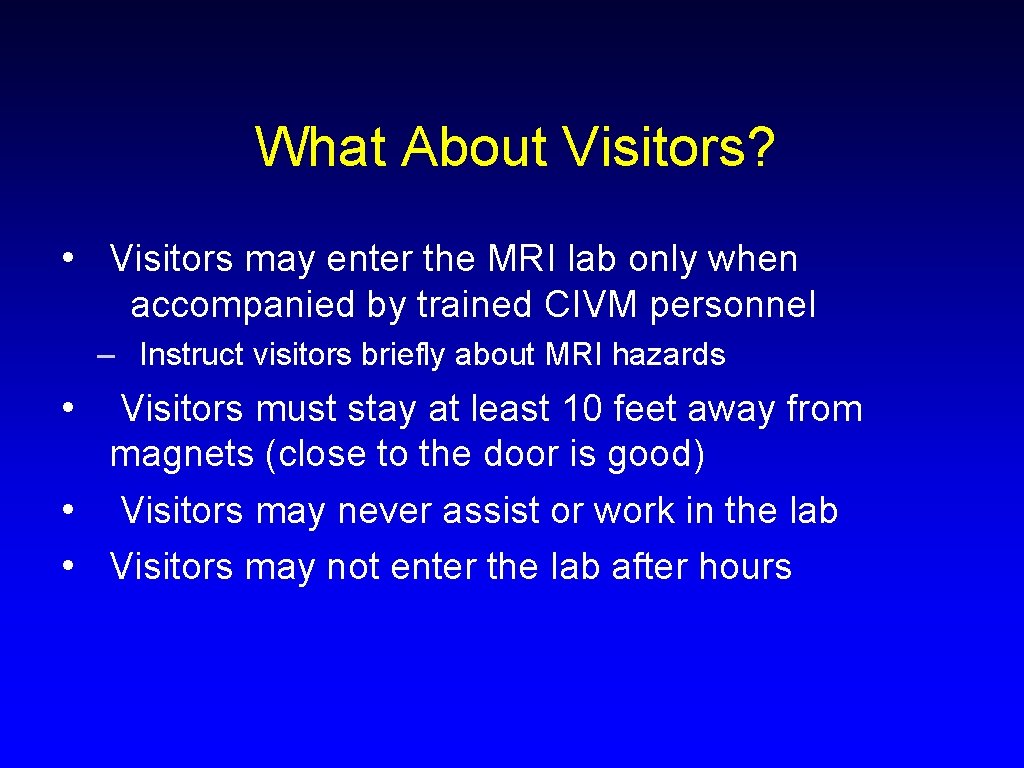
What About Visitors? • Visitors may enter the MRI lab only when accompanied by trained CIVM personnel – Instruct visitors briefly about MRI hazards • Visitors must stay at least 10 feet away from magnets (close to the door is good) • Visitors may never assist or work in the lab • Visitors may not enter the lab after hours
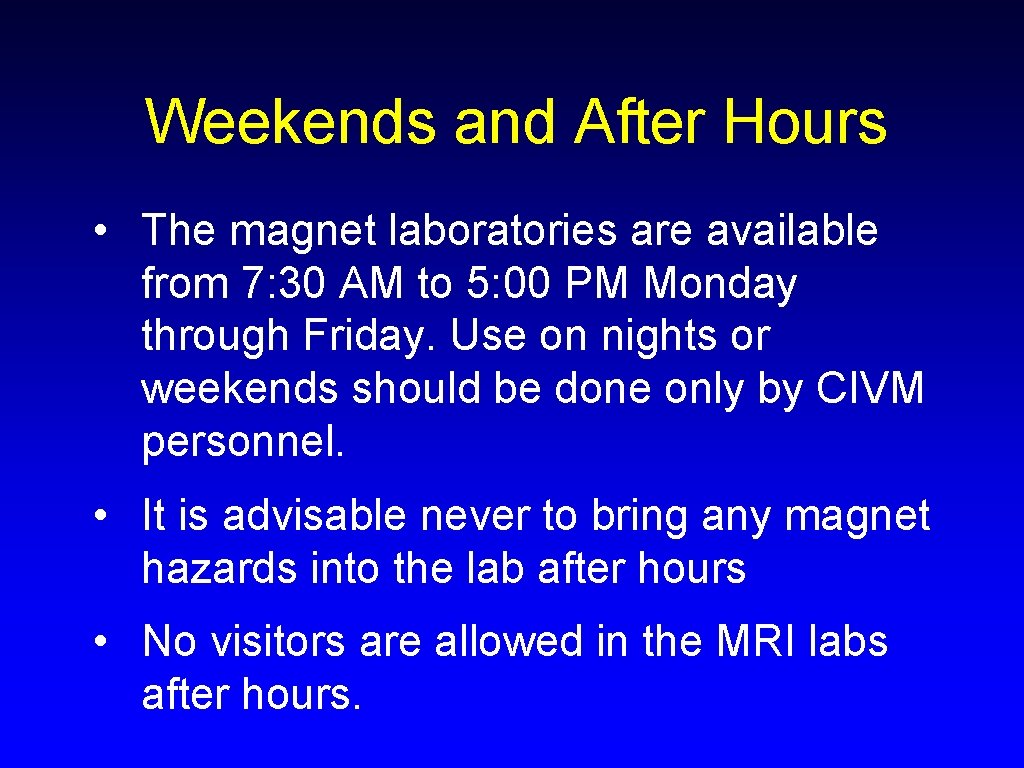
Weekends and After Hours • The magnet laboratories are available from 7: 30 AM to 5: 00 PM Monday through Friday. Use on nights or weekends should be done only by CIVM personnel. • It is advisable never to bring any magnet hazards into the lab after hours • No visitors are allowed in the MRI labs after hours.
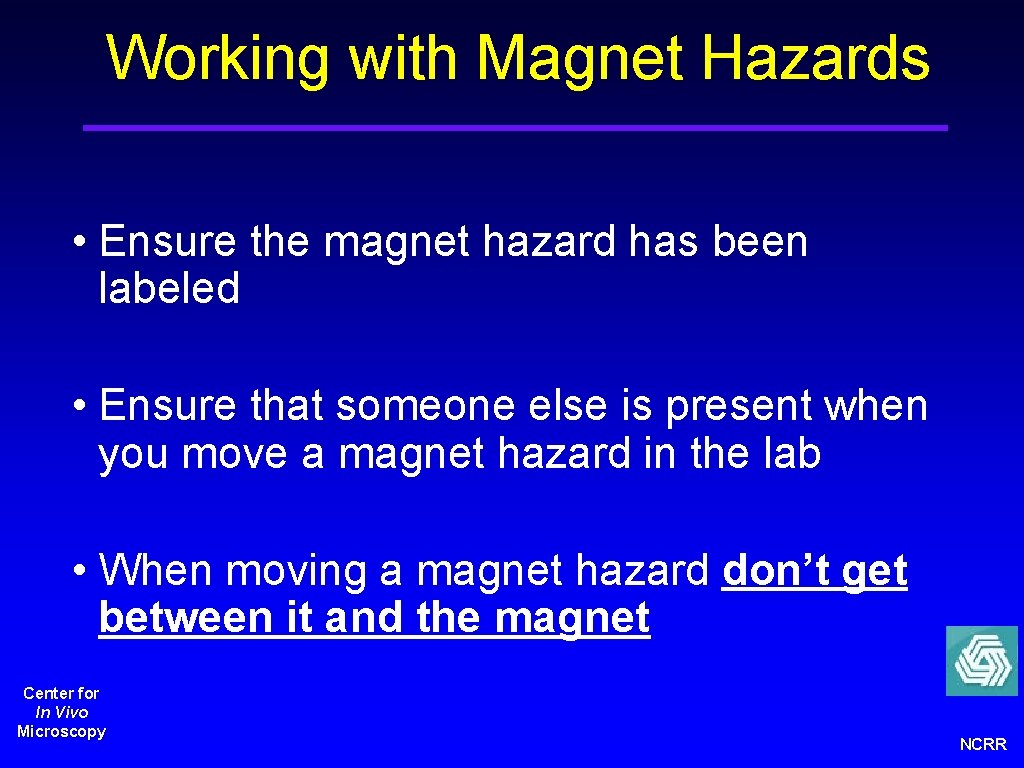
Working with Magnet Hazards • Ensure the magnet hazard has been labeled • Ensure that someone else is present when you move a magnet hazard in the lab • When moving a magnet hazard don’t get between it and the magnet Center for In Vivo Microscopy NCRR
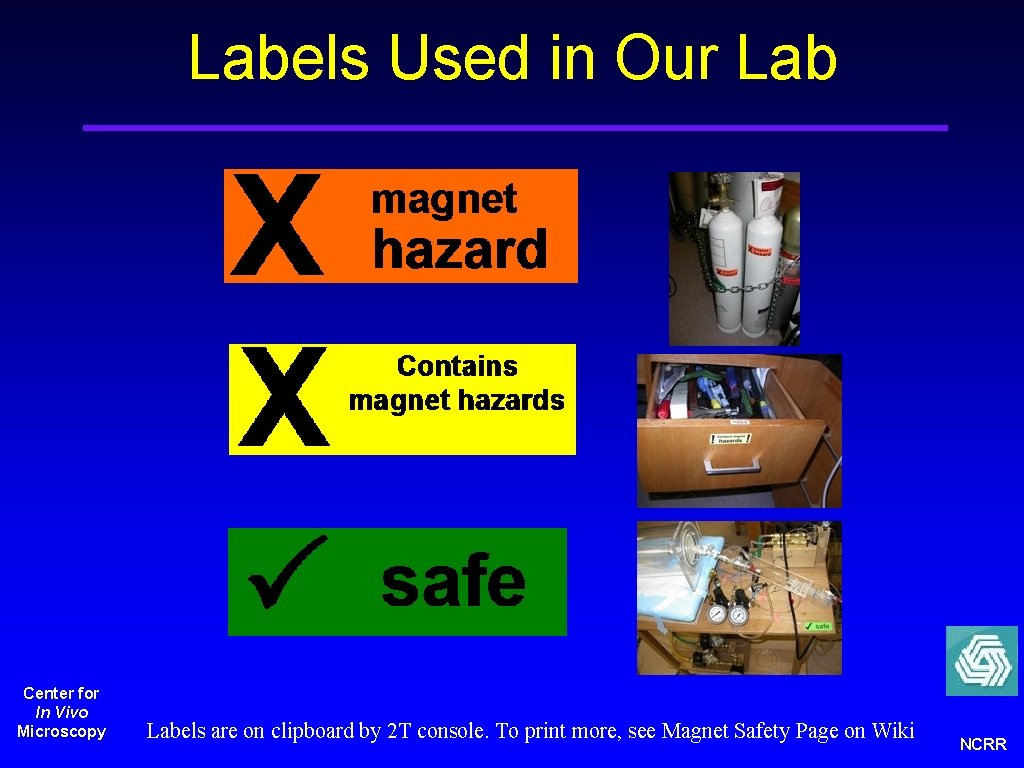
Labels Used in Our Lab Center for In Vivo Microscopy Labels are on clipboard by 2 T console. To print more, see Magnet Safety Page on Wiki NCRR
If You Do Get Something Stuck • Evacuate the lab • Seek medical help (if appropriate) • Contact magnet safety team member for removal of object • (get a camera and take a picture so we can update this presentation) Center for In Vivo Microscopy NCRR
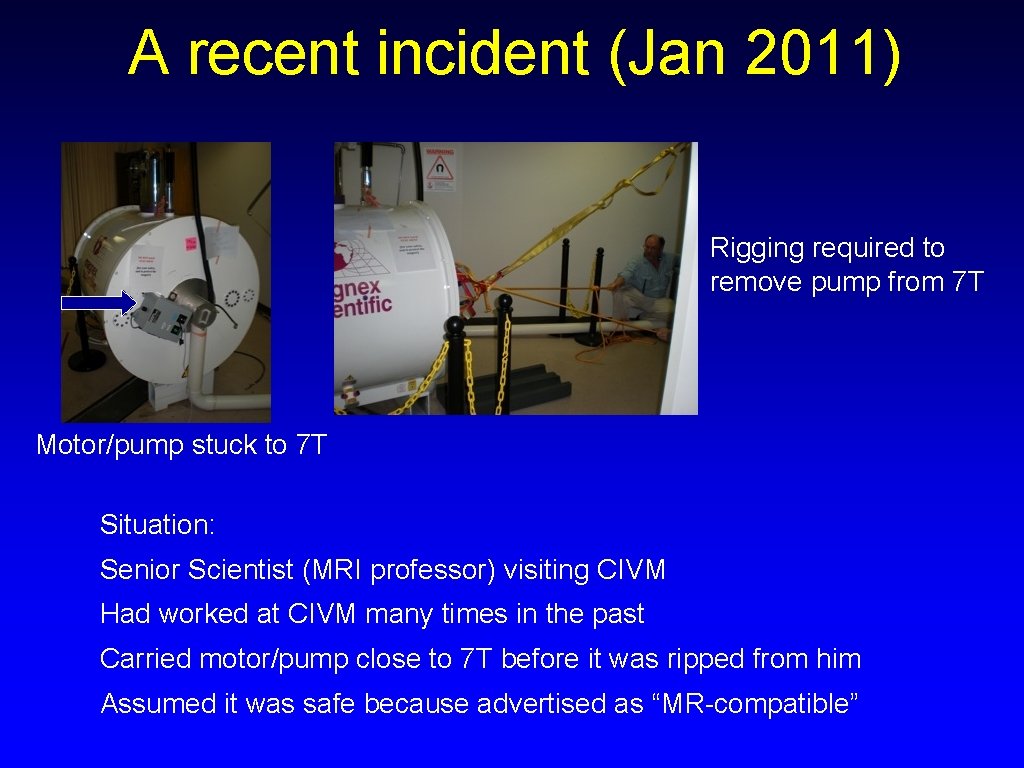
A recent incident (Jan 2011) Rigging required to remove pump from 7 T Motor/pump stuck to 7 T Situation: Senior Scientist (MRI professor) visiting CIVM Had worked at CIVM many times in the past Carried motor/pump close to 7 T before it was ripped from him Assumed it was safe because advertised as “MR-compatible”
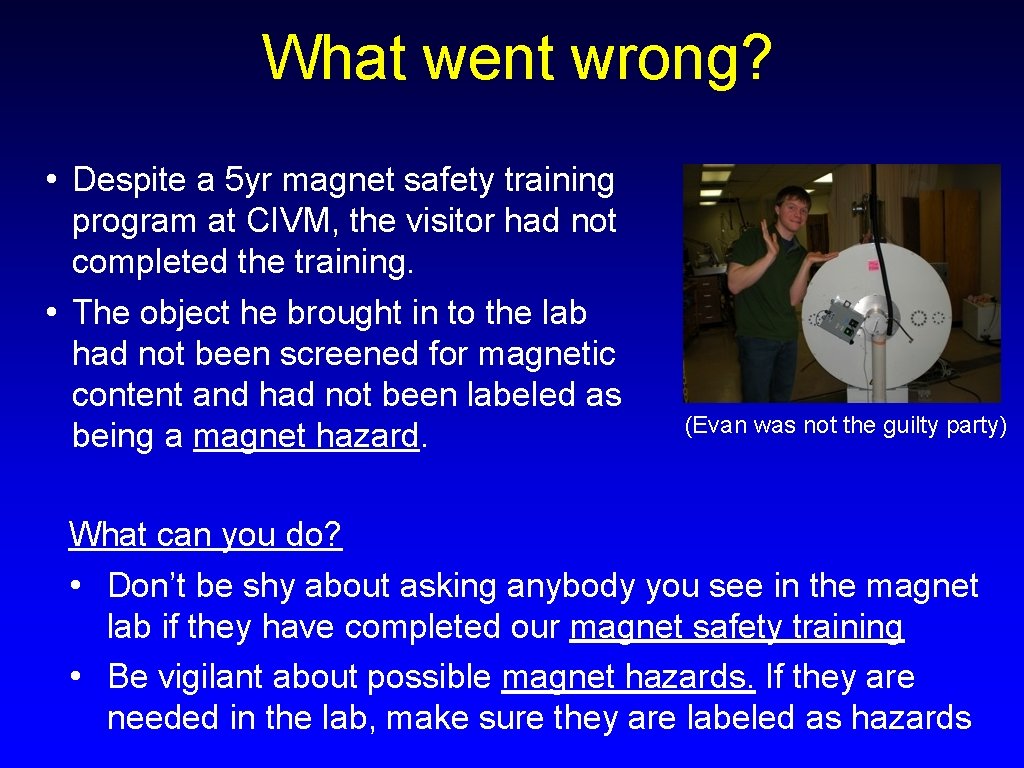
What went wrong? • Despite a 5 yr magnet safety training program at CIVM, the visitor had not completed the training. • The object he brought in to the lab had not been screened for magnetic content and had not been labeled as being a magnet hazard. (Evan was not the guilty party) What can you do? • Don’t be shy about asking anybody you see in the magnet lab if they have completed our magnet safety training • Be vigilant about possible magnet hazards. If they are needed in the lab, make sure they are labeled as hazards
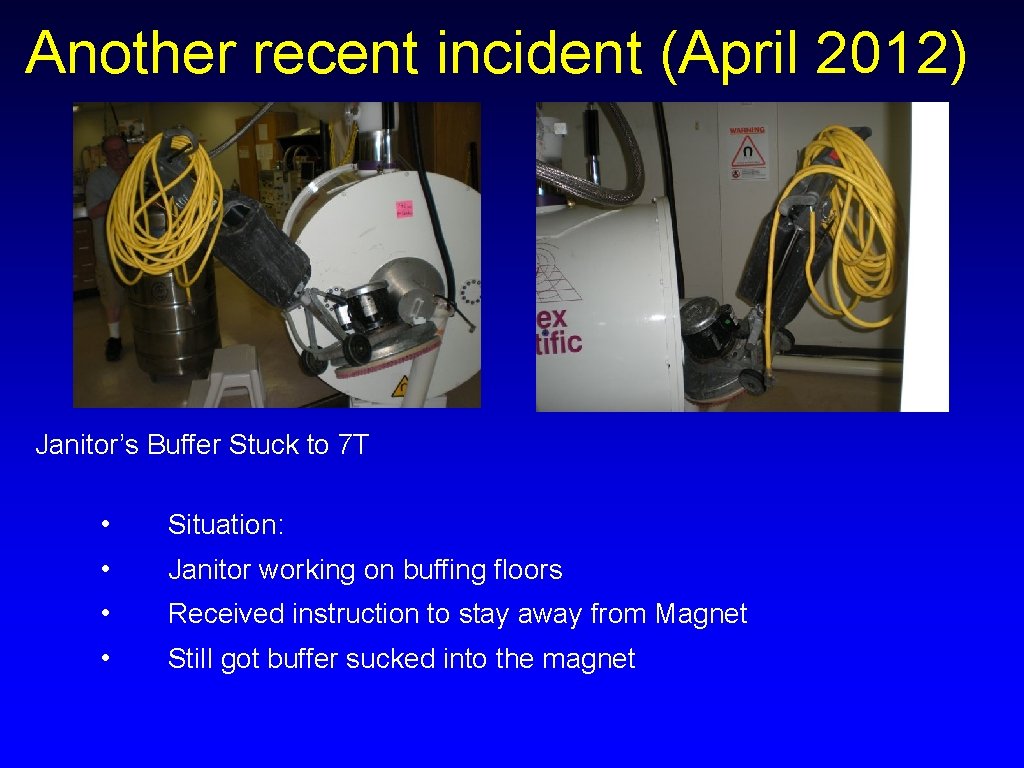
Another recent incident (April 2012) Janitor’s Buffer Stuck to 7 T • Situation: • Janitor working on buffing floors • Received instruction to stay away from Magnet • Still got buffer sucked into the magnet
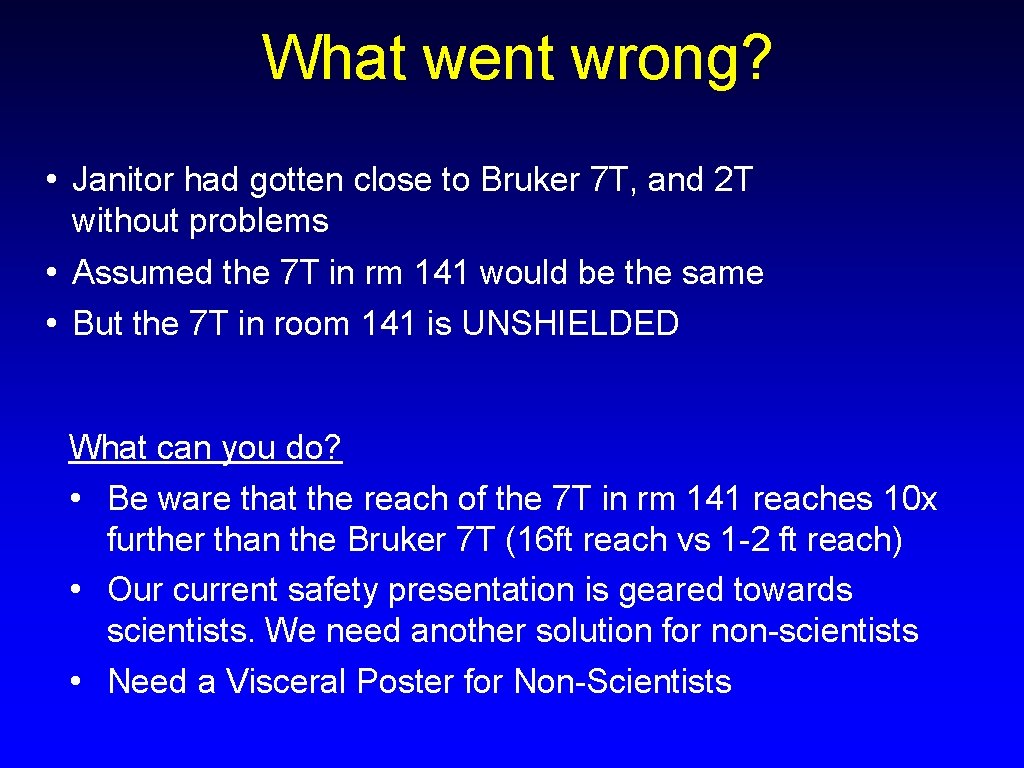
What went wrong? • Janitor had gotten close to Bruker 7 T, and 2 T without problems • Assumed the 7 T in rm 141 would be the same • But the 7 T in room 141 is UNSHIELDED What can you do? • Be ware that the reach of the 7 T in rm 141 reaches 10 x further than the Bruker 7 T (16 ft reach vs 1 -2 ft reach) • Our current safety presentation is geared towards scientists. We need another solution for non-scientists • Need a Visceral Poster for Non-Scientists
Fact Review • Ferrous objects are our biggest hazard • Objects can reach 45 mph in the 2 T magnet and 83 mph in the 7 T magnet • 1 meter from magnets, the magnetic force becomes equal to gravitational force • Objects can be pulled (accelerated) with 50 -300 x their normal gravitational pull • Labeling and your vigilance are our best defense against a serious accident Center for In Vivo Microscopy Please sign/date training record on the Magnet Safety Wiki page to verify that you have completed this NCRR
Appendix for Physicists and Engineers
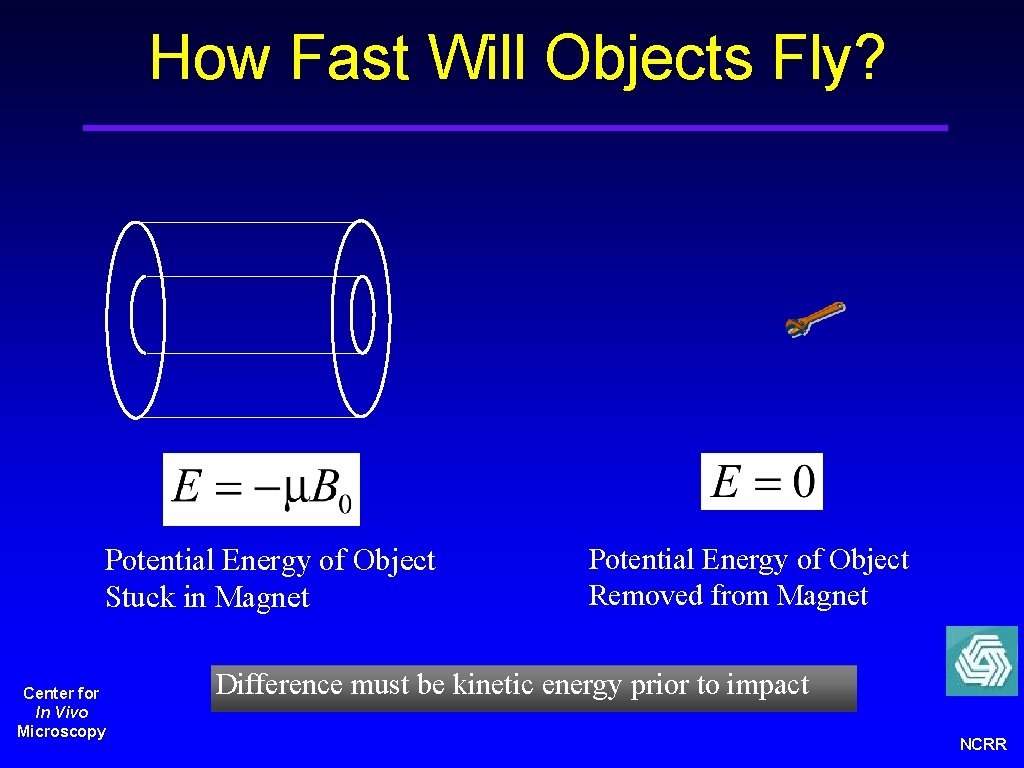
How Fast Will Objects Fly? Potential Energy of Object Stuck in Magnet Center for In Vivo Microscopy Potential Energy of Object Removed from Magnet Difference must be kinetic energy prior to impact NCRR
Projectile Velocity Estimates Conserve Energy • Notable Observations: • Vobj =45 mph at 2 T – Equivalent to 7 -story free-fall Treat object as iron chunk: • Vobj =83 mph at 7 T – Equivalent to 23 -story free-fall • Terminal velocity facts: – Scales as square root of B 0 – independent of mass* Velocity scales as sqrt(B 0) • Impact energy – Scales with mass – Scales linearly with B 0 Center for In Vivo Microscopy NCRR
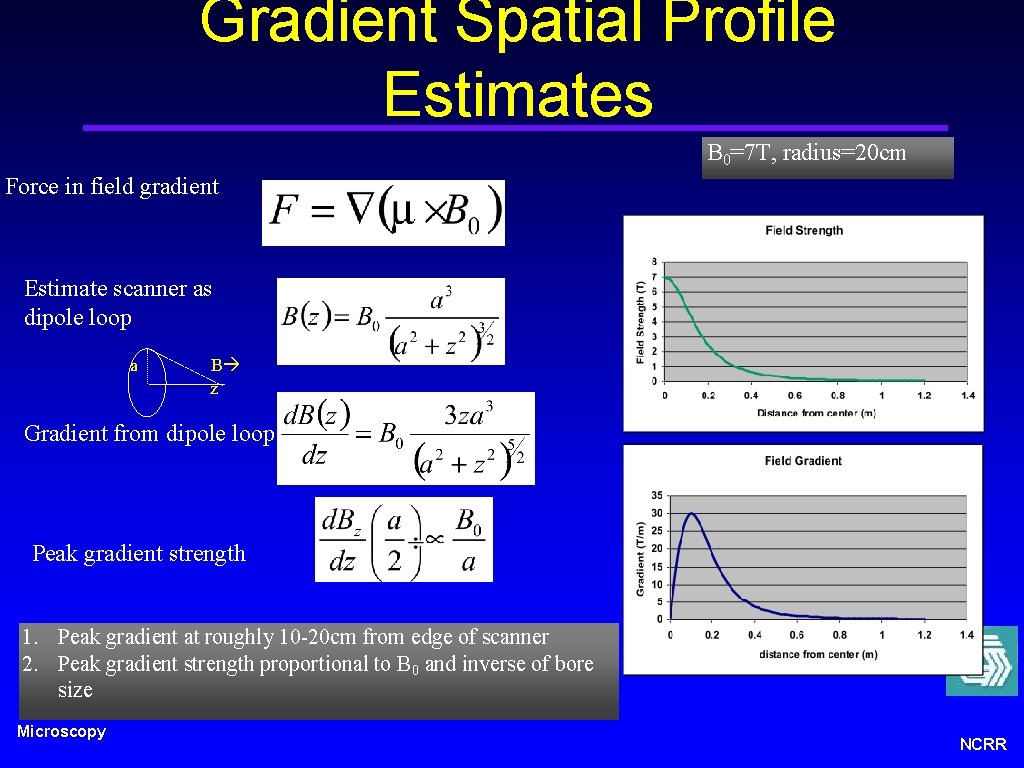
Gradient Spatial Profile Estimates B 0=7 T, radius=20 cm Force in field gradient Estimate scanner as dipole loop a B z Gradient from dipole loop Peak gradient strength 1. Peak gradient at roughly 10 -20 cm from edge of scanner 2. Peak gradient strength proportional to B 0 and inverse of bore size Center for In Vivo Microscopy NCRR
Forces! B 0=7 T, radius=20 cm Force on object Point where magnetic force = gravitational force 1. Within 1 m of scanners tools can slip off surfaces and start accelerating into the magnet 2. Objects can be pulled with 50 -300 x their normal Center for In Vivo gravitational weight at peak gradient point Microscopy NCRR