
Magnet for ARIESCS Magnet protection Cooling of magnet
- Slides: 21
Magnet for ARIES-CS Magnet protection Cooling of magnet structure L. Bromberg J. H. Schultz MIT Plasma Science and Fusion Center ARIES meeting UCSD January 23, 2005
Topics • Cooling of large magnet structure in ARIES -CS • Quench and magnet protection
Cooling of magnet-structure • Low temperature magnet operates near liquid He temperature – Complex shape of magnet requires structure surrounding magnets – “Continuous” structure represents large thermal load to the cryogenic system – Can higher temperatures be used to cool the magnet structure, with coil winding at lower temperatures?
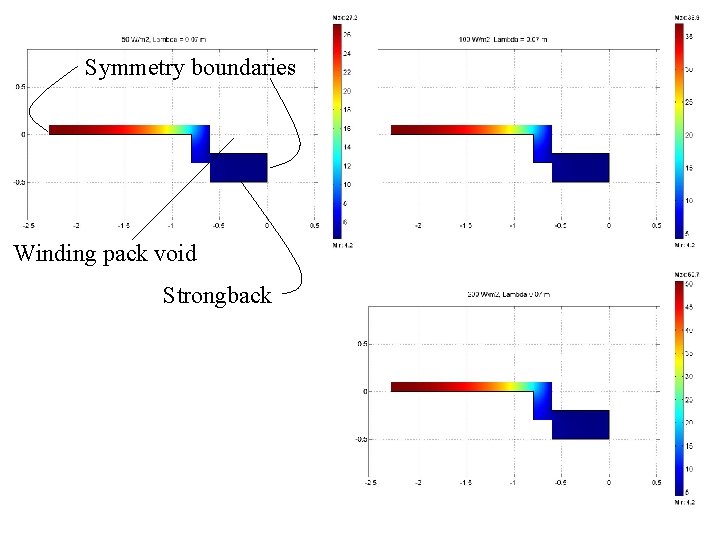
Model • 2 -D thermal analysis – Steel structure, • 0. 10 m thick, outside of shield – Outer region of reactor, with coil spacing determined by constant toroidal width (that is, same toroidal width as inboard region) – Variable thermal loading • What is it? – 2 mm insulation between structure and coil winding – Non-linear thermal heat transfer due to strong dependence of thermal conductivity on temperature
Material properties: Copper
Material properties: Insulation (G 10)
Material properties: steel
Model • Peak thermal loading – 50, 100, 200 W/m 2 • Dimensions of NCSX-like with 5 MW/m 2 peak wall loading (6. 83 m plasma major radius) • e-folding distance of heating is 0. 07 m
Symmetry boundaries Winding pack void Strongback
Structure cooling • Cooling of the structure can be achieved at reduced refrigeration power by removing thermal load at higher temperature – For 20 K, 0. 1 W/cm 3 and higher can result in a reduction of the 4 K thermal load in the structure by about a factor of 3. – For lower power densities, temperature must be lower than 20 K – Need closure on thermal loadings from neutronic analysis
Quench constrains • For the High Tc case (with YBCO superconductor, generation 2) – No-quench postulated • It will not be possible to monitor a quench, even if one occurred • Large heat capacities, coupled with conductor placed in intimate contact with structure (no conductor motion). • For low Tc conservative engineering design, quench quickly monitored, with dump in a few seconds.
Magnet energy dump • Properties given to system code assumes a 2 s energy extraction – Aggressive – If external dump (baseline): • High voltage, high current many parallel circuits • 20 k. V, 50 k. A, 20 -40 circuits (i. e. , more than one per coil) • High current requires large cross section conductor – Wind and react [Previous baseline] – Ceramic braid insulation, epoxy impregnation after heat treatment – Internal dump?
Internal dump • Externally induced quench of magnet – Easily achieved by the externally activated heaters – Heaters, in principle, could be passive • However, active heaters would provide better protection • Low thermal capacity of magnet at low temperature implies to power requirements for the externally activated circuits – Advanced thermal quench desired • Fiber-optics based. • Idea is to uniformly deposit magnet energy throughout the magnet winding pack.
Internal dump • Initial temperature of winding pack ~ 150 K • Final time ~ 20, 000 s (~ 6 hours) • No cooling • Internal dump of ~ 40 GJ
Recool issues • Need to determine reactor implications of magnet quench – Of course, no power. – How will the blanket/balance of plant handle offnormal event (scram? ) – Requirements for restart – Refrigeration requirement for recool: • Remove energy from magnet with flowing He gas, as cooling power scales inversely with temperature (I. e. , do not want to cool a magnet at 100 K with 4 K He).
Recool time • Assume that 40 GJ are released to the magnet, uniformly distributed over the winding and structure (about 4000 tonnes) – rising the average temperature of the magnet to about 100 K – Cooling power ~ 10 k. W at 4 K • Refrigeration power scales ~ T • 1 ton cooled down in 24 hours with 4 W from 77 K with 3 W
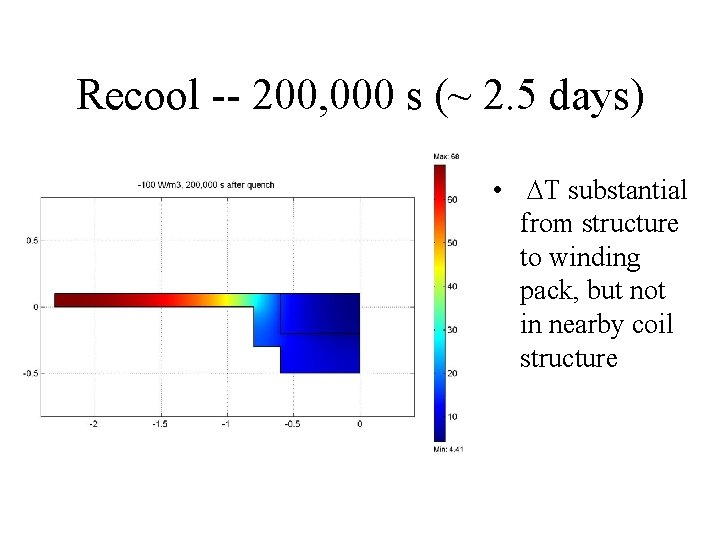
Recool • 10 k. W recool (-100 W/m 3) • 200000 s • Only winding pack is being recooled
Recool -- 200, 000 s (~ 2. 5 days) • DT substantial from structure to winding pack, but not in nearby coil structure
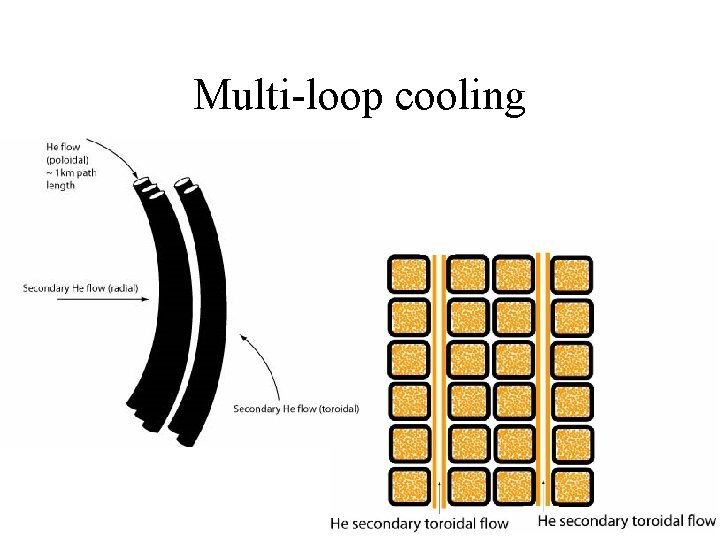
Recool • 40 GJ • If cooled nearly isentropically (with little DT), the recool can be completed in ~ 2 days • Can it be accomplished with small DT across the coil • Cooling can be performed by using two circuits, as in the blanket. A fast moving one that cools locally the coil, and a slow moving one that cools along the coil.
Multi-loop cooling
Summary • Structure can be cooled separately from the winding pack of low-Tc magnet to reduce thermal load to refrigerator, if this load is high – Useful to calculate the radiation loading, especially in the other regions of the magnet • Internally dumping the magnetic energy is an attractive means of protecting the magnet – Although it results in larger load to the refrigerator, how long does it take to restart a fusion reactor after a quench? – What determines the minimimum downtime after quench: • the balance of plant, the blanket, the magnet