
Magnet and RF Cavity Test Stand Design Tom
- Slides: 61
Magnet and RF Cavity Test Stand Design Tom Peterson, SLAC USPAS January, 2017
Outline • Test dewars and test stands – Saturated bath test dewars – Double bath test dewars – SRF test cryostats – SRF cryomodule test stands – Horizontal magnet test stands • Procurement and assembly January, 2017 USPAS Superconducting Test Stand Design Tom Peterson 2
Saturated bath vs. subcooled • Accelerator magnets are often cooled with subcooled liquid – Typically working near the limit of the superconductor with large stored energy – Ensure complete liquid coverage and penetration • Superconducting RF cavities are generally cooled with a saturated bath – Large surface heat transfer in pool boiling for local “hot spots” – Very stable pressures, avoid impact pressure variation on cavity tune January, 2017 USPAS Superconducting Test Stand Design Tom Peterson 3
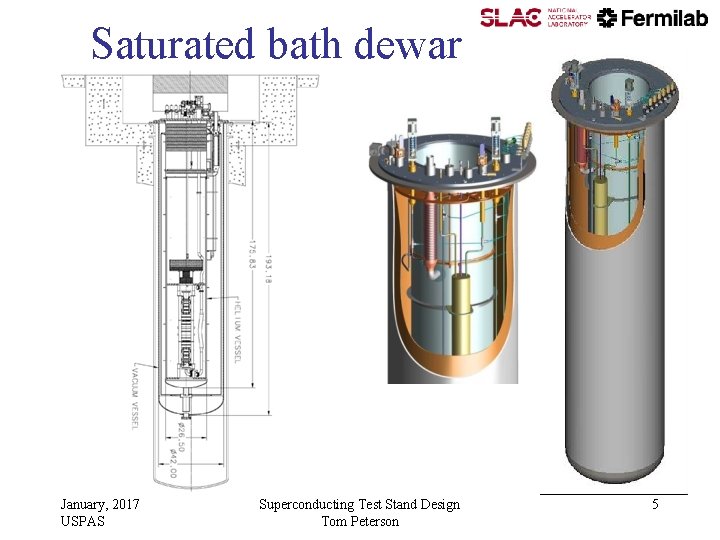
Saturated bath dewar • Simple, in principle – Essentially a “bucket” of liquid helium • Entirely at saturation pressure • Very stable pressure and temperature • Low heat load due to simple “hanging” construction of inner vessel January, 2017 USPAS Superconducting Test Stand Design Tom Peterson 4
Saturated bath dewar January, 2017 USPAS Superconducting Test Stand Design Tom Peterson 5
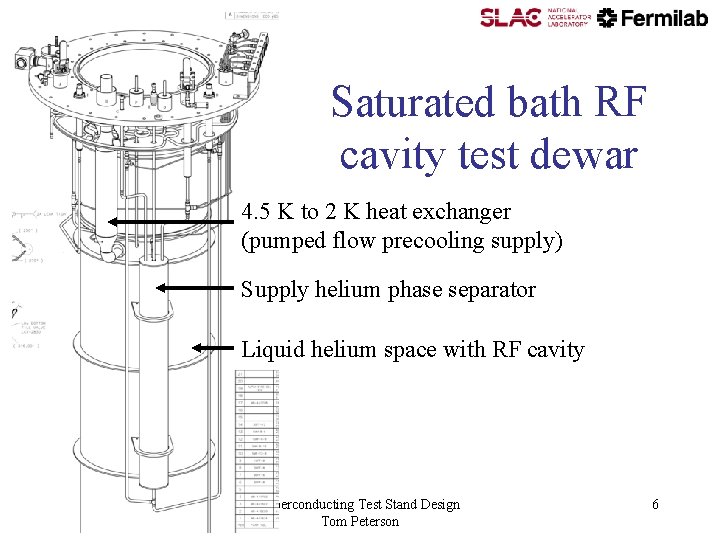
Saturated bath RF cavity test dewar 4. 5 K to 2 K heat exchanger (pumped flow precooling supply) Supply helium phase separator Liquid helium space with RF cavity January, 2017 USPAS Superconducting Test Stand Design Tom Peterson 6
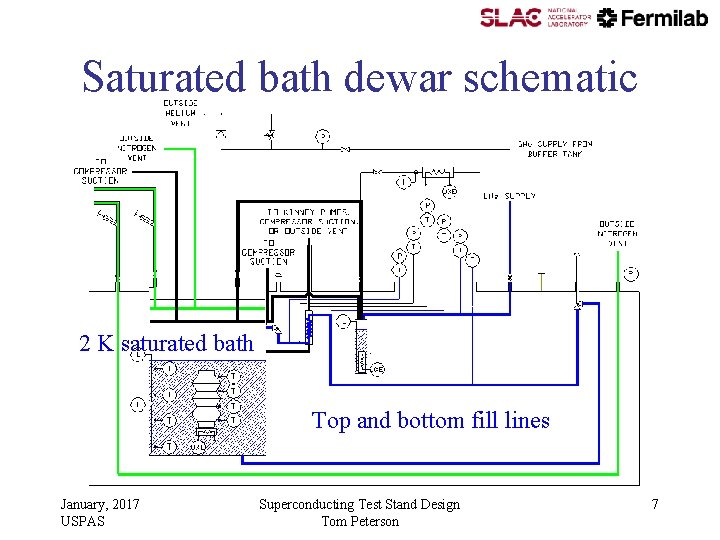
Saturated bath dewar schematic 2 K saturated bath Top and bottom fill lines January, 2017 USPAS Superconducting Test Stand Design Tom Peterson 7
Saturated bath dewar issues • Subatmospheric if less than 4. 2 K – Many potential air inleaks if < 4. 2 K – Air inleak may appear as operational problem without a clear cause • For example, low pump-down or cool-down rate • Large volume of liquid presents venting problem with loss of insulating vacuum to air – As much as 4 W/sq. cm. heat deposition on bare surface – Venting may be a design challenge for a low pressure vessel (large pipes, etc. ) – We use MLI even under a thermal shield in order to reduce venting flow rate with loss of vacuum January, 2017 USPAS Superconducting Test Stand Design Tom Peterson 8
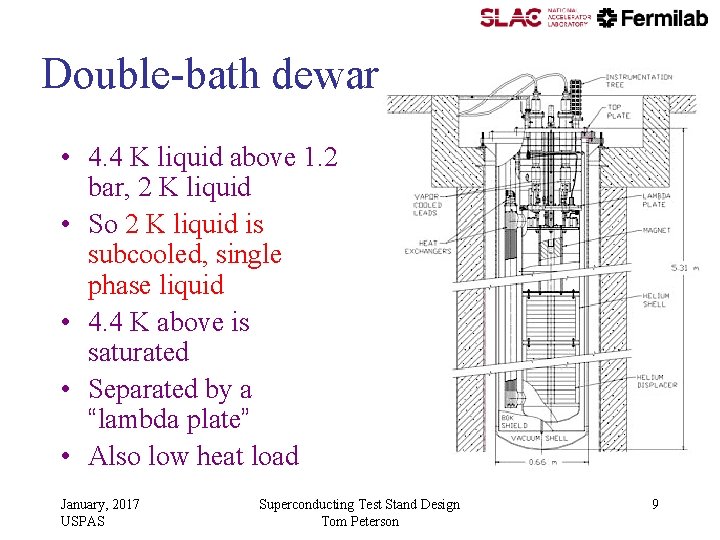
Double-bath dewar • 4. 4 K liquid above 1. 2 bar, 2 K liquid • So 2 K liquid is subcooled, single phase liquid • 4. 4 K above is saturated • Separated by a “lambda plate” • Also low heat load January, 2017 USPAS Superconducting Test Stand Design Tom Peterson 9
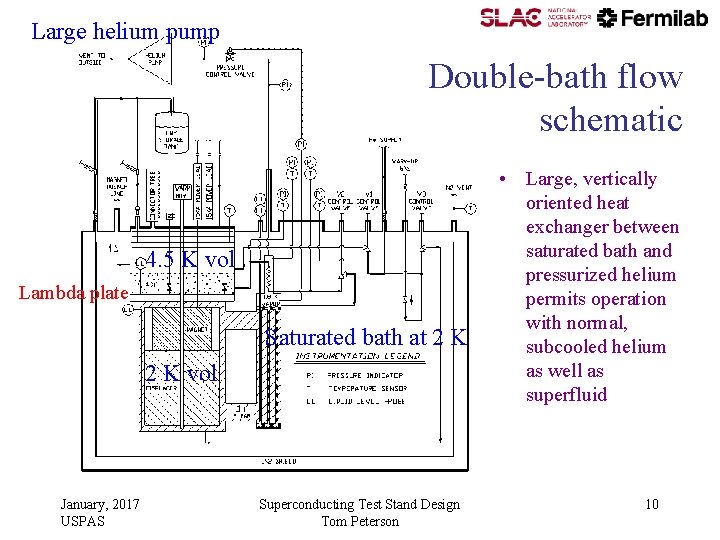
Large helium pump Double-bath flow schematic 4. 5 K vol Lambda plate Saturated bath at 2 K vol January, 2017 USPAS Superconducting Test Stand Design Tom Peterson • Large, vertically oriented heat exchanger between saturated bath and pressurized helium permits operation with normal, subcooled helium as well as superfluid 10
Double-bath dewar • Mostly positive pressure – Provides subcooled liquid • Seal between 4. 3 K and sub-lambda regions is a heat transfer barrier – Need not be hermetically tight – Key feature is to provide long, thin path for heat transport, so leaks should be long – Flat seal rather than “knife-edge” January, 2017 USPAS Superconducting Test Stand Design Tom Peterson 11
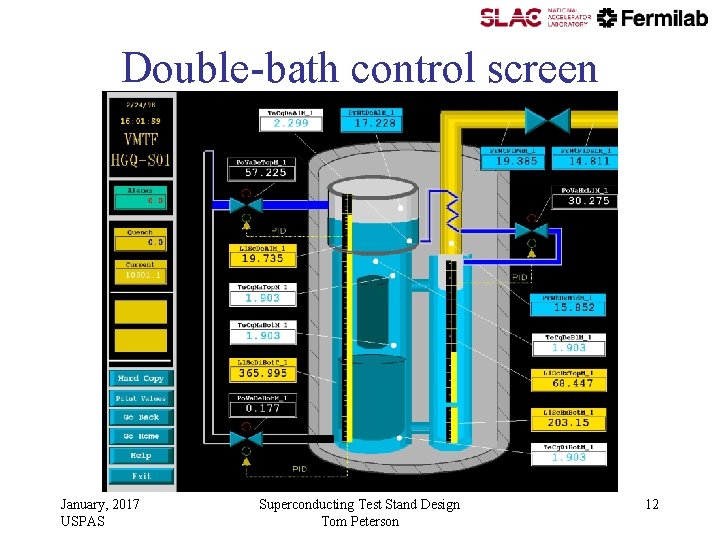
Double-bath control screen January, 2017 USPAS Superconducting Test Stand Design Tom Peterson 12
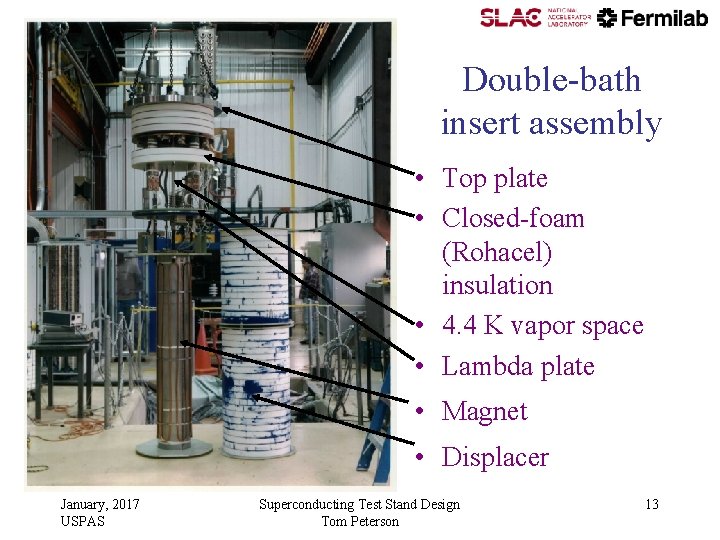
Double-bath insert assembly • Top plate • Closed-foam (Rohacel) insulation • 4. 4 K vapor space • Lambda plate • Magnet • Displacer January, 2017 USPAS Superconducting Test Stand Design Tom Peterson 13
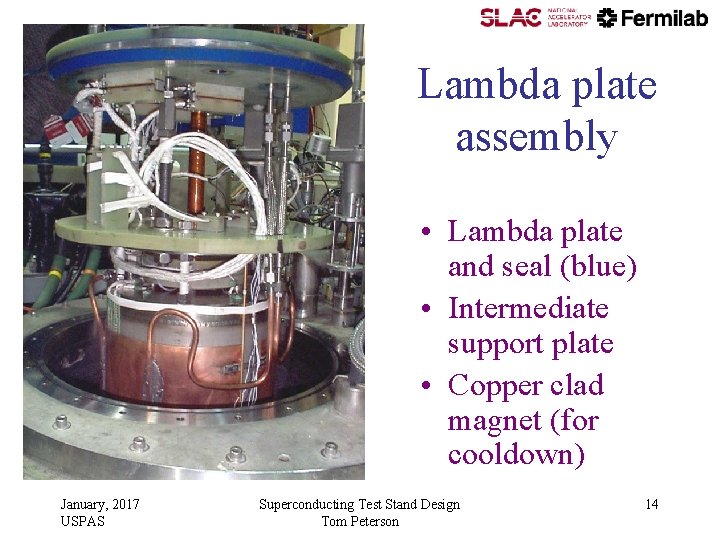
Lambda plate assembly • Lambda plate and seal (blue) • Intermediate support plate • Copper clad magnet (for cooldown) January, 2017 USPAS Superconducting Test Stand Design Tom Peterson 14
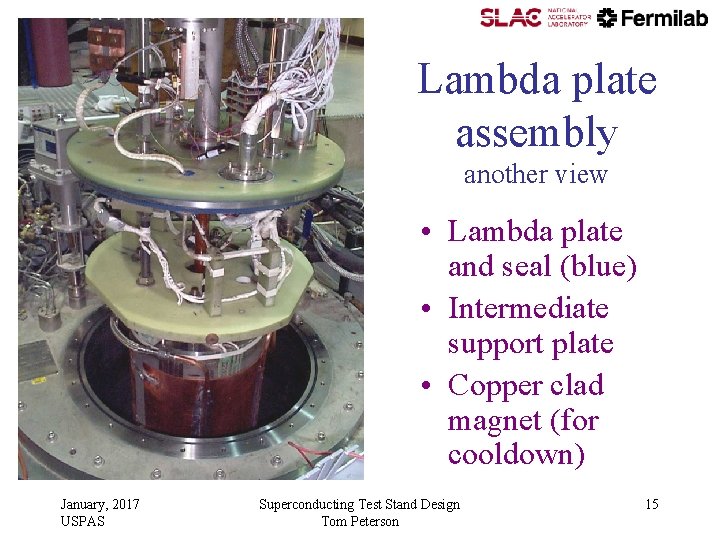
Lambda plate assembly another view • Lambda plate and seal (blue) • Intermediate support plate • Copper clad magnet (for cooldown) January, 2017 USPAS Superconducting Test Stand Design Tom Peterson 15
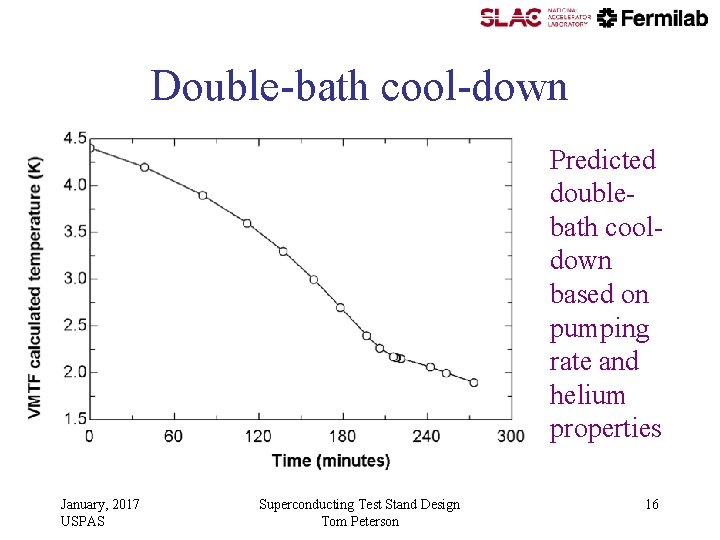
Double-bath cool-down • Predicted doublebath cooldown based on pumping rate and helium properties January, 2017 USPAS Superconducting Test Stand Design Tom Peterson 16
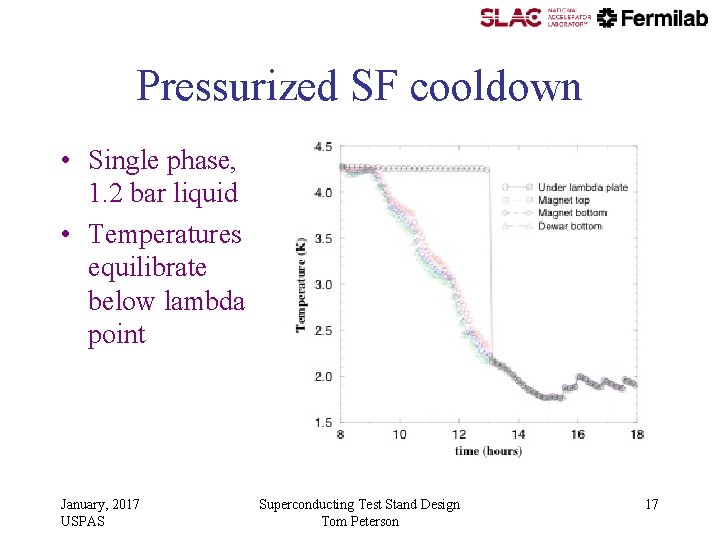
Pressurized SF cooldown • Single phase, 1. 2 bar liquid • Temperatures equilibrate below lambda point January, 2017 USPAS Superconducting Test Stand Design Tom Peterson 17
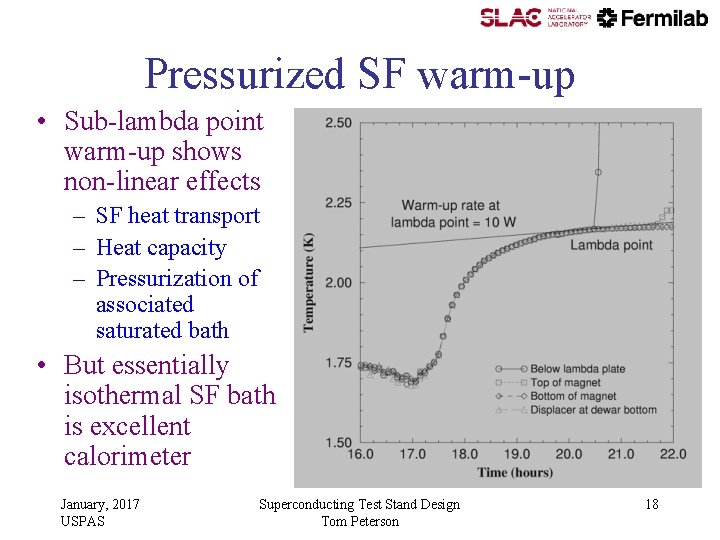
Pressurized SF warm-up • Sub-lambda point warm-up shows non-linear effects – SF heat transport – Heat capacity – Pressurization of associated saturated bath • But essentially isothermal SF bath is excellent calorimeter January, 2017 USPAS Superconducting Test Stand Design Tom Peterson 18
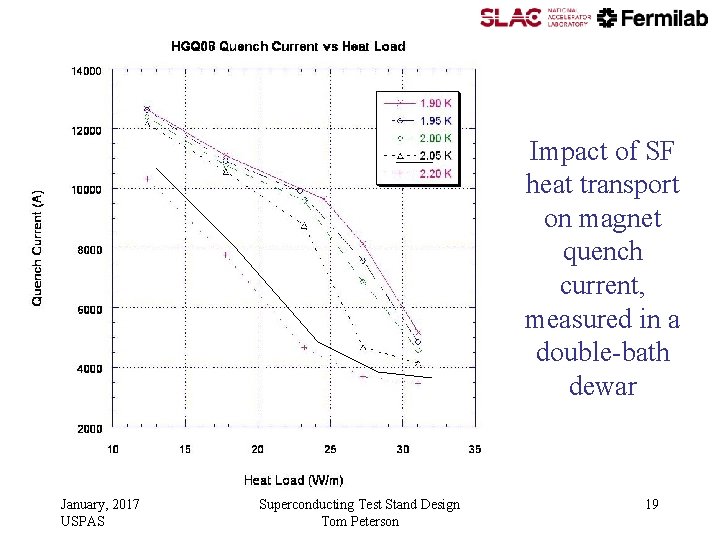
Impact of SF heat transport on magnet quench current, measured in a double-bath dewar January, 2017 USPAS Superconducting Test Stand Design Tom Peterson 19
Double-bath dewar issues • Subatmospheric portion of dewar is more limited than in the completely saturated bath dewar, so less extensive but still important to be leak tight • Heat transport via a “lambda” seal between normal and SF is a problem – Seal must be tight with long leak paths – Heat loads come from various sources, so difficult to distinguish lambda seal leak from others January, 2017 USPAS Superconducting Test Stand Design Tom Peterson 20
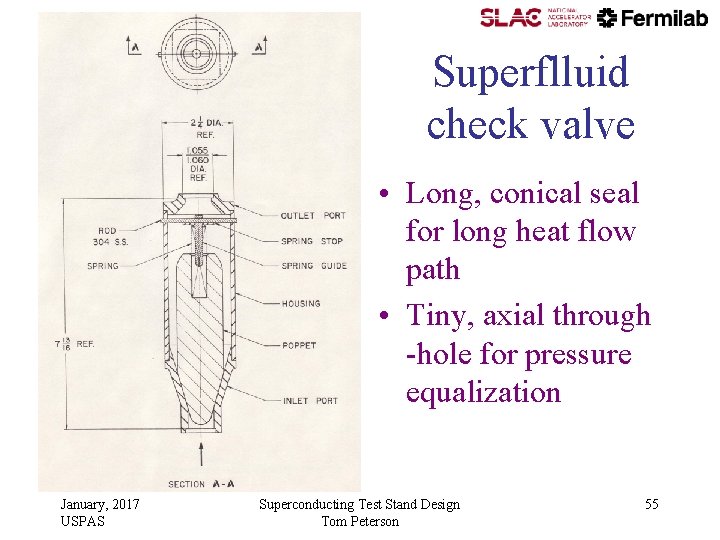
Barriers between superfluid and normal fluid • Lambda plate, lambda plug (detailed example in part 3), check valve (later in this talk) • If the barrier plane is oriented horizontally and the 4. 5 K bath above is quiescent, the bath above slowly stratifies to 2. 17 K just above the barrier • In fact one can operate a “double bath” without a lambda plate down to 2. 2 K – A 2 K heat exchanger below the surface will subcool the liquid – There will still be a 4. 4 K layer and positive vapor pressure on top -- vapor and liquid surface equilibrium • Fermilab routinely tests magnets in subcooled liquid in the positive pressure vertical dewar January, 2017 USPAS Superconducting Test Stand Design Tom Peterson 21
Some Common Thermal Prediction Errors Thermal intercept temperature assumption, overestimating conduction, free convection thermal “short”, incidental contact
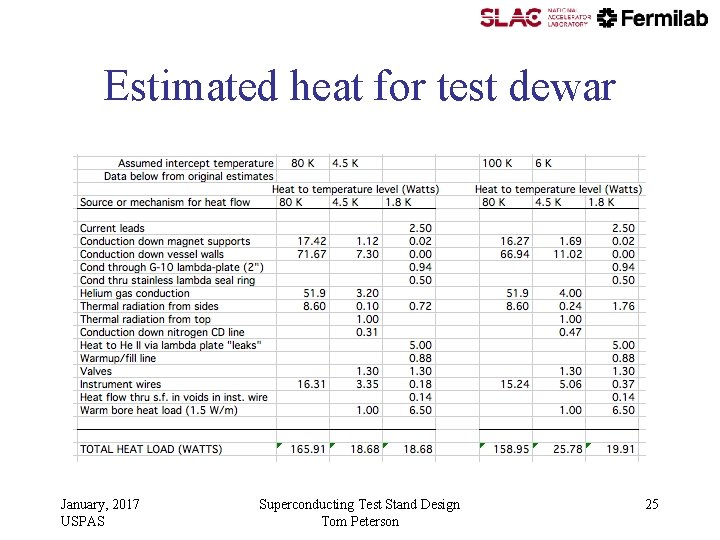
Thermal intercept temperatures • A common source of underestimated heat loads is analysis which assumes ideal thermal intercept temperatures, for example 77 K or even 80 K for an LN 2 thermal intercept, when in fact due to thermal resistance of long thermal strap connections, nitrogen or helium pressure, or other factors, thermal intercept temperature is higher than assumed. • The following example for the vertical test cryostat which I just described illustrates the issue. January, 2017 USPAS Superconducting Test Stand Design Tom Peterson 23
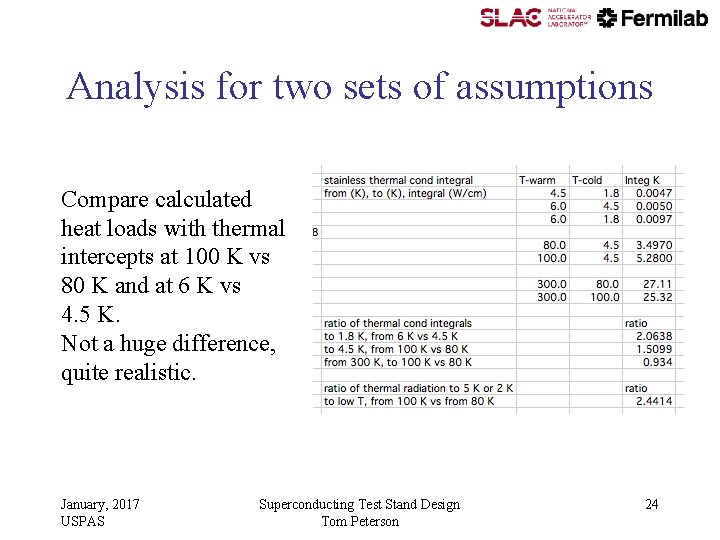
Analysis for two sets of assumptions Compare calculated heat loads with thermal intercepts at 100 K vs 80 K and at 6 K vs 4. 5 K. Not a huge difference, quite realistic. January, 2017 USPAS Superconducting Test Stand Design Tom Peterson 24
Estimated heat for test dewar January, 2017 USPAS Superconducting Test Stand Design Tom Peterson 25
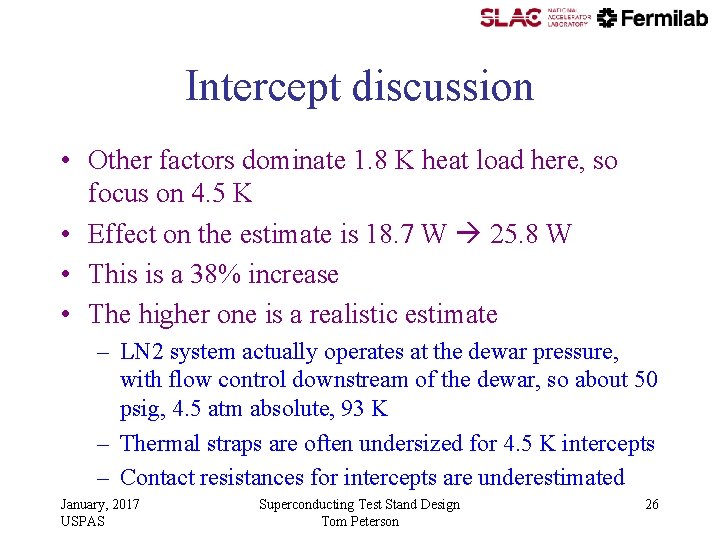
Intercept discussion • Other factors dominate 1. 8 K heat load here, so focus on 4. 5 K • Effect on the estimate is 18. 7 W 25. 8 W • This is a 38% increase • The higher one is a realistic estimate – LN 2 system actually operates at the dewar pressure, with flow control downstream of the dewar, so about 50 psig, 4. 5 atm absolute, 93 K – Thermal straps are often undersized for 4. 5 K intercepts – Contact resistances for intercepts are underestimated January, 2017 USPAS Superconducting Test Stand Design Tom Peterson 26
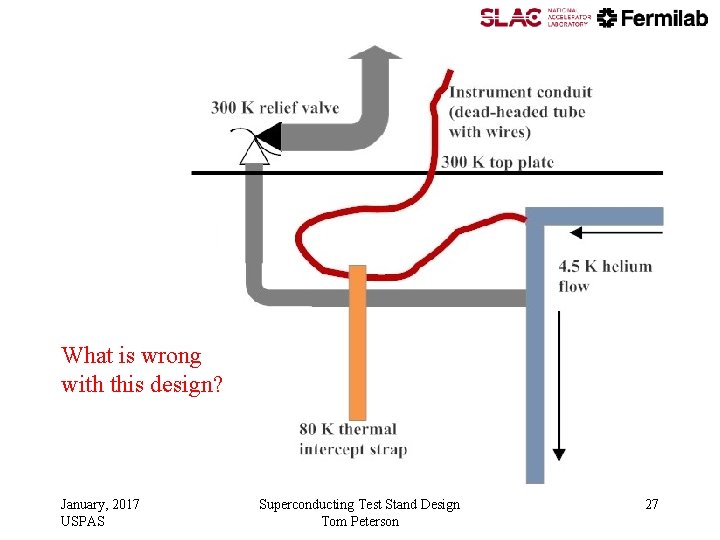
What is wrong with this design? January, 2017 USPAS Superconducting Test Stand Design Tom Peterson 27
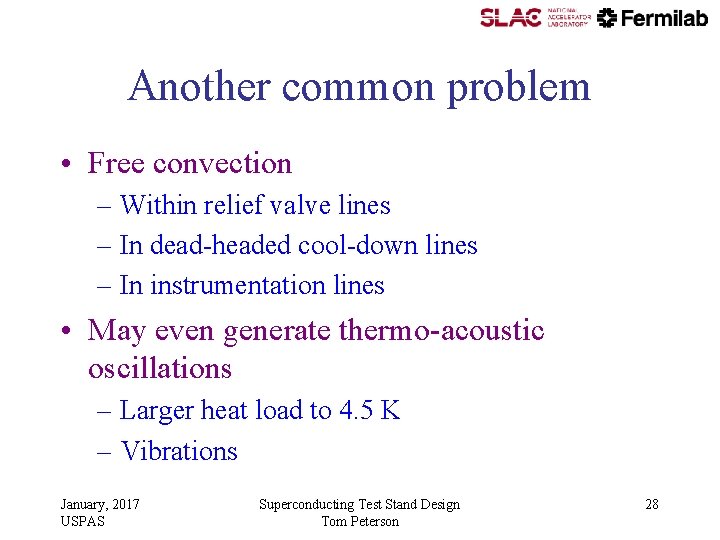
Another common problem • Free convection – Within relief valve lines – In dead-headed cool-down lines – In instrumentation lines • May even generate thermo-acoustic oscillations – Larger heat load to 4. 5 K – Vibrations January, 2017 USPAS Superconducting Test Stand Design Tom Peterson 28
Lesson • Critically examine assumptions in thermal analyses • Specify thermal intercepts in detail • Include thermal intercept links, straps, contact resistances, and real fluid temperatures in the analysis • Look at temperature gradients in the fluid in deadheaded lines and possible free convection drivers January, 2017 USPAS Superconducting Test Stand Design Tom Peterson 29
Back to Test Stands January, 2017 USPAS Superconducting Test Stand Design Tom Peterson 30
Horizontal test stands • Horizontal -- simply as opposed to vertical orientation of a long magnet or SRF cavity in a typically vertically oriented dewar • May consist of just end boxes – – A supply box for power and cryogens A turnaround box Test object in its own cryostat Interconnects to the end boxes • Or may be more like a horizontal vacuum chamber or horizontally oriented dewar • Like vertical test dewars, may provide saturated bath or subcooled liquid January, 2017 USPAS Superconducting Test Stand Design Tom Peterson 31
Features due to horizontal configuration • Not such a simple support structure • Helium container typically needs separate enclosure within vacuum container – Test device typically not hanging but supported with low thermal conductivity structure within the vacuum space – Installation of test device more complicated January, 2017 USPAS Superconducting Test Stand Design Tom Peterson 32
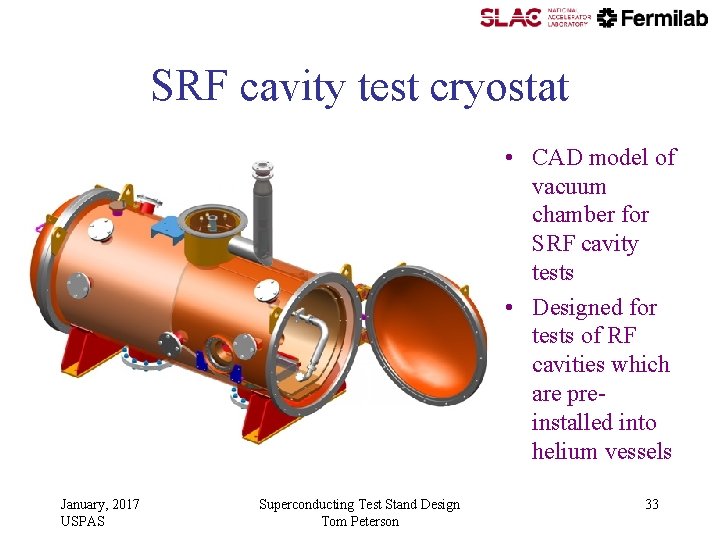
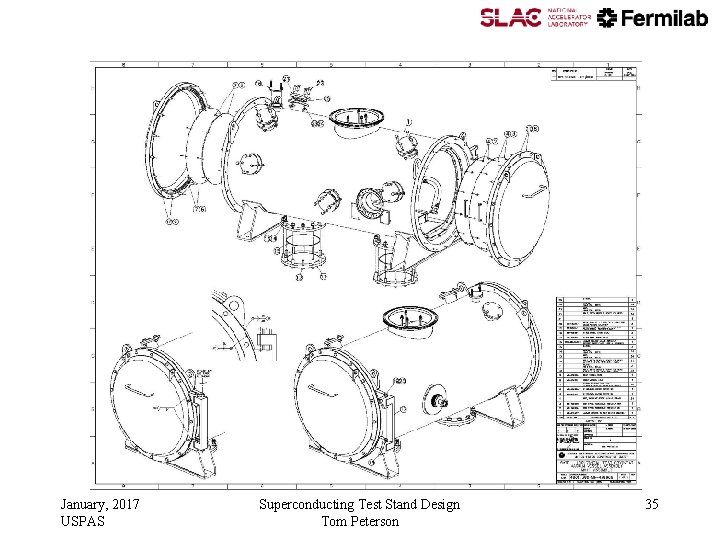
SRF cavity test cryostat • CAD model of vacuum chamber for SRF cavity tests • Designed for tests of RF cavities which are preinstalled into helium vessels January, 2017 USPAS Superconducting Test Stand Design Tom Peterson 33
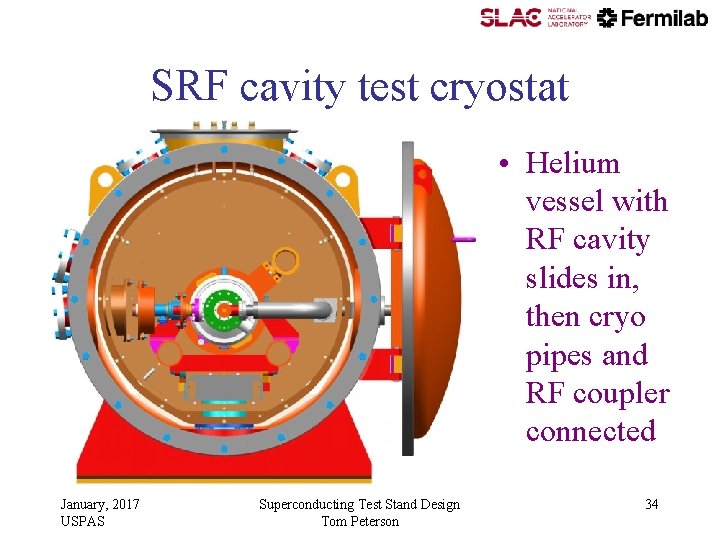
SRF cavity test cryostat • Helium vessel with RF cavity slides in, then cryo pipes and RF coupler connected January, 2017 USPAS Superconducting Test Stand Design Tom Peterson 34
January, 2017 USPAS Superconducting Test Stand Design Tom Peterson 35
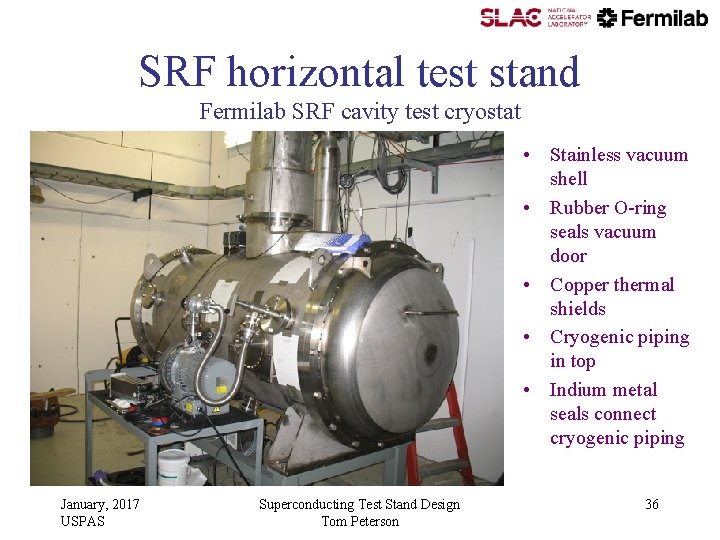
SRF horizontal test stand Fermilab SRF cavity test cryostat • Stainless vacuum shell • Rubber O-ring seals vacuum door • Copper thermal shields • Cryogenic piping in top • Indium metal seals connect cryogenic piping January, 2017 USPAS Superconducting Test Stand Design Tom Peterson 36
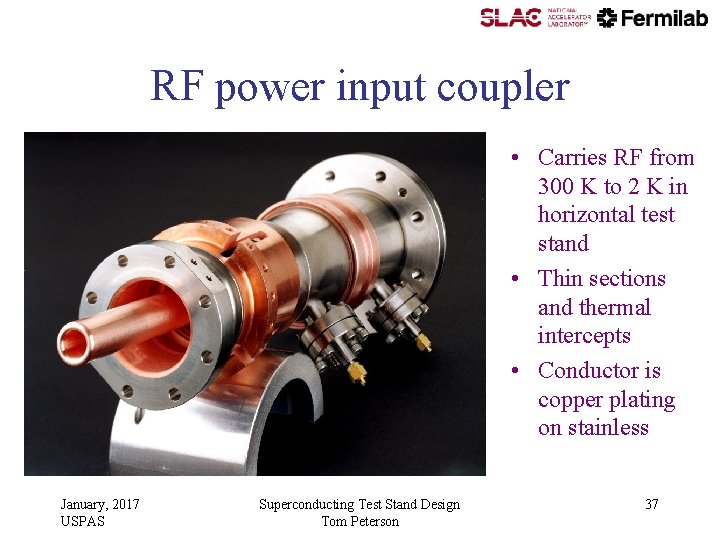
RF power input coupler • Carries RF from 300 K to 2 K in horizontal test stand • Thin sections and thermal intercepts • Conductor is copper plating on stainless January, 2017 USPAS Superconducting Test Stand Design Tom Peterson 37
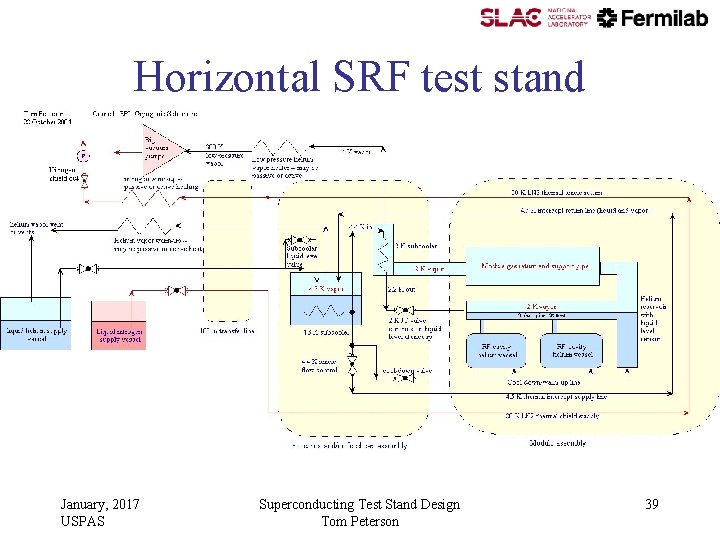
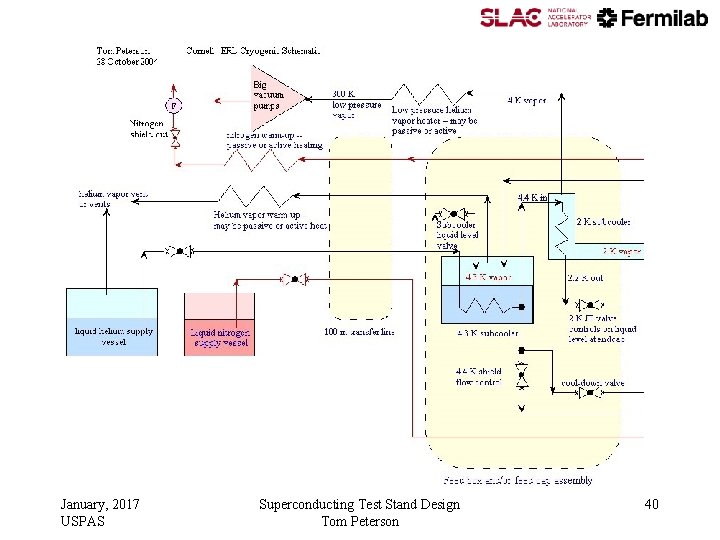
Providing 2 K on a test stand • Test stand refrigeration requirements are typically small – A large, 2 K cryoplant will not be available – 4. 5 K helium from either a small liquefier or storage dewars will provide refrigeration – Room-temperature vacuum pumps provide the low pressure for the low temperature helium – Small heat exchangers may be incorporated for continuous fill duty January, 2017 USPAS Superconducting Test Stand Design Tom Peterson 38
Horizontal SRF test stand January, 2017 USPAS Superconducting Test Stand Design Tom Peterson 39
January, 2017 USPAS Superconducting Test Stand Design Tom Peterson 40
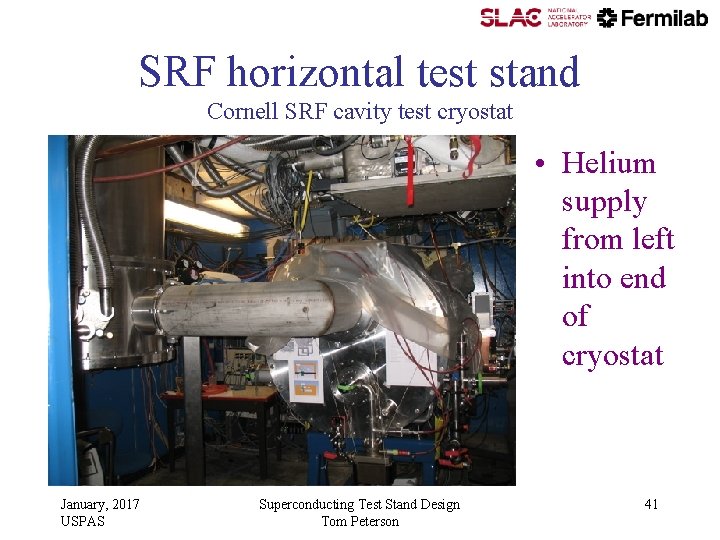
SRF horizontal test stand Cornell SRF cavity test cryostat • Helium supply from left into end of cryostat January, 2017 USPAS Superconducting Test Stand Design Tom Peterson 41
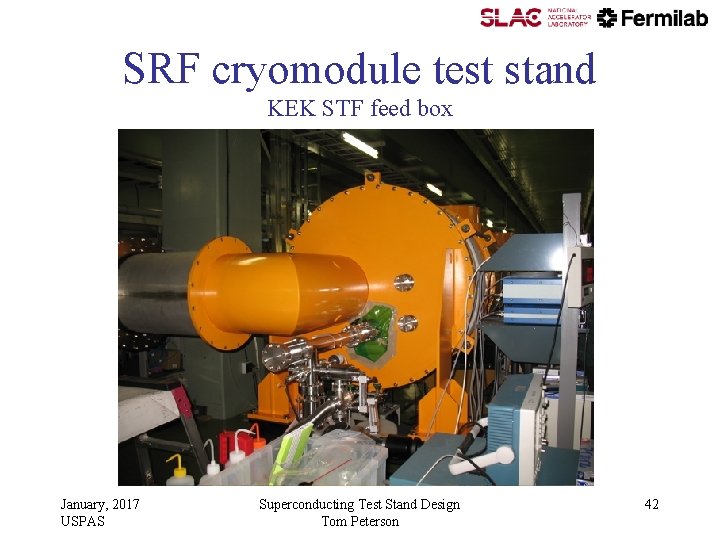
SRF cryomodule test stand KEK STF feed box January, 2017 USPAS Superconducting Test Stand Design Tom Peterson 42
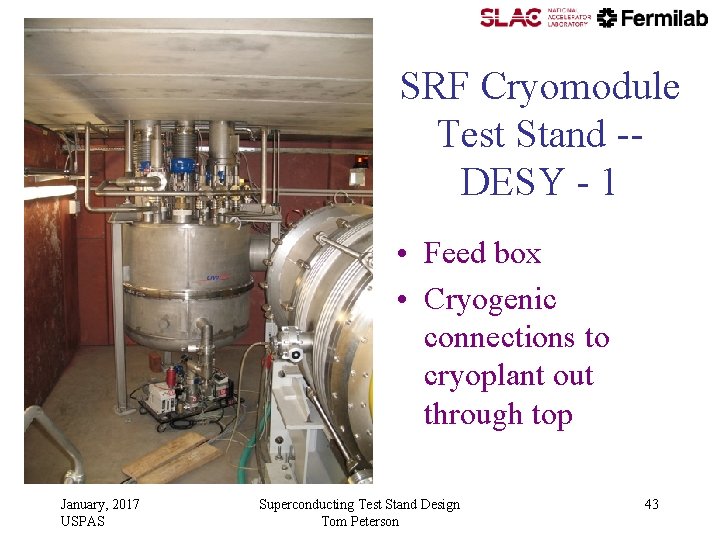
SRF Cryomodule Test Stand -DESY - 1 • Feed box • Cryogenic connections to cryoplant out through top January, 2017 USPAS Superconducting Test Stand Design Tom Peterson 43
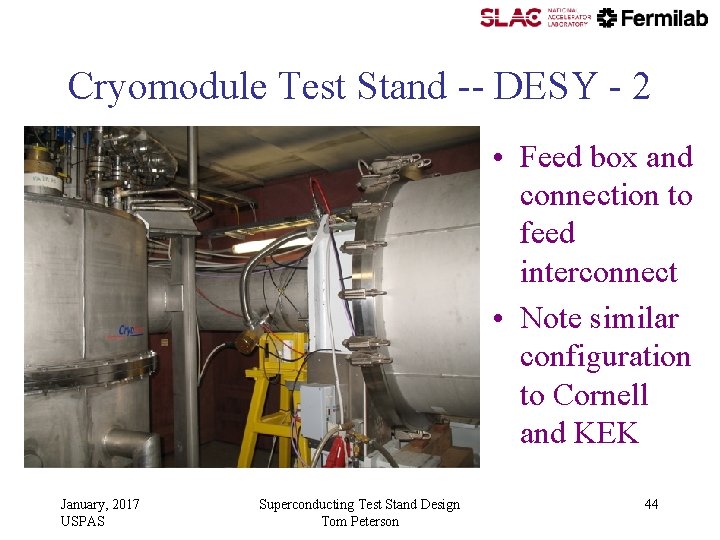
Cryomodule Test Stand -- DESY - 2 • Feed box and connection to feed interconnect • Note similar configuration to Cornell and KEK January, 2017 USPAS Superconducting Test Stand Design Tom Peterson 44
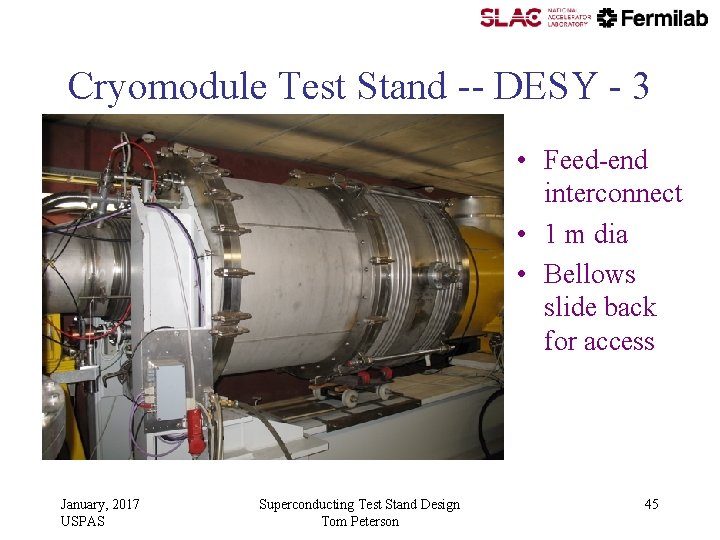
Cryomodule Test Stand -- DESY - 3 • Feed-end interconnect • 1 m dia • Bellows slide back for access January, 2017 USPAS Superconducting Test Stand Design Tom Peterson 45
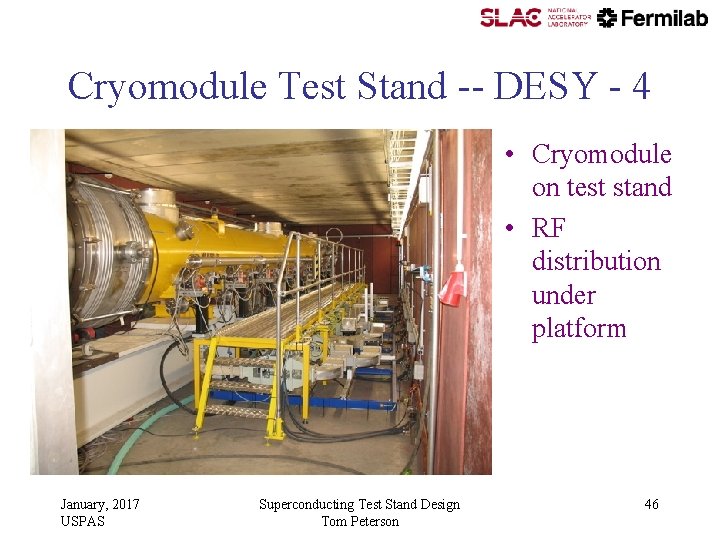
Cryomodule Test Stand -- DESY - 4 • Cryomodule on test stand • RF distribution under platform January, 2017 USPAS Superconducting Test Stand Design Tom Peterson 46
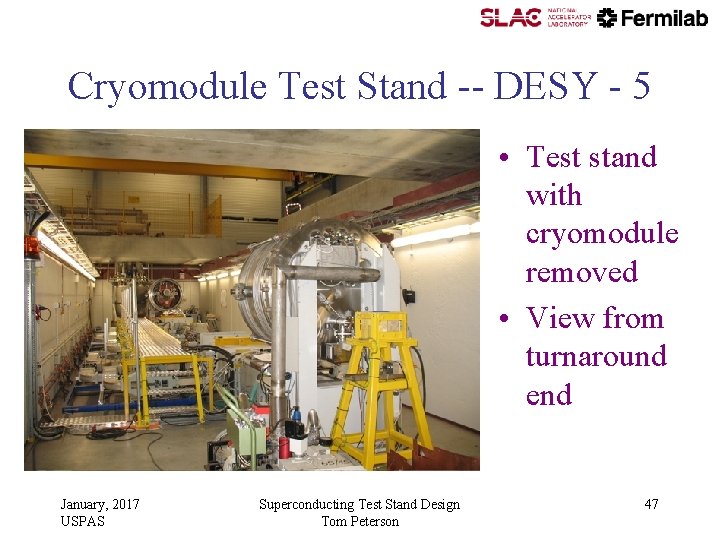
Cryomodule Test Stand -- DESY - 5 • Test stand with cryomodule removed • View from turnaround end January, 2017 USPAS Superconducting Test Stand Design Tom Peterson 47
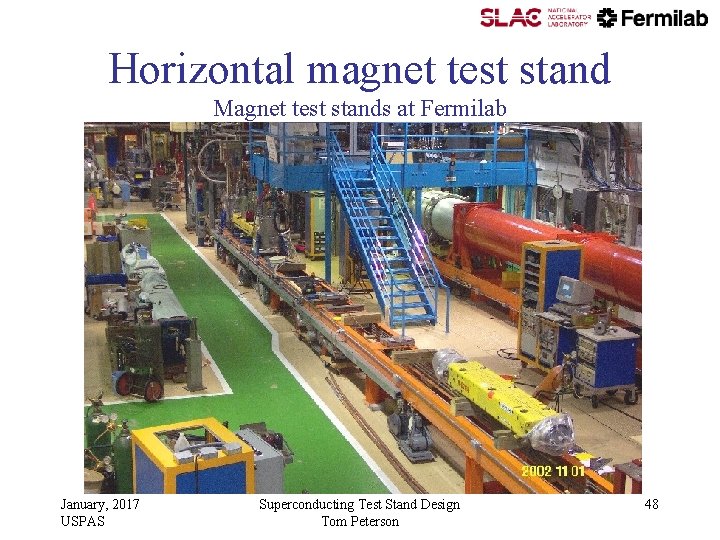
Horizontal magnet test stand Magnet test stands at Fermilab January, 2017 USPAS Superconducting Test Stand Design Tom Peterson 48
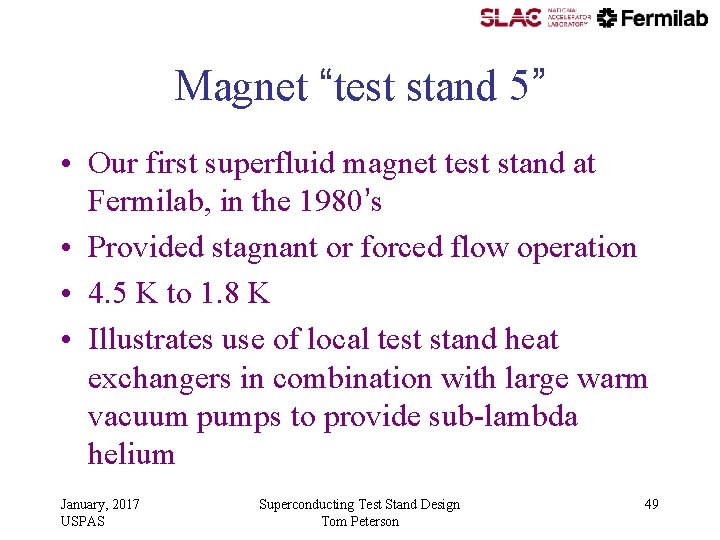
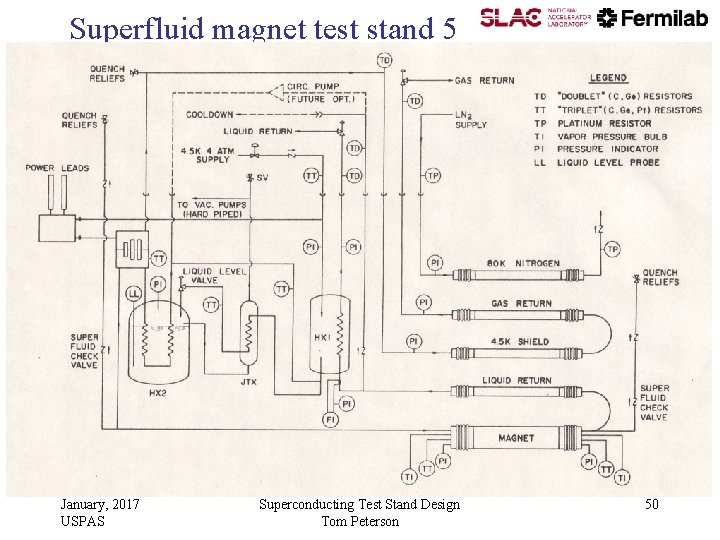
Magnet “test stand 5” • Our first superfluid magnet test stand at Fermilab, in the 1980’s • Provided stagnant or forced flow operation • 4. 5 K to 1. 8 K • Illustrates use of local test stand heat exchangers in combination with large warm vacuum pumps to provide sub-lambda helium January, 2017 USPAS Superconducting Test Stand Design Tom Peterson 49
Superfluid magnet test stand 5 January, 2017 USPAS Superconducting Test Stand Design Tom Peterson 50
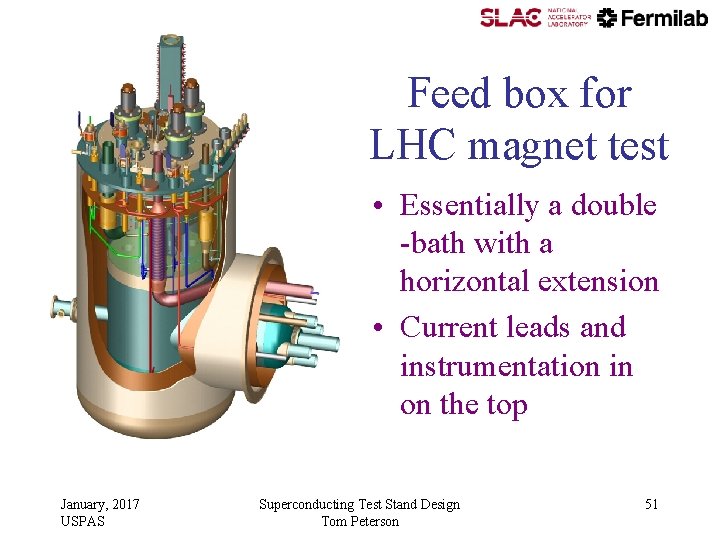
Feed box for LHC magnet test • Essentially a double -bath with a horizontal extension • Current leads and instrumentation in on the top January, 2017 USPAS Superconducting Test Stand Design Tom Peterson 51
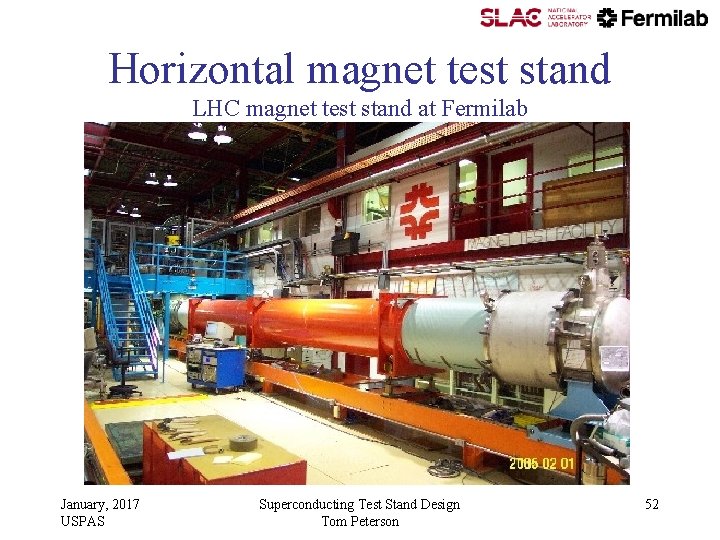
Horizontal magnet test stand LHC magnet test stand at Fermilab January, 2017 USPAS Superconducting Test Stand Design Tom Peterson 52
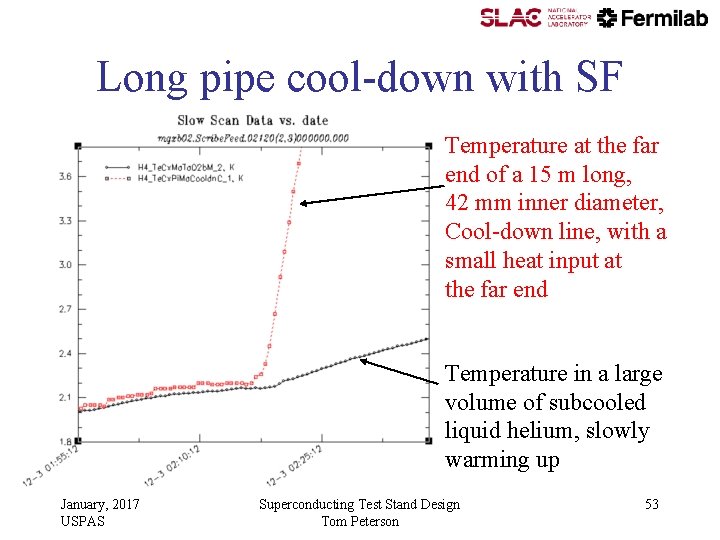
Long pipe cool-down with SF Temperature at the far end of a 15 m long, 42 mm inner diameter, Cool-down line, with a small heat input at the far end Temperature in a large volume of subcooled liquid helium, slowly warming up January, 2017 USPAS Superconducting Test Stand Design Tom Peterson 53
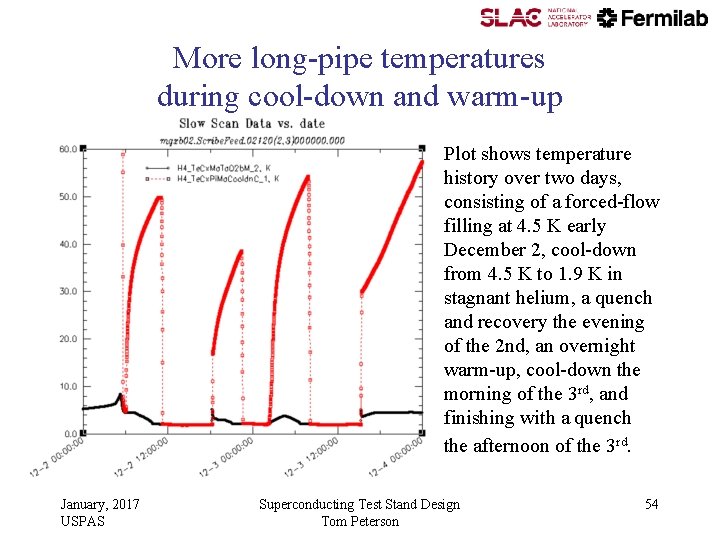
More long-pipe temperatures during cool-down and warm-up Plot shows temperature history over two days, consisting of a forced-flow filling at 4. 5 K early December 2, cool-down from 4. 5 K to 1. 9 K in stagnant helium, a quench and recovery the evening of the 2 nd, an overnight warm-up, cool-down the morning of the 3 rd, and finishing with a quench the afternoon of the 3 rd. January, 2017 USPAS Superconducting Test Stand Design Tom Peterson 54
Superflluid check valve • Long, conical seal for long heat flow path • Tiny, axial through -hole for pressure equalization January, 2017 USPAS Superconducting Test Stand Design Tom Peterson 55
Procurement strategies • Design and build in-house • Design and procure “to print” • Detail interfaces and critical areas but not entire object -- procure to spec’s and drawings • Performance specification with only a few key interfaces detailed January, 2017 USPAS Superconducting Test Stand Design Tom Peterson 56
Procurement experience • Test vessels and stands with end boxes are typically unique -- one or a few-of-a-kind • Industry is small and specialized • Designs often contain new, risky, or erroneous features • Close collaboration with a vendor is critical – Frequent (once per week or more) inspections and meetings at the vendor January, 2017 USPAS Superconducting Test Stand Design Tom Peterson 57
Design, procurement, installation time scale • Design of a new cryogenic box – 0. 5 or more man-years engineering – 1. 0 or more man-years drafting – Typically 6 - 9 months calendar time • Procurement -- another 6 - 12 months • Installation – Complexity of instrumentation, controls, interfaces are often underestimated – Several months • Result -- two years or more January, 2017 USPAS Superconducting Test Stand Design Tom Peterson 58
Operations • Common problems encountered – Warm gas in adds large amount of heat • A very small leak via a valve isolating warmer helium from the lower temperature system may be a hidden source of heat • 1 mg/sec at 300 K ==> 1. 5 Watts to 4. 5 K! – Air leak in (contamination) • Subatmospheric operation for sub-4. 2 K provides risk of air inleaks, especially through instrumentation and other seals January, 2017 USPAS Superconducting Test Stand Design Tom Peterson 59
More about operations • Instrumentation – Often in doubt – In situ checks like at a phase change can provide verification of temperatures and pressures – We generally allow a period of “thermal studies” upon startup of a new test system • Check instrumention • Review operating procedures • Verify thermal performance January, 2017 USPAS Superconducting Test Stand Design Tom Peterson 60
References • More information about Fermilab’s and other test stands may be found in Cryogenic Engineering Conference (CEC) and International Cryogenic Engineering Conference (ICEC) proceedings. • Here is a sample for Fermilab: – P. O. Mazur and T. J. Peterson, “A Cryogenic Test Stand for Full Length SSC Magnets with Superfluid Capability, ” Advances in Cryogenic Engineering, Volume 35 A, pg. 785. – T. J. Peterson, et al, “A 1400 Liter 1. 8 K Test Facility, ” Advances in Cryogenic Engineering, Volume 43 A, pg. 541. – R. H. Carcagno, et al, “A Cryogenic Test Stand for LHC Quadrupole Magnets, ” Advances in Cryogenic Engineering, Volume 49 A, pg. 225. January, 2017 USPAS Superconducting Test Stand Design Tom Peterson 61