
Magnet Alignment Challenges for an MBA Storage Ring
Magnet Alignment Challenges for an MBA Storage Ring* Animesh Jain Superconducting Magnet Division Brookhaven National Laboratory, Upton, NY 11973, USA 2 nd Workshop on Beam Dynamics Meets Magnets (Be. Ma 2014) December 1 -4, 2014 Park Hotel, Bad Zurzach, Switzerland * Work supported by the U. S. Department of Energy under contract DE-AC 02 -98 CH 10886
Outline • Definition of “alignment” in the context of this talk: – The process of positioning multiple (>2) physically disjointed objects such that their magnetic centers lie on a desired curve. • Alignment methods involving survey and/or mechanical precision, with or without the use of magnetic measurements: – Magnetic measurements to fiducialize, then survey to install – Magnetic measurements to characterize, then shim (? ) to install – Alignment using manufacturing tolerances alone Alignment Challenges for an MBA Storage Ring: Animesh Jain, BNL Beam Dynamics Meets Magnets-II, Dec. 1 -4, 2014, Bad Zurzach • Direct alignment using magnetic measurements 1
Fiducialization of Magnetic Axis • Techniques such as rotating coils or wire based magnetic measurements (vibrating wire, stretched wire, …) of a single magnet element can measure the magnetic axis to within ± 1 -5 mm in a coordinate system tied to the measurement probe. • But the probe itself must be located in relation to fiducials or reference surfaces of the magnet. This is typically carried out by survey. Errors may be ~10 -25 mm, or more, depending on setup. • Final installation may incur additional errors (e. g. by survey). • Using magnetic measurements reduces uncertainty due Alignment Challenges for an MBA Storage Ring: Animesh Jain, BNL Dynamics Meets Magnets-II, Dec. the 1 -4, 2014, Bad Zurzach to possible Beam mismatch between mechanical and 2
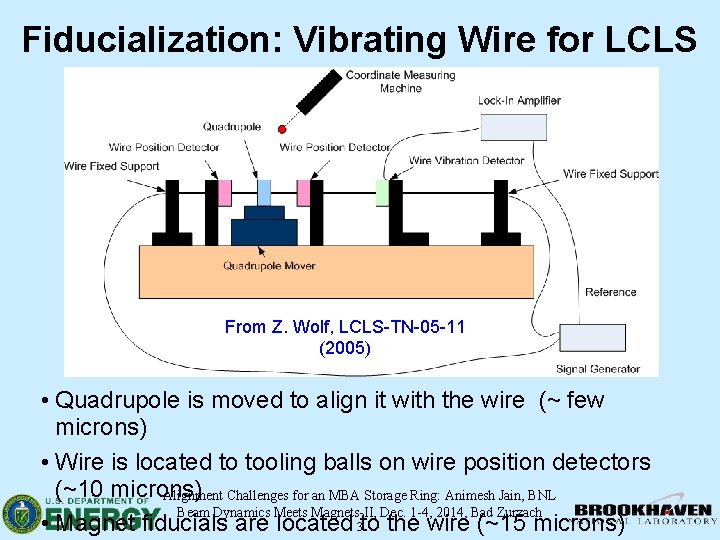
Fiducialization: Vibrating Wire for LCLS From Z. Wolf, LCLS-TN-05 -11 (2005) • Quadrupole is moved to align it with the wire (~ few microns) • Wire is located to tooling balls on wire position detectors (~10 microns) Alignment Challenges for an MBA Storage Ring: Animesh Jain, BNL Beam Dynamics Meets Magnets-II, Dec. 1 -4, 2014, Bad Zurzach • Magnet fiducials are located 3 to the wire (~15 microns)

Characterization: Rotating Coil for SLS Based on Antokhin et al. , Nucl. Instrum. Meth. A 470 (2001) 11– 17. • Rotating coil axis precisely adjusted relative to reference surfaces on the girder. • Magnet located to the girder using reference surfaces. • Measurements verify that the magnetic axis is within specification. • Mean offset of all magnets < 5 mm horizontal, < 10 mm vertical, Std. dev. < 20 mm. Alignment Challenges for an MBA Storage Ring: Animesh Jain, BNL Beam Dynamics Meets Magnets-II, Dec. 1 -4, 2014, Bad Zurzach • Several magnets installed on a girder using reference surfaces. 4
Alignment of SLS Multipoles on Girders Based on Antokhin et al. , Nucl. Instrum. Meth. A 470 (2001) 11– 17. • Magnet axis is verified to be within specification in relation to the reference surfaces by magnetic measurements. • Installation of several magnets on a girder is done entirely based on reference surfaces. This allows easy alignment of several magnets. • It is possible. Alignment to use shims if the axis is found to be too far off Challenges for an MBA Storage Ring: Animesh Jain, BNL from nominal. Beam Dynamics Meets Magnets-II, Dec. 1 -4, 2014, Bad Zurzach 5
Purely Mechanical Alignment • It may be argued that in a well built magnet (good field quality), the magnetic and mechanical axes must coincide. • It should, therefore, be possible to skip fiducialization, or a verification using magnetic measurements. • A purely mechanical alignment does require precision machined surfaces on all magnets, as well as on long and massive support structures, similar to those used for SLS. • Since magnets are to be machined to high precision anyway, it. Alignment may. Challenges not be too expensive to add for an MBA Storage Ring: Animesh Jain, BNL Beam Dynamics Meets Magnets-II, Dec. 1 -4, 2014, Bad Zurzach precision reference surfaces. 6
Mechanical Vs. Magnetic Axes • While the definition of magnetic axis is less ambiguous, there is no unique definition of the mechanical axis of an as-built magnet – Option 1: Define as a fixed offset from reference surfaces • Easy to use; no ambiguity; but really only pole positions matter – Option 2: Define somehow based on survey of individual poles • Tedious; complex pole profiles not very suitable to work with; subject to data analysis procedures; not too useful for aligning. • While good agreement between mechanical and Alignment Challenges for an MBA Storage Ring: Animesh Jain, BNL Beam Dynamics Meets Magnets-II, in Dec. some 1 -4, 2014, Bad Zurzach (e. g. SLS), magnetic axes is reported cases 7
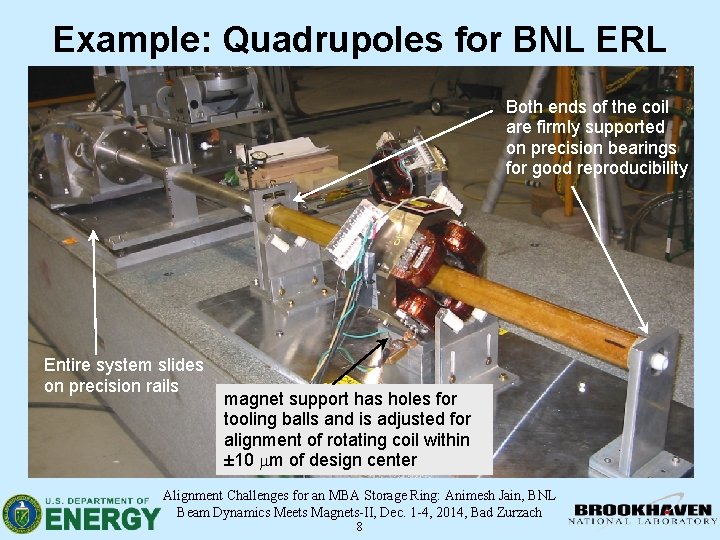
Example: Quadrupoles for BNL ERL Both ends of the coil are firmly supported on precision bearings for good reproducibility Entire system slides on precision rails magnet support has holes for tooling balls and is adjusted for alignment of rotating coil within ± 10 mm of design center Alignment Challenges for an MBA Storage Ring: Animesh Jain, BNL Beam Dynamics Meets Magnets-II, Dec. 1 -4, 2014, Bad Zurzach 8
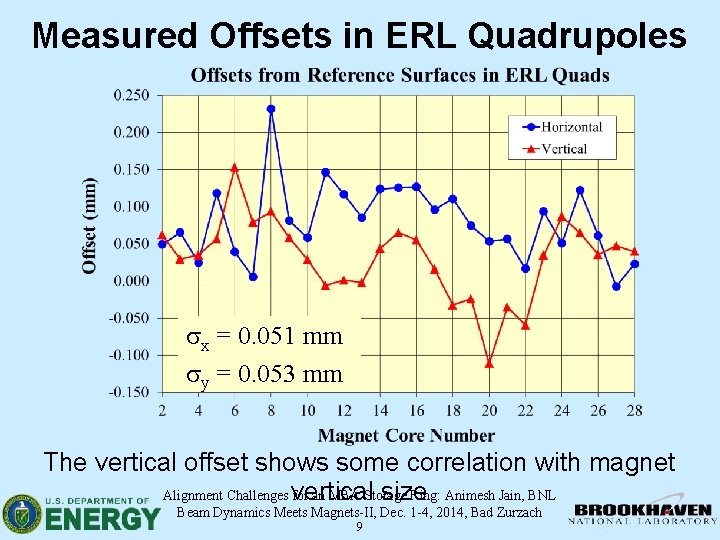
Measured Offsets in ERL Quadrupoles sx = 0. 051 mm sy = 0. 053 mm The vertical offset shows some correlation with magnet Alignment Challenges vertical for an MBA Storage Ring: Animesh Jain, BNL size Beam Dynamics Meets Magnets-II, Dec. 1 -4, 2014, Bad Zurzach 9
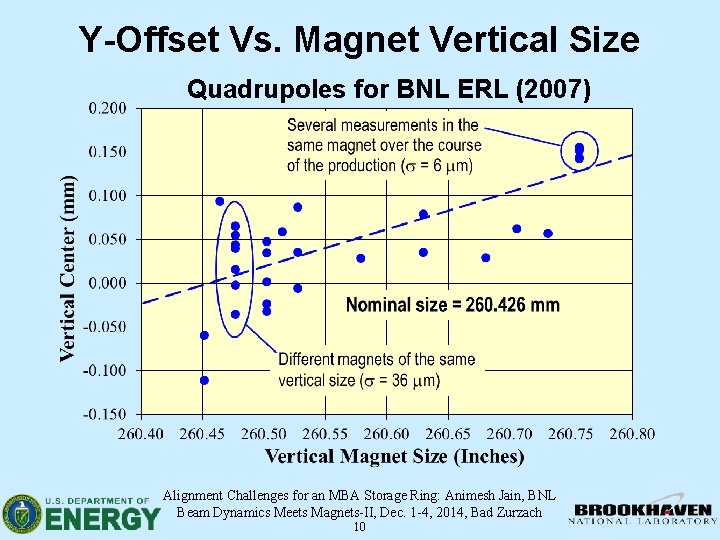
Y-Offset Vs. Magnet Vertical Size Quadrupoles for BNL ERL (2007) Alignment Challenges for an MBA Storage Ring: Animesh Jain, BNL Beam Dynamics Meets Magnets-II, Dec. 1 -4, 2014, Bad Zurzach 10
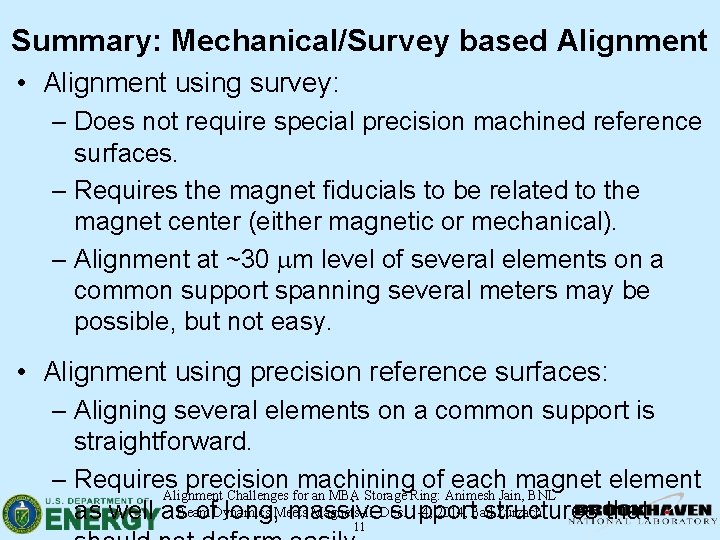
Summary: Mechanical/Survey based Alignment • Alignment using survey: – Does not require special precision machined reference surfaces. – Requires the magnet fiducials to be related to the magnet center (either magnetic or mechanical). – Alignment at ~30 mm level of several elements on a common support spanning several meters may be possible, but not easy. • Alignment using precision reference surfaces: – Aligning several elements on a common support is straightforward. – Requires precision machining of each magnet element Alignment Challenges for an MBA Storage Ring: Animesh Jain, BNL Magnets-II, Dec. 1 -4, 2014, Bad Zurzach as well as. Beam of. Dynamics long, Meets massive support structures that 11

Direct Magnetic Alignment • Magnets may be aligned directly to each other using magnetic measurements. This offers some advantages: – No need to fiducialize magnets, no stack up of errors – No need for precision reference surfaces – Support structure requires no precision manufacturing (cheap) – Mechanical vs. magnetic axes is irrelevant (less R&D & monitoring) • Requires a wire based measurement technique, and is thus most suitable for straight assemblies up to ~5 m long. Challenges for an MBA Storage Ring: Animesh Jain, BNL • Requires Alignment temporary fixtures to move and secure Beam Dynamics Meets Magnets-II, Dec. 1 -4, 2014, Bad Zurzach 12
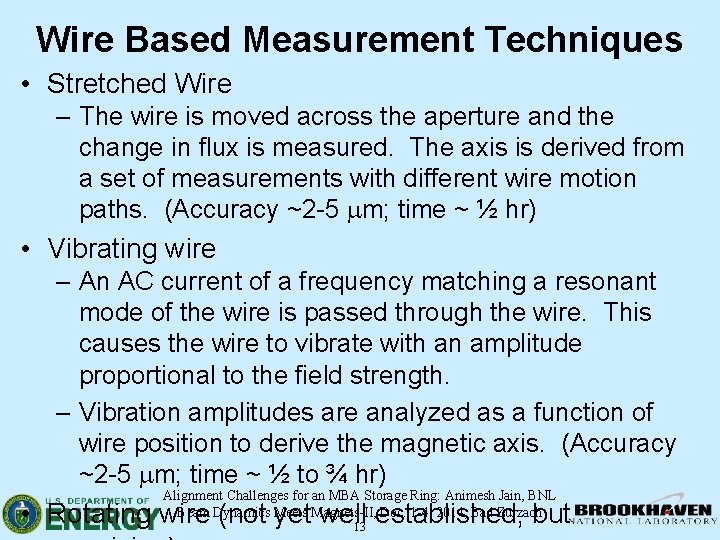
Wire Based Measurement Techniques • Stretched Wire – The wire is moved across the aperture and the change in flux is measured. The axis is derived from a set of measurements with different wire motion paths. (Accuracy ~2 -5 mm; time ~ ½ hr) • Vibrating wire – An AC current of a frequency matching a resonant mode of the wire is passed through the wire. This causes the wire to vibrate with an amplitude proportional to the field strength. – Vibration amplitudes are analyzed as a function of wire position to derive the magnetic axis. (Accuracy ~2 -5 mm; time ~ ½ to ¾ hr) Alignment Challenges for an MBA Storage Ring: Animesh Jain, BNL Beam Dynamics Meets Magnets-II, Dec. 1 -4, 2014, Bad Zurzach • Rotating wire (not yet well 13 established, but
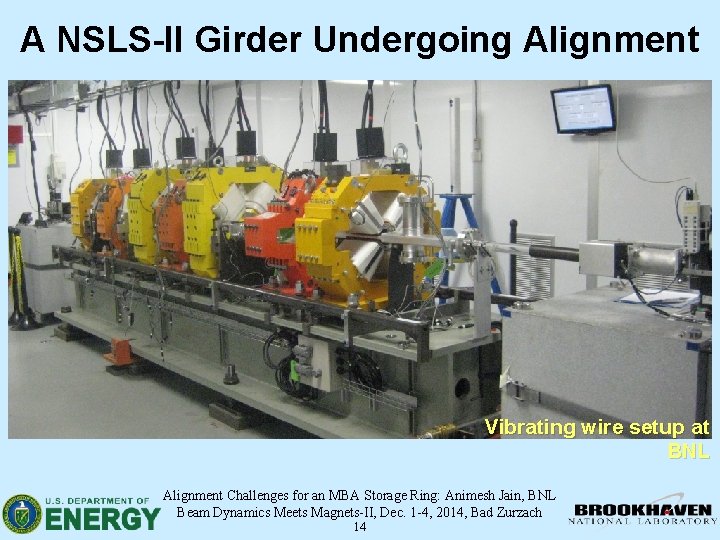
A NSLS-II Girder Undergoing Alignment Vibrating wire setup at BNL Alignment Challenges for an MBA Storage Ring: Animesh Jain, BNL Beam Dynamics Meets Magnets-II, Dec. 1 -4, 2014, Bad Zurzach 14
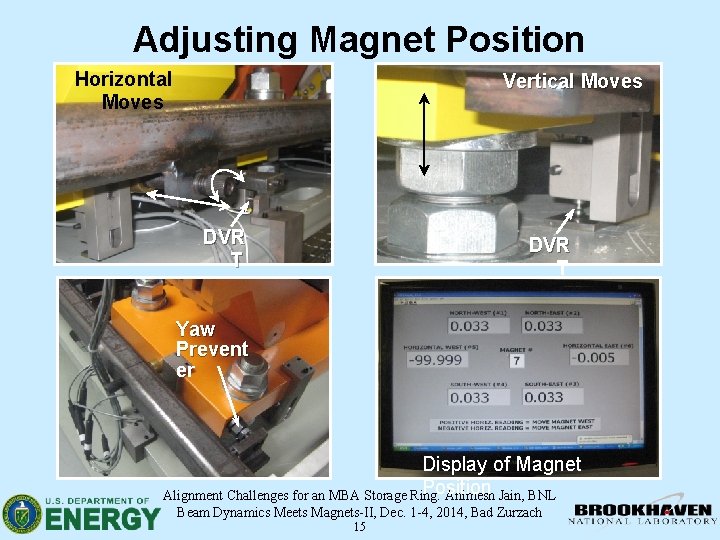
Adjusting Magnet Position Horizontal Moves Vertical Moves DVR T Yaw Prevent er Display of Magnet Position Alignment Challenges for an MBA Storage Ring: Animesh Jain, BNL Beam Dynamics Meets Magnets-II, Dec. 1 -4, 2014, Bad Zurzach 15
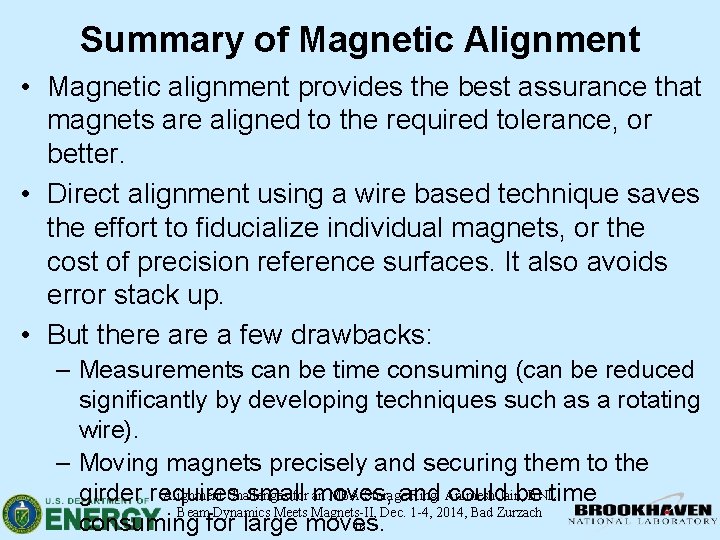
Summary of Magnetic Alignment • Magnetic alignment provides the best assurance that magnets are aligned to the required tolerance, or better. • Direct alignment using a wire based technique saves the effort to fiducialize individual magnets, or the cost of precision reference surfaces. It also avoids error stack up. • But there a few drawbacks: – Measurements can be time consuming (can be reduced significantly by developing techniques such as a rotating wire). – Moving magnets precisely and securing them to the Alignment Challenges for moves, an MBA Storage Ring: Animesh BNLtime girder requires small and could. Jain, be Beam Dynamics Meets Magnets-II, Dec. 1 -4, 2014, Bad Zurzach 16 consuming for large moves.
Multi-bend Acromat Storage Rings • Multi-bend acromat (MBA) designs for the low emittance rings contain several bending elements per cell, and a large number of magnets packed closer together. • One obvious challenge is that there are many magnet elements to align, and any technique used must be cost effective. • The presence of many bending elements may mean that not all magnets within a “logical group” are arranged in a straight line. • The MBA designs also feature combined function magnets where both the field and the field gradient Alignment Challenges for an MBA Storage Ring: Animesh Jain, BNL Beam Dynamics Meets Magnets-II, Dec. 1 -4, pose 2014, Bad Zurzach are very high. These magnets a unique 17
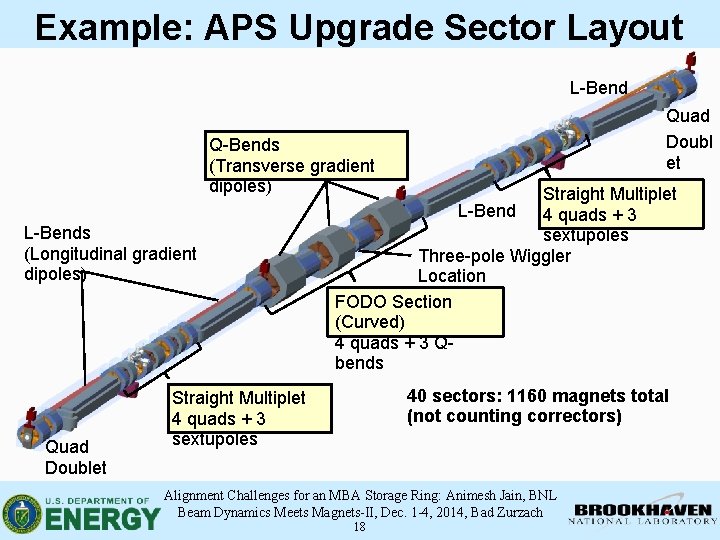
Example: APS Upgrade Sector Layout L-Bend Quad Doubl et Q-Bends (Transverse gradient dipoles) L-Bends (Longitudinal gradient dipoles) Quad Doublet Straight Multiplet L-Bend 4 quads + 3 sextupoles Three-pole Wiggler Location FODO Section (Curved) 4 quads + 3 Qbends 40 sectors: 1160 magnets total (not counting correctors) Straight Multiplet 4 quads + 3 sextupoles Alignment Challenges for an MBA Storage Ring: Animesh Jain, BNL Beam Dynamics Meets Magnets-II, Dec. 1 -4, 2014, Bad Zurzach 18
Straight Sections in MBA Lattice • If only multipoles are to be aligned on a straight line, these assemblies are similar to existing machines and any of the alignment techniques described earlier may be used. • The choice of which method to use depends on several factors: – Prior experience and resources available for magnetic alignment. – Level of agreement between mechanical and magnetic axes. – Availability and cost of high precision (~10 mm) machining. Alignment Challenges for an MBA Storage Ring: Animesh Jain, BNL Beam Dynamics Meets Magnets-II, Dec. 1 -4, 2014, Bad Zurzach • Perhaps a good compromise could be (? ): 19
Curved Sections in MBA Lattice • Several bending and focusing elements are closely interleaved in some sections, e. g. , the central FODO section for the APS upgrade. The bending elements may have strong gradients too. • An assembly of reasonable length may consist of at least one bending element. • The alignment of the bending element may also be critical due to strong transverse gradients: – Example (APS-U): 100 mm misalignment ~ 0. 8% bending error • There is no well established technique to find the axis of a curved magnet at the level of precision Alignment Challenges for an MBA Storage Ring: Animesh Jain, BNL Beam Dynamics Meets Magnets-II, Dec. 1 -4, 2014, Bad Zurzach needed (~10 -15 mm). 20
Options for Curved Sections • Standard technique applicable to measurement of curved sections is to use a Hall probe system with precision stages. • Hall probe element can be located in the stage coordinate system using a magnetic pin, for example. But this involves accurate knowledge (survey) of the pin location. • The magnet can be mapped using Hall probe, and the axis derived, provided there is easy access for the Hall probe holder. – Easier to do with an open side design (e. g. ESRF design) Alignment Challenges for an MBA Storage Ring: Animesh Jain, BNL Beam accuracy Dynamics Meets Magnets-II, Dec. 2014, Bad Zurzach – Achievable may not 1 -4, be sufficient; also time 21
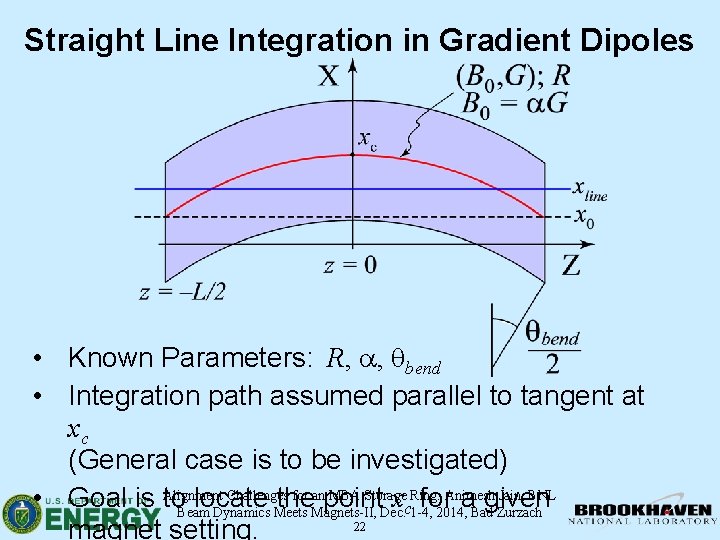
Straight Line Integration in Gradient Dipoles • Known Parameters: R, a, qbend • Integration path assumed parallel to tangent at xc (General case is to be investigated) Alignment Challenges for anpoint MBA Storage Ring: Animesh Jain, BNL • Goal is to locate the x for a given c Beam Dynamics Meets Magnets-II, Dec. 1 -4, 2014, Bad Zurzach 22 magnet setting.
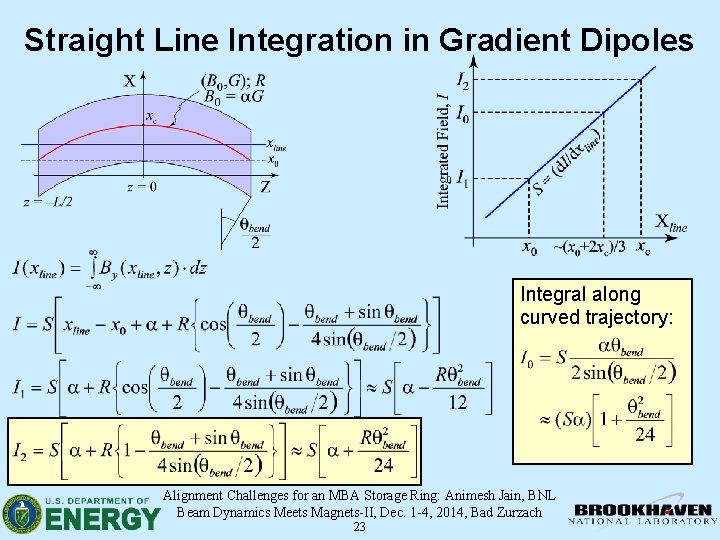
Straight Line Integration in Gradient Dipoles Integral along curved trajectory: Alignment Challenges for an MBA Storage Ring: Animesh Jain, BNL Beam Dynamics Meets Magnets-II, Dec. 1 -4, 2014, Bad Zurzach 23
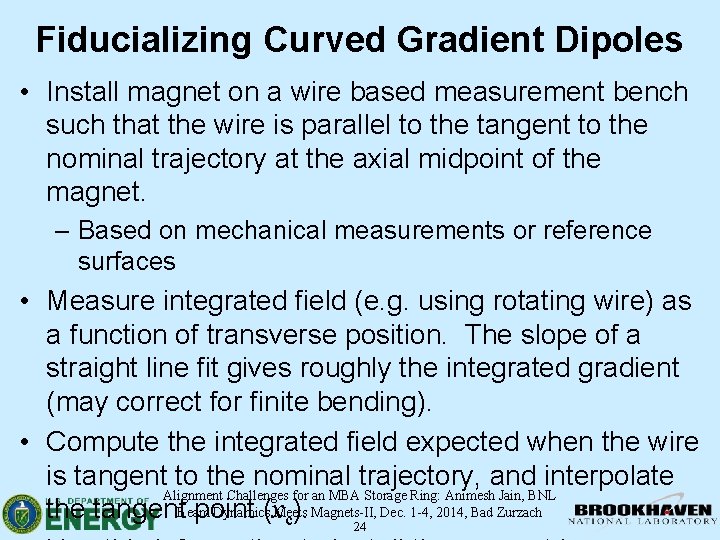
Fiducializing Curved Gradient Dipoles • Install magnet on a wire based measurement bench such that the wire is parallel to the tangent to the nominal trajectory at the axial midpoint of the magnet. – Based on mechanical measurements or reference surfaces • Measure integrated field (e. g. using rotating wire) as a function of transverse position. The slope of a straight line fit gives roughly the integrated gradient (may correct for finite bending). • Compute the integrated field expected when the wire is tangent to the nominal trajectory, and interpolate Alignment Challenges for an MBA Storage Ring: Animesh Jain, BNL Dynamics Dec. 1 -4, 2014, Bad Zurzach the tangent. Beam point (x. Meets c). Magnets-II, 24
Summary • Alignment methods used in the past range from purely mechanical to purely magnetic alignment. • Mechanical alignment offers ease of installation, but requires precision machined surfaces on all magnets, as well as on long support structures. Magnetic alignment is not guaranteed. • Direct magnetic alignment offers the best assurance of good alignment without requiring precision machined surfaces. • Multi-bend achromats contain many more magnets. Method used should be the fastest, while ensuring alignment Alignment tolerance is met. Challenges for an MBA Storage Ring: Animesh Jain, BNL Beam Dynamics Meets Magnets-II, Dec. 1 -4, 2014, Bad Zurzach • Curved gradient dipoles pose the maximum 25
- Slides: 26