
Magma l Differentiate magma based on its chemical
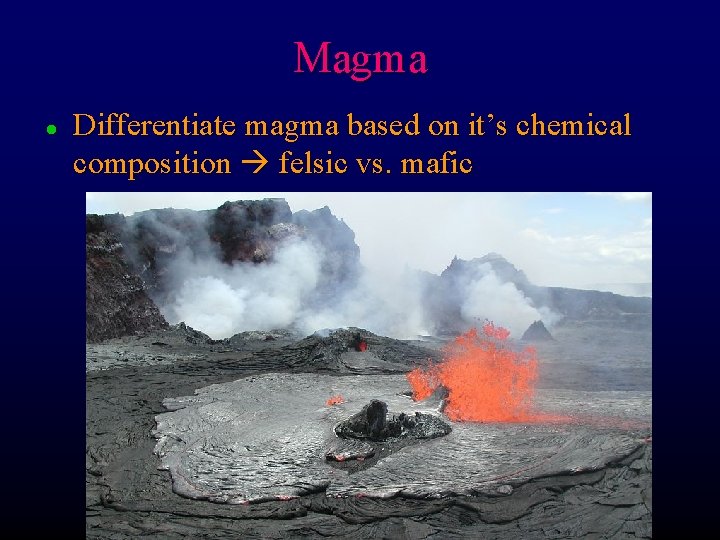
Magma l Differentiate magma based on it’s chemical composition felsic vs. mafic
Melt Composition + ‘freezing’ T l l Liquid magma freezes into crystals the composition of what freezes first is governed by the melt’s composition Analogous to the composition of seawater icebergs are composed of pure water; pure water freezes first, leaving the concentrated brine behind In magmas More silica = lower T; more Ca, Mg=higher T Silica polymerization also affected by T and how much Si there is!
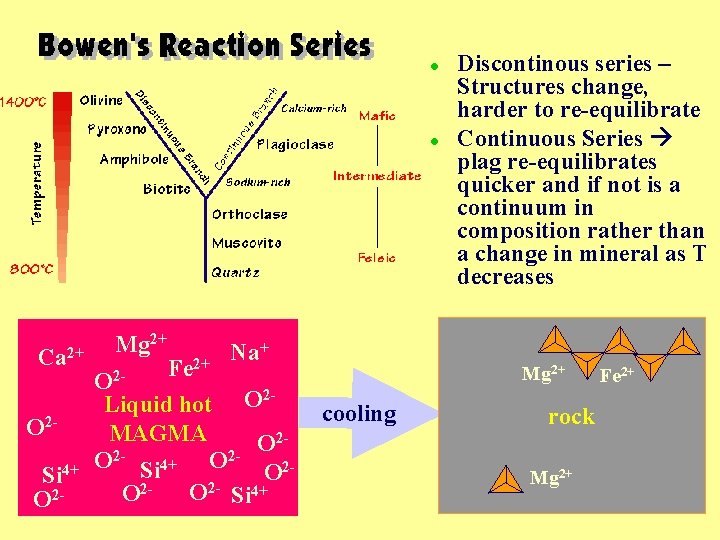
l l Ca 2+ O 2 Si 4+ O 2 - Mg 2+ Na+ Fe 2+ Liquid hot O 2 MAGMA 2 O O 2 - Si 4+ O 2 - Si 4+ Discontinous series – Structures change, harder to re-equilibrate Continuous Series plag re-equilibrates quicker and if not is a continuum in composition rather than a change in mineral as T decreases Mg 2+ O 2 - cooling rock Mg 2+ Fe 2+
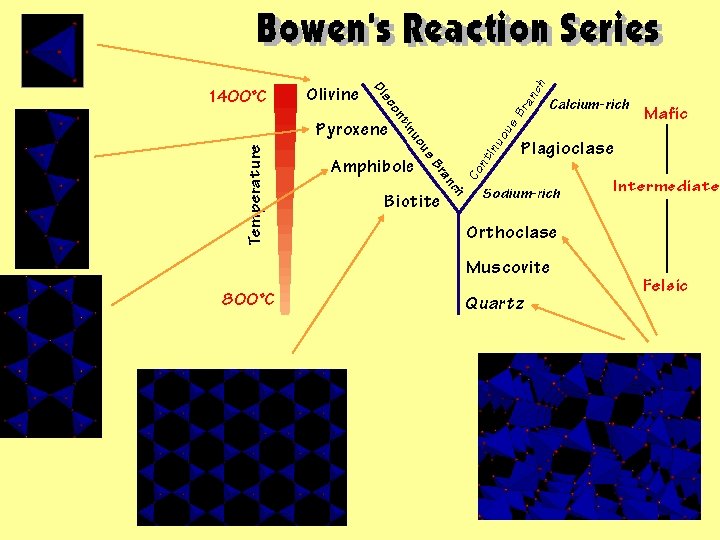
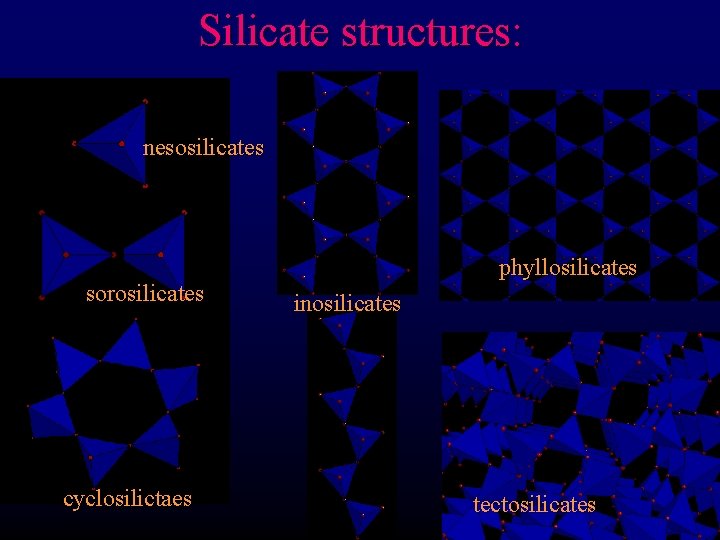
Silicate structures: nesosilicates sorosilicates cyclosilictaes phyllosilicates inosilicates tectosilicates
![Mineral Structures Silicates are classified on the basis of Si-O polymerism [Si. O 4]4](http://slidetodoc.com/presentation_image_h2/0987902e8d12aa09d4dc8480c57a2474/image-6.jpg "Mineral Structures Silicates are classified on the basis of Si-O polymerism [Si. O 4]4")
Mineral Structures Silicates are classified on the basis of Si-O polymerism [Si. O 4]4 - Isolated tetrahedra Nesosilicates Examples: olivine garnet [Si 2 O 7]6 - Paired tetrahedra Sorosilicates Examples: lawsonite n[Si. O 3]2 - n = 3, 4, 6 Ring silicates Cyclosilicates Examples: benitoite Ba. Ti[Si 3 O 9] axinite Ca 3 Al 2 BO 3[Si 4 O 12]OH beryl Be 3 Al 2[Si 6 O 18]
![Mineral Structures Chain Silicates – single and double [Si. O 3]2 - single chains](http://slidetodoc.com/presentation_image_h2/0987902e8d12aa09d4dc8480c57a2474/image-7.jpg "Mineral Structures Chain Silicates – single and double [Si. O 3]2 - single chains")
Mineral Structures Chain Silicates – single and double [Si. O 3]2 - single chains pryoxenes pyroxenoids Inosilicates [Si 4 O 11]4 Double tetrahedra amphiboles
![Mineral Structures Sheet Silicates – aka Phyllosilicates [Si 2 O 5]2 Sheets of tetrahedra](http://slidetodoc.com/presentation_image_h2/0987902e8d12aa09d4dc8480c57a2474/image-8.jpg "Mineral Structures Sheet Silicates – aka Phyllosilicates [Si 2 O 5]2 Sheets of tetrahedra")
Mineral Structures Sheet Silicates – aka Phyllosilicates [Si 2 O 5]2 Sheets of tetrahedra micas talc clay minerals serpentine Phyllosilicates
![Mineral Structures Framework silicates – aka Tectosilicates low-quartz [Si. O 2] quartz 3 -D](http://slidetodoc.com/presentation_image_h2/0987902e8d12aa09d4dc8480c57a2474/image-9.jpg "Mineral Structures Framework silicates – aka Tectosilicates low-quartz [Si. O 2] quartz 3 -D")
Mineral Structures Framework silicates – aka Tectosilicates low-quartz [Si. O 2] quartz 3 -D frameworks of tetrahedra: fully polymerized feldspars feldspathoids zeolites Tectosilicates
Characterizing minerals l WITHIN classes (like the silicate classes) Minerals put into groups based on similar crystal structures differing typically in chemical substitution Groups usually named after principle mineral F Feldspar group, mica group, feldspathoid group F l Sites – designated M 1, M 2, etc. – designate spots where cations go into structure F different site designations have different characteristics (‘see’ different charge, have different sizes, etc. ) and accommodate different ions based on this
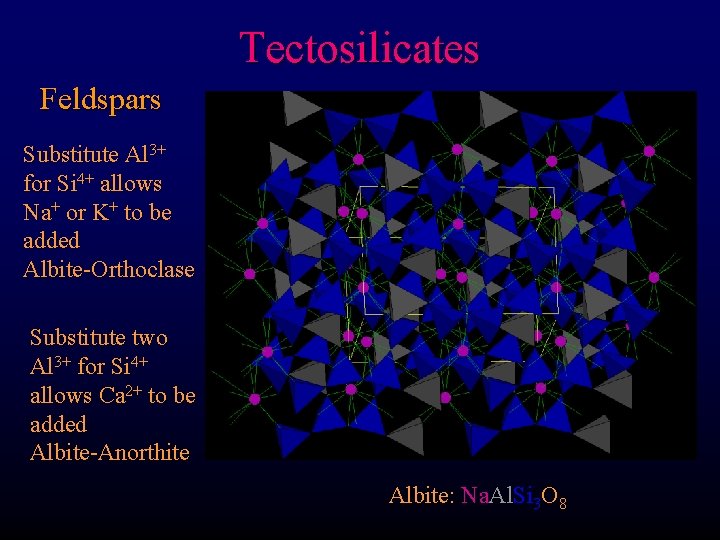
Tectosilicates Feldspars Substitute Al 3+ for Si 4+ allows Na+ or K+ to be added Albite-Orthoclase Substitute two Al 3+ for Si 4+ allows Ca 2+ to be added Albite-Anorthite Albite: Na. Al. Si 3 O 8
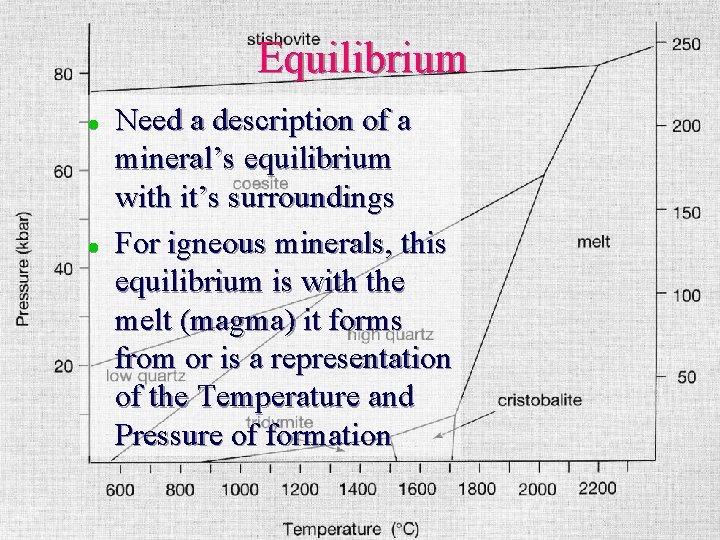
Equilibrium l l Need a description of a mineral’s equilibrium with it’s surroundings For igneous minerals, this equilibrium is with the melt (magma) it forms from or is a representation of the Temperature and Pressure of formation
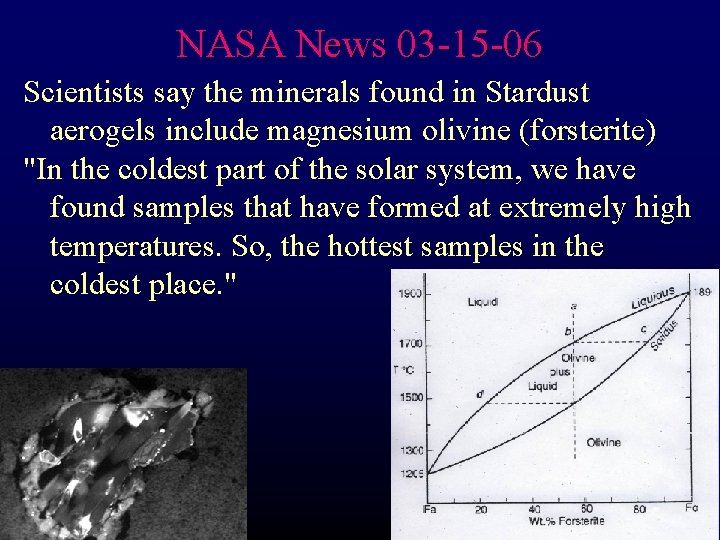
NASA News 03 -15 -06 Scientists say the minerals found in Stardust aerogels include magnesium olivine (forsterite) "In the coldest part of the solar system, we have found samples that have formed at extremely high temperatures. So, the hottest samples in the coldest place. "
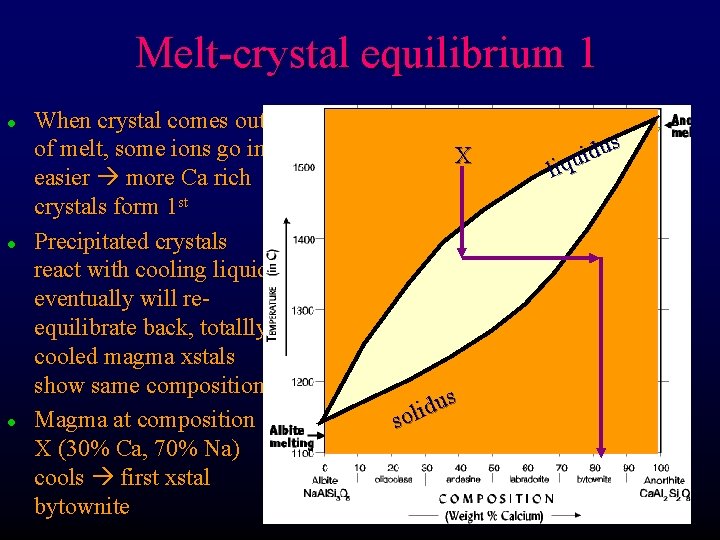
Melt-crystal equilibrium 1 l l l When crystal comes out of melt, some ions go in easier more Ca rich crystals form 1 st Precipitated crystals react with cooling liquid, eventually will reequilibrate back, totallly cooled magma xstals show same composition Magma at composition X (30% Ca, 70% Na) cools first xstal bytownite X s u d i sol us d i liqu
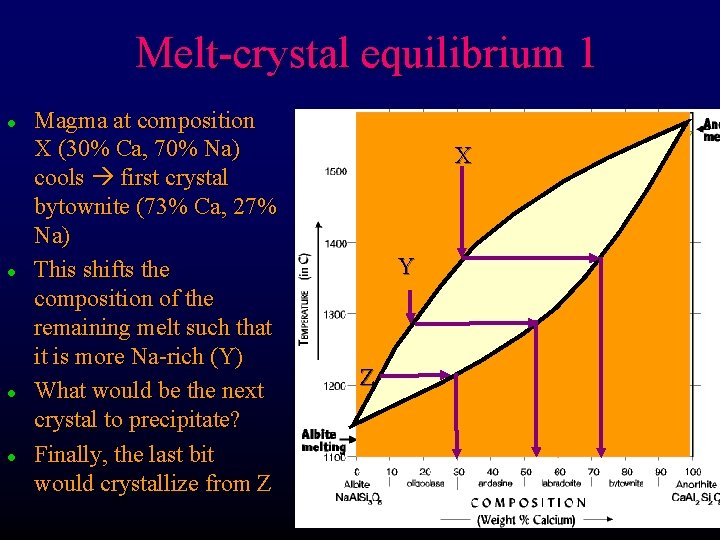
Melt-crystal equilibrium 1 l l Magma at composition X (30% Ca, 70% Na) cools first crystal bytownite (73% Ca, 27% Na) This shifts the composition of the remaining melt such that it is more Na-rich (Y) What would be the next crystal to precipitate? Finally, the last bit would crystallize from Z X Y Z
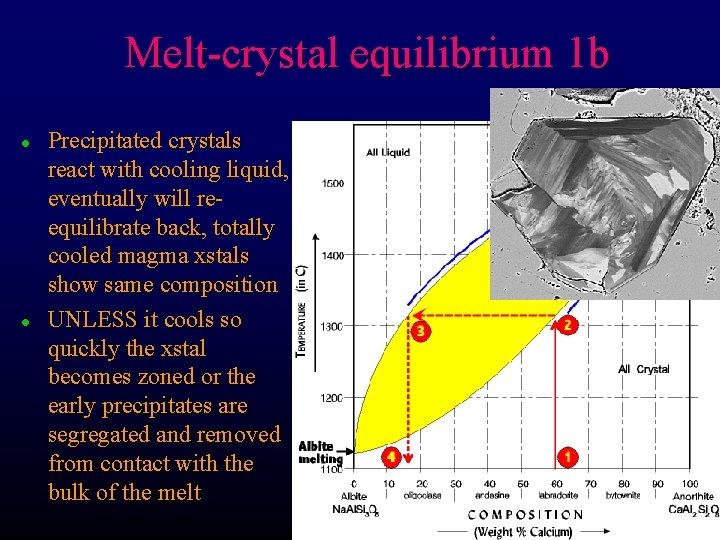
Melt-crystal equilibrium 1 b l l Precipitated crystals react with cooling liquid, eventually will reequilibrate back, totally cooled magma xstals show same composition UNLESS it cools so quickly the xstal becomes zoned or the early precipitates are segregated and removed from contact with the bulk of the melt
Why aren’t all feldspars zoned? l l l Kinetics, segregation IF there is sufficient time, the crystals will reequilibrate with the magma they are in – and reflect the total Na-Ca content of the magma IF not, then different minerals of different composition will be present in zoned plagioclase or segregated from each other physically
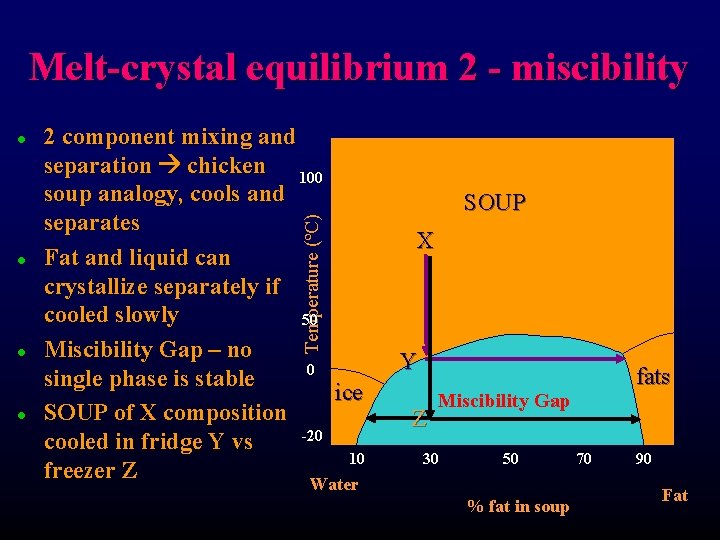
Melt-crystal equilibrium 2 - miscibility l l l 2 component mixing and separation chicken 100 soup analogy, cools and separates Fat and liquid can crystallize separately if cooled slowly 50 Miscibility Gap – no 0 single phase is stable ice SOUP of X composition -20 cooled in fridge Y vs 10 freezer Z Water Temperature (ºC) l SOUP X Y Z fats Miscibility Gap 30 50 % fat in soup 70 90 Fat
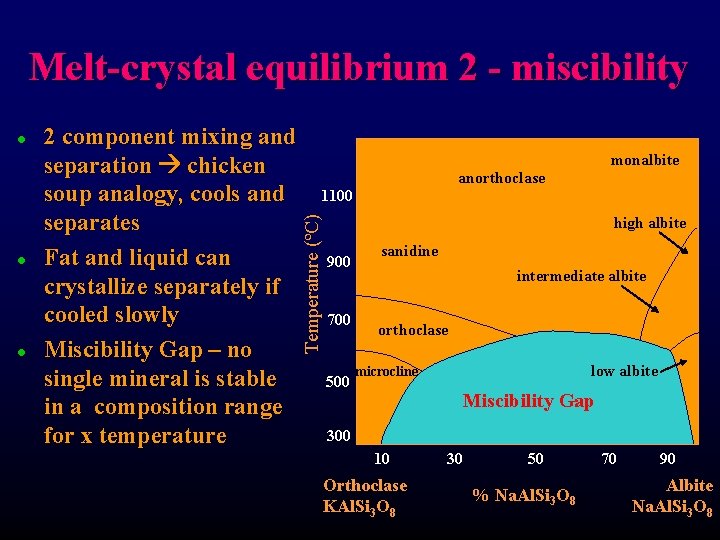
Melt-crystal equilibrium 2 - miscibility l l 2 component mixing and separation chicken soup analogy, cools and separates Fat and liquid can crystallize separately if cooled slowly Miscibility Gap – no single mineral is stable in a composition range for x temperature monalbite anorthoclase 1100 Temperature (ºC) l high albite 900 700 500 sanidine intermediate albite orthoclase low albite microcline Miscibility Gap 300 10 Orthoclase KAl. Si 3 O 8 30 50 % Na. Al. Si 3 O 8 70 90 Albite Na. Al. Si 3 O 8
- Slides: 19