
MAGLEV A DREAM TRAIN TECHNOLOGY Driving without wheels


![REFERENCES : [1] Dan’s Data. Rare Earth Magnets for Fun and Profit. October, 2009.](https://slidetodoc.com/presentation_image/55b81933f04df30307ca49710d4029fe/image-24.jpg "REFERENCES : [1] Dan’s Data. Rare Earth Magnets for Fun and Profit. October, 2009.")

- Slides: 25
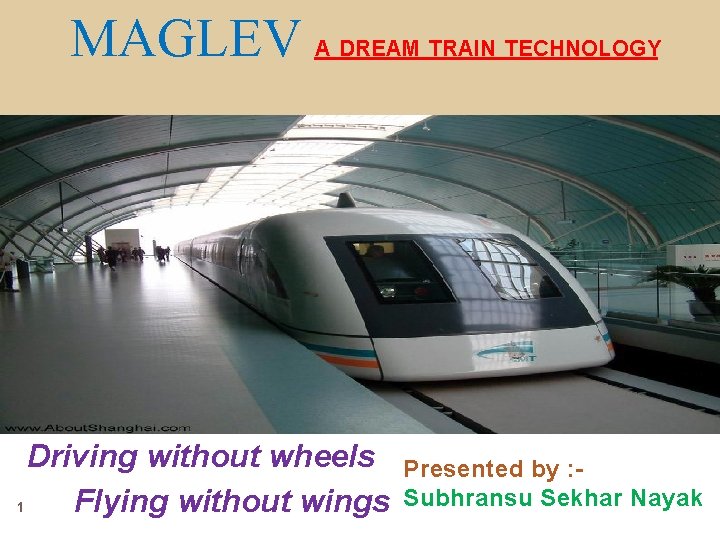
MAGLEV A DREAM TRAIN TECHNOLOGY Driving without wheels Flying without wings 1 Presented by : Subhransu Sekhar Nayak
PLAN OF PRESENTATION: • Introduction Levitation • Basic principle of magnetic trains Propulsion • Electromagnetic suspension • Electrodynamics suspension Lateral Guidance • Pros & Cons • Advantage of maglev transportation system • Current projects • Other Applications • Conclusion • References 2
3
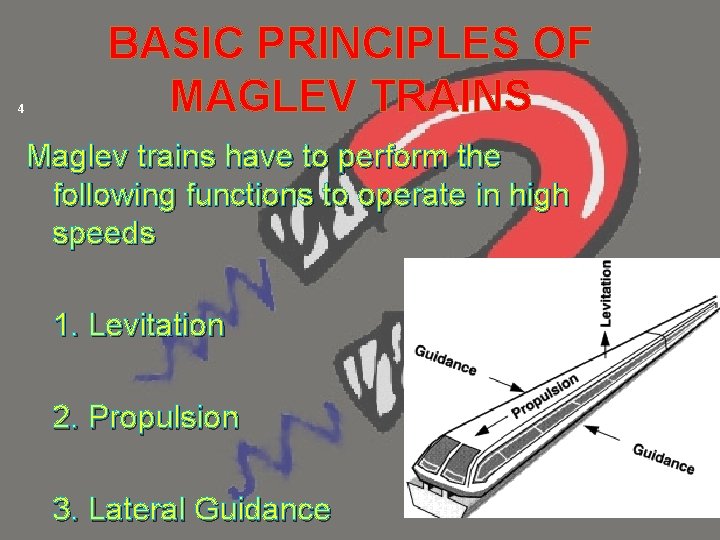
4 BASIC PRINCIPLES OF MAGLEV TRAINS Maglev trains have to perform the following functions to operate in high speeds 1. Levitation 2. Propulsion 3. Lateral Guidance
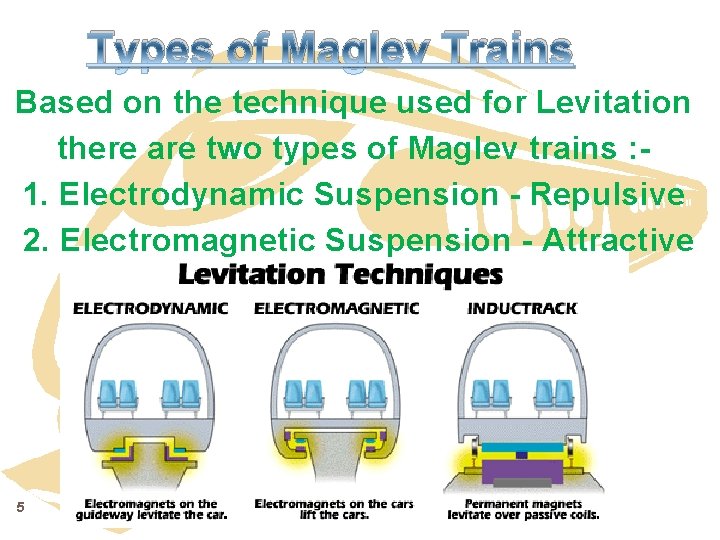
Types of Maglev Trains Based on the technique used for Levitation there are two types of Maglev trains : 1. Electrodynamic Suspension - Repulsive 2. Electromagnetic Suspension - Attractive 5
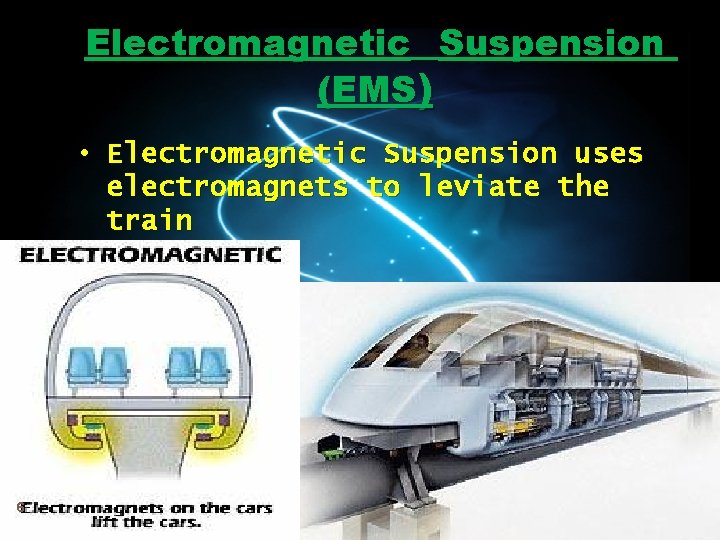
Electromagnetic Suspension (EMS) • Electromagnetic Suspension uses • electromagnets Electromagnetic Suspension uses to leviate the train electromagnets to leviate the train 6
Principle of Magnetic Levitation In the EMS-attractive system, the electromagnets which do 7 the work of levitation are attached on the top side of a casing When a current is passed through it, and the electromagnet switched on, there is attraction between electromagnets and due to attraction car levitates.
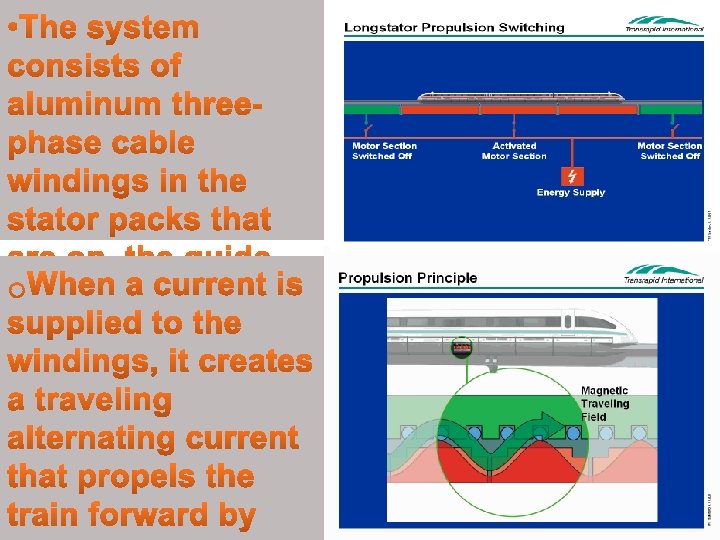
Principle of Propulsion v. The propulsion of the train is mainly based on two types of motors: Ø Linear Electric Motor (LEM) Ø and Linear Induction Motor (LIM) v A linear electric motor (LEM) is a machine which converts electrical energy directly into linear motion without employing any intervening rotary components. v. Linear Induction Motor (LIM) is basically a rotating squirrel cage induction motor which opened out flat to produce linear force. v Speeds vary from zero to many meters per second are 8 determined by design and supply frequency
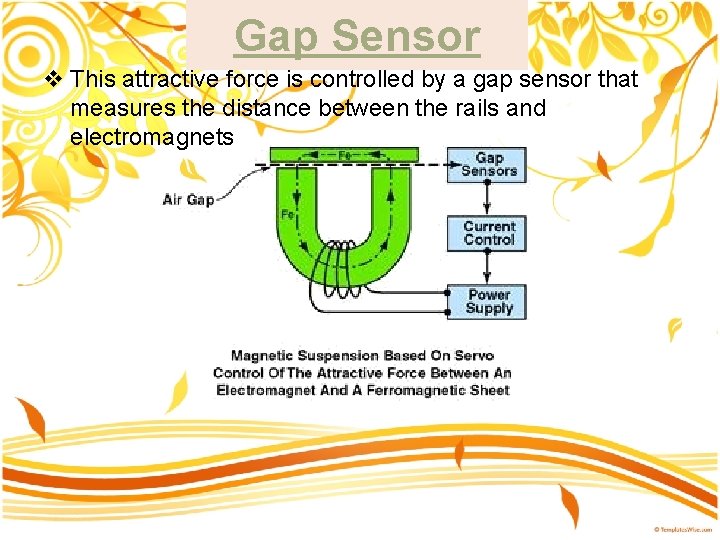
Gap Sensor 9 v This attractive force is controlled by a gap sensor that measures the distance between the rails and electromagnets
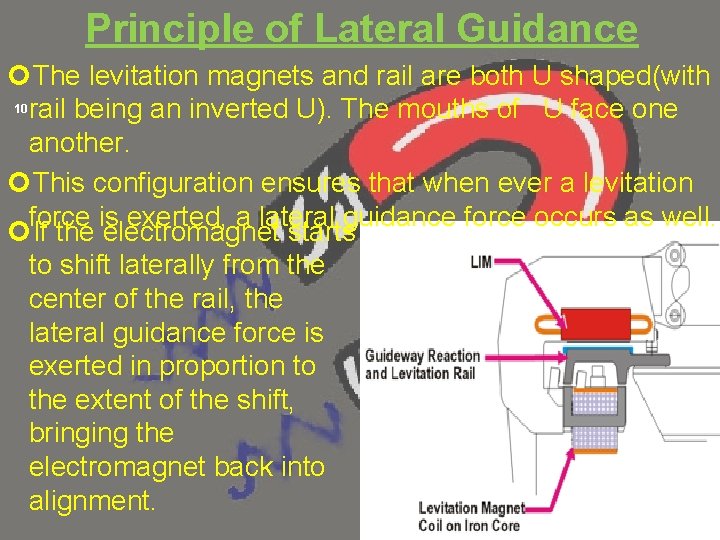
Principle of Lateral Guidance The levitation magnets and rail are both U shaped(with 10 rail being an inverted U). The mouths of U face one another. This configuration ensures that when ever a levitation force is exerted, a lateral guidance force occurs as well. If the electromagnet starts to shift laterally from the center of the rail, the lateral guidance force is exerted in proportion to the extent of the shift, bringing the electromagnet back into alignment.
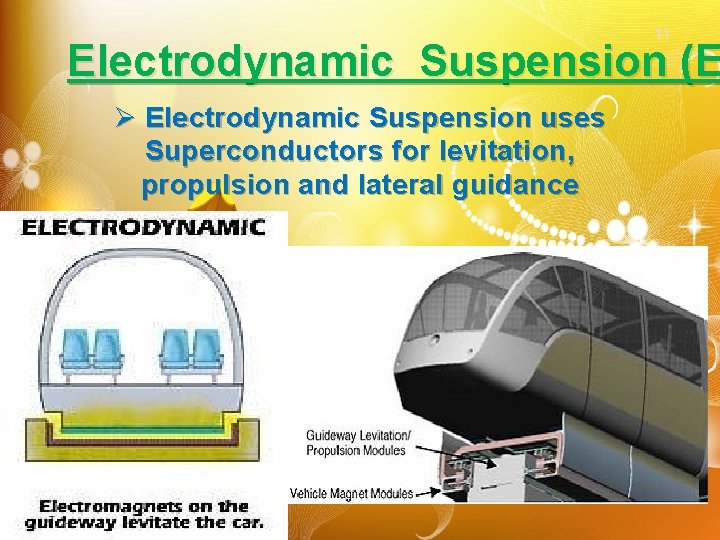
11 Electrodynamic Suspension (E Ø Electrodynamic Suspension uses Superconductors for levitation, propulsion and lateral guidance
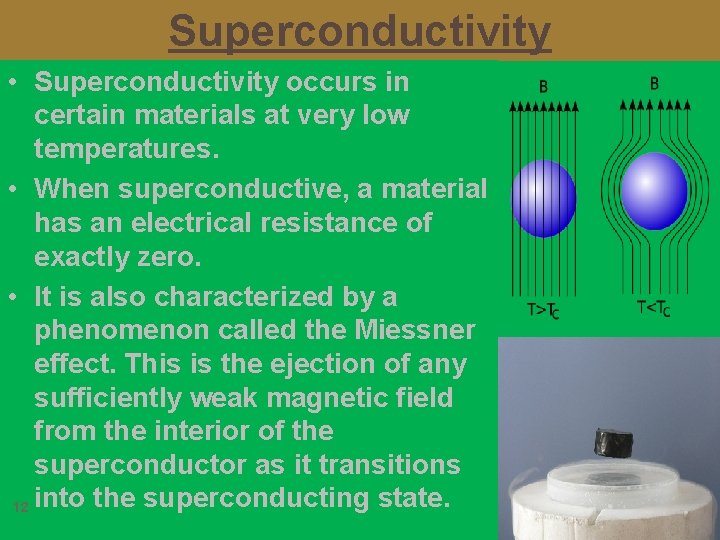
Superconductivity • Superconductivity occurs in certain materials at very low temperatures. • When superconductive, a material has an electrical resistance of exactly zero. • It is also characterized by a phenomenon called the Miessner effect. This is the ejection of any sufficiently weak magnetic field from the interior of the superconductor as it transitions 12 into the superconducting state.
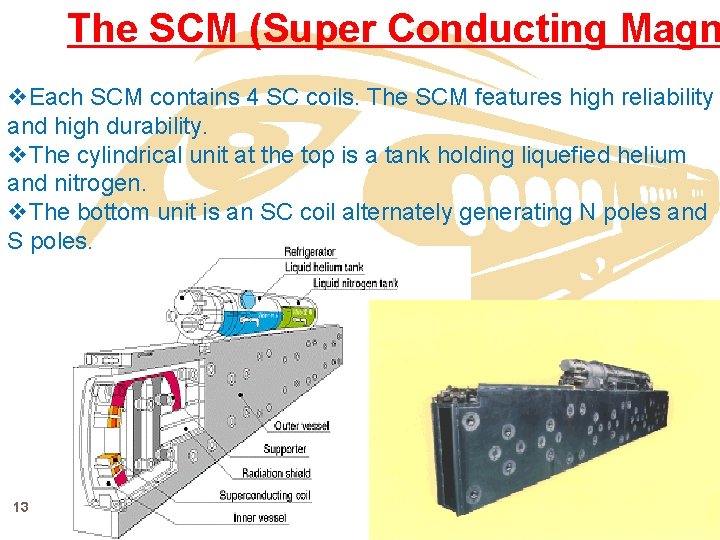
The SCM (Super Conducting Magn v. Each SCM contains 4 SC coils. The SCM features high reliability and high durability. v. The cylindrical unit at the top is a tank holding liquefied helium and nitrogen. v. The bottom unit is an SC coil alternately generating N poles and S poles. 13
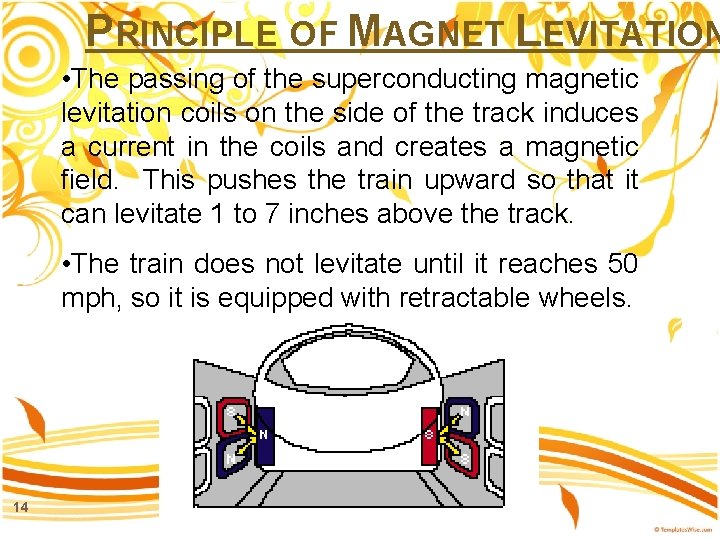
PRINCIPLE OF MAGNET LEVITATION • The passing of the superconducting magnetic levitation coils on the side of the track induces a current in the coils and creates a magnetic field. This pushes the train upward so that it can levitate 1 to 7 inches above the track. • The train does not levitate until it reaches 50 mph, so it is equipped with retractable wheels. 14
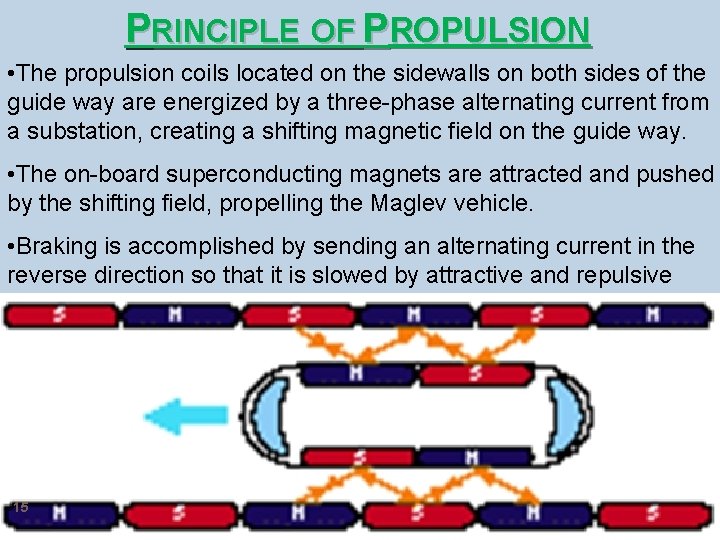
PRINCIPLE OF PROPULSION • The propulsion coils located on the sidewalls on both sides of the guide way are energized by a three-phase alternating current from a substation, creating a shifting magnetic field on the guide way. • The on-board superconducting magnets are attracted and pushed by the shifting field, propelling the Maglev vehicle. • Braking is accomplished by sending an alternating current in the reverse direction so that it is slowed by attractive and repulsive forces. 15
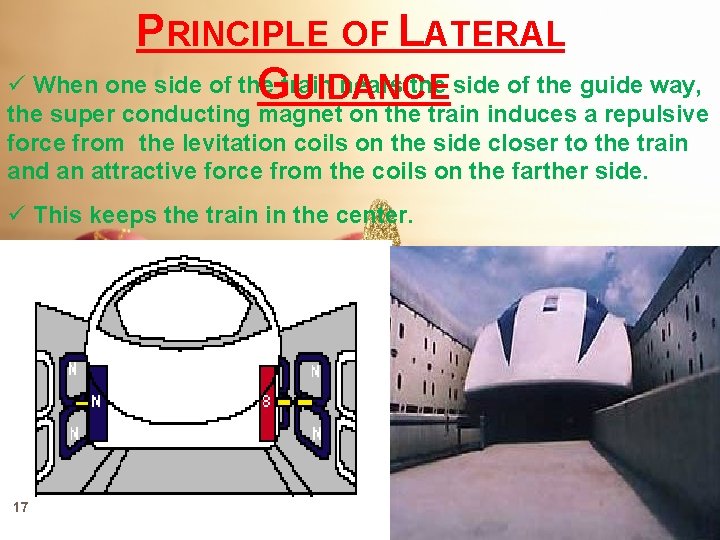
PRINCIPLE OF LATERAL ü When one side of the nears the side of the guide way, Gtrain UIDANCE the super conducting magnet on the train induces a repulsive force from the levitation coils on the side closer to the train and an attractive force from the coils on the farther side. ü This keeps the train in the center. 17
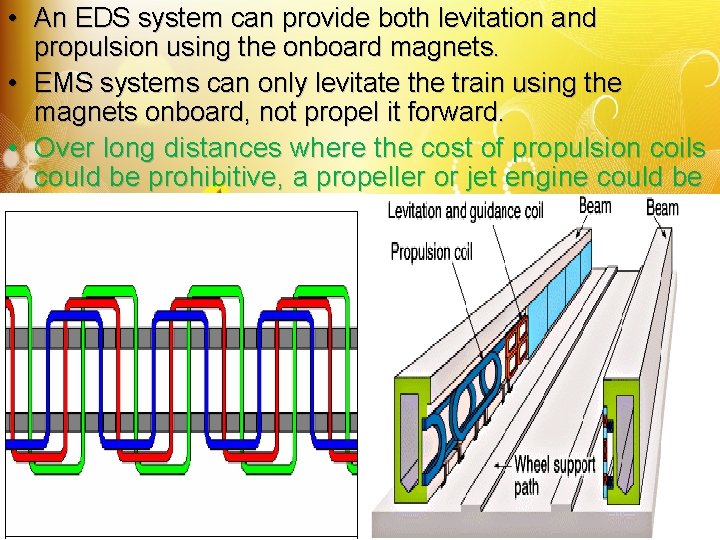
• An EDS system can provide both levitation and propulsion using the onboard magnets. • EMS systems can only levitate the train using the magnets onboard, not propel it forward. • Over long distances where the cost of propulsion coils could be prohibitive, a propeller or jet engine could be used. 18
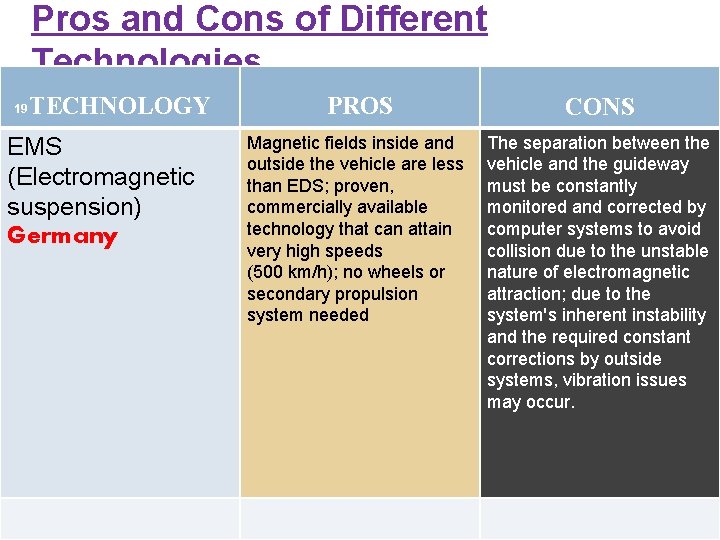
Pros and Cons of Different Technologies 19 TECHNOLOGY EMS (Electromagnetic suspension) Germany PROS CONS Magnetic fields inside and outside the vehicle are less than EDS; proven, commercially available technology that can attain very high speeds (500 km/h); no wheels or secondary propulsion system needed The separation between the vehicle and the guideway must be constantly monitored and corrected by computer systems to avoid collision due to the unstable nature of electromagnetic attraction; due to the system's inherent instability and the required constant corrections by outside systems, vibration issues may occur.
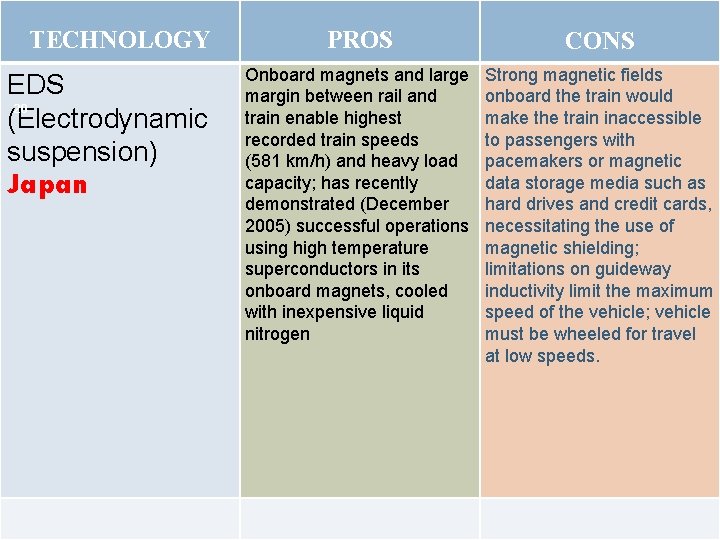
TECHNOLOGY EDS 20 (Electrodynamic suspension) Japan PROS CONS Onboard magnets and large margin between rail and train enable highest recorded train speeds (581 km/h) and heavy load capacity; has recently demonstrated (December 2005) successful operations using high temperature superconductors in its onboard magnets, cooled with inexpensive liquid nitrogen Strong magnetic fields onboard the train would make the train inaccessible to passengers with pacemakers or magnetic data storage media such as hard drives and credit cards, necessitating the use of magnetic shielding; limitations on guideway inductivity limit the maximum speed of the vehicle; vehicle must be wheeled for travel at low speeds.
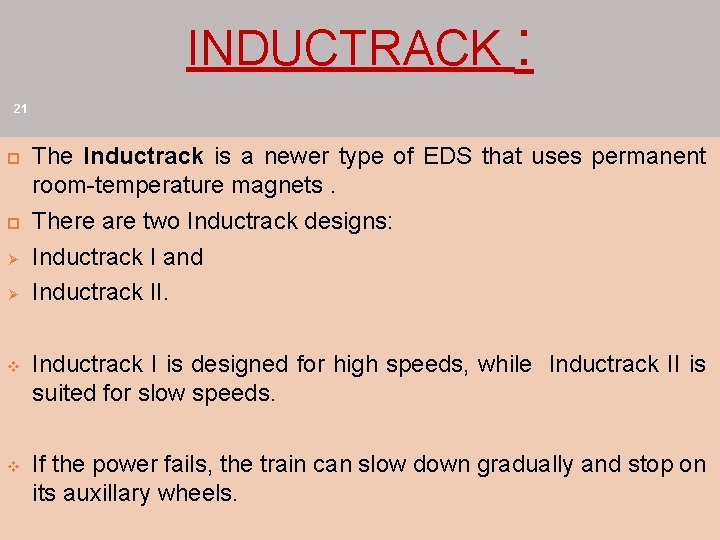
INDUCTRACK : 21 Ø Ø v v The Inductrack is a newer type of EDS that uses permanent room-temperature magnets. There are two Inductrack designs: Inductrack I and Inductrack II. Inductrack I is designed for high speeds, while Inductrack II is suited for slow speeds. If the power fails, the train can slow down gradually and stop on its auxillary wheels.
Advantages of Magnetic Levitated Transportation System § Maglev uses 30% less energy than a high-speed train traveling at the same speed (1/3 more power for the same amount of energy). § The operating costs of a maglev system are approximately half that of conventional long-distance railroads. § Research has shown that the maglev is about 20 times safer than airplanes, 250 times safer than conventional railroads, and 700 times safer than automobile travel. § Maglev vehicle carries no fuel to increase fire hazard § The materials used to construct maglev vehicles are non 22 combustible, poor penetration transmitters of heat, and able to withstand fire.
Other Applications
REFERENCES : [1] Dan’s Data. Rare Earth Magnets for Fun and Profit. October, 2009. http: //www. dansdata. com/magnets. htm [2] Force Analysis of Linear Induction Motor for Magnetic Levitation System 14 th International Power Electronics and Motion Control Conference, EPE-PEMC 2010 [3] Engineering Concepts. Explanation of Magnet Ratings. November, 2008. http: //www. engconcepts. net/Magnet_Ratings. htm [4] super conduting train ppt-110408112238 phpapp 01 http: //maglevinfo /Maglev. Train 1 Final. Report. pdf [5] http: //maglevinfotosharecntdfrommyblogarticlefromtheweb 120310231742 -phpapp 01/maglev/FUNCT%20 DISC. pdf [6] Friend, Paul. Project Proposal. December, 2011. http: //cegt 201. bradley. edu/projects/proj 2004/maglevt 1/dproposal. pdf [7] Friend, Paul. System Block Diagram. December, 2011. http: //cegt 201. bradley. edu/projects/proj 2004/maglevt 1/Block%20 Diagra 24 m
25