
Magic e Rule 1 A silent e at
- Slides: 34
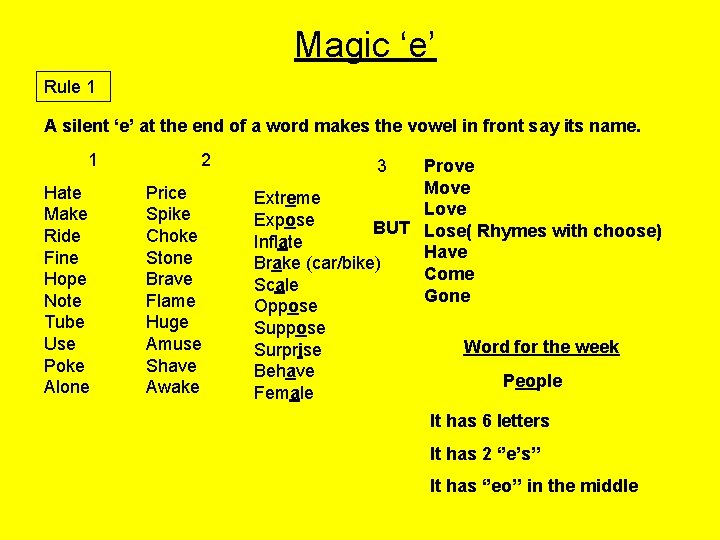
Magic ‘e’ Rule 1 A silent ‘e’ at the end of a word makes the vowel in front say its name. 1 Hate Make Ride Fine Hope Note Tube Use Poke Alone 2 Price Spike Choke Stone Brave Flame Huge Amuse Shave Awake 3 Prove Move Extreme Love Expose BUT Lose( Rhymes with choose) Inflate Have Brake (car/bike) Come Scale Gone Oppose Suppose Word for the week Surprise Behave People Female It has 6 letters It has 2 ‘’e’s’’ It has ‘’eo’’ in the middle
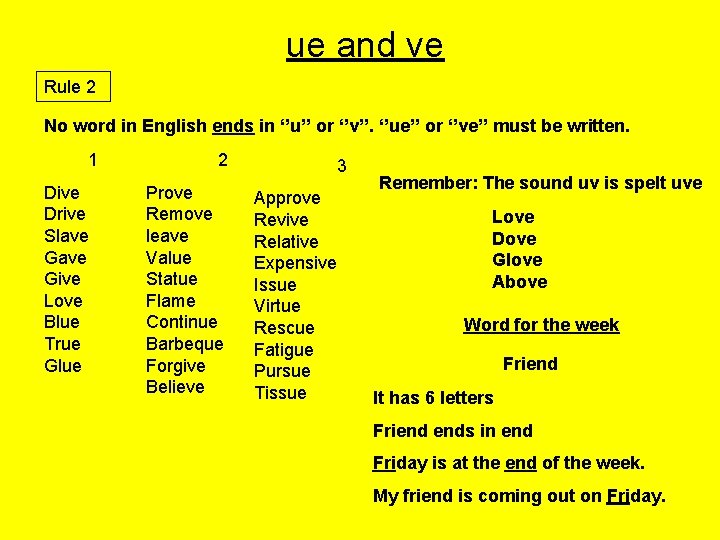
ue and ve Rule 2 No word in English ends in ‘’u’’ or ‘’v’’. ‘’ue’’ or ‘’ve’’ must be written. 1 Dive Drive Slave Give Love Blue True Glue 2 Prove Remove leave Value Statue Flame Continue Barbeque Forgive Believe 3 Approve Revive Relative Expensive Issue Virtue Rescue Fatigue Pursue Tissue Remember: The sound uv is spelt uve Love Dove Glove Above Word for the week Friend It has 6 letters Friend ends in end Friday is at the end of the week. My friend is coming out on Friday.
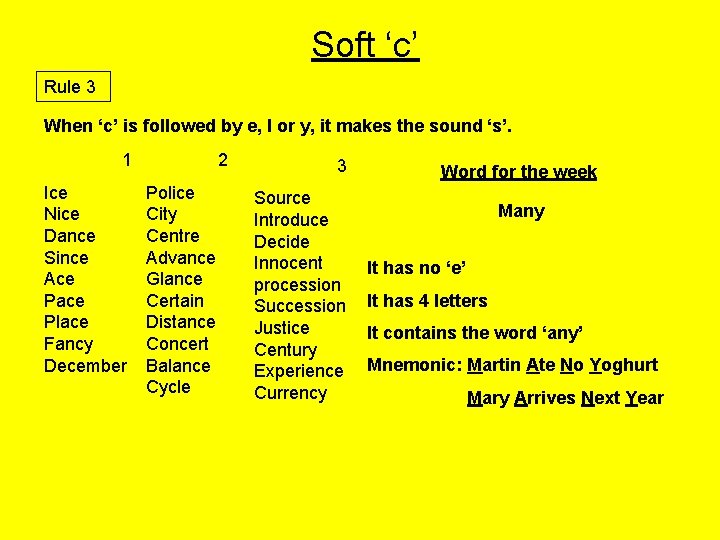
Soft ‘c’ Rule 3 When ‘c’ is followed by e, I or y, it makes the sound ‘s’. 1 Ice Nice Dance Since Ace Pace Place Fancy December 2 Police City Centre Advance Glance Certain Distance Concert Balance Cycle 3 Source Introduce Decide Innocent procession Succession Justice Century Experience Currency Word for the week Many It has no ‘e’ It has 4 letters It contains the word ‘any’ Mnemonic: Martin Ate No Yoghurt Mary Arrives Next Year
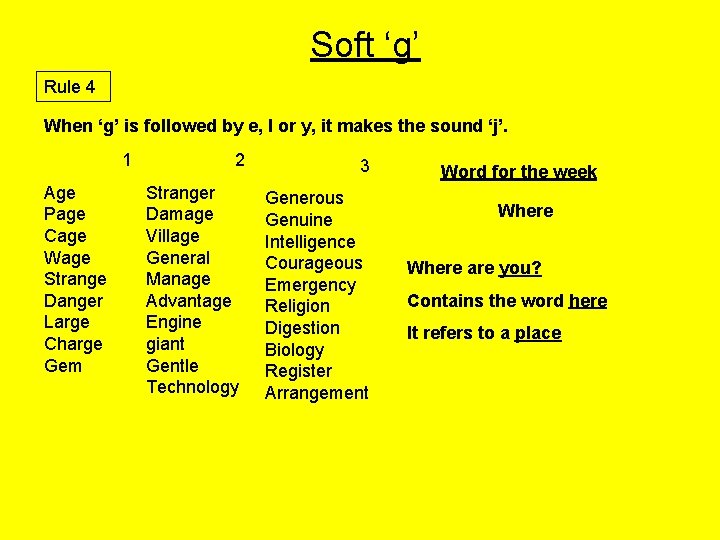
Soft ‘g’ Rule 4 When ‘g’ is followed by e, I or y, it makes the sound ‘j’. 1 Age Page Cage Wage Strange Danger Large Charge Gem 2 Stranger Damage Village General Manage Advantage Engine giant Gentle Technology 3 Generous Genuine Intelligence Courageous Emergency Religion Digestion Biology Register Arrangement Word for the week Where are you? Contains the word here It refers to a place
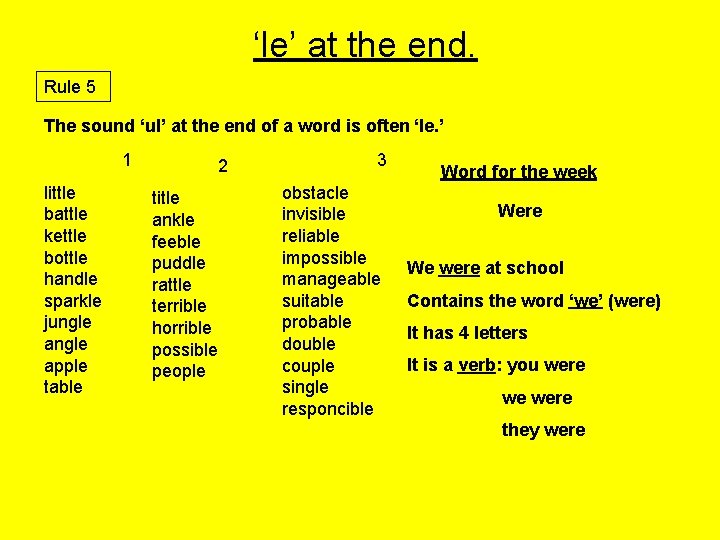
‘le’ at the end. Rule 5 The sound ‘ul’ at the end of a word is often ‘le. ’ 1 little battle kettle bottle handle sparkle jungle apple table 2 title ankle feeble puddle rattle terrible horrible possible people 3 obstacle invisible reliable impossible manageable suitable probable double couple single responcible Word for the week Were We were at school Contains the word ‘we’ (were) It has 4 letters It is a verb: you were we were they were
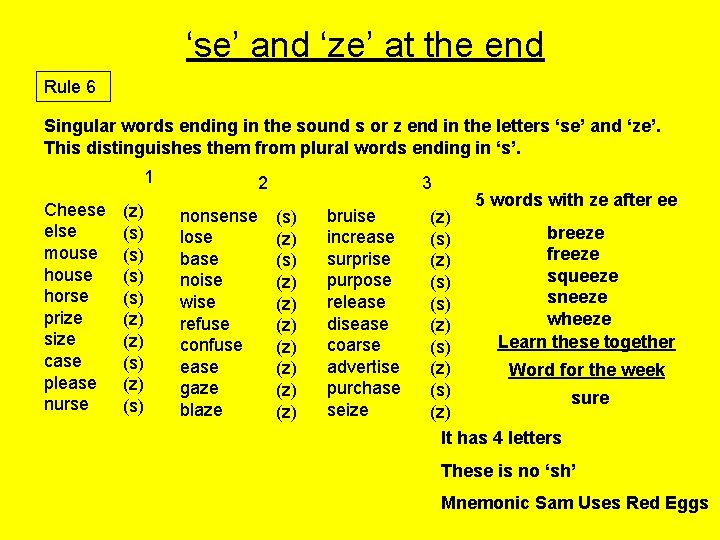
‘se’ and ‘ze’ at the end Rule 6 Singular words ending in the sound s or z end in the letters ‘se’ and ‘ze’. This distinguishes them from plural words ending in ‘s’. 1 Cheese else mouse horse prize size case please nurse (z) (s) (s) (z) (s) 2 nonsense lose base noise wise refuse confuse ease gaze blaze 3 (s) (z) (z) bruise increase surprise purpose release disease coarse advertise purchase seize 5 words with ze after ee (z) breeze (s) freeze (z) squeeze (s) sneeze (s) wheeze (z) Learn these together (s) (z) Word for the week (s) sure (z) It has 4 letters These is no ‘sh’ Mnemonic Sam Uses Red Eggs
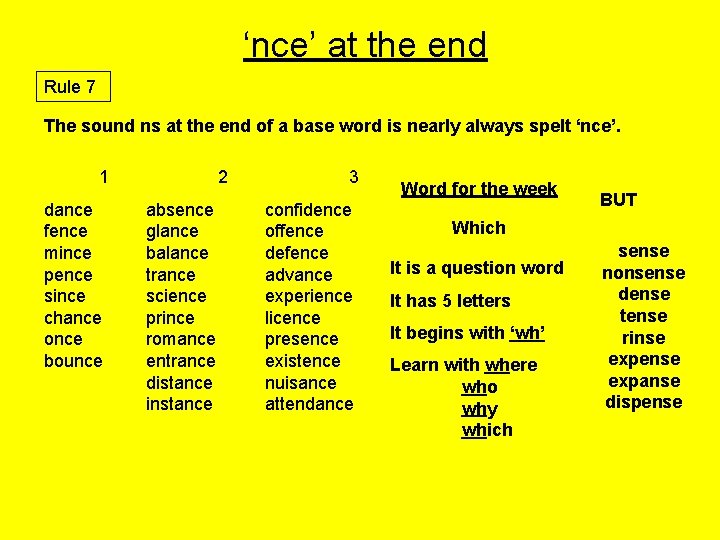
‘nce’ at the end Rule 7 The sound ns at the end of a base word is nearly always spelt ‘nce’. 1 dance fence mince pence since chance once bounce 2 absence glance balance trance science prince romance entrance distance instance 3 confidence offence defence advance experience licence presence existence nuisance attendance Word for the week BUT Which It is a question word It has 5 letters It begins with ‘wh’ Learn with where who why which sense nonsense dense tense rinse expense expanse dispense
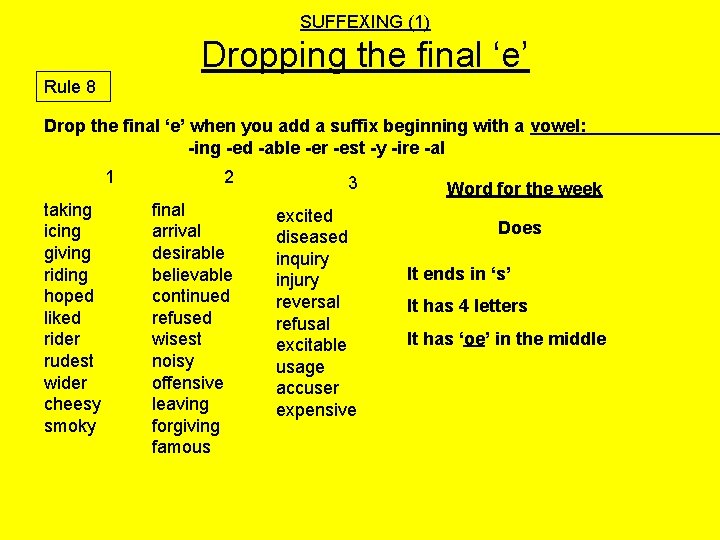
SUFFEXING (1) Dropping the final ‘e’ Rule 8 Drop the final ‘e’ when you add a suffix beginning with a vowel: -ing -ed -able -er -est -y -ire -al 1 taking icing giving riding hoped liked rider rudest wider cheesy smoky 2 3 final arrival desirable believable continued refused wisest noisy offensive leaving forgiving famous excited diseased inquiry injury reversal refusal excitable usage accuser expensive Word for the week Does It ends in ‘s’ It has 4 letters It has ‘oe’ in the middle
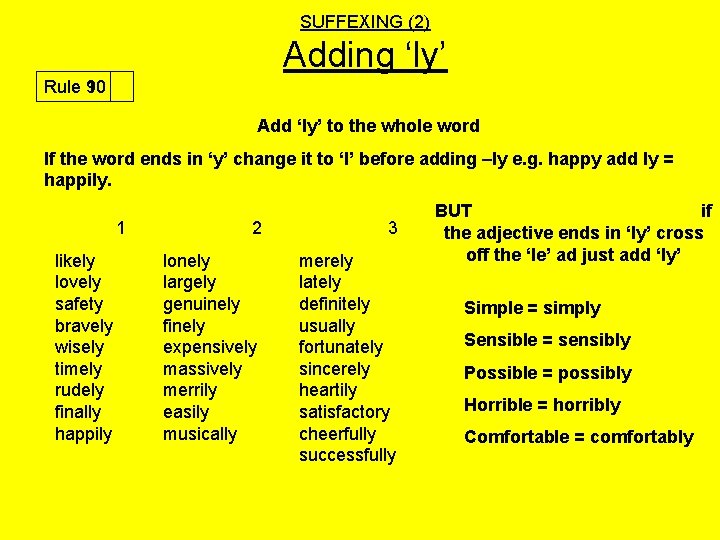
SUFFEXING (2) Adding ‘ly’ Rule 10 9 Add ‘ly’ to the whole word If the word ends in ‘y’ change it to ‘I’ before adding –ly e. g. happy add ly = happily. 1 likely lovely safety bravely wisely timely rudely finally happily 2 3 lonely largely genuinely finely expensively massively merrily easily musically merely lately definitely usually fortunately sincerely heartily satisfactory cheerfully successfully BUT if the adjective ends in ‘ly’ cross off the ‘le’ ad just add ‘ly’ Simple = simply Sensible = sensibly Possible = possibly Horrible = horribly Comfortable = comfortably
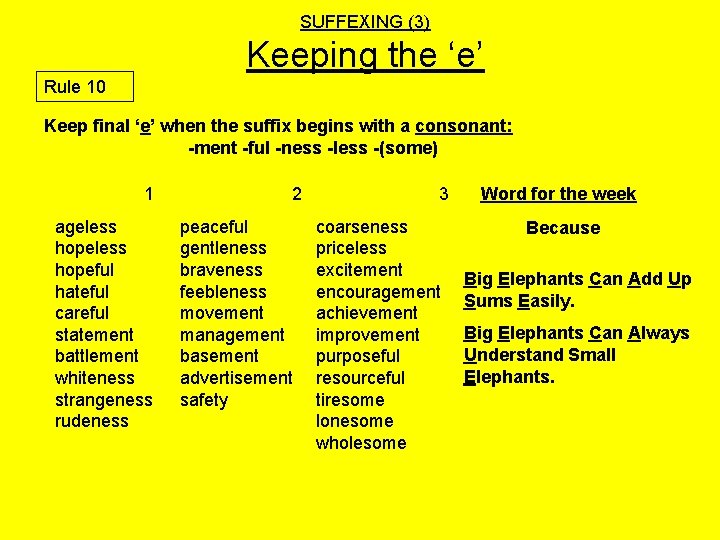
SUFFEXING (3) Keeping the ‘e’ Rule 10 Keep final ‘e’ when the suffix begins with a consonant: -ment -ful -ness -less -(some) 1 ageless hopeful hateful careful statement battlement whiteness strangeness rudeness 2 peaceful gentleness braveness feebleness movement management basement advertisement safety 3 coarseness priceless excitement encouragement achievement improvement purposeful resourceful tiresome lonesome wholesome Word for the week Because Big Elephants Can Add Up Sums Easily. Big Elephants Can Always Understand Small Elephants.
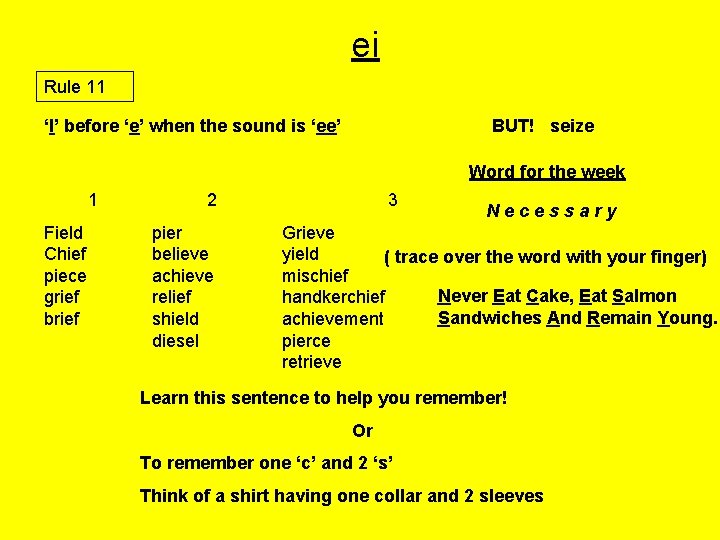
ei Rule 11 ‘I’ before ‘e’ when the sound is ‘ee’ BUT! seize Word for the week 1 Field Chief piece grief brief 2 pier believe achieve relief shield diesel 3 Necessary Grieve yield ( trace over the word with your finger) mischief Never Eat Cake, Eat Salmon handkerchief Sandwiches And Remain Young. achievement pierce retrieve Learn this sentence to help you remember! Or To remember one ‘c’ and 2 ‘s’ Think of a shirt having one collar and 2 sleeves
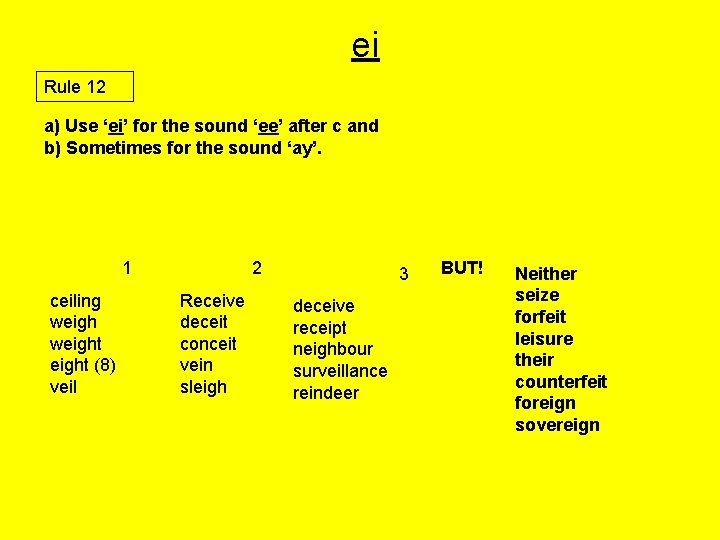
ei Rule 12 a) Use ‘ei’ for the sound ‘ee’ after c and b) Sometimes for the sound ‘ay’. 1 ceiling weight (8) veil 2 Receive deceit conceit vein sleigh 3 deceive receipt neighbour surveillance reindeer BUT! Neither seize forfeit leisure their counterfeit foreign sovereign
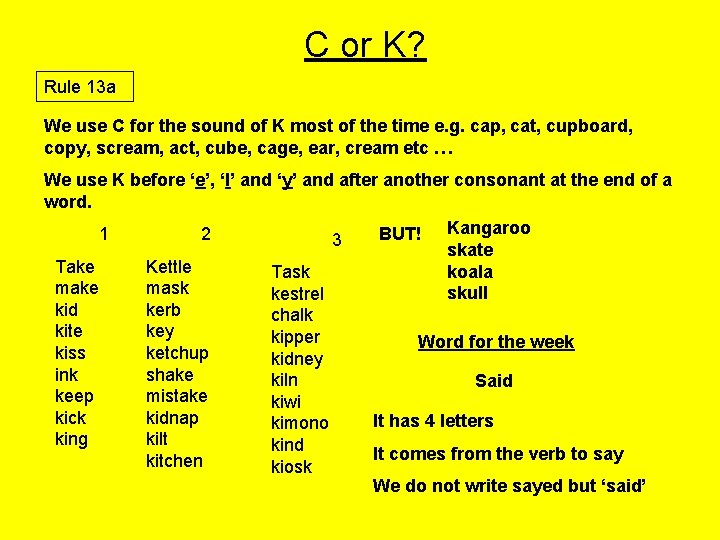
C or K? Rule 13 a We use C for the sound of K most of the time e. g. cap, cat, cupboard, copy, scream, act, cube, cage, ear, cream etc … We use K before ‘e’, ‘I’ and ‘y’ and after another consonant at the end of a word. 1 2 BUT! Kangaroo 3 skate Take Kettle koala Task make mask skull kestrel kid kerb chalk kite key kipper Word for the week kiss ketchup kidney ink shake kiln Said keep mistake kiwi kick kidnap It has 4 letters kimono king kilt kind It comes from the verb to say kitchen kiosk We do not write sayed but ‘said’
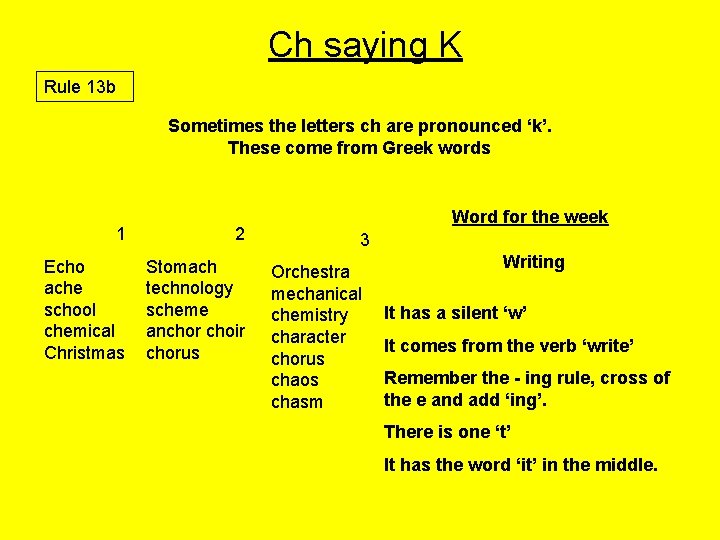
Ch saying K Rule 13 b Sometimes the letters ch are pronounced ‘k’. These come from Greek words 1 2 Echo ache school chemical Christmas Stomach technology scheme anchor choir chorus Word for the week 3 Orchestra mechanical chemistry character chorus chaos chasm Writing It has a silent ‘w’ It comes from the verb ‘write’ Remember the - ing rule, cross of the e and add ‘ing’. There is one ‘t’ It has the word ‘it’ in the middle.
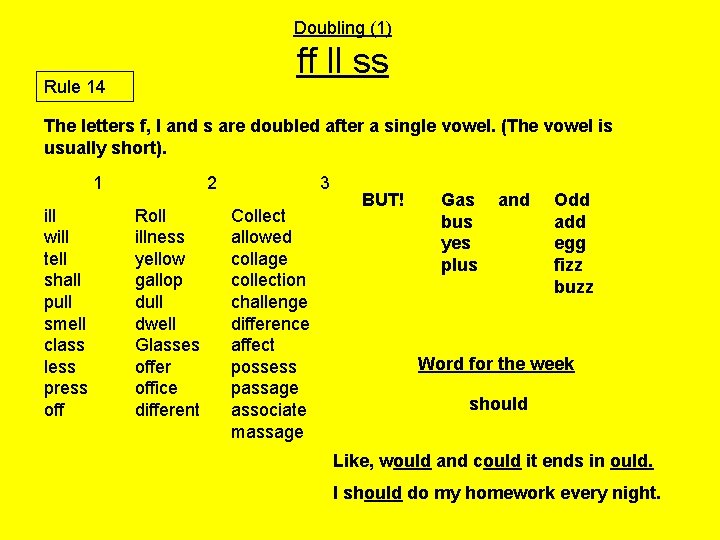
Doubling (1) ff ll ss Rule 14 The letters f, l and s are doubled after a single vowel. (The vowel is usually short). 1 ill will tell shall pull smell class less press off 2 Roll illness yellow gallop dull dwell Glasses offer office different 3 Collect allowed collage collection challenge difference affect possess passage associate massage BUT! Gas bus yes plus and Odd add egg fizz buzz Word for the week should Like, would and could it ends in ould. I should do my homework every night.
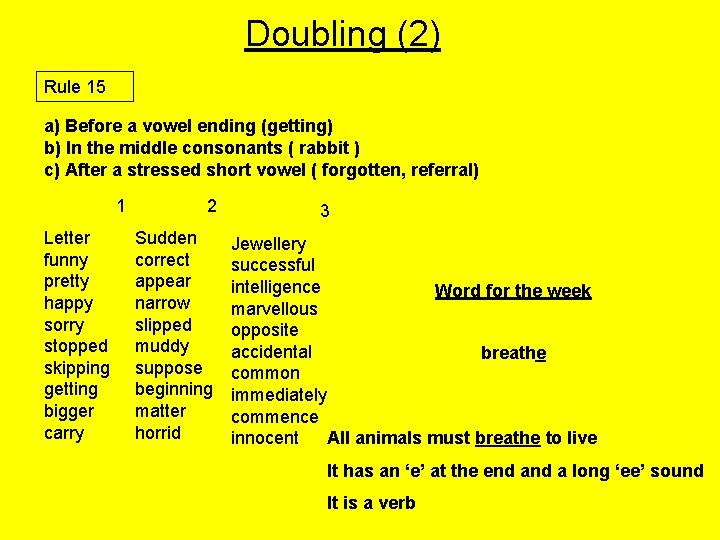
Doubling (2) Rule 15 a) Before a vowel ending (getting) b) In the middle consonants ( rabbit ) c) After a stressed short vowel ( forgotten, referral) 1 Letter funny pretty happy sorry stopped skipping getting bigger carry 2 Sudden correct appear narrow slipped muddy suppose beginning matter horrid 3 Jewellery successful intelligence Word for the week marvellous opposite accidental breathe common immediately commence innocent All animals must breathe to live It has an ‘e’ at the end a long ‘ee’ sound It is a verb
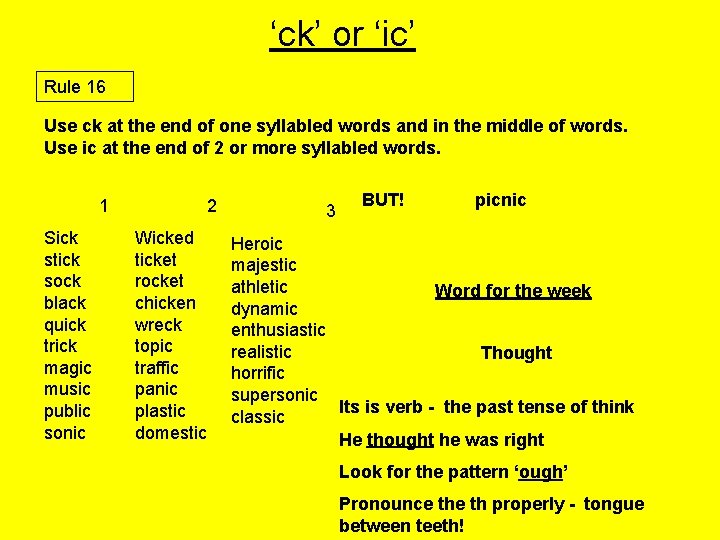
‘ck’ or ‘ic’ Rule 16 Use ck at the end of one syllabled words and in the middle of words. Use ic at the end of 2 or more syllabled words. 1 Sick stick sock black quick trick magic music public sonic 2 Wicked ticket rocket chicken wreck topic traffic panic plastic domestic 3 BUT! picnic Heroic majestic athletic Word for the week dynamic enthusiastic realistic Thought horrific supersonic Its is verb - the past tense of think classic He thought he was right Look for the pattern ‘ough’ Pronounce th properly - tongue between teeth!
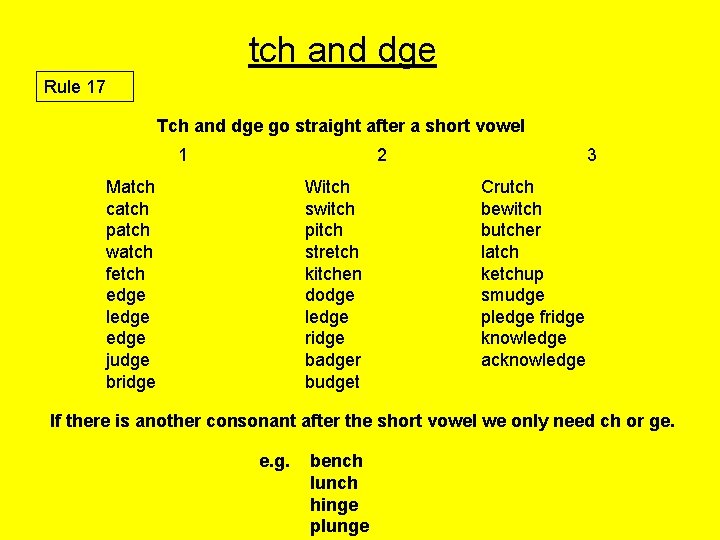
tch and dge Rule 17 Tch and dge go straight after a short vowel 1 2 Match catch patch watch fetch edge ledge judge bridge Witch switch pitch stretch kitchen dodge ledge ridge badger budget 3 Crutch bewitch butcher latch ketchup smudge pledge fridge knowledge acknowledge If there is another consonant after the short vowel we only need ch or ge. e. g. bench lunch hinge plunge
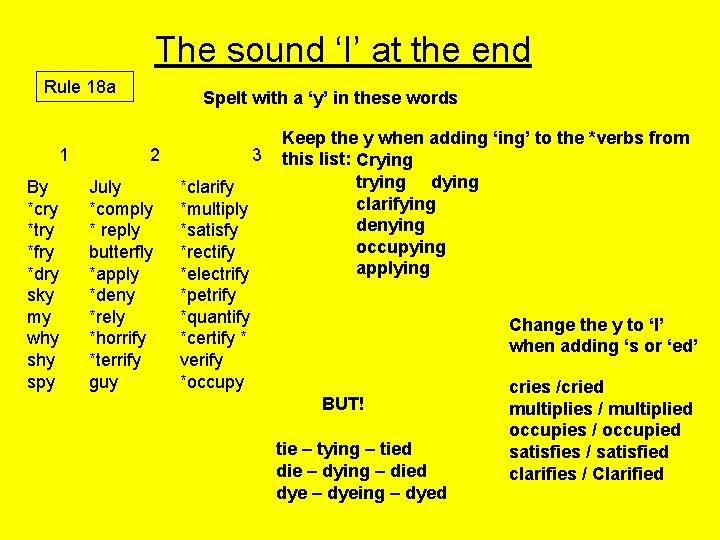
The sound ‘I’ at the end Rule 18 a 1 By *cry *try *fry *dry sky my why spy Spelt with a ‘y’ in these words 2 July *comply * reply butterfly *apply *deny *rely *horrify *terrify guy 3 *clarify *multiply *satisfy *rectify *electrify *petrify *quantify *certify * verify *occupy Keep the y when adding ‘ing’ to the *verbs from this list: Crying trying dying clarifying denying occupying applying Change the y to ‘I’ when adding ‘s or ‘ed’ BUT! tie – tying – tied die – dying – died dye – dyeing – dyed cries /cried multiplies / multiplied occupies / occupied satisfies / satisfied clarifies / Clarified
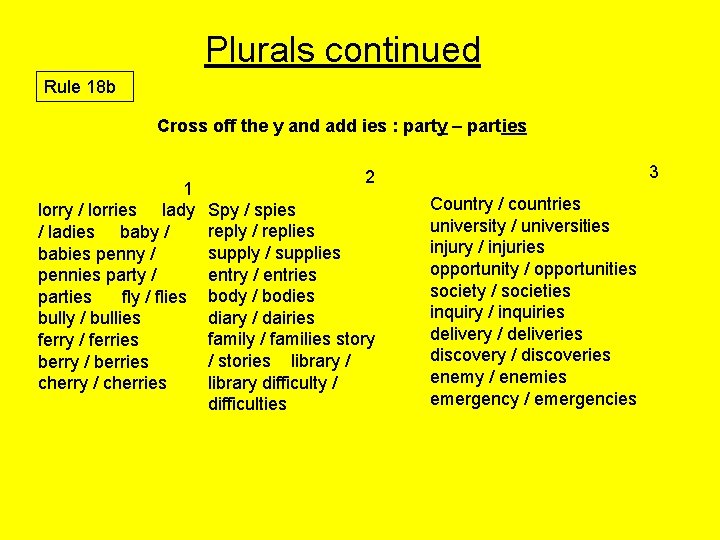
Plurals continued Rule 18 b Cross off the y and add ies : party – parties 1 lorry / lorries lady / ladies baby / babies penny / pennies party / parties fly / flies bully / bullies ferry / ferries berry / berries cherry / cherries 3 2 Spy / spies reply / replies supply / supplies entry / entries body / bodies diary / dairies family / families story / stories library / library difficulty / difficulties Country / countries university / universities injury / injuries opportunity / opportunities society / societies inquiry / inquiries delivery / deliveries discovery / discoveries enemy / enemies emergency / emergencies
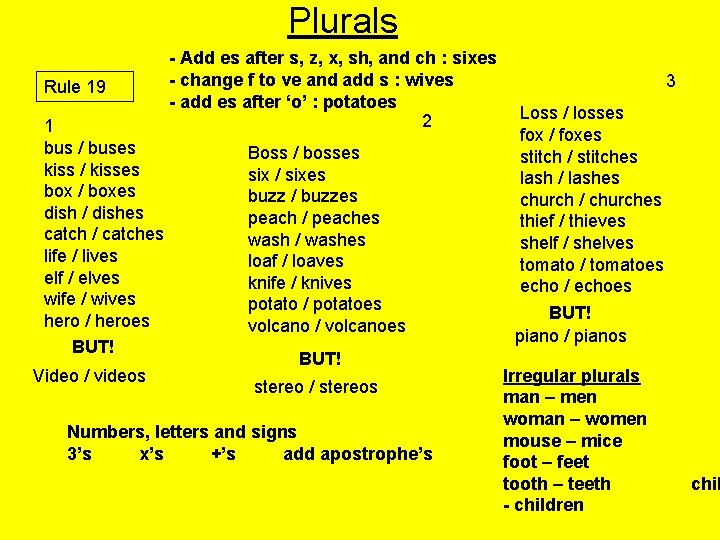
Plurals Rule 19 1 bus / buses kiss / kisses box / boxes dish / dishes catch / catches life / lives elf / elves wife / wives hero / heroes BUT! Video / videos - Add es after s, z, x, sh, and ch : sixes - change f to ve and add s : wives - add es after ‘o’ : potatoes 2 Boss / bosses six / sixes buzz / buzzes peach / peaches wash / washes loaf / loaves knife / knives potato / potatoes volcano / volcanoes BUT! stereo / stereos Numbers, letters and signs 3’s x’s +’s add apostrophe’s 3 Loss / losses fox / foxes stitch / stitches lash / lashes church / churches thief / thieves shelf / shelves tomato / tomatoes echo / echoes BUT! piano / pianos Irregular plurals man – men woman – women mouse – mice foot – feet tooth – teeth - children chil
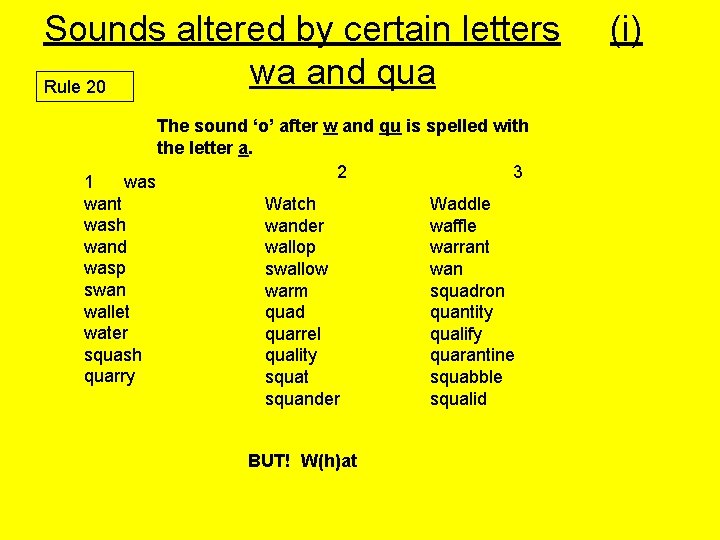
Sounds altered by certain letters wa and qua Rule 20 1 was want wash wand wasp swan wallet water squash quarry The sound ‘o’ after w and qu is spelled with the letter a. 2 3 Watch wander wallop swallow warm quad quarrel quality squat squander BUT! W(h)at Waddle waffle warrant wan squadron quantity qualify quarantine squabble squalid (i)
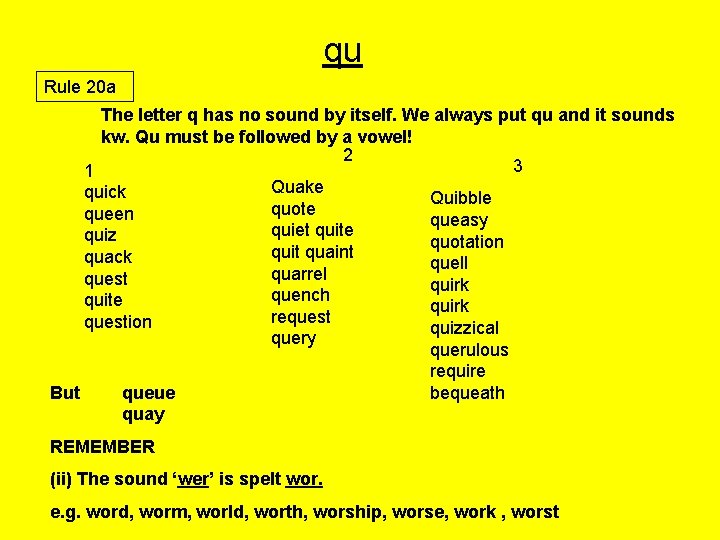
qu Rule 20 a The letter q has no sound by itself. We always put qu and it sounds kw. Qu must be followed by a vowel! 2 3 1 Quake quick Quibble quote queen queasy quiet quite quiz quotation quit quaint quack quell quarrel quest quirk quench quite quirk requestion quizzical query querulous require bequeath But queue quay REMEMBER (ii) The sound ‘wer’ is spelt wor. e. g. word, worm, world, worth, worship, worse, work , worst
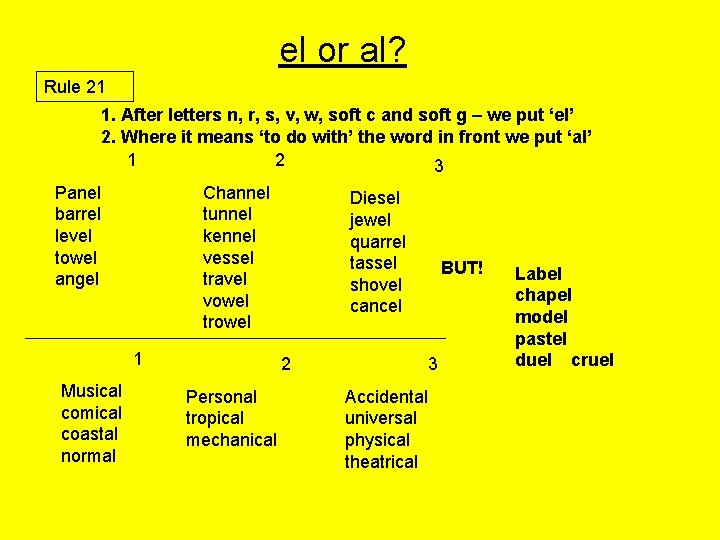
el or al? Rule 21 1. After letters n, r, s, v, w, soft c and soft g – we put ‘el’ 2. Where it means ‘to do with’ the word in front we put ‘al’ 1 2 3 Panel barrel level towel angel Channel tunnel kennel vessel travel vowel trowel 1 Musical comical coastal normal Diesel jewel quarrel tassel shovel cancel 2 Personal tropical mechanical BUT! 3 Accidental universal physical theatrical Label chapel model pastel duel cruel
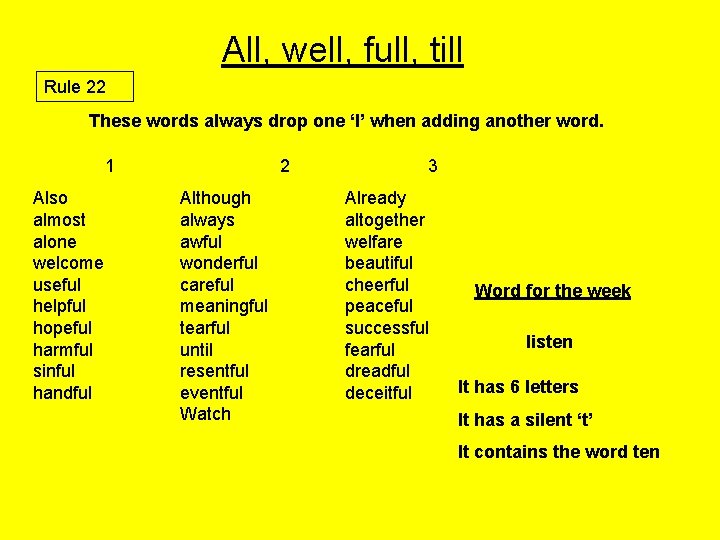
All, well, full, till Rule 22 These words always drop one ‘l’ when adding another word. 1 Also almost alone welcome useful helpful hopeful harmful sinful handful 2 Although always awful wonderful careful meaningful tearful until resentful eventful Watch 3 Already altogether welfare beautiful cheerful peaceful successful fearful dreadful deceitful Word for the week listen It has 6 letters It has a silent ‘t’ It contains the word ten
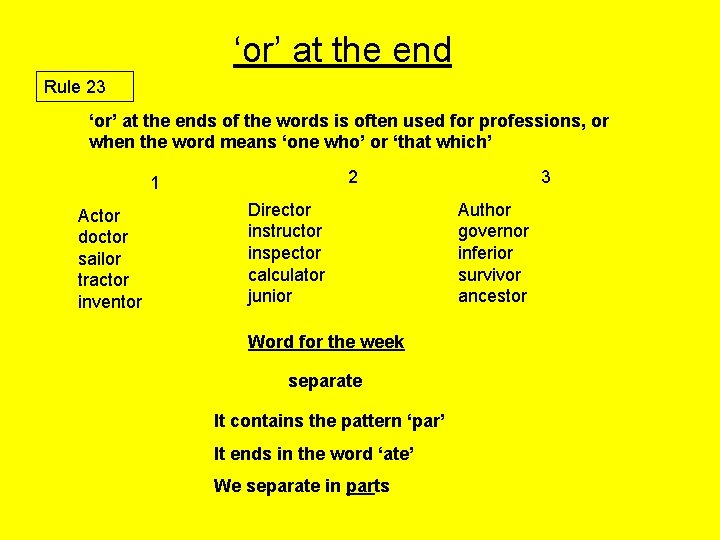
‘or’ at the end Rule 23 ‘or’ at the ends of the words is often used for professions, or when the word means ‘one who’ or ‘that which’ 2 1 Actor doctor sailor tractor inventor Director instructor inspector calculator junior Word for the week separate It contains the pattern ‘par’ It ends in the word ‘ate’ We separate in parts 3 Author governor inferior survivor ancestor
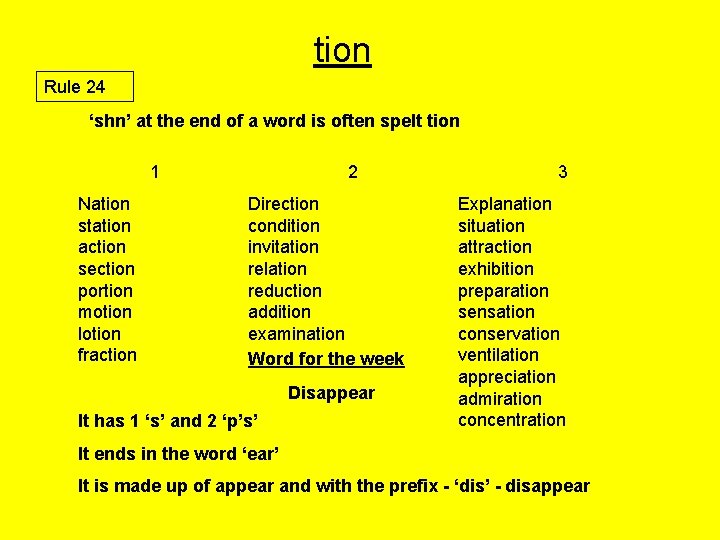
tion Rule 24 ‘shn’ at the end of a word is often spelt tion 1 Nation station action section portion motion lotion fraction 2 Direction condition invitation relation reduction addition examination Word for the week Disappear It has 1 ‘s’ and 2 ‘p’s’ 3 Explanation situation attraction exhibition preparation sensation conservation ventilation appreciation admiration concentration It ends in the word ‘ear’ It is made up of appear and with the prefix - ‘dis’ - disappear
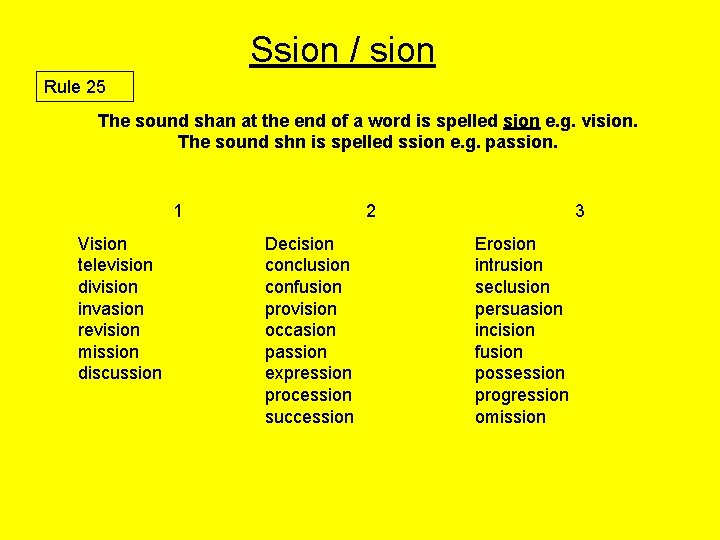
Ssion / sion Rule 25 The sound shan at the end of a word is spelled sion e. g. vision. The sound shn is spelled ssion e. g. passion. 1 Vision television division invasion revision mission discussion 2 Decision conclusion confusion provision occasion passion expression procession succession 3 Erosion intrusion seclusion persuasion incision fusion possession progression omission
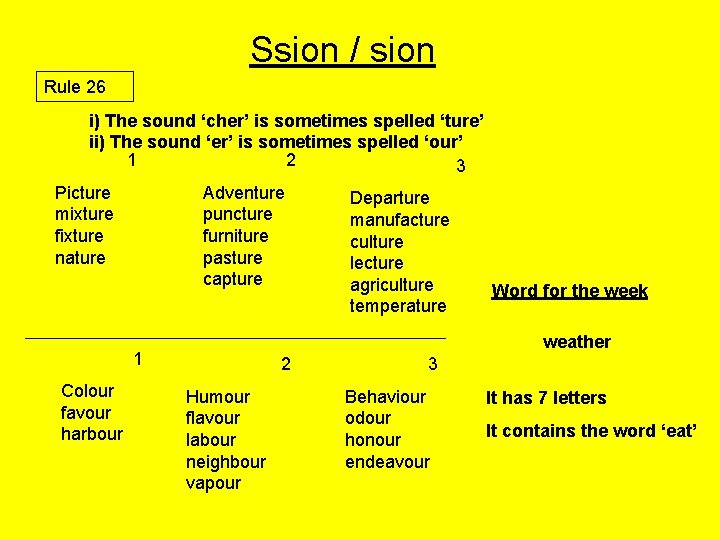
Ssion / sion Rule 26 i) The sound ‘cher’ is sometimes spelled ‘ture’ ii) The sound ‘er’ is sometimes spelled ‘our’ 1 2 3 Picture Adventure Departure mixture puncture manufacture fixture furniture culture nature pasture lecture capture agriculture temperature weather 1 Colour favour harbour Word for the week 2 Humour flavour labour neighbour vapour 3 Behaviour odour honour endeavour It has 7 letters It contains the word ‘eat’
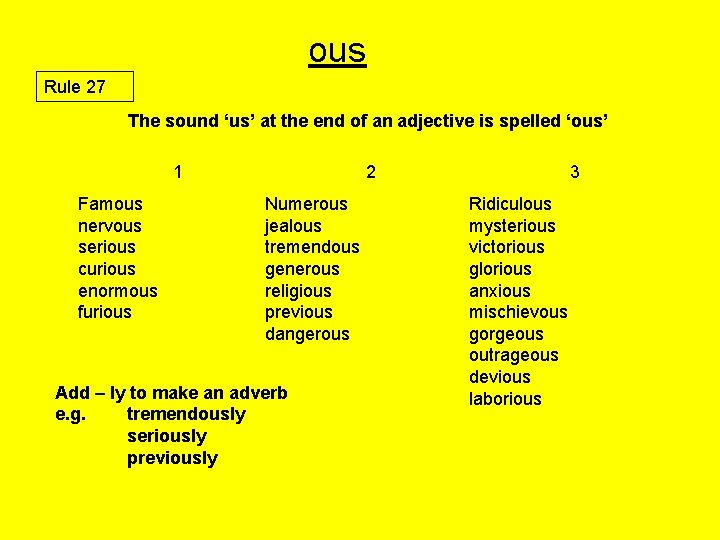
ous Rule 27 The sound ‘us’ at the end of an adjective is spelled ‘ous’ 1 Famous nervous serious curious enormous furious 2 Numerous jealous tremendous generous religious previous dangerous Add – ly to make an adverb e. g. tremendously seriously previously 3 Ridiculous mysterious victorious glorious anxious mischievous gorgeous outrageous devious laborious
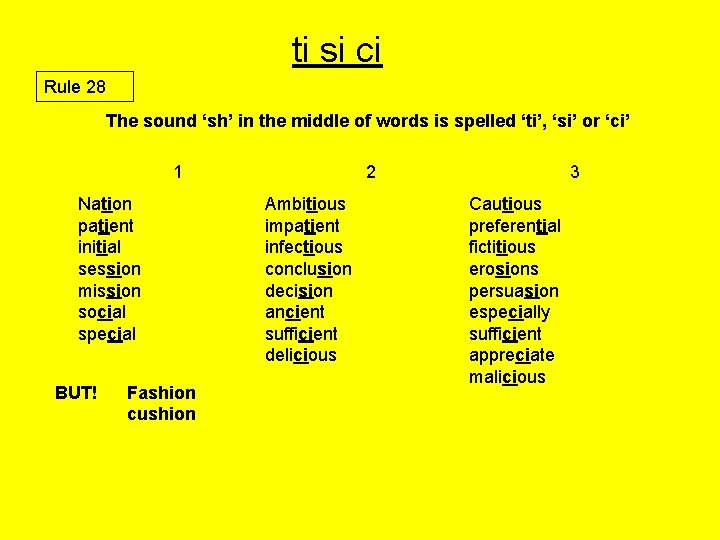
ti si ci Rule 28 The sound ‘sh’ in the middle of words is spelled ‘ti’, ‘si’ or ‘ci’ 1 Nation patient initial session mission social special BUT! Fashion cushion 2 Ambitious impatient infectious conclusion decision ancient sufficient delicious 3 Cautious preferential fictitious erosions persuasion especially sufficient appreciate malicious
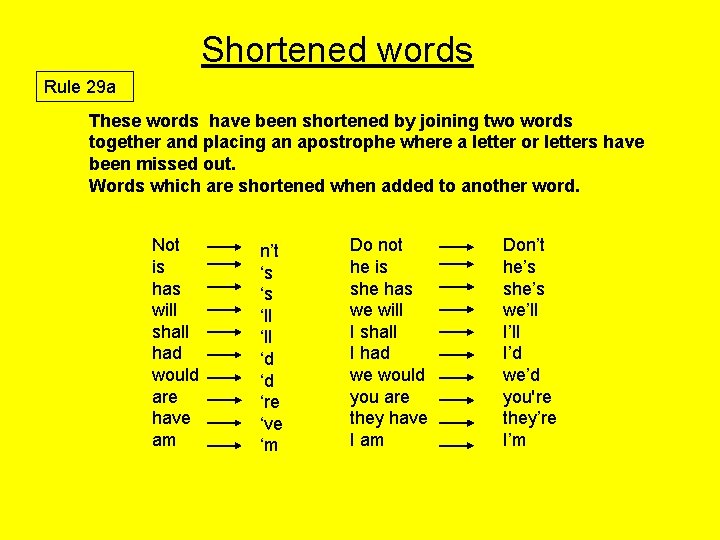
Shortened words Rule 29 a These words have been shortened by joining two words together and placing an apostrophe where a letter or letters have been missed out. Words which are shortened when added to another word. Not is has will shall had would are have am n’t ‘s ‘s ‘ll ‘d ‘d ‘re ‘ve ‘m Do not he is she has we will I shall I had we would you are they have I am Don’t he’s she’s we’ll I’d we’d you're they’re I’m
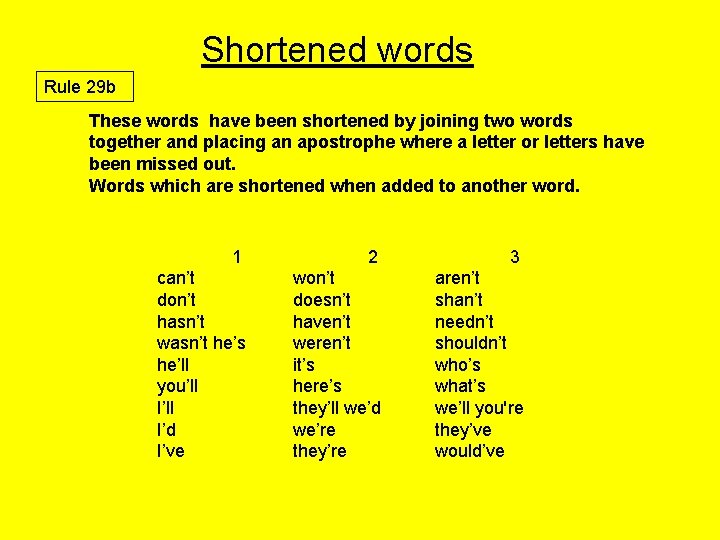
Shortened words Rule 29 b These words have been shortened by joining two words together and placing an apostrophe where a letter or letters have been missed out. Words which are shortened when added to another word. 1 2 3 can’t don’t hasn’t wasn’t he’s he’ll you’ll I’d I’ve won’t doesn’t haven’t weren’t it’s here’s they’ll we’d we’re they’re aren’t shan’t needn’t shouldn’t who’s what’s we’ll you're they’ve would’ve
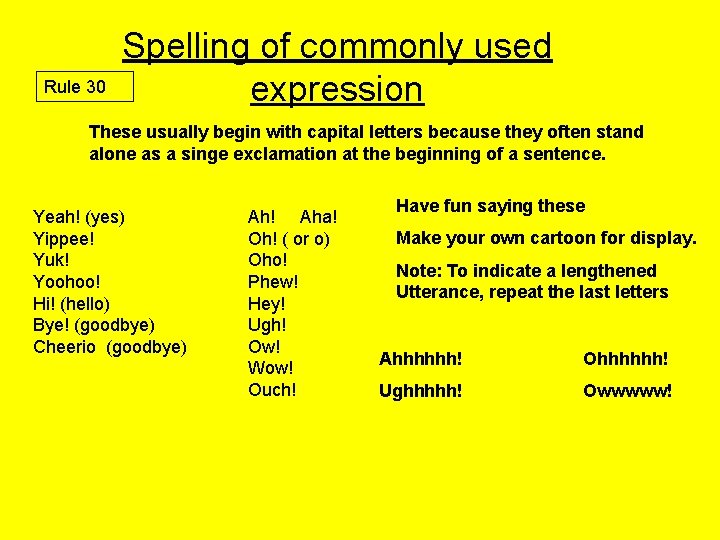
Rule 30 Spelling of commonly used expression These usually begin with capital letters because they often stand alone as a singe exclamation at the beginning of a sentence. Yeah! (yes) Yippee! Yuk! Yoohoo! Hi! (hello) Bye! (goodbye) Cheerio (goodbye) Ah! Aha! Oh! ( or o) Oho! Phew! Hey! Ugh! Ow! Wow! Ouch! Have fun saying these Make your own cartoon for display. Note: To indicate a lengthened Utterance, repeat the last letters Ahhhhhh! Ohhhhhh! Ughhhhh! Owwwww!