
Mag Dipl Ing Dr Michael Sonntag Electronic Signatures
- Slides: 36
Mag. Dipl. -Ing. Dr. Michael Sonntag Electronic Signatures Legal and Technical Aspects of E-Commerce, Budapest, 7. -11. 10. 2002 E-Mail: sonntag@fim. uni-linz. ac. at WWW: http: //www. fim. uni-linz. ac. at/staff/sonntag. htm Copyright, 2002 © Michael Sonntag
? ? Questions? ? ? Please ask them immediately! ? Michael Sonntag ? Legal and Technical Aspects of E-Commerce 2
Content Why the need? l Cryptography basics l èSymmetric, asymmetric, hash; types of attacks Key distribution / Signature systems l Requirements for and functions of signatures l Legal requirements l èEU signature directive Implementation in Austria l US Electronic Signatures Act l Michael Sonntag Legal and Technical Aspects of E-Commerce 3
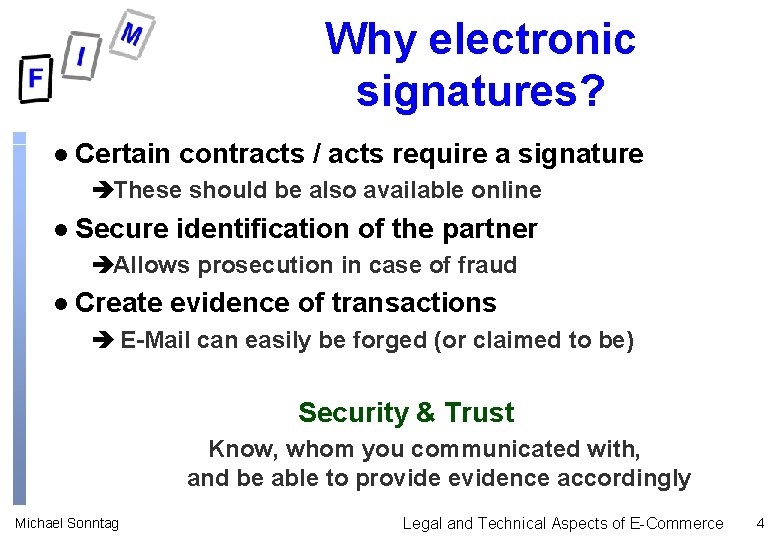
Why electronic signatures? l Certain contracts / acts require a signature èThese should be also available online l Secure identification of the partner èAllows prosecution in case of fraud l Create evidence of transactions è E-Mail can easily be forged (or claimed to be) Security & Trust Know, whom you communicated with, and be able to provide evidence accordingly Michael Sonntag Legal and Technical Aspects of E-Commerce 4
Types of attacks System for public transmission of data must cope with the following attacks: è Eavesdropping: Reading data during transmission è Manipulation: Changing data during transmission è Replay: Copying (legitimate) data and sending it again è Pretending different identity: Claiming to be someone else è Repudiation: Denying to have sent/received some data è Denial of service: Cutting off communication è Traffic analysis: Analyzing patterns of communication Michael Sonntag Legal and Technical Aspects of E-Commerce 5
Types of protection The following methods can be used for protecting systems for public transmission: èAuthentication: Verifying the identity of a party èIsolation: Attributing rights of persons to objects and preventing unauthorized access èEncryption: Coding of data to be unreadable without some secret information èChecksums: Verifying no changes have been introduced èSignatures: Relating identities to messages èSteganography/Anonymizers: Hiding of a message Michael Sonntag Legal and Technical Aspects of E-Commerce 6
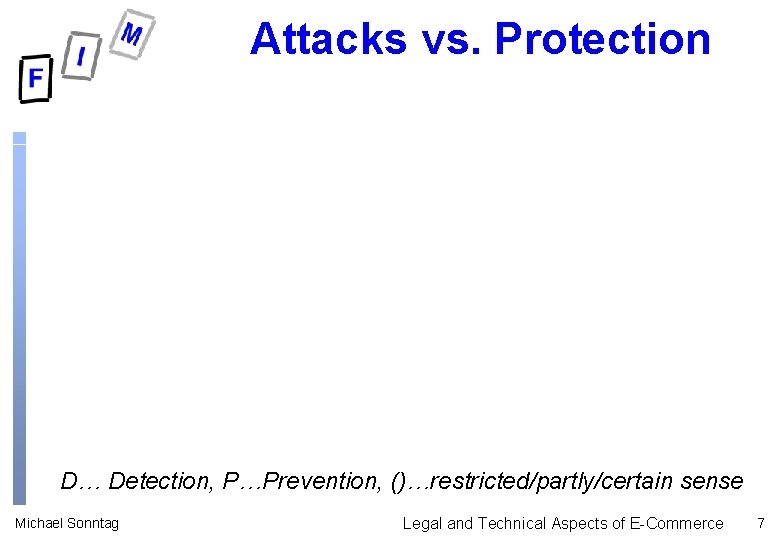
Attacks vs. Protection D… Detection, P…Prevention, ()…restricted/partly/certain sense Michael Sonntag Legal and Technical Aspects of E-Commerce 7
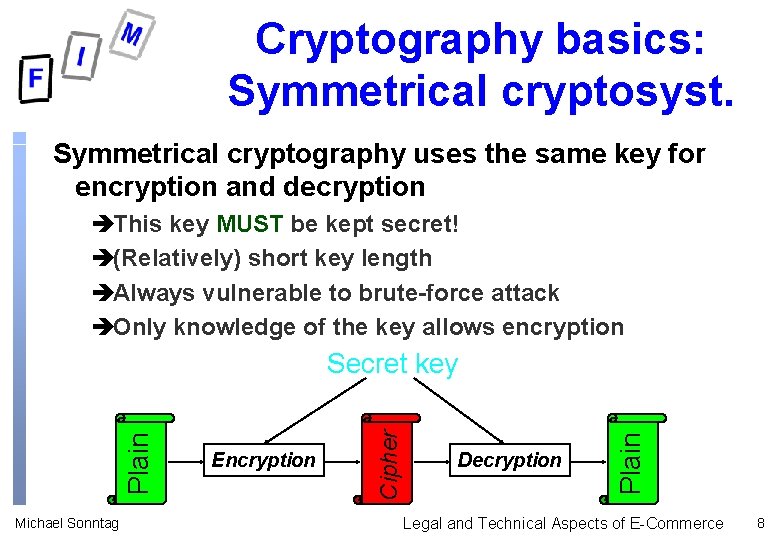
Cryptography basics: Symmetrical cryptosyst. Symmetrical cryptography uses the same key for encryption and decryption èThis key MUST be kept secret! è(Relatively) short key length èAlways vulnerable to brute-force attack èOnly knowledge of the key allows encryption Michael Sonntag Decryption Plain Encryption Cipher Plain Secret key Legal and Technical Aspects of E-Commerce 8
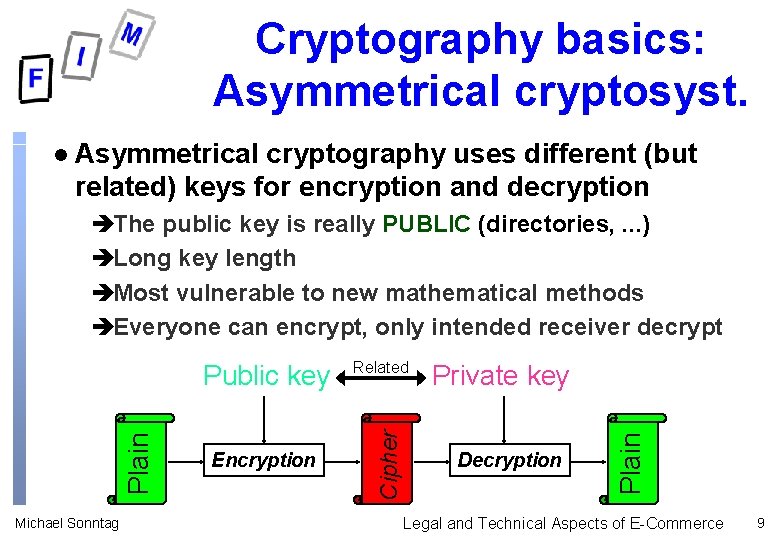
Cryptography basics: Asymmetrical cryptosyst. l Asymmetrical cryptography uses different (but related) keys for encryption and decryption èThe public key is really PUBLIC (directories, . . . ) èLong key length èMost vulnerable to new mathematical methods èEveryone can encrypt, only intended receiver decrypt Michael Sonntag Private key Decryption Plain Encryption Related Cipher Plain Public key Legal and Technical Aspects of E-Commerce 9
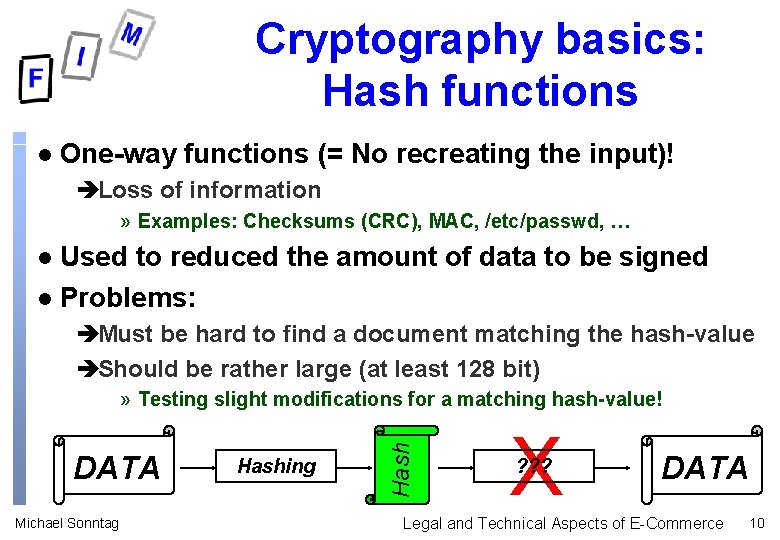
Cryptography basics: Hash functions l One-way functions (= No recreating the input)! èLoss of information » Examples: Checksums (CRC), MAC, /etc/passwd, … Used to reduced the amount of data to be signed l Problems: l èMust be hard to find a document matching the hash-value èShould be rather large (at least 128 bit) DATA Michael Sonntag Hashing Hash » Testing slight modifications for a matching hash-value! X ? ? ? DATA Legal and Technical Aspects of E-Commerce 10
Cryptography basics: Encryption / Signatures l Based on asymmetric cryptography èUsually (e. g. RSA): Signing = Encryption with private key, verification = decryption with public key » Some signature algorithms DO NOT allow encryption, e. g. DSA! Everyone can verify the signature’s validity l Two functions of a signature: l èVerifying the knowledge of the private key = Identity of the signer èChecking that no later modifications took place l Problem: How do you verify the public key? Michael Sonntag Legal and Technical Aspects of E-Commerce 11
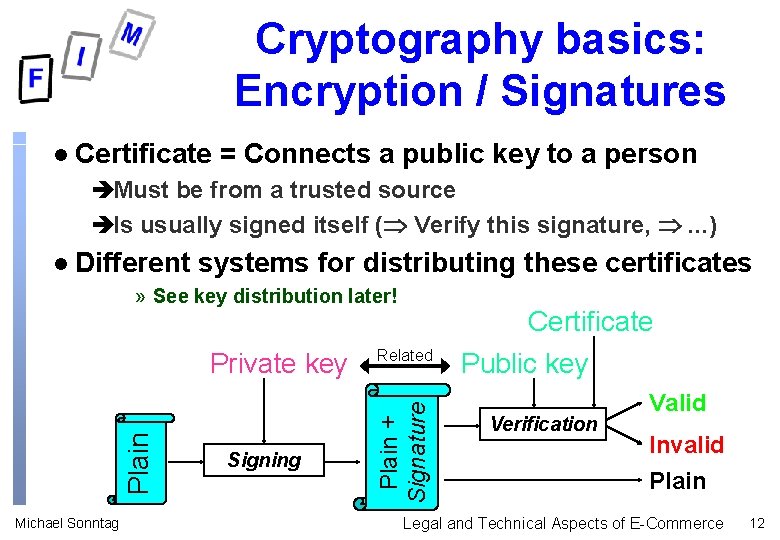
Cryptography basics: Encryption / Signatures l Certificate = Connects a public key to a person èMust be from a trusted source èIs usually signed itself ( Verify this signature, . . . ) l Different systems for distributing these certificates » See key distribution later! Michael Sonntag Signing Related Plain + Signature Plain Private key Certificate Public key Verification Valid Invalid Plain Legal and Technical Aspects of E-Commerce 12
Key storage (1) l Keys for encryption/signatures should be. . . èstored encrypted to be useless if stolen èon physical tokens: Much harder to loose, importance of use is clearer if a card (or something else) is inserted èimmediately marked as “invalid” if lost in any way èregularly changed to avoid too large sets of data èused only for one service: Encryption OR signatures; business OR private, door locks OR file encryption, . . . l PBE: Passphrase Based Encryption èFor avoiding the hen-egg problem when encrypting keys èLong (>20 characters) passwords are used as key Michael Sonntag Legal and Technical Aspects of E-Commerce 13
Key storage (2) l Important areas in life-cycle of keys + examples: » Generation: Use “real” randomness (physical generator), who/where are they created » Distribution: How to publish public keys/transmit secret keys » Storage: Preventing unauthorized access (tokens, encryption; see above) » Usage: Is the software / environment secure, viewer problem, usability » Administration: Which key(s) are used/required for an operation » Disposal: Secure destroying of keys, access to backups, buffers, storage for random identical keys, . . . Michael Sonntag Legal and Technical Aspects of E-Commerce 14
Key distribution: Trusted channels l Easiest way of distributing keys: Trusted channels èKnown to be secure / no eavesdropping èExamples: Couriers, personal meetings Not usable for large groups, initially unknown partners, or when in a hurry l Can NEVER be exchanged using the untrusted channel on which they shall be used later l » Except when a previous secret is shared, which is still secure l Only very rarely used èONLY possibility for Vernam cipher Michael Sonntag Legal and Technical Aspects of E-Commerce 15
Key distribution: Certificate Authorities (1) l Central authority vouches for the association of a public key to an individual èDepends on the trust of the users to this authority èImportant to note, what the authority verifies/guarantees » Certification policy » E. g. Certificates for signing code DO NOT guarantee ANYTHING about the code; only the identity of the signer (which need NOT be the programmer!) èUsually under supervision by public administration l This model is used for signatures accepted by public administration in the EU E-Government Michael Sonntag Legal and Technical Aspects of E-Commerce 16
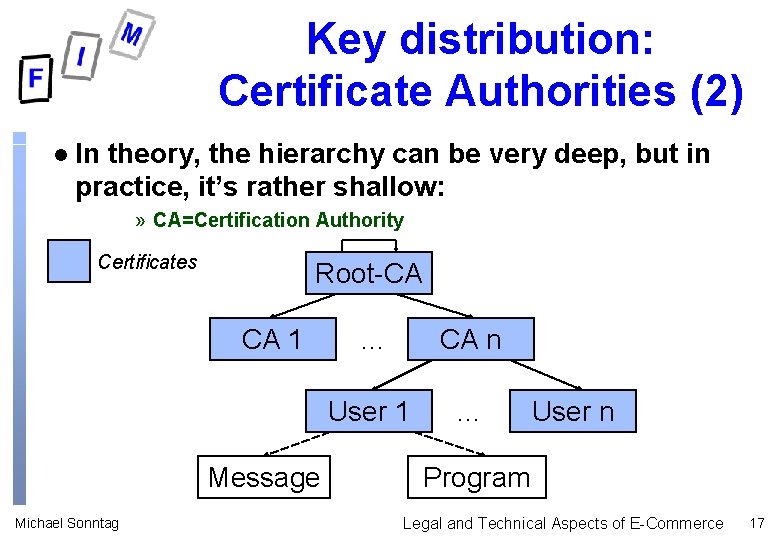
Key distribution: Certificate Authorities (2) l In theory, the hierarchy can be very deep, but in practice, it’s rather shallow: » CA=Certification Authority Certificates Root-CA CA 1 Message Michael Sonntag . . . CA n User 1 . . . User n Program Legal and Technical Aspects of E-Commerce 17
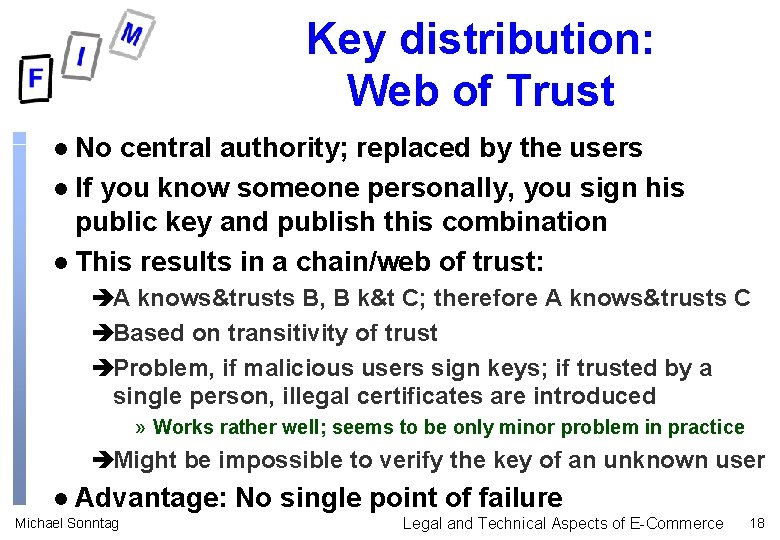
Key distribution: Web of Trust No central authority; replaced by the users l If you know someone personally, you sign his public key and publish this combination l This results in a chain/web of trust: l èA knows&trusts B, B k&t C; therefore A knows&trusts C èBased on transitivity of trust èProblem, if malicious users sign keys; if trusted by a single person, illegal certificates are introduced » Works rather well; seems to be only minor problem in practice èMight be impossible to verify the key of an unknown user l Advantage: No single point of failure Michael Sonntag Legal and Technical Aspects of E-Commerce 18
Re-Signing l Electronic signatures loose their reliability over time èToday’s secure keys can be broken/forged easily in several years èSome signatures must be valid for long periods » E. g. Austria: Statute of limitations 30/40 years l Contracts are still valid, but the proof is lost! Solution: Before method (not: certificate!) expires, a signature with a new (longer/more secure) key must be created, which includes a secure timestamp. Michael Sonntag Legal and Technical Aspects of E-Commerce 19
Systems for el. signatures l An electronic signature cannot be easily created; a whole system is needed èEvery chain is only as strong as its weakest link! è 2048 Bit RSA are of no use if the private key is secured with a 4 digit password! l Main problems: èTechnical: Signature terminals must be secure » =Trusted hardware + trusted software èOrganizational: Verifying persons for issuing certificates » Lots of trusted persons needed in any scheme èLegal: Reduction of needs for signatures » At least in Austria signature-requirements were reduced later Michael Sonntag Legal and Technical Aspects of E-Commerce 20
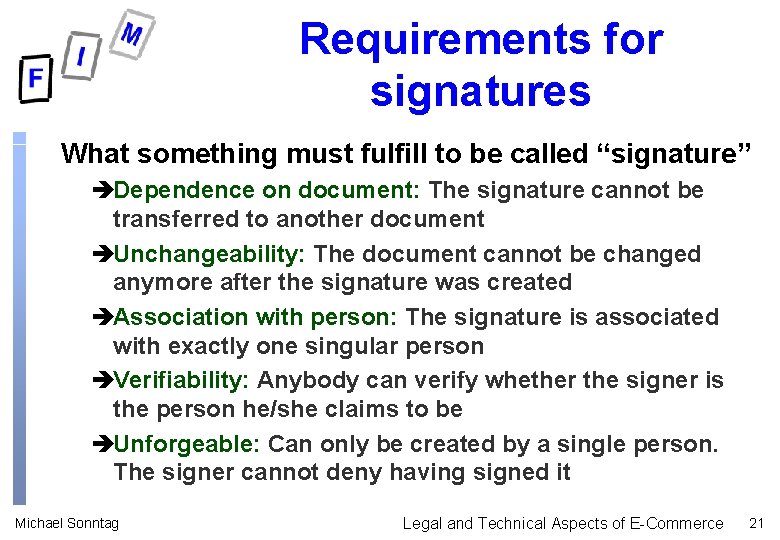
Requirements for signatures What something must fulfill to be called “signature” èDependence on document: The signature cannot be transferred to another document èUnchangeability: The document cannot be changed anymore after the signature was created èAssociation with person: The signature is associated with exactly one singular person èVerifiability: Anybody can verify whether the signer is the person he/she claims to be èUnforgeable: Can only be created by a single person. The signer cannot deny having signed it Michael Sonntag Legal and Technical Aspects of E-Commerce 21
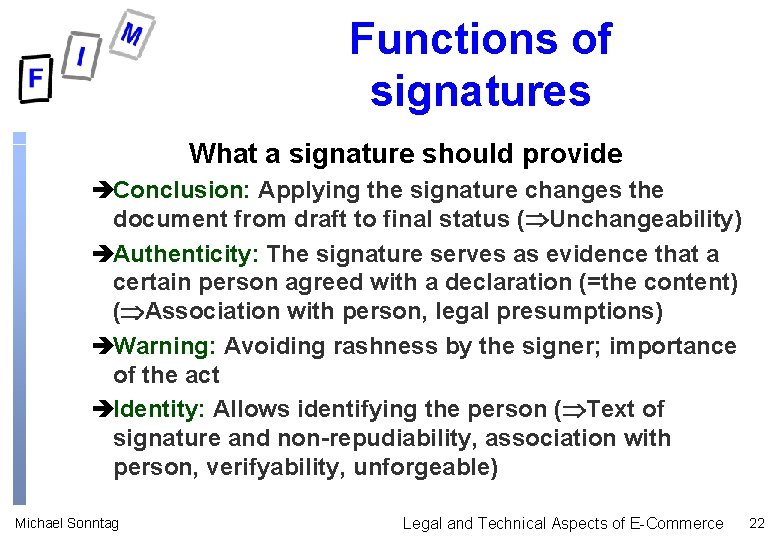
Functions of signatures What a signature should provide èConclusion: Applying the signature changes the document from draft to final status ( Unchangeability) èAuthenticity: The signature serves as evidence that a certain person agreed with a declaration (=the content) ( Association with person, legal presumptions) èWarning: Avoiding rashness by the signer; importance of the act èIdentity: Allows identifying the person ( Text of signature and non-repudiability, association with person, verifyability, unforgeable) Michael Sonntag Legal and Technical Aspects of E-Commerce 22
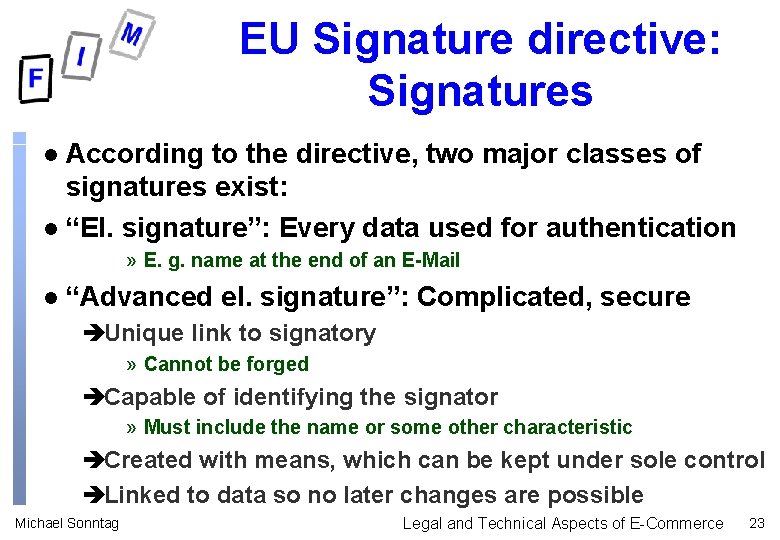
EU Signature directive: Signatures According to the directive, two major classes of signatures exist: l “El. signature”: Every data used for authentication l » E. g. name at the end of an E-Mail l “Advanced el. signature”: Complicated, secure èUnique link to signatory » Cannot be forged èCapable of identifying the signator » Must include the name or some other characteristic èCreated with means, which can be kept under sole control èLinked to data so no later changes are possible Michael Sonntag Legal and Technical Aspects of E-Commerce 23
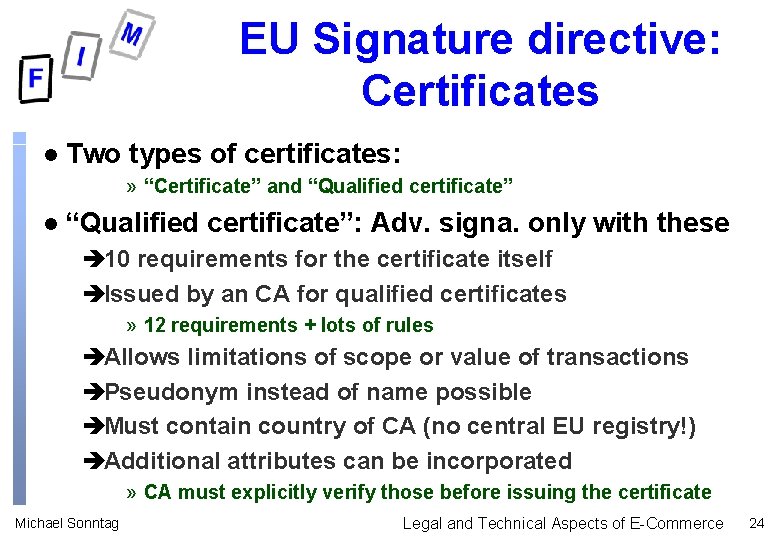
EU Signature directive: Certificates l Two types of certificates: » “Certificate” and “Qualified certificate” l “Qualified certificate”: Adv. signa. only with these è 10 requirements for the certificate itself èIssued by an CA for qualified certificates » 12 requirements + lots of rules èAllows limitations of scope or value of transactions èPseudonym instead of name possible èMust contain country of CA (no central EU registry!) èAdditional attributes can be incorporated » CA must explicitly verify those before issuing the certificate Michael Sonntag Legal and Technical Aspects of E-Commerce 24
EU Signature directive: Revocation l Sometimes certificates must be revoked èPrivate key lost, chipcard stolen, password disclosed, . . . l Technical problems èNo generally agreed upon standard; different solutions èNo offline check for revocation possible l Legal regulations (Austria): » EU: CA must provide “secure & immediate revocation service” èMust also be possible in (hand-)written form èAt most after 3 hours completed èTwo types: Preliminary (Lock) and final (Revocation) Michael Sonntag Legal and Technical Aspects of E-Commerce 25
EU Signature directive: Legal effects (1) l Advanced signature + qualified certificate + secure signature-creation device: èMust satisfy legal requirements in same manner as handwritten signatures on paper » Can be used as a replacement èMust be admissible as evidence in legal proceedings » But might be of less or more “value” than signatures on paper! èNO legal presumptions » Austria: Presumption that signed content is from the signator l Certificates: Admissible in proceedings and non-discrimination Michael Sonntag Legal and Technical Aspects of E-Commerce 26
EU Signature directive: Legal effects (2) Area where el. signatures are equal to handwritten ones (and have the same effect) are open to states l Restrictions are in the E-Commerce directive: It must be possible to conclude everything electronically, except l ÊAll real estate contracts excluding rental rights ËAll contracts requiring courts, public authorities or professions exercising public authority (e. g. notaries) ÌContracts of suretyship by persons acting for purposes outside their trade, business or profession ÍContracts of family law or the law of succession Michael Sonntag Legal and Technical Aspects of E-Commerce 27
EU Signature directive: Liability l CA is liable to ANYONE who reasonably relied on a qualified certificate, for èall information in the certificate at the time of issuing, èthat it is a valid qualified certificate, èthe signator held the private key èprivate and public key match unless the CA proves, he did not act negligently failure to register revocation of a certificate l No liability over/outside limitations in the certificate l Michael Sonntag Legal and Technical Aspects of E-Commerce 28
EU Signature directive: Requirements for CA General reliability l Ensure operation of secure and reliable directory and revocation services l Personnel with expert knowledge l Trustworthy systems and products l Sufficient financial resources l Extensive logging of all relevant actions l Informing customers Requires a secure computing center, large organization and numerous experts Rare! l Michael Sonntag Legal and Technical Aspects of E-Commerce 29
EU Signature directive: Accreditation Purely optional l A kind of “official seal” l States can set higher standards than in the directive for these CA’s l èAustria: Exactly the same l “Replacement” for model “no licensing required” èSeal is only awarded AFTER verification! Michael Sonntag Legal and Technical Aspects of E-Commerce 30
EU Signature directive: Various For public sector additional requirements for el. signatures can be prescribed l No prior authorization required for CA’s l CA’s may operate within the whole EU l Cert. from foreign CA’s are equal to national ones l Special rules for data protection l » CA may collect ANY information ONLY from the subject itself l … See the directive and the local laws/ordinances! Michael Sonntag Legal and Technical Aspects of E-Commerce 31
Implementation in Austria l RTR: Broadcast & Telecomm. Regulation Incorp. èPublic supervision, registration of CA’s l A-SIT: Secure Inform. Technology Center-Austria èTechnical part: Inspection of CA’s for RTR èAssociation: University Graz, Ministry of Finance, Austrian National Bank Currently 5 CA’s; 2 offering advanced signatures l Few certificates in use l èLack of applications èOnly very recently advanced signatures available Michael Sonntag Legal and Technical Aspects of E-Commerce 32
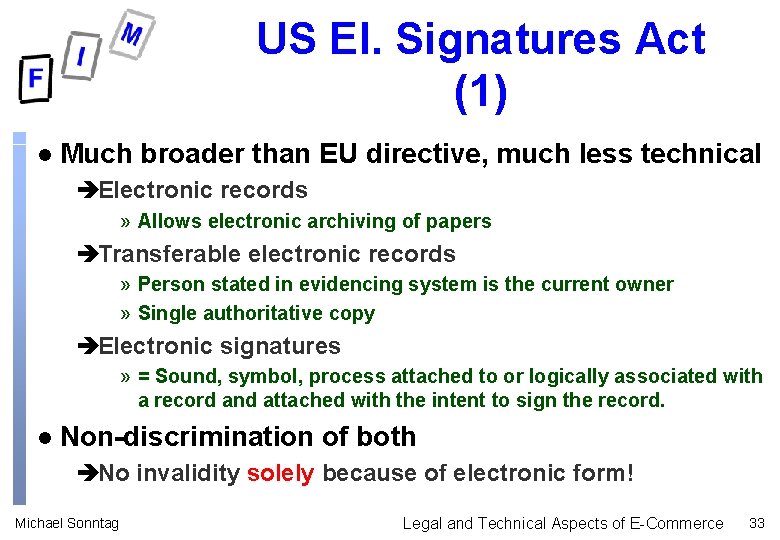
US El. Signatures Act (1) l Much broader than EU directive, much less technical èElectronic records » Allows electronic archiving of papers èTransferable electronic records » Person stated in evidencing system is the current owner » Single authoritative copy èElectronic signatures » = Sound, symbol, process attached to or logically associated with a record and attached with the intent to sign the record. l Non-discrimination of both èNo invalidity solely because of electronic form! Michael Sonntag Legal and Technical Aspects of E-Commerce 33
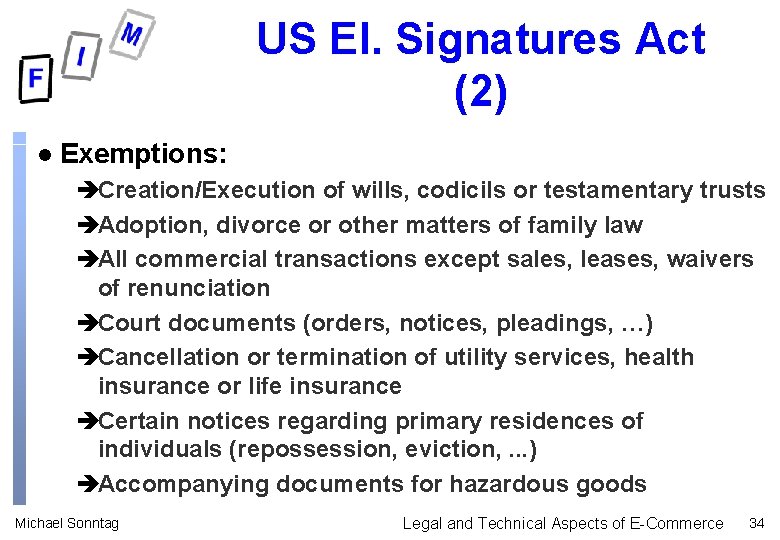
US El. Signatures Act (2) l Exemptions: èCreation/Execution of wills, codicils or testamentary trusts èAdoption, divorce or other matters of family law èAll commercial transactions except sales, leases, waivers of renunciation èCourt documents (orders, notices, pleadings, …) èCancellation or termination of utility services, health insurance or life insurance èCertain notices regarding primary residences of individuals (repossession, eviction, . . . ) èAccompanying documents for hazardous goods Michael Sonntag Legal and Technical Aspects of E-Commerce 34
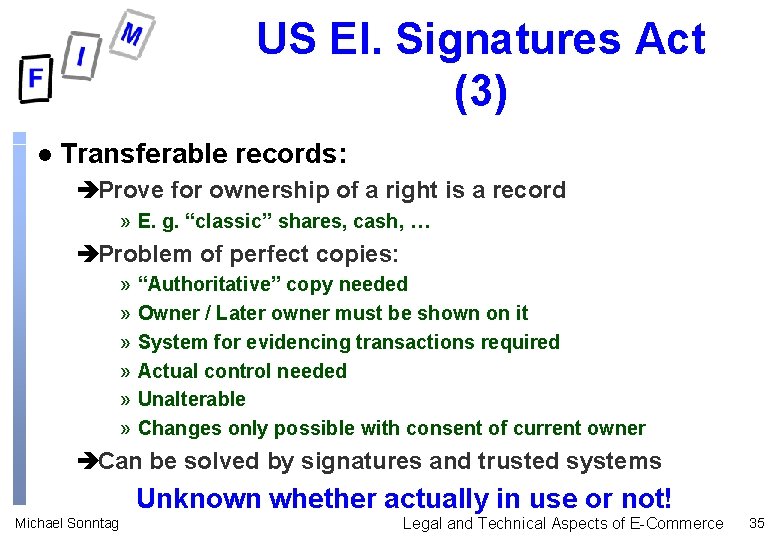
US El. Signatures Act (3) l Transferable records: èProve for ownership of a right is a record » E. g. “classic” shares, cash, … èProblem of perfect copies: » » » “Authoritative” copy needed Owner / Later owner must be shown on it System for evidencing transactions required Actual control needed Unalterable Changes only possible with consent of current owner èCan be solved by signatures and trusted systems Unknown whether actually in use or not! Michael Sonntag Legal and Technical Aspects of E-Commerce 35
Literature/Links: l l l EU Signature directive: 1999/93/EC, L 13/12 -20 19. 1. 2000 EU E-Commerce directive: 2000/31/EC, L 178/1 -16 17. 7. 2000 Austrian Signature Law: Sig. G Bg. Bl I Nr. 190/1999 id. F Bg. Bl I Nr. 152/2001 Austrian Signature Ordinance: Sig. VO Bg. Bl II Nr. 30/2000 US El. Signature Act: http: //www. dud. de/dud/documents/usesignact 0608. pdf Mayr-Schönberger/Pilz/Reiser/Schmölzer: Praxiskommentar Signaturgesetz. Wien: Orac 1999 Michael Sonntag Legal and Technical Aspects of E-Commerce 36