
Mag Biology The Cell Part 2 The Working
Mag Biology “The Cell” (Part 2) The Working Cell: Cellular Processes *References: Mader Text. Also, Open. Stax www. openstax. org
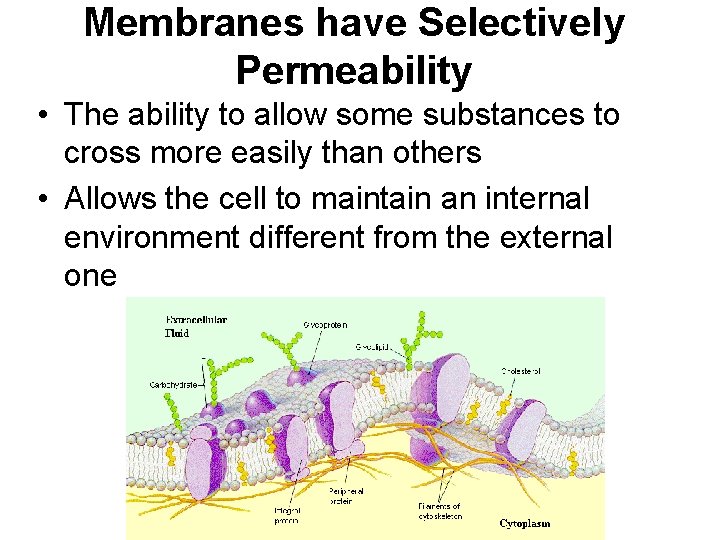
Membranes have Selectively Permeability • The ability to allow some substances to cross more easily than others • Allows the cell to maintain an internal environment different from the external one
Types of Transport • Passive: goes “with” the concentration gradient; no ATP energy required – Exp: Diffusion and Facilitated Diffusion; Osmosis • Active- goes “against” the concentration gradient (“low to high”); requires ATP energy – Exp: Na+/K+ pump (neurons); Endocytosis and exocytosis
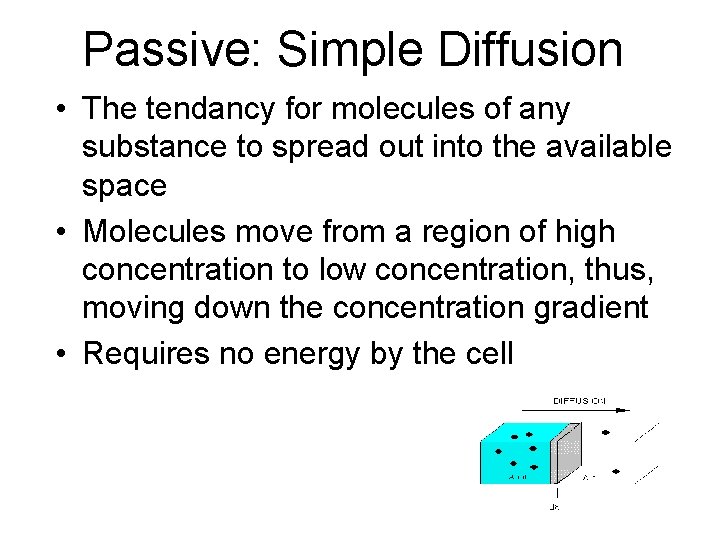
Passive: Simple Diffusion • The tendancy for molecules of any substance to spread out into the available space • Molecules move from a region of high concentration to low concentration, thus, moving down the concentration gradient • Requires no energy by the cell
Passive: Osmosis • Osmosis is the diffusion of water across a semi permeable membrane • Types – HYPERTONIC – HYPOTONIC – ISOTONIC
Osmosis • Water always moves from a hypotonic solution to a hypertonic solution. *Sometimes this is referred to as moving from an area of ‘higher water potential’ to an area of ‘lower water potential’ • What happens to cells when placed in hypotonic, hypertonic or isotonic solutions?
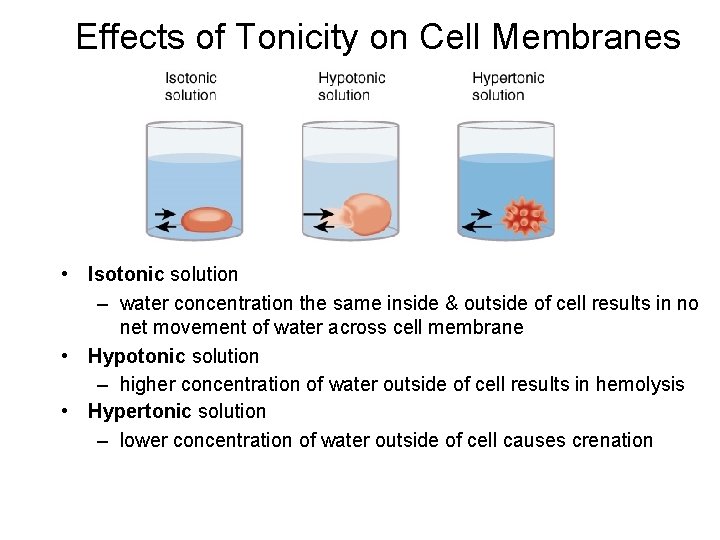
Effects of Tonicity on Cell Membranes • Isotonic solution – water concentration the same inside & outside of cell results in no net movement of water across cell membrane • Hypotonic solution – higher concentration of water outside of cell results in hemolysis • Hypertonic solution – lower concentration of water outside of cell causes crenation
Osmosis Question • Suppose a cell containing 10% solutes is placed in a beaker of pure (deionized) water. Which direction will the water move and what will be the result? • CW- Osmosis questions
Facilitated Diffusion-Passive • Transport proteins – Provide corridors allowing a specific molecule or ion to cross membrane – Undergo a shape change that translocates the molecule across the membrane – Process requires no energy, because particles are moving from an area of high concentration to low concentration
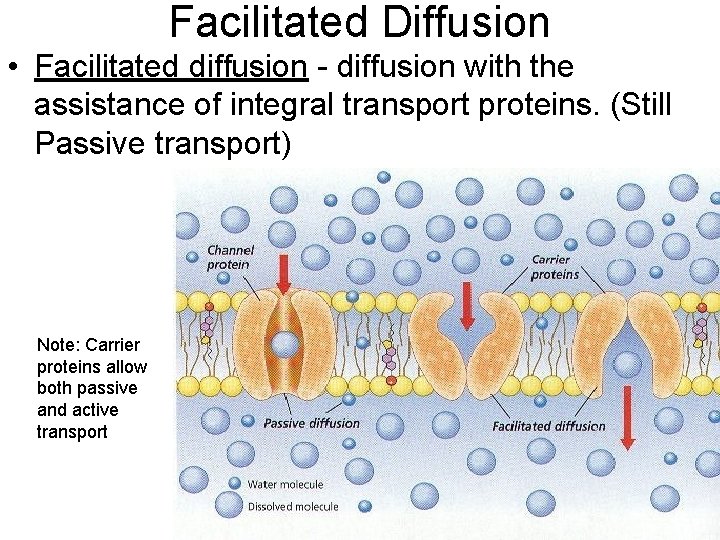
Facilitated Diffusion • Facilitated diffusion - diffusion with the assistance of integral transport proteins. (Still Passive transport) Note: Carrier proteins allow both passive and active transport
Active Transport • Movement of solutes AGAINST the concentration gradient. Goes from low to high concentration. • Requires energy input by the cell • ATP supplies this energy
Active transport • Carrier proteins are needed to transport molecules across the membrane against the concentration gradient and require an expenditure of energy • ATP- ADP +P (ATP must release energy to go [low] to [high] • Often referred to as “pumps”. Ex- Na+ and K+ for nerve (neuron) impulses. http: //highered. mheducation. com/sites/9834092339/student_view 0/c hapter 5/sodium-potassium_exchange_pump. html
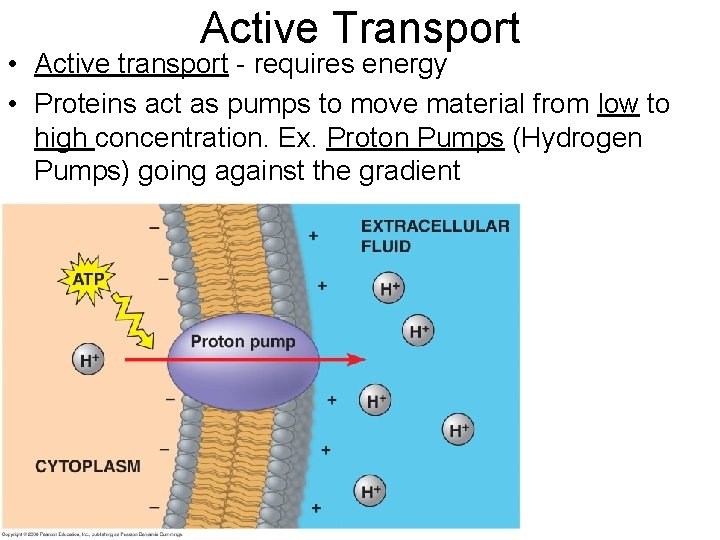
Active Transport • Active transport - requires energy • Proteins act as pumps to move material from low to high concentration. Ex. Proton Pumps (Hydrogen Pumps) going against the gradient
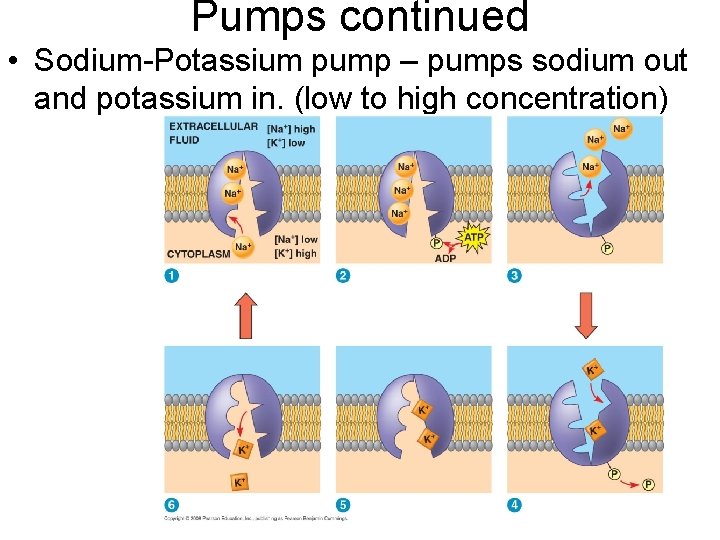
Pumps continued • Sodium-Potassium pump – pumps sodium out and potassium in. (low to high concentration)
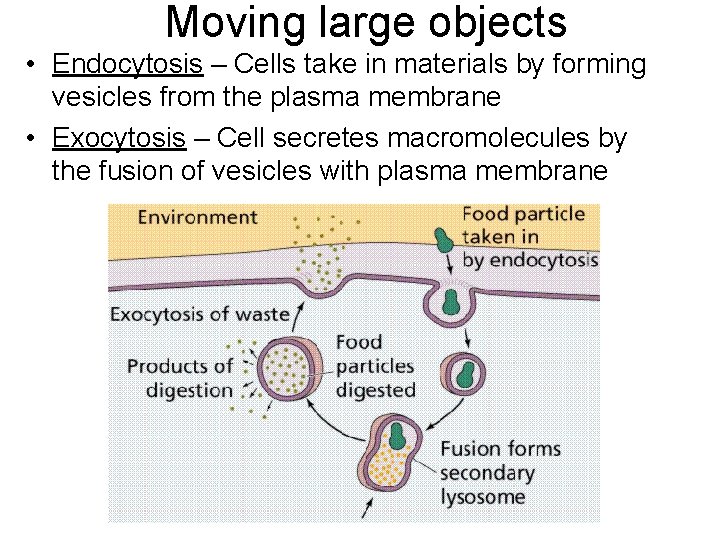
Moving large objects • Endocytosis – Cells take in materials by forming vesicles from the plasma membrane • Exocytosis – Cell secretes macromolecules by the fusion of vesicles with plasma membrane
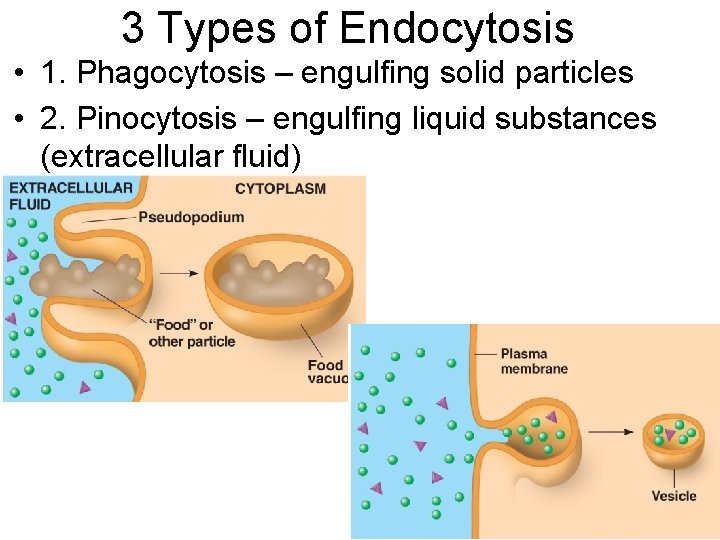
3 Types of Endocytosis • 1. Phagocytosis – engulfing solid particles • 2. Pinocytosis – engulfing liquid substances (extracellular fluid)
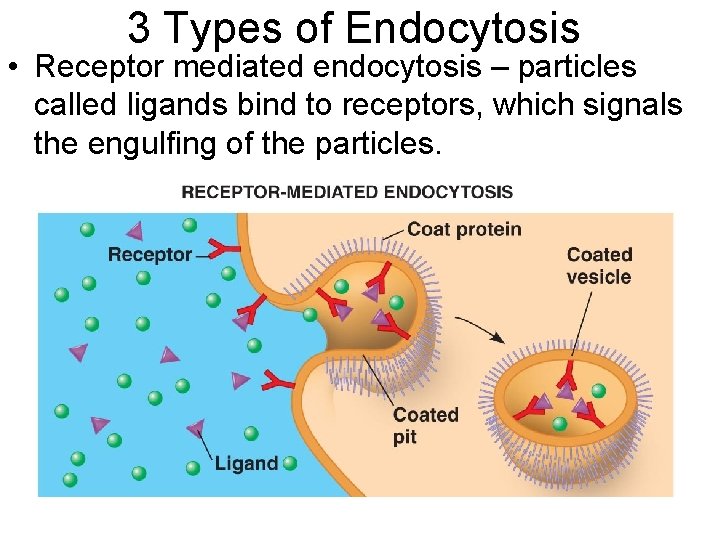
3 Types of Endocytosis • Receptor mediated endocytosis – particles called ligands bind to receptors, which signals the engulfing of the particles.
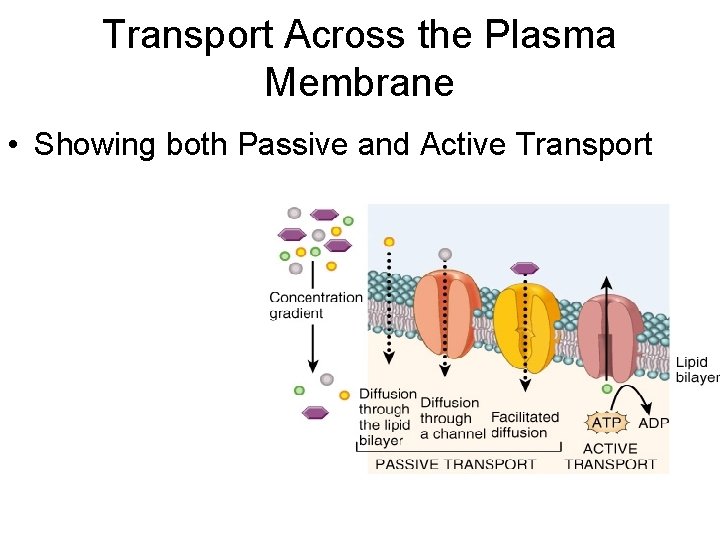
Transport Across the Plasma Membrane • Showing both Passive and Active Transport
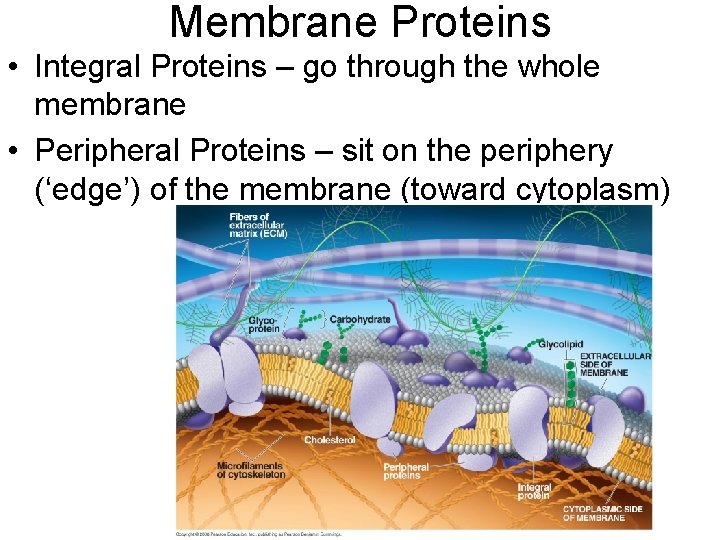
Membrane Proteins • Integral Proteins – go through the whole membrane • Peripheral Proteins – sit on the periphery (‘edge’) of the membrane (toward cytoplasm)
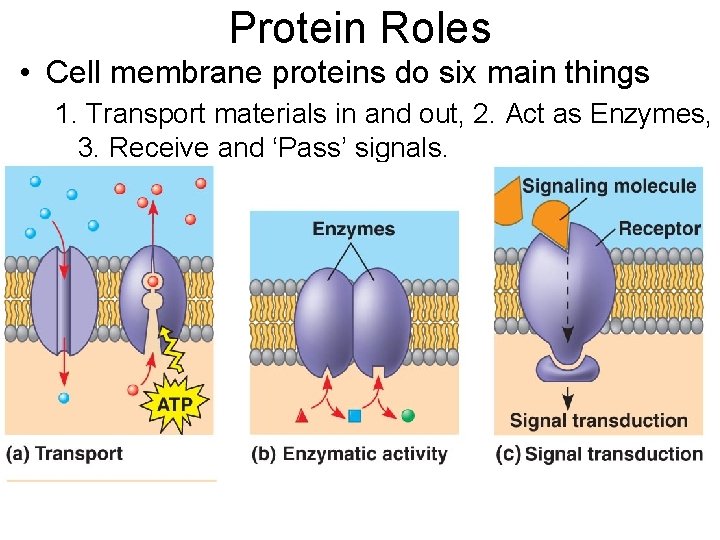
Protein Roles • Cell membrane proteins do six main things 1. Transport materials in and out, 2. Act as Enzymes, 3. Receive and ‘Pass’ signals.
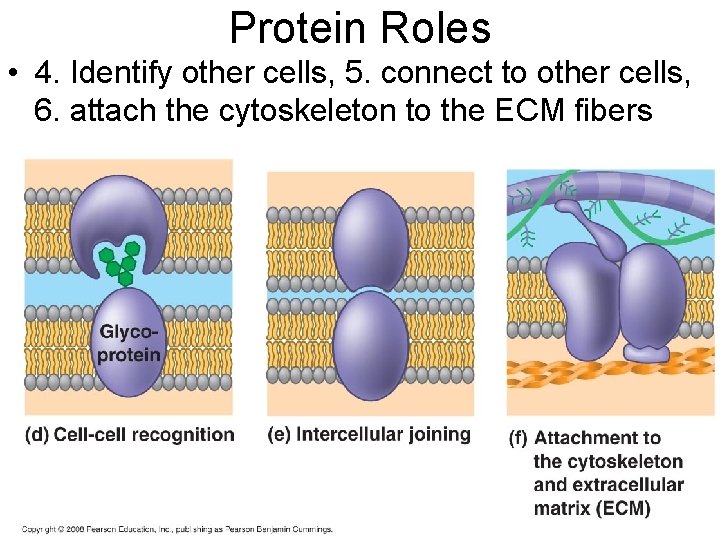
Protein Roles • 4. Identify other cells, 5. connect to other cells, 6. attach the cytoskeleton to the ECM fibers
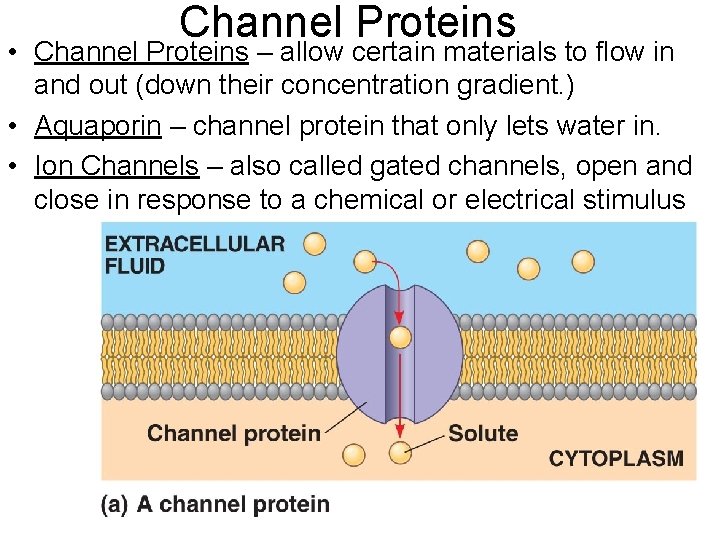
Channel Proteins • Channel Proteins – allow certain materials to flow in and out (down their concentration gradient. ) • Aquaporin – channel protein that only lets water in. • Ion Channels – also called gated channels, open and close in response to a chemical or electrical stimulus
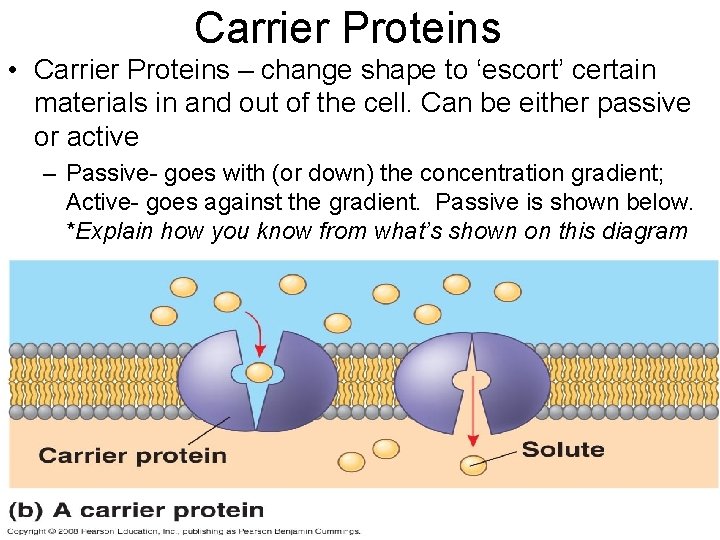
Carrier Proteins • Carrier Proteins – change shape to ‘escort’ certain materials in and out of the cell. Can be either passive or active – Passive- goes with (or down) the concentration gradient; Active- goes against the gradient. Passive is shown below. *Explain how you know from what’s shown on this diagram
Functions of Membrane Proteins • Channel Proteins- Passive. Channel proteins are embedded in the cell membrane & have a pore for materials to cross • Carrier Proteins- Passive and Active. Carrier proteins are specific regarding which substances can pass through. They change shape to move material from one side of the membrane to the other.
Membrane proteins – Cell recognition proteins (glycoproteins): “alert” if being invaded by pathogens, so immune response is initiated – Receptor proteins (May be embedded in membrane or in cytoplasm): Ligand (signal molecule) binds to receptor (using H bonding), and it changes shape and starts cellular response (further reactions inside cell called signal transduction). Ex- hormones. **See next few slides – Enzymes: Initiate reactions directly at membrane site. Ex- converting ATP->ADP +P (an exergonic rxn) and using the energy for active transport (ex- Na+/K+ pump)
Cell Communication • How do ‘messages’ get from cell to cell? • Some cells make direct contact to ‘communicate’, but others do not. Cells send molecular messages to other cells to generate a particular response. The general name for a signaling molecule is called a ligand.
Cell Communication: Signal Transduction l A signal transduction pathway is a series of steps by which a signal on a cell’s surface is converted into a specific cellular response l Molecules that are small enough or hydrophobic and pass through the membrane - directly activate intracellular receptors in the cytoplasm or nucleus of target cell l Molecules that are too large or too hydrophilic to cross the plasma membrane - rely on membrane receptors l Ligand- general name for signaling molecule
Example of Cell Communication – Hormones- long distance signaling messengers. Hormones are made in one place in an organism (ex: adrenal glands) and sent to another place for a cellular response. – After the signal is received by the cell, the message is ‘relayed’ through various (transduction) pathways in the cell. Often, the cellular response involves ‘instructing’ DNA to either ‘turn a gene on’ or ‘turn it off’. Remember: Genes are segments of DNA that have ‘instructions’ for making proteins. – Question: Where are proteins synthesized?
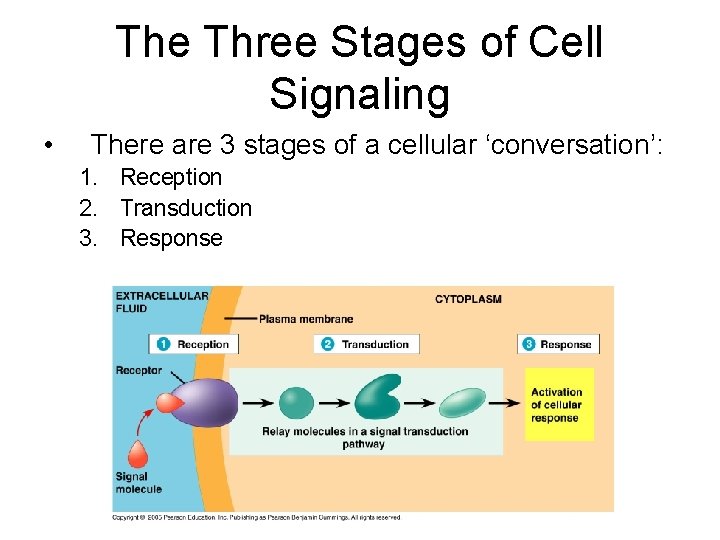
The Three Stages of Cell Signaling • There are 3 stages of a cellular ‘conversation’: 1. Reception 2. Transduction 3. Response
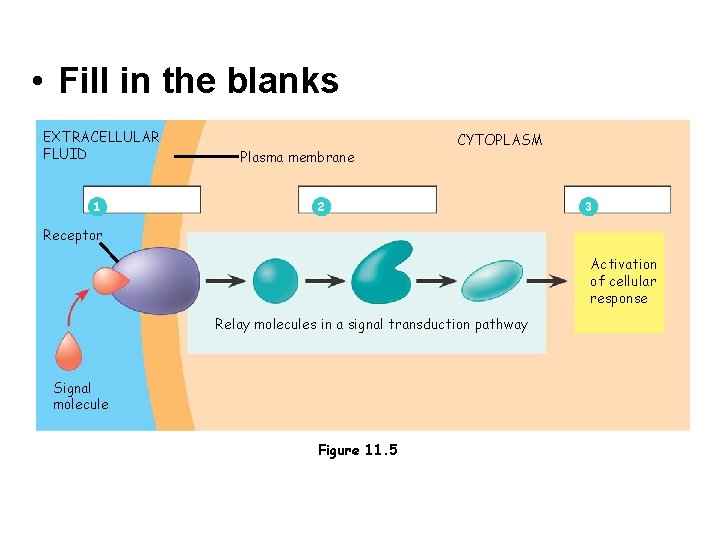
• Fill in the blanks EXTRACELLULAR FLUID 1 Plasma membrane CYTOPLASM 2 3 Receptor Activation of cellular response Relay molecules in a signal transduction pathway Signal molecule Figure 11. 5
Cellular Metabolism • Thermodynamics and Reactions: – Exergonic (‘exothermic’) rxns: Releases energy – Endergonic (‘endothermic’): Absorbs energy
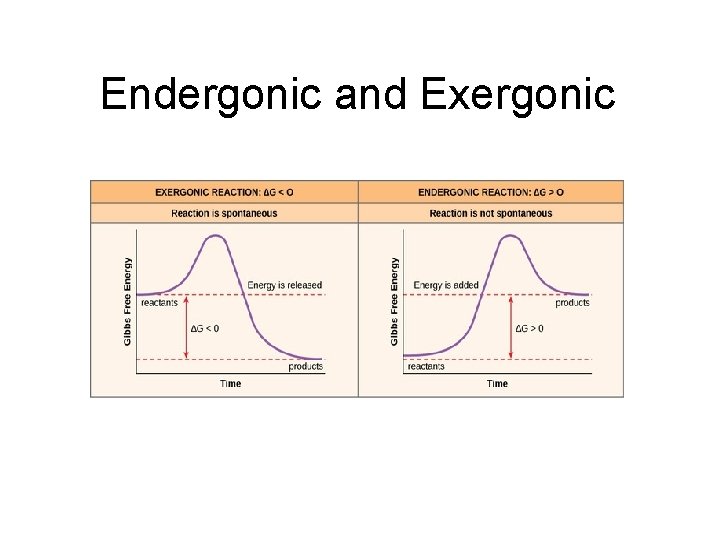
Endergonic and Exergonic
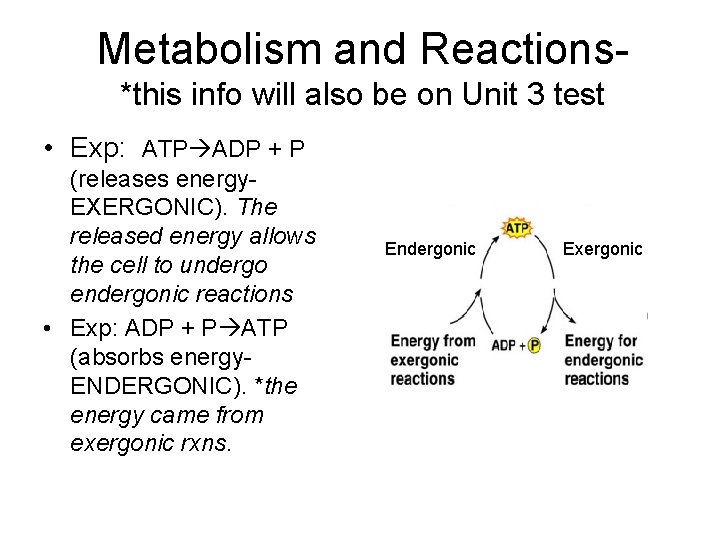
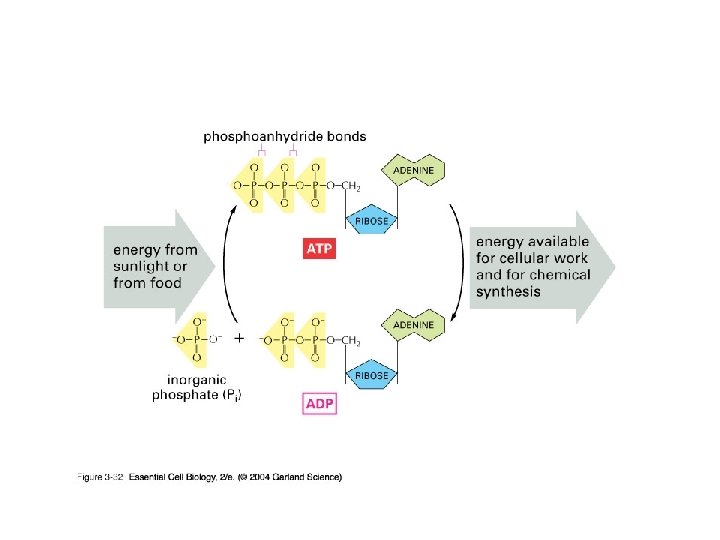
Metabolism and Reactions*this info will also be on Unit 3 test • Exp: ATP ADP + P (releases energy. EXERGONIC). The released energy allows the cell to undergo endergonic reactions • Exp: ADP + P ATP (absorbs energy. ENDERGONIC). *the energy came from exergonic rxns. Endergonic Exergonic
Enzymes (*continued from Unit 1) • Functional proteins used to catalyze chem. rxns. • Don’t get changed in the rxn • Work on highly specific substrates. Substrate attaches to Active Site with of the enzyme and is converted to product • Enzymes decrease the amt. of activation energy needed for the rxn to occur
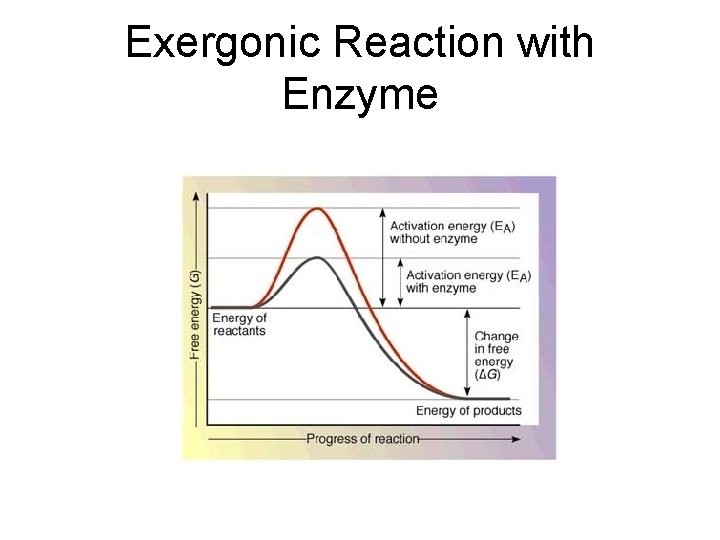
Exergonic Reaction with Enzyme
Enzymes • Competitive Inhibitor-Takes the place of the normal substrate and does not change the ‘shape’ of the active site. Usually reversible • Non-Competitive Inhibitor- Attaches to the allosteric site (different than the active site) and thus changes the shape of the enzyme, and thereby the active site. Many are non reversible. -Ex- DDT. Pesticide that attaches to a central nervous system enzyme of insects. Results in death. – Ex- Penicillin. Binds to bacterial enzyme that inhibits it from making cell wall
Factors affecting Enzymes • Many will not work properly without Cofactors (inorganic- ex: Zn, Fe) or Coenzymes (organic). Most coenzymes are vitamins or vitamin derivatives • Denaturation of Enzymes: – p. H – Temp – Salinity
Homework: What is Apoptosis? Be prepared to share your response tomorrow!
- Slides: 39