
MAE 3241 AERODYNAMICS AND FLIGHT MECHANICS Review of
- Slides: 57
MAE 3241: AERODYNAMICS AND FLIGHT MECHANICS Review of Basic Aerodynamics February 28, 2011 Mechanical and Aerospace Engineering Department Florida Institute of Technology D. R. Kirk
MAE 3241: AERODYNAMICS AND FLIGHT MECHANICS AIRFOIL DATA FROM: INTRODUCTION TO FLIGHT, APPENDIX D JOHN D. ANDERSON, JR. Mechanical and Aerospace Engineering Department Florida Institute of Technology D. R. Kirk
LECTURE OUTLINE • Review of Euler’s Equation – Euler’s equation for incompressible flow → Bernoulli’s Equation • Basic Definitions – Airfoils, Wings and Other Objects – Airfoil Nomenclature – Lift, Drag, Moments • Aerodynamics – How does an airfoil or wing generate lift? – What are effects of viscosity? – Why does an airfoil stall? • Summary
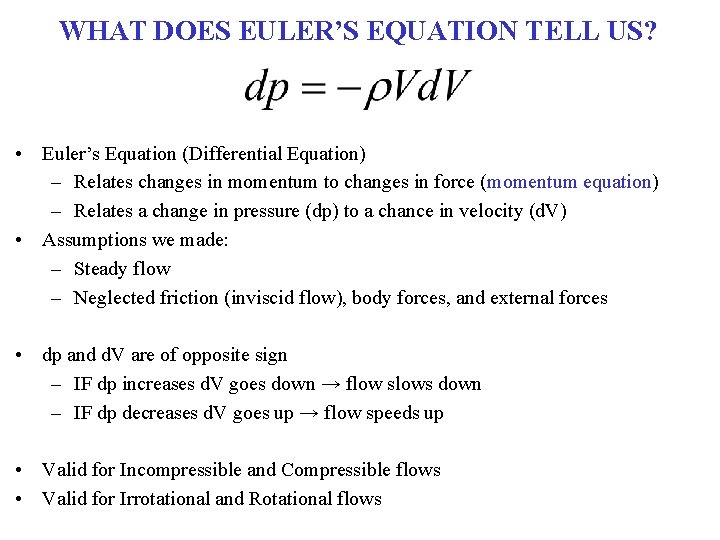
WHAT DOES EULER’S EQUATION TELL US? • Euler’s Equation (Differential Equation) – Relates changes in momentum to changes in force (momentum equation) – Relates a change in pressure (dp) to a chance in velocity (d. V) • Assumptions we made: – Steady flow – Neglected friction (inviscid flow), body forces, and external forces • dp and d. V are of opposite sign – IF dp increases d. V goes down → flow slows down – IF dp decreases d. V goes up → flow speeds up • Valid for Incompressible and Compressible flows • Valid for Irrotational and Rotational flows
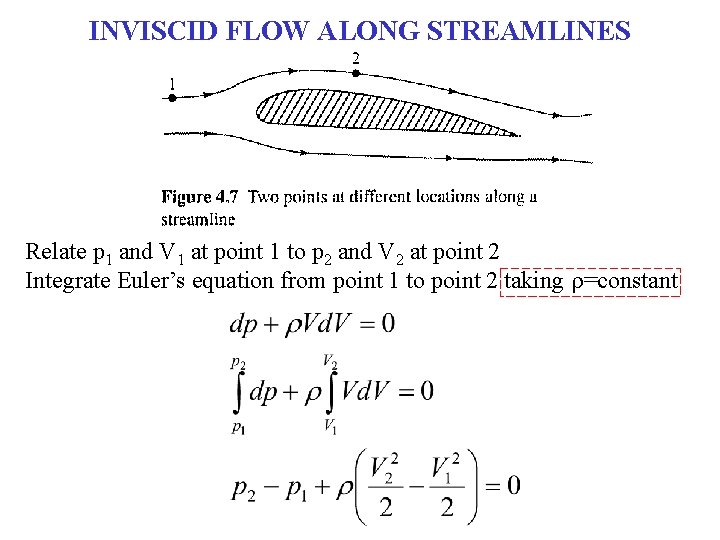
INVISCID FLOW ALONG STREAMLINES Relate p 1 and V 1 at point 1 to p 2 and V 2 at point 2 Integrate Euler’s equation from point 1 to point 2 taking r=constant
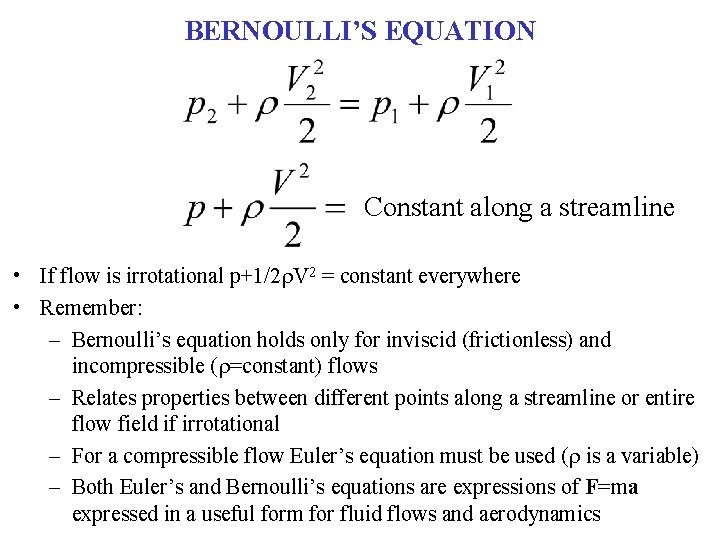
BERNOULLI’S EQUATION Constant along a streamline • If flow is irrotational p+1/2 r. V 2 = constant everywhere • Remember: – Bernoulli’s equation holds only for inviscid (frictionless) and incompressible (r=constant) flows – Relates properties between different points along a streamline or entire flow field if irrotational – For a compressible flow Euler’s equation must be used (r is a variable) – Both Euler’s and Bernoulli’s equations are expressions of F=ma expressed in a useful form for fluid flows and aerodynamics
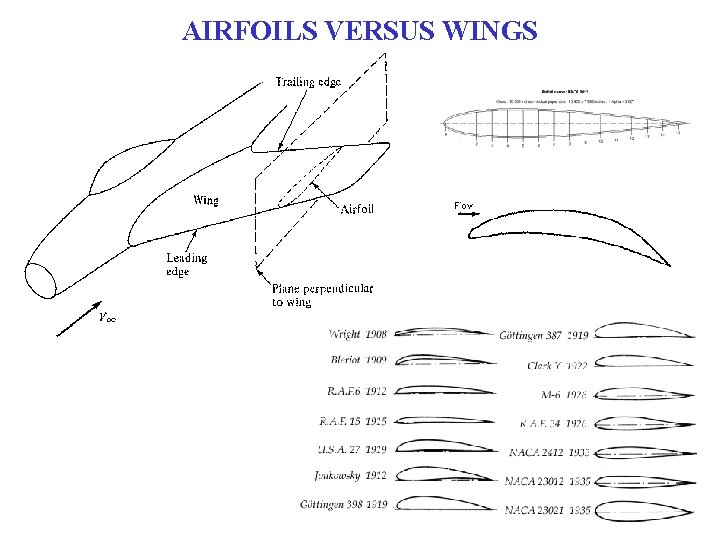
AIRFOILS VERSUS WINGS
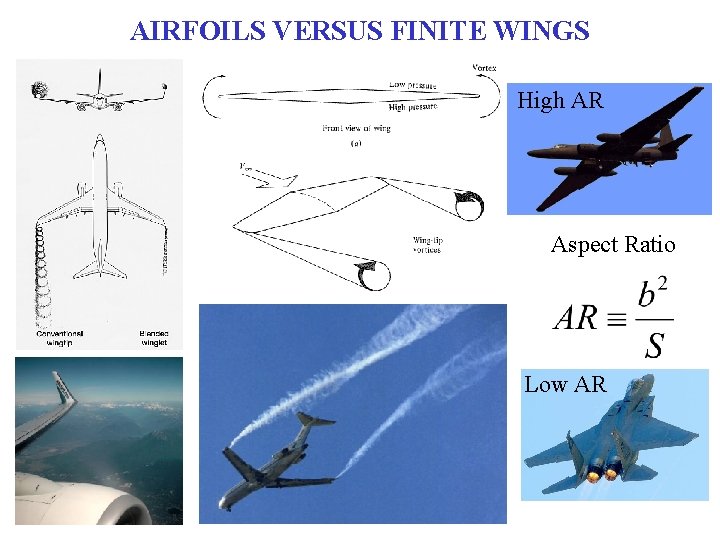
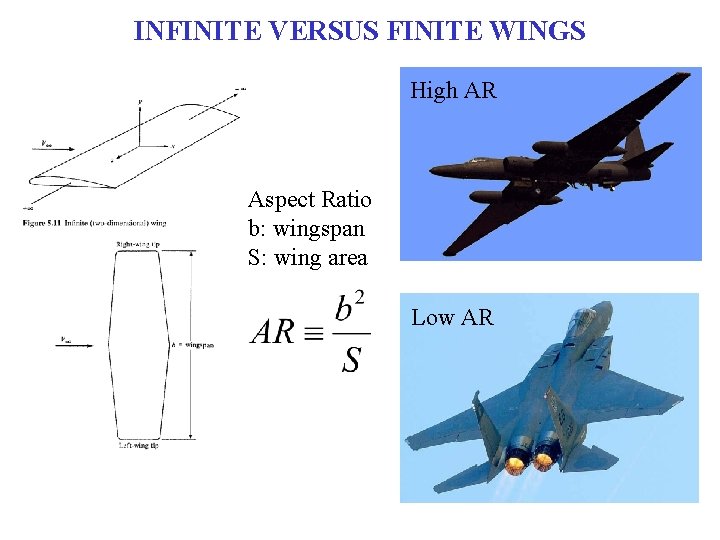
AIRFOILS VERSUS FINITE WINGS High AR Aspect Ratio Low AR
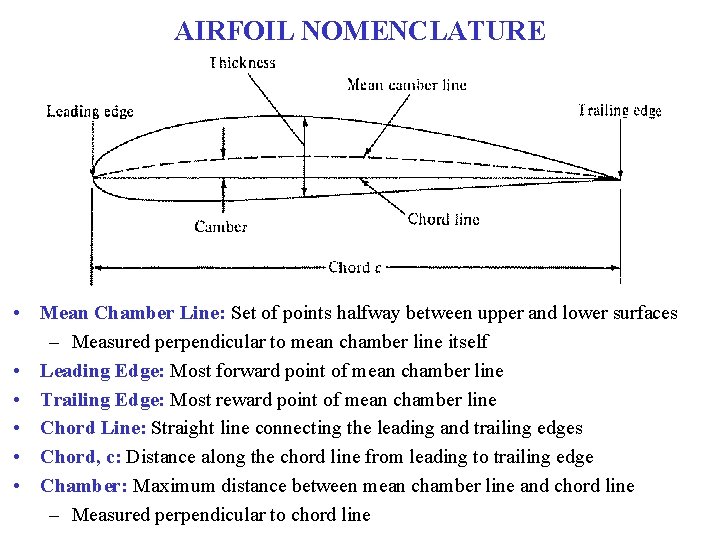
AIRFOIL NOMENCLATURE • Mean Chamber Line: Set of points halfway between upper and lower surfaces – Measured perpendicular to mean chamber line itself • Leading Edge: Most forward point of mean chamber line • Trailing Edge: Most reward point of mean chamber line • Chord Line: Straight line connecting the leading and trailing edges • Chord, c: Distance along the chord line from leading to trailing edge • Chamber: Maximum distance between mean chamber line and chord line – Measured perpendicular to chord line
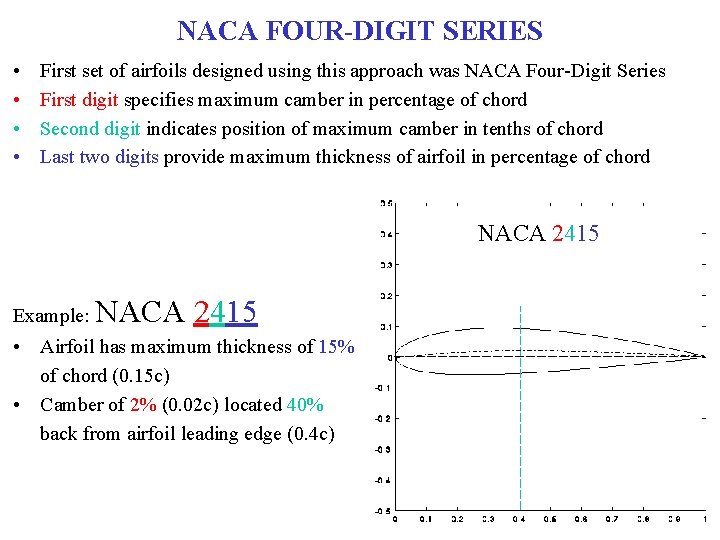
NACA FOUR-DIGIT SERIES • • First set of airfoils designed using this approach was NACA Four-Digit Series First digit specifies maximum camber in percentage of chord Second digit indicates position of maximum camber in tenths of chord Last two digits provide maximum thickness of airfoil in percentage of chord NACA 2415 Example: NACA 2415 • Airfoil has maximum thickness of 15% of chord (0. 15 c) • Camber of 2% (0. 02 c) located 40% back from airfoil leading edge (0. 4 c)
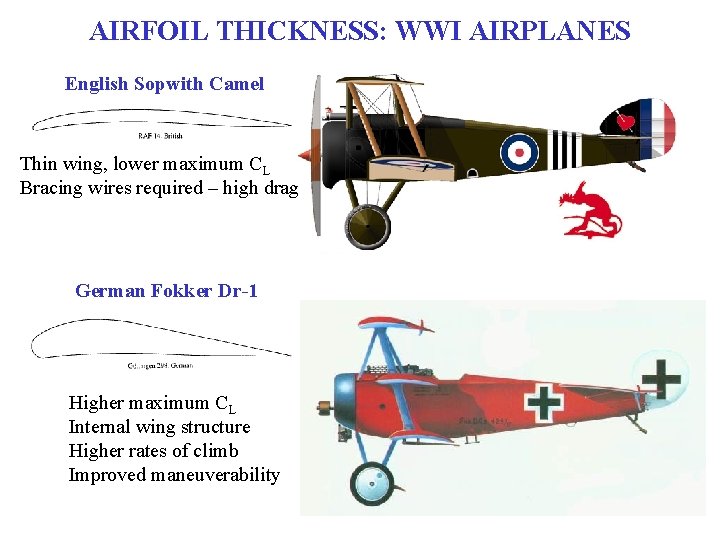
AIRFOIL THICKNESS: WWI AIRPLANES English Sopwith Camel Thin wing, lower maximum CL Bracing wires required – high drag German Fokker Dr-1 Higher maximum CL Internal wing structure Higher rates of climb Improved maneuverability
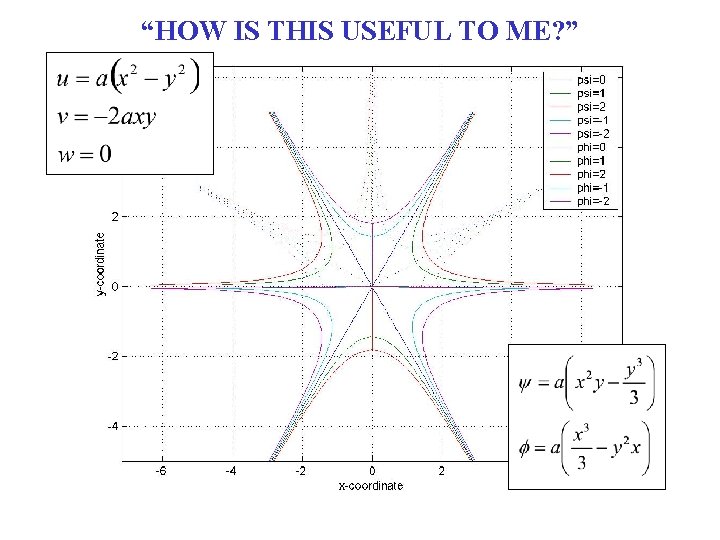
“HOW IS THIS USEFUL TO ME? ”
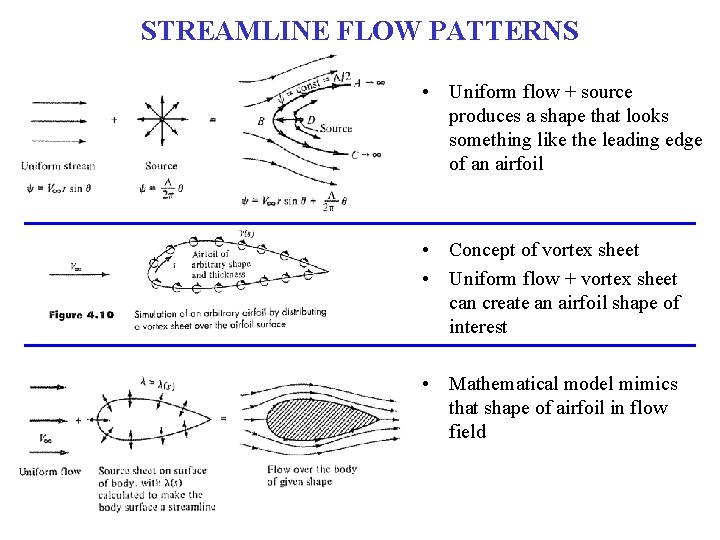
STREAMLINE FLOW PATTERNS • Uniform flow + source produces a shape that looks something like the leading edge of an airfoil • Concept of vortex sheet • Uniform flow + vortex sheet can create an airfoil shape of interest • Mathematical model mimics that shape of airfoil in flow field
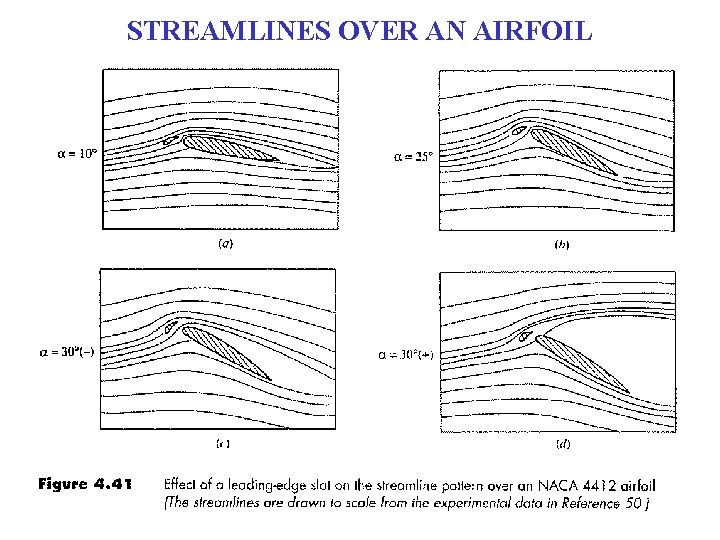
STREAMLINES OVER AN AIRFOIL
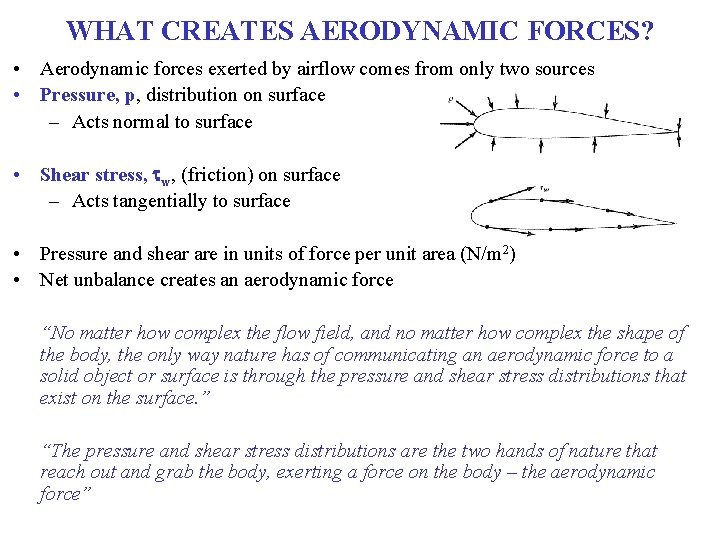
WHAT CREATES AERODYNAMIC FORCES? • Aerodynamic forces exerted by airflow comes from only two sources • Pressure, p, distribution on surface – Acts normal to surface • Shear stress, tw, (friction) on surface – Acts tangentially to surface • Pressure and shear are in units of force per unit area (N/m 2) • Net unbalance creates an aerodynamic force “No matter how complex the flow field, and no matter how complex the shape of the body, the only way nature has of communicating an aerodynamic force to a solid object or surface is through the pressure and shear stress distributions that exist on the surface. ” “The pressure and shear stress distributions are the two hands of nature that reach out and grab the body, exerting a force on the body – the aerodynamic force”
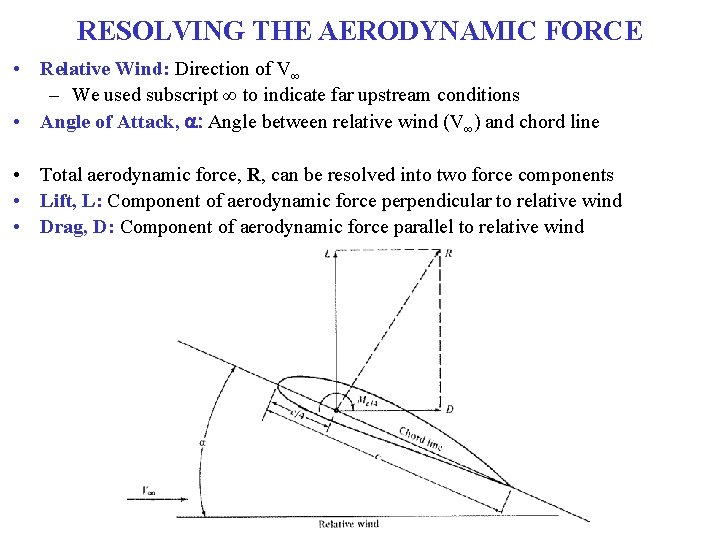
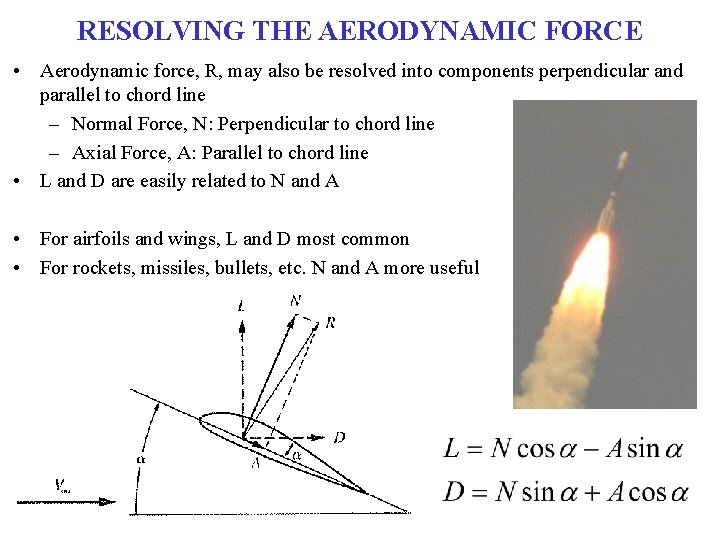
RESOLVING THE AERODYNAMIC FORCE • Relative Wind: Direction of V∞ – We used subscript ∞ to indicate far upstream conditions • Angle of Attack, a: Angle between relative wind (V∞) and chord line • Total aerodynamic force, R, can be resolved into two force components • Lift, L: Component of aerodynamic force perpendicular to relative wind • Drag, D: Component of aerodynamic force parallel to relative wind
RESOLVING THE AERODYNAMIC FORCE • Aerodynamic force, R, may also be resolved into components perpendicular and parallel to chord line – Normal Force, N: Perpendicular to chord line – Axial Force, A: Parallel to chord line • L and D are easily related to N and A • For airfoils and wings, L and D most common • For rockets, missiles, bullets, etc. N and A more useful
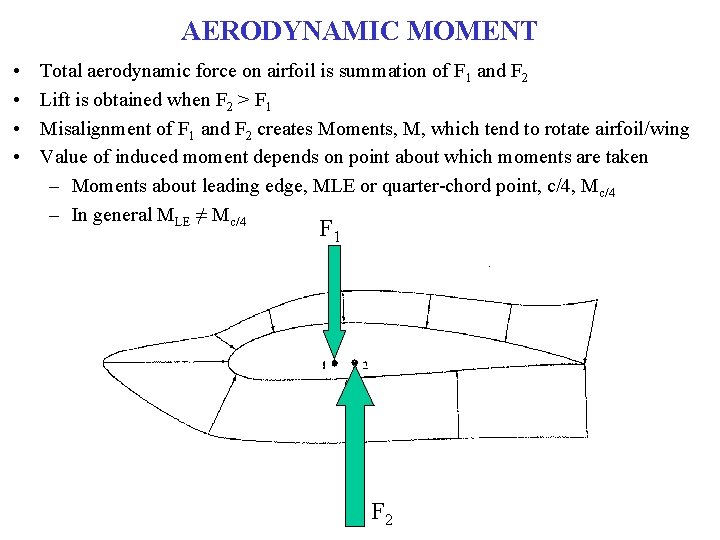
AERODYNAMIC MOMENT • • Total aerodynamic force on airfoil is summation of F 1 and F 2 Lift is obtained when F 2 > F 1 Misalignment of F 1 and F 2 creates Moments, M, which tend to rotate airfoil/wing Value of induced moment depends on point about which moments are taken – Moments about leading edge, MLE or quarter-chord point, c/4, Mc/4 – In general MLE ≠ Mc/4 F 1 F 2
VARIATION OF L, D, AND M WITH a • Lift, Drag and M on a airfoil or wing will change as a changes • Variations of these quantities are some of most important information that an airplane designer needs to know • Aerodynamic Center – Point about which moments essentially do not vary with a – Mac=constant (independent of a) – For low speed airfoils aerodynamic center is near quarter-chord point
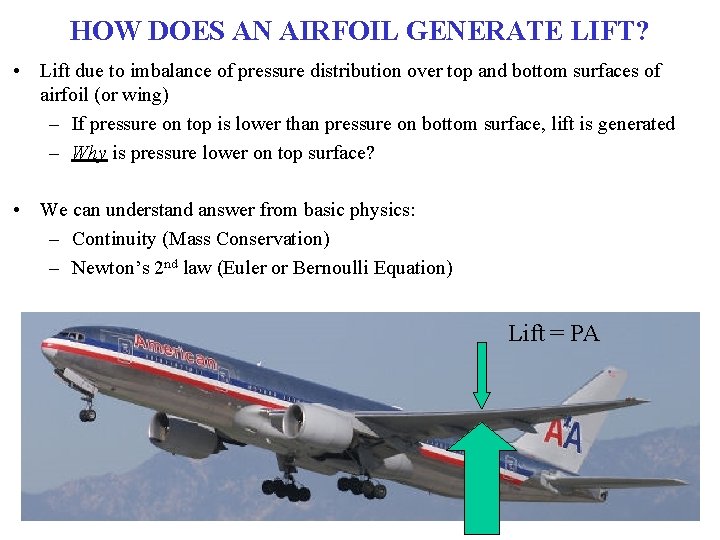
HOW DOES AN AIRFOIL GENERATE LIFT? • Lift due to imbalance of pressure distribution over top and bottom surfaces of airfoil (or wing) – If pressure on top is lower than pressure on bottom surface, lift is generated – Why is pressure lower on top surface? • We can understand answer from basic physics: – Continuity (Mass Conservation) – Newton’s 2 nd law (Euler or Bernoulli Equation) Lift = PA
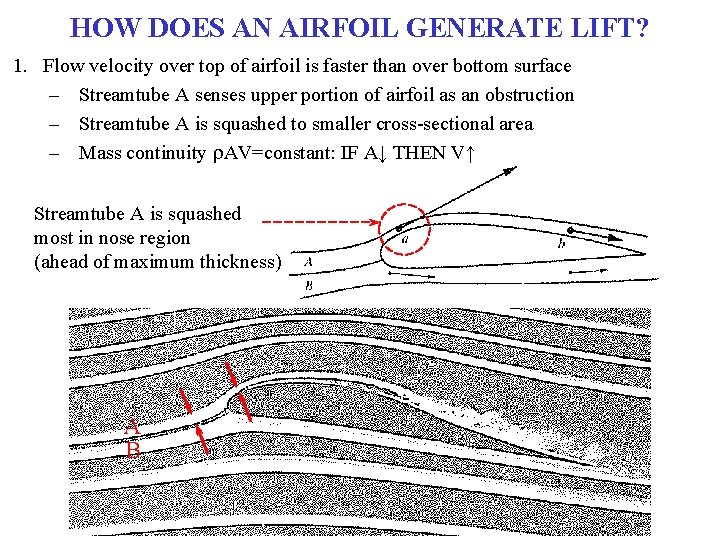
HOW DOES AN AIRFOIL GENERATE LIFT? 1. Flow velocity over top of airfoil is faster than over bottom surface – Streamtube A senses upper portion of airfoil as an obstruction – Streamtube A is squashed to smaller cross-sectional area – Mass continuity r. AV=constant: IF A↓ THEN V↑ Streamtube A is squashed most in nose region (ahead of maximum thickness) A B
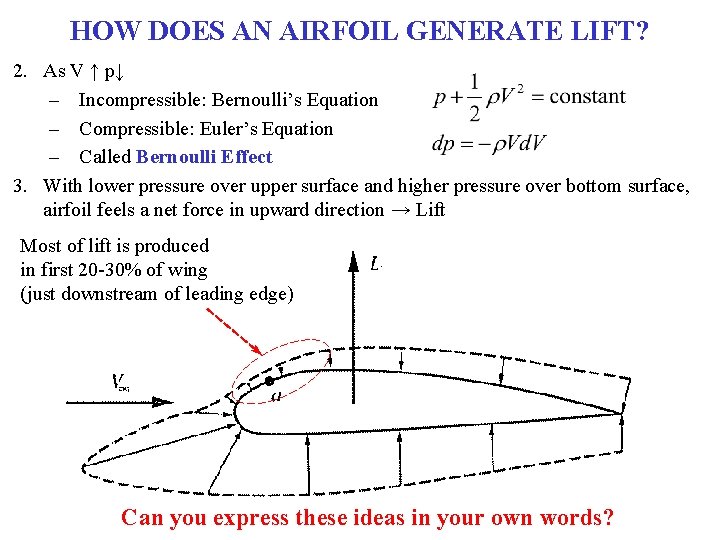
HOW DOES AN AIRFOIL GENERATE LIFT? 2. As V ↑ p↓ – Incompressible: Bernoulli’s Equation – Compressible: Euler’s Equation – Called Bernoulli Effect 3. With lower pressure over upper surface and higher pressure over bottom surface, airfoil feels a net force in upward direction → Lift Most of lift is produced in first 20 -30% of wing (just downstream of leading edge) Can you express these ideas in your own words?
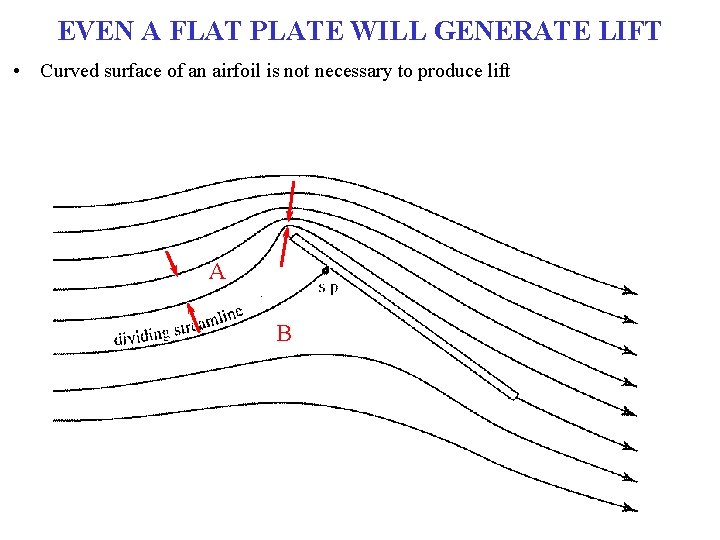
EVEN A FLAT PLATE WILL GENERATE LIFT • Curved surface of an airfoil is not necessary to produce lift A B
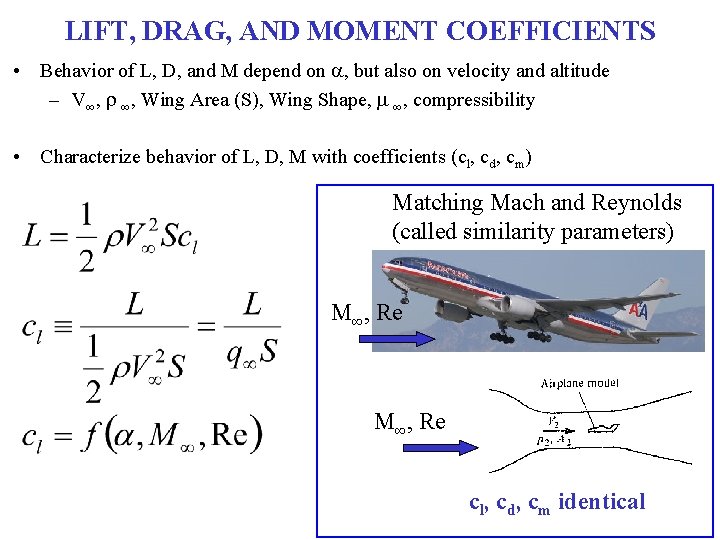
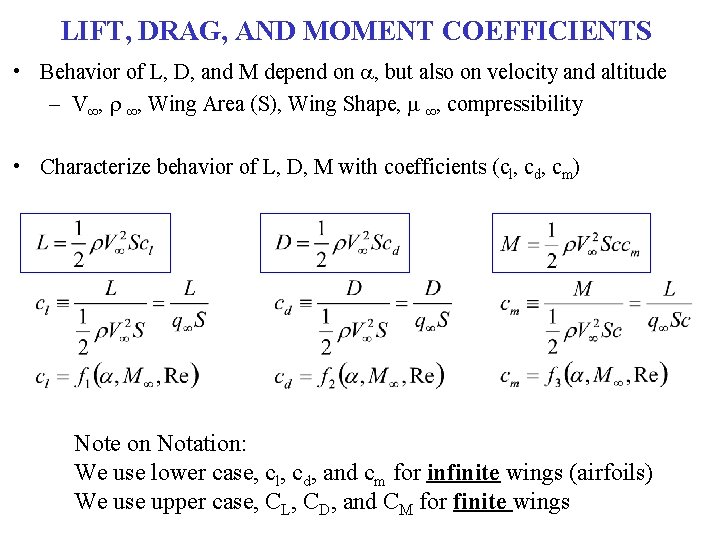
LIFT, DRAG, AND MOMENT COEFFICIENTS • Behavior of L, D, and M depend on a, but also on velocity and altitude – V∞, r ∞, Wing Area (S), Wing Shape, m ∞, compressibility • Characterize behavior of L, D, M with coefficients (cl, cd, cm) Matching Mach and Reynolds (called similarity parameters) M∞, Re cl, cd, cm identical
LIFT, DRAG, AND MOMENT COEFFICIENTS • Behavior of L, D, and M depend on a, but also on velocity and altitude – V∞, r ∞, Wing Area (S), Wing Shape, m ∞, compressibility • Characterize behavior of L, D, M with coefficients (cl, cd, cm) Note on Notation: We use lower case, cl, cd, and cm for infinite wings (airfoils) We use upper case, CL, CD, and CM for finite wings
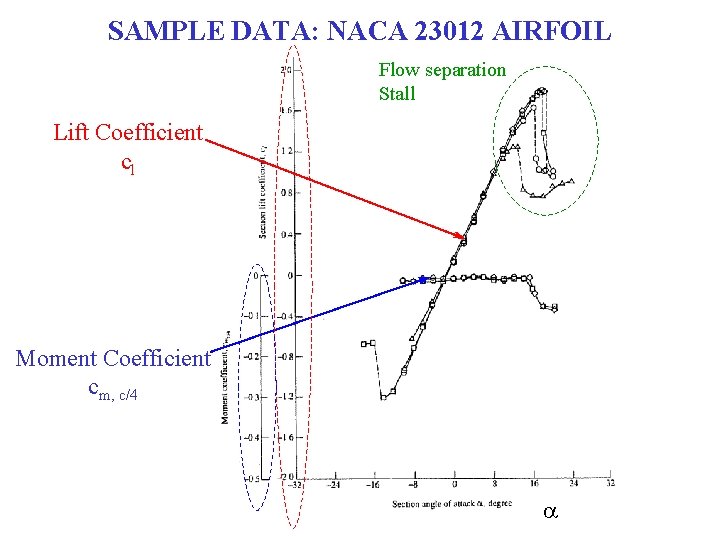
SAMPLE DATA: NACA 23012 AIRFOIL Flow separation Stall Lift Coefficient cl Moment Coefficient cm, c/4 a
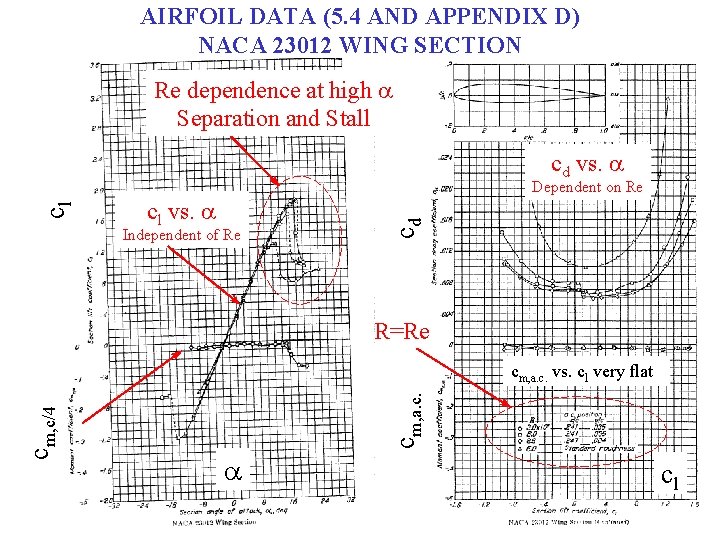
AIRFOIL DATA (5. 4 AND APPENDIX D) NACA 23012 WING SECTION Re dependence at high a Separation and Stall Dependent on Re cl vs. a Independent of Re cd cl cd vs. a R=Re cm, a. c. cm, c/4 cm, a. c. vs. cl very flat a cl
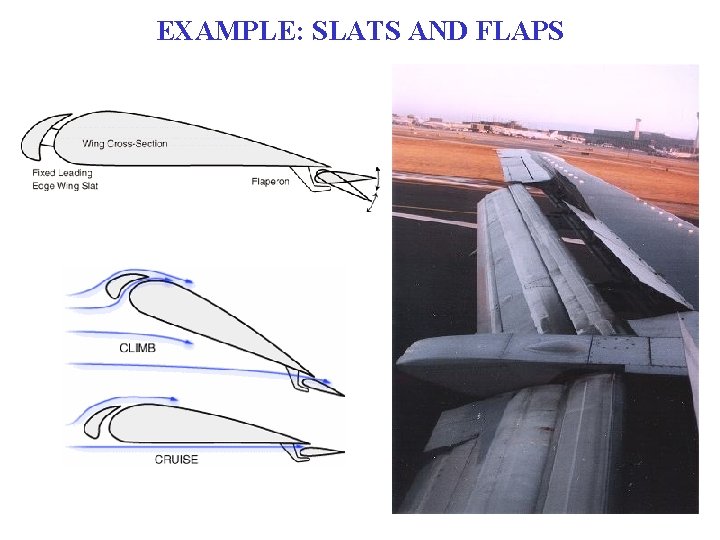
EXAMPLE: SLATS AND FLAPS
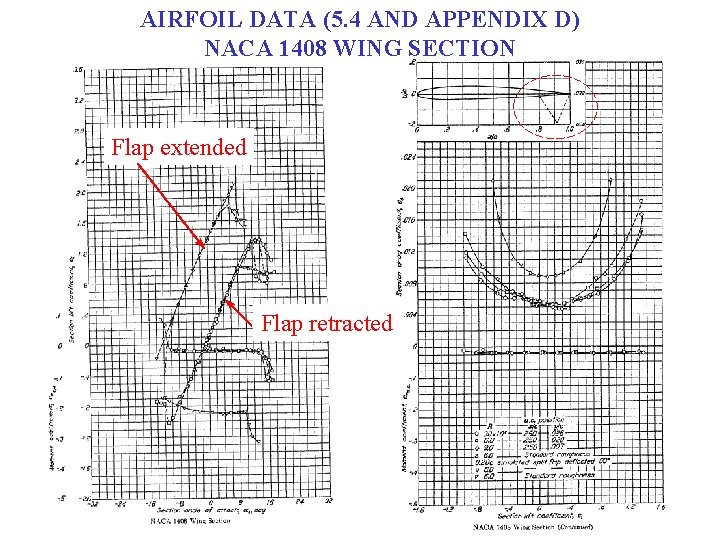
AIRFOIL DATA (5. 4 AND APPENDIX D) NACA 1408 WING SECTION Flap extended Flap retracted
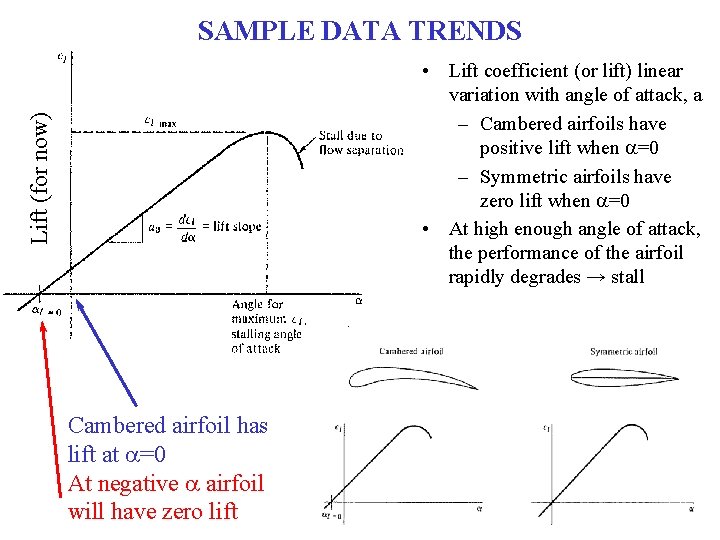
SAMPLE DATA TRENDS Lift (for now) • Lift coefficient (or lift) linear variation with angle of attack, a – Cambered airfoils have positive lift when a=0 – Symmetric airfoils have zero lift when a=0 • At high enough angle of attack, the performance of the airfoil rapidly degrades → stall Cambered airfoil has lift at a=0 At negative a airfoil will have zero lift
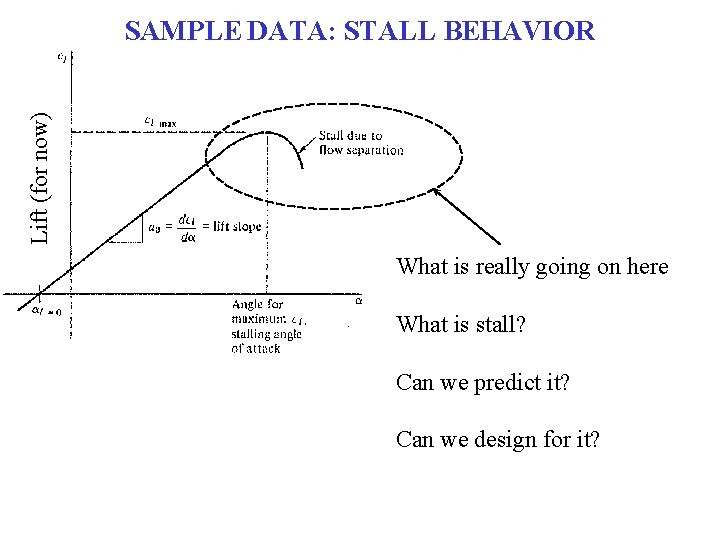
Lift (for now) SAMPLE DATA: STALL BEHAVIOR What is really going on here What is stall? Can we predict it? Can we design for it?
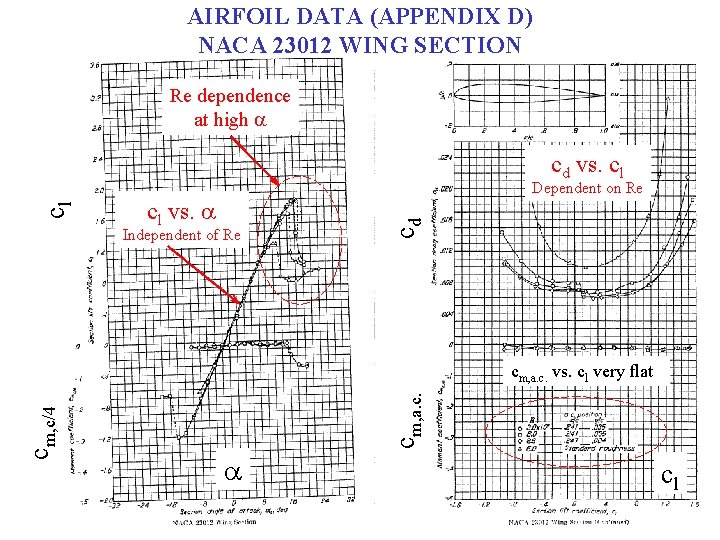
AIRFOIL DATA (APPENDIX D) NACA 23012 WING SECTION Re dependence at high a Dependent on Re cl vs. a Independent of Re cd cl cd vs. cl cm, a. c. cm, c/4 cm, a. c. vs. cl very flat a cl
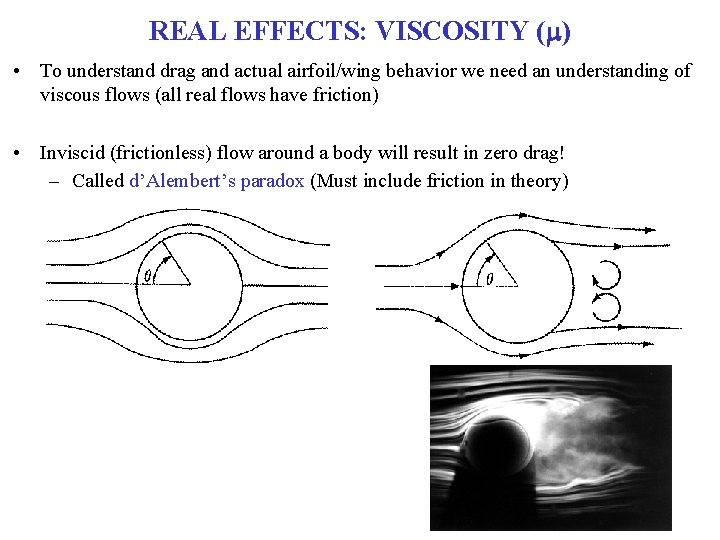
REAL EFFECTS: VISCOSITY (m) • To understand drag and actual airfoil/wing behavior we need an understanding of viscous flows (all real flows have friction) • Inviscid (frictionless) flow around a body will result in zero drag! – Called d’Alembert’s paradox (Must include friction in theory)
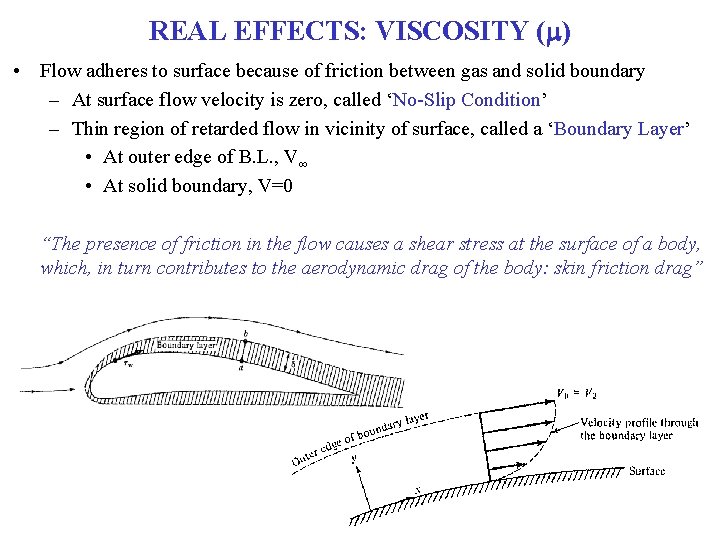
REAL EFFECTS: VISCOSITY (m) • Flow adheres to surface because of friction between gas and solid boundary – At surface flow velocity is zero, called ‘No-Slip Condition’ – Thin region of retarded flow in vicinity of surface, called a ‘Boundary Layer’ • At outer edge of B. L. , V∞ • At solid boundary, V=0 “The presence of friction in the flow causes a shear stress at the surface of a body, which, in turn contributes to the aerodynamic drag of the body: skin friction drag”
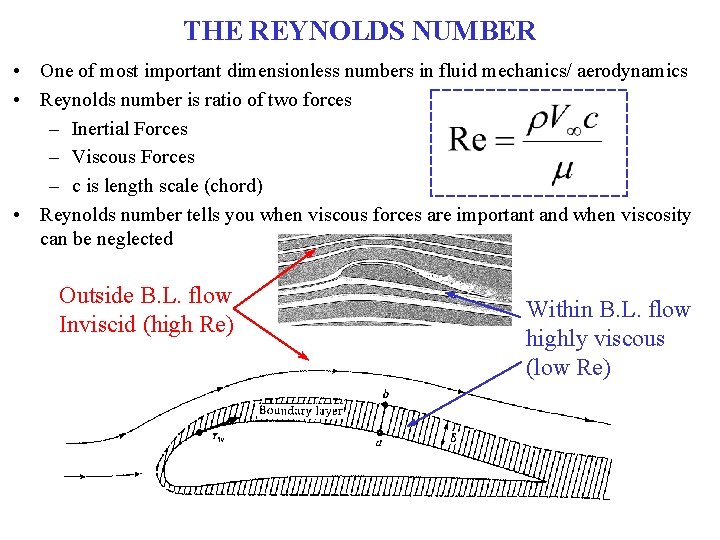
THE REYNOLDS NUMBER • One of most important dimensionless numbers in fluid mechanics/ aerodynamics • Reynolds number is ratio of two forces – Inertial Forces – Viscous Forces – c is length scale (chord) • Reynolds number tells you when viscous forces are important and when viscosity can be neglected Outside B. L. flow Inviscid (high Re) Within B. L. flow highly viscous (low Re)
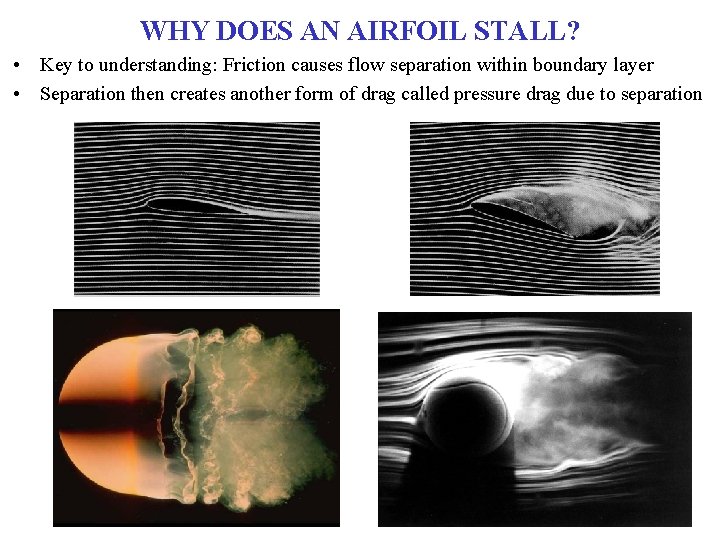
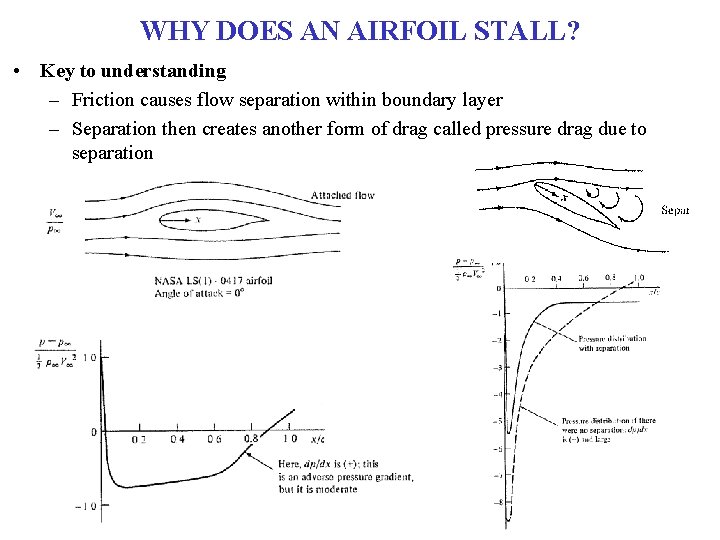
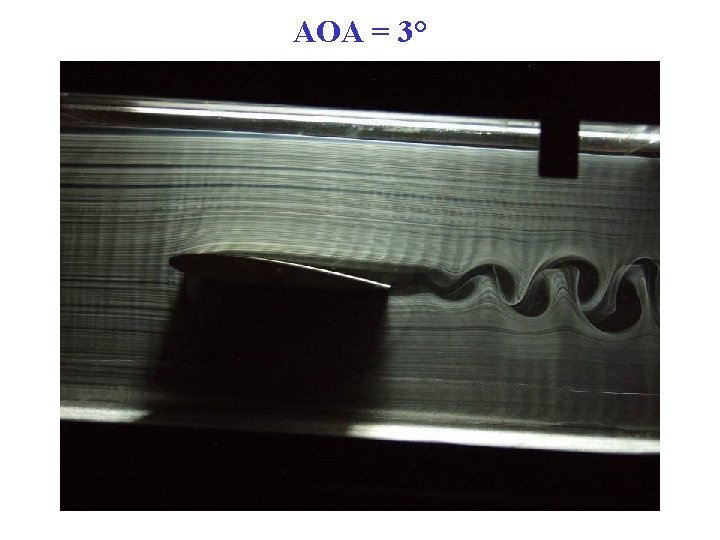
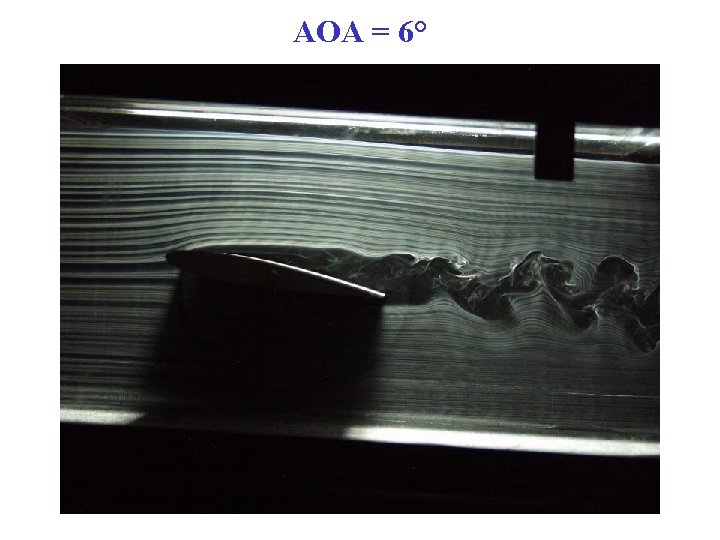
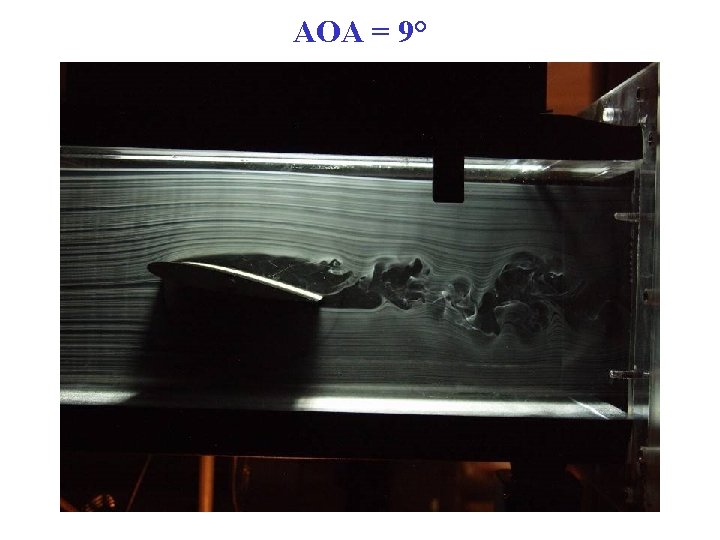
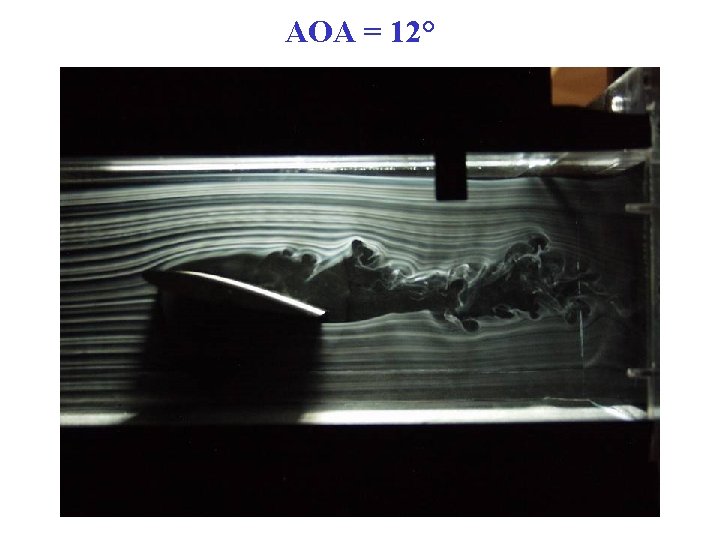
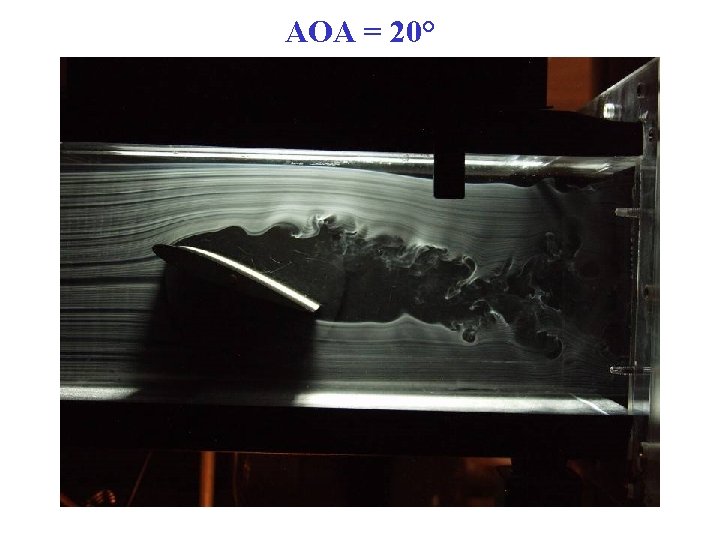
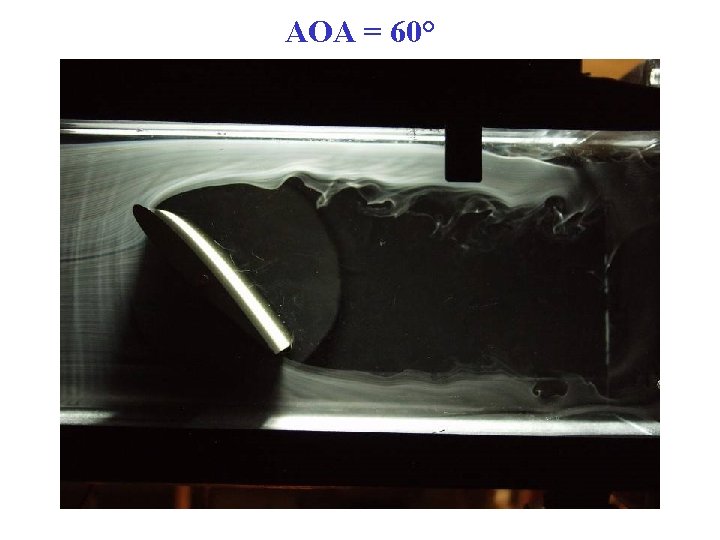
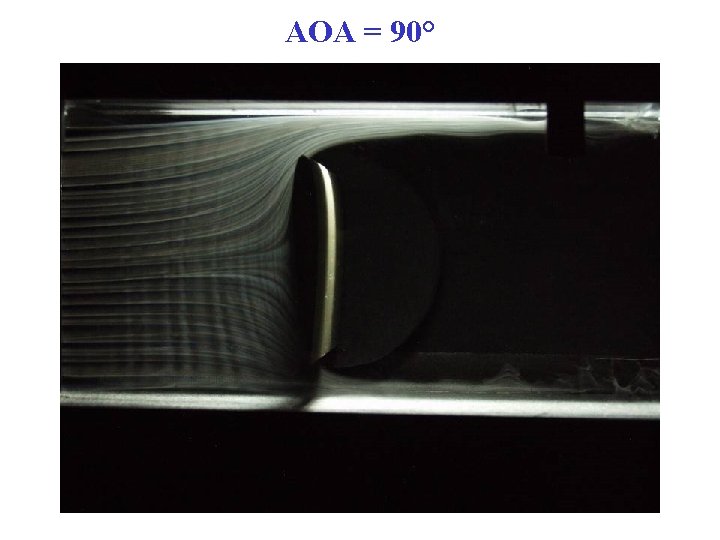
WHY DOES AN AIRFOIL STALL? • Key to understanding: Friction causes flow separation within boundary layer • Separation then creates another form of drag called pressure drag due to separation
WHY DOES AN AIRFOIL STALL? • Key to understanding – Friction causes flow separation within boundary layer – Separation then creates another form of drag called pressure drag due to separation
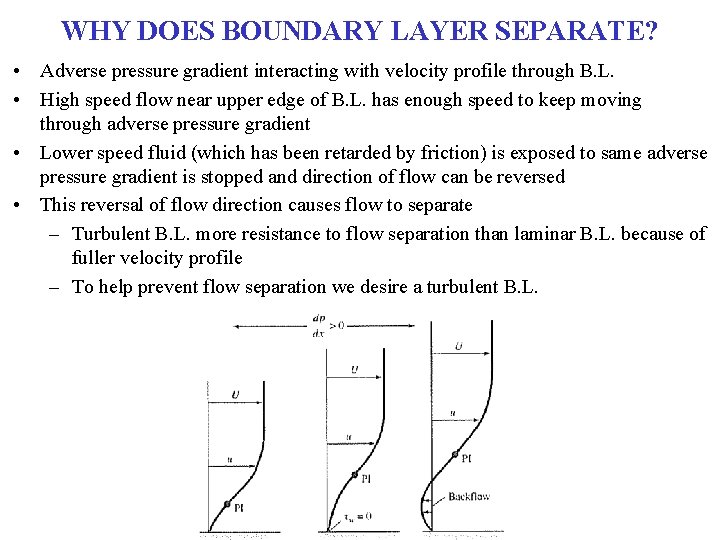
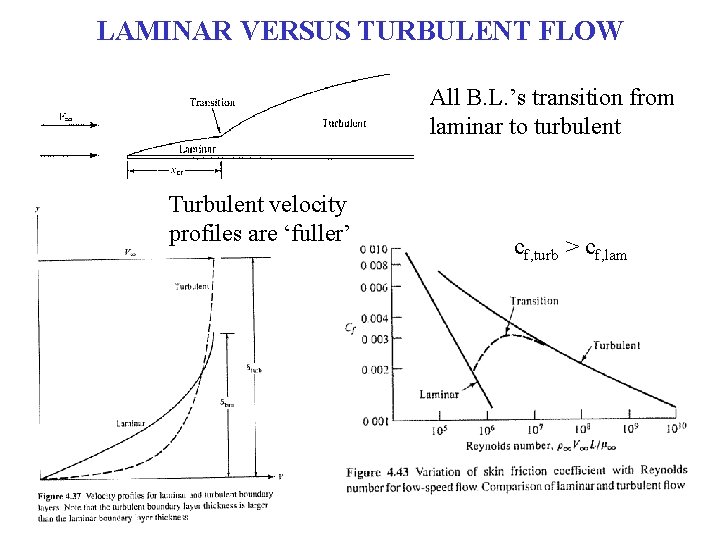
WHY DOES BOUNDARY LAYER SEPARATE? • Adverse pressure gradient interacting with velocity profile through B. L. • High speed flow near upper edge of B. L. has enough speed to keep moving through adverse pressure gradient • Lower speed fluid (which has been retarded by friction) is exposed to same adverse pressure gradient is stopped and direction of flow can be reversed • This reversal of flow direction causes flow to separate – Turbulent B. L. more resistance to flow separation than laminar B. L. because of fuller velocity profile – To help prevent flow separation we desire a turbulent B. L.
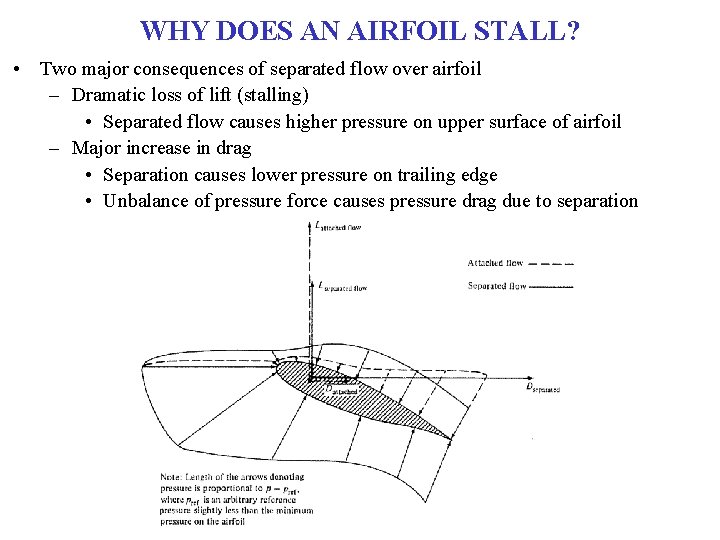
WHY DOES AN AIRFOIL STALL? • Two major consequences of separated flow over airfoil – Dramatic loss of lift (stalling) • Separated flow causes higher pressure on upper surface of airfoil – Major increase in drag • Separation causes lower pressure on trailing edge • Unbalance of pressure force causes pressure drag due to separation
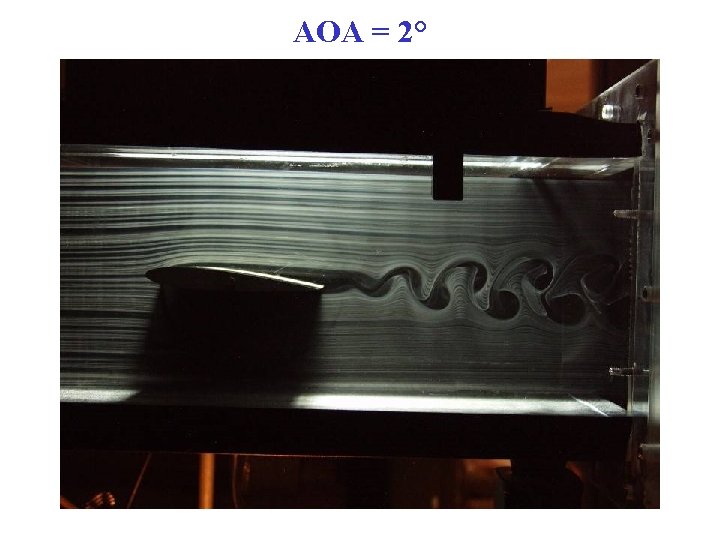
AOA = 2°
AOA = 3°
AOA = 6°
AOA = 9°
AOA = 12°
AOA = 20°
AOA = 60°
AOA = 90°
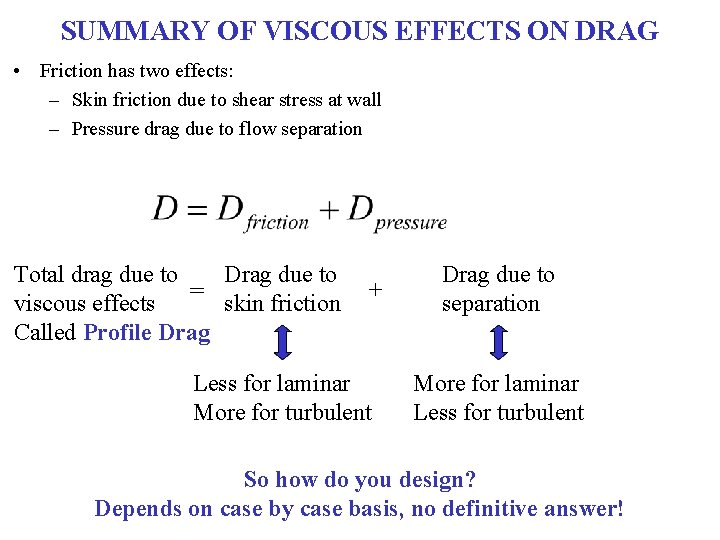
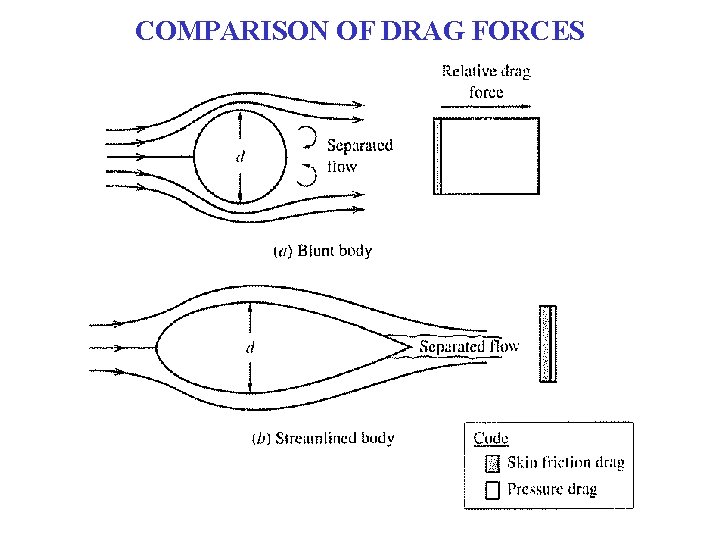
SUMMARY OF VISCOUS EFFECTS ON DRAG • Friction has two effects: – Skin friction due to shear stress at wall – Pressure drag due to flow separation Total drag due to Drag due to = viscous effects skin friction Called Profile Drag + Less for laminar More for turbulent Drag due to separation More for laminar Less for turbulent So how do you design? Depends on case by case basis, no definitive answer!
COMPARISON OF DRAG FORCES
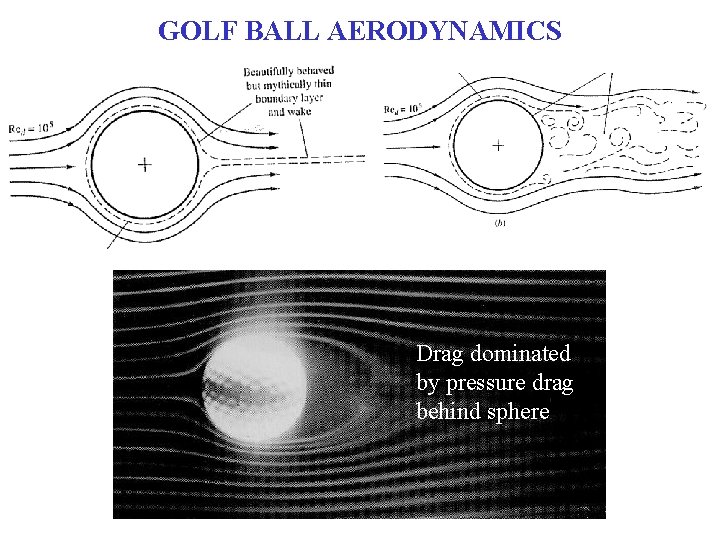
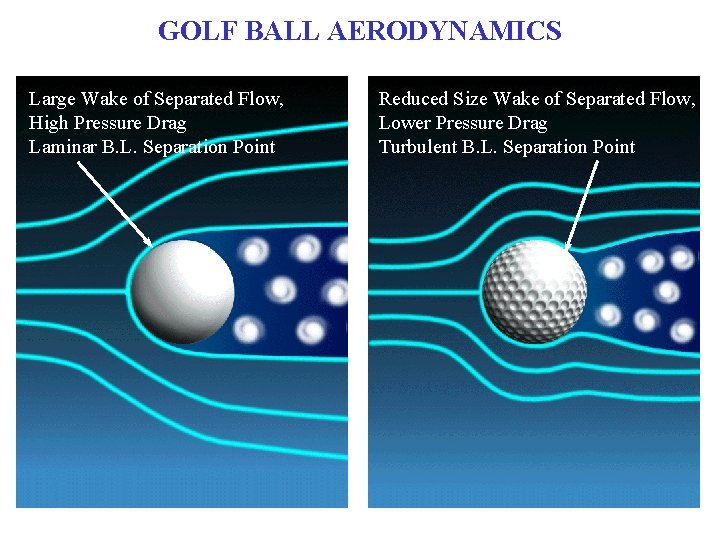
GOLF BALL AERODYNAMICS Drag dominated by pressure drag behind sphere
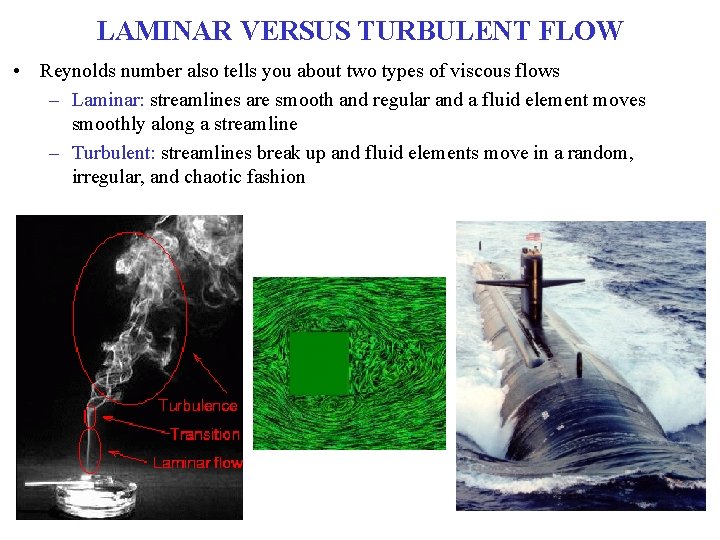
LAMINAR VERSUS TURBULENT FLOW • Reynolds number also tells you about two types of viscous flows – Laminar: streamlines are smooth and regular and a fluid element moves smoothly along a streamline – Turbulent: streamlines break up and fluid elements move in a random, irregular, and chaotic fashion
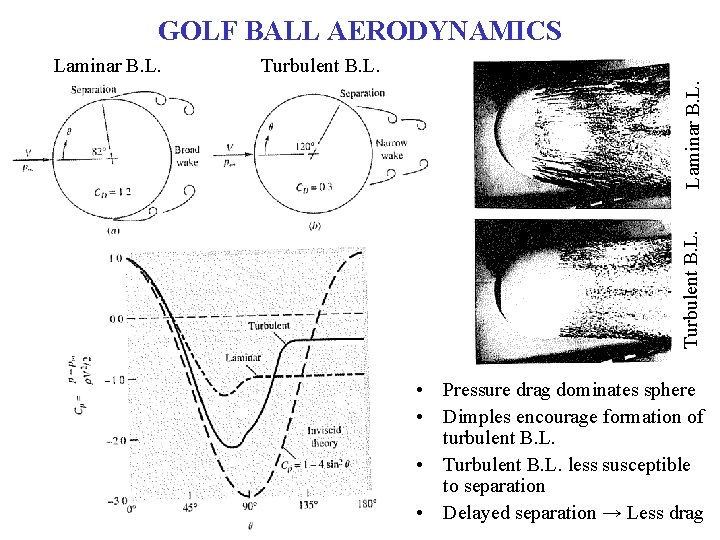
LAMINAR VERSUS TURBULENT FLOW All B. L. ’s transition from laminar to turbulent Turbulent velocity profiles are ‘fuller’ cf, turb > cf, lam
GOLF BALL AERODYNAMICS Large Wake of Separated Flow, High Pressure Drag Laminar B. L. Separation Point Reduced Size Wake of Separated Flow, Lower Pressure Drag Turbulent B. L. Separation Point
GOLF BALL AERODYNAMICS Laminar B. L. Turbulent B. L. Laminar B. L. • Pressure drag dominates sphere • Dimples encourage formation of turbulent B. L. • Turbulent B. L. less susceptible to separation • Delayed separation → Less drag
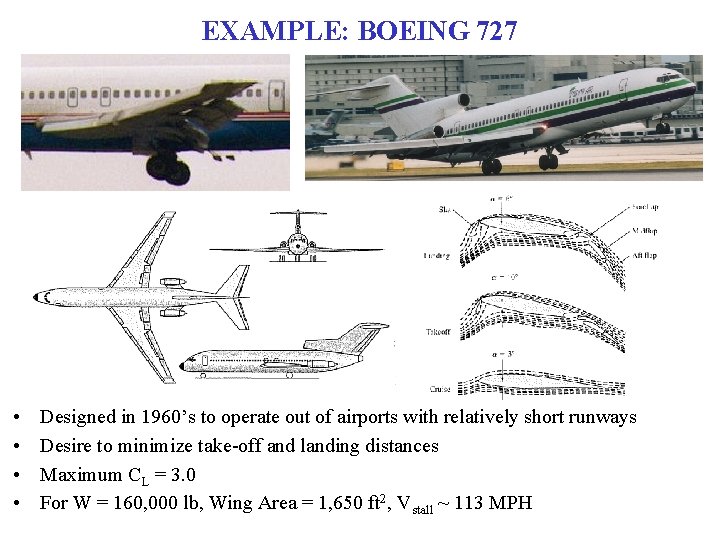
EXAMPLE: BOEING 727 • • Designed in 1960’s to operate out of airports with relatively short runways Desire to minimize take-off and landing distances Maximum CL = 3. 0 For W = 160, 000 lb, Wing Area = 1, 650 ft 2, Vstall ~ 113 MPH
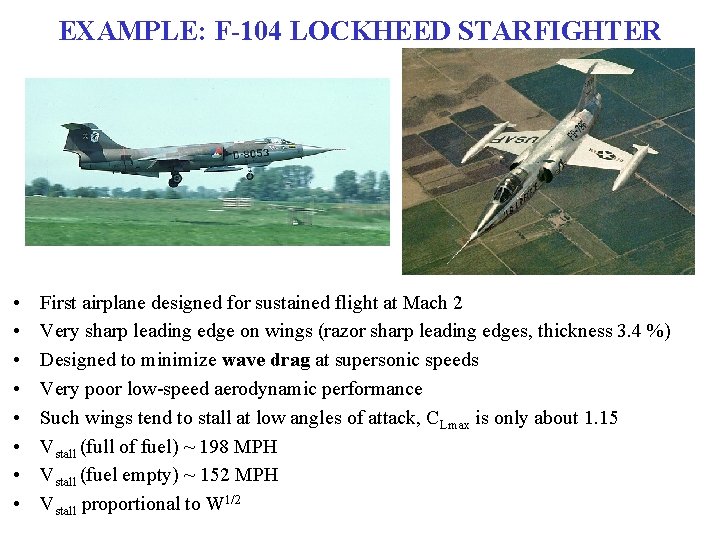
EXAMPLE: F-104 LOCKHEED STARFIGHTER • • First airplane designed for sustained flight at Mach 2 Very sharp leading edge on wings (razor sharp leading edges, thickness 3. 4 %) Designed to minimize wave drag at supersonic speeds Very poor low-speed aerodynamic performance Such wings tend to stall at low angles of attack, CLmax is only about 1. 15 Vstall (full of fuel) ~ 198 MPH Vstall (fuel empty) ~ 152 MPH Vstall proportional to W 1/2
INFINITE VERSUS FINITE WINGS High AR Aspect Ratio b: wingspan S: wing area Low AR