
MAE 3241 AERODYNAMICS AND FLIGHT MECHANICS Further Examples
- Slides: 8
MAE 3241: AERODYNAMICS AND FLIGHT MECHANICS Further Examples of Infinite Wing Implications April 9, 2007 Mechanical and Aerospace Engineering Department Florida Institute of Technology D. R. Kirk
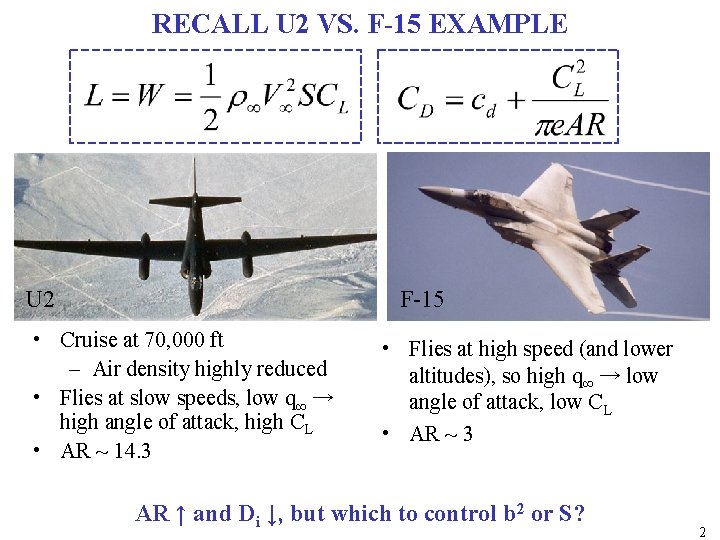
RECALL U 2 VS. F-15 EXAMPLE U 2 F-15 • Cruise at 70, 000 ft – Air density highly reduced • Flies at slow speeds, low q∞ → high angle of attack, high CL • AR ~ 14. 3 • Flies at high speed (and lower altitudes), so high q∞ → low angle of attack, low CL • AR ~ 3 AR ↑ and Di ↓, but which to control b 2 or S? 2
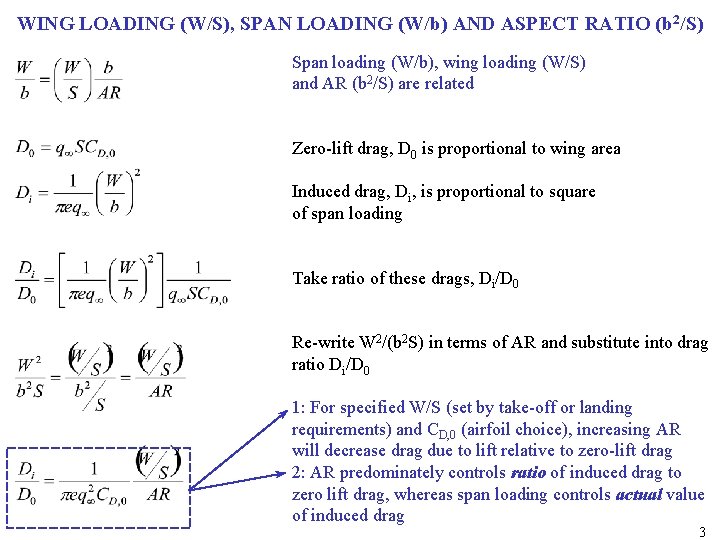
WING LOADING (W/S), SPAN LOADING (W/b) AND ASPECT RATIO (b 2/S) Span loading (W/b), wing loading (W/S) and AR (b 2/S) are related Zero-lift drag, D 0 is proportional to wing area Induced drag, Di, is proportional to square of span loading Take ratio of these drags, Di/D 0 Re-write W 2/(b 2 S) in terms of AR and substitute into drag ratio Di/D 0 1: For specified W/S (set by take-off or landing requirements) and CD, 0 (airfoil choice), increasing AR will decrease drag due to lift relative to zero-lift drag 2: AR predominately controls ratio of induced drag to zero lift drag, whereas span loading controls actual value of induced drag 3
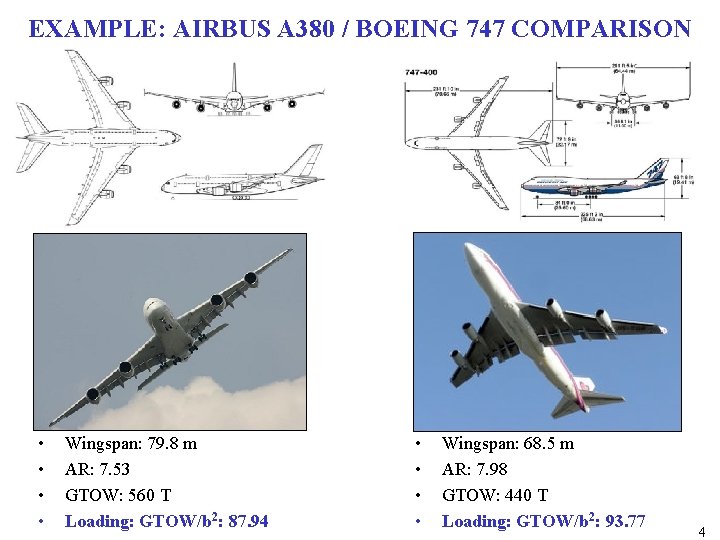
EXAMPLE: AIRBUS A 380 / BOEING 747 COMPARISON • • Wingspan: 79. 8 m AR: 7. 53 GTOW: 560 T Loading: GTOW/b 2: 87. 94 • • Wingspan: 68. 5 m AR: 7. 98 GTOW: 440 T Loading: GTOW/b 2: 93. 77 4
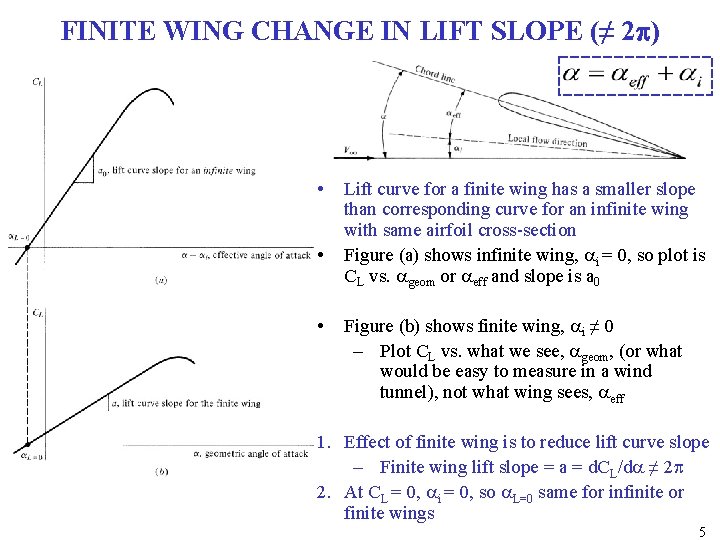
FINITE WING CHANGE IN LIFT SLOPE (≠ 2 p) • • • Lift curve for a finite wing has a smaller slope than corresponding curve for an infinite wing with same airfoil cross-section Figure (a) shows infinite wing, ai = 0, so plot is CL vs. ageom or aeff and slope is a 0 Figure (b) shows finite wing, ai ≠ 0 – Plot CL vs. what we see, ageom, (or what would be easy to measure in a wind tunnel), not what wing sees, aeff 1. Effect of finite wing is to reduce lift curve slope – Finite wing lift slope = a = d. CL/da ≠ 2 p 2. At CL = 0, ai = 0, so a. L=0 same for infinite or finite wings 5
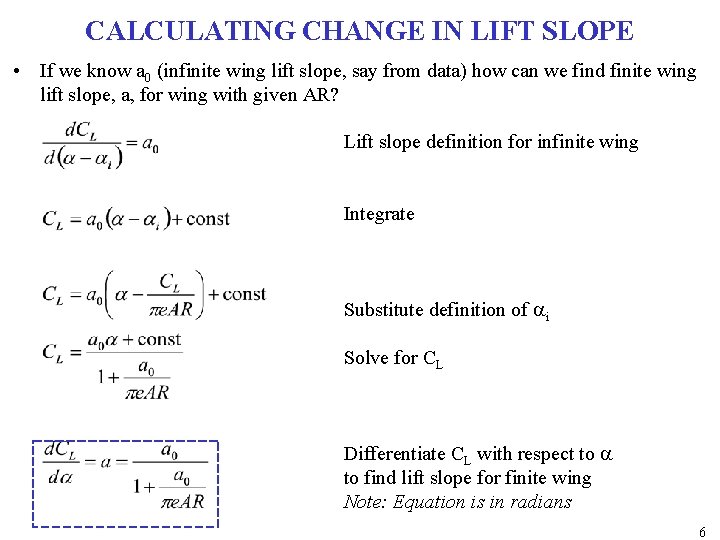
CALCULATING CHANGE IN LIFT SLOPE • If we know a 0 (infinite wing lift slope, say from data) how can we find finite wing lift slope, a, for wing with given AR? Lift slope definition for infinite wing Integrate Substitute definition of ai Solve for CL Differentiate CL with respect to a to find lift slope for finite wing Note: Equation is in radians 6
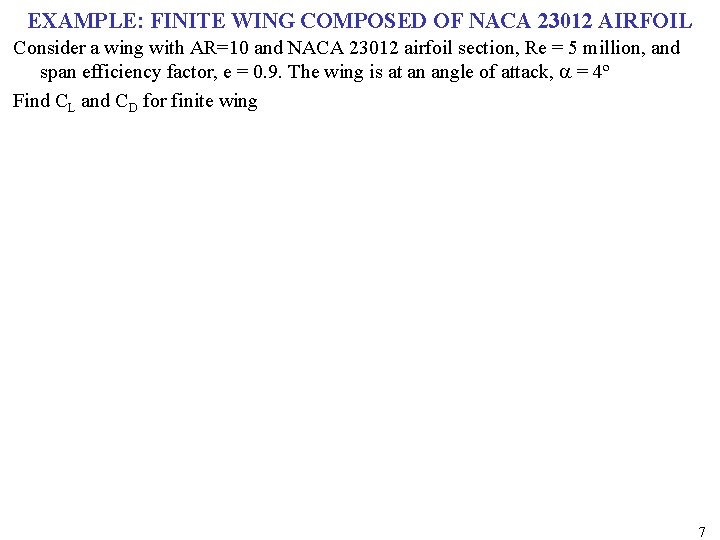
EXAMPLE: FINITE WING COMPOSED OF NACA 23012 AIRFOIL Consider a wing with AR=10 and NACA 23012 airfoil section, Re = 5 million, and span efficiency factor, e = 0. 9. The wing is at an angle of attack, a = 4º Find CL and CD for finite wing 7
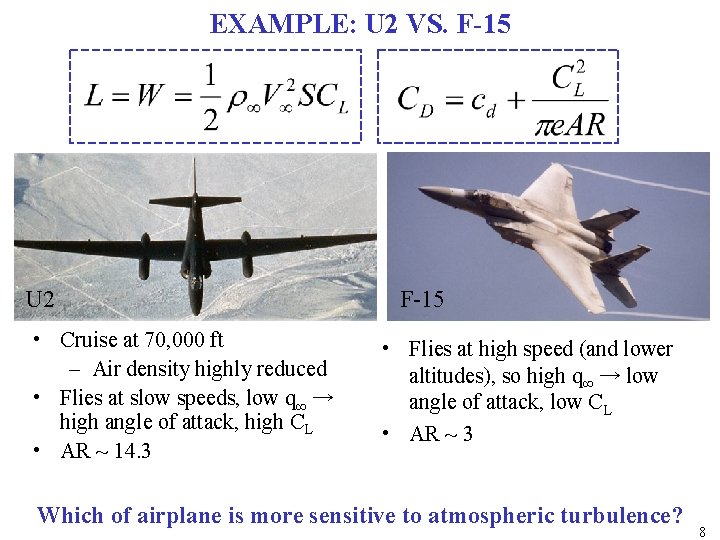
EXAMPLE: U 2 VS. F-15 U 2 • Cruise at 70, 000 ft – Air density highly reduced • Flies at slow speeds, low q∞ → high angle of attack, high CL • AR ~ 14. 3 F-15 • Flies at high speed (and lower altitudes), so high q∞ → low angle of attack, low CL • AR ~ 3 Which of airplane is more sensitive to atmospheric turbulence? 8