
MADES A MultiLayered Adaptive Distributed Event Store Tilmann
MADES - A Multi-Layered, Adaptive, Distributed Event Store Tilmann Rabl Mohammad Sadoghi Kaiwen Zhang Hans-Arno Jacobsen DEBS Conference 2013 MIDDLEWARE SYSTEMS RESEARCH GROUP MSRG. ORG
2 MIDDLEWARE SYSTEMS RESEARCH GROUP MSRG. ORG Abstract Application performance monitoring (APM) is shifting towards capturing and analyzing every event that arises in an enterprise infrastructure. Current APM systems, for example, make it possible to monitor enterprise applications at the granularity of tracing each method invocation (i. e. , an event). Naturally, there is great interest in monitoring these events in real-time to react to system and application failures and in storing the captured information for and extended period of time to enable detailed system analysis, data analytics, and future auditing of trends in the historic data. However, the high insertionrates (up to millions of events per second) and the purposely limited resource, a small fraction of all enterprise resources (i. e. , 1 -2% of the overall system resources), dedicated to APM are the key challenges for applying current data management solutions in this context. Emerging distributed key-value stores, often positioned to operate at this scale, induce additional storage overhead when dealing with relatively small data points (e. g. , method invocation events) inserted at a rate of millions per second. Thus, they are not a promising solution for such an important class of workloads given APM’s highly constrained resource budget. To address these shortcomings, we propose Multilayered, Adaptive, Distributed Event Store (MADES): a massively distributed store for collecting, querying, and storing event data at a rate of millions of events per second. DEBS'13 - (C) 2013, Middleware Systems Research Group, msrg. org
3 MIDDLEWARE SYSTEMS RESEARCH GROUP MSRG. ORG Application Performance Management • Enterprise system architectures ▫ Very complex distributed systems ▫ Need of detailed monitoring ▫ Service level agreements • Application performance management ▫ ▫ ▫ How many transactions fail? Where is the root cause of failure? What is the end to end response time? Which component is the bottleneck? Which and how many transactions are there? DEBS'13 - (C) 2013, Middleware Systems Research Group, msrg. org
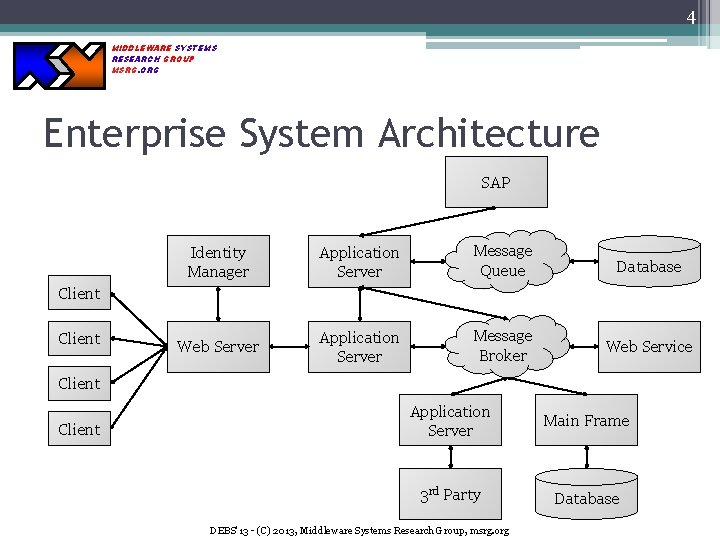
4 MIDDLEWARE SYSTEMS RESEARCH GROUP MSRG. ORG Enterprise System Architecture SAP Identity Manager Application Server Message Queue Database Web Server Application Server Message Broker Web Service Client Application Server Main Frame 3 rd Party Database DEBS'13 - (C) 2013, Middleware Systems Research Group, msrg. org
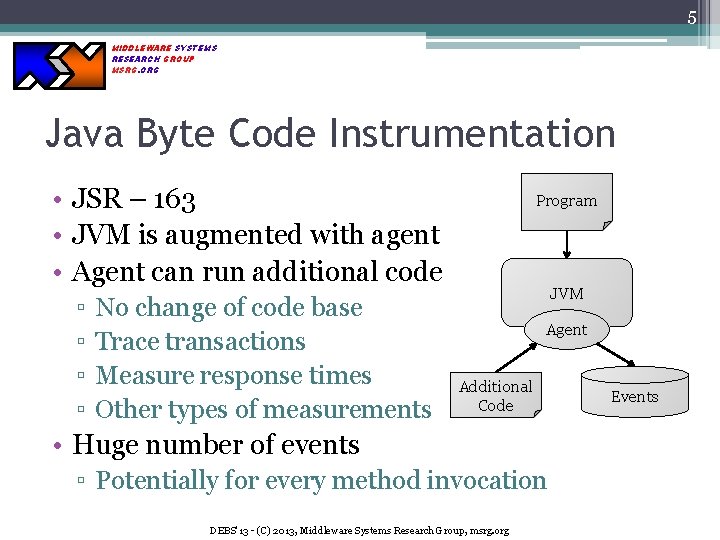
5 MIDDLEWARE SYSTEMS RESEARCH GROUP MSRG. ORG Java Byte Code Instrumentation • JSR – 163 • JVM is augmented with agent • Agent can run additional code ▫ ▫ No change of code base Trace transactions Measure response times Other types of measurements Program JVM Agent Additional Code • Huge number of events ▫ Potentially for every method invocation DEBS'13 - (C) 2013, Middleware Systems Research Group, msrg. org Events
6 MIDDLEWARE SYSTEMS RESEARCH GROUP MSRG. ORG APM Performance Requirements • High insert rates ▫ Millions inserts / sec • High query rates ▫ Thousands queries / sec • Write ratio: >99 % • Agents send data in bulks ▫ Different periods (seconds to minutes) DEBS'13 - (C) 2013, Middleware Systems Research Group, msrg. org
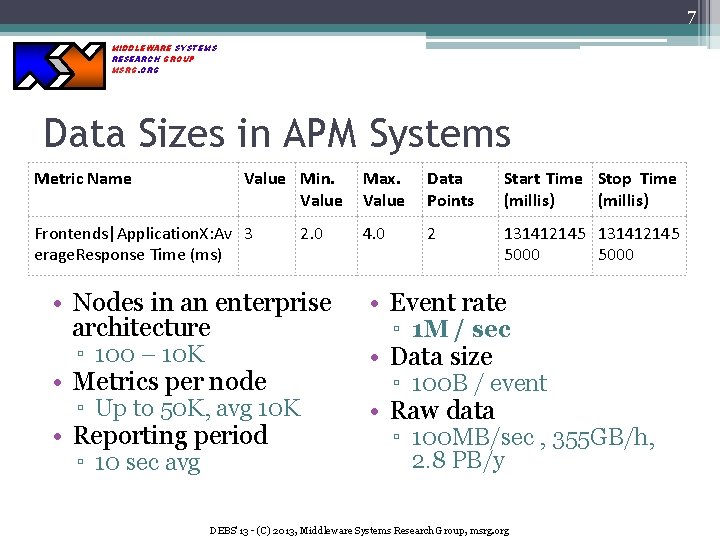
7 MIDDLEWARE SYSTEMS RESEARCH GROUP MSRG. ORG Data Sizes in APM Systems Metric Name Value Min. Value Frontends|Application. X: Av 3 erage. Response Time (ms) 2. 0 • Nodes in an enterprise architecture ▫ 100 – 10 K • Metrics per node ▫ Up to 50 K, avg 10 K • Reporting period ▫ 10 sec avg Max. Value Data Points Start Time Stop Time (millis) 4. 0 2 131412145 5000 • Event rate ▫ 1 M / sec • Data size ▫ 100 B / event • Raw data ▫ 100 MB/sec , 355 GB/h, 2. 8 PB/y DEBS'13 - (C) 2013, Middleware Systems Research Group, msrg. org
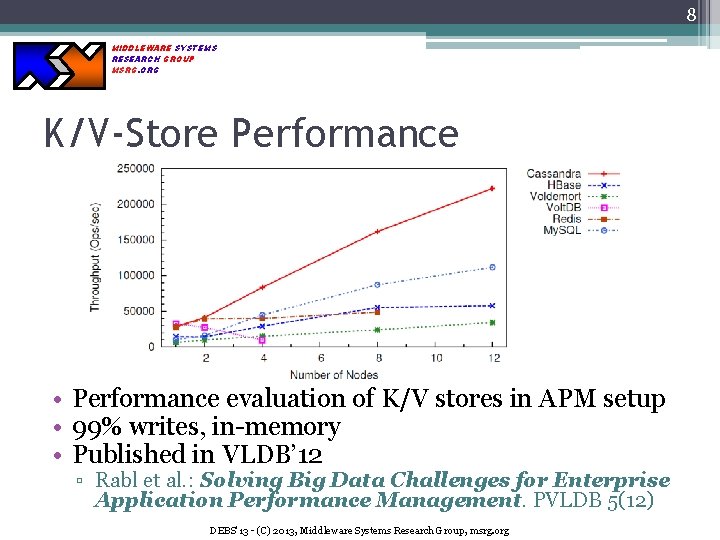
8 MIDDLEWARE SYSTEMS RESEARCH GROUP MSRG. ORG K/V-Store Performance • Performance evaluation of K/V stores in APM setup • 99% writes, in-memory • Published in VLDB’ 12 ▫ Rabl et al. : Solving Big Data Challenges for Enterprise Application Performance Management. PVLDB 5(12) DEBS'13 - (C) 2013, Middleware Systems Research Group, msrg. org
9 MIDDLEWARE SYSTEMS RESEARCH GROUP MSRG. ORG MADES Project • Current system’s performance ▫ YCSB results < 15 K ops / sec ▫ TPC-C results ~ 500 K transactions / sec ▫ VLDB’ 12 results ~ 200 K ops / sec • Need for a new architecture ▫ ▫ ▫ Multi-layered Adaptive Distributed Event Store Highly scalable High write throughput Apart from measurements data mostly static Static queries ØHybrid key-value store DEBS'13 - (C) 2013, Middleware Systems Research Group, msrg. org
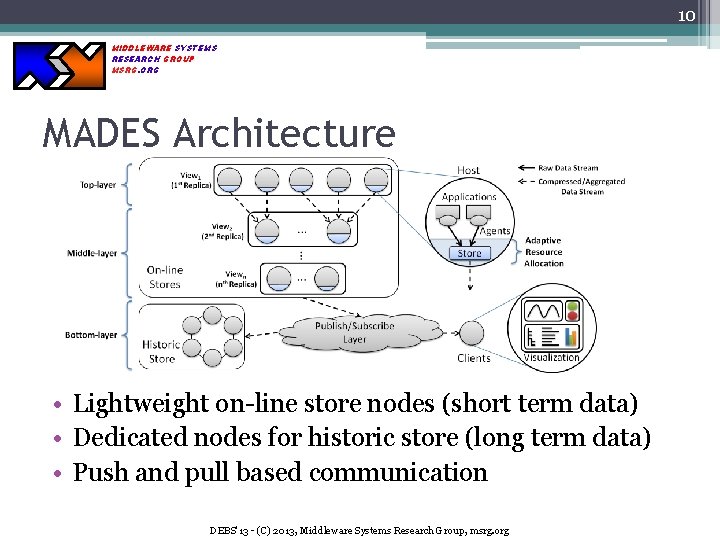
10 MIDDLEWARE SYSTEMS RESEARCH GROUP MSRG. ORG MADES Architecture • Lightweight on-line store nodes (short term data) • Dedicated nodes for historic store (long term data) • Push and pull based communication DEBS'13 - (C) 2013, Middleware Systems Research Group, msrg. org
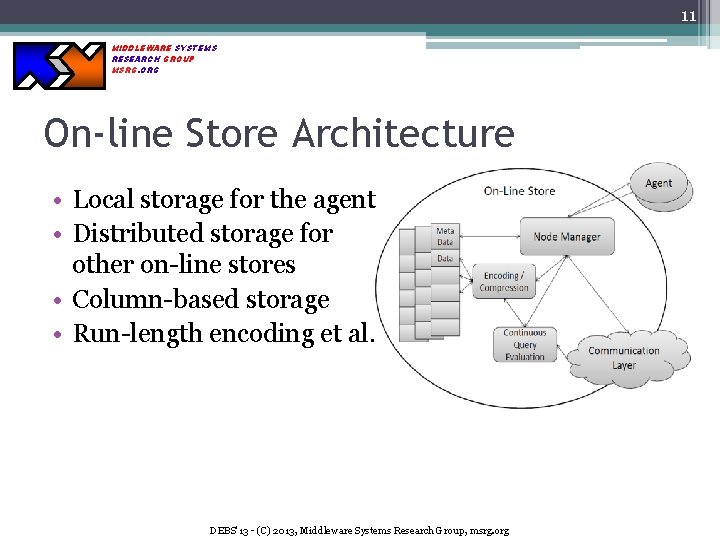
11 MIDDLEWARE SYSTEMS RESEARCH GROUP MSRG. ORG On-line Store Architecture • Local storage for the agent • Distributed storage for other on-line stores • Column-based storage • Run-length encoding et al. DEBS'13 - (C) 2013, Middleware Systems Research Group, msrg. org
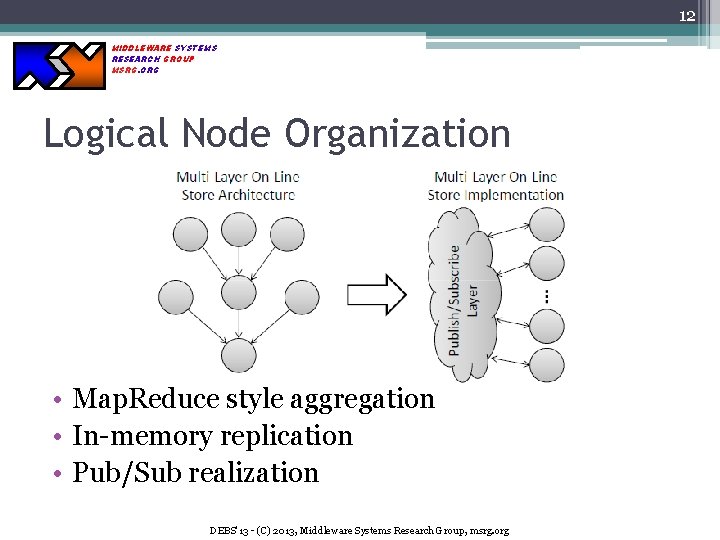
12 MIDDLEWARE SYSTEMS RESEARCH GROUP MSRG. ORG Logical Node Organization • Map. Reduce style aggregation • In-memory replication • Pub/Sub realization DEBS'13 - (C) 2013, Middleware Systems Research Group, msrg. org
13 MIDDLEWARE SYSTEMS RESEARCH GROUP MSRG. ORG Contact • • Tilmann Rabl Mohammad Sadoghi Kaiwen Zhang Hans-Arno Jacobsen DEBS'13 - (C) 2013, Middleware Systems Research Group, msrg. org
- Slides: 13