
MAD AND DEAD MONSTROUS WOMEN TRANSGRESSIVE SEXUALITY AND
![APOTHEOSIS v Laura Diehl describes the “two great climactic ends…prescribed for women [in literature]—madness](https://slidetodoc.com/presentation_image_h/30579900ac25bb00496684b3abe67f85/image-6.jpg "APOTHEOSIS v Laura Diehl describes the “two great climactic ends…prescribed for women [in literature]—madness")
- Slides: 16
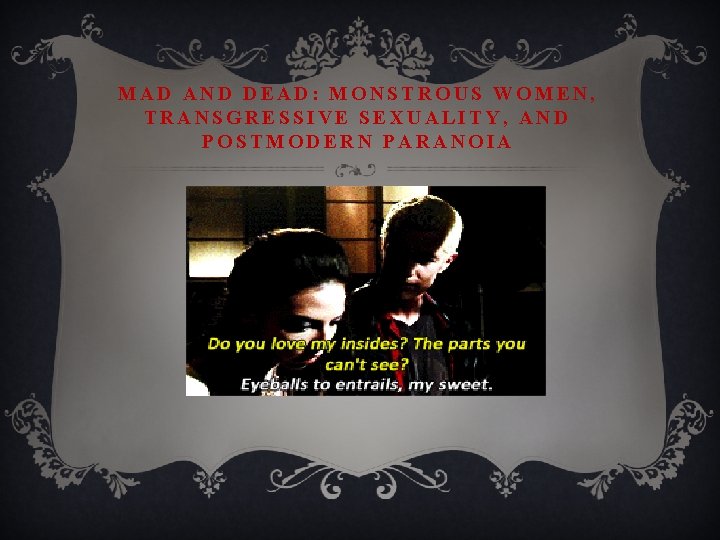
MAD AND DEAD: MONSTROUS WOMEN, TRANSGRESSIVE SEXUALITY, AND POSTMODERN PARANOIA
WHAT ARE YOU TALKING ABOUT? v Once a folkloric symbol for the spread of devastating diseases such as tuberculosis and syphilis, the literary vampire arose as a stand-in for the “safe” exploration of male-on-female rape, distanced from the real-world horror of sexual assault through a monster that penetrates not (usually) with a penis but with animal-like fangs. What do these eternally popular creatures represent when drafted into the fictions of the feminist and queer communities, and what cultural space do they now inhabit, amid the political and social upheavals predicted by postmodernists? What does it mean when a woman is transformed into a vampire—should we read her as predator or power figure? v Disempowered groups have rejected the reading of the vampire as rapist and re-envisioned it as an allegory for queer and female empowerment.
IN THE BEGINNING… v The literary vampire is rooted in misogynist dialogues that modern feminist, radical, and queer writers have reimagined as powerful allegories for feminism and alternative sexual identities. v Amy Kind notes that “[t]ransgressive and violent eroticism links the vampire’s monstrousness to revolution against norms established by patriarchal institutions of religion, science, law, and the nuclear family” (99).
GIRL POWER v Since the early nineteenth century, the vampire frequently has been linked to that most dreaded of creatures, the sexually aggressive woman. v David J. Skal points out that in the latter part of the nineteenth century, the image of the sexual female as vampire began to fuse with issues of liberation and power. Darwinism had led to irrational postulates that such women were prone to “evolutionary backsliding, ” since those who rejected traditional roles were, in effect, subhuman destroyers of society (37).
I LOVE LUCY Female monstrousness is forever linked to sexuality and the fear of women as sexual beings. One of the best-known examples is Lucy Westenra from Bram Stoker’s Dracula. “…[A]s a vampire, Lucy's natural physical attractiveness comes out: her ‘purity’ is turned ‘to voluptuous wantonness’…. [A]ny maternal instincts Lucy had before she was a vampire are perverted—she clutches a child to her chest, but instead of feeding the child, she feeds on it. And when she is interrupted by the men in the graveyard, she ‘fl[ings] [the child] to the ground, callous as a devil’ (Shmoop Editorial Team).
APOTHEOSIS v Laura Diehl describes the “two great climactic ends…prescribed for women [in literature]—madness and death. Death is women’s apotheosis. ” From Greek tragedies to Shakespeare and beyond, the feminine is glorified only when it has been rendered harmless to men by insanity or non-existence. v This notion is brilliantly sabotaged through the character Drusilla in the Buffy the Vampire Slayer and Angel series
DRUSIL LA As a vampire, she “is both mad and dead, yet she nevertheless rises and wreaks as much vengeance upon the symbolic order as she possibly can. ” Though she begins as weak and childlike, she becomes the “repository of patriarchal anxieties over female strength and sexuality…. [H]er mouth is the devouring maw of female sexuality, a nightmarish disturbance…of traditional gender characteristics” (Diehl).
GENDER ROLES v Drusilla’s appetite for children, much like that of Lucy Westenra’s, “mocks misogynist discourses that oppressively tie women to motherhood. Both she and Lucy are demonic mother parodies, women in white who stalk the neighborhood at night” (Diehl). v Lucy was silenced by the phallic symbol embodied in the stake, but Drusilla only grows stronger throughout the course of Buffy until she and her lover, Spike, experience a reversal of heteronormative gender roles. She eventually casts off Spike for being too weak.
REPRODUCTION v Any vampire—male or female—can and does reproduce, in a mockery of the “repressive discourses that bind women’s sexuality to reproduction and motherhood…. Her ‘warm, ’ ‘receiving’ womb…gives birth only to death and destruction, or, to her own desires, a fascinating (if clichéd) inversion of the fetishization of women’s ‘life-giving’ capacities” (Diehl). v Few things are more empowering than the idea that our wombs, rather than constraining us to patriarchal social structures, allow us to create whatever we wish.
COMING OUT v Mimi Marinucci uses the example of Harmony and Cordelia from the Buffy spin-off Angel: “Cordelia senses that Harmony, her old friend from Sunnydale, is attracted to her, but she does not know that Harmony became a vampire…. Harmony refrains from biting Cordelia, who eventually realizes that Harmony was ‘coming out’ to her, not as a lesbian, but as a vampire” (70). v The HBO series True Blood, based on Charlaine Harris’ Southern Vampire Mysteries books and adapted by Alan Ball of Six Feet Under fame, takes a similar if somewhat heavy-handed approach to the metaphor of coming out.
THE QUEER VAMPIRE v Vampirism can be viewed as an “alternative” sexuality and has frequently stood in as a metaphor for the queer community—the vampire’s penetrative, subversive sex act and outsider status are easily coded to gay men in particular, and have been for decades. v The queer vampire “functions as a…parodic subversion of its traditional associations—sexual degeneration and pestilence, decay and disease. Transgressive sexualities have always been coded as monstrous” (Diehl).
IDENTIFICATION v Michael Rowe and Thomas S. Roche overtly identify with this metaphor in their introduction to the 1996 anthology Sons of Darkness: Tales of Men, Blood, and Immortality: v “As queer writers whose work had often dealt with alternative and radical sexuality, we had both developed some alienation from what we felt was the mainstream of society. We had always known what it meant—both metaphorically and literally—to walk the dark streets in the moonlight, finally knowing both the freedom and terror of the night, while our more respectable colleagues slept” (10). v The vampire has thus “become a politically perverse figure for exploring transgressive conceptions of family and community, critiques of origins, alternative potentials for selfhood, and the cultural and social inscriptions of sexual and gendered subjects” (Diehl). Few, if any, other horror tropes can claim such potential for investigation and analysis of the fundamental question of our existence: Who are we, really?
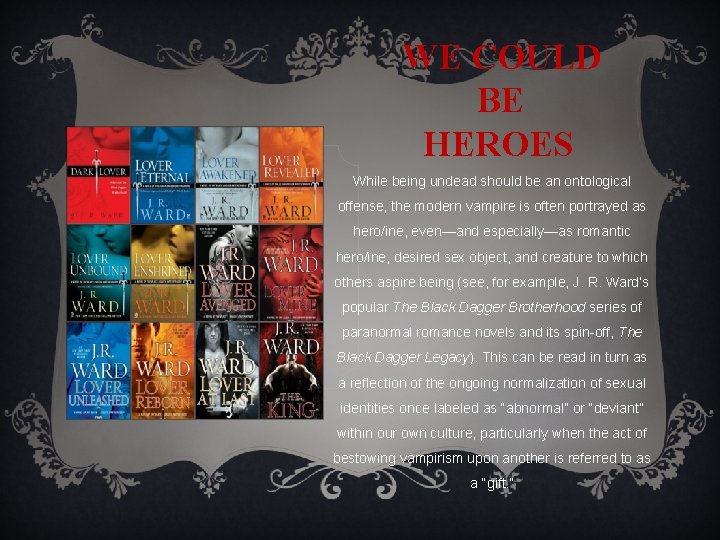
WE COULD BE HEROES While being undead should be an ontological offense, the modern vampire is often portrayed as hero/ine, even—and especially—as romantic hero/ine, desired sex object, and creature to which others aspire being (see, for example, J. R. Ward’s popular The Black Dagger Brotherhood series of paranormal romance novels and its spin-off, The Black Dagger Legacy). This can be read in turn as a reflection of the ongoing normalization of sexual identities once labeled as “abnormal” or “deviant” within our own culture, particularly when the act of bestowing vampirism upon another is referred to as a “gift. ”
IN CONCLUSION… v the vampire in its many guises still holds a great deal of power—and likewise, the ability to empower those who utilize it to explore various sexualities and identities. One cannot help but wonder, then, what form the Trump-era vampire will take in this age of white nationalism, misogyny, and homophobia from a far-right government—themselves predominantly cis-gendered, heterosexual white males—that daily veers closer to full-blown plutocracy. The vampire may well become once again a primary vehicle of rebellion against the bigotry espoused by an administration claiming to be “by the people, for the people. ”
WORKS CITED v Diehl, Laura. “Why Drusilla Is More Interesting Than Buffy. ” Slayage: The Journal of the Whedon Studies Association. Volume 4. 1 -2 Issue 13 -14 (2004): n. pag. PDF. v Kind, Amy. “The Vampire with a Soul: Angel and the Quest for Identity. ” The Philosophy of Horror. Ed. Thomas Fahy. Lexington: The University Press of Kentucky, 2010. 86 -101. Print. v Marinucci, Mimi. “Feminism and the Ethics of Violence: Why Buffy Kicks Ass. ” Buffy the Vampire Slayer and Philosophy: Fear and Trembling in Sunnydale. Ed. James B. South. Popular Culture and Philosophy series. Ed. William Irwin. Chicago and La Salle: Open Court, 2003. Print. v Rowe, Michael and Thomas S. Roche. “Introduction. ” Sons of Darkness: Tales of Men, Blood, and Immortality. Pittsburgh and San Francisco: Cleis Press, 1996. Print. v Shmoop Editorial Team. “Lucy Westenra in Dracula. ” Shmoop University, Inc. , 16 Nov. 2017, https: //www. shmoop. com/dracula/lucy-westenra. html. v Skal, David J. Romancing the Vampire: From Past to Present. Atlanta: Whitman Publishing, 2009. Print.