
MACSSE 474 Theory of Computation More Reduction Examples
- Slides: 35
MA/CSSE 474 Theory of Computation More Reduction Examples Non-SD Reductions
Your Questions? • Previous class days' material • Reading Assignments • HW 15 problems • Anything else
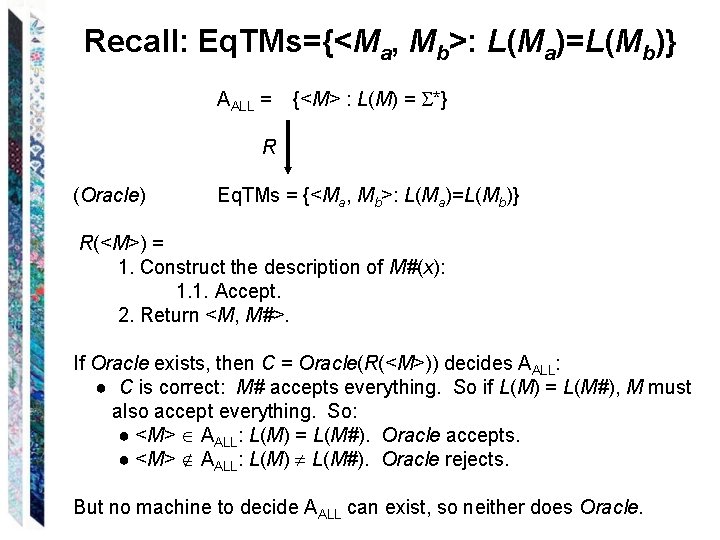
Recall: Eq. TMs={<Ma, Mb>: L(Ma)=L(Mb)} AALL = {<M> : L(M) = *} R (Oracle) Eq. TMs = {<Ma, Mb>: L(Ma)=L(Mb)} R(<M>) = 1. Construct the description of M#(x): 1. 1. Accept. 2. Return <M, M#>. If Oracle exists, then C = Oracle(R(<M>)) decides AALL: ● C is correct: M# accepts everything. So if L(M) = L(M#), M must also accept everything. So: ● <M> AALL: L(M) = L(M#). Oracle accepts. ● <M> AALL: L(M) L(M#). Oracle rejects. But no machine to decide AALL can exist, so neither does Oracle.
A Practical Consequence Consider the problem of virus detection. Suppose that a new virus V is discovered and its code is <V>. ● Is it sufficient for antivirus software to check solely for occurrences of <V>? ● Is it possible for it to check for equivalence to V?
How many Turing machines does it take to change a light bulb?
How many Turing machines does it take to change a light bulb? One. How can you tell whether your Turing machine is the one? You can't!
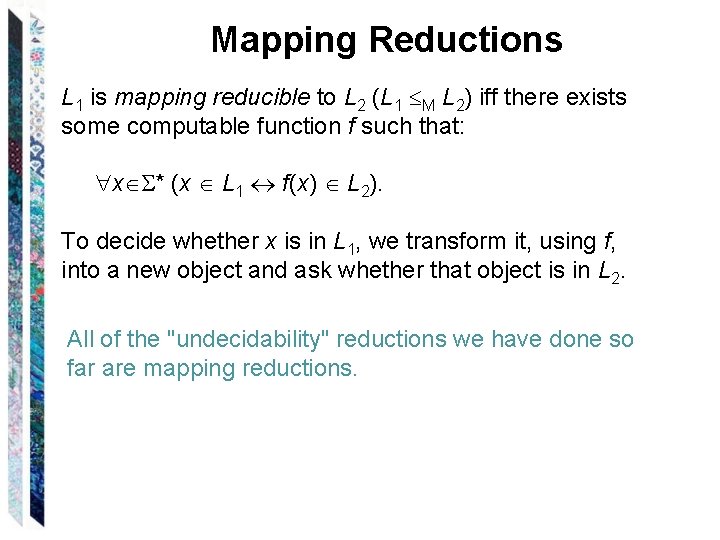
Mapping Reductions L 1 is mapping reducible to L 2 (L 1 M L 2) iff there exists some computable function f such that: x * (x L 1 f(x) L 2). To decide whether x is in L 1, we transform it, using f, into a new object and ask whether that object is in L 2. All of the "undecidability" reductions we have done so far are mapping reductions.
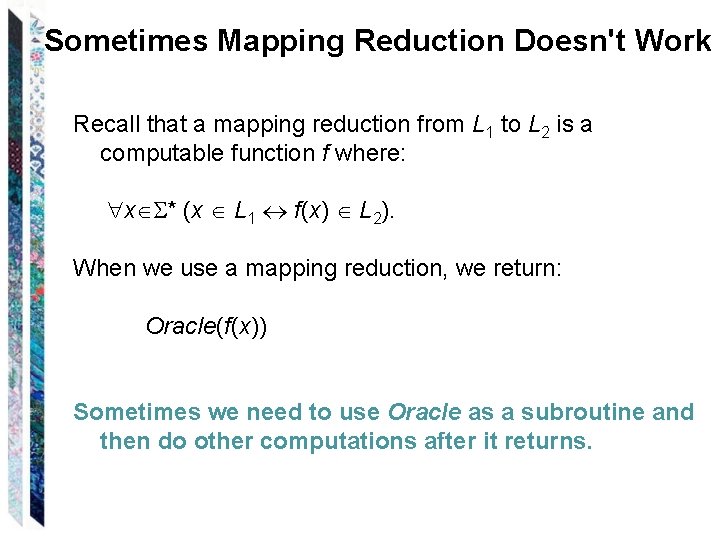
Sometimes Mapping Reduction Doesn't Work Recall that a mapping reduction from L 1 to L 2 is a computable function f where: x * (x L 1 f(x) L 2). When we use a mapping reduction, we return: Oracle(f(x)) Sometimes we need to use Oracle as a subroutine and then do other computations after it returns.
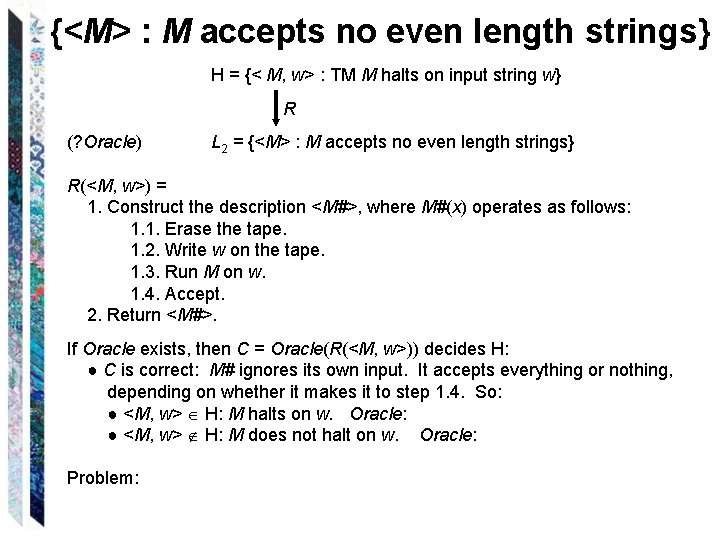
{<M> : M accepts no even length strings} H = {< M, w> : TM M halts on input string w} R (? Oracle) L 2 = {<M> : M accepts no even length strings} R(<M, w>) = 1. Construct the description <M#>, where M#(x) operates as follows: 1. 1. Erase the tape. 1. 2. Write w on the tape. 1. 3. Run M on w. 1. 4. Accept. 2. Return <M#>. If Oracle exists, then C = Oracle(R(<M, w>)) decides H: ● C is correct: M# ignores its own input. It accepts everything or nothing, depending on whether it makes it to step 1. 4. So: ● <M, w> H: M halts on w. Oracle: ● <M, w> H: M does not halt on w. Oracle: Problem:
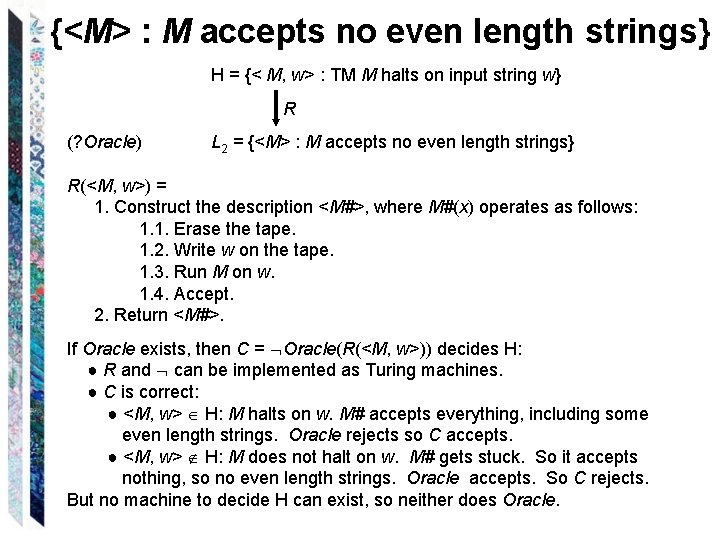
{<M> : M accepts no even length strings} H = {< M, w> : TM M halts on input string w} R (? Oracle) L 2 = {<M> : M accepts no even length strings} R(<M, w>) = 1. Construct the description <M#>, where M#(x) operates as follows: 1. 1. Erase the tape. 1. 2. Write w on the tape. 1. 3. Run M on w. 1. 4. Accept. 2. Return <M#>. If Oracle exists, then C = Oracle(R(<M, w>)) decides H: ● R and can be implemented as Turing machines. ● C is correct: ● <M, w> H: M halts on w. M# accepts everything, including some even length strings. Oracle rejects so C accepts. ● <M, w> H: M does not halt on w. M# gets stuck. So it accepts nothing, so no even length strings. Oracle accepts. So C rejects. But no machine to decide H can exist, so neither does Oracle.
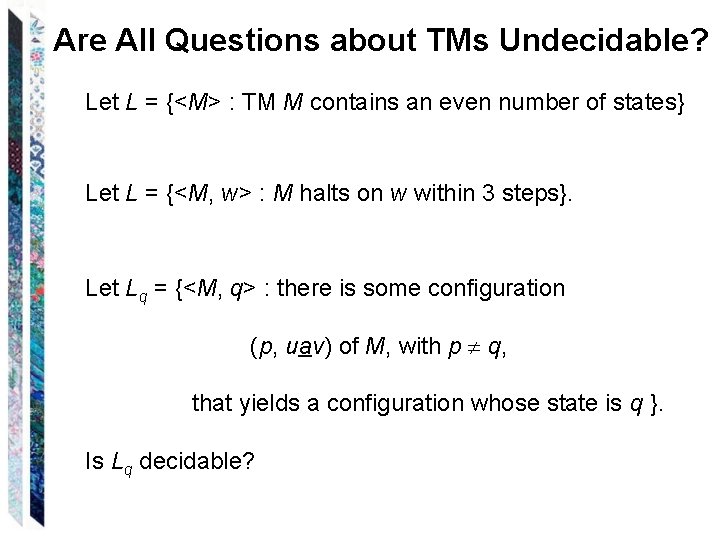
Are All Questions about TMs Undecidable? Let L = {<M> : TM M contains an even number of states} Let L = {<M, w> : M halts on w within 3 steps}. Let Lq = {<M, q> : there is some configuration (p, uav) of M, with p q, that yields a configuration whose state is q }. Is Lq decidable?
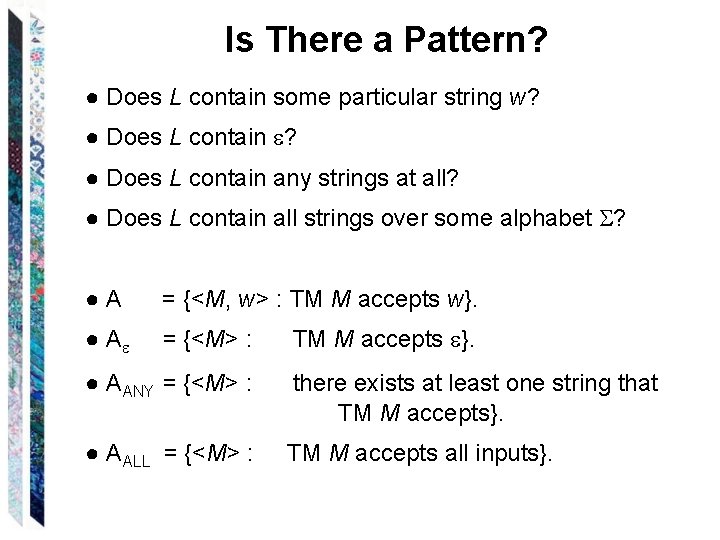
Is There a Pattern? ● Does L contain some particular string w? ● Does L contain any strings at all? ● Does L contain all strings over some alphabet ? ●A = {<M, w> : TM M accepts w}. ● A = {<M> : TM M accepts }. ● AANY = {<M> : there exists at least one string that TM M accepts}. ● AALL = {<M> : TM M accepts all inputs}.
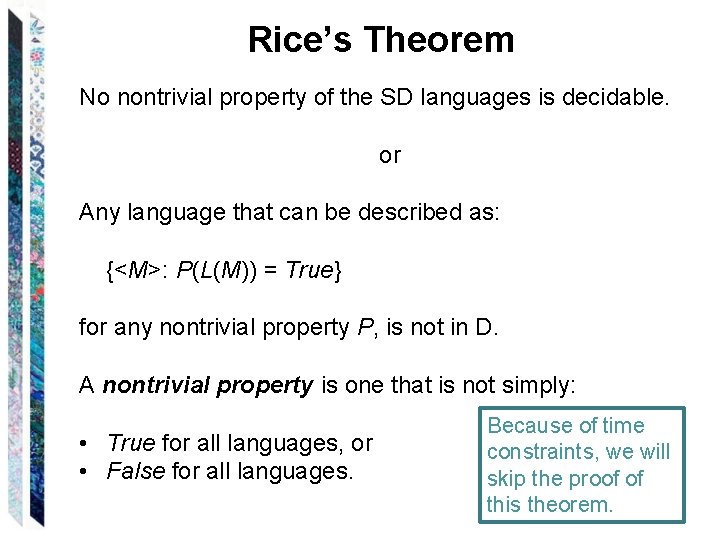
Rice’s Theorem No nontrivial property of the SD languages is decidable. or Any language that can be described as: {<M>: P(L(M)) = True} for any nontrivial property P, is not in D. A nontrivial property is one that is not simply: • True for all languages, or • False for all languages. Because of time constraints, we will skip the proof of this theorem.
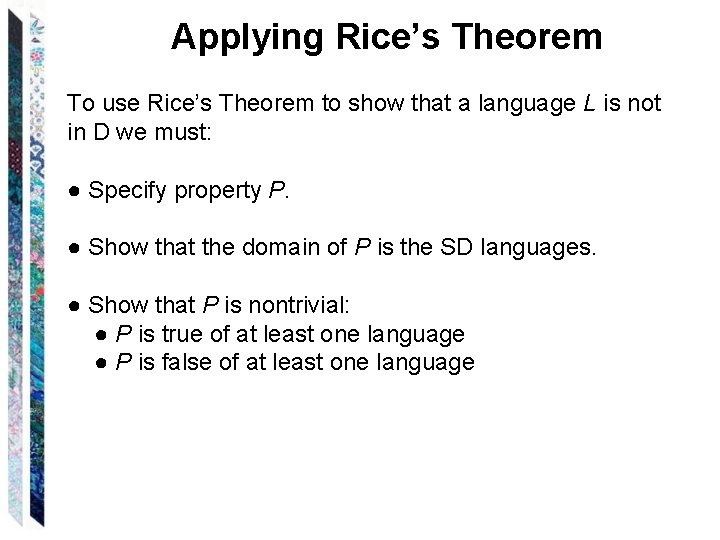
Applying Rice’s Theorem To use Rice’s Theorem to show that a language L is not in D we must: ● Specify property P. ● Show that the domain of P is the SD languages. ● Show that P is nontrivial: ● P is true of at least one language ● P is false of at least one language
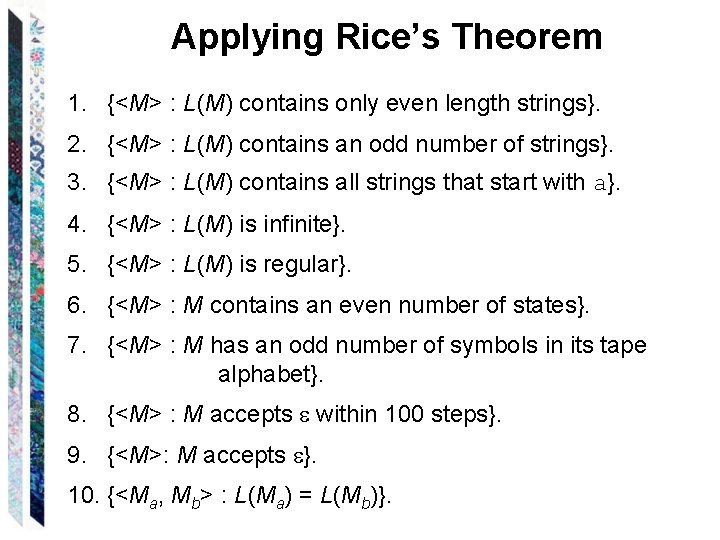
Applying Rice’s Theorem 1. {<M> : L(M) contains only even length strings}. 2. {<M> : L(M) contains an odd number of strings}. 3. {<M> : L(M) contains all strings that start with a}. 4. {<M> : L(M) is infinite}. 5. {<M> : L(M) is regular}. 6. {<M> : M contains an even number of states}. 7. {<M> : M has an odd number of symbols in its tape alphabet}. 8. {<M> : M accepts within 100 steps}. 9. {<M>: M accepts }. 10. {<Ma, Mb> : L(Ma) = L(Mb)}.
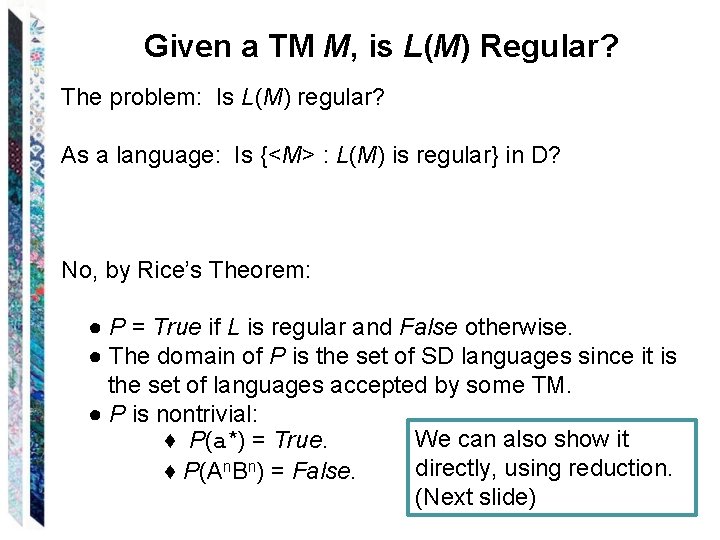
Given a TM M, is L(M) Regular? The problem: Is L(M) regular? As a language: Is {<M> : L(M) is regular} in D? No, by Rice’s Theorem: ● P = True if L is regular and False otherwise. ● The domain of P is the set of SD languages since it is the set of languages accepted by some TM. ● P is nontrivial: We can also show it ♦ P(a*) = True. directly, using reduction. ♦ P(An. Bn) = False. (Next slide)
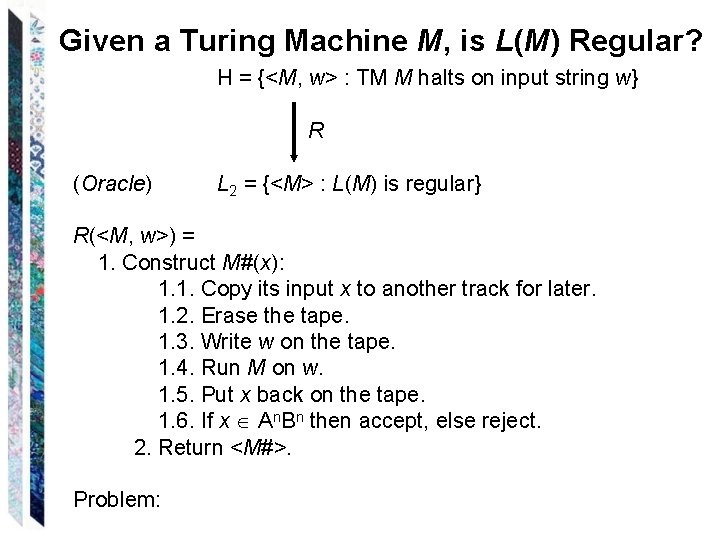
Given a Turing Machine M, is L(M) Regular? H = {<M, w> : TM M halts on input string w} R (Oracle) L 2 = {<M> : L(M) is regular} R(<M, w>) = 1. Construct M#(x): 1. 1. Copy its input x to another track for later. 1. 2. Erase the tape. 1. 3. Write w on the tape. 1. 4. Run M on w. 1. 5. Put x back on the tape. 1. 6. If x An. Bn then accept, else reject. 2. Return <M#>. Problem:
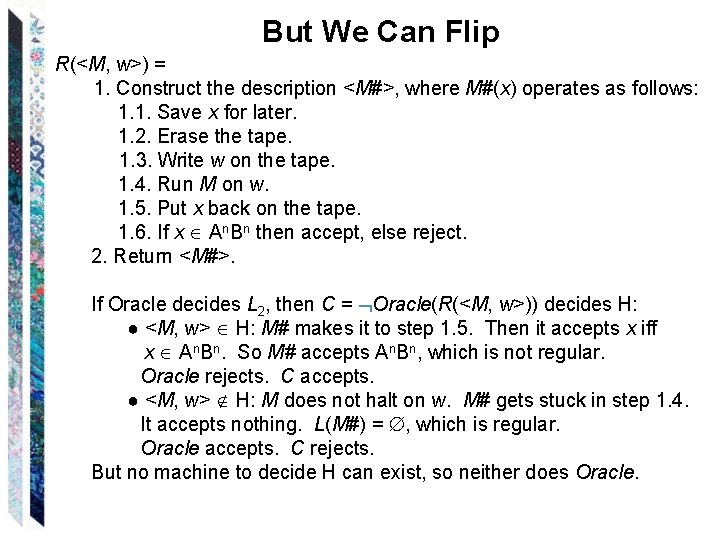
But We Can Flip R(<M, w>) = 1. Construct the description <M#>, where M#(x) operates as follows: 1. 1. Save x for later. 1. 2. Erase the tape. 1. 3. Write w on the tape. 1. 4. Run M on w. 1. 5. Put x back on the tape. 1. 6. If x An. Bn then accept, else reject. 2. Return <M#>. If Oracle decides L 2, then C = Oracle(R(<M, w>)) decides H: ● <M, w> H: M# makes it to step 1. 5. Then it accepts x iff x An. Bn. So M# accepts An. Bn, which is not regular. Oracle rejects. C accepts. ● <M, w> H: M does not halt on w. M# gets stuck in step 1. 4. It accepts nothing. L(M#) = , which is regular. Oracle accepts. C rejects. But no machine to decide H can exist, so neither does Oracle.
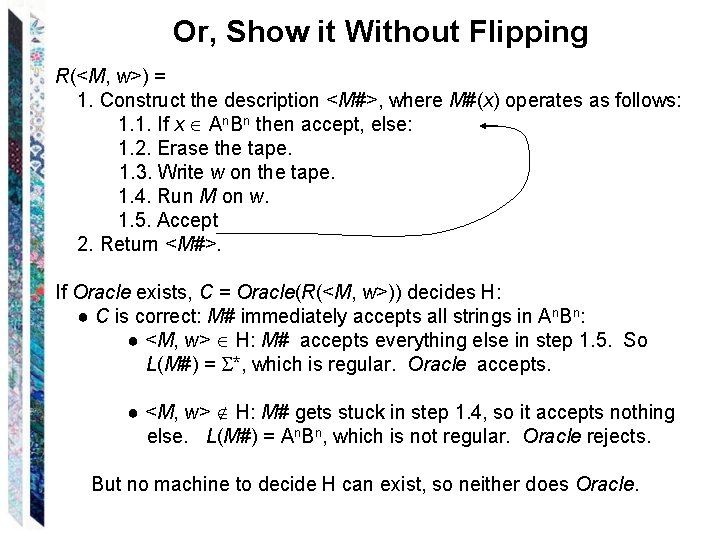
Or, Show it Without Flipping R(<M, w>) = 1. Construct the description <M#>, where M#(x) operates as follows: 1. 1. If x An. Bn then accept, else: 1. 2. Erase the tape. 1. 3. Write w on the tape. 1. 4. Run M on w. 1. 5. Accept 2. Return <M#>. If Oracle exists, C = Oracle(R(<M, w>)) decides H: ● C is correct: M# immediately accepts all strings in An. Bn: ● <M, w> H: M# accepts everything else in step 1. 5. So L(M#) = *, which is regular. Oracle accepts. ● <M, w> H: M# gets stuck in step 1. 4, so it accepts nothing else. L(M#) = An. Bn, which is not regular. Oracle rejects. But no machine to decide H can exist, so neither does Oracle.
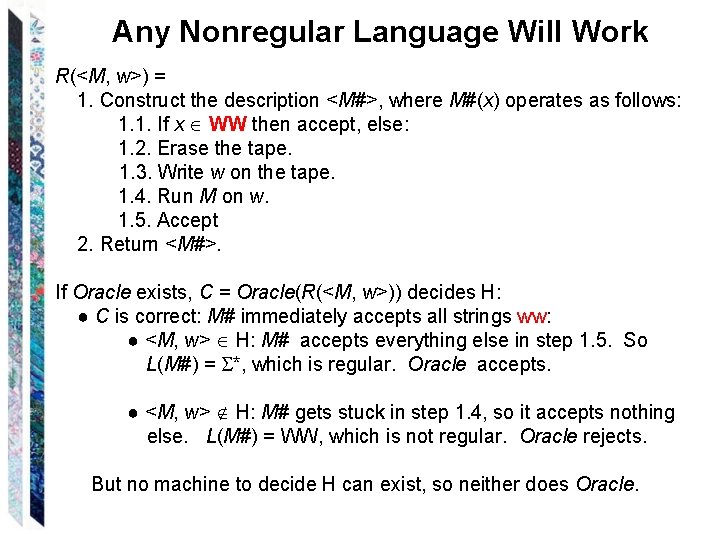
Any Nonregular Language Will Work R(<M, w>) = 1. Construct the description <M#>, where M#(x) operates as follows: 1. 1. If x WW then accept, else: 1. 2. Erase the tape. 1. 3. Write w on the tape. 1. 4. Run M on w. 1. 5. Accept 2. Return <M#>. If Oracle exists, C = Oracle(R(<M, w>)) decides H: ● C is correct: M# immediately accepts all strings ww: ● <M, w> H: M# accepts everything else in step 1. 5. So L(M#) = *, which is regular. Oracle accepts. ● <M, w> H: M# gets stuck in step 1. 4, so it accepts nothing else. L(M#) = WW, which is not regular. Oracle rejects. But no machine to decide H can exist, so neither does Oracle.
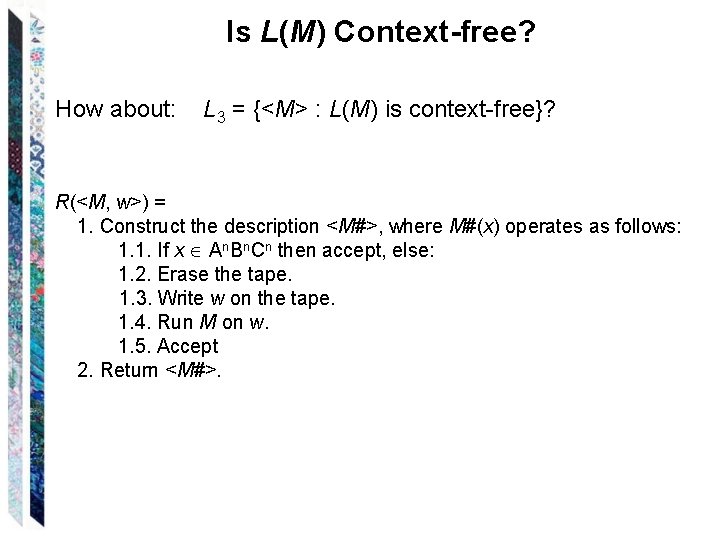
Is L(M) Context-free? How about: L 3 = {<M> : L(M) is context-free}? R(<M, w>) = 1. Construct the description <M#>, where M#(x) operates as follows: 1. 1. If x An. Bn. Cn then accept, else: 1. 2. Erase the tape. 1. 3. Write w on the tape. 1. 4. Run M on w. 1. 5. Accept 2. Return <M#>.
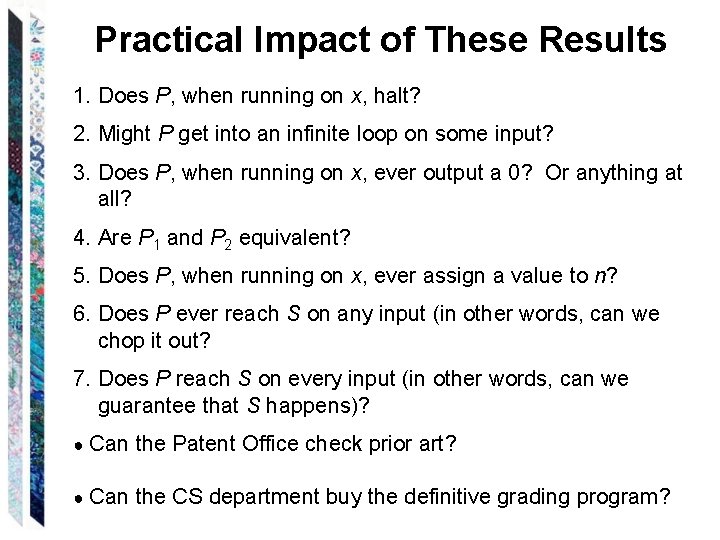
Practical Impact of These Results 1. Does P, when running on x, halt? 2. Might P get into an infinite loop on some input? 3. Does P, when running on x, ever output a 0? Or anything at all? 4. Are P 1 and P 2 equivalent? 5. Does P, when running on x, ever assign a value to n? 6. Does P ever reach S on any input (in other words, can we chop it out? 7. Does P reach S on every input (in other words, can we guarantee that S happens)? ● Can the Patent Office check prior art? ● Can the CS department buy the definitive grading program?
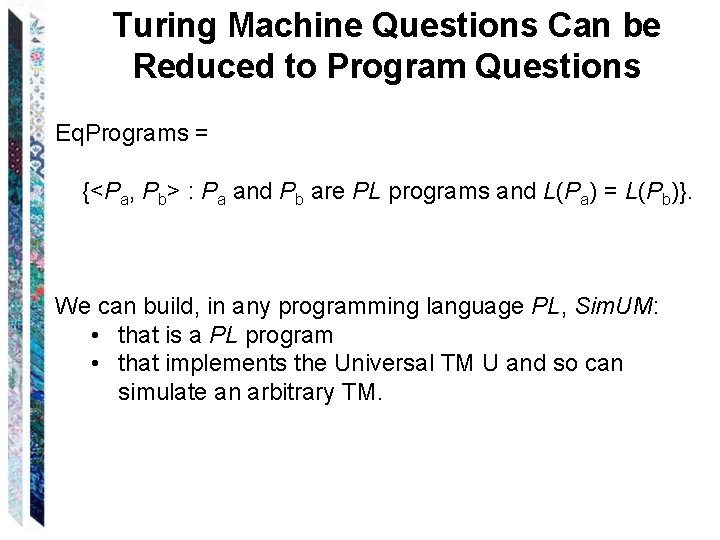
Turing Machine Questions Can be Reduced to Program Questions Eq. Programs = {<Pa, Pb> : Pa and Pb are PL programs and L(Pa) = L(Pb)}. We can build, in any programming language PL, Sim. UM: • that is a PL program • that implements the Universal TM U and so can simulate an arbitrary TM.
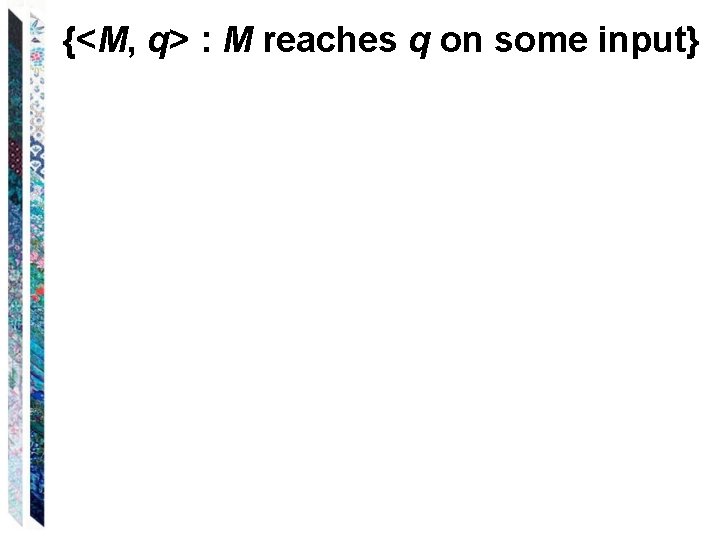
{<M, q> : M reaches q on some input}
Side Road with a purpose: obtain. Self From Section 25. 3: In section 25. 3, the author proves the existence of a very useful computable function: obtain. Self. When called as a subroutine by any Turing machine M, obtain. Self writes <M> onto M's tape. Related to quines: A quine is a computer program which takes no input and produces a copy of its own source code as its only output. Definition is from http: //en. wikipedia. org/wiki/Quine_(computing)
Some quines • main(){char q=34, n=10, *a="main() {char q=34, n=10, *a=%c%s%c; printf(a, q, n); }%c"; printf(a, q, n); } • ((lambda (x) (list x (list 'quote x))) (quote (lambda (x) (list x (list 'quote x))))) • Quine's paradox and a related sentence: "Yields falsehood when preceded by its quotation" yields falsehood when preceded by its quotation. "quoted and followed by itself is a quine. " quoted and followed by itself is a quine.
Non-SD Languages There is an uncountable number of non-SD languages, but only a countably infinite number of TM’s (hence SD languages). The class of non-SD languages is much bigger than that of SD languages!
Non-SD Languages Intuition: Non-SD languages usually involve either infinite search (where testing each potential member could loop forever), or determining whether a TM will infinite loop. Examples: • H = {<M, w> : TM M does not halt on w}. • {<M> : L(M) = *}. • {<M> : TM M halts on nothing}.
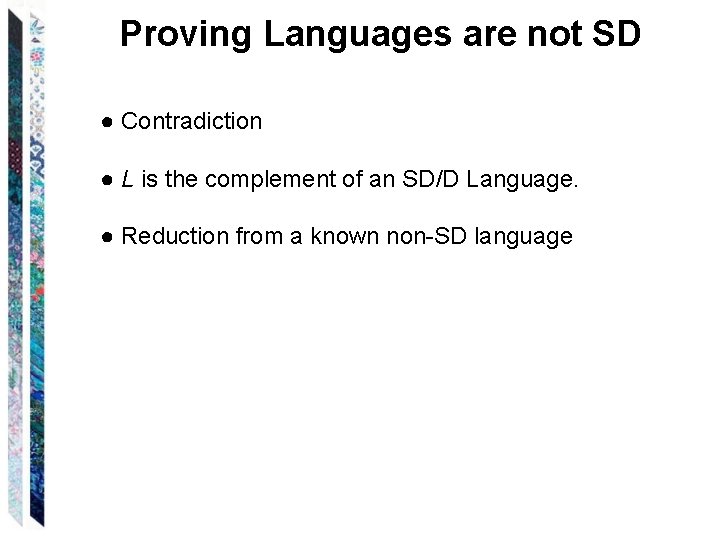
Proving Languages are not SD ● Contradiction ● L is the complement of an SD/D Language. ● Reduction from a known non-SD language
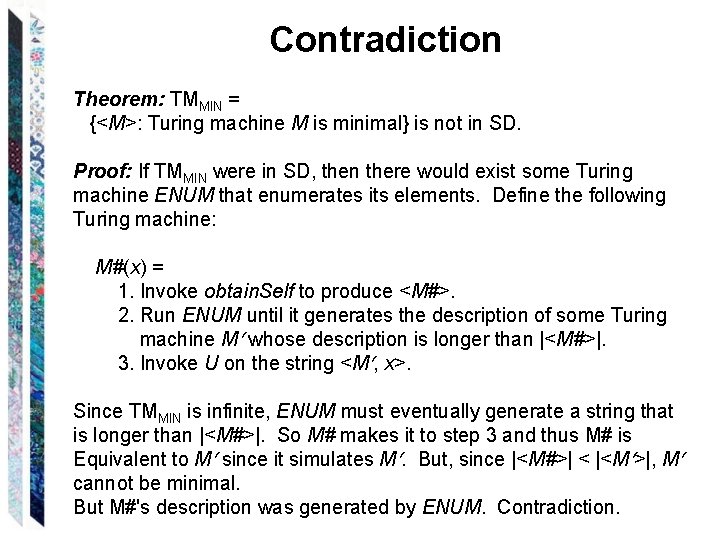
Contradiction Theorem: TMMIN = {<M>: Turing machine M is minimal} is not in SD. Proof: If TMMIN were in SD, then there would exist some Turing machine ENUM that enumerates its elements. Define the following Turing machine: M#(x) = 1. Invoke obtain. Self to produce <M#>. 2. Run ENUM until it generates the description of some Turing machine M whose description is longer than |<M#>|. 3. Invoke U on the string <M , x>. Since TMMIN is infinite, ENUM must eventually generate a string that is longer than |<M#>|. So M# makes it to step 3 and thus M# is Equivalent to M since it simulates M. But, since |<M#>| < |<M >|, M cannot be minimal. But M#'s description was generated by ENUM. Contradiction.
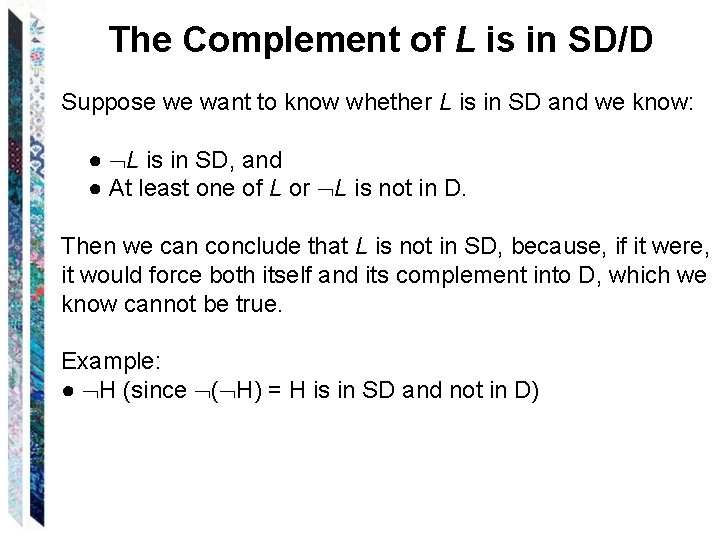
The Complement of L is in SD/D Suppose we want to know whether L is in SD and we know: ● L is in SD, and ● At least one of L or L is not in D. Then we can conclude that L is not in SD, because, if it were, it would force both itself and its complement into D, which we know cannot be true. Example: ● H (since ( H) = H is in SD and not in D)
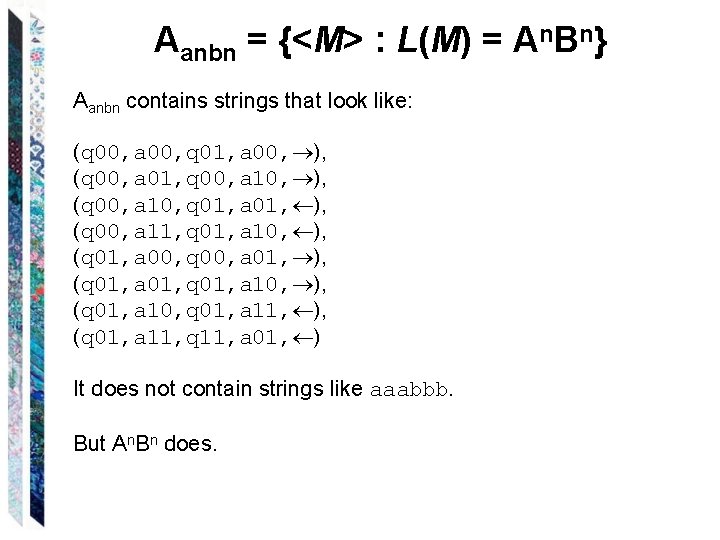
Aanbn = {<M> : L(M) = An. Bn} Aanbn contains strings that look like: (q 00, a 00, q 01, a 00, ), (q 00, a 01, q 00, a 10, ), (q 00, a 10, q 01, a 01, ), (q 00, a 11, q 01, a 10, ), (q 01, a 00, q 00, a 01, ), (q 01, a 01, q 01, a 10, ), (q 01, a 10, q 01, a 11, ), (q 01, a 11, q 11, a 01, ) It does not contain strings like aaabbb. But An. Bn does.
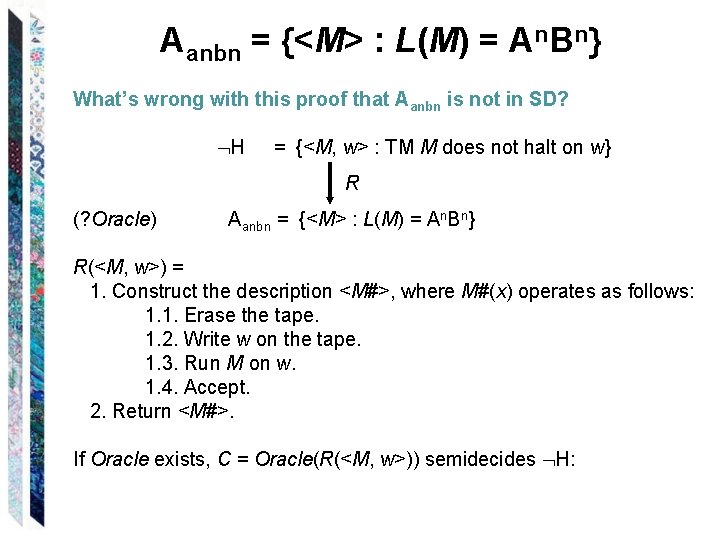
Aanbn = {<M> : L(M) = An. Bn} What’s wrong with this proof that Aanbn is not in SD? H = {<M, w> : TM M does not halt on w} R (? Oracle) Aanbn = {<M> : L(M) = An. Bn} R(<M, w>) = 1. Construct the description <M#>, where M#(x) operates as follows: 1. 1. Erase the tape. 1. 2. Write w on the tape. 1. 3. Run M on w. 1. 4. Accept. 2. Return <M#>. If Oracle exists, C = Oracle(R(<M, w>)) semidecides H:
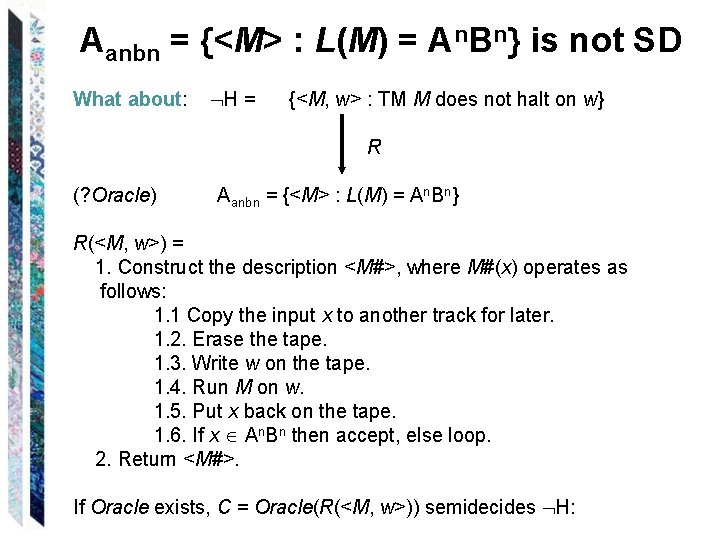
Aanbn = {<M> : L(M) = An. Bn} is not SD What about: H = {<M, w> : TM M does not halt on w} R (? Oracle) Aanbn = {<M> : L(M) = An. Bn} R(<M, w>) = 1. Construct the description <M#>, where M#(x) operates as follows: 1. 1 Copy the input x to another track for later. 1. 2. Erase the tape. 1. 3. Write w on the tape. 1. 4. Run M on w. 1. 5. Put x back on the tape. 1. 6. If x An. Bn then accept, else loop. 2. Return <M#>. If Oracle exists, C = Oracle(R(<M, w>)) semidecides H:
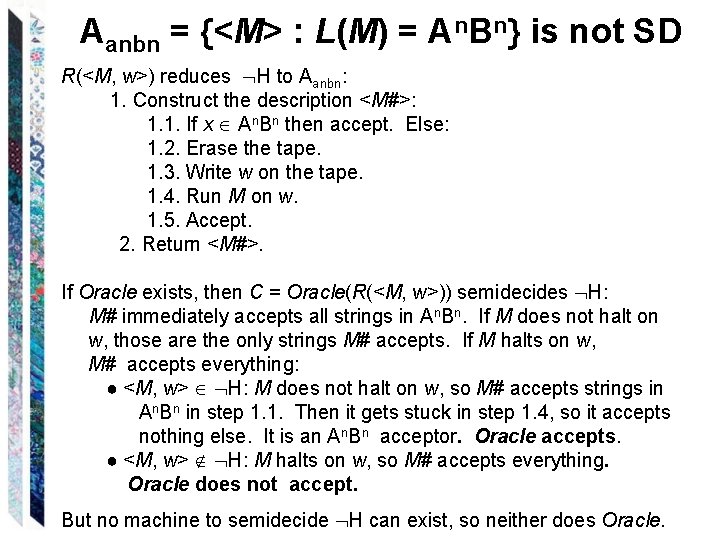
Aanbn = {<M> : L(M) = An. Bn} is not SD R(<M, w>) reduces H to Aanbn: 1. Construct the description <M#>: 1. 1. If x An. Bn then accept. Else: 1. 2. Erase the tape. 1. 3. Write w on the tape. 1. 4. Run M on w. 1. 5. Accept. 2. Return <M#>. If Oracle exists, then C = Oracle(R(<M, w>)) semidecides H: M# immediately accepts all strings in An. Bn. If M does not halt on w, those are the only strings M# accepts. If M halts on w, M# accepts everything: ● <M, w> H: M does not halt on w, so M# accepts strings in An. Bn in step 1. 1. Then it gets stuck in step 1. 4, so it accepts nothing else. It is an An. Bn acceptor. Oracle accepts. ● <M, w> H: M halts on w, so M# accepts everything. Oracle does not accept. But no machine to semidecide H can exist, so neither does Oracle.