
MACSSE 473 Day 14 Permutations wrapup Subset generation
MA/CSSE 473 Day 14 Permutations wrap-up Subset generation (Horner’s method)
MA/CSSE 473 Day 14 • Student questions • Monday will begin with "ask questions about exam material” time. • Exam details are Day 16 of the schedule page. • Today's topics: – Permutations wrap-up – Generating subsets of a set – (Horner’s method)
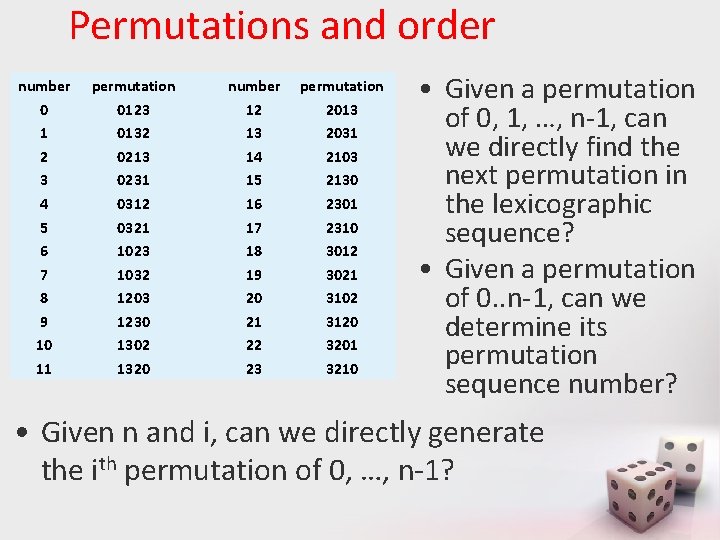
Permutations and order number 0 1 2 3 4 5 6 7 8 9 10 11 permutation 0123 0132 0213 0231 0312 0321 1023 1032 1203 1230 1302 1320 number 12 13 14 15 16 17 18 19 20 21 22 23 permutation 2013 2031 2103 2130 2301 2310 3012 3021 3102 3120 3201 3210 • Given a permutation of 0, 1, …, n-1, can we directly find the next permutation in the lexicographic sequence? • Given a permutation of 0. . n-1, can we determine its permutation sequence number? • Given n and i, can we directly generate the ith permutation of 0, …, n-1?
Yesterday's Discovery • Which permutation follows each of these in lexicographic order? – 183647520 471638520 – Try to write an algorithm for generating the next permutation, with only the current permutation as input.
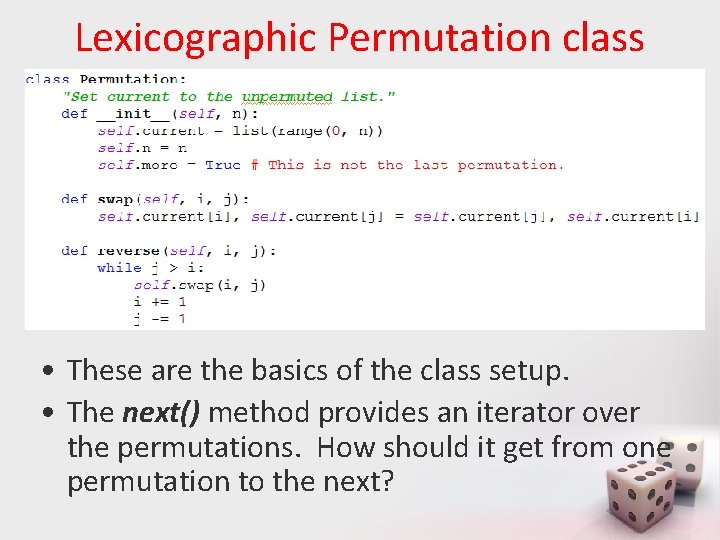
Lexicographic Permutation class • These are the basics of the class setup. • The next() method provides an iterator over the permutations. How should it get from one permutation to the next?
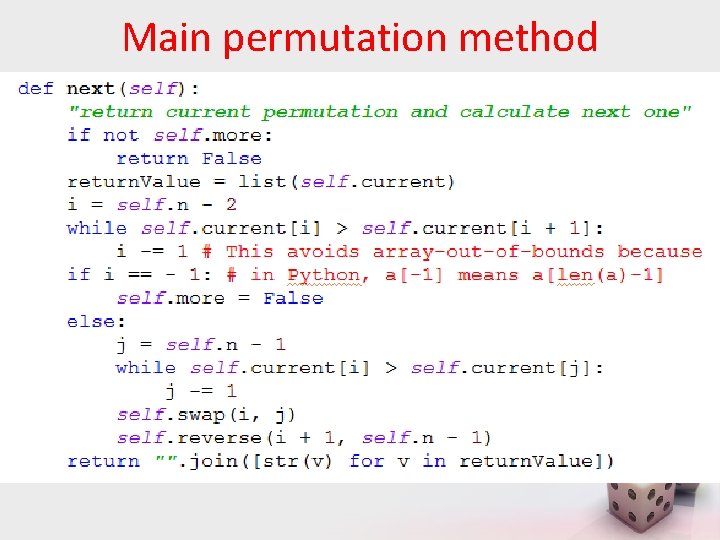
Main permutation method
More discoveries • Which permutation follows each of these in lexicographic order? – 183647520 471638520 – Try to write an algorithm for generating the next permutation, with only the current permutation as input. • If the lexicographic permutations of the numbers [0, 1, 2, 3, 4] are numbered starting with 0, what is the number of the permutation 14032? – General algorithm? How to calculate efficiency? • In the lexicographic ordering of permutations of [0, 1, 2, 3, 4, 5], which permutation is number 541? – General algorithm? How to calculate efficiently? – Application: Generate a random permutation
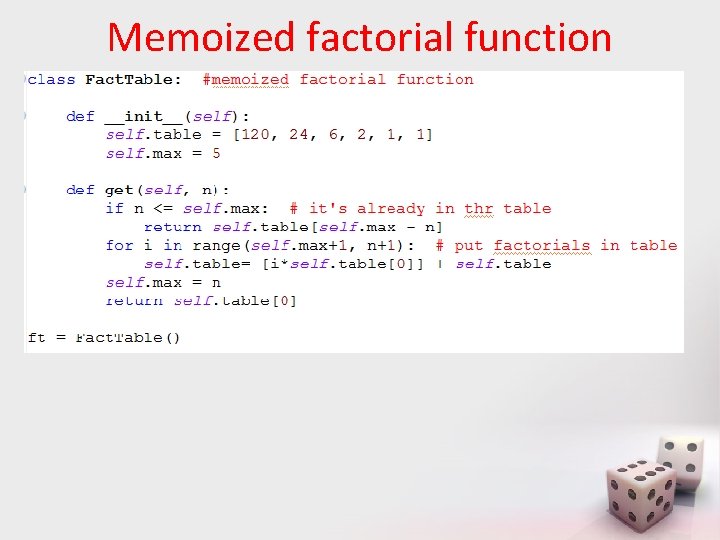
Memoized factorial function
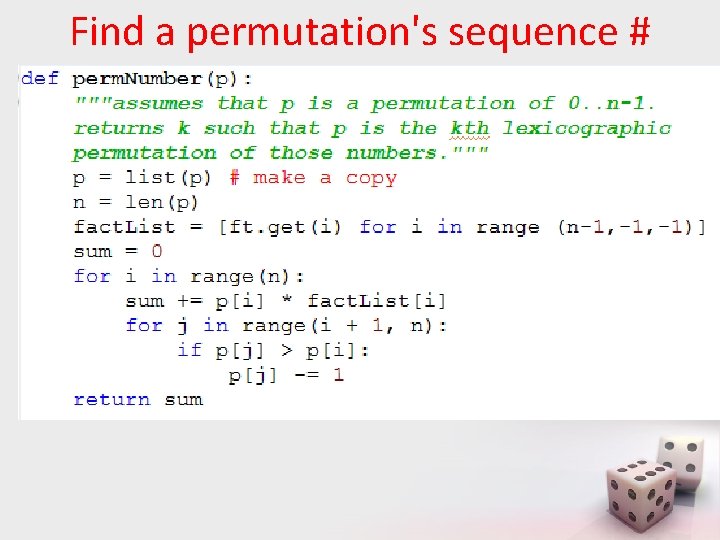
Find a permutation's sequence #
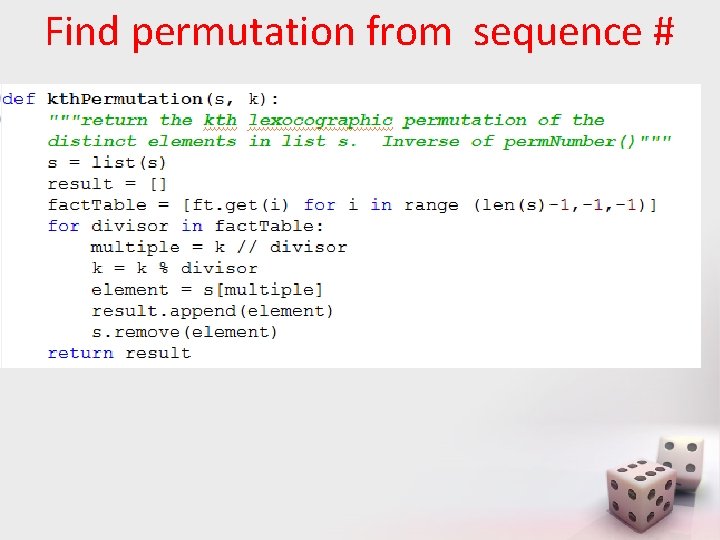
Find permutation from sequence #

Bottom-up, “numeric order”, binary reflected Gray code SUBSET GENERATION
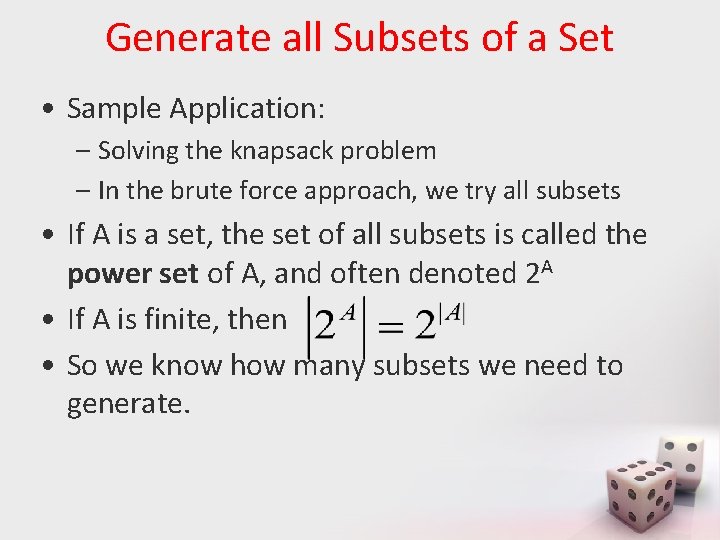
Generate all Subsets of a Set • Sample Application: – Solving the knapsack problem – In the brute force approach, we try all subsets • If A is a set, the set of all subsets is called the power set of A, and often denoted 2 A • If A is finite, then • So we know how many subsets we need to generate.
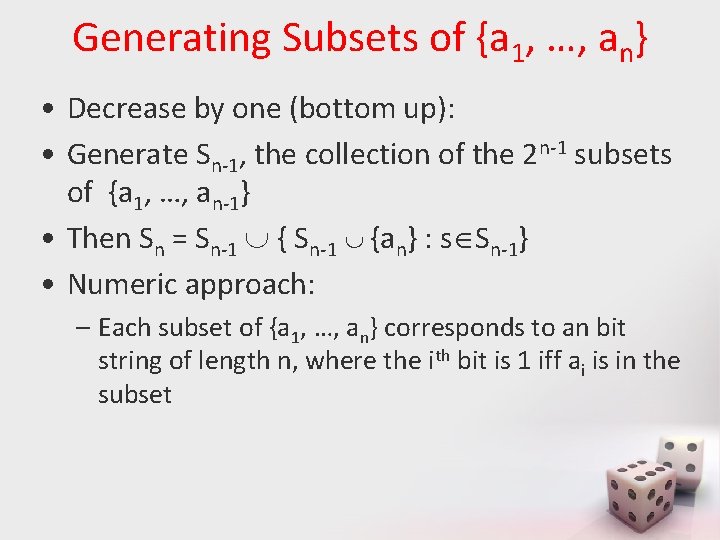
Generating Subsets of {a 1, …, an} • Decrease by one (bottom up): • Generate Sn-1, the collection of the 2 n-1 subsets of {a 1, …, an-1} • Then Sn = Sn-1 {an} : s Sn-1} • Numeric approach: – Each subset of {a 1, …, an} corresponds to an bit string of length n, where the ith bit is 1 iff ai is in the subset
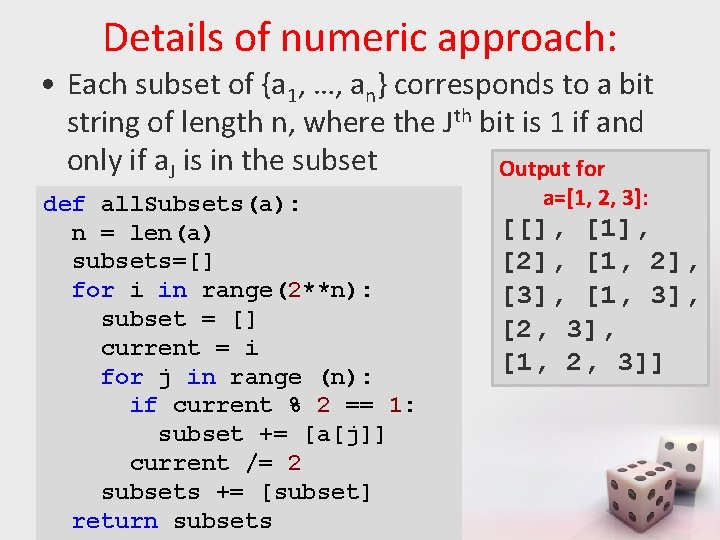
Details of numeric approach: • Each subset of {a 1, …, an} corresponds to a bit string of length n, where the Jth bit is 1 if and only if a. J is in the subset Output for def all. Subsets(a): n = len(a) subsets=[] for i in range(2**n): subset = [] current = i for j in range (n): if current % 2 == 1: subset += [a[j]] current /= 2 subsets += [subset] return subsets a=[1, 2, 3]: [[], [1], [2], [1, 2], [3], [1, 3], [2, 3], [1, 2, 3]]
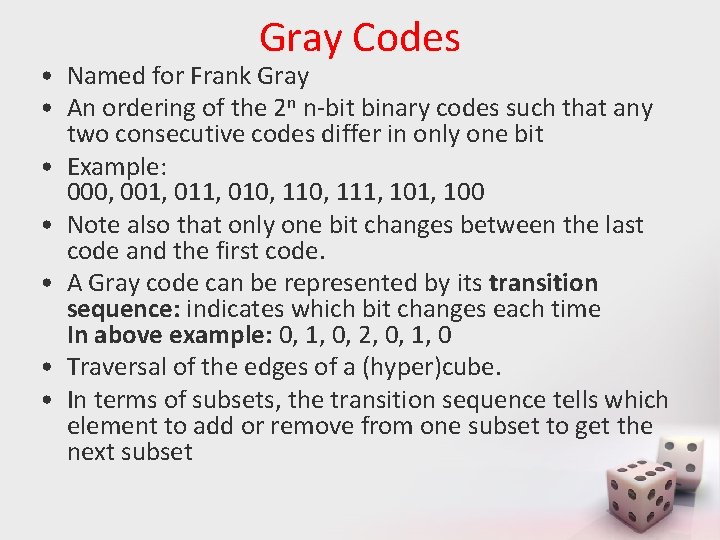
Gray Codes • Named for Frank Gray • An ordering of the 2 n n-bit binary codes such that any two consecutive codes differ in only one bit • Example: 000, 001, 010, 111, 100 • Note also that only one bit changes between the last code and the first code. • A Gray code can be represented by its transition sequence: indicates which bit changes each time In above example: 0, 1, 0, 2, 0, 1, 0 • Traversal of the edges of a (hyper)cube. • In terms of subsets, the transition sequence tells which element to add or remove from one subset to get the next subset
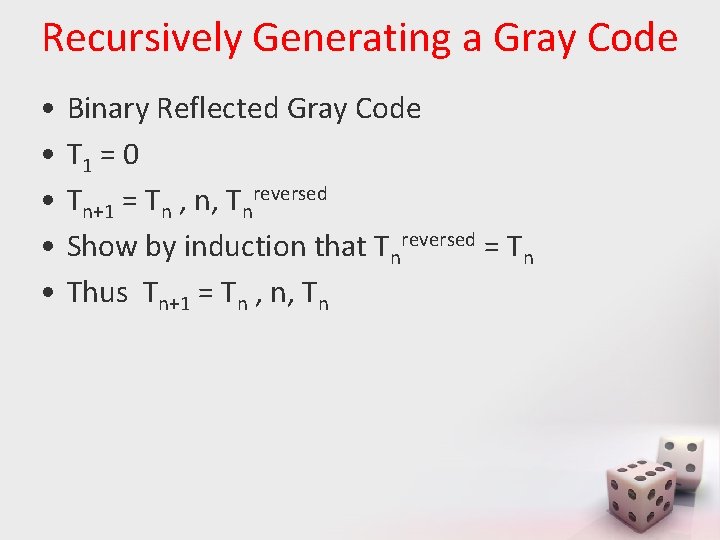
Recursively Generating a Gray Code • • • Binary Reflected Gray Code T 1 = 0 Tn+1 = Tn , n, Tnreversed Show by induction that Tnreversed = Tn Thus Tn+1 = Tn , n, Tn
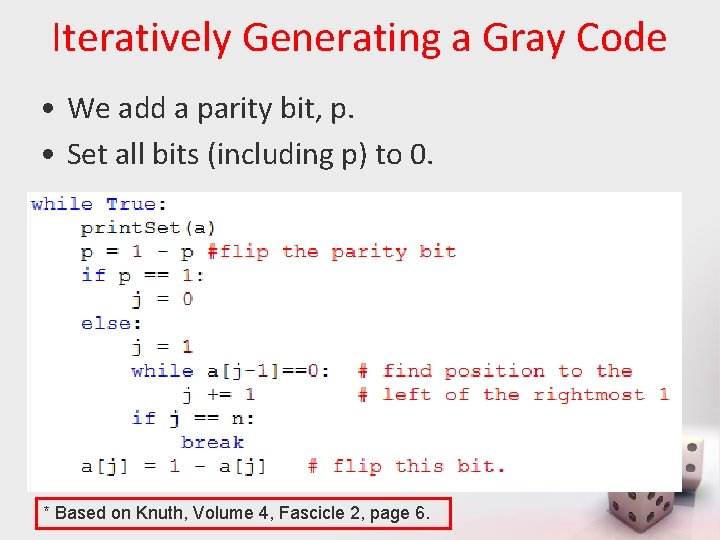
Iteratively Generating a Gray Code • We add a parity bit, p. • Set all bits (including p) to 0. * Based on Knuth, Volume 4, Fascicle 2, page 6.
Side road: Polynomial Evaluation • Given a polynomial p(x) = anxn + an-1 xn-1 + … + a 1 x + a 0 • How can we efficiently evaluate p(c) for some number c? • Apply this to evaluation of "31427894" or any other string that represents a positive integer. • Write and analyze (pseudo)code
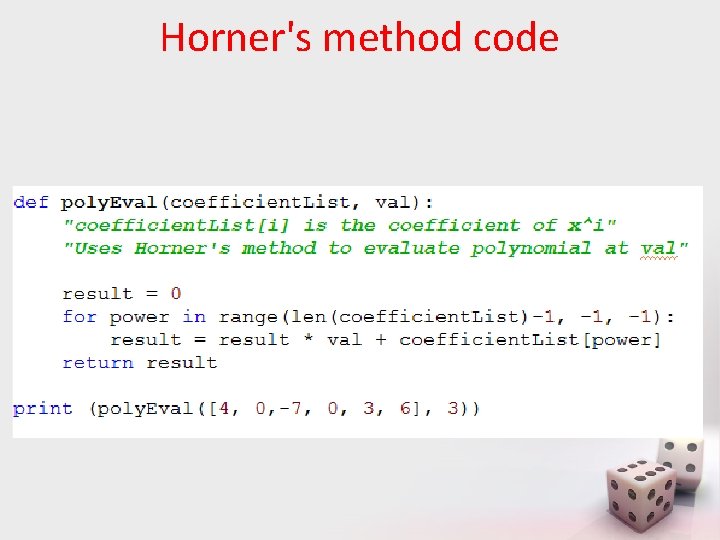
Horner's method code
Decrease by a constant factor Decrease by a variable amount OTHER DECREASE-AND-CONQUER ALGORITHMS
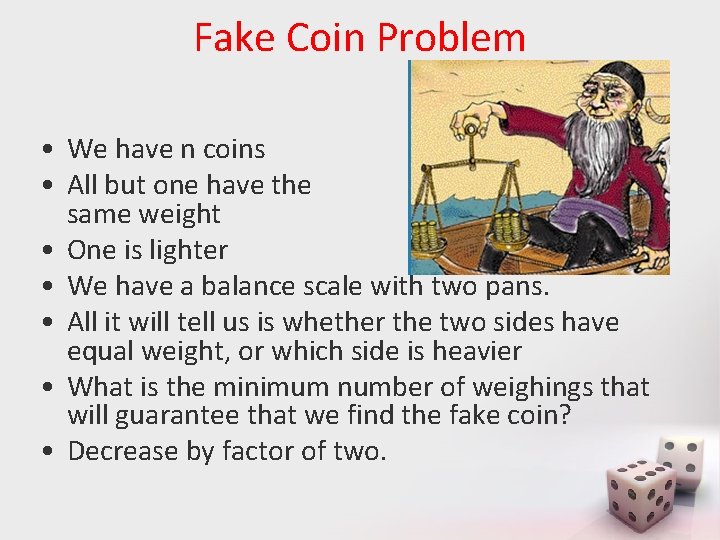
Fake Coin Problem • We have n coins • All but one have the same weight • One is lighter • We have a balance scale with two pans. • All it will tell us is whether the two sides have equal weight, or which side is heavier • What is the minimum number of weighings that will guarantee that we find the fake coin? • Decrease by factor of two.
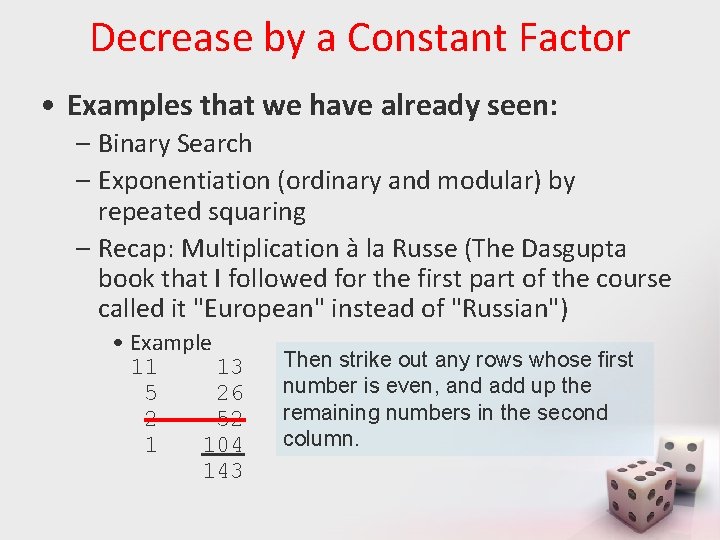
Decrease by a Constant Factor • Examples that we have already seen: – Binary Search – Exponentiation (ordinary and modular) by repeated squaring – Recap: Multiplication à la Russe (The Dasgupta book that I followed for the first part of the course called it "European" instead of "Russian") • Example 11 13 5 26 2 52 1 104 143 Then strike out any rows whose first number is even, and add up the remaining numbers in the second column.
Decrease by a variable amount • Search in a Binary Search Tree • Interpolation Search – See Levitin, pp 190 -191 – Also Weiss, Section 5. 6. 3 • Median Finding – Find the kth element of an (unordered) list of n elements – Start with quicksort's partition method – Best case analysis
- Slides: 23