
MACSSE 473 Day 07 Extended Euclids Algorithm Modular

- Slides: 16
MA/CSSE 473 Day 07 Extended Euclid's Algorithm Modular Division Fermat's little theorem intro
MA/CSSE 473 Day 07 • Student Questions • Extended Euclid Algorithm, the “calculate forward, substitute backward” approach • Modular Division • Fermat's Little Theorem • Intro to primality testing.
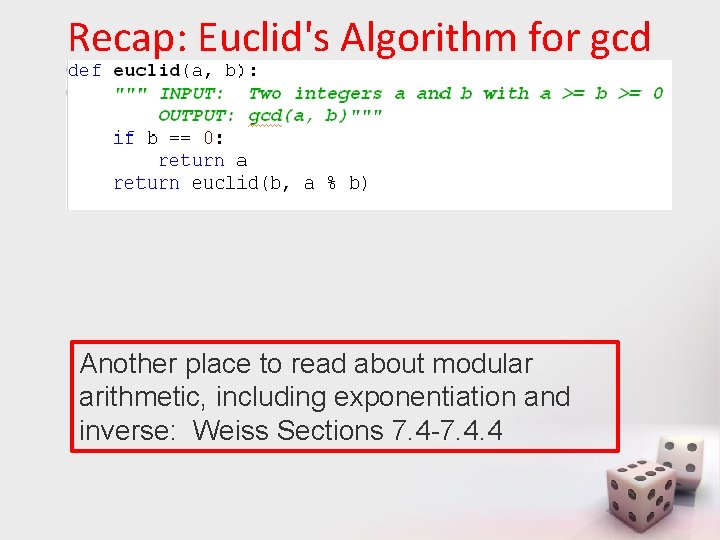
Recap: Euclid's Algorithm for gcd Another place to read about modular arithmetic, including exponentiation and inverse: Weiss Sections 7. 4 -7. 4. 4
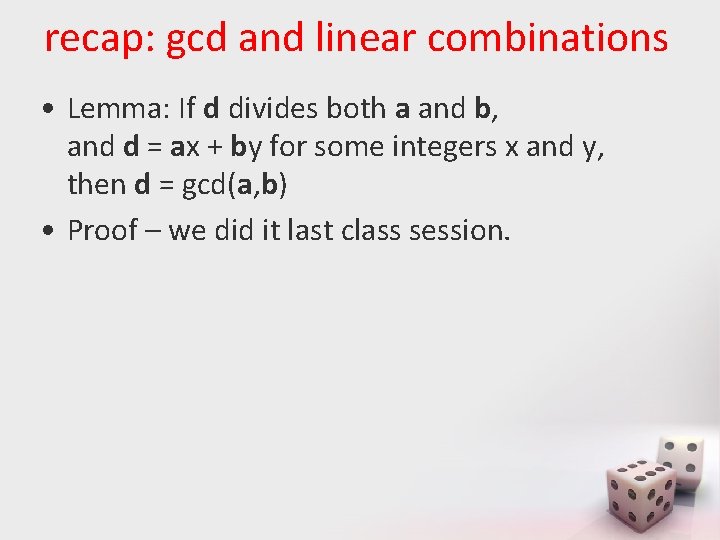
recap: gcd and linear combinations • Lemma: If d divides both a and b, and d = ax + by for some integers x and y, then d = gcd(a, b) • Proof – we did it last class session.
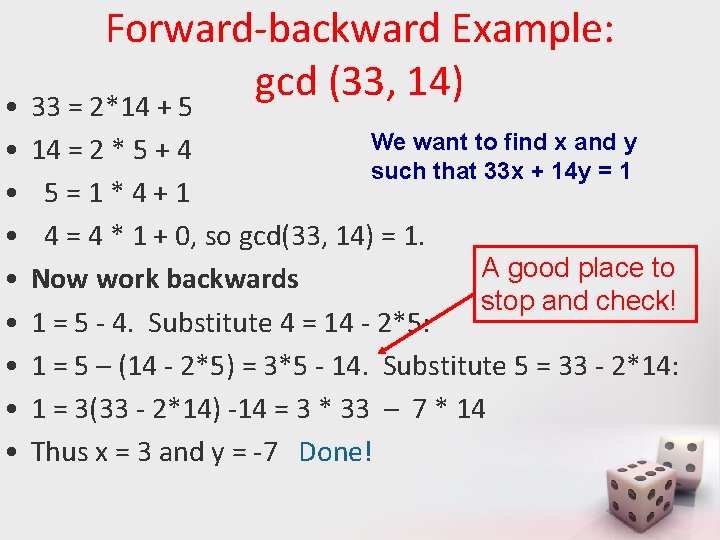
Forward-backward Example: gcd (33, 14) • 33 = 2*14 + 5 • • We want to find x and y 14 = 2 * 5 + 4 such that 33 x + 14 y = 1 5=1*4+1 4 = 4 * 1 + 0, so gcd(33, 14) = 1. A good place to Now work backwards stop and check! 1 = 5 - 4. Substitute 4 = 14 - 2*5: 1 = 5 – (14 - 2*5) = 3*5 - 14. Substitute 5 = 33 - 2*14: 1 = 3(33 - 2*14) -14 = 3 * 33 – 7 * 14 Thus x = 3 and y = -7 Done!
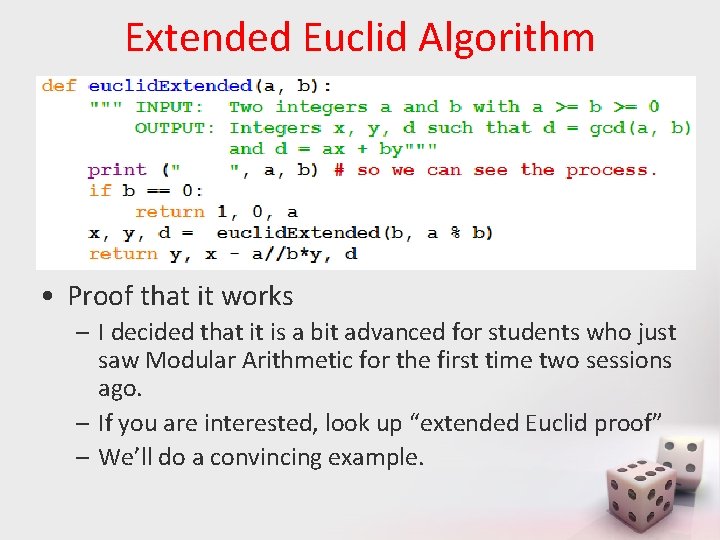
Extended Euclid Algorithm • Proof that it works – I decided that it is a bit advanced for students who just saw Modular Arithmetic for the first time two sessions ago. – If you are interested, look up “extended Euclid proof” – We’ll do a convincing example.
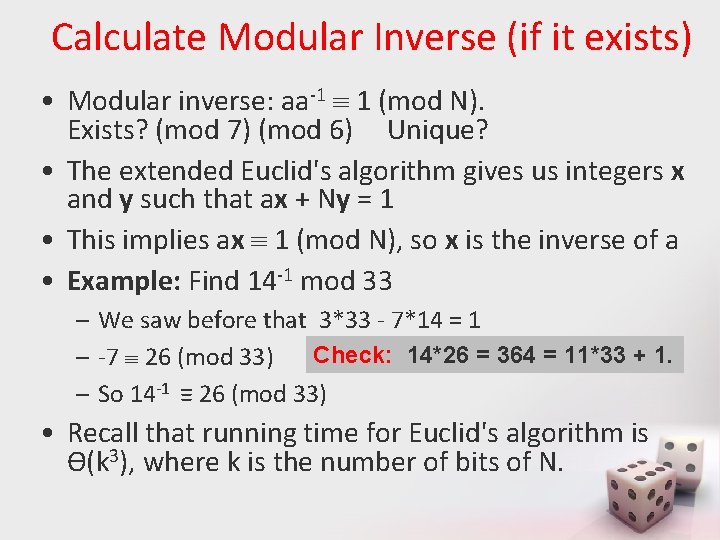
Calculate Modular Inverse (if it exists) • Modular inverse: aa-1 1 (mod N). Exists? (mod 7) (mod 6) Unique? • The extended Euclid's algorithm gives us integers x and y such that ax + Ny = 1 • This implies ax 1 (mod N), so x is the inverse of a • Example: Find 14 -1 mod 33 – We saw before that 3*33 - 7*14 = 1 – -7 26 (mod 33) Check: 14*26 = 364 = 11*33 + 1. – So 14 -1 ≡ 26 (mod 33) • Recall that running time for Euclid's algorithm is Ѳ(k 3), where k is the number of bits of N.
Modular division • We can only divide b by a (modulo N) if N and a are relatively prime • In that case b/a = b∙a-1 • What is the running time for modular division?
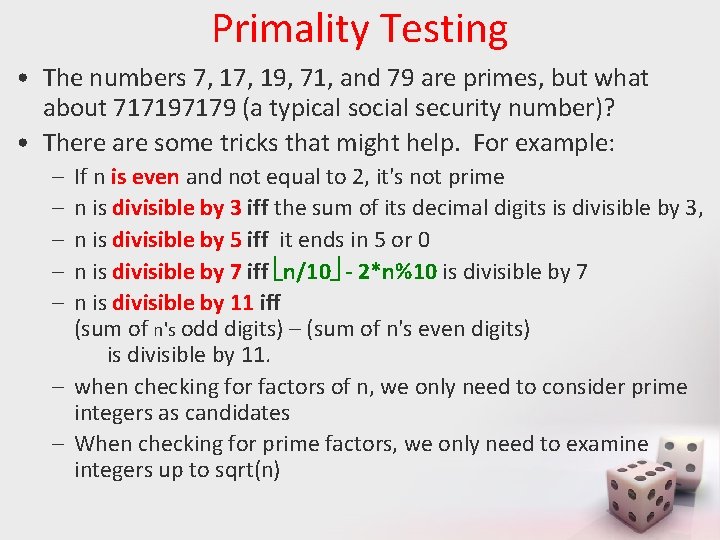
Primality Testing • The numbers 7, 19, 71, and 79 are primes, but what about 717197179 (a typical social security number)? • There are some tricks that might help. For example: – – – If n is even and not equal to 2, it's not prime n is divisible by 3 iff the sum of its decimal digits is divisible by 3, n is divisible by 5 iff it ends in 5 or 0 n is divisible by 7 iff n/10 - 2*n%10 is divisible by 7 n is divisible by 11 iff (sum of n's odd digits) – (sum of n's even digits) is divisible by 11. – when checking for factors of n, we only need to consider prime integers as candidates – When checking for prime factors, we only need to examine integers up to sqrt(n)
Primality testing • Factoring is harder than primality testing. • Is there a way to tell whether a number is prime without actually factoring the number? Like a few other things that we have done so far ion this course, this discussion follows Dasgupta, et. al. , Algortihms (Mc. Graw-Hill 2008)
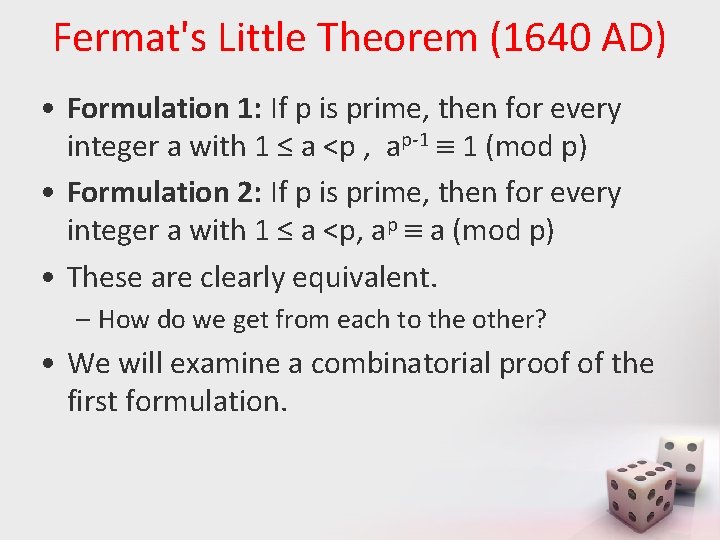
Fermat's Little Theorem (1640 AD) • Formulation 1: If p is prime, then for every integer a with 1 ≤ a <p , ap-1 1 (mod p) • Formulation 2: If p is prime, then for every integer a with 1 ≤ a <p, ap a (mod p) • These are clearly equivalent. – How do we get from each to the other? • We will examine a combinatorial proof of the first formulation.
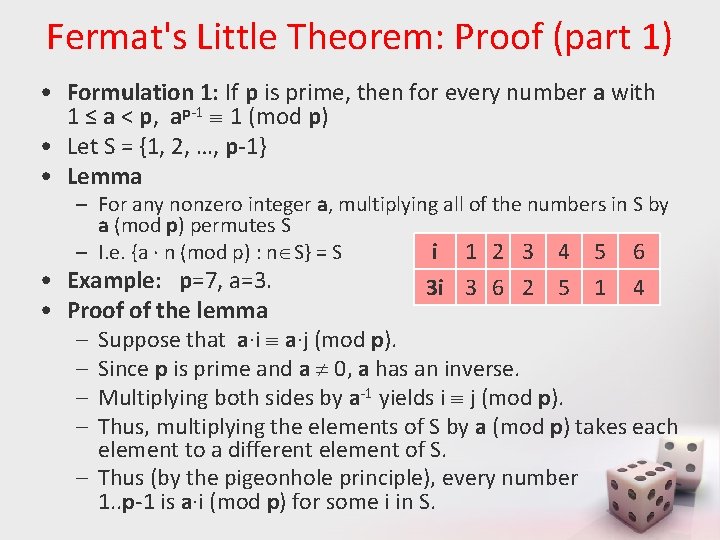
Fermat's Little Theorem: Proof (part 1) • Formulation 1: If p is prime, then for every number a with 1 ≤ a < p, ap-1 1 (mod p) • Let S = {1, 2, …, p-1} • Lemma – For any nonzero integer a, multiplying all of the numbers in S by a (mod p) permutes S – I. e. {a ∙ n (mod p) : n S} = S i 1 2 3 4 5 6 • Example: p=7, a=3. 3 i 3 6 2 5 1 4 • Proof of the lemma – Suppose that a∙i a∙j (mod p). – Since p is prime and a 0, a has an inverse. – Multiplying both sides by a-1 yields i j (mod p). – Thus, multiplying the elements of S by a (mod p) takes each element to a different element of S. – Thus (by the pigeonhole principle), every number 1. . p-1 is a∙i (mod p) for some i in S.
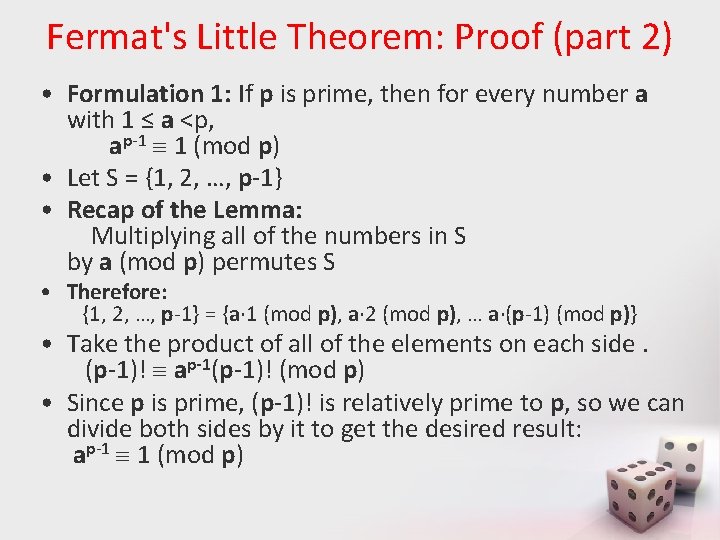
Fermat's Little Theorem: Proof (part 2) • Formulation 1: If p is prime, then for every number a with 1 ≤ a <p, ap-1 1 (mod p) • Let S = {1, 2, …, p-1} • Recap of the Lemma: Multiplying all of the numbers in S by a (mod p) permutes S • Therefore: {1, 2, …, p-1} = {a∙ 1 (mod p), a∙ 2 (mod p), … a∙(p-1) (mod p)} • Take the product of all of the elements on each side. (p-1)! ap-1(p-1)! (mod p) • Since p is prime, (p-1)! is relatively prime to p, so we can divide both sides by it to get the desired result: ap-1 1 (mod p)
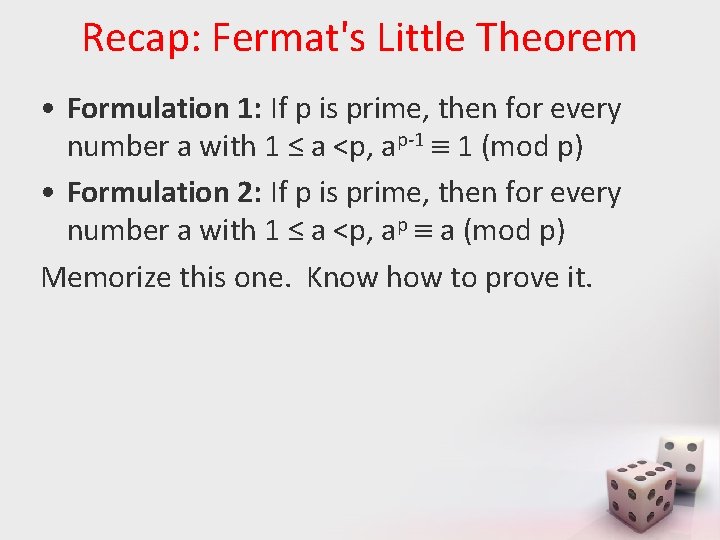
Recap: Fermat's Little Theorem • Formulation 1: If p is prime, then for every number a with 1 ≤ a <p, ap-1 1 (mod p) • Formulation 2: If p is prime, then for every number a with 1 ≤ a <p, ap a (mod p) Memorize this one. Know how to prove it.
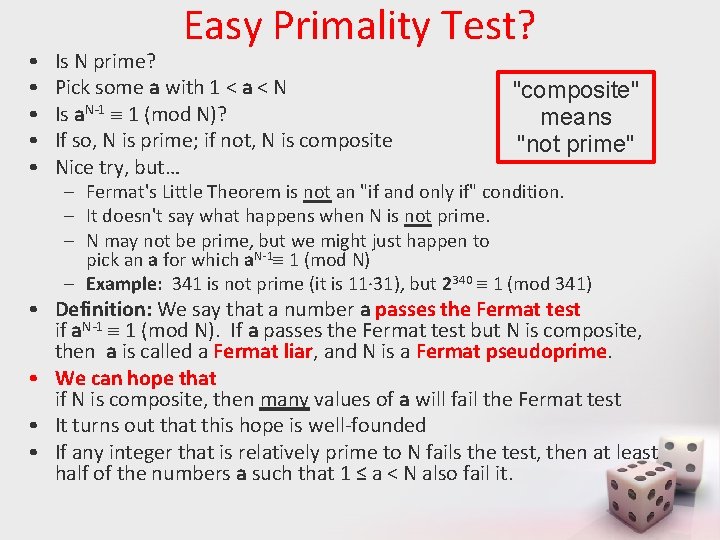
• • • Easy Primality Test? Is N prime? Pick some a with 1 < a < N Is a. N-1 1 (mod N)? If so, N is prime; if not, N is composite Nice try, but… "composite" means "not prime" – Fermat's Little Theorem is not an "if and only if" condition. – It doesn't say what happens when N is not prime. – N may not be prime, but we might just happen to pick an a for which a. N-1 1 (mod N) – Example: 341 is not prime (it is 11∙ 31), but 2340 1 (mod 341) • Definition: We say that a number a passes the Fermat test if a. N-1 1 (mod N). If a passes the Fermat test but N is composite, then a is called a Fermat liar, and N is a Fermat pseudoprime. • We can hope that if N is composite, then many values of a will fail the Fermat test • It turns out that this hope is well-founded • If any integer that is relatively prime to N fails the test, then at least half of the numbers a such that 1 ≤ a < N also fail it.
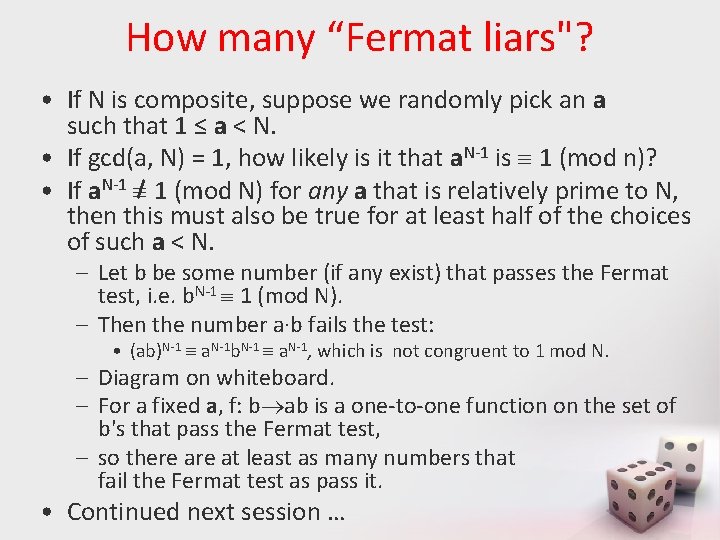
How many “Fermat liars"? • If N is composite, suppose we randomly pick an a such that 1 ≤ a < N. • If gcd(a, N) = 1, how likely is it that a. N-1 is 1 (mod n)? • If a. N-1 1 (mod N) for any a that is relatively prime to N, then this must also be true for at least half of the choices of such a < N. – Let b be some number (if any exist) that passes the Fermat test, i. e. b. N-1 1 (mod N). – Then the number a∙b fails the test: • (ab)N-1 a. N-1 b. N-1 a. N-1, which is not congruent to 1 mod N. – Diagram on whiteboard. – For a fixed a, f: b ab is a one-to-one function on the set of b's that pass the Fermat test, – so there at least as many numbers that fail the Fermat test as pass it. • Continued next session …