
Macroscopic work in general 1 Microscopic work heat
- Slides: 18
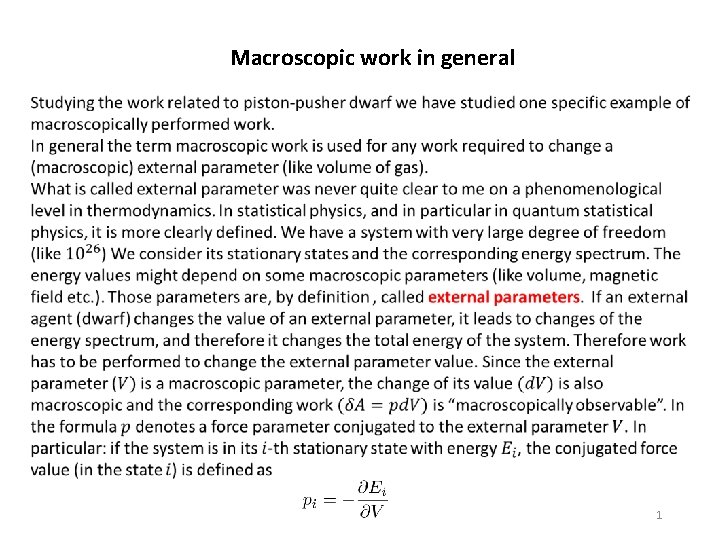
Macroscopic work in general 1
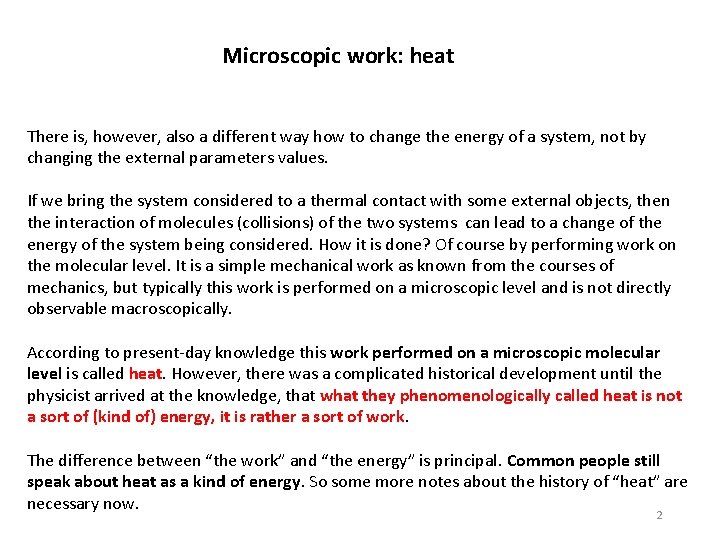
Microscopic work: heat There is, however, also a different way how to change the energy of a system, not by changing the external parameters values. If we bring the system considered to a thermal contact with some external objects, then the interaction of molecules (collisions) of the two systems can lead to a change of the energy of the system being considered. How it is done? Of course by performing work on the molecular level. It is a simple mechanical work as known from the courses of mechanics, but typically this work is performed on a microscopic level and is not directly observable macroscopically. According to present-day knowledge this work performed on a microscopic molecular level is called heat. However, there was a complicated historical development until the physicist arrived at the knowledge, that what they phenomenologically called heat is not a sort of (kind of) energy, it is rather a sort of work. The difference between “the work” and “the energy” is principal. Common people still speak about heat as a kind of energy. So some more notes about the history of “heat” are necessary now. 2
Historical notes We have at least intuitive feeling about temperature. So it was in the history. People learned how to measure temperature without properly understanding what “temperature really is”. The invention of a thermometer was not a single act. Various thermoscopes were known by old Greeks. But only much later people introduced some arbitrary scales to thermoscope leading gradually to the development of thermometer. Our practical scale was introduced by Celsius at the first half of the 18 century. The invention of thermometer opened the way to gather empirical facts related to temperature an how it can be changed. It was obvious, that temperature of some object could be changed by heating it or cooling it, what essentially meant to bring it into a thermal contact with something hotter (with higher temperature) or something cooler (with lower temperature). Again what physical process is hidden behind the heating or cooling was not understood at all. 3
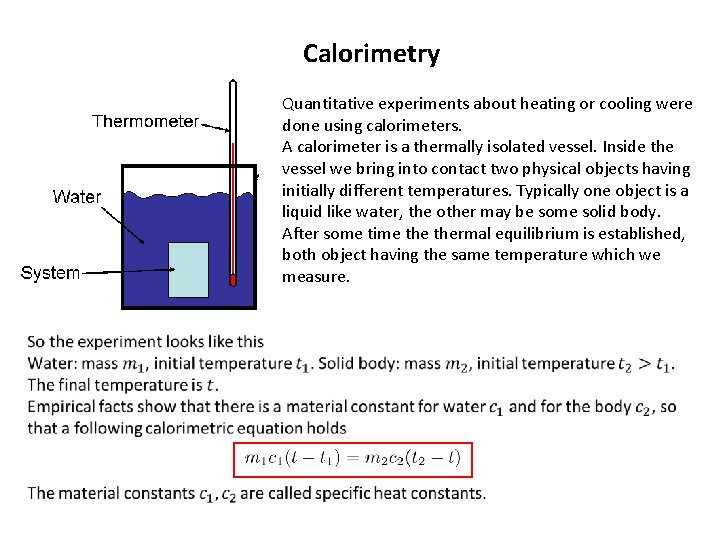
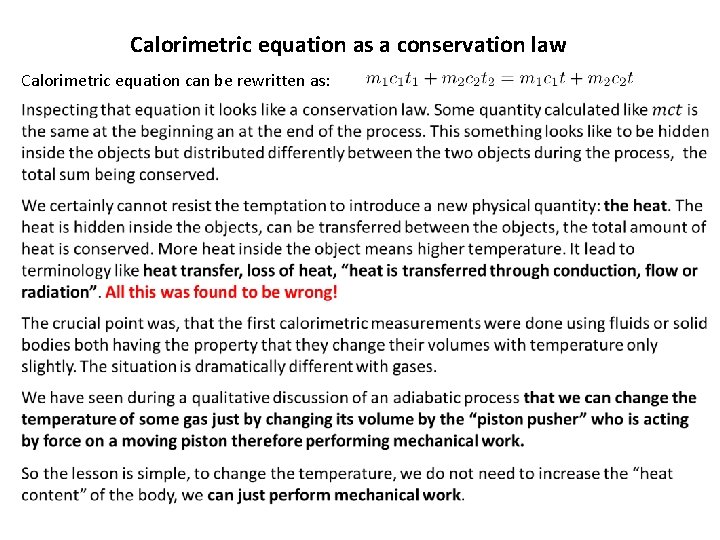
Calorimetry Quantitative experiments about heating or cooling were done using calorimeters. A calorimeter is a thermally isolated vessel. Inside the vessel we bring into contact two physical objects having initially different temperatures. Typically one object is a liquid like water, the other may be some solid body. After some time thermal equilibrium is established, both object having the same temperature which we measure.
Calorimetric equation as a conservation law Calorimetric equation can be rewritten as:
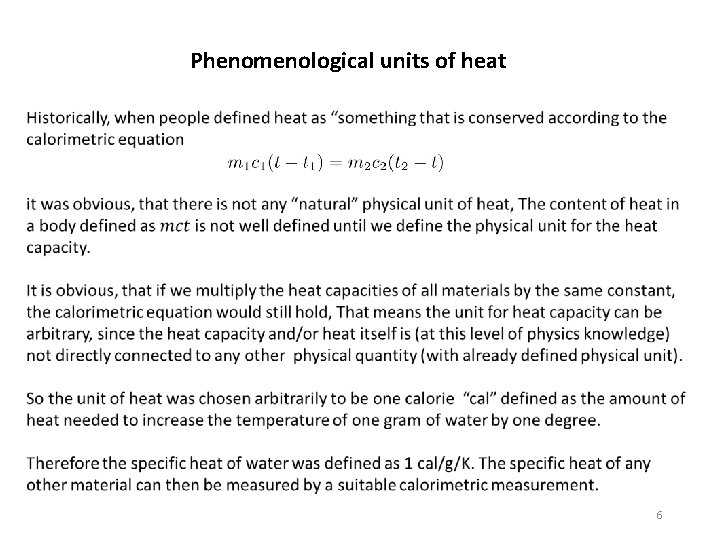
Phenomenological units of heat 6
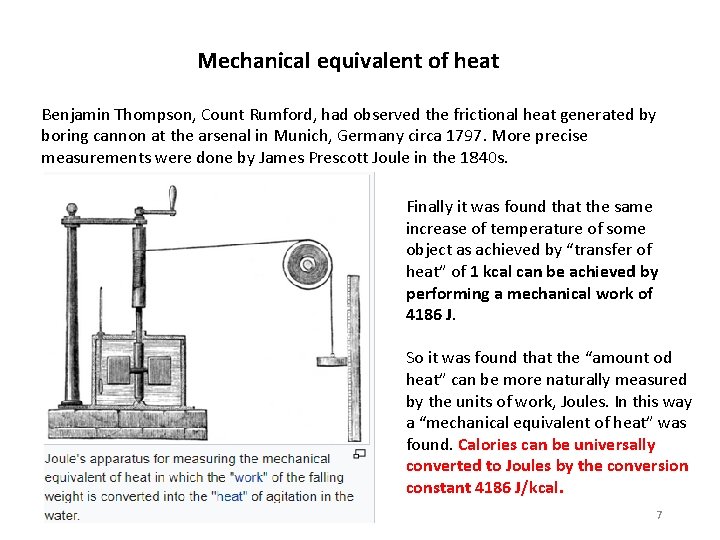
Mechanical equivalent of heat Benjamin Thompson, Count Rumford, had observed the frictional heat generated by boring cannon at the arsenal in Munich, Germany circa 1797. More precise measurements were done by James Prescott Joule in the 1840 s. Finally it was found that the same increase of temperature of some object as achieved by “transfer of heat” of 1 kcal can be achieved by performing a mechanical work of 4186 J. So it was found that the “amount od heat” can be more naturally measured by the units of work, Joules. In this way a “mechanical equivalent of heat” was found. Calories can be universally converted to Joules by the conversion constant 4186 J/kcal. 7
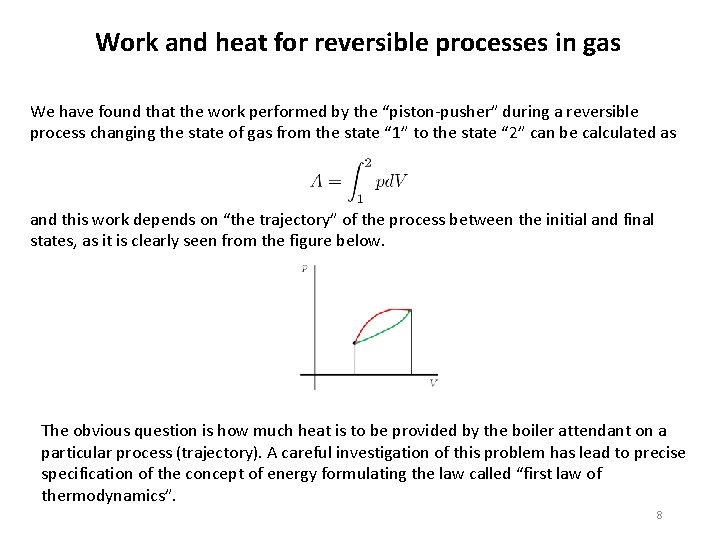
Work and heat for reversible processes in gas We have found that the work performed by the “piston-pusher” during a reversible process changing the state of gas from the state “ 1” to the state “ 2” can be calculated as and this work depends on “the trajectory” of the process between the initial and final states, as it is clearly seen from the figure below. The obvious question is how much heat is to be provided by the boiler attendant on a particular process (trajectory). A careful investigation of this problem has lead to precise specification of the concept of energy formulating the law called “first law of thermodynamics”. 8
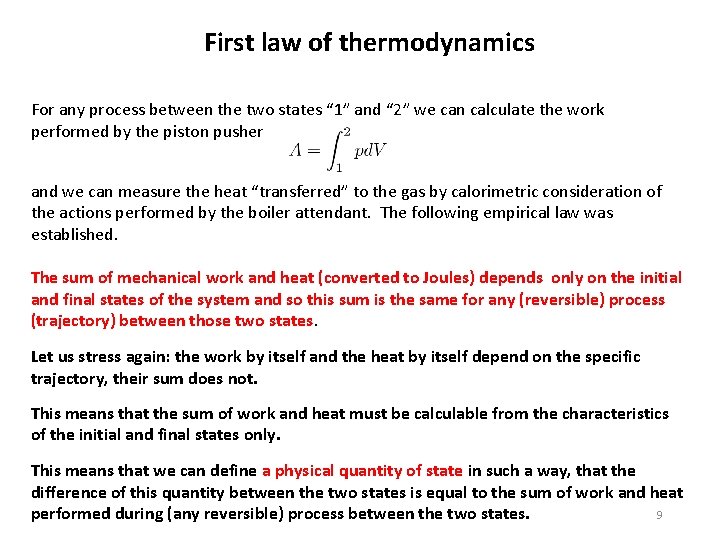
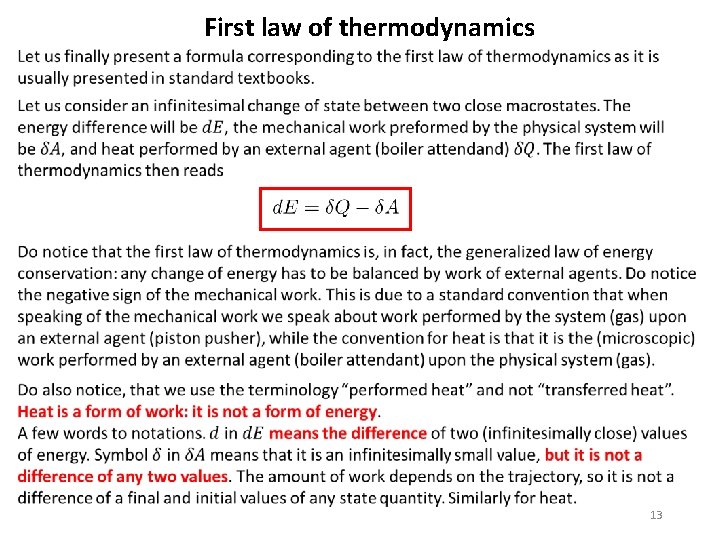
First law of thermodynamics For any process between the two states “ 1” and “ 2” we can calculate the work performed by the piston pusher and we can measure the heat “transferred” to the gas by calorimetric consideration of the actions performed by the boiler attendant. The following empirical law was established. The sum of mechanical work and heat (converted to Joules) depends only on the initial and final states of the system and so this sum is the same for any (reversible) process (trajectory) between those two states. Let us stress again: the work by itself and the heat by itself depend on the specific trajectory, their sum does not. This means that the sum of work and heat must be calculable from the characteristics of the initial and final states only. This means that we can define a physical quantity of state in such a way, that the difference of this quantity between the two states is equal to the sum of work and heat 9 performed during (any reversible) process between the two states.
First law of thermodynamics Repeating: the first law of thermodynamics says, that there must be a physical quantity of state such that the sum of work and heat is calculable as a difference of this quantity between the final and initial state. This quantity was given a name: energy. More precisely, the phenomenological thermodynamics used the name internal energy. The reason perhaps was, that it was not obvious that the state function “energy” as found by thermodynamical considerations has anything common with the quantity “energy” as found in the studies of Newtonian mechanics of particles. Of course, there was a connection: the internal energy can be changed at the expense of mechanical work, the same work as found in classical mechanics. Only after molecules were discovered, it was clear that the “internal energy” is a “standard” mechanical energy of molecules, just macroscopically “not directly visible”. In what follows we shall use the terminology “energy”, without the attribute internal. 10
First law of thermodynamics The obvious task for a phenomenologist is to find the formula for energy as a function of quantities defining the macrostate. Obviously, the first law of thermodynamics can determine only the difference of energies of two states, so energy in thermodynamics is defined up to an arbitrary additive constant. The phenomenologist has to define some arbitrary reference macrostate whose energy is set to 0 by definition. Then he has to measure the sum of work and heat going from the reference state to an arbitrary macrostate. Based on experimental data he has to “guess” a formula for energy. A theoretician, who already knows that behind the macrostate there is some microstate of molecules can in principle calculate the (mechanical) energy of molecules in the chosen representing microstate and, based on statistical considerations, express the energy of the macrostate through the macroscopic quantities defining the macrostate considered. 11
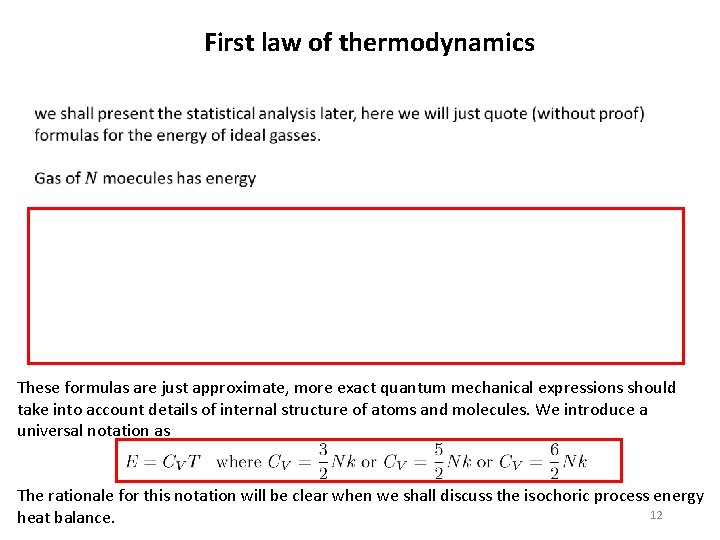
First law of thermodynamics These formulas are just approximate, more exact quantum mechanical expressions should take into account details of internal structure of atoms and molecules. We introduce a universal notation as The rationale for this notation will be clear when we shall discuss the isochoric process energy 12 heat balance.
First law of thermodynamics 13
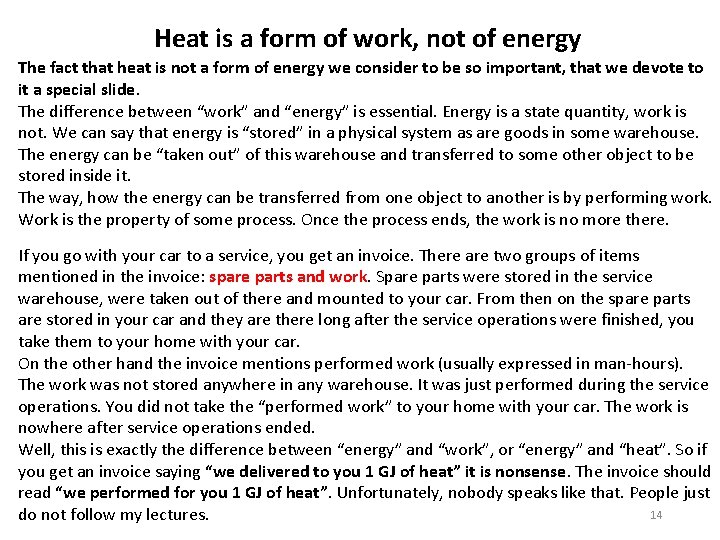
Heat is a form of work, not of energy The fact that heat is not a form of energy we consider to be so important, that we devote to it a special slide. The difference between “work” and “energy” is essential. Energy is a state quantity, work is not. We can say that energy is “stored” in a physical system as are goods in some warehouse. The energy can be “taken out” of this warehouse and transferred to some other object to be stored inside it. The way, how the energy can be transferred from one object to another is by performing work. Work is the property of some process. Once the process ends, the work is no more there. If you go with your car to a service, you get an invoice. There are two groups of items mentioned in the invoice: spare parts and work. Spare parts were stored in the service warehouse, were taken out of there and mounted to your car. From then on the spare parts are stored in your car and they are there long after the service operations were finished, you take them to your home with your car. On the other hand the invoice mentions performed work (usually expressed in man-hours). The work was not stored anywhere in any warehouse. It was just performed during the service operations. You did not take the “performed work” to your home with your car. The work is nowhere after service operations ended. Well, this is exactly the difference between “energy” and “work”, or “energy” and “heat”. So if you get an invoice saying “we delivered to you 1 GJ of heat” it is nonsense. The invoice should read “we performed for you 1 GJ of heat”. Unfortunately, nobody speaks like that. People just 14 do not follow my lectures.
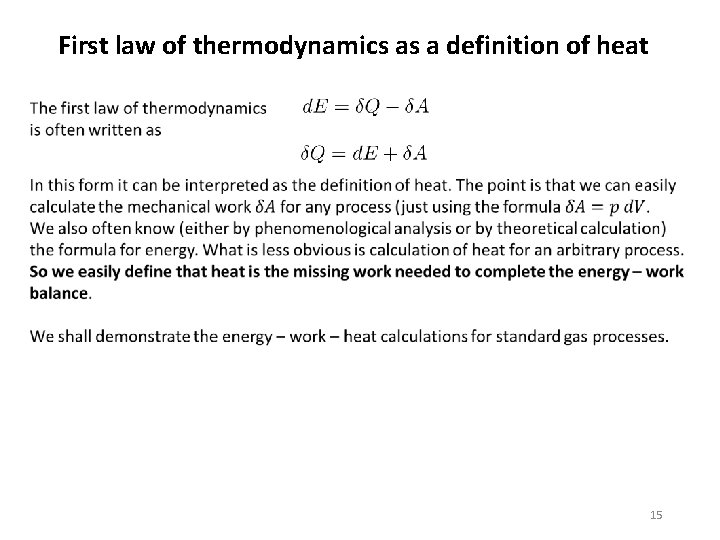
First law of thermodynamics as a definition of heat 15
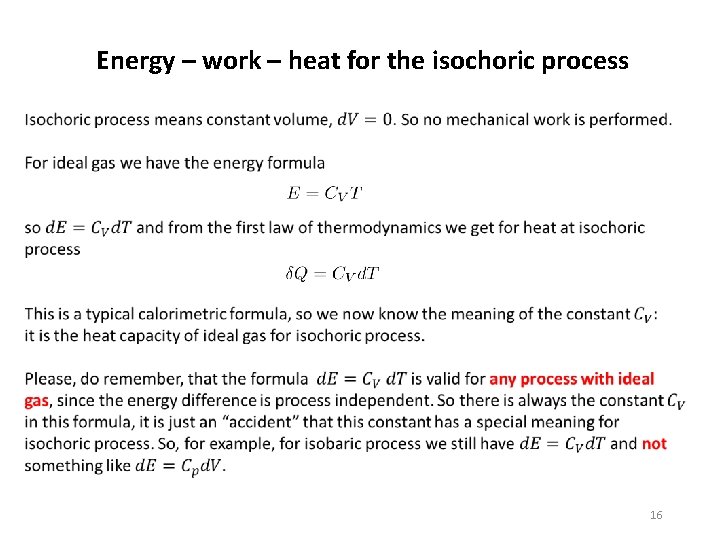
Energy – work – heat for the isochoric process 16
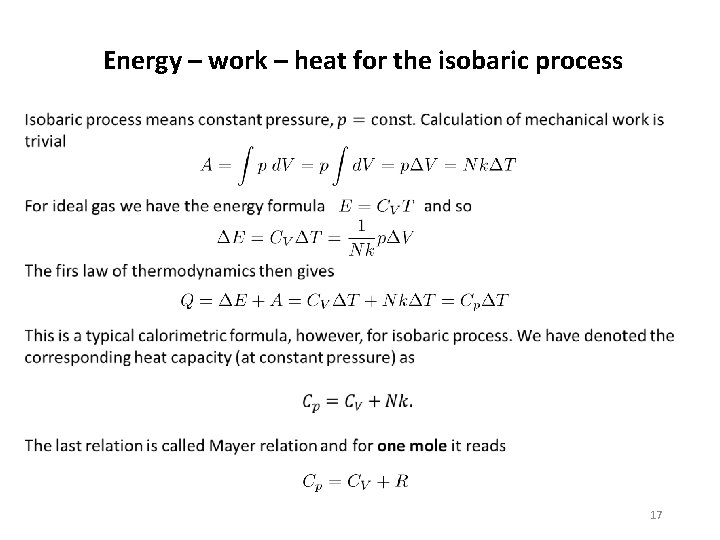
Energy – work – heat for the isobaric process 17
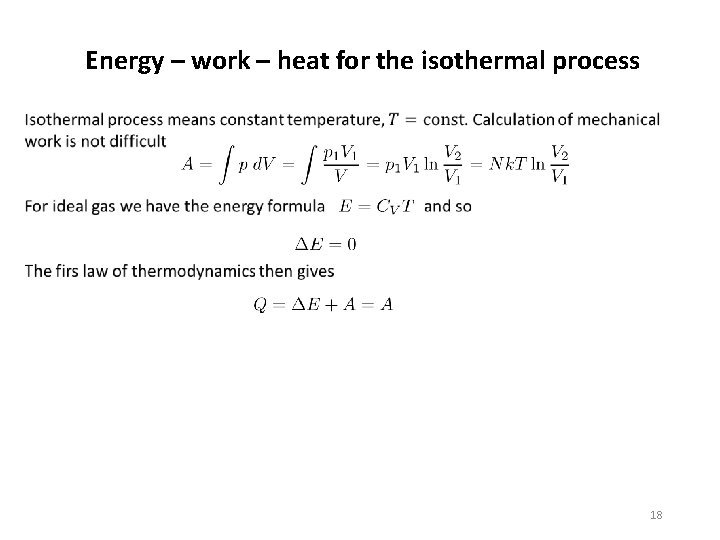
Energy – work – heat for the isothermal process 18