
Macromolecules The 4 largest molecules of life What
- Slides: 23
Macromolecules { The 4 largest molecules of life
What is life again? The ability to biosynthesize the 4 major macromolecules i. e. you can create by yourself- the 4 major molecules of life
Remember those elements necessary for life? The reason these are necessary for life is because they are the basic ingredients for the macromolecules: CHNOPS Carbon Hydrogen Nitrogen Oxygen Phosphorus Sulfur
The 4 Macromolecules are: PROTEINS NUCLEIC ACIDS CARBOHYDRATES LIPIDS
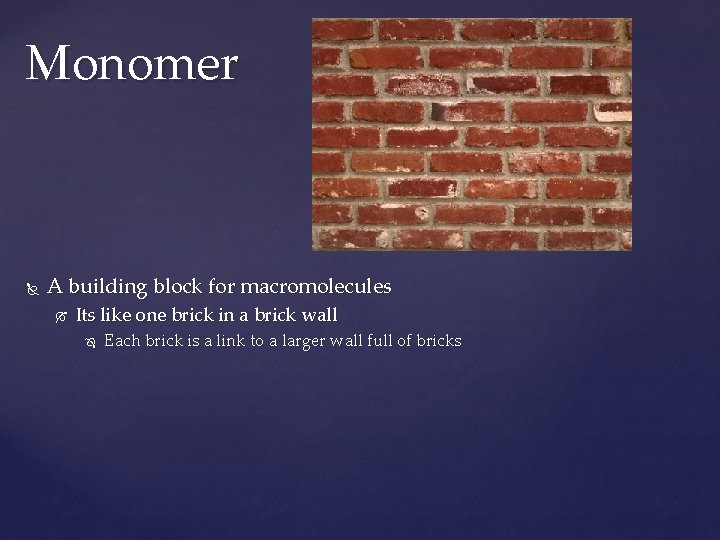
Monomer A building block for macromolecules Its like one brick in a brick wall Each brick is a link to a larger wall full of bricks
Important facts to take note of on macromolecules FUNCTION Calories of energy Chemical Structure What is the name of its monomer? What does the monomer look like? What is the chemical structure of the macromolecule Examples
Carbohydrates { The energy and structure macromolecules
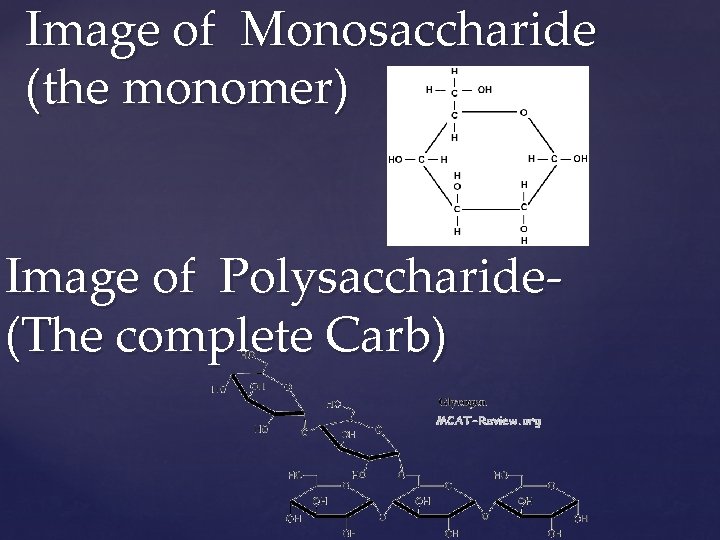
Carb info *Carbohydrate Energy: Carbs provide 4 calories of energy per gram *Carbohydrate function: carbs are simple sugars. Their job is in their simplest form to provide energy, in their more complex form, their function is structural (to help *Carbohydrate Monomer: Monosaccharides
Image of Monosaccharide (the monomer) Image of Polysaccharide(The complete Carb)
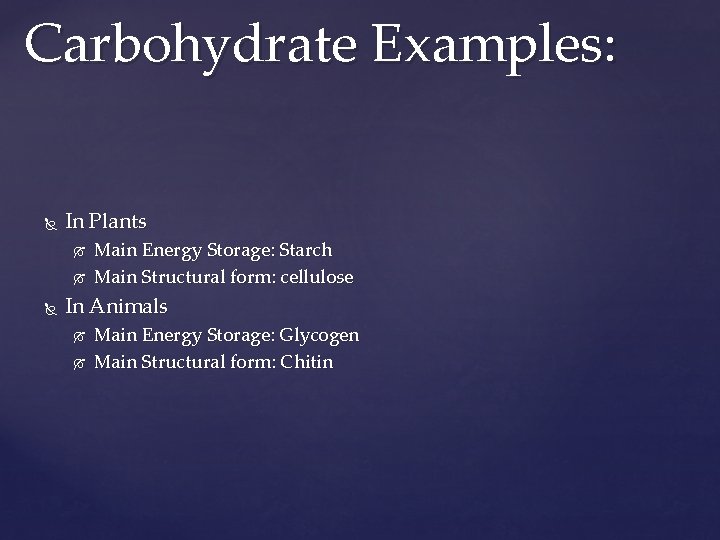
Carbohydrate Examples: In Plants Main Energy Storage: Starch Main Structural form: cellulose In Animals Main Energy Storage: Glycogen Main Structural form: Chitin
PROTEINS { The Structural and enzymatic macromolecules
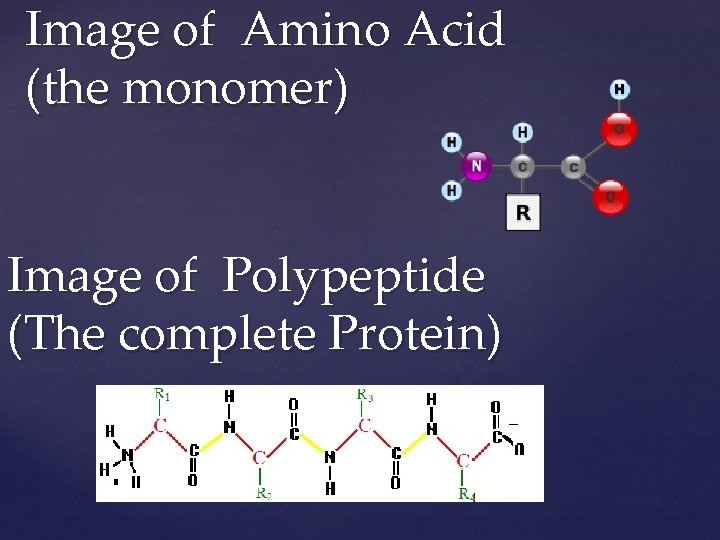
Protein info *Protein Energy: Carbs provide 4 calories of energy per gram *Protein function: structural, enzymatic, (support, defense, and movement) *Protein Monomer: Amino Acidsthere are only 20 amino acids that create every protein in your body
Image of Amino Acid (the monomer) Image of Polypeptide (The complete Protein)
*Protein Examples: Enzymatic Proteins: ENZYMES- help lower the activation energy to do chemical reactions, they usually all end in the suffix –ASE some include: helicase, DNA polymerase, Structural Proteins: hemoglobin is a structural protein in red blood cells.
ENZYMES Enzymes are special proteins used to reduce the activation energy required for specific chemical reactions within the body Enzymes are : Specific Enzymes are: temperature dependent- if it’s too hot or too cold they breakdown Salinity dependent- if it’s too salty they break down p. H dependent- if it’s too acidic or basic they break down
LIPIDS { Hormone, storage and insulation macromolecules
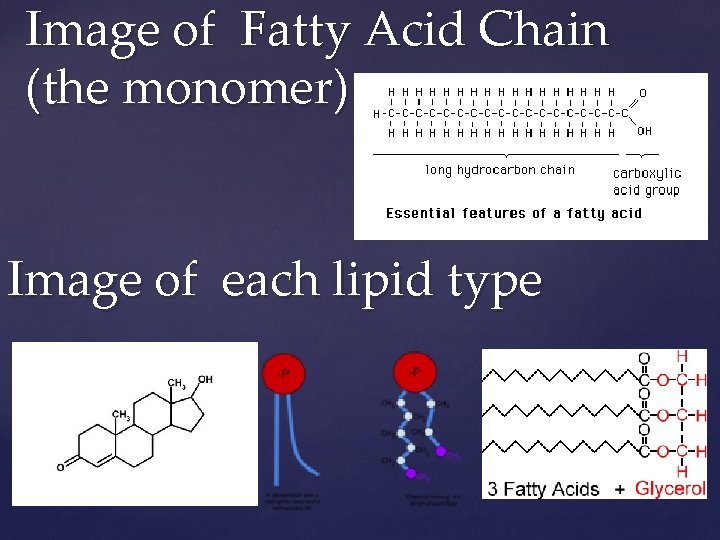
Lipid info *Lipid Energy: Carbs provide 9 calories of energy per gram *Lipid function: energy storage, insulation, and membrane structure *Lipid Monomer: in fats- fatty acid chains
Image of Fatty Acid Chain (the monomer) Image of each lipid type
*Lipid Examples: There are three groups of lipids FATS: saturated, unsaturated, trans fats PHOSPHOLIPIDS: these are found in cell membranes STEROIDS: like cholesterol, testosterone, estrogen,
NUCLEIC ACIDS { The information macromolecule
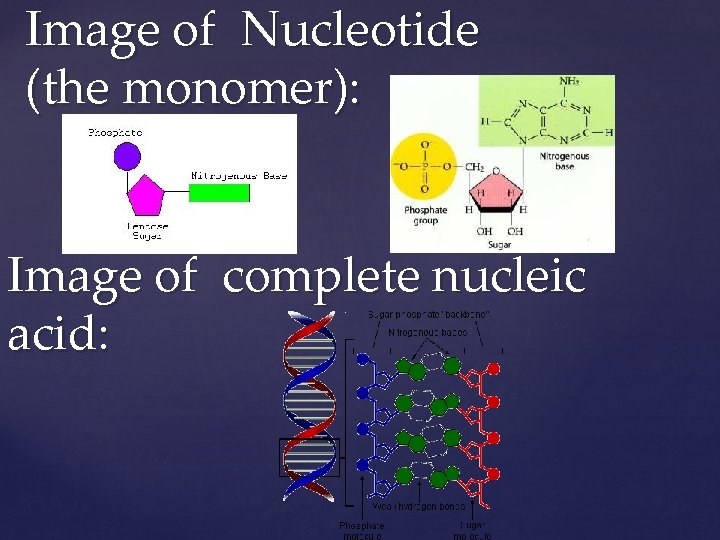
Nucleic Acid info *Nucleic acid Energy: nucleic acids caloric value is rarely documented or is of little concern some sources say it provides 2 calories of energy per gram *Nucleic Acid function: materials used for storing the genetic information to create proteins * Nucleic Acid Monomer: Nucleotide
Image of Nucleotide (the monomer): Image of complete nucleic acid:
* Nucleic Acid Examples: DNA RNA