
Macromolecules copyright cmassengale 1 Objectives Students will learn
Macromolecules copyright cmassengale 1
Objectives Students will learn: • What organic compounds are and how they relate to macromolecules. • The importance of carbon and it’s relation to organic compounds • The four macromolecules that are essential for life: Carbohydrates, Lipids, Proteins and Nucleic Acids • The key components of each macromolecule and their functions copyright cmassengale 2
Organic Compounds • Compounds that contain CARBON are called organic • Macromolecules are large organic molecules copyright cmassengale 3
Carbon (C) • Carbon has 4 electrons in outer shell. • Carbon can form covalent bonds with as many as 4 other atoms (elements). • Usually with C, H, O or N. N • Example: CH 4(methane) copyright cmassengale 4
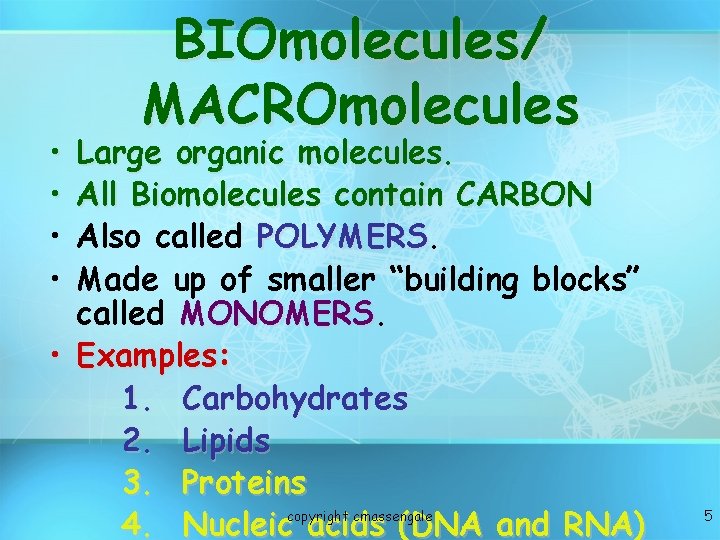
• • BIOmolecules/ MACROmolecules Large organic molecules. All Biomolecules contain CARBON Also called POLYMERS Made up of smaller “building blocks” called MONOMERS • Examples: 1. Carbohydrates 2. Lipids 3. Proteins cmassengale 4. Nucleiccopyright acids (DNA and RNA) 5
Question: How Are Macromolecules Formed? copyright cmassengale 6
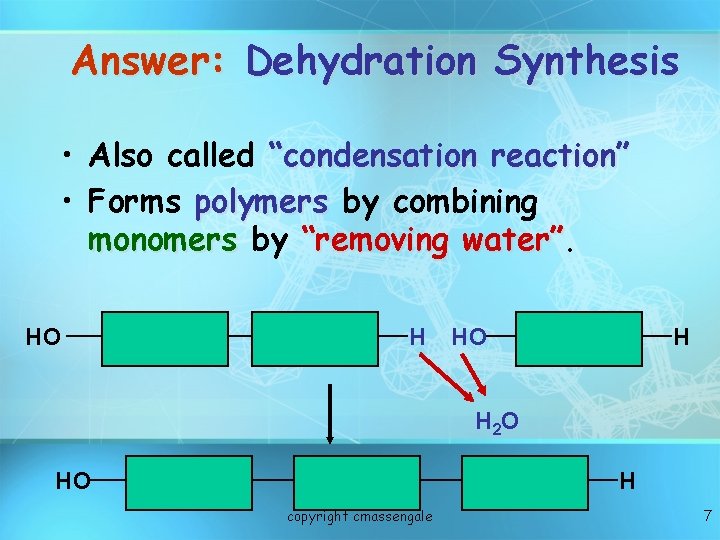
Answer: Dehydration Synthesis • Also called “condensation reaction” • Forms polymers by combining monomers by “removing water” HO H H 2 O HO H copyright cmassengale 7
Question: How are Macromolecules separated or digested? copyright cmassengale 8
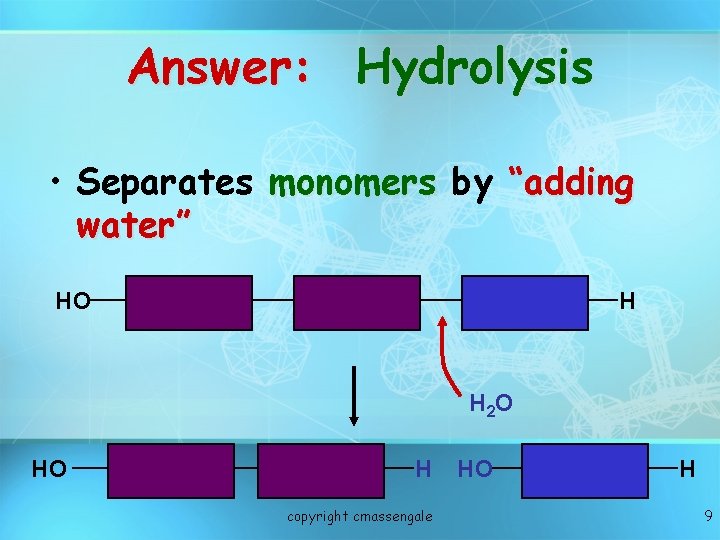
Answer: Hydrolysis • Separates monomers by “adding water” HO H H 2 O HO H copyright cmassengale HO H 9
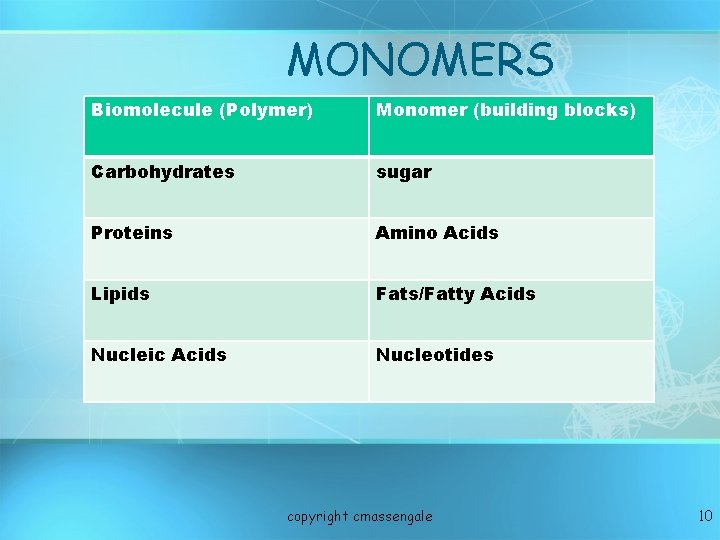
MONOMERS Biomolecule (Polymer) Monomer (building blocks) Carbohydrates sugar Proteins Amino Acids Lipids Fats/Fatty Acids Nucleic Acids Nucleotides copyright cmassengale 10
Carbohydrates copyright cmassengale 11
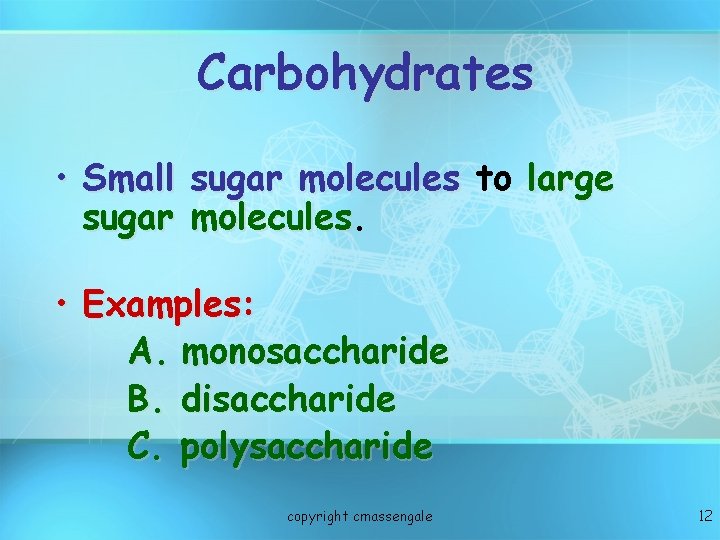
Carbohydrates • Small sugar molecules to large sugar molecules • Examples: A. monosaccharide B. disaccharide C. polysaccharide copyright cmassengale 12
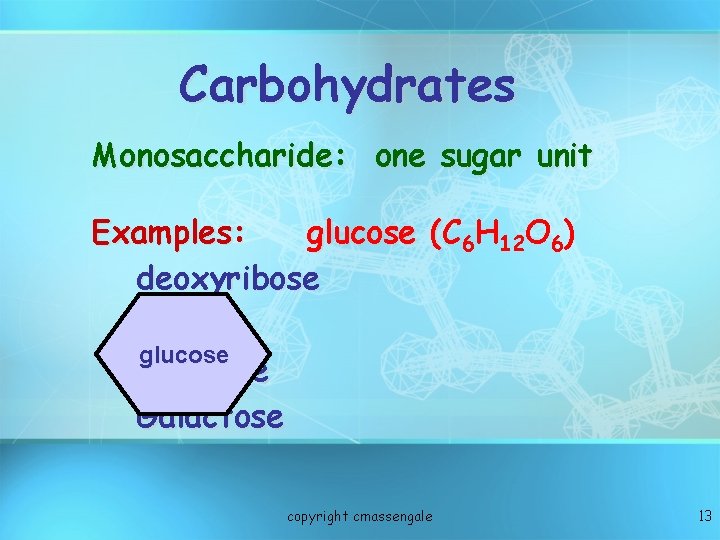
Carbohydrates Monosaccharide: one sugar unit Examples: glucose (C ( 6 H 12 O 6) deoxyribose glucose Fructose Galactose copyright cmassengale 13
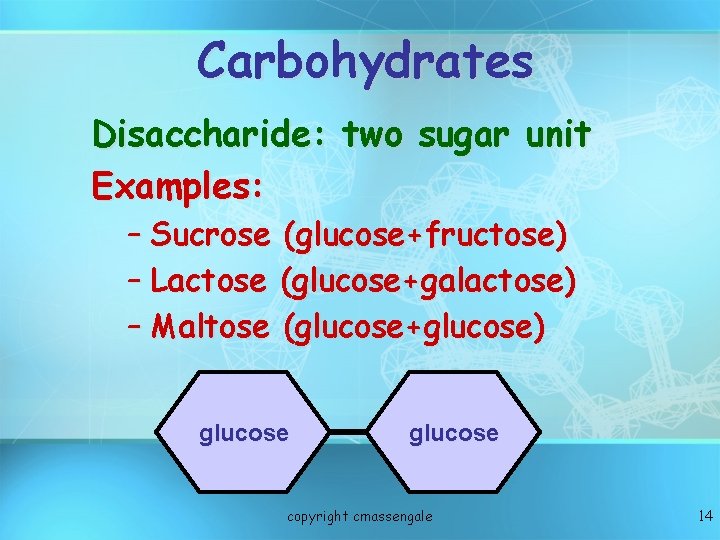
Carbohydrates Disaccharide: two sugar unit Examples: – Sucrose (glucose+fructose) – Lactose (glucose+galactose) – Maltose (glucose+glucose) glucose copyright cmassengale 14
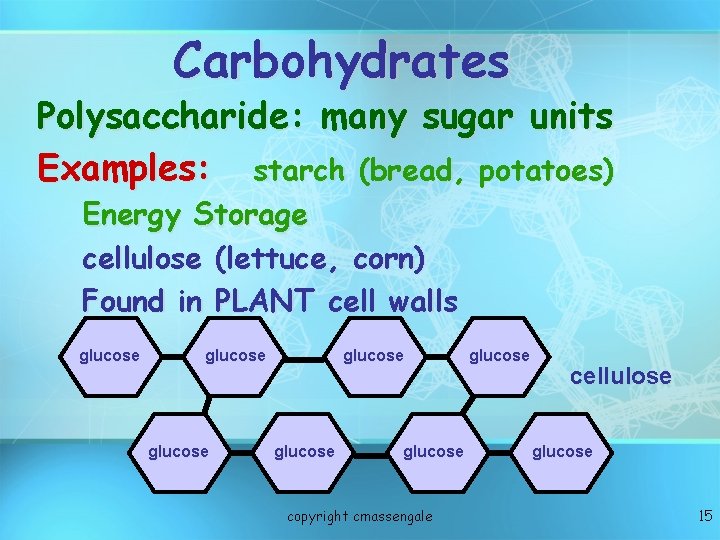
Carbohydrates Polysaccharide: many sugar units Examples: starch (bread, potatoes) Energy Storage cellulose (lettuce, corn) Found in PLANT cell walls glucose glucose copyright cmassengale glucose cellulose glucose 15
Lipids copyright cmassengale 16
Lipids • General term for compounds which are non-soluble in water(do not mix) • Lipids are soluble(mix) in hydrophobic(afraid of water) solvents • Remember: “stores the most energy” • Examples: 1. Fats 2. Phospholipids 3. Oils 4. Waxes 5. Steroid hormones cmassengale 6. copyright Triglycerides 17
Lipids Six functions of lipids: 1. Long term energy storage 2. Protection against heat loss (insulation) 3. Protection against physical shock 4. Protection against water loss 5. Chemical messengers (hormones) 6. Major component of membranes (phospholipids) copyright cmassengale 18
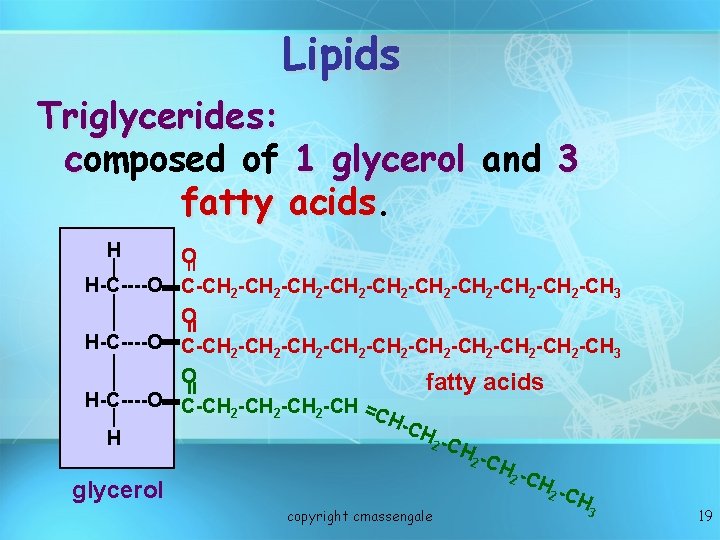
Lipids Triglycerides: composed of 1 glycerol and 3 fatty acids H = O H-C----O C-CH 2 -CH 2 -CH 2 -CH 2 -CH 2 -CH 3 O fatty acids H-C----O C-CH -CH = 2 2 2 CH -CH H 2 -C H 2 C Hglycerol 2 C H = copyright cmassengale 3 19
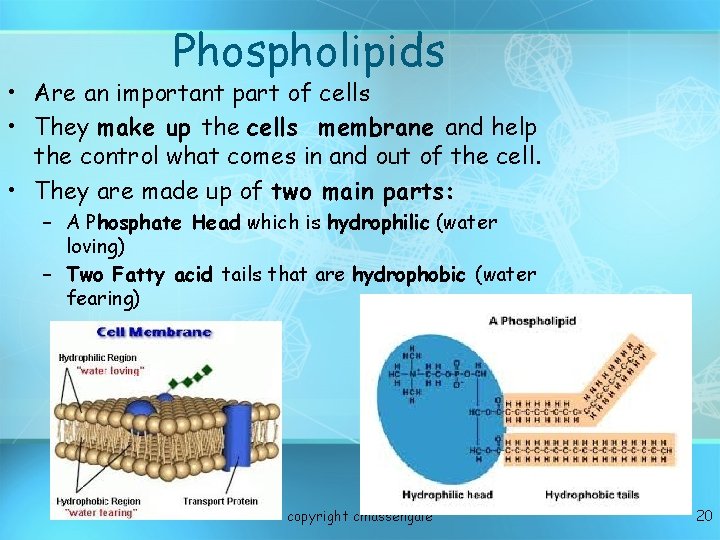
Phospholipids • Are an important part of cells • They make up the cells membrane and help the control what comes in and out of the cell. • They are made up of two main parts: – A Phosphate Head which is hydrophilic (water loving) – Two Fatty acid tails that are hydrophobic (water fearing) copyright cmassengale 20
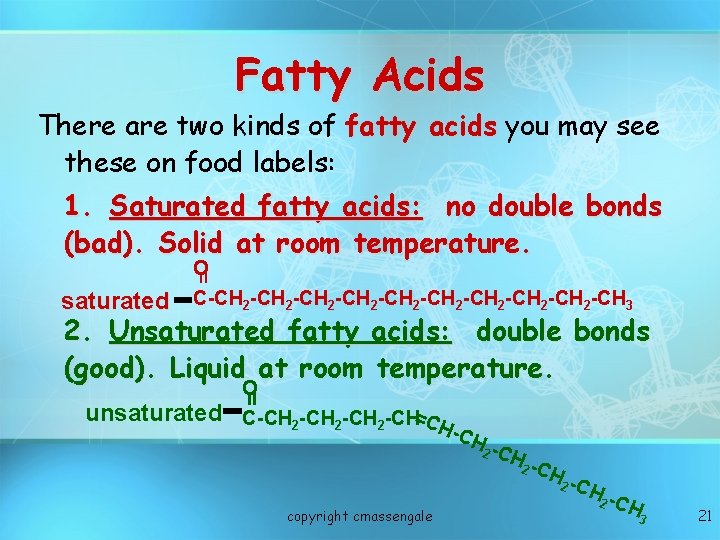
Fatty Acids There are two kinds of fatty acids you may see these on food labels: 1. Saturated fatty acids: no double bonds (bad). Solid at room temperature. = O C-CH 2 -CH 2 -CH 2 -CH 3 saturated 2. Unsaturated fatty acids: double bonds (good). Liquid at room temperature. = unsaturated O C-CH 2 -CH=CH -CH 2 -C copyright cmassengale H 2 C H 3 21
Proteins copyright cmassengale 22
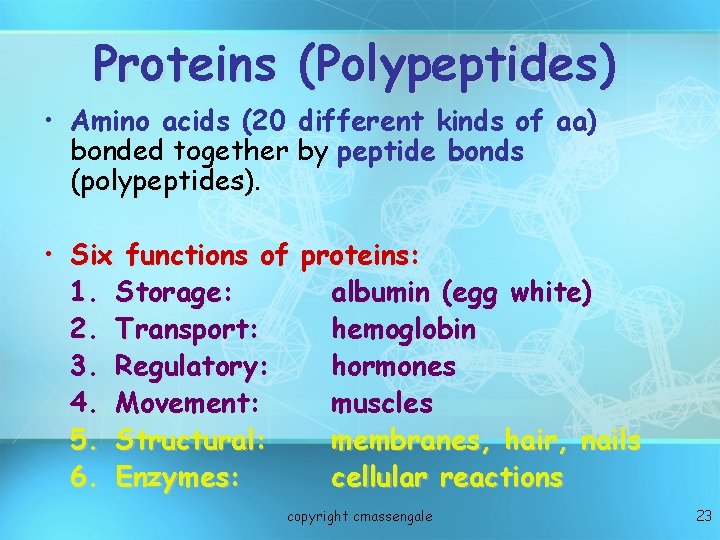
Proteins (Polypeptides) • Amino acids (20 different kinds of aa) bonded together by peptide bonds (polypeptides). polypeptides • Six functions of proteins: 1. Storage: albumin (egg white) 2. Transport: hemoglobin 3. Regulatory: hormones 4. Movement: muscles 5. Structural: membranes, hair, nails 6. Enzymes: cellular reactions copyright cmassengale 23
Proteins (Polypeptides) Four levels of protein structure: A. Primary Structure B. Secondary Structure C. Tertiary Structure D. Quaternary Structure copyright cmassengale 24
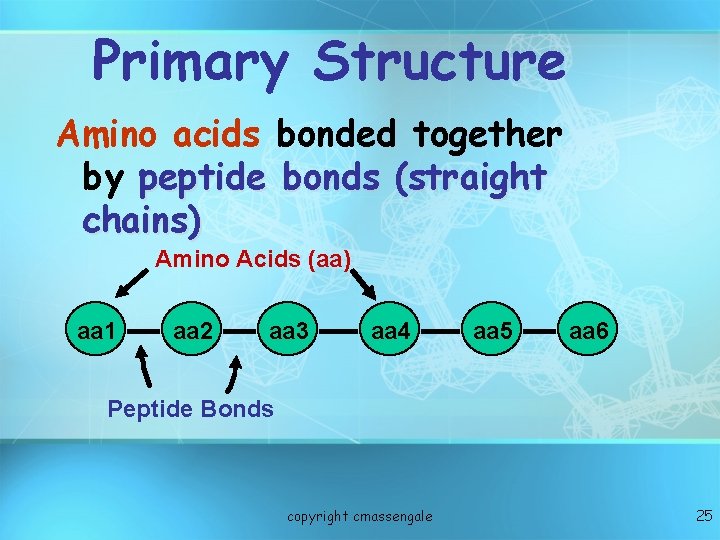
Primary Structure Amino acids bonded together by peptide bonds (straight chains) Amino Acids (aa) aa 1 aa 2 aa 3 aa 4 aa 5 aa 6 Peptide Bonds copyright cmassengale 25
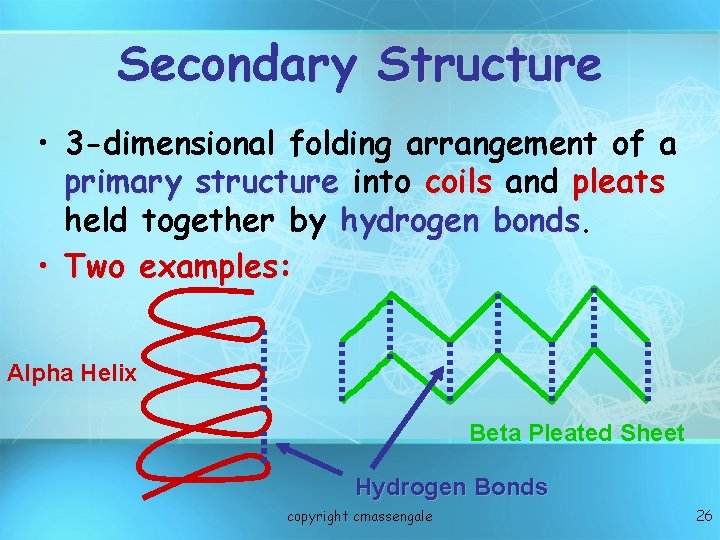
Secondary Structure • 3 -dimensional folding arrangement of a primary structure into coils and pleats held together by hydrogen bonds • Two examples: Alpha Helix Beta Pleated Sheet Hydrogen Bonds copyright cmassengale 26
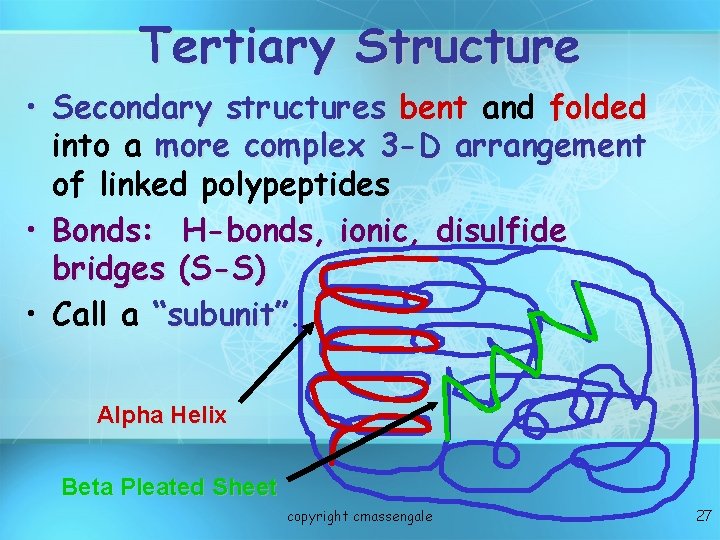
Tertiary Structure • Secondary structures bent and folded into a more complex 3 -D arrangement of linked polypeptides • Bonds: H-bonds, ionic, disulfide bridges (S-S) • Call a “subunit”. Alpha Helix Beta Pleated Sheet copyright cmassengale 27
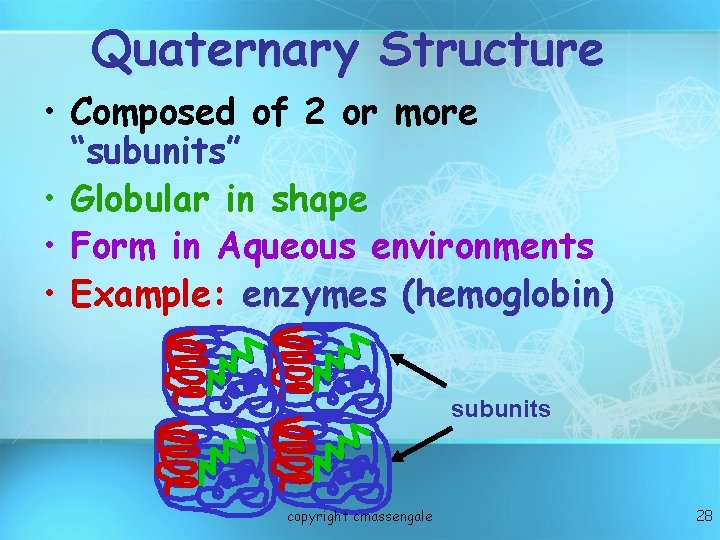
Quaternary Structure • Composed of 2 or more “subunits” • Globular in shape • Form in Aqueous environments • Example: enzymes (hemoglobin) subunits copyright cmassengale 28
Nucleic Acids copyright cmassengale 29
Nucleic acids • Two types: a. Deoxyribonucleic acid (DNAdouble helix) b. Ribonucleic acid (RNA-single strand) • Nucleic acids are composed of long chains of nucleotides linked by dehydration synthesis copyright cmassengale 30
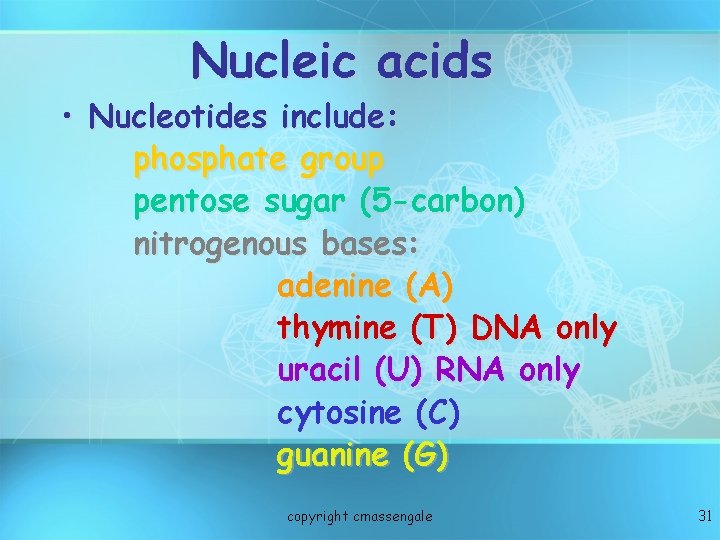
Nucleic acids • Nucleotides include: phosphate group pentose sugar (5 -carbon) nitrogenous bases: adenine (A) thymine (T) DNA only uracil (U) RNA only cytosine (C) guanine (G) copyright cmassengale 31
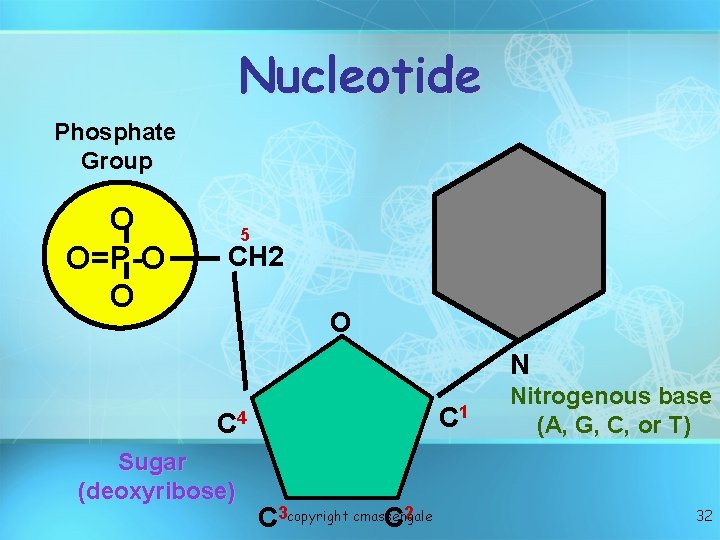
Nucleotide Phosphate Group O O=P-O O 5 CH 2 O N C 1 C 4 Sugar (deoxyribose) C 3 copyright cmassengale C 2 Nitrogenous base (A, G, C, or T) 32
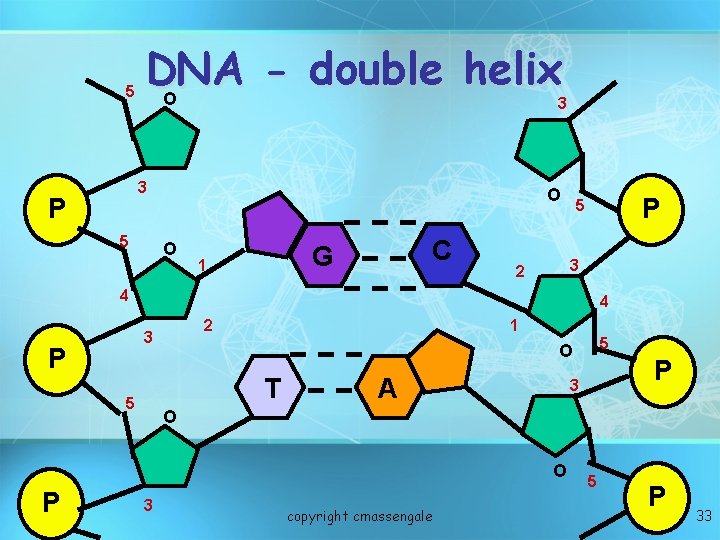
5 DNA double helix O 3 3 P 5 O O C G 1 P 5 3 2 4 4 2 3 P 1 T 5 A P 3 O O P 5 O 3 copyright cmassengale 5 P 33
Summary of Objectives What organic compounds are and how they relate to macromolecules. The importance of carbon and it’s relation to organic compounds The four macromolecules that are essential for life: Carbohydrates, Lipids, Proteins and Nucleic Acids The key components of each macromolecule and their functions copyright cmassengale 34
- Slides: 34