
Macroeconomic s Theory of Investment HE EDUCATOR Dr


- Slides: 31
Macroeconomic s Theory of Investment HE EDUCATOR Dr. Waqar Ahmad Faculty of Administrative Sciences and Economics
Introduction • In Economic, Investments means the new expenditure incurred on addition of capital goods such as machine, building, equipments, tools etc. • In Keynes view investment refers real investment which adds to capital equipment. • It leads to increase in the level of income, production and purchase of capital goods.
Types of Investment 1. Gross and Net Investment 2. Private and public Investment 3. Autonomous Investment 4. Induced Investment
Gross and Net Investment • Net Investment = Gross Investment minus Depreciation • Gross investment is the purchase of fixed assets and unsold stock during an accounting cycle. • Depreciation is the loss of value over time for the fixed assets through normal use and wear and tear. • Once depreciation is deducted from the gross investment, the remaining amount is the net investment. Net investment can also be thought of as the actual investment in capital assets.
Private and Public Investment • The purchase of a capital asset that is expected to produce income, appreciate in value, or both generate income and appreciate in value. A capital asset is simply property that is not easily sold and is generally purchased to help an investor to generate a profit. Examples of capital assets include land, buildings, machinery, and equipment. • Public investment is investment by government – To provide basic resources such as water, sanitation which private sector cant deliver. This leads to higher productivity and better living Std. – To shape choices where people live and work – to influence nature and type of private investment – To boost growth and provide infrastructure to private sector for more investment.
Autonomous Investment • The investment which doesn’t change with the change in income level and therefore independent of income is said to be autonomous investment. • This investment generally taken place in roads, house public undertaking and other types of economic infrastructure such as power transport and communication. • This investment depends more on population growth and technical progress than the level of income.
Induced Investment • Induced Investment is the investment which is affected by the change in level of income. • The investment depends more on income than on the rate of interest. • The induces investment is undertaken both fixed capital assets and inventories.
Determinant of Investment 1. Managerial efficiency of Capital (MEC): • The term managerial efficiency of capital is associated with the real and not financial investment. • If the value of MEC is high, more capital will be invested and vice versa. 2. Technological Progress: • The new technological increase the productivity of labour and capital • The selection of new of the new technology depends upon the net benefit over the lost of having the technology. 3. Demand Forecast: • The long term demand forecast is one of the determinants of investment decision. • If the firms finds markets potential for the product in the long run, the firm will increase in investment
4. Level of Income – If the price of income increases in an economy through increases in money wage rate the demand for the goods will increases – This will induce to investment and vice versa 5. Government Policy – – Government policy also important factors which influence the inducement to invest in the country. If the government imposes low tax on the corporate income the investment will increase and vice versa. 6. Political Climate – – If there is any political instability the inducement to may be adversely affected. On the other hand if there is political stability the investment increases
The Financial Theory of Investment • Acceleration Theory The principle of acceleration states that if demand for consumption goods rises, there will be an increase in the demand for factor of production, say machine, which is used to produce the goods. In other words, the accelerator measures the change in investment goods industries as a result of changes in consumption goods industries. According to K. K. Kurihara : “The acceleration coefficient is the ration induced investment and an initial change in consumption.
• The accelerator theory was introduced by T. N. Carver in 1903 and J. M. in 1917. • Later on, it was rigorously developed by economists like Harrod, Salow, Samuelsom, hicks, etc. in trade cycle theory. • The accelerator theory explain the interrelationship between customer goods industries in an economy. • It states that when the demand for consumer goods increase, the demand for capital gods increase, i. e. , there is positive association between capital goods and consumer goods industries.
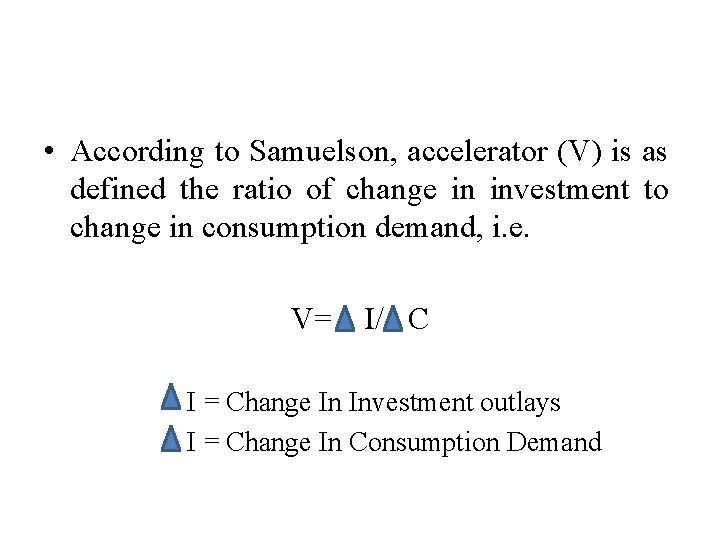
• According to Samuelson, accelerator (V) is as defined the ratio of change in investment to change in consumption demand, i. e. V= I/ C I = Change In Investment outlays I = Change In Consumption Demand
Assumptions • Capital output ration remains constant. • There should be excess capacity in the capital goods industries. • There is permanent change in consumption demand. • The supply of resources should be elastic so that the investment in capital goods industries can be increased easily. • The should be elastic supply of cheap credit. • Technology remains constant. • There is absence of time lag.
• Thus, the principle of acceleration is based on the fact that the demand for capital goods is derived from the demand for consumer goods. • The acceleration principle explain the process by which a change in demand for consumption goods lead to a change in investment on capital goods.
• Saving is the part of personal income that is neither consumed nor paid out in taxes. The income saved is focus to business firms in two different ways. – Households buy bonds and stocks issued by business firms and the firms then use the money to but investment goods. – Households deposit saving into the banks. The band then lend the money to the firms, which use it to but investment goods.
• Investment is the portion of final products that adds to the nation’s stock of income yielding physical assets or that replaces old, worn- out physical assets. Final goods that business firms keep for themselves are called private investment or private capital formation. Private investment consist of inventory investment and fixed investment
• Inventory investment means goods purchased business by the firms but not resold to consumer in the current period, stays in the stock raise the level of inventories. Inventories of raw materials, parts and finished goods are essential forms of income yielding assets for business. • Fixed investment includes all final goods purchased by business firms other that addition to inventory. It includes all final goods purchased by business firms that are not intended to resale. The main types of fixed investment (investment on capital goods) are structure ( Factories, offices building, plants and machinery).
Saving – Investment Theory • First of all coined by Thomas Tooke in 1884. • Further explained by classical economist who believe on monitories. This theory is called as income theory. • Elaborate and explained by J. M. Keynes in the names of Saving – Investment Theory. • The major objective of this theory is to explain the changes in prices level or the value of money
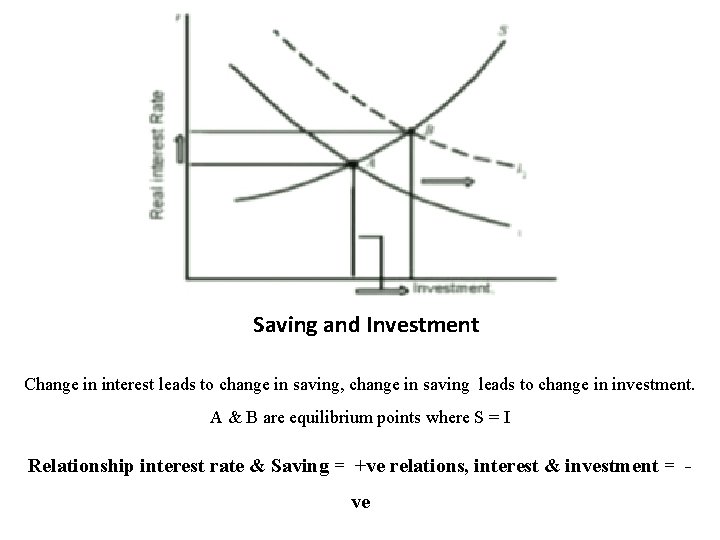
Classical View / Thought • The classical view states that the economy is always at full employment equilibrium. • The theory is termed as “ Income theory” • The saving and investment are always equals. • The classical economist believe that equality between saving and investment brought by interest rate. • When, saving exceeds investment, the rate of interest falls to discourage saving and encourage investment and vice versa.
Saving and Investment Change in interest leads to change in saving, change in saving leads to change in investment. A & B are equilibrium points where S = I Relationship interest rate & Saving = +ve relations, interest & investment = ve
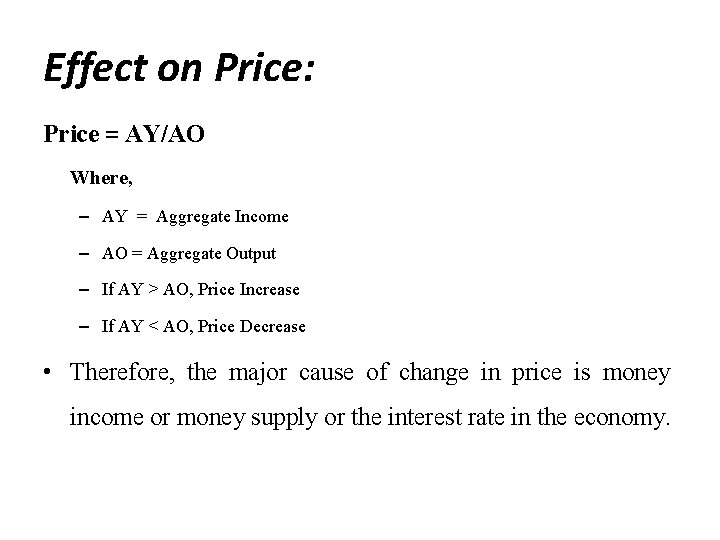
Effect on Price: Price = AY/AO Where, – AY = Aggregate Income – AO = Aggregate Output – If AY > AO, Price Increase – If AY < AO, Price Decrease • Therefore, the major cause of change in price is money income or money supply or the interest rate in the economy.
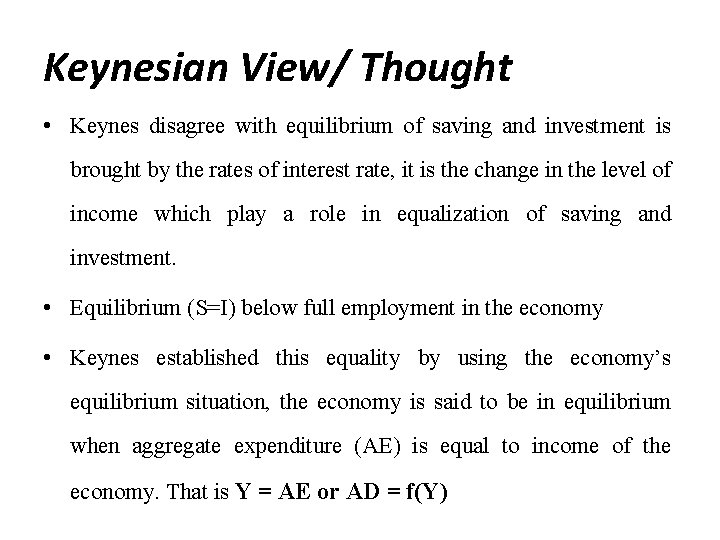
Keynesian View/ Thought • Keynes disagree with equilibrium of saving and investment is brought by the rates of interest rate, it is the change in the level of income which play a role in equalization of saving and investment. • Equilibrium (S=I) below full employment in the economy • Keynes established this equality by using the economy’s equilibrium situation, the economy is said to be in equilibrium when aggregate expenditure (AE) is equal to income of the economy. That is Y = AE or AD = f(Y)
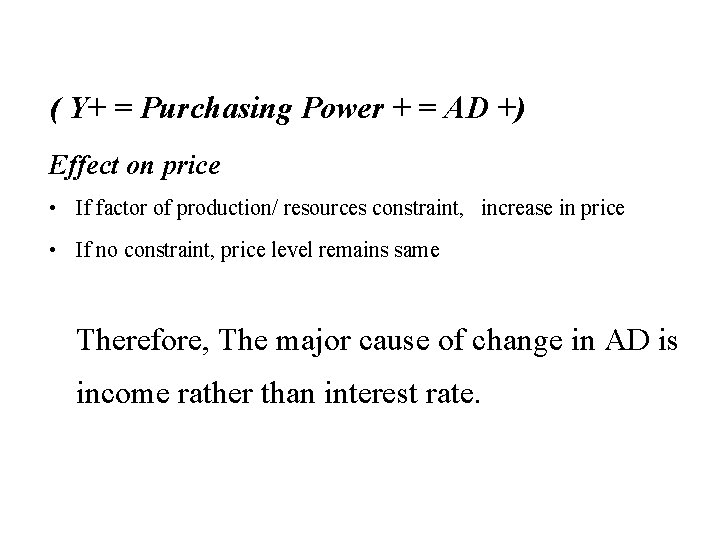
( Y+ = Purchasing Power + = AD +) Effect on price • If factor of production/ resources constraint, increase in price • If no constraint, price level remains same Therefore, The major cause of change in AD is income rather than interest rate.
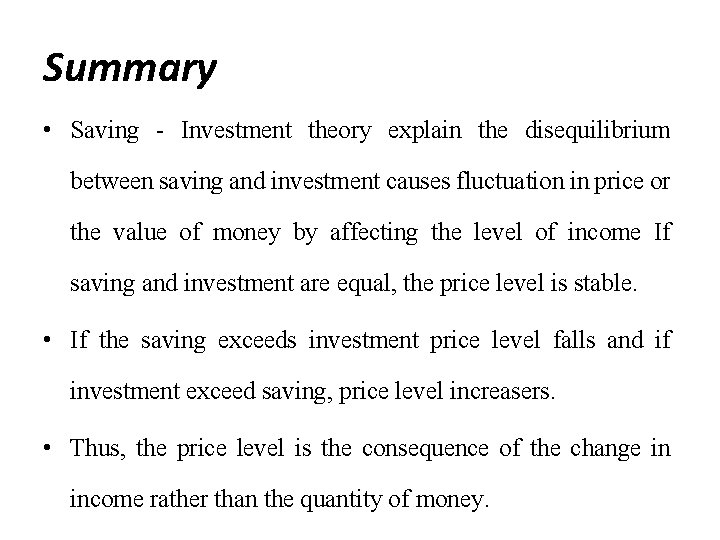
Summary • Saving - Investment theory explain the disequilibrium between saving and investment causes fluctuation in price or the value of money by affecting the level of income If saving and investment are equal, the price level is stable. • If the saving exceeds investment price level falls and if investment exceed saving, price level increasers. • Thus, the price level is the consequence of the change in income rather than the quantity of money.
Why CIT? • Growth • Risk • Funding • Irreversibility • Complexity Capital Investment Theory
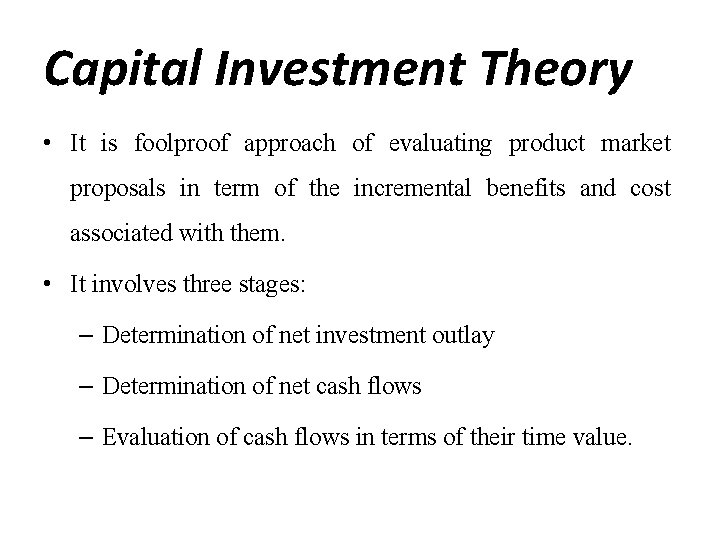
Capital Investment Theory • It is foolproof approach of evaluating product market proposals in term of the incremental benefits and cost associated with them. • It involves three stages: – Determination of net investment outlay – Determination of net cash flows – Evaluation of cash flows in terms of their time value.
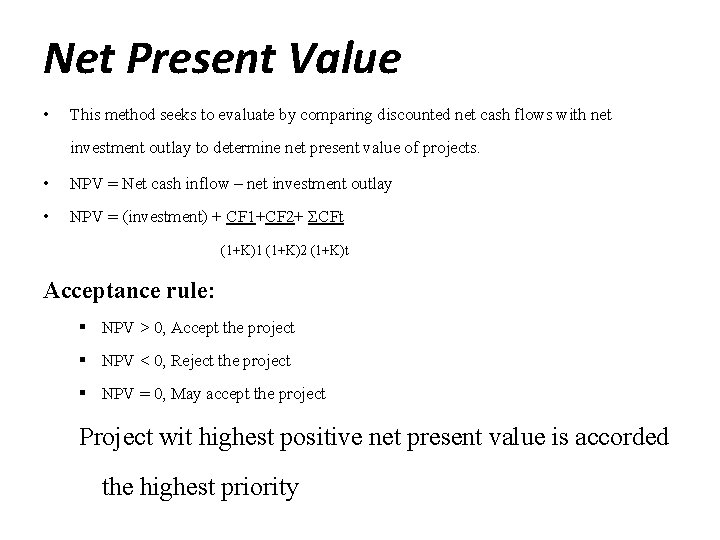
Net Present Value • This method seeks to evaluate by comparing discounted net cash flows with net investment outlay to determine net present value of projects. • NPV = Net cash inflow – net investment outlay • NPV = (investment) + CF 1+CF 2+ ƩCFt (1+K)1 (1+K)2 (1+K)t Acceptance rule: § NPV > 0, Accept the project § NPV < 0, Reject the project § NPV = 0, May accept the project Project wit highest positive net present value is accorded the highest priority
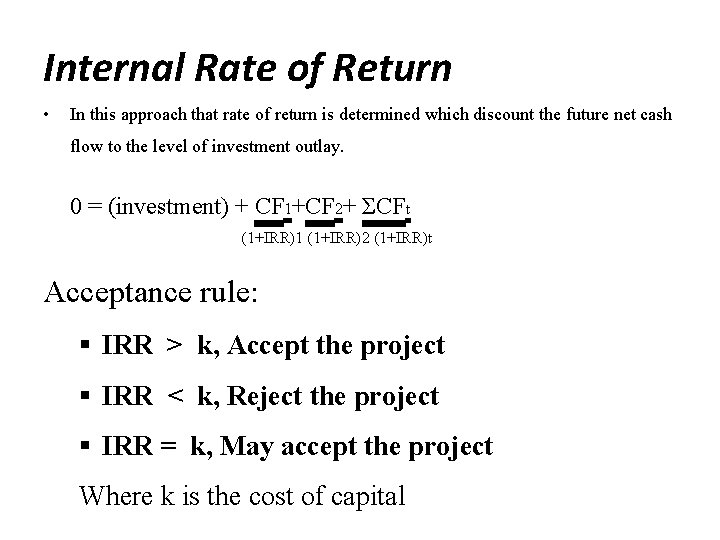
Internal Rate of Return • In this approach that rate of return is determined which discount the future net cash flow to the level of investment outlay. 0 = (investment) + CF 1+CF 2+ ƩCFt (1+IRR)1 (1+IRR)2 (1+IRR)t Acceptance rule: § IRR > k, Accept the project § IRR < k, Reject the project § IRR = k, May accept the project Where k is the cost of capital
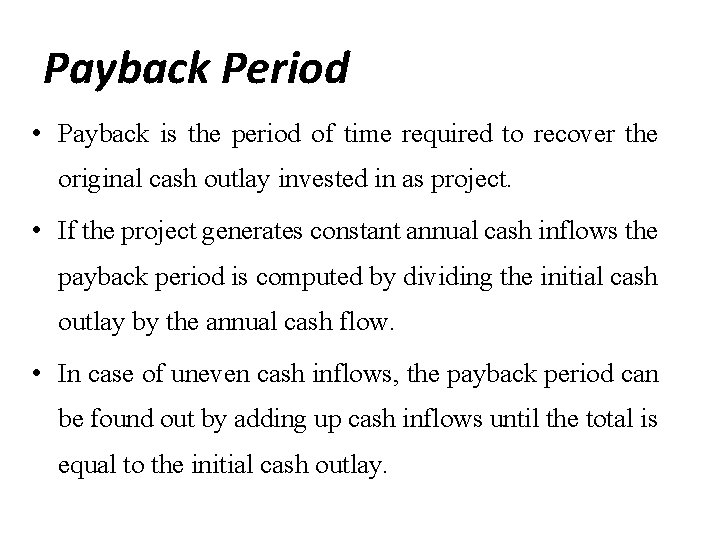
Payback Period • Payback is the period of time required to recover the original cash outlay invested in as project. • If the project generates constant annual cash inflows the payback period is computed by dividing the initial cash outlay by the annual cash flow. • In case of uneven cash inflows, the payback period can be found out by adding up cash inflows until the total is equal to the initial cash outlay.
Shortcoming of CIT fails to take cognizance of the phase (First three) of strategic decision making i. e. 1. Identification of the problem 2. Formulation of alternate course of action. 3. Evaluation of the alternatives. 4. Choice of one or more alternative for implementations Requires accurate measurement of cash flows at different interval of time.
Thank You