
Macroeconomic Factors 6 1 What is Macroeconomics 6






- Slides: 34
Macroeconomic Factors 6. 1 What is Macroeconomics? 6. 2 Economic Growth 6. 3 Unemployment 6. 4 Inflation 6. 5 The relationship between Inflation, Unemployment and Economic growth 6. 6 Stagflation Apply Economic Principles to Work in the Financial Services Industry 1
What is Macroeconomics? Macroeconomics is concerned with how an overall economic environment emerges from the choices made by individuals and organisations. It studies economy-wide factors such as economic growth, unemployment and inflation. Macroeconomic factors are aggregates of microeconomic factors. Apply Economic Principles to Work in the Financial Services Industry 2
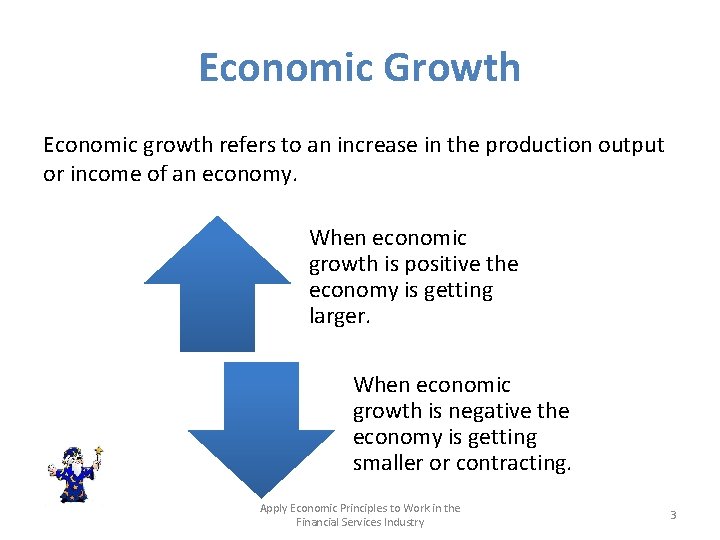
Economic Growth Economic growth refers to an increase in the production output or income of an economy. When economic growth is positive the economy is getting larger. When economic growth is negative the economy is getting smaller or contracting. Apply Economic Principles to Work in the Financial Services Industry 3
Measurement of Economic Growth Economic growth is measured in terms of Gross Domestic Product (GDP). Gross Domestic Product measures the total market value of all final goods and services produced in the economy in a year. Apply Economic Principles to Work in the Financial Services Industry 4
Nominal GDP and Real GDP Economic growth is a comparison of this period’s GDP with last period’s GDP to provide a growth rate. Nominal GDP is GDP unadjusted for changes in prices. Real GDP is GDP adjusted for changes in prices. Real GDP = Nominal GDP ________ Change in price level • See example pg 202, 203. Apply Economic Principles to Work in the Financial Services Industry 5
Economic Growth and Living Standards Economic growth is used to measure increases in living standards. In order to get a true measure of the increase in living standards we need to adjust real GDP for changes in population. GDP per capita = Real GDP ________ Population Apply Economic Principles to Work in the Financial Services Industry 6
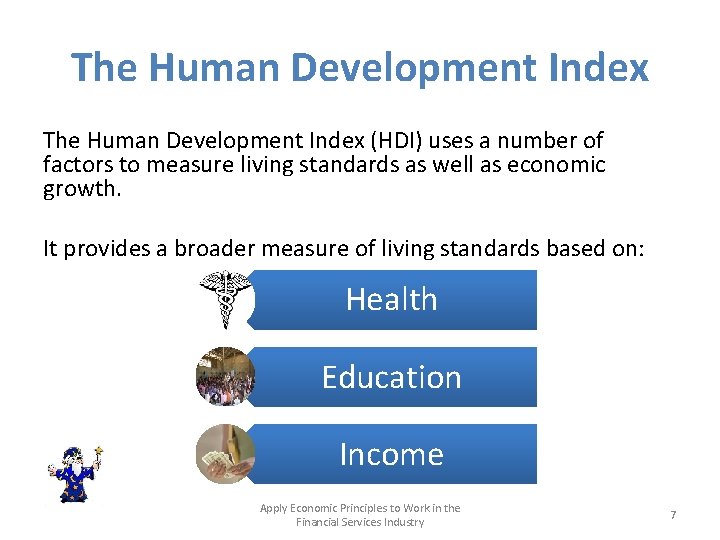
The Human Development Index (HDI) uses a number of factors to measure living standards as well as economic growth. It provides a broader measure of living standards based on: Health Education Income Apply Economic Principles to Work in the Financial Services Industry 7
Aggregate Demand Aggregate demand is the total demand for all final goods and services. Can be thought of as the sum of all consumers individual demand curves for all products. Major determinant of the level of economic activity. • Aggregate Demand = C + I + (G – T) + (X – M) Apply Economic Principles to Work in the Financial Services Industry 8
Consumption (C) Household purchases of goods and services. If consumption rises, aggregate demand will rise, causing economic growth to rise. Largest component of aggregate demand usually making up around 60% of the total. Some level of autonomous consumption, making it less volatile. Apply Economic Principles to Work in the Financial Services Industry 9
Investment (I) is when firms invest money into future projects or capital such as machinery. Most volatile component of aggregate demand. Very high when growth is strong and very low when growth is weak. • The driver of economic growth. Apply Economic Principles to Work in the Financial Services Industry 10
Government Spending (G) Government spending (G) is the spending by the government on infrastructure such as roads, schools and public transport. Increases in government spending will increase aggregate demand economic growth. Apply Economic Principles to Work in the Financial Services Industry 11
Taxation (T) is revenue the government raises from financial charges to firms and households. Governments use taxation revenue to finance government spending. An increase in taxation will lower disposable incomes causing consumption to fall and aggregate demand economic growth to fall. Apply Economic Principles to Work in the Financial Services Industry 12
Exports (X) and Imports (I) Exports are goods produced domestically, sold overseas. Imports are goods produced overseas , sold domestically. If more Australian exports are sold overseas then aggregate demand economic growth will rise. Income spent on imports is leaving the country so a rise in import expenditure will cause aggregate demand economic growth to fall. Apply Economic Principles to Work in the Financial Services Industry 13
Sources of economic growth Technological Advances Microeconomic reform Education Expectations Apply Economic Principles to Work in the Financial Services Industry 14
Benefits of Economic Growth Increases in the standard of Living Higher taxation revenue Lower unemployment Apply Economic Principles to Work in the Financial Services Industry 15
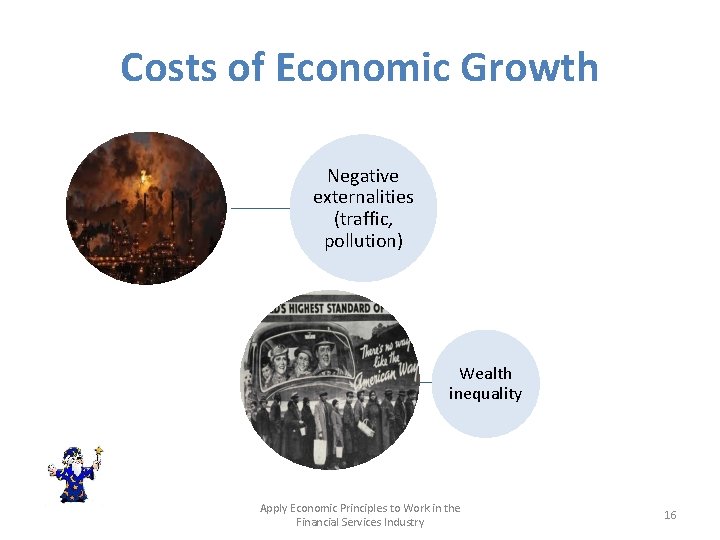
Costs of Economic Growth Negative externalities (traffic, pollution) Wealth inequality Apply Economic Principles to Work in the Financial Services Industry 16
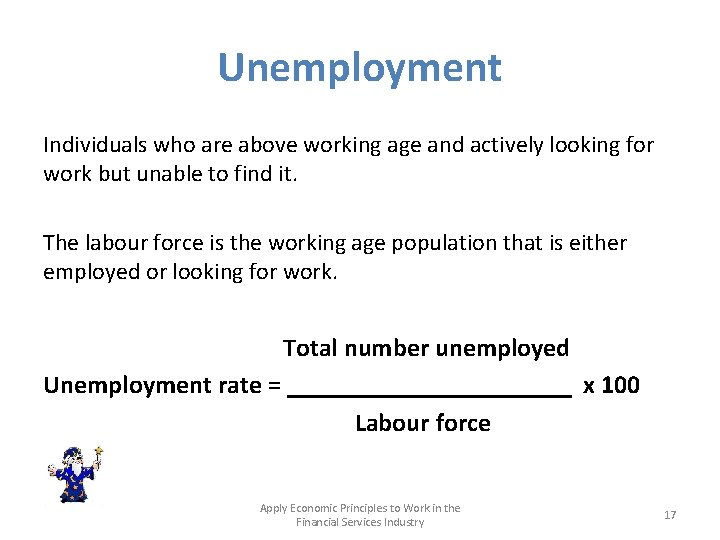
Unemployment Individuals who are above working age and actively looking for work but unable to find it. The labour force is the working age population that is either employed or looking for work. Total number unemployed Unemployment rate = ___________ x 100 Labour force Apply Economic Principles to Work in the Financial Services Industry 17
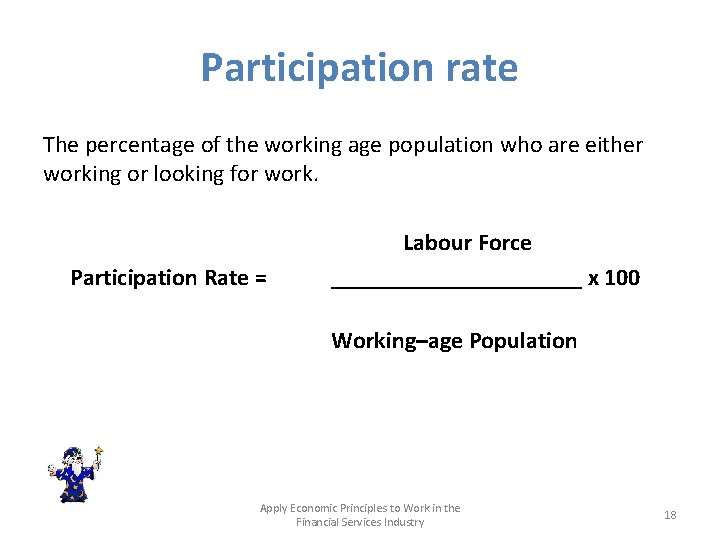
Participation rate The percentage of the working age population who are either working or looking for work. Participation Rate = Labour Force ___________ x 100 Working–age Population Apply Economic Principles to Work in the Financial Services Industry 18
Unemployment and Economic Growth As the economy grows firms need to hire more workers to meet increasing demand with increased production. As economic growth rises, unemployment falls. As economic growth falls, firms lay off workers as production levels have fallen and they can no longer afford to keep the extra staff as sales and profits are down. As economic growth falls, unemployment rises Apply Economic Principles to Work in the Financial Services Industry 19
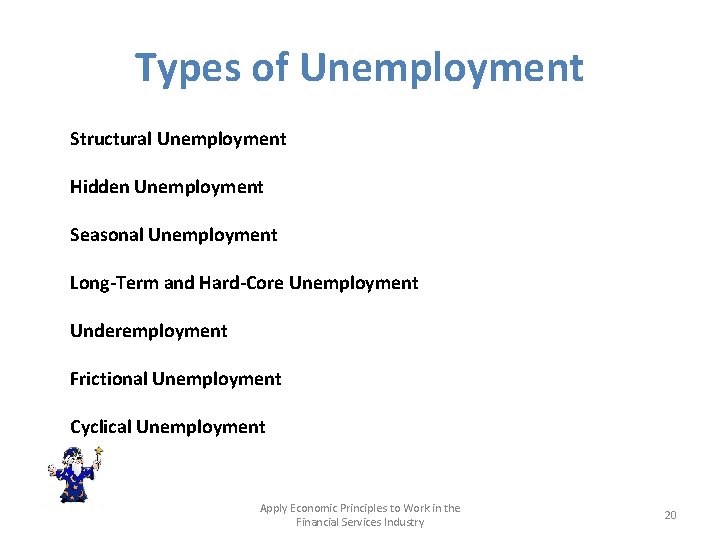
Types of Unemployment Structural Unemployment Hidden Unemployment Seasonal Unemployment Long-Term and Hard-Core Unemployment Underemployment Frictional Unemployment Cyclical Unemployment Apply Economic Principles to Work in the Financial Services Industry 20
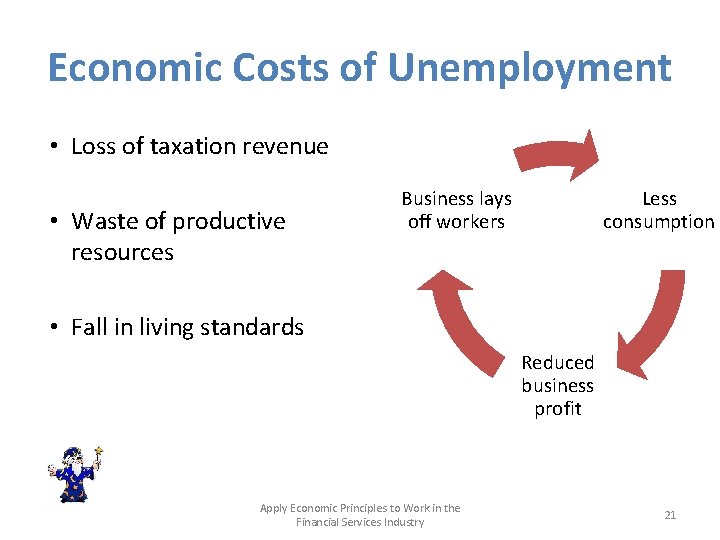
Economic Costs of Unemployment • Loss of taxation revenue • Waste of productive resources Business lays off workers Less consumption • Fall in living standards Reduced business profit Apply Economic Principles to Work in the Financial Services Industry 21
Social Costs of Unemployment Depression and self-esteem issues. Increase in crime. A black market providing alternative employment can form: Drug smuggling Prostitution Apply Economic Principles to Work in the Financial Services Industry 22
Groups worst affected by unemployment • • • School leavers Females Those with physical and mental disabilities Aborigines and Torres Strait Islanders Rural and regional communities Apply Economic Principles to Work in the Financial Services Industry 23
Why Do Some Workers Get Paid More than Others? • The level of education, training and experience a worker has is their human capital. • A person with more human capital will usually provide a firm with more value and revenue than one with less human capital. • Therefore, those with higher human capital usually get paid more than those with less. • Natural attributes can add to a workers unique skill set. People may get paid more due to these natural assets or abilities. • Some industries will compensate workers with higher wages for taking on dangerous or undesirable jobs. • Industries that are performing well may be able to pay higher wages than weakly performing industries. Apply Economic Principles to Work in the Financial Services Industry 24
Unemployment Benefits Higher unemployment benefits may reduce some of the social costs of unemployment. May also raise some of the economic costs of unemployment such as the strain on taxpayers. Apply Economic Principles to Work in the Financial Services Industry 25
Minimum Wages and Conditions Most countries set a minimum wage so that employees cannot be exploited. Minimum wage can distort a labour market as some people’s human capital may be less than minimum wage. Apply Economic Principles to Work in the Financial Services Industry 26
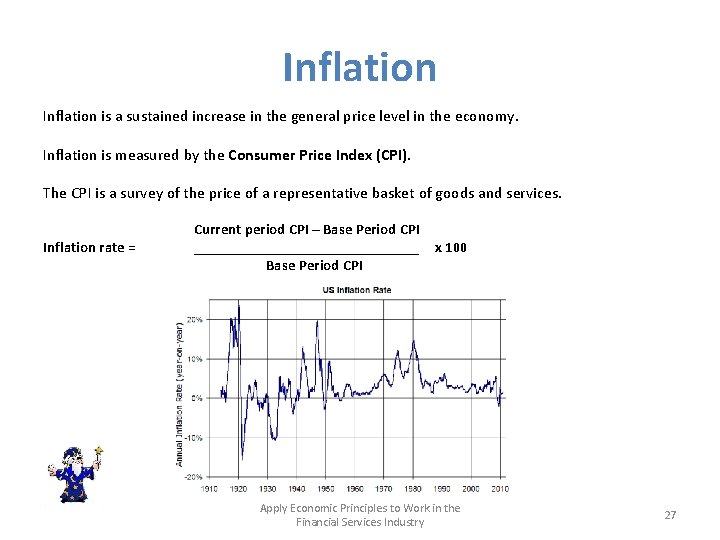
Inflation is a sustained increase in the general price level in the economy. Inflation is measured by the Consumer Price Index (CPI). The CPI is a survey of the price of a representative basket of goods and services. Inflation rate = Current period CPI – Base Period CPI _______________ Base Period CPI x 100 Apply Economic Principles to Work in the Financial Services Industry 27
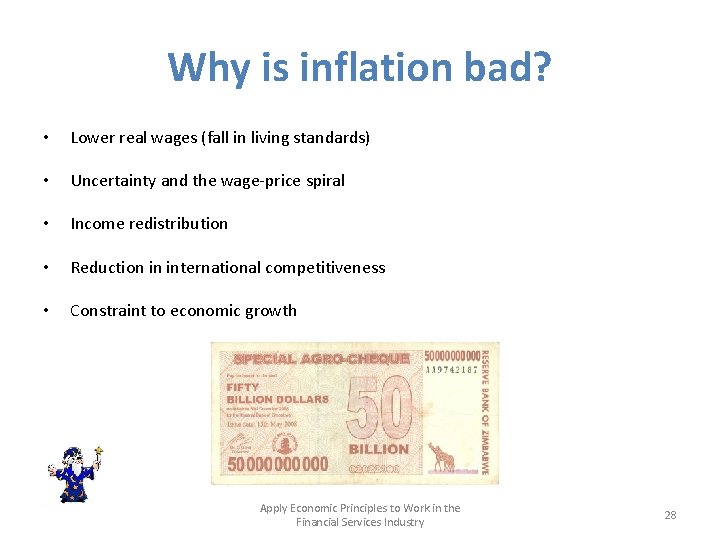
Why is inflation bad? • Lower real wages (fall in living standards) • Uncertainty and the wage-price spiral • Income redistribution • Reduction in international competitiveness • Constraint to economic growth Apply Economic Principles to Work in the Financial Services Industry 28
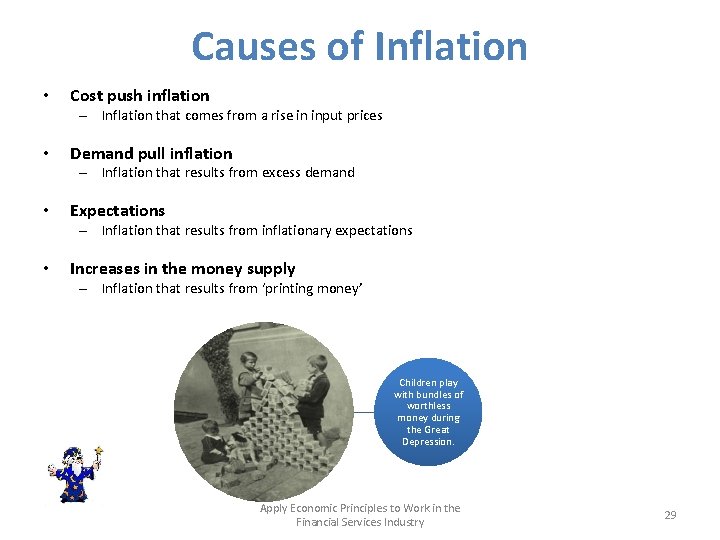
Causes of Inflation • Cost push inflation – Inflation that comes from a rise in input prices • Demand pull inflation – Inflation that results from excess demand • Expectations – Inflation that results from inflationary expectations • Increases in the money supply – Inflation that results from ‘printing money’ Children play with bundles of worthless money during the Great Depression. Apply Economic Principles to Work in the Financial Services Industry 29
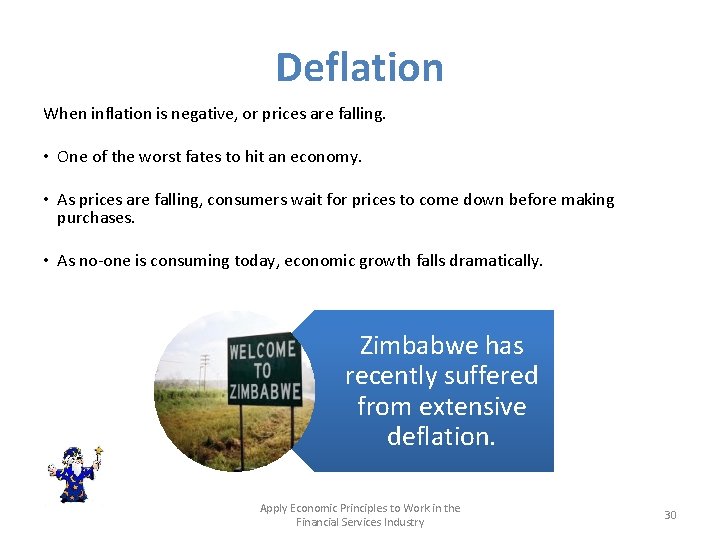
Deflation When inflation is negative, or prices are falling. • One of the worst fates to hit an economy. • As prices are falling, consumers wait for prices to come down before making purchases. • As no-one is consuming today, economic growth falls dramatically. Zimbabwe has recently suffered from extensive deflation. Apply Economic Principles to Work in the Financial Services Industry 30
The “good” level of inflation low, stable and predictable levels of inflation. The RBA targets a level of inflation between 2– 3%. Some level of inflation is inevitable in a growing economy. Low levels of inflation ‘greases the wheels’ of the labour market. Apply Economic Principles to Work in the Financial Services Industry 31
Inflation in Australia’s inflation levels have become much less volatile since the early 1990’s. In 1993 inflation targeting was introduced by the RBA and has been very effective. In recent times has Australia’s inflation rate has hovered around the RBA’s target range of 2– 3%. Apply Economic Principles to Work in the Financial Services Industry 32
The Relationship Between Inflation, Unemployment and Economic growth Inflation tends to rise when unemployment levels are very low. High economic growth can cause inflation (demand pull inflation) Inflation is negatively related to both economic growth and unemployment. Apply Economic Principles to Work in the Financial Services Industry 33
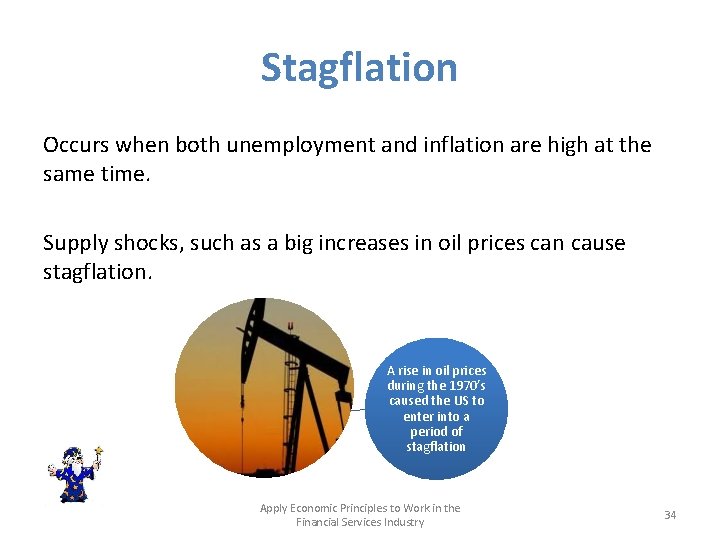
Stagflation Occurs when both unemployment and inflation are high at the same time. Supply shocks, such as a big increases in oil prices can cause stagflation. A rise in oil prices during the 1970’s caused the US to enter into a period of stagflation Apply Economic Principles to Work in the Financial Services Industry 34