
Macro II Fiscal Policy 1 Outline I Overview

- Slides: 32
Macro - II Fiscal Policy 1
Outline I. Overview II. Stabilization Policy III. Growth 2
Overview What is Fiscal Policy? The term fiscal policy refers to the use of public finance instruments to influence how the economic system is operating. The effects of fiscal policy reflect not only the impact of the fiscal balance, but also various elements of taxation, spending, and budget financing … by all levels of the government 3
Overview Fiscal policy can serve many objectives • Achieve internal balance Adjusting aggregate demand to available supply Achieving low inflation, potential output • Promote external balance sustainability Sustainable current account balance Reducing risk of external crisis • Promote economic growth Public infrastructure, education • Achieve a given level of income distribution • Achieving these objectives requires coordinating fiscal policy with monetary, exchange rate, and structural policies 4
Outline I. Overview II. Stabilization Policy III. Growth 5
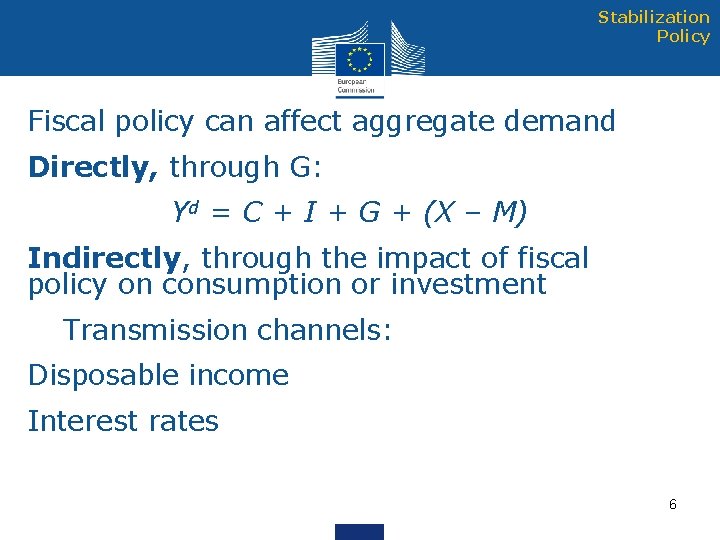
Stabilization Policy Fiscal policy can affect aggregate demand Directly, through G: Yd = C + I + G + (X – M) Indirectly, through the impact of fiscal policy on consumption or investment Transmission channels: Disposable income Interest rates 6
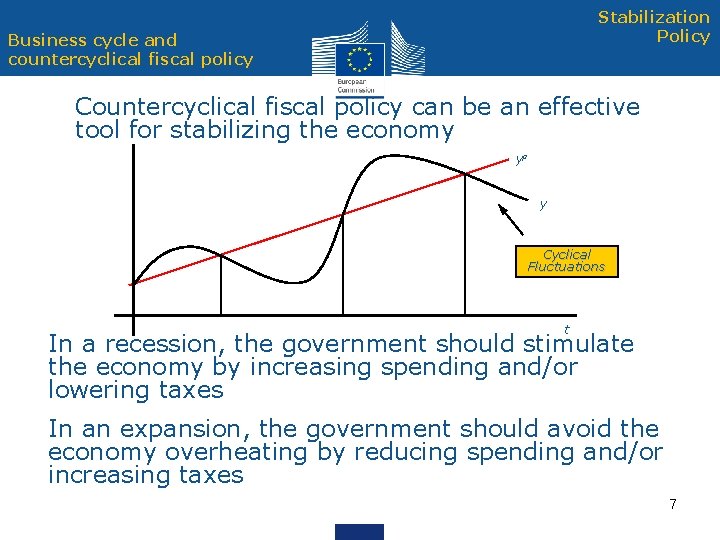
Stabilization Policy Business cycle and countercyclical fiscal policy Countercyclical fiscal policy can be an effective tool for stabilizing the economy yp y Cyclical Fluctuations t In a recession, the government should stimulate the economy by increasing spending and/or lowering taxes In an expansion, the government should avoid the economy overheating by reducing spending and/or increasing taxes 7
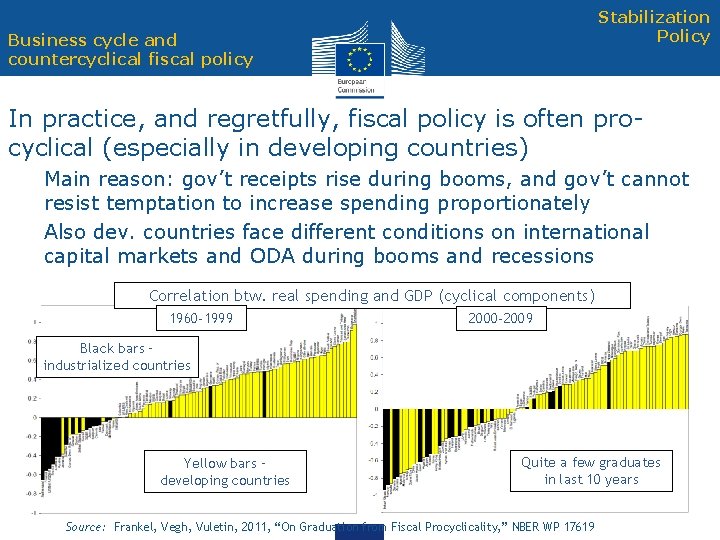
Stabilization Policy Business cycle and countercyclical fiscal policy In practice, and regretfully, fiscal policy is often procyclical (especially in developing countries) Main reason: gov’t receipts rise during booms, and gov’t cannot resist temptation to increase spending proportionately Also dev. countries face different conditions on international capital markets and ODA during booms and recessions Correlation btw. real spending and GDP (cyclical components) 1960 -1999 2000 -2009 Black bars – industrialized countries Yellow bars – developing countries Quite a few graduates in last 10 years 8 Source: Frankel, Vegh, Vuletin, 2011, “On Graduation from Fiscal Procyclicality, ” NBER WP 17619
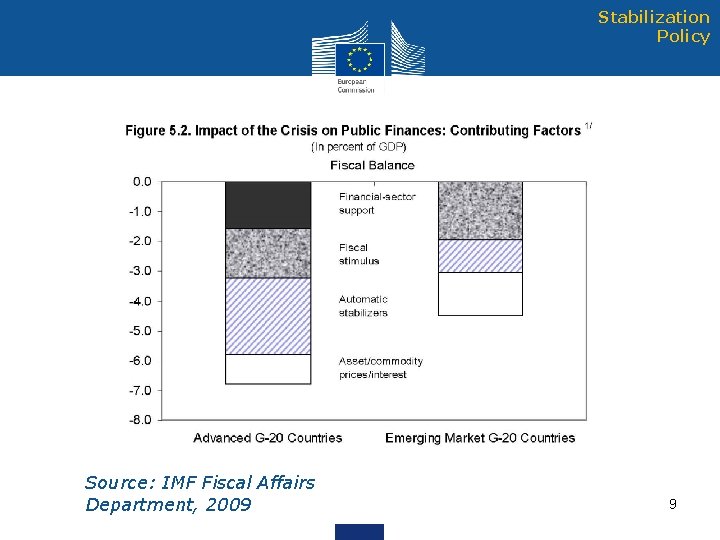
Stabilization Policy Source: IMF Fiscal Affairs Department, 2009 9
Stabilization Policy Automatic Stabilizers Automatic stabilizers are revenue or expenditure provisions that have countercyclical impact without need for policy intervention q Protect against shocks q Dampen business cycles Examples q Progressive taxes on income, profits q Unemployment insurance q Price stabilization funds 10
Stabilization Policy Fiscal Multipliers A fiscal multiplier measures the impact of a given policy on output • Multiplier of government spending: by how many $ does output increase if government spending increases by $1 • Multipliers capture all direct and indirect impacts of policy (can be different than one) • The larger the multipliers, the more effective fiscal policy would be in stabilizing the economy 11
Stabilization Policy Fiscal Multipliers Fiscal multipliers would be larger, among other things, if • The economy suffers from a lack of demand • Additional income is mostly consumed, rather than saved • Additional consumption is mostly in domestic, not imported, goods • The fiscal deficit does not crowd-out private investment, by competing for financing and increasing interest rates • Fiscal policy does not exacerbate distortions which affect the efficiency in the allocation of resources 12
Stabilization Policy Fiscal Multipliers Temporary stimulus: the effects vanish after a short period of time Permanent stimulus: the effects are felt in the long run only if : • public investment sustains economic growth via an impact on total factor productivity • and/or tax cut boosts labor supply and/or private investment Permanent stimulus : how do you pay for the increased deficit? 13
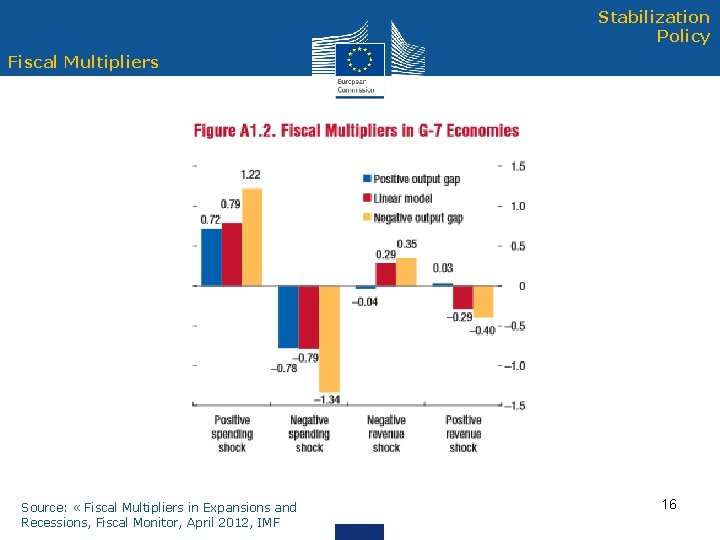
Stabilization Policy Fiscal Multipliers The evidence shows that • The multiplier on government spending is probably larger than one, but not by much • The multiplier on government taxes is less than one When the economy reaches the zero-bound for the interest rate, fiscal multipliers can be much larger 14
Stabilization Policy Fiscal Multipliers However, when deficits are large and public debt is growing, public spending can have weak or even negative effects • By creating expectations of a fiscal crisis, and hence of higher future taxes • Higher savings may lead to a sharp fall in consumption (“Ricardian Equivalence”) • Hence, fiscal stimulus can fail, and may even prove counterproductive è Credibility of exit strategies is key 15
Stabilization Policy Fiscal Multipliers Source: « Fiscal Multipliers in Expansions and Recessions, Fiscal Monitor, April 2012, IMF 16
Stabilization Policy Designing Fiscal stimulus Timely: increasing government expenditures cannot always be done quick enough to dampen a recession: • Time to pass a bill • Time to start infrastructure projects (risk that expenditures boost aggregate demand at a moment when it is no longer needed) Targeted • on the more efficient projects (the one that will boost the activity on the short term the most). • In case of tax cut …. , should be targeted on the people who are more likely to spend it sooner and in large part (financially constraint households) Temporary: to avoid eviction to private sector ; to avoid permanent budget deficit 17
Fiscal Policy and exchange rate regime Stabilization Policy Under a fixed exchange rate, a fiscal stimulus increases the need for financing: Raising domestic interest rates Increasing capital inflows and appreciating the currency To keep the exchange rate fixed, the Central Bank must increase money supply, thereby reinforcing initial fiscal stimulus As a consequence, fiscal stimulus is more powerful under fixed exchange rates 18
Fiscal Policy and exchange rate regime Stabilization Policy Under a flexible exchange rate, a fiscal stimulus raises domestic interest rate, increases capital inflows and appreciates the currency Appreciation reduces net exports, aggregate demand, and interest rates Process continues until interest rates fall to their initial level Fiscal stimulus is ineffective with perfect capital mobility … but concerted fiscal stimulus can work even under floating exchange rates 19
Fiscal Policy and Inflation Central bank financing involves money creation q. Inflation tax: Most inflationary form of financing Bond finance is less inflationary (or not at all) q. Removes financial resources from circulation q. Increases real interest rates q. Crowds out investment 20
Outline I. Overview II. Stabilization Policy III. Growth 21
Fiscal Policy for Growth • Taxes and spending affect not only demand but also aggregate supply through various channels: • Labor decisions • Savings/consumption decisions • Investment decisions (e. g. health, education, social safety net, infrastructure) • Supply-side effects have longer-term consequences compared to demand effects 22
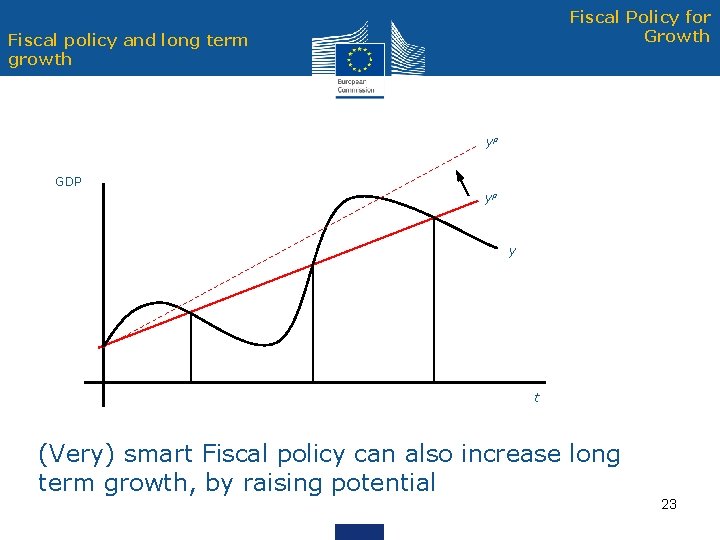
Fiscal Policy for Growth Fiscal policy and long term growth yp GDP yp y t (Very) smart Fiscal policy can also increase long term growth, by raising potential 23
Fiscal Policy for Growth The government has an important role in providing public goods, which generate positive externalities for growth • Public investment in infrastructure affects growth positively However, this relation is hard to find in cross-country data, Quality of investment matters! • Education and health spending are essential for economic growth Again, the link to growth appears quite weak in empirical studies Government intervention should respond to a market failure (i. e. , the inability of private sector to provide this good or service adequately) 24
Fiscal Policy for Growth The government can also provide a role of insurance, through the development of safety nets • Social Security • Health care • Unemployment insurance When private markets for these types of risks do not exist or work imperfectly, the government can fill the gap … helping with welfare but also with dynamic efficiency (precautionary savings) 25
Fiscal Policy for Growth • To perform all these important roles, governments need first to build fiscal space … making budgetary room for specific purposes (fiscal space) … without compromising the sustainability of public debt • Different ways to create fiscal space: • Increase tax revenue • Cut low-priority expenditures • Borrowing from domestic or external sources, only for investment projects with high return • Joint ventures with private sector (e. g. , highways) 26
Some Caveats Fiscal Policy for Growth Government activity has costs: • Interferes in market transactions; distortions • Government services have administrative costs: cost of government workers cost to private sector of compliance, obtaining or administering benefits • Heavy regulation, high taxes inhibit private sector • Public enterprises can waste resources if inefficiently managed Even in cases of market failure, government intervention needs to be assessed in terms of efficiency, productivity 27
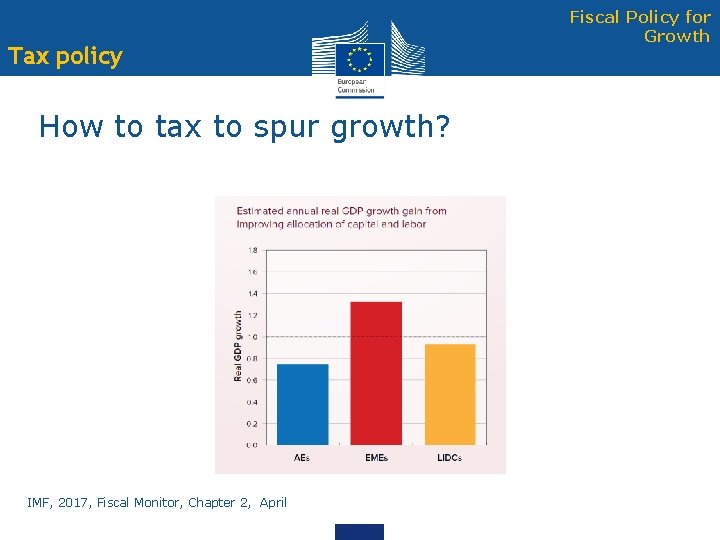
Tax policy How to tax to spur growth? IMF, 2017, Fiscal Monitor, Chapter 2, April Fiscal Policy for Growth
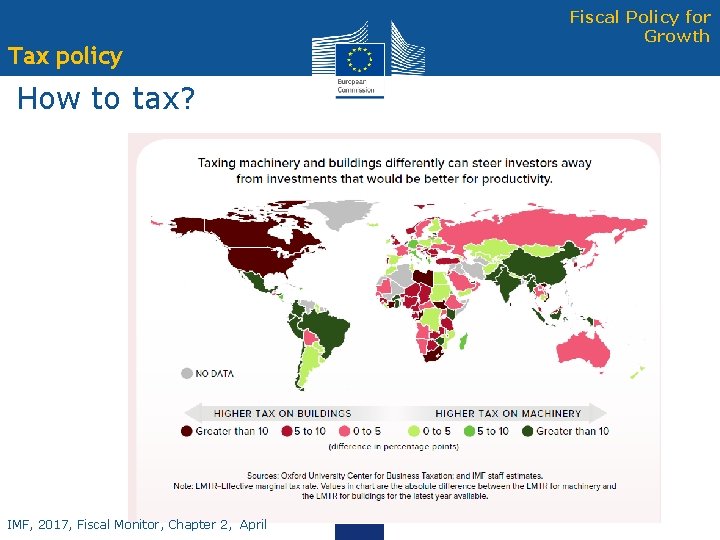
Tax policy How to tax? IMF, 2017, Fiscal Monitor, Chapter 2, April Fiscal Policy for Growth
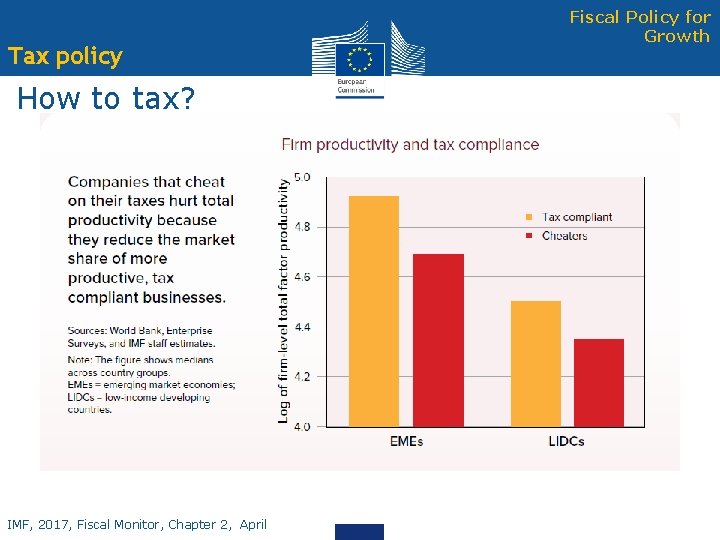
Tax policy How to tax? IMF, 2017, Fiscal Monitor, Chapter 2, April Fiscal Policy for Growth
References • Frankel, Vegh, Vuletin, 2011, “On Graduation from Fiscal Procyclicality, ” NBER WP 17619 • http: //www. nber. org/papers/w 17619 • IMF, 2017, “Upgrading the Tax system to Boost Productivity”, Chapter 2, Fiscal Monitor, IMF, 2017. • http: //www. nber. org/papers/w 17619
Thank you