
Macro I Macroeconomic Assessment and Risk Management Framework

- Slides: 31
Macro - I Macroeconomic Assessment and Risk Management Framework 1
Outline of the lecture • - Introduction / Overview • - Identification of macroeconomic risks • - Filling up the RMF 2
Overview Budget support is an aid modality. It involves the transfer of financial resources to the national Treasury of a partner country. The process that leads to BS involves 4 assessments by the Commission of (the relevance and credibility of): • • Public policies Macroeconomic framework Public financial management Transparency and oversight of the budget process. 3
Overview The risk assessment framework helps anticipate, monitor and react to political or economic development in the economy. 5 risk categories are considered 1. Political risks 2. Macroeconomic risks 3. Development risks 4. Public Financial Management risks 5. Corruption and fraud The materialization of any of these risks is likely to significantly reduce the effectiveness of budget support unless adequate mitigating measures are taken by the 4 partner country
Outline of the lecture • • - Introduction / Overview What is macroeconomic stability? Detecting macroeconomic risks Filling up the RMF 5
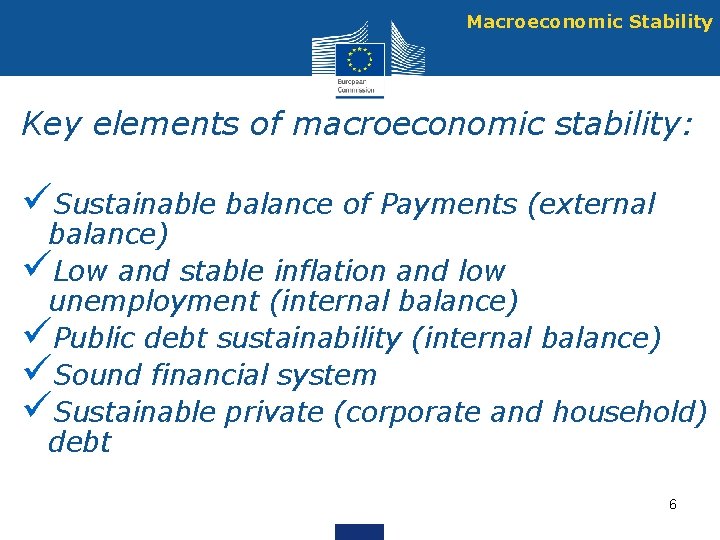
Macroeconomic Stability Key elements of macroeconomic stability: üSustainable balance of Payments (external balance) üLow and stable inflation and low unemployment (internal balance) üPublic debt sustainability (internal balance) üSound financial system üSustainable private (corporate and household) debt 6
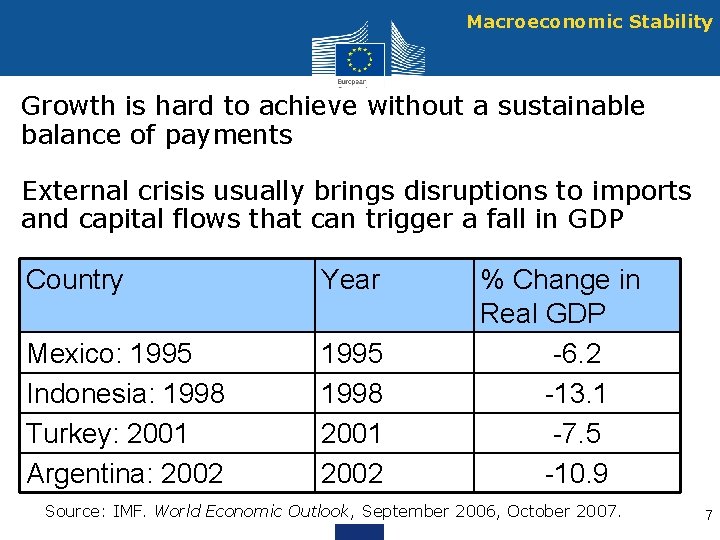
Macroeconomic Stability Growth is hard to achieve without a sustainable balance of payments External crisis usually brings disruptions to imports and capital flows that can trigger a fall in GDP Country Year Mexico: 1995 Indonesia: 1998 Turkey: 2001 Argentina: 2002 1995 1998 2001 2002 % Change in Real GDP -6. 2 -13. 1 -7. 5 -10. 9 Source: IMF. World Economic Outlook, September 2006, October 2007. 7
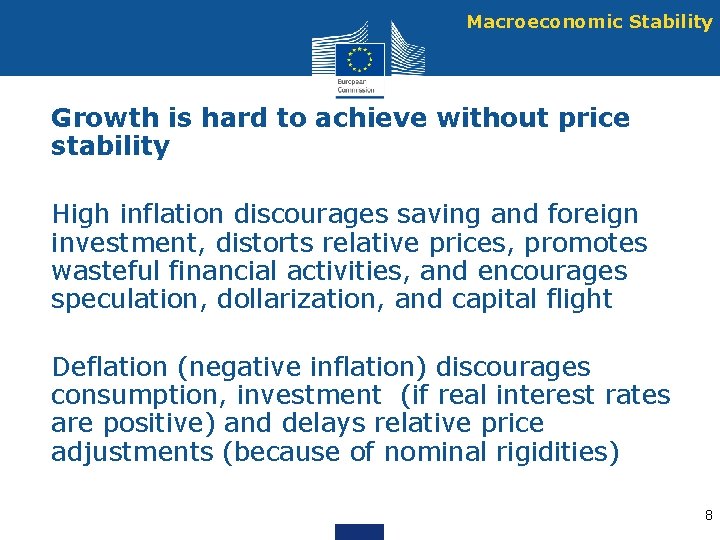
Macroeconomic Stability • Growth is hard to achieve without price stability • High inflation discourages saving and foreign investment, distorts relative prices, promotes wasteful financial activities, and encourages speculation, dollarization, and capital flight • Deflation (negative inflation) discourages consumption, investment (if real interest rates are positive) and delays relative price adjustments (because of nominal rigidities) 8
Macroeconomic Stability Unsustainable public debt can threaten macroeconomic stability and economic growth A high public debt o May reduce the ability of the government to implement contra-cyclical fiscal policies as needed o Can panic investors and thus result in a self-fulfilling public debt crisis (high interest rates and inability to roll-over short term debt) 9
Macroeconomic Stability In addition, high fiscal deficit can lead to • o High inflation (notably in case of fiscal dominance that forces the CB to “print money” to finance the budget deficit) o A reduction in private investment when government borrowing crowds out the private sector o Increased external vulnerability in case of foreign borrowing 10
Macroeconomic Stability The global financial crisis showed that the health of a country’s financial sector has far-reaching implications for its economy as well as for other economies Financial soundness is crucial to shock absorption. A fragile banking system is likely (i) to reduce the effectiveness of monetary policy because of weak transmission channels to the real sector 11
Macroeconomic Stability (ii) to propagate and amplify shocks, rather than facilitate their absorption by the economy o e. g. by impeding recovery because of inability to lend to sectors important for the recovery o e. g. by putting public debt sustainability in case of recapitalization needs. 12
Macroeconomic Stability (iii) to complicate policy responses to shocks and imbalances o e. g. in case of Bo. P imbalances, devaluation might be delayed for fear of its impact on the banking sector (short in foreign currency) o e. g. in case of inflation, monetary policy tightening might be delayed for fear of an increase in non performing loans (NPL) that would undermine banks 13
Macroeconomic Stability Large gross private debt can challenge macroeconomic stability - Large and growing private debt can be a sign of an unsustainable growth model (based on an excessive increase in borrowing by the private sector) 14
Outline of the lecture • • - Introduction / Overview Macroeconomic stability Detecting macroeconomic risks Filling up the RMF 15
Detecting macroeconomic risks External Sector Current Account Balance check list (1/2) - CAB: Deficit or Surplus? Reason for deficit ? (high investment? Low saving? ) - Composition of exports (product diversification of exports ; destination of exports) - Level and evolution of the real exchange rate (has the country lost competitiveness ? ) 16
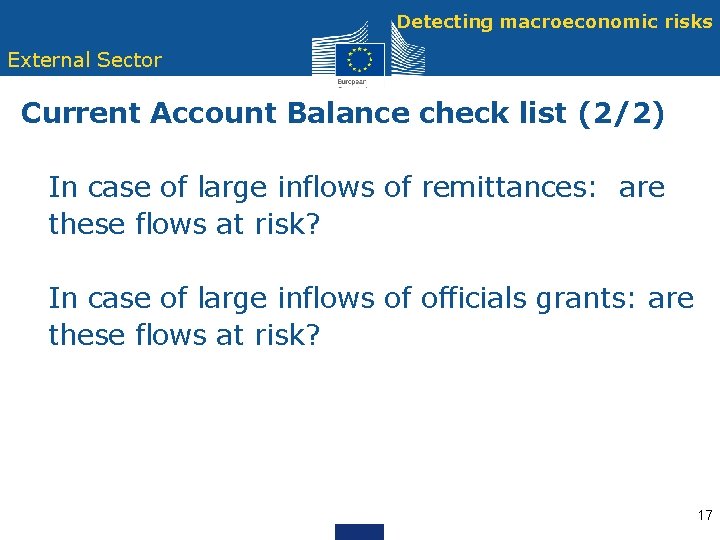
Detecting macroeconomic risks External Sector Current Account Balance check list (2/2) - In case of large inflows of remittances: are these flows at risk? - In case of large inflows of officials grants: are these flows at risk? 17
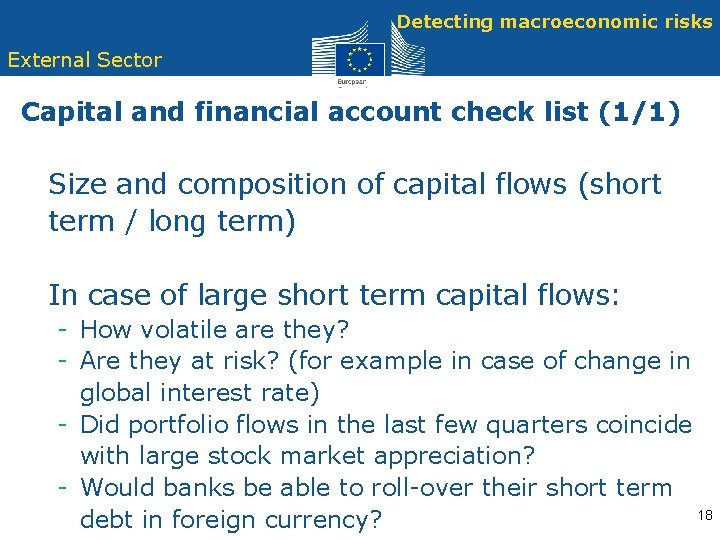
Detecting macroeconomic risks External Sector Capital and financial account check list (1/1) - Size and composition of capital flows (short term / long term) - In case of large short term capital flows: - How volatile are they? - Are they at risk? (for example in case of change in global interest rate) - Did portfolio flows in the last few quarters coincide with large stock market appreciation? - Would banks be able to roll-over their short term 18 debt in foreign currency?
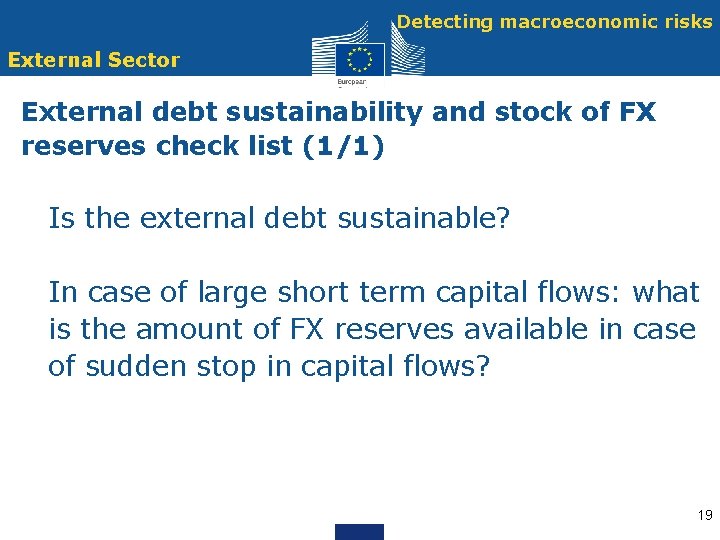
Detecting macroeconomic risks External Sector External debt sustainability and stock of FX reserves check list (1/1) - Is the external debt sustainable? - In case of large short term capital flows: what is the amount of FX reserves available in case of sudden stop in capital flows? 19
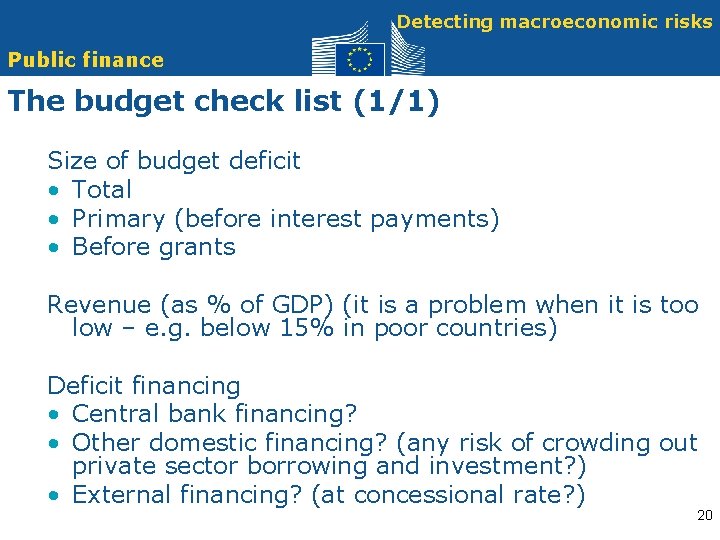
Detecting macroeconomic risks Public finance The budget check list (1/1) Size of budget deficit • Total • Primary (before interest payments) • Before grants Revenue (as % of GDP) (it is a problem when it is too low – e. g. below 15% in poor countries) Deficit financing • Central bank financing? • Other domestic financing? (any risk of crowding out private sector borrowing and investment? ) • External financing? (at concessional rate? ) 20
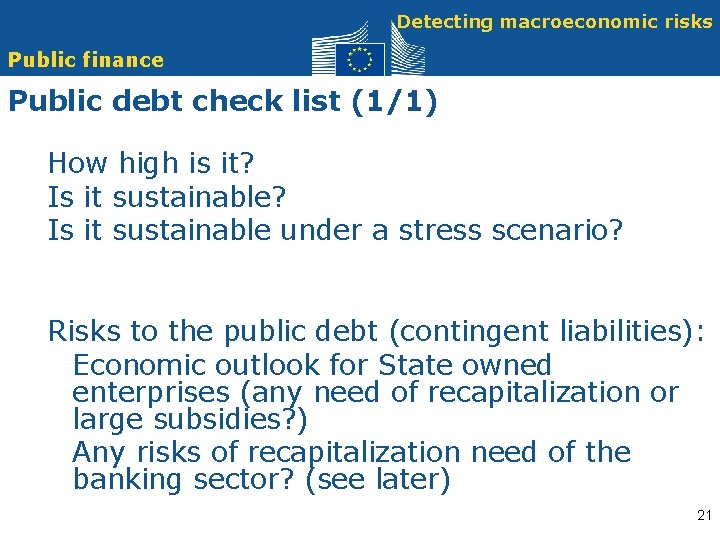
Detecting macroeconomic risks Public finance Public debt check list (1/1) How high is it? Is it sustainable under a stress scenario? Risks to the public debt (contingent liabilities): Economic outlook for State owned enterprises (any need of recapitalization or large subsidies? ) Any risks of recapitalization need of the banking sector? (see later) 21
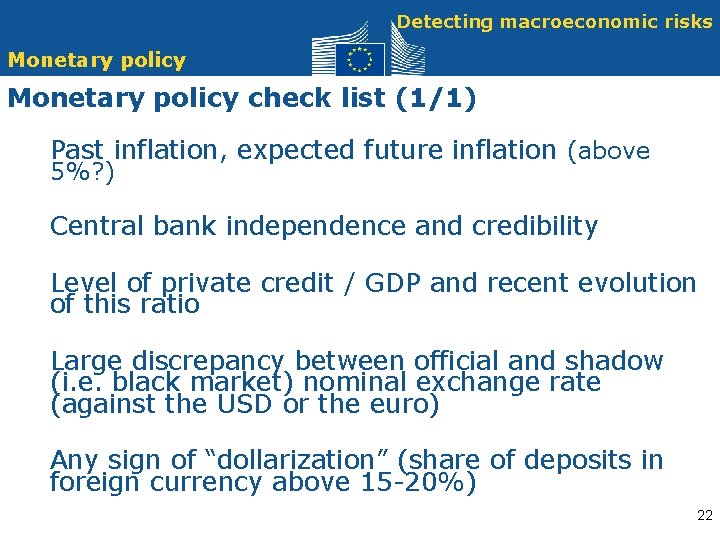
Detecting macroeconomic risks Monetary policy check list (1/1) Past inflation, expected future inflation (above 5%? ) Central bank independence and credibility Level of private credit / GDP and recent evolution of this ratio Large discrepancy between official and shadow (i. e. black market) nominal exchange rate (against the USD or the euro) Any sign of “dollarization” (share of deposits in foreign currency above 15 -20%) 22
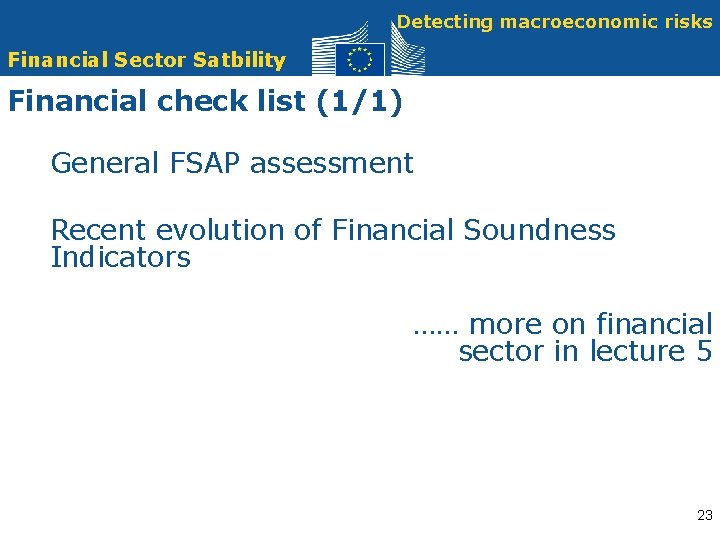
Detecting macroeconomic risks Financial Sector Satbility Financial check list (1/1) General FSAP assessment Recent evolution of Financial Soundness Indicators …… more on financial sector in lecture 5 23
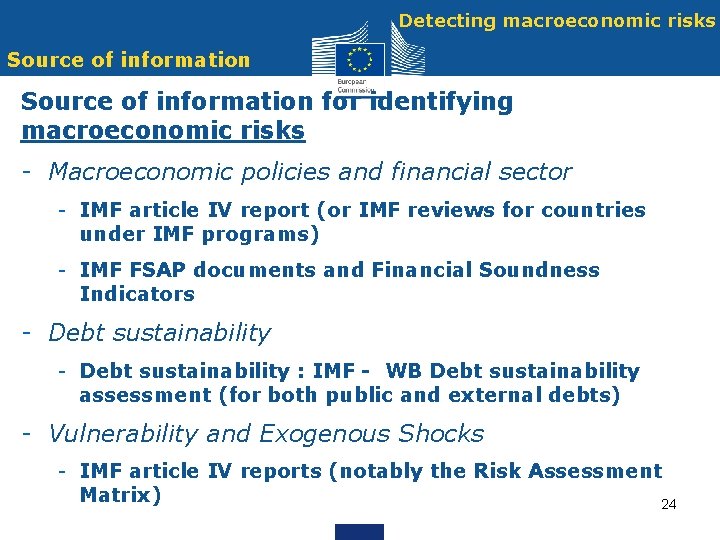
Detecting macroeconomic risks Source of information for identifying macroeconomic risks - Macroeconomic policies and financial sector - IMF article IV report (or IMF reviews for countries under IMF programs) - IMF FSAP documents and Financial Soundness Indicators - Debt sustainability : IMF - WB Debt sustainability assessment (for both public and external debts) - Vulnerability and Exogenous Shocks - IMF article IV reports (notably the Risk Assessment Matrix) 24
Outline of the lecture • • - Introduction / Overview Macroeconomic stability Detecting macroeconomic risks Filling up the RMF 25
RMF The Excel spread sheet (1/3) 2 files: Questionnaire - Risk profile Important note: “Excel spread sheet” doesn’t mean that’s it’s only about numbers (or even mainly numbers). The process of filling up the spread sheet increases the probability that most potential risks are being scrutinized and understood. The process leads to a recommendation regarding EU budget support in the country. 26
RFM The Excel spread sheet (2/3) -Questionnaire: concentrates on basic risks -44 questions in total, 7 of which for macroeconomic risks -For each of them, one needs to - assess the level of risk (Low – Moderate – Substantial – High) - give a justification for the level chosen and a description of the exact nature of the risk -Most of the answers are not straightforward -For the numerical part, level of risk are averaged by dimensions (14 of them) with some room for ad-hoc adjustment (up or down by one notch) based on judgement. 27
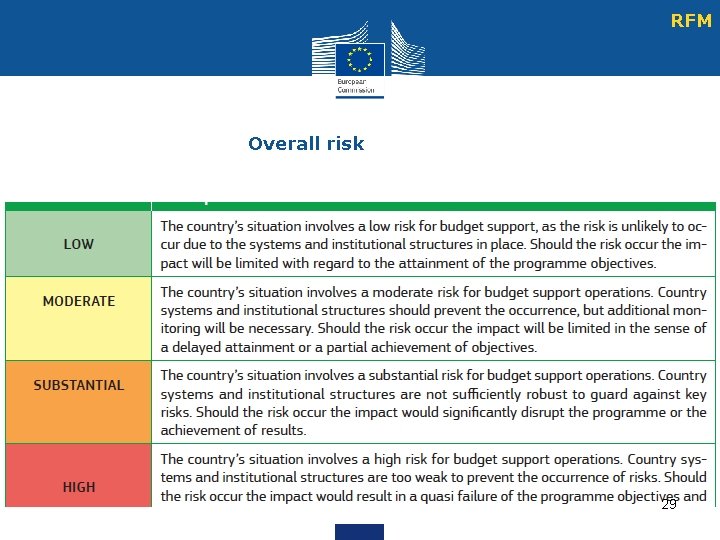
RFM The Excel spread sheet (4/4) Risk profile : • Average level of risks for the 5 categories and overall average and trends (automatic) • Overall recommendation: “What should the EU do regarding BS in this country? ” (written statement) • Major risks and risk (or benefits) of non EU intervention (written statement) • Key mitigating measures (written statement) 28
RFM Overall risk 29
Assignment - Using IMF information, please write a short country fiche for either Cambodia or Ghana and fill the RMF excel file. - In order to do so, it is convenient first to use the check-list above, and identify the relevant risks for the country. Then indicate whether the country authorities are aware of the risks and are taking measures to reduce/mitigate them. - Day-3 class will be on Financial Soundness indicators. Your assessment will be adjusted in the afternoon of day 3 to include financial stability. 30
Thank you 31